Knowledge-Based Pull Requests: A Trusted Workflow for Agent-Mediated Knowledge Collaboration
Pith reviewed 2026-06-26 04:13 UTC · model grok-4.3
The pith
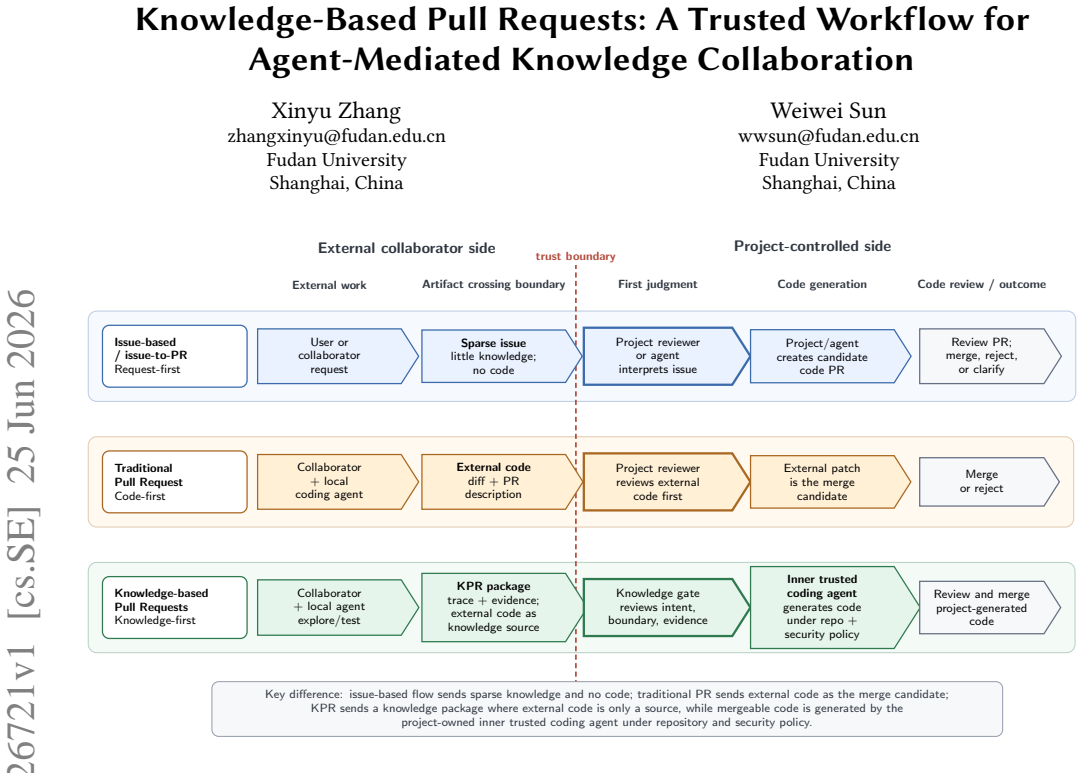
Knowledge-Based Pull Requests treat external code contributions as knowledge sources that agents distill into auditable packages before a project-owned agent regenerates compliant code inside the receiving repository.
A machine-rendered reading of the paper's core claim, the machinery that carries it, and where it could break.
Core claim
In KPR an external collaborator's local code, tests, and cleaned agent interaction trace are treated as knowledge sources rather than as the default merge candidate. Agents distill these sources into a human-confirmed knowledge package and render it into reviewer-facing forms such as design memos, risk checklists, test plans, or implementation briefs. A project-owned inner trusted coding agent then regenerates candidate code inside the receiving project's environment under repository context, engineering conventions, tests, and security policy. KPR therefore separates two decisions that traditional pull requests often collapse: whether the knowledge should enter the project, and whether a pa
What carries the argument
The KPR workflow, which converts external contributions into distilled knowledge packages that a project-owned agent then renders into new code inside the target repository's trusted environment.
If this is right
- Auditable extraction, transformation, and project-side regeneration can reduce the cost of understanding and reworking high-context external changes.
- KPR packages can be instantiated from real PR material and stress-tested under description ablation, diff ablation, and synthetic poisoned-patch conditions.
- The workflow applies across open source, enterprise, vendor, contractor, and customer-driven settings.
- A cost-accounting view and collaboration gateway architecture become available once the separation of knowledge acceptance from implementation merge is enforced.
Where Pith is reading between the lines
- Projects could publish reusable knowledge-package schemas that multiple external agents learn to target, lowering per-collaboration setup cost.
- The same separation might apply to non-code artifacts such as documentation or configuration changes that cross trust boundaries.
- Empirical measurement of reviewer time saved versus regeneration overhead would be required to confirm net cost reduction.
- If regeneration reliably preserves intent, KPR could support automated policy enforcement that current direct-merge workflows cannot achieve.
Load-bearing premise
External sources can be reliably distilled by agents into auditable knowledge packages and a project-owned agent can regenerate code that preserves the original intent while satisfying internal engineering conventions, tests, and security policy.
What would settle it
A controlled comparison in which the same external contribution is processed both as a traditional pull request and via KPR, measuring whether reviewers reach the same knowledge-acceptance decision faster or with fewer rework cycles under KPR.
Figures
read the original abstract
AI coding agents are changing the bottleneck in software collaboration: code is increasingly cheap, while understanding intent, negotiating scope, and governing long-term project responsibility remain costly. This paper proposes \emph{Knowledge-Based Pull Requests} (KPR), a trusted workflow for agent-mediated software collaboration across trust boundaries, including open source, enterprise, vendor, contractor, and customer-driven settings. In KPR, an external collaborator's local code, tests, and cleaned agent interaction trace are treated as knowledge sources rather than as the default merge candidate. Agents distill these sources into a human-confirmed knowledge package and render it into reviewer-facing forms such as design memos, risk checklists, test plans, or implementation briefs. A project-owned inner trusted coding agent then regenerates candidate code inside the receiving project's environment under repository context, engineering conventions, tests, and security policy. KPR therefore separates two decisions that traditional pull requests often collapse: whether the knowledge should enter the project, and whether a particular implementation should be merged. We contribute the KPR workflow, a candidate artifact schema, a cost-accounting view, a collaboration gateway architecture, a minimal controlled simulation pilot over seven merged public pull requests, and an evaluation agenda. The pilot shows that KPR packages can be instantiated from real PR material and stress-tested under description ablation, diff ablation, and synthetic poisoned-patch conditions. We position KPR as an empirically testable workflow: its value depends on whether auditable extraction, transformation, and project-side regeneration reduce the cost of understanding and reworking high-context external changes.
Editorial analysis
A structured set of objections, weighed in public.
Referee Report
Summary. The manuscript proposes Knowledge-Based Pull Requests (KPR), a workflow for agent-mediated collaboration across trust boundaries. External code, tests, and agent traces are treated as knowledge sources rather than direct merge candidates; agents distill them into human-confirmed knowledge packages rendered as design memos or risk checklists. A project-owned agent then regenerates candidate implementations inside the receiving repository under its conventions, tests, and policies. This separates the knowledge-entry decision from the implementation-merge decision. Contributions include the workflow, artifact schema, cost-accounting view, collaboration gateway architecture, and a minimal pilot instantiating packages from seven real public PRs with stress-tests under description ablation, diff ablation, and synthetic poisoned-patch conditions. The work frames KPR as an empirically testable proposal whose value hinges on auditable extraction and regeneration reducing rework costs.
Significance. If the regeneration step can be shown to preserve external intent while satisfying project constraints, KPR would provide a structured mechanism for handling AI-generated contributions in open-source, enterprise, and contractor settings where trust boundaries matter. The pilot's use of real merged PRs and inclusion of ablation and poisoning stress-tests supplies a concrete starting point for empirical follow-up and demonstrates that package instantiation is feasible. These elements strengthen the proposal's grounding even though quantitative regeneration metrics are absent.
major comments (2)
- [Pilot Evaluation] Pilot section: the evaluation reports successful package instantiation from seven PRs and stress-testing under description/diff ablation and poisoned-patch injection, but contains no measurements of intent preservation, post-regeneration test-pass rates, or policy-violation rates. This omission is load-bearing for the central claim that KPR cleanly separates the two decisions, because the separation is only advantageous if project-side regeneration reliably realizes the original external intent.
- [Workflow Description and Collaboration Gateway Architecture] Workflow and Architecture sections: the description assumes external traces can be distilled into auditable packages and that the inner agent can regenerate code satisfying internal engineering conventions, tests, and security policy, yet provides no verification protocol, failure-mode analysis, or bounds on agent error that would make the trusted workflow claim operational.
minor comments (2)
- [Abstract] Abstract states 'minimal controlled simulation pilot' while the body describes instantiation from real merged PRs; align the wording for consistency.
- [Cost-Accounting View] The cost-accounting view is introduced but not illustrated with even a single worked example of before/after effort; adding one would clarify the claimed reduction in understanding and reworking costs.
Simulated Author's Rebuttal
We thank the referee for the constructive comments and for recognizing the pilot's use of real PRs and stress tests. The manuscript presents KPR as a workflow proposal with a minimal feasibility pilot and an explicit evaluation agenda; it does not claim quantitative proof of regeneration reliability. We address the major comments point by point below.
read point-by-point responses
-
Referee: [Pilot Evaluation] Pilot section: the evaluation reports successful package instantiation from seven PRs and stress-testing under description/diff ablation and poisoned-patch injection, but contains no measurements of intent preservation, post-regeneration test-pass rates, or policy-violation rates. This omission is load-bearing for the central claim that KPR cleanly separates the two decisions, because the separation is only advantageous if project-side regeneration reliably realizes the original external intent.
Authors: The pilot is described in the manuscript as minimal and controlled, with the explicit goal of demonstrating that packages can be instantiated from real merged PRs and subjected to ablation and poisoning stress tests. It does not include intent-preservation or regeneration-success metrics because those measurements are listed in the evaluation agenda as items for subsequent empirical work. The manuscript does not assert that the separation is already advantageous; it proposes the separation as a testable structure whose value hinges on whether such regeneration metrics prove favorable. The human confirmation step for the knowledge package provides an independent checkpoint regardless of regeneration outcomes. No revision is planned to add these metrics to the current manuscript. revision: no
-
Referee: [Workflow Description and Collaboration Gateway Architecture] Workflow and Architecture sections: the description assumes external traces can be distilled into auditable packages and that the inner agent can regenerate code satisfying internal engineering conventions, tests, and security policy, yet provides no verification protocol, failure-mode analysis, or bounds on agent error that would make the trusted workflow claim operational.
Authors: The workflow does not presuppose error-free distillation or regeneration. The trusted character of the workflow rests on two explicit mechanisms stated in the manuscript: (1) human confirmation of the distilled knowledge package before any regeneration occurs, and (2) execution of regeneration by a project-owned agent inside the receiving repository's own context, tests, and policies. No detailed verification protocol or quantitative error bounds are supplied because the contribution is the high-level separation of decisions and the artifact schema, not a fully specified implementation. A brief expansion of potential failure modes can be added to the architecture section to make the proposal's scope clearer. revision: partial
Circularity Check
No circularity: conceptual workflow proposal with no equations or self-referential derivations
full rationale
The manuscript proposes an architectural workflow (KPR) that separates knowledge-entry and implementation-merge decisions, supported by a schema, cost view, gateway architecture, and a minimal pilot instantiating packages from seven public PRs under ablation and poisoning conditions. No equations, fitted parameters, predictions, or self-citations appear in the provided text; the central separation claim is presented as a design hypothesis whose value is explicitly stated to depend on future empirical tests of extraction and regeneration, rather than being forced by construction from any inputs or prior author results. The pilot demonstrates package instantiation and stress-testing but makes no load-bearing predictive claims that reduce to the inputs.
Axiom & Free-Parameter Ledger
axioms (2)
- domain assumption AI agents can distill code, tests, and interaction traces into reliable, human-confirmable knowledge packages.
- domain assumption A project-owned agent can regenerate code inside the receiving environment that respects local context, conventions, tests, and security policy.
Reference graph
Works this paper leans on
-
[1]
Anomaly. 2026. OpenCode contributing guide. https://github.com/anomalyco/ opencode/blob/dev/CONTRIBUTING.md. Accessed: 2026-06-24
2026
-
[2]
Alberto Bacchelli and Christian Bird. 2013. Expectations, Outcomes, and Chal- lenges of Modern Code Review. InProceedings of the 35th International Conference on Software Engineering (ICSE 2013). IEEE Press, Piscataway, NJ, USA, 712–721. doi:10.1109/ICSE.2013.6606617
-
[3]
James, and Nadia Polikarpova
Shraddha Barke, Michael B. James, and Nadia Polikarpova. 2023. Grounded Copilot: How Programmers Interact with Code-Generating Models.Proceedings of the ACM on Programming Languages7, OOPSLA1 (2023), 85–111. doi:10.1145/ 3586030
2023
-
[4]
Joachim Baumann, Vishakh Padmakumar, Xiang Li, John Yang, Diyi Yang, and Sanmi Koyejo. 2026. SWE-chat: Coding Agent Interactions From Real Users in the Wild.arXiv preprint arXiv:2604.20779(2026). doi:10.48550/arXiv.2604.20779
work page internal anchor Pith review Pith/arXiv arXiv doi:10.48550/arxiv.2604.20779 2026
-
[5]
Ramtin Ehsani, Sakshi Pathak, Shriya Rawal, Abdullah Al Mujahid, Mia Moham- mad Imran, and Preetha Chatterjee. 2026. Where Do AI Coding Agents Fail? An Empirical Study of Failed Agentic Pull Requests in GitHub.arXiv preprint arXiv:2601.15195(2026). doi:10.48550/arXiv.2601.15195 11 Zhang and Sun
-
[6]
GitHub. 2026. Agent pull requests are everywhere. Here’s how to review them. https://github.blog/ai-and-ml/generative-ai/agent-pull-requests-are- everywhere-heres-how-to-review-them/. Accessed: 2026-06-24
2026
-
[7]
GitHub. 2026. Limit open pull requests for users without write ac- cess. https://github.blog/changelog/2026-06-17-limit-open-pull-requests-for- users-without-write-access/. Accessed: 2026-06-24
2026
-
[8]
GitHub. 2026. New repository settings for configuring pull request ac- cess. https://github.blog/changelog/2026-02-13-new-repository-settings-for- configuring-pull-request-access/. Accessed: 2026-06-24
2026
-
[9]
Thibaud Gloaguen, Niels Mundler, Mark Muller, Veselin Raychev, and Martin Vechev. 2026. Evaluating AGENTS.md: Are Repository-Level Context Files Helpful for Coding Agents?arXiv preprint arXiv:2602.11988(2026). doi:10.48550/ arXiv.2602.11988
Pith/arXiv arXiv 2026
-
[10]
Georgios Gousios, Martin Pinzger, and Arie van Deursen. 2014. An Exploratory Study of the Pull-Based Software Development Model. InProceedings of the 36th International Conference on Software Engineering (ICSE 2014). Association for Computing Machinery, New York, NY, USA, 345–355. doi:10.1145/2568225. 2568260
-
[11]
Georgios Gousios, Margaret-Anne Storey, and Alberto Bacchelli. 2016. Work Practices and Challenges in Pull-Based Development: The Contributor’s Perspec- tive. InProceedings of the 38th International Conference on Software Engineering (ICSE 2016). Association for Computing Machinery, New York, NY, USA, 285–296. doi:10.1145/2884781.2884826
-
[12]
Georgios Gousios, Andy Zaidman, Margaret-Anne Storey, and Arie van Deursen
-
[13]
InProceedings of the 37th IEEE/ACM International Conference on Software Engineering (ICSE 2015)
Work Practices and Challenges in Pull-Based Development: The Integra- tor’s Perspective. InProceedings of the 37th IEEE/ACM International Conference on Software Engineering (ICSE 2015). IEEE Press, Piscataway, NJ, USA, 358–368. doi:10.1109/ICSE.2015.55
-
[15]
Anthonia Oluchukwu Njoku, Zohreh Sharafi, and Foutse Khomh. 2026. When Code Authors Are Agents: A Large-Scale Study of Human-Agent Collaboration in Pull Requests. OpenReview. https://openreview.net/forum?id=ArurxAmCtR
2026
-
[16]
Sien Reeve O. Peralta, Fumika Hoshi, Hironori Washizaki, Naoyasu Ubayashi, Inase Kondo, Yoshiki Higo, Hiroki Mukai, Norihiro Yoshida, Kazuki Kusama, Hidetake Tanaka, and Youmei Fan. 2026. Why Are Agentic Pull Requests Merged or Rejected? An Empirical Study. InProceedings of the 23rd International Confer- ence on Mining Software Repositories (MSR ’26). doi...
-
[17]
Shirin Pirouzkhah, Pavlina Wurzel Goncalves, and Alberto Bacchelli. 2026. The Value of Effective Pull Request Description. InProceedings of the 23rd Interna- tional Conference on Mining Software Repositories (MSR ’26). doi:10.1145/3793302. 3793368
-
[18]
Deepak Babu R. Piskala. 2026. Spec-Driven Development: From Code to Contract in the Age of AI Coding Assistants.arXiv preprint arXiv:2602.00180(2026). doi:10.48550/arXiv.2602.00180
-
[19]
Ross, Fernando Martinez, Stephanie Houde, Michael Muller, and Justin D
Steven I. Ross, Fernando Martinez, Stephanie Houde, Michael Muller, and Justin D. Weisz. 2023. The Programmer’s Assistant: Conversational Interaction with a Large Language Model for Software Development. InProceedings of the 28th International Conference on Intelligent User Interfaces (IUI 2023). Association for Computing Machinery, New York, NY, USA, 491...
-
[20]
Caitlin Sadowski, Emma Soderberg, Luke Church, Michal Sipko, and Alberto Bacchelli. 2018. Modern Code Review: A Case Study at Google. InProceedings of the 40th International Conference on Software Engineering: Software Engineering in Practice (ICSE-SEIP 2018). Association for Computing Machinery, New York, NY, USA, 181–190. doi:10.1145/3183519.3183525
-
[21]
Sivasurya Santhanam, Tobias Hecking, Andreas Schreiber, and Stefan Wagner
-
[22]
Bots in Software Engineering: A Systematic Mapping Study.PeerJ Computer Science8 (2022), e866. doi:10.7717/peerj-cs.866
-
[23]
Mohammed Sayagh. 2025. What Makes a GitHub Issue Ready for Copilot?arXiv preprint arXiv:2512.21426(2025). doi:10.48550/arXiv.2512.21426
-
[24]
Mehedi Sun, Antu Saha, Nadeeshan De Silva, Antonio Mastropaolo, and Oscar Chaparro. 2026. Fine-grained Multi-Document Extraction and Generation of Code Change Rationale.arXiv preprint arXiv:2604.10345(2026). doi:10.48550/ arXiv.2604.10345
Pith/arXiv arXiv 2026
-
[25]
Pardis Taghavi and Santosh Bhavani. 2026. Spec Kit Agents: Context-Grounded Agentic Workflows.arXiv preprint arXiv:2604.05278(2026). doi:10.48550/arXiv. 2604.05278
work page internal anchor Pith review Pith/arXiv arXiv doi:10.48550/arxiv 2026
-
[26]
Yiqi Wang, Jiaqi Zhang, Taotao Cai, Zirui Liu, Qingqiang Sun, Zequn Sun, Zhangkai Wu, Mingkai Zheng, and Yanming Zhu. 2026. From Agent Traces to Trust: Evidence Tracing and Execution Provenance in LLM Agents.arXiv preprint arXiv:2606.04990(2026). doi:10.48550/arXiv.2606.04990
work page internal anchor Pith review Pith/arXiv arXiv doi:10.48550/arxiv.2606.04990 2026
-
[27]
Warp. 2026. Oz for OSS contributing guide. https://github.com/warpdotdev/oz- for-oss/blob/main/CONTRIBUTING.md. Accessed: 2026-06-24
2026
-
[28]
Mairieli Santos Wessel, Bruno Mendes de Souza, Igor Steinmacher, Igor Scaliante Wiese, Ivanilton Polato, Ana Paula Chaves, and Marco Aurelio Gerosa. 2018. The Power of Bots: Characterizing and Understanding Bots in OSS Projects. Proceedings of the ACM on Human-Computer Interaction2, CSCW, Article 182 (2018), 19 pages. doi:10.1145/3274451 12
discussion (0)
Sign in with ORCID, Apple, or X to comment. Anyone can read and Pith papers without signing in.