REVIEW 3 major objections 5 minor 67 references
Black hole spin governs efficiency, accretion rate governs power.
Reviewed by Pith at T0; open to challenge. T0 means a machine referee read the full paper against a public rubric. the ladder, T0–T4 →
T0 review · deepseek-v4-flash
2026-08-03 01:19 UTC pith:COROSTKM
load-bearing objection First systematic 3D GRRMHD MAD grid across mass, spin, and accretion rate; the spin-dependent scalings are new and likely useful, but the headline beaming numbers depend on M1 closure in exactly the region where it is least secure. the 3 major comments →
Strongly Magnetized Super-Eddington Accretion: How Spin and Accretion Rate Regulate Energy Output and Mass Loss
The pith
A machine-rendered reading of the paper's core claim, the machinery that carries it, and where it could break.
Core claim
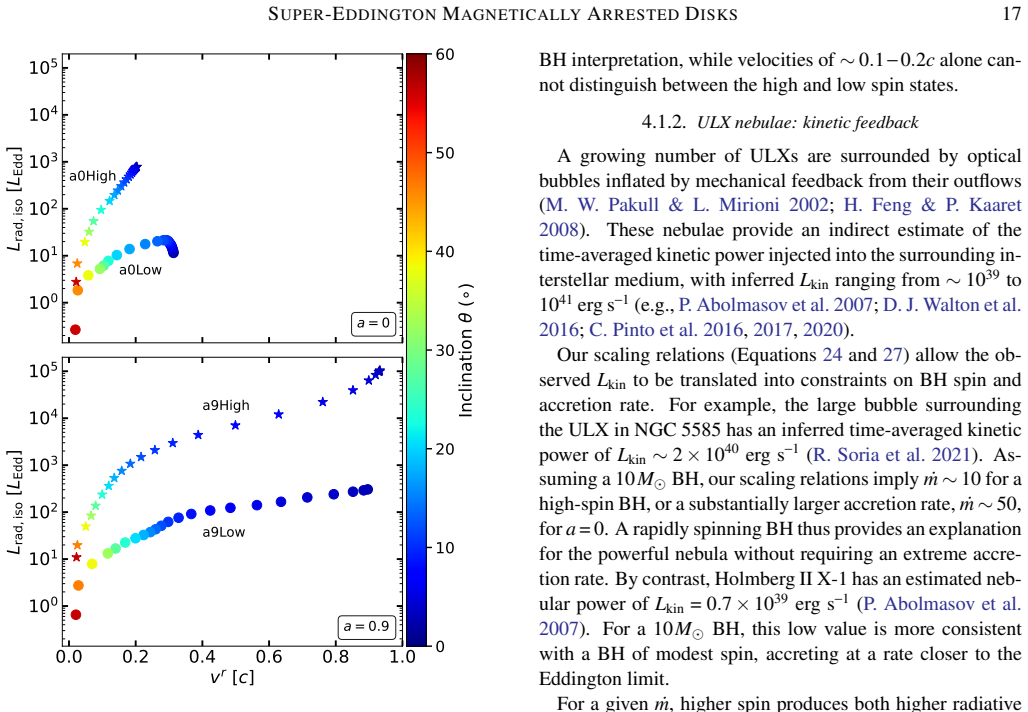
By varying spin (0 and 0.9), accretion rate (about 1 to 2000 times Eddington), and black hole mass (5, 15, 30 solar masses) in a suite of three-dimensional general relativistic radiation magnetohydrodynamics simulations of magnetically arrested disks, the paper finds that the black hole accretes only 10–40% of the supplied gas; the rest is lost to winds. For non-spinning black holes the radiative, kinetic, and electromagnetic efficiencies stay roughly constant at a few percent across the entire accretion-rate range. For rapidly spinning black holes, wind and jet power scale super-linearly with accretion rate — jet power roughly as the 1.27 power of Eddington rate below 100 Eddington, then sa
What carries the argument
The central object is the magnetically arrested disk (MAD): a super-Eddington accretion flow in which a strong, ordered magnetic field threads the black hole horizon and impedes infall, reaching a dimensionless magnetic flux around 30–60. The argument is carried by full 3D general relativistic radiation magnetohydrodynamics simulations with an M1 closure for radiation transport, which track the coupled gas, magnetic, and radiation energy fluxes. The key diagnostics are the efficiency of each energy channel (radiative, kinetic, electromagnetic), the mass accretion ratio (fraction of supplied gas that accretes), and the beaming factor (true luminosity divided by isotropic-equivalent luminosity
Load-bearing premise
The load-bearing premise is that the M1 radiation-transport closure accurately captures the anisotropic escape of light through the optically thin polar funnel, including the extreme beaming factors and high radiative efficiencies; if it distorts the funnel's transparency, the quantitative spin-efficiency and beaming results would shift.
What would settle it
Run the same models with a more accurate radiation-transport treatment (e.g., Monte Carlo or variable Eddington tensor): if inverse beaming factors above ~100 do not survive, or if the radiative efficiency does not rise steeply with spin, the central claim is falsified. Observationally, a black-hole ULX candidate seen face-on with isotropic-equivalent luminosity above 100 L_Edd but without fast (>0.3c) polar outflow or jet signatures would contradict the predicted coupling between beaming and fast polar outflow.
If this is right
- A stellar-mass black hole accreting near 200 Eddington rates in a magnetically arrested state, viewed nearly face-on, would appear as a source with isotropic-equivalent luminosity exceeding 100 L_Edd, offering a natural explanation for ultraluminous X-ray sources.
- Observed kinetic powers of ULX bubbles can be converted, via the paper's scaling relations, into constraints on black hole spin and accretion rate; fast outflows above 0.3c would favor a spinning black hole.
- Because only 10–40% of the supplied mass reaches the black hole, super-Eddington accretion is highly self-limiting for mass growth while still producing high apparent luminosity.
- In high-spin systems, jet power saturates past about 100 Eddington rates, so additional mass supply mostly strengthens the wind rather than the jet.
- Black hole mass has no effect across 5–30 solar masses, so population synthesis of ULXs can ignore mass dependence in this range.
Where Pith is reading between the lines
- The strong beaming implies the same object would appear as a bright ULX face-on and much fainter edge-on; counting the relative numbers of face-on and edge-on systems in X-ray surveys could test the predicted beaming fractions.
- If the M1 closure is replaced by a more accurate radiation-transport scheme (e.g., Monte Carlo), the extreme inverse beaming factors above 100 are the most fragile quantitative prediction; a moderate reduction would still preserve the spin-efficiency ordering.
- The scaling relations, derived for stellar-mass black holes, may extend to supermassive black holes in tidal disruption events, where similar efficiencies would imply strong feedback and rapid spin-down of the hole.
- The jet saturation at high rates suggests a natural brake: beyond about 100 Eddington, the magnetic flux threading the horizon saturates, so additional gas does not produce more jet power — an effect that could shape radio–X-ray correlations in super-Eddington sources.
Editorial analysis
A structured set of objections, weighed in public.
Referee Report
Summary. This paper presents 32 three-dimensional GRRMHD simulations of super-Eddington magnetically arrested disks around stellar-mass black holes, varying mass (5, 15, 30 M_sun), spin (a=0, 0.9), and accretion rate (Mdot/Mdot_Edd ≈ 1–2000). The authors define a set of diagnostics for mass and energy fluxes and report that: BH mass has no effect; wind kinetic, radiative, and electromagnetic efficiencies are nearly constant for a=0 but grow super-linearly with accretion rate for a=0.9; jet power saturates at high Eddington ratios; the BH accretes only 10–40% of the supplied gas; and radiation is strongly beamed along the polar funnel, with inverse beaming factors exceeding 100 for high-spin, high-Mdot models. They conclude that BH spin is the primary driver of super-Eddington MAD efficiency while accretion rate sets the overall energy scale, and they provide scaling relations intended for interpreting ULXs and related sources.
Significance. If the quantitative results are robust, this is a valuable systematic step: the 32-run parameter survey, clearly defined diagnostics, and explicit scaling relations give a framework that can be compared with ULX outflows, nebulae, and hyper-luminous sources. The qualitative message that rapid spin boosts energy-extraction efficiency and that accretion rate sets the power scale is credible and consistent with earlier MAD simulations. The paper also makes falsifiable predictions, e.g., UFO velocities >0.3c favoring high spin, and a strong viewing-angle dependence of apparent luminosity. However, the quantitative claims—especially the extreme beaming factors and the super-linear efficiency scalings—rest on the M1 radiation closure in the optically thin polar funnel and on a set of fits without quoted uncertainties or a resolution study. These issues need to be addressed before the scaling relations can be used as a secure observational framework.
major comments (3)
- [§2.1, §3.5.3, §5] The M1 closure for radiation transport is used throughout, and Section 3.5.3 reports inverse beaming factors b^-1 > 100 at θ<10° for a=0.9 high-Mdot models. Section 5 concedes that M1 'may affect the precise beaming profile in optically thin polar regions.' This caveat is load-bearing: L_rad in Eq. (22) integrates only regions with τ_eff<1, i.e., the free-streaming funnel, and b(θ) in Eq. (23) is the ratio of flux through that funnel. M1's single-axis Eddington tensor is known to distort the radiation field in optically thin regions illuminated by an extended source. The assertion that total L_rad is less affected is not tested, and the headline b^-1 values and the a=0.9 radiative efficiencies (η_rad ≈ 8–20%) are precisely the quantities that would change. Please add a quantitative test—e.g., post-processing snapshots with Monte Carlo transport or a two-moment closure comparison—or subst
- [§3.1, Table 1, Appendix B] All 32 models are run at a single numerical resolution; no same-model resolution study is presented (Table 1 lists different grids for different models). The time-averaged efficiencies in Tables B1/B2 are quoted without error bars or convergence metrics. Since the conclusions depend on power-law exponents and on the jet saturation at Ṁ~100, and since individual models show non-monotonic behavior (e.g., m15a9r4 has lower η_kin and η_rad than m15a9r3 despite higher Ṁacc), a resolution/convergence test at least for the four fiducial models, together with time-averaging uncertainties, is required before the quantitative scalings can be considered robust.
- [§3.2.1, Eqs. (24)–(31)] Equations (24)–(31) are fit to the same simulations whose interpretation they then frame; no fit uncertainties, residuals, or goodness-of-fit measures are reported. For example, the super-linear exponents for a=0.9 in Eqs. (27)–(29) rest on a limited number of points with visible scatter in Figure 4 and Table B1. Because these exponents are used to argue that high spin makes efficiency grow faster than accretion rate, the fits need confidence intervals and a robustness check (e.g., excluding the most extreme Ṁ point or testing a broken power law). As written, the 'framework for interpreting observations' is self-calibrated rather than independently validated.
minor comments (5)
- [§5, item 6] Typo: 'can can have' should be 'can have'. Also, Section 4.2 states η_kin reaches ~70% at the highest Ṁ, but Table B1 lists values up to 92.8% (m15a9r7); please reconcile.
- [§2.3, Eq. (5)] The fixed η_acc=0.1 used to define Ṁ_Edd is a convention, but since η_rad for a=0.9 exceeds 0.1, the dimensionless ratio Ṁ/Ṁ_Edd is not the physical Eddington ratio. This is stated, but it should be reiterated where Ṁ values are compared with observational Eddington ratios.
- [§3.5.1, Fig. 11] The footnote that jet gas densities are contaminated by numerical floors should be repeated when the photosphere and beaming results are discussed, because the polar funnel is exactly where the floors act.
- [§3.5.3, Fig. 12] Panels (b) and (c) use different y-axis ranges (0–30 vs 0–300). This makes comparison more difficult; consider a common scale or explicit annotation of the scale change.
- [§3.3, Eq. (31)] The a=0.9 power-law fit in Eq. (31) may not capture the apparent steepening at high Ṁ_t; a broken power law or a statement of the fit range's sensitivity would be more informative.
Circularity Check
No significant circularity: the central claims are direct simulation measurements, and the fitted scaling relations are used only to summarize the simulations and to map external observations, not to generate the claims they support.
full rationale
The paper's central claims — that BH spin boosts energy-extraction efficiency, that accretion rate sets the overall power scale, that BH mass is unimportant over 5-30 Msun, and that the BH accretes only 10-40% of the supplied gas — are direct comparisons of time-averaged outflow quantities measured in 32 GRRMHD simulations. They do not reduce to any fitted parameter or to any self-consistent definition. The scaling relations (Eqs. 24-31) are power-law fits to the same simulation suite, but the paper uses them as compact summaries and as a bridge to external ULX observations (e.g., translating an observed nebular Lkin into a spin/rate constraint). That is an application of a fit to outside data, not a prediction validated by the same fit, so it is not circular. The cited prior work by the authors (Dai et al. 2018, Thomsen et al. 2022, Yang et al. 2023, Kwan et al. 2023) is used for code provenance, initial-condition choices, and qualitative consistency checks; none of it is invoked as a uniqueness theorem or as the sole justification for the paper's central efficiency ranking. The acknowledged M1-closure limitation in the optically thin polar funnel is a genuine numerical-accuracy concern, but it is a correctness risk, not a circularity: the beaming factors and efficiencies are measured from the simulations rather than imposed by construction. Therefore the derivation chain is self-contained and the circularity score is 0.
Axiom & Free-Parameter Ledger
free parameters (5)
- eta_acc (Eddington efficiency for Mdot definition) =
0.1 (chosen)
- a=0 wind scaling coefficients/exponents =
Lkin=0.37 mdot^0.96; Lrad=0.19 mdot^0.96; LEM=0.08 mdot^0.95
- a=0.9 wind scaling coefficients/exponents =
Lkin=1.27 mdot^1.29; Lrad=0.75 mdot^1.15; LEM=0.65 mdot^1.29
- Jet power scaling coefficient/exponent =
0.91 and 1.27 for Pjet/LEdd = 0.91 mdot^1.27
- Accretion ratio scaling normalizations/exponents =
a=0: 0.4, -0.09; a=0.9: 0.4, -0.18
axioms (5)
- domain assumption The M1 closure approximates the radiation stress-energy tensor in all regimes, including optically thin polar funnels.
- domain assumption The initial poloidal magnetic field with midplane beta~30 leads to a MAD state representative of real ULX accretion flows.
- domain assumption The thermally unbound criterion (-hut>1) correctly identifies gas that will escape to infinity, and wind measured at r=2000 rg is close to asymptotic.
- ad hoc to paper eta_acc=0.1 is a fixed radiative efficiency for defining Eddington accretion rate.
- domain assumption Solar abundances and the opacity tables (including Chianti) accurately describe the accreting gas.
Cite this review
Pith. "Pith review of Strongly Magnetized Super-Eddington Accretion: How Spin and Accretion Rate Regulate Energy Output and Mass Loss." pith.science (2026). https://pith.science/paper/COROSTKM
@misc{pith2026260728919,
  author       = {Pith},
  title        = {Pith review of: Strongly Magnetized Super-Eddington Accretion: How Spin and Accretion Rate Regulate Energy Output and Mass Loss},
  year         = {2026},
  howpublished = {\url{https://pith.science/paper/COROSTKM}},
  note         = {Machine review of arXiv:2607.28919}
}
read the original abstract
Strongly magnetized super-Eddington accretion flows power many important astrophysical systems, but how black hole parameters control their output is unclear. We present 32 general relativistic radiation magnetohydrodynamics simulations of super-Eddington magnetically arrested disks onto stellar-mass black holes, varying mass ($M_{\rm BH}= 5, 15, 30\,M_{\odot}$), spin ($a=0,0.9$), and accretion rate ($\dot{M}_{\rm acc} \approx 1-2000\,\dot{M}_{\rm Edd}$). We find that black hole spin and accretion rate jointly regulate wind loss rates and energy output efficiencies, while black hole mass has no effect over the mass range studied here. The BH accretes only $10-40\%$ of the mass supplied to the accretion flow, while the rest is expelled in winds. This accretion fraction decreases with mass supply rate and is lower for high-spin systems. Both spin states produce strong magnetically driven outflows. For $a = 0$, the wind kinetic, radiative, and electromagnetic efficiencies are modest and show little variation across the full simulated range of accretion rates. For $a = 0.9$, both wind power and jet power increase super-linearly with $\dot{M}_{\rm acc}$, with the jet power saturating beyond $\dot{M}_{\rm acc} \sim 100\,\dot{M}_{\rm Edd}$. Radiation is strongly beamed along the funnel, with inverse beaming factors exceeding $100$ for high-spin, high-$\dot{m}$ models viewed face-on. Our results establish that rapid BH spin boosts energy-extraction efficiency, while high accretion rate amplifies total power. We provide scaling relations for luminosities, jet power, accretion ratio, and beaming, offering a framework for interpreting observations of ULXs and other super-Eddington systems.
Figures


Reference graph
Works this paper leans on
-
[1]
2007, Astrophysical Bulletin, 62, 36, doi: 10.1134/S199034130701004X
Abolmasov, P., Fabrika, S., Sholukhova, O., & Afanasiev, V . 2007, Astrophysical Bulletin, 62, 36, doi: 10.1134/S199034130701004X
-
[2]
Abramowicz, M. A., Czerny, B., Lasota, J. P., & Szuszkiewicz, E. 1988, ApJ, 332, 646, doi: 10.1086/166683
doi:10.1086/166683 1988
-
[3]
Asahina, Y ., & Ohsuga, K. 2022, ApJ, 929, 93, doi: 10.3847/1538-4357/ac5d37 SUPER-EDDINGTONMAGNETICALLYARRESTEDDISKS21 Figure A1.Initial rest-mass densityρ(colour map) and magnetic field configuration (black lines). 103 104 105 106 107 108 T [K] 10 10 10 9 10 8 10 7 10 6 10 5 10 4 10 3 10 2 [g cm 3] abs 103 104 105 106 107 108 T [K] tot 10 4 10 2 100 102...
-
[4]
Asahina, Y ., Takahashi, H. R., & Ohsuga, K. 2020, ApJ, 901, 96, doi: 10.3847/1538-4357/abaf51
-
[5]
Begelman, M. C., King, A. R., & Pringle, J. E. 2006, MNRAS, 370, 399, doi: 10.1111/j.1365-2966.2006.10469.x
arXiv 2006
-
[6]
Blandford, R. D., & Znajek, R. L. 1977, MNRAS, 179, 433, doi: 10.1093/mnras/179.3.433
-
[7]
Buchler, J. R., & Yueh, W. R. 1976, ApJ, 210, 440, doi: 10.1086/154847
doi:10.1086/154847 1976
-
[8]
2023, MNRAS, 519, 2812, doi: 10.1093/mnras/stac3716
Curd, B., Emami, R., Anantua, R., et al. 2023, MNRAS, 519, 2812, doi: 10.1093/mnras/stac3716
-
[9]
2019, MNRAS, 483, 565, doi: 10.1093/mnras/sty3134
Curd, B., & Narayan, R. 2019, MNRAS, 483, 565, doi: 10.1093/mnras/sty3134
-
[10]
2023, MNRAS, 518, 3441, doi: 10.1093/mnras/stac3330
Curd, B., & Narayan, R. 2023, MNRAS, 518, 3441, doi: 10.1093/mnras/stac3330
-
[11]
Dai, J. L., Lodato, G., & Cheng, R. 2021, SSRv, 217, 12, doi: 10.1007/s11214-020-00747-x
-
[12]
C., Roth, N., Ramirez-Ruiz, E., & Miller, M
Dai, L., McKinney, J. C., Roth, N., Ramirez-Ruiz, E., & Miller, M. C. 2018, ApJ, 859, L20, doi: 10.3847/2041-8213/aab429
-
[13]
2014, ApJ, 782, 45, doi: 10.1088/0004-637X/782/1/45 22 KWAN ET AL
Du, P., Hu, C., Lu, K.-X., et al. 2014, ApJ, 782, 45, doi: 10.1088/0004-637X/782/1/45 22 KWAN ET AL. Table B1.More model parameters: spina, black hole massM BH, BH accretion rate ˙Macc, kinetic, radiative, and electromagnetic luminosities of the thermally unbound wind,Lkin,L rad, andL EM, kinetic, radiative, and electromagnetic wind efficiencies,η kin,w,η...
-
[14]
Evans, C. R., & Kochanek, C. S. 1989, ApJL, 346, L13, doi: 10.1086/185567
doi:10.1086/185567 1989
-
[15]
Farrell, S. A., Webb, N. A., Barret, D., Godet, O., & Rodrigues, J. M. 2009, Nature, 460, 73, doi: 10.1038/nature08083
-
[16]
2004, ARA&A, 42, 317, doi: 10.1146/annurev.astro.42.053102.134031
Fender, R., & Belloni, T. 2004, ARA&A, 42, 317, doi: 10.1146/annurev.astro.42.053102.134031
arXiv 2004
-
[17]
2008, ApJ, 675, 1067, doi: 10.1086/527353
Feng, H., & Kaaret, P. 2008, ApJ, 675, 1067, doi: 10.1086/527353
-
[18]
Fragile, P. C., Middleton, M. J., Bollimpalli, D. A., & Smith, Z. 2025, MNRAS, 540, 2820, doi: 10.1093/mnras/staf890
-
[19]
2025, ApJ, 978, 148, doi: 10.3847/1538-4357/ad9926
Liska, M. 2025, ApJ, 978, 148, doi: 10.3847/1538-4357/ad9926
-
[20]
Gladstone, J. C., Roberts, T. P., & Done, C. 2009, MNRAS, 397, 1836, doi: 10.1111/j.1365-2966.2009.15123.x
arXiv 2009
-
[21]
Hopkins, P. F., Grudic, M. Y ., Su, K.-Y ., et al. 2024, The Open Journal of Astrophysics, 7, 18, doi: 10.21105/astro.2309.13115
arXiv 2024
-
[22]
L., Belfiore, A., Stella, L., et al
Israel, G. L., Belfiore, A., Stella, L., et al. 2017, Science, 355, 817, doi: 10.1126/science.aai8635
-
[23]
Jiang, Y .-F., & Dai, L. 2024, arXiv e-prints, arXiv:2408.16856, doi: 10.48550/arXiv.2408.16856 SUPER-EDDINGTONMAGNETICALLYARRESTEDDISKS23 Table B2.Jet properties of the spinning (a= 0.9) models atr= 2,000r g: jet efficiencyη jet, total jet powerP jet, and radiative, kinetic, and electromagnetic jet luminosities,L rad,jet,L kin,jet, andL EM,jet. Modelη je...
-
[24]
Jiang, Y .-F., Stone, J. M., & Davis, S. W. 2014, ApJ, 796, 106, doi: 10.1088/0004-637X/796/2/106
-
[25]
Jiang, Y .-F., Stone, J. M., & Davis, S. W. 2019, ApJ, 880, 67, doi: 10.3847/1538-4357/ab29ff
-
[26]
Kaaret, P., Feng, H., & Roberts, T. P. 2017, ARA&A, 55, 303, doi: 10.1146/annurev-astro-091916-055259
-
[27]
2025, ApJ, 979, 248, doi: 10.3847/1538-4357/ad9a86
Jacquemin-Ide, J. 2025, ApJ, 979, 248, doi: 10.3847/1538-4357/ad9a86
-
[28]
2023, NewAR, 96, 101672, doi: 10.1016/j.newar.2022.101672
King, A., Lasota, J.-P., & Middleton, M. 2023, NewAR, 96, 101672, doi: 10.1016/j.newar.2022.101672
arXiv 2023
-
[29]
2015, ARA&A, 53, 115, doi: 10.1146/annurev-astro-082214-122316
King, A., & Pounds, K. 2015, ARA&A, 53, 115, doi: 10.1146/annurev-astro-082214-122316
-
[30]
King, A. R. 2008, MNRAS, 385, L113, doi: 10.1111/j.1745-3933.2008.00444.x
arXiv 2008
-
[31]
King, A. R., Davies, M. B., Ward, M. J., Fabbiano, G., & Elvis, M. 2001, ApJL, 552, L109, doi: 10.1086/320343
doi:10.1086/320343 2001
-
[32]
King, A. R., & Pounds, K. A. 2003, MNRAS, 345, 657, doi: 10.1046/j.1365-8711.2003.06980.x
arXiv 2003
-
[33]
2021, PASJ, 73, 450, doi: 10.1093/pasj/psab011
Kitaki, T., Mineshige, S., Ohsuga, K., & Kawashima, T. 2021, PASJ, 73, 450, doi: 10.1093/pasj/psab011
-
[34]
M., Dai, L., & Tchekhovskoy, A
Kwan, T. M., Dai, L., & Tchekhovskoy, A. 2023, ApJL, 946, L42, doi: 10.3847/2041-8213/acc334
-
[35]
2024, ApJ, 960, 82, doi: 10.3847/1538-4357/ad09af
Lowell, B., Jacquemin-Ide, J., Tchekhovskoy, A., & Duncan, A. 2024, ApJ, 960, 82, doi: 10.3847/1538-4357/ad09af
-
[36]
1984, ARA&A, 22, 507, doi: 10.1146/annurev.aa.22.090184.002451
Margon, B. 1984, ARA&A, 22, 507, doi: 10.1146/annurev.aa.22.090184.002451
arXiv 1984
-
[37]
McKinney, J. C., Dai, L., & Avara, M. J. 2015, MNRAS, 454, L6, doi: 10.1093/mnrasl/slv115
-
[38]
C., Tchekhovskoy, A., & Blandford, R
McKinney, J. C., Tchekhovskoy, A., & Blandford, R. D. 2012, MNRAS, 423, 3083, doi: 10.1111/j.1365-2966.2012.21074.x
arXiv 2012
-
[39]
C., Tchekhovskoy, A., S ˛ adowski, A., & Narayan, R
McKinney, J. C., Tchekhovskoy, A., S ˛ adowski, A., & Narayan, R. 2014, MNRAS, 441, 3177, doi: 10.1093/mnras/stu762
-
[40]
Misra, D., Kovlakas, K., Fragos, T., et al. 2023, arXiv e-prints, arXiv:2309.15904, doi: 10.48550/arXiv.2309.15904
work page internal anchor Pith review Pith/arXiv arXiv doi:10.48550/arxiv.2309.15904 2023
-
[41]
2022, MNRAS, 511, 3795, doi: 10.1093/mnras/stac285
Narayan, R., Chael, A., Chatterjee, K., Ricarte, A., & Curd, B. 2022, MNRAS, 511, 3795, doi: 10.1093/mnras/stac285
-
[42]
Narayan, R., Igumenshchev, I. V ., & Abramowicz, M. A. 2003, PASJ, 55, L69, doi: 10.1093/pasj/55.6.L69
-
[43]
2017, MNRAS, 469, 2997, doi: 10.1093/mnras/stx1027
Narayan, R., Sa̧dowski, A., & Soria, R. 2017, MNRAS, 469, 2997, doi: 10.1093/mnras/stx1027
-
[44]
2017, PASJ, 69, 33, doi: 10.1093/pasj/psx006
Hashizume, K. 2017, PASJ, 69, 33, doi: 10.1093/pasj/psx006
-
[45]
2009, PASJ, 61, L7, doi: 10.1093/pasj/61.3.L7
Ohsuga, K., Mineshige, S., Mori, M., & Kato, Y . 2009, PASJ, 61, L7, doi: 10.1093/pasj/61.3.L7
-
[46]
2005, ApJ, 628, 368, doi: 10.1086/430728
Ohsuga, K., Mori, M., Nakamoto, T., & Mineshige, S. 2005, ApJ, 628, 368, doi: 10.1086/430728
doi:10.1086/430728 2005
-
[47]
1983, ApJ, 267, 315, doi: 10.1086/160870
Paczynski, B. 1983, ApJ, 267, 315, doi: 10.1086/160870
doi:10.1086/160870 1983
-
[48]
Pakull, M. W., & Grisé, F. 2008, in American Institute of Physics Conference Series, V ol. 1010, A Population Explosion: The Nature & Evolution of X-ray Binaries in Diverse Environments, ed. R. M. Bandyopadhyay, S. Wachter, D. Gelino, & C. R. Gelino (AIP), 303–307, doi: 10.1063/1.2945062
-
[49]
Pakull, M. W., & Mirioni, L. 2002, arXiv e-prints, astro, doi: 10.48550/arXiv.astro-ph/0202488
-
[50]
Pinto, C., Middleton, M. J., & Fabian, A. C. 2016, Nature, 533, 64, doi: 10.1038/nature17417 24 KWAN ET AL
-
[51]
2017, MNRAS, 468, 2865, doi: 10.1093/mnras/stx641
Pinto, C., Alston, W., Soria, R., et al. 2017, MNRAS, 468, 2865, doi: 10.1093/mnras/stx641
-
[52]
Pinto, C., Mehdipour, M., Walton, D. J., et al. 2020, MNRAS, 491, 5702, doi: 10.1093/mnras/stz3392
-
[53]
Rees, M. J. 1988, Nature, 333, 523, doi: 10.1038/333523a0
doi:10.1038/333523a0 1988
-
[54]
2023, ApJL, 954, L22, doi: 10.3847/2041-8213/aceda5 S ˛ adowski, A
Ricarte, A., Narayan, R., & Curd, B. 2023, ApJL, 954, L22, doi: 10.3847/2041-8213/aceda5 S ˛ adowski, A. 2009, ApJS, 183, 171, doi: 10.1088/0067-0049/183/2/171 S ˛ adowski, A., & Narayan, R. 2015a, MNRAS, 453, 3213, doi: 10.1093/mnras/stv1802 S ˛ adowski, A., & Narayan, R. 2015b, MNRAS, 454, 2372, doi: 10.1093/mnras/stv2022 S ˛ adowski, A., & Narayan, R. ...
-
[55]
Soria, R., Pakull, M. W., Motch, C., et al. 2021, MNRAS, 501, 1644, doi: 10.1093/mnras/staa3784
-
[56]
Tchekhovskoy, A., McKinney, J. C., & Narayan, R. 2012, in Journal of Physics Conference Series, V ol. 372, Journal of Physics Conference Series, 012040, doi: 10.1088/1742-6596/372/1/012040
-
[57]
Tchekhovskoy, A., Narayan, R., & McKinney, J. C. 2010, ApJ, 711, 50, doi: 10.1088/0004-637X/711/1/50
-
[58]
Tchekhovskoy, A., Narayan, R., & McKinney, J. C. 2011, MNRAS, 418, L79, doi: 10.1111/j.1745-3933.2011.01147.x
arXiv 2011
-
[59]
Thomsen, L. L., Kwan, T. M., Dai, L., et al. 2022, ApJL, 937, L28, doi: 10.3847/2041-8213/ac911f
-
[60]
Tombesi, F., Cappi, M., Reeves, J. N., et al. 2010, A&A, 521, A57, doi: 10.1051/0004-6361/200913440
-
[61]
Walton, D. J., Middleton, M. J., Pinto, C., et al. 2016, ApJL, 826, L26, doi: 10.3847/2041-8205/826/2/L26
-
[62]
2013, PhRvL, 110, 081301, doi: 10.1103/PhysRevLett.110.081301
Wang, J.-M., Du, P., Valls-Gabaud, D., Hu, C., & Netzer, H. 2013, PhRvL, 110, 081301, doi: 10.1103/PhysRevLett.110.081301
-
[63]
2017, ApJ, 846, 17, doi: 10.3847/1538-4357/aa821d
Wiktorowicz, G., Sobolewska, M., Lasota, J.-P., & Belczynski, K. 2017, ApJ, 846, 17, doi: 10.3847/1538-4357/aa821d
-
[64]
2023, MNRAS, 523, 208, doi: 10.1093/mnras/stad1444
Yang, H., Yuan, F., Kwan, T., & Dai, L. 2023, MNRAS, 523, 208, doi: 10.1093/mnras/stad1444
-
[65]
2022, PASJ, 74, 1378, doi: 10.1093/pasj/psac076
Yoshioka, S., Mineshige, S., Ohsuga, K., Kawashima, T., & Kitaki, T. 2022, PASJ, 74, 1378, doi: 10.1093/pasj/psac076
-
[66]
2024, PASJ, 76, 1015, doi: 10.1093/pasj/psae067
Yoshioka, S., Mineshige, S., Ohsuga, K., Kawashima, T., & Kitaki, T. 2024, PASJ, 76, 1015, doi: 10.1093/pasj/psae067
-
[67]
2015, ApJ, 804, 101, doi: 10.1088/0004-637X/804/2/101
Yuan, F., Gan, Z., Narayan, R., et al. 2015, ApJ, 804, 101, doi: 10.1088/0004-637X/804/2/101
discussion (0)
Sign in with ORCID, Apple, or X to comment. Anyone can read and Pith papers without signing in.