REVIEW 3 major objections 4 minor 36 references
Dimer Models and Hochschild Cohomology
T0 review · 3 major / 4 minor · reviewed 2026-08-14 · deepseek-v4-flash
Pith's one-line read For a zigzag consistent dimer in a torus, the Hochschild cohomology of its Jacobi algebra and its BV structure are determined by the dimer's fan and perfect matchings.
desk verdict A serious, detailed computation of Hochschild cohomology and BV structure for toric dimer models; the main theorems are new and mostly well-proven, with one load-bearing imported uniqueness result that a referee should verify. read the letter →
The pith
A machine-rendered reading of the paper's core claim, the machinery that carries it, and where it could break.
The reading
What carries the argument
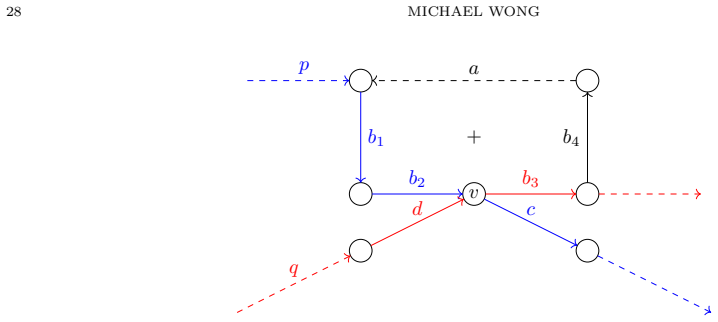
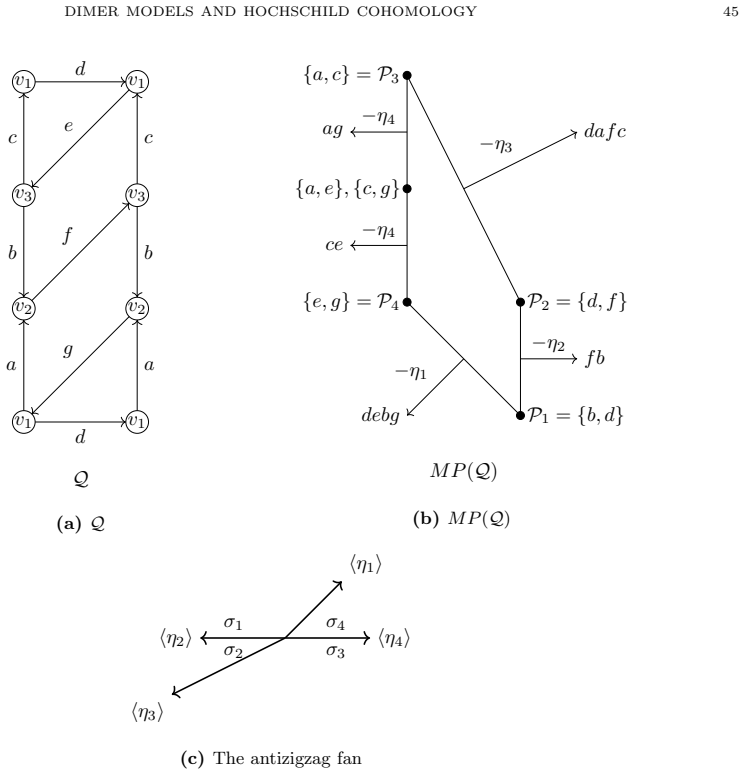
The load-bearing mechanism is comparison with central localization. For a Calabi-Yau algebra $A$, the paper proves that Hochschild cohomology commutes with localization away from a central element: $HH^*(\hat A)$ is the localization of $HH^*(A)$, and the BV operators are related by $\hat{\Delta}(f \otimes s^{-1}) = \Delta(f) \otimes s^{-1} - \{s, f\} \otimes s^{-2}$. For a dimer, $J(Q)[\ell^{-1}]$ is Morita equivalent to the group algebra of the torus fundamental group, i.e. Laurent polynomials in three variables, whose Hochschild cohomology is the algebra of polyvector fields with a divergence operator as BV differential. The hard lifting step—deciding which classes on the localization come from $J(Q)$—is carried out with perfect-matching gradings (integral gradings from selecting one arrow in each face) and the antizigzag fan, whose cones $\sigma_i$ and semigroup algebras $S_i$ index the non-local summands; minimal-path uniqueness then makes the basis well defined.
What would settle it
Find a zigzag consistent dimer in a torus with two minimal paths between the same vertices that have the same homotopy class and the same degrees in every corner matching but are not equal in $J(Q)$ up to a power of $\ell$; the claimed bases for $HH^1$, $HH^2$, and $HH^3$ would then contain spurious classes. Concretely, checking the suspended pinch point by a direct bar-complex computation of $HH^1$ would either confirm or contradict the dimension formula.
Extended reading notes
Core claim
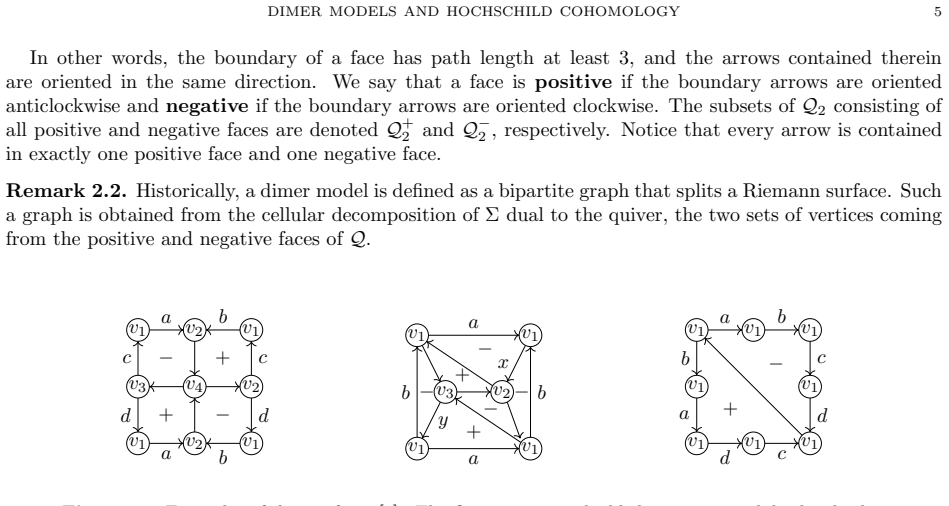
The central discovery is that, under zigzag consistency, the entire Hochschild cohomology of the Jacobi algebra $J(Q)$ of a toric dimer is additively built from the center $Z$, the lattice $N^{out}$ of one-parameter subgroups of outer automorphisms, and powers of zigzag cycles. In the paper's notation, $HH^0(J(Q)) \cong Z$, $HH^1(J(Q)) \cong Z \otimes N^{out}_{\mathbb{C}} \oplus \bigoplus_i S_i$, while $HH^2(J(Q))$ and $HH^3(J(Q))$ are direct sums of the corresponding wedge powers of $N^{out}_{\mathbb{C}}$, the semigroup algebras $S_i = \mathbb{C}[\mathrm{Int}\,\sigma_i \cap \mathbb{Z}^2]$, powers of zigzag cycles, and, in the top degree, vertex generators. The paper further shows that the BV operator is unique up to scaling, is computed by a divergence operator on the localization $J(Q)[\ell^{-1}]$, and satisfies explicit formulas on all basis elements; together with the cup products and Gerstenhaber bracket, this determines the full BV algebra structure.
Load-bearing premise
The whole computation rests on the imported lemma that, in the localized algebra, a path is determined by its homotopy class and its degrees in the perfect matchings, so minimal paths are unique up to powers of the potential; if two non-equivalent minimal paths shared those data, the derivation basis and everything built from it would fail.
Editorial extensions
If this is right
- The additive formulas give explicit bases for $HH^0$ through $HH^3$: the ranks and generator degrees are read directly from the antizigzag fan, the corner matchings, and the number of parallel zigzag cycles.
- The complete BV algebra structure means the Gerstenhaber bracket, the BV operator, and the cup product on $HH^*(J(Q))$ are computable for any toric dimer, so deformation-theoretic invariants of the associated noncommutative crepant resolution are explicit.
- All first-order Calabi-Yau deformations of $J(Q)$ are deformations of the superpotential, classified up to gauge equivalence by boundary cycles, minimal interior cycles, and powers of antizigzag cycles.
- For the matrix-factorization category, the compactly supported Hochschild cohomology is additively $H^*(\Sigma^\vee \setminus Q_0^\vee, \mathbb{C})$ plus even and odd polynomial generators $Z_j^n$ attached to each zigzag; this reproduces the symplectic cohomology of the punctured mirror surface as a BV complex.
- In the four-punctured-sphere example the computed BV algebra is isomorphic to the symplectic cohomology algebra, while in the five-punctured-sphere example the additive and BV-operator structures agree but the ring structures differ, pinpointing where the B-side remembers more than the punctures do.
Reading between the lines
- The formulas suggest that $HH^*(J(Q))$ depends only on the antizigzag fan together with the corner-matching data, so dimers with the same fan and matching polygon should have isomorphic Hochschild cohomology; the paper does not explicitly state this invariance.
- If the natural map from compactly supported to ordinary Hochschild cohomology of the matrix-factorization category is an isomorphism, Theorem 1.3 would upgrade to a full computation of $HH^*(MF(J(Q),\ell))$, matching the A-side wrapped category on the cochain level rather than only additively.
- A testable extension is to replace the torus by a higher-genus surface: the localization comparison would express $HH^*(J(Q))$ in terms of the string-topology BV structure on the free loop space of the surface, provided an analog of the minimal-path-uniqueness lemma holds.
- The multiplicative discrepancy in the five-punctured-sphere example predicts that the filtration on symplectic cohomology recording parallel zigzags is the B-side shadow of the BV algebra's noncommutativity; this could be checked by comparing the filtered ring structure on the A-side.
Signed reviews
Editorial analysis
A structured set of objections, weighed in public.
Referee Report
Summary. The paper computes the Hochschild cohomology of the Jacobi algebra J(Q) of a zigzag-consistent dimer Q embedded in a torus, in purely combinatorial terms: additive bases for HH^0 through HH^3 are given in Theorem 1.2, the BV algebra structure is described in Section 4.5, and the compactly supported Hochschild cohomology of the matrix factorization category MF(J(Q),ℓ) is computed in Theorem 1.3 and shown to agree additively with the symplectic cohomology of the dual punctured surface. The main technical tools are a central localization theorem for Hochschild cohomology and BV structures (Section 3), a derivation classification for J(Q) (Section 4), and a spectral sequence for the matrix factorization category (Section 5).
Significance. If the main theorems are correct, the paper provides explicit, parameter-free, combinatorially defined bases and BV products for nontrivial noncommutative invariants of dimer models, and it gives concrete evidence for the expected agreement with symplectic cohomology on the mirror side. The manuscript is careful in many places: the localization compatibility with BV structure in Section 3 is written out in detail, the grading arguments in Section 4 are systematic, and the spectral sequence in Section 5 is set up with attention to inverse limits. The central claim is of clear interest to the dimer-model and homological-mirror-symmetry communities, and the results would be a useful reference if the identified gaps are filled.
major comments (3)
- [§4.2, Lemma 4.5] The classification of derivations of J(Q) is the load-bearing step for Theorems 4.6, 4.17, 4.19, and hence for Theorem 1.2. Its proof relies on two imported facts: that minimal path representatives in J(Q)[ℓ^{-1}] are unique up to powers of ℓ, and that nonnegative perfect-matching degrees characterize membership in J(Q). These are cited to [6, Lemma 7.4] and [8, Lemmas 3.18–3.19] but are not proved or even stated as explicit hypotheses. Because the basis {∂_i, ∂_α} of HH^1 and everything built from it depend on this classification, the paper should either prove these facts or formulate them as explicit assumptions with a precise verification. In the ray case n = -1, the step asserting that a nontrivial γ supported on P_i must equal E_{P_i} also needs proof: the face equations (19) alone show only that γ is supported on P_i, and it is not immediate that the only grading in N supported on P_i is proportional, modulo N^in, to E_{P_i}.
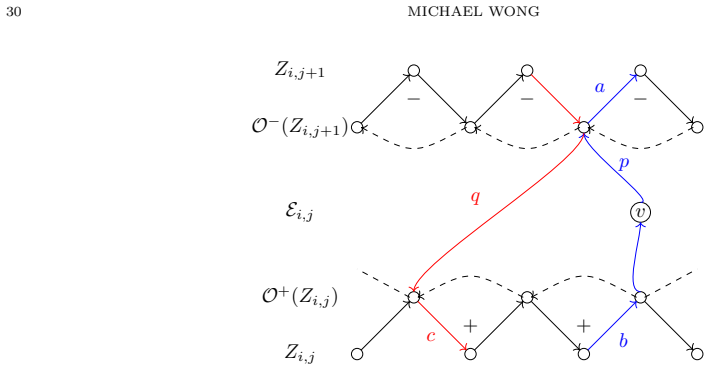
- [§5, Proposition 5.2] The spectral sequence argument leading to the isomorphisms (31) is too compressed. The text states that the only possible nonzero components of d^2 are d^2_{i,i}, but in a first-quadrant spectral sequence d^2 has bidegree (-1,2); a bidegree-by-bidegree check is needed before concluding that d^2 vanishes. More importantly, after showing d^2 = 0, the paper asserts that the spectral sequence degenerates at the second page. Since the matching-degree argument shows that d^r has degree at least r in all perfect matchings, the vanishing of all higher differentials should be stated uniformly for all r, and the convergence of the inverse-limit exact sequence (29) should be tied explicitly to this degeneration. As written, Theorem 1.3 depends on an unproved degeneration claim.
- [§3.1, Theorem 3.5(2)] The proof of the localization isomorphism for Hochschild cohomology checks the key quasi-isomorphism only for the free bimodule M = A^e and then asserts it for general perfect M. The statement is used for M = A, so the argument should either be written for that case or justified by a finite-cell argument. This is a small but load-bearing gap in the localization theorem on which the later computations rely.
minor comments (4)
- [§4.2, Lemma 4.5] In the ray case, the sentence invoking Theorem 2.10 refers to zigzag cycles of homology -η_i, but the relevant corner matchings are P_i and P_{i+1}; presumably the intended homology class is -η_{i+1}. Please correct the index.
- [Throughout] The symbol Z is overloaded: it denotes the center of J(Q), the integer lattice, and the Laurent variable z in the localization. In formulas such as Z·N_C in §4.2 this is confusing; a distinct notation for the center would help.
- [Abstract and §2.9] There are several typographical slips: 'noncommutati ve' in the abstract, 'compactly suppported' in §2.9, and 'Van den Berg' on page 21 for 'Van den Bergh'.
- [§4.5, Proposition 4.21] The formula in item (4) writes {∂_α, f} = deg_{P_i}(f)x_αℓ^{-1}f, but for a homogeneous f of arbitrary degree the right-hand side should be x_αℓ^{-1} times a scalar depending on the degree of f; please state the degree convention for f explicitly.
Circularity Check
No significant circularity: central derivation is self-contained given standard external dimer-model results.
full rationale
The paper derives additive bases and BV structure for HH^*(J(Q)) and HH^*_c(MF(J(Q),ell)) under the stated hypothesis that Q is a zigzag consistent dimer in a torus. The derivation chain is not circular. The potentially load-bearing facts are imported from prior work by other authors: the existence and uniqueness of minimal paths up to powers of ell is taken from Bocklandt ([6, Lemma 7.4] and [8, Lemma 3.18]), and the matching-polytope facts come from Gulotta ([23]) and Broomhead ([10]). These are external, parameter-free theorems about dimer combinatorics and path classes; they do not assume or encode the Hochschild cohomology groups being computed. Lemma 4.5 uses these facts to classify derivations, Theorem 4.6 converts that classification into an HH^1 basis, and Theorems 4.17 and 4.19 compute HH^3 and HH^2 by grading-and-dimension arguments from that basis, not by assuming the answer. The BV operator is pinned down by the unique volume of J(Q) (Lemma 3.9), itself proved inside the paper from the self-dual Ginzburg resolution, together with grading constraints in Theorem 3.10. The matrix-factorization result in Theorem 1.3 is obtained by feeding Theorem 1.2 into the Caldăraru–Tu spectral sequence, whose degeneration is proved by degree arguments. There are no author self-citations, no fitted parameters, and no renaming of a known result as a new prediction. The acknowledged external dependence on minimal-path uniqueness is real but is independent support, not circularity, because it concerns path representatives rather than cohomological conclusions. Overall the central claims have genuine content beyond their inputs.
Assumptions & free parameters
assumptions (6)
- domain assumption Q is zigzag consistent and admits a perfect matching.
- standard math J(Q)[ell^-1] is Morita equivalent to Mat_{#Q0}(C[pi_1(Sigma)] tensor C[z^{+-1}]).
- standard math For zigzag consistent Q in a torus, minimal paths are unique up to multiplication by powers of the potential ell.
- standard math J(Q) is Calabi-Yau of dimension 3 for zigzag consistent dimers in positive genus, and its volume is unique up to scalar.
- standard math The compactly supported Hochschild cohomology of MF(A,W) equals that of the curved algebra (A,W), and the Caldararu-Tu spectral sequence applies.
- standard math Homotopy class and perfect matching degrees determine path classes in J(Q)[ell^-1].
Cite this review
Pith. "Pith review of Dimer Models and Hochschild Cohomology." pith.science (2026). https://pith.science/paper/CQE5JOQU
@misc{pith2026190803005,
  author       = {Pith},
  title        = {Pith review of: Dimer Models and Hochschild Cohomology},
  year         = {2026},
  howpublished = {\url{https://pith.science/paper/CQE5JOQU}},
  note         = {Machine review of arXiv:1908.03005}
}
read the original abstract
Dimer models provide a method of constructing noncommutative crepant resolutions of affine toric Gorenstein threefolds. In homological mirror symmetry, they can also be used to describe noncommutative Landau--Ginzburg models dual to punctured Riemann surfaces. For a zigzag consistent dimer embedded in a torus, we explicitly compute the Hochschild cohomology of its Jacobi algebra in terms of dimer combinatorics. This includes a full characterization of the Batalin--Vilkovisky structure induced by the Calabi--Yau structure of the Jacobi algebra. We then compute the compactly supported Hochschild cohomology of the category of matrix factorizations for the Jacobi algebra with its canonical potential.
Figures

Figures from the paper (4 more)

Reference graph
Works this paper leans on
-
[1]
Efimov, Lu dmil Katzarkov, and Dmitri Orlov
Mohammed Abouzaid, Denis Auroux, Alexander I. Efimov, Lu dmil Katzarkov, and Dmitri Orlov. Homological mirror symmetry for punctured spheres. J. Amer. Math. Soc. , 26(4):1051–1083, 2013
work page 2013
-
[2]
Andr´ es Angel and Diego Duarte. The BV-algebra structur e of the Hochschild cohomology of the group ring of cyclic gro ups of prime order. In Geometric, algebraic and topological methods for quantum fi eld theory, pages 353–372. W orld Sci. Publ., Hackensack, NJ, 2017
work page 2017
-
[3]
Derived invariance of the cap product in Hochschild theory
Marco Armenta and Bernhard Keller. Derived invariance o f the cap product in Hochschild theory. arXiv:1711.02947
-
[4]
A c ategory of kernels for equivariant factorizations and its i mpli- cations for Hodge theory
Matthew Ballard, David Favero, and Ludmil Katzarkov. A c ategory of kernels for equivariant factorizations and its i mpli- cations for Hodge theory. Publ. Math. Inst. Hautes ´Etudes Sci. , 120:1–111, 2014
work page 2014
-
[5]
Toby Stafford, and Michael W emyss
Gwyn Bellamy, Daniel Rogalski, Travis Schedler, J. Toby Stafford, and Michael W emyss. Noncommutative algebraic geom- etry, volume 64 of Mathematical Sciences Research Institute Publications . Cambridge University Press, New York, 2016. Lecture notes based on courses given at the Summer Graduate S chool at the Mathematical Sciences Research Institute (MSRI...
work page 2016
-
[6]
Consistency conditions for dimer models
Raf Bocklandt. Consistency conditions for dimer models . Glasg. Math. J. , 54(2):429–447, 2012
work page 2012
-
[7]
Calabi-Yau algebras and weighted quiver polyhedra
Raf Bocklandt. Calabi-Yau algebras and weighted quiver polyhedra. Math. Z. , 273(1-2):311–329, 2013
work page 2013
- [8]
Show all 36 references
-
[9]
Noncommutative mirror symmetry for punc tured surfaces
Raf Bocklandt. Noncommutative mirror symmetry for punc tured surfaces. Trans. Amer. Math. Soc. , 368(1):429–469, 2016. With an appendix by Mohammed Abouzaid
2016
-
[10]
Dimer models and Calabi-Yau algebra s
Nathan Broomhead. Dimer models and Calabi-Yau algebra s. Mem. Amer. Math. Soc. , 215(1011):viii+86, 2012
2012
-
[11]
Central localization in Hochschi ld homology
Jean-Luc Brylinski. Central localization in Hochschi ld homology. J. Pure Appl. Algebra , 57(1):1–4, 1989
1989
-
[12]
String topology
Moira Chas and Dennis Sullivan. String topology. arXiv :math/9911159. 46 MICHAEL WONG
-
[13]
Curved A∞ algebras and Landau-Ginzburg models
Andrei C˘ ald˘ araru and Junwu Tu. Curved A∞ algebras and Landau-Ginzburg models. New York J. Math. , 19:305–342, 2013
2013
-
[14]
Consistency conditions for brane tilings
Ben Davison. Consistency conditions for brane tilings . J. Algebra, 338:1–23, 2011
2011
-
[15]
C alabi-Yau deformations and negative cyclic homology
Louis de Thanhoffer de Volcesy and Michel Van den Bergh. C alabi-Yau deformations and negative cyclic homology. arXiv:1201.1520. To appear in Journal of Noncommutative Ge ometry
-
[16]
Compact generators in categories of matrix factorizations
Tobias Dyckerhoff. Compact generators in categories of matrix factorizations. Duke Math. J. , 159(2):223–274, 2011
2011
-
[17]
Noncommutative com plete intersections and matrix integrals
Pavel Etingof and Victor Ginzburg. Noncommutative com plete intersections and matrix integrals. Pure Appl. Math. Q. , 3(1, Special Issue: In honor of Robert D. MacPherson. Part 3) :107–151, 2007
2007
-
[18]
Noncommutative del Pezzo surfaces and Calabi-Yau algebras
Pavel Etingof and Victor Ginzburg. Noncommutative del Pezzo surfaces and Calabi-Yau algebras. J. Eur. Math. Soc. (JEMS), 12(6):1371–1416, 2010
2010
-
[19]
Hochschild duality, localization, an d smash products
Marco Farinati. Hochschild duality, localization, an d smash products. J. Algebra, 284(1):415–434, 2005
2005
-
[20]
Symplectic cohomology and duality for the wrapped Fukaya ca tegory
Sheel Ganatra. Symplectic cohomology and duality for the wrapped Fukaya ca tegory. PhD thesis, Massachusetts Institute of Technology, 2012
2012
-
[21]
The cohomology structure of an as sociative ring
Murray Gerstenhaber. The cohomology structure of an as sociative ring. Ann. of Math. (2) , 78:267–288, 1963
1963
-
[22]
Calabi-Yau algebras
Victor Ginzburg. Calabi-Yau algebras. arXiv:math/06 12139
-
[23]
Daniel R. Gulotta. Properly ordered dimers, R-charges, and an efficient inverse algorithm. J. High Energy Phys. , (10):014, 31, 2008
2008
-
[24]
Hochschild, Bertram Kostant, and Alex Rosenberg
G. Hochschild, Bertram Kostant, and Alex Rosenberg. Di fferential forms on regular affine algebras. Trans. Amer. Math. Soc., 102:383–408, 1962
1962
-
[25]
T. Y. Lam. Lectures on modules and rings , volume 189 of Graduate Texts in Mathematics . Springer-Verlag, New York, 1999
1999
-
[26]
Floer cohomology of g-equivariant Lagrangian branes
Yanki Lekili and James Pascaleff. Floer cohomology of g-equivariant Lagrangian branes. Compos. Math., 152(5):1071–1110, 2016
2016
-
[27]
Lin and Daniel Pomerleano
Kevin H. Lin and Daniel Pomerleano. Global matrix facto rizations. Math. Res. Lett. , 20(1):91–106, 2013
2013
-
[28]
Cyclic homology, volume 301 of Grundlehren der Mathematischen Wissenschaften [Fundamen tal Prin- ciples of Mathematical Sciences]
Jean-Louis Loday. Cyclic homology, volume 301 of Grundlehren der Mathematischen Wissenschaften [Fundamen tal Prin- ciples of Mathematical Sciences] . Springer-Verlag, Berlin, second edition, 1998. Appendix E by Mar ´ ıa O. Ronco, Chapter 13 by the author in collaboration with ...
1998
-
[29]
Hochsch ild (co)homology of the second kind I
Alexander Polishchuk and Leonid Positselski. Hochsch ild (co)homology of the second kind I. Trans. Amer. Math. Soc. , 364(10):5311–5368, 2012
2012
-
[30]
Two kinds of derived categories, K oszul duality, and comodule-contramodule correspondence
Leonid Positselski. Two kinds of derived categories, K oszul duality, and comodule-contramodule correspondence . Mem. Amer. Math. Soc. , 212(996):vi+133, 2011
2011
-
[31]
The ring of differenti al operators on forms in noncommutative calculus
Dmitri Tamarkin and Boris Tsygan. The ring of differenti al operators on forms in noncommutative calculus. In Graphs and patterns in mathematics and theoretical physics , volume 73 of Proc. Sympos. Pure Math. , pages 105–131. Amer. Math. Soc., Providence, RI, 2005
2005
-
[32]
The homotopy theory of dg-categories and derived Morita theory
Bertrand Toen. The homotopy theory of dg-categories and derived Morita theory. Invent. Math. , 167(3):615–667, 2007
2007
-
[33]
The string topology BV algebra, Hochs child cohomology and the Goldman bracket on surfaces
Dmitry Vaintrob. The string topology BV algebra, Hochs child cohomology and the Goldman bracket on surfaces. arXiv:math/0702859
-
[34]
A relation between Hochschild hom ology and cohomology for Gorenstein rings
Michel van den Bergh. A relation between Hochschild hom ology and cohomology for Gorenstein rings. Proc. Amer. Math. Soc., 126(5):1345–1348, 1998
1998
-
[35]
Charles A. W eibel. An introduction to homological algebra , volume 38 of Cambridge Studies in Advanced Mathematics . Cambridge University Press, Cambridge, 1994
1994
-
[36]
Derived categories and Calabi-Yau algeb ras
Jieheng Zeng. Derived categories and Calabi-Yau algeb ras. arXiv:1711.08574. Department of Mathematics, University College London, Gowe r Street, London WC1E 6BT E-mail address : michael.wong@ucl.ac.uk
Reviewed August 14, 2026 · model on record in the stance chip above.
Discussion (0). Continue with ORCID to comment.