Inference-Time Conformal Reasoning with Valid Factuality Control for Large Language Models
Pith reviewed 2026-06-30 11:02 UTC · model grok-4.3
The pith
Integrating conformal prediction into reasoning graph generation yields nested outputs with valid factuality coverage guarantees.
A machine-rendered reading of the paper's core claim, the machinery that carries it, and where it could break.
Core claim
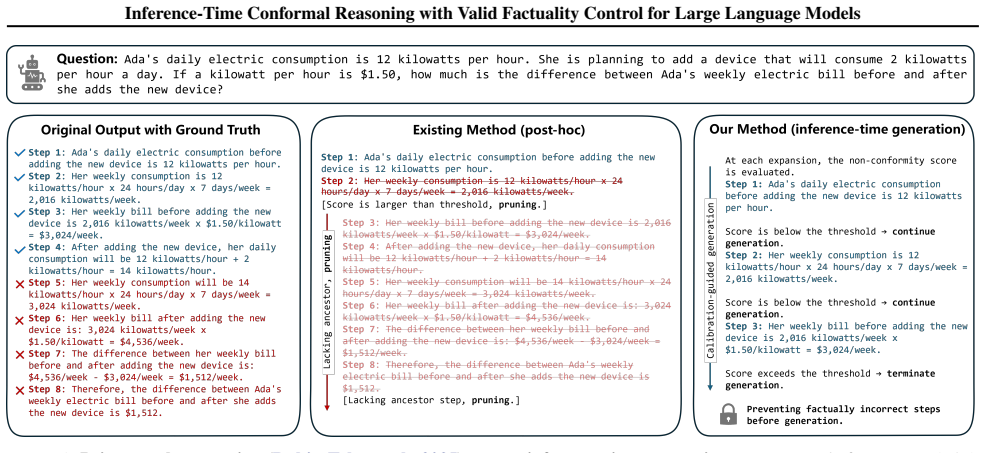
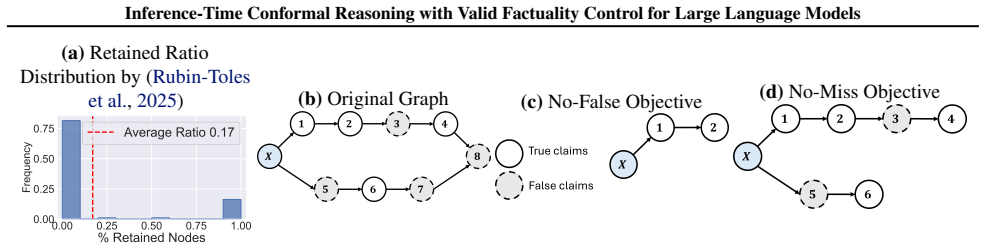
The central claim is that a structure-level factuality uncertainty function can be learned to aggregate claim-level signals over reasoning graphs, after which a non-conformity score based on that function can be calibrated at inference time to produce nested generation sequences that deliver valid coverage guarantees for any user-chosen factuality level.
What carries the argument
The Inference-Time Conformal Reasoning framework, which calibrates a graph-level non-conformity score derived from an aggregated factuality uncertainty function to decide when generation stops.
Load-bearing premise
A structure-level factuality uncertainty function can be learned to aggregate claim-level signals over reasoning graphs without complex modeling assumptions.
What would settle it
A test set where the fraction of generated graphs that meet the target factuality level falls below the promised coverage probability after calibration.
Figures
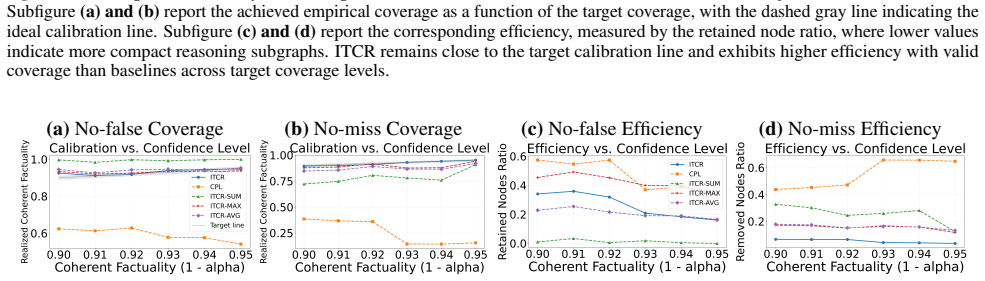
read the original abstract
Large language models (LLMs) increasingly perform multi-step reasoning, where intermediate claims form implicit directed acyclic graphs whose node correctness is structurally conditioned on their ancestors. This makes factuality uncertainty structural, rather than a trivial accumulation of node-wise errors, and necessitates inference-time uncertainty quantification over the reasoning structure. While conformal prediction (CP) offers flexible user-specified factuality control, existing work remains post-hoc and cannot intervene during generation. To fill the gap between CP's flexibility and its post-hoc limitation, we propose an \emph{Inference-Time Conformal Reasoning (ITCR)} framework that integrates CP directly into reasoning graph generation. ITCR learns a structure-level factuality uncertainty function that aggregates claim-level factuality signals over reasoning graphs without complex modeling assumptions. We then design the non-conformity score based on graph-level factuality uncertainty and calibrate the conformal threshold to decide when to stop generation. We theoretically show such generation is nested, yielding valid coverage guarantees for factuality control. Experiments over multiple datasets and coverage objectives demonstrate empirically valid coverage. In downstream reasoning tasks, inference-time calibrated graphs yield more accurate generation than post-hoc pruned graphs.
Editorial analysis
A structured set of objections, weighed in public.
Referee Report
Summary. The paper proposes an Inference-Time Conformal Reasoning (ITCR) framework that integrates conformal prediction directly into LLM reasoning-graph generation. It learns a structure-level factuality uncertainty function to aggregate claim-level signals, defines a graph-level non-conformity score, calibrates a stopping threshold at inference time, and claims that the resulting generation process is nested, thereby inheriting valid coverage guarantees for user-specified factuality levels. Experiments on multiple datasets are said to confirm empirical validity, and downstream reasoning tasks are reported to show higher accuracy than post-hoc pruning.
Significance. If the nesting argument and coverage guarantees hold without hidden modeling assumptions, the work would provide a principled way to enforce factuality control during generation rather than after the fact, which is a meaningful advance over existing post-hoc conformal methods for structured LLM outputs.
major comments (2)
- [Abstract / §3] Abstract and §3 (theoretical section): the claim that 'such generation is nested, yielding valid coverage guarantees' is load-bearing for the central contribution, yet the manuscript supplies neither the explicit definition of the structure-level non-conformity score nor the proof that the stopping rule produces nested sets. Without these, it is impossible to verify whether the coverage guarantee follows from standard conformal arguments or requires additional unstated assumptions on the learned aggregator.
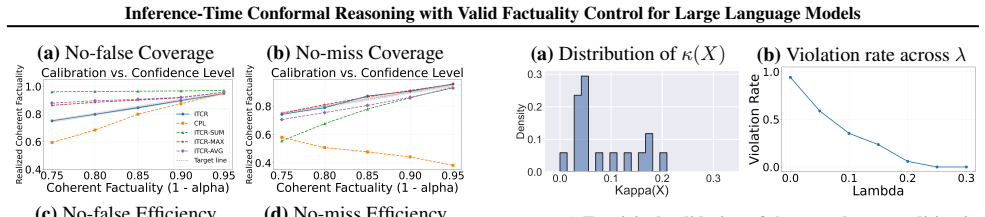
- [§4] §4 (experiments): the abstract asserts 'empirically valid coverage' across datasets and objectives, but no tables, coverage plots, or ablation results on the learned uncertainty function are referenced. This prevents assessment of whether the empirical validity is robust or sensitive to the choice of aggregator.
minor comments (2)
- [§2] Notation for the reasoning graph (nodes as claims, edges as dependencies) should be introduced with a small diagram or formal definition early in §2 to clarify the structural conditioning.
- [Abstract / §3] The phrase 'without complex modeling assumptions' for the structure-level aggregator is repeated but never operationalized; a concrete functional form or pseudocode would help.
Simulated Author's Rebuttal
We thank the referee for the careful reading and constructive comments. We address each major comment below. Where the manuscript is missing explicit details, we will revise to include them.
read point-by-point responses
-
Referee: [Abstract / §3] Abstract and §3 (theoretical section): the claim that 'such generation is nested, yielding valid coverage guarantees' is load-bearing for the central contribution, yet the manuscript supplies neither the explicit definition of the structure-level non-conformity score nor the proof that the stopping rule produces nested sets. Without these, it is impossible to verify whether the coverage guarantee follows from standard conformal arguments or requires additional unstated assumptions on the learned aggregator.
Authors: We agree that the explicit definition of the structure-level non-conformity score and the proof of nesting are essential to substantiate the coverage claim. The manuscript states in §3 that a graph-level non-conformity score is defined from the learned structure-level uncertainty function and that the stopping rule yields nested sets, but does not spell out the mathematical form or the nesting argument in the main text. In revision we will add the precise definition of the non-conformity score (aggregating claim-level signals via the learned function without further modeling assumptions) and include the short proof that the resulting generation process is nested, thereby inheriting standard conformal coverage guarantees. We will also state any assumptions on the aggregator explicitly. revision: yes
-
Referee: [§4] §4 (experiments): the abstract asserts 'empirically valid coverage' across datasets and objectives, but no tables, coverage plots, or ablation results on the learned uncertainty function are referenced. This prevents assessment of whether the empirical validity is robust or sensitive to the choice of aggregator.
Authors: We acknowledge that the current draft does not sufficiently reference the supporting experimental material. The experiments section contains results on multiple datasets and coverage objectives, but explicit pointers to coverage plots, tables, and ablations on the uncertainty-function aggregator are missing. In revision we will add these references in both the abstract and §4, including ablations that vary the aggregator to demonstrate robustness. revision: yes
Circularity Check
No significant circularity identified
full rationale
The paper applies conformal prediction to structure-level uncertainty over reasoning graphs, asserting that the generation process is nested and therefore inherits standard CP coverage. No equations, self-citations, or fitted quantities are shown that reduce the coverage claim to a definitional tautology or to a parameter fit renamed as a prediction. The nesting argument is presented as a theoretical property of the proposed stopping rule rather than an input smuggled in via prior self-work. The structure-level aggregator is described as learned without complex assumptions, but this is an assertion of modeling choice, not a circular reduction. The derivation chain remains self-contained against external CP benchmarks.
Axiom & Free-Parameter Ledger
axioms (1)
- standard math Conformal prediction yields valid coverage under appropriate exchangeability or nestedness conditions on the non-conformity scores.
Reference graph
Works this paper leans on
-
[1]
Dey, N., Ding, J., Ferrell, J., Kapper, C., Lovig, M., Plan- chon, E., and Williams, J
URL https://openreview.net/forum? id=3Pf3Wg6o-A4. Dey, N., Ding, J., Ferrell, J., Kapper, C., Lovig, M., Plan- chon, E., and Williams, J. P. Conformal prediction for text infilling and part-of-speech prediction.The New England Journal of Statistics in Data Science, 2022. Fontana, M., Zeni, G., and Vantini, S. Conformal prediction: a unified review of theo...
2022
-
[2]
URLhttps://proceedings.mlr.press/ v179/giovannotti22a.html. Grattafiori, A., Dubey, A., Jauhri, A., Pandey, A., Kadian, A., Al-Dahle, A., Letman, A., Mathur, A., Schelten, A., Vaughan, A., et al. The llama 3 herd of models, 2024. URLhttps://arxiv.org/abs/2407.21783. Guan, L. Localized conformal prediction: A generalized in- ference framework for conformal...
work page internal anchor Pith review Pith/arXiv arXiv doi:10.1038/s41586-025-09422-z 2024
-
[3]
Holtzman, A., Buys, J., Du, L., Forbes, M., and Choi, Y
URL https://openreview.net/forum? id=7Bywt2mQsCe. Holtzman, A., Buys, J., Du, L., Forbes, M., and Choi, Y . The curious case of neural text degeneration. In International Conference on Learning Representations,
-
[4]
Huang, J., Xi, H., Zhang, L., Yao, H., Qiu, Y ., and Wei, H
URL https://openreview.net/forum? id=rygGQyrFvH. Huang, J., Xi, H., Zhang, L., Yao, H., Qiu, Y ., and Wei, H. Conformal prediction for deep classifier via label ranking. InInternational Conference on Machine Learning, pp. 20331–20347. PMLR, 2024. Jiang, S., Shakeri, Z., Chan, A., Sanjabi, M., Firooz, H., Xia, Y ., Akyildiz, B., Sun, Y ., Li, J., Wang, Q.,...
-
[5]
GraphMind: Theorem Selection and Conclusion Generation Framework with Dynamic GNN for LLM Reasoning
URL https://aclanthology.org/2024. naacl-long.210/. Li, Y ., Zhou, Y ., Wang, X., GuoChen, and Qin, C. Graph- mind: Theorem selection and conclusion generation framework with dynamic gnn for llm reasoning, 2025. URLhttps://arxiv.org/abs/2511.19078. Liao, R., Urtasun, R., and Zemel, R. A {pac}-bayesian approach to generalization bounds for graph neural net...
work page internal anchor Pith review Pith/arXiv arXiv doi:10.1016/j.patcog 2024
-
[6]
URL https://aclanthology.org/2023. findings-acl.3/. Romano, Y ., Sesia, M., and Candes, E. Classification with valid and adaptive coverage.Advances in neural informa- tion processing systems, 33:3581–3591, 2020. Rouzrokh, P., Faghani, S., Gamble, C. U., Shariatnia, M., and Erickson, B. J. Conflare: Conformal large language model retrieval, 2024. URL https...
-
[7]
V ovk, V .The Basic Conformal Prediction Framework, pp
URL https://openreview.net/forum? id=rJXMpikCZ. V ovk, V .The Basic Conformal Prediction Framework, pp. 3–
-
[8]
Elsevier, 1 edition, 2014. ISBN 978-0-12-398537-8. doi: 10.1016/B978-0-12-398537-8.00001-8. V ovk, V . Cross-conformal predictors.Annals of Mathemat- ics and Artificial Intelligence, 74(1–2):9–28, June 2015. ISSN 1012-2443. doi: 10.1007/s10472-013-9368-4. V ovk, V ., Gammerman, A., and Shafer, G.Algorithmic learning in a random world. Springer, 2005. 12 I...
-
[9]
Wang, S., Guo, X., Tie, Y ., Lee, I., Qi, L., and Guan, L
URL https://openreview.net/forum? id=0e1Kn76HM1. Wang, S., Guo, X., Tie, Y ., Lee, I., Qi, L., and Guan, L. Graph-based safe support vector machine for multiple classes.IEEE Access, 6:28097–28107, 2018. Wang, T., Zhou, Z., and Luo, R. Enhancing trustworthiness of graph neural networks with rank-based conformal train- ing. InProceedings of the AAAI Confere...
-
[10]
URL https://aclanthology.org/2024. findings-emnlp.404/. Wei, J., Wang, X., Schuurmans, D., Bosma, M., Xia, F., Chi, E., Le, Q. V ., Zhou, D., et al. Chain-of-thought prompting elicits reasoning in large language models.Advances in neural information processing systems, 35:24824–24837, 2022. Wu, H., Xu, B., Shu, Y ., Yang, M., and Qin, C. Thinking with not...
-
[11]
a" depends on subclaim
Graph Description: - Represent dependency relationships between subclaims as a directed graph. - Each subclaim is a vertex in the graph. - An edge (b -> a) exists if subclaim "a" depends on subclaim "b". - Subclaims that are a priori (e.g., assumptions or definitions) should not have any ancestors.,→
-
[12]
- A value of 1 at position i in row j indicates that subclaim j depends on subclaim i
Output Format: - Provide your graph as an adjacency list of size NUM x NUM, where NUM is the number of subclaims.,→ - A template adjacency list with all entries zero will be included at the end of the prompt as reference.,→ - Replace 0s with 1s where relevant dependencies exist. - A value of 1 at position i in row j indicates that subclaim j depends on su...
-
[13]
- Each row must contain exactly NUM integers
Rules: - The adjacency list must be square with exactly NUM rows and NUM columns. - Each row must contain exactly NUM integers. - Output must consist solely of the adjacency list (e.g., [[0,1,0],[0,0,1],[0,0,0]]). - Do not include explanations, commentary, or any other formatting
-
[14]
- Always represent dependencies, even if the subclaims are incorrect
Dependencies: - Consider explicit and implicit dependencies between subclaims. - Always represent dependencies, even if the subclaims are incorrect. Now provide your adjacency list for the following question and subclaims: Question: <QUESTION TEXT> NUM = <N> Subclaims:
-
[15]
subclaim
<subclaim 2> ... N. <subclaim N> Template: [[0,0,...,0], [0,0,...,0], ... 16 Inference-Time Conformal Reasoning with Valid Factuality Control for Large Language Models [0,0,...,0]] C. Implementation of Thinking via Inference-Time Calibration For reproducibility, we report the prompt templates used for (i) step generation, and (ii) Step intervene. Step gen...
discussion (0)
Sign in with ORCID, Apple, or X to comment. Anyone can read and Pith papers without signing in.