Blackknife: Hard-Label Query-Limited Black-Box Attacks on Heterogeneous Graph Neural Networks
Pith reviewed 2026-06-30 08:35 UTC · model grok-4.3
The pith
Blackknife shows that HGNNs can be evaded by attacks using only hard-label queries and local one-hop neighborhoods.
A machine-rendered reading of the paper's core claim, the machinery that carries it, and where it could break.
Core claim
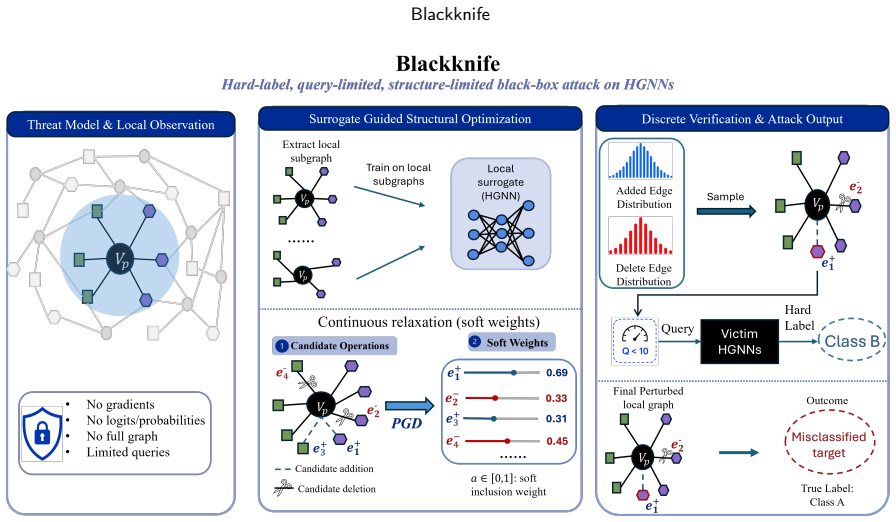
Blackknife first constructs a local relation-aware surrogate model from observable heterogeneous neighborhoods. It then relaxes discrete edge addition and deletion operations into continuous soft weights and optimizes them through projected gradient descent. Finally, the optimized perturbations are discretized into relation-preserving structural rewiring operations and verified using limited hard-label feedback from the victim model, achieving strong attack success rates on ACM, DBLP, and IMDB datasets against representative HGNN models while remaining effective under topology-based defenses.
What carries the argument
Local relation-aware surrogate model built from one-hop heterogeneous neighborhoods, used to optimize and transfer structural perturbations under hard-label constraints.
If this is right
- Blackknife achieves strong attack success rates on representative HGNN models across ACM, DBLP, and IMDB datasets.
- The attacks remain effective when topology-based defense strategies are applied.
- The method operates without any access to gradients, logits, confidence scores, or the complete graph structure.
- Edge perturbations are generated by optimizing continuous soft weights then discretizing them into relation-preserving rewirings.
Where Pith is reading between the lines
- If one-hop neighborhoods contain enough relational signal, the same local-surrogate approach could extend to attacks on other graph neural network variants.
- Service providers might need to add query-rate limits or inject noise into neighborhood views to reduce transfer from such surrogates.
- The continuous-to-discrete step indicates that gradient-based optimization on relaxed graph edits can produce transferable discrete changes even when only binary labels are available.
- This line of work could encourage new robustness tests that explicitly restrict attackers to local structure and hard labels rather than full white-box access.
Load-bearing premise
A surrogate model built only from locally observable one-hop heterogeneous neighborhoods can produce perturbations that transfer effectively to the unknown victim HGNN under hard-label feedback.
What would settle it
If the discretized rewirings produced by the surrogate cause no measurable drop in the victim HGNN's accuracy on targeted nodes despite successful optimization and query verification, the transfer claim would fail.
Figures
read the original abstract
Heterogeneous graph neural networks (HGNNs) have achieved strong performance in modeling complex graph-structured data with multiple node and relation types. However, their robustness under realistic black-box adversarial settings remains insufficiently explored. Existing attacks on HGNNs usually assume access to model gradients, soft prediction scores, or the complete graph structure, which is often unavailable when HGNN-based services are deployed as closed systems. In this paper, we propose Blackknife, a hard-label, query-limited, and structure-limited black-box evasion attack framework for heterogeneous graph neural networks. Blackknife assumes no access to the victim model architecture, parameters, gradients, logits, confidence scores, or the full graph structure. Instead, it only relies on locally observable one-hop heterogeneous structures and a small number of hard-label queries. To generate effective perturbations under these strict constraints, Blackknife first constructs a local relation-aware surrogate model from observable heterogeneous neighborhoods. It then relaxes discrete edge addition and deletion operations into continuous soft weights and optimizes them through projected gradient descent. Finally, the optimized perturbations are discretized into relation-preserving structural rewiring operations and verified using limited hard-label feedback from the victim model. Extensive experiments on three benchmark heterogeneous graph datasets, including ACM, DBLP, and IMDB, demonstrate that Blackknife consistently achieves strong attack success rates against representative HGNN models. The results further show that Blackknife remains effective under topology-based defense strategies, revealing the vulnerability of HGNNs to local structure-limited black-box attacks.
Editorial analysis
A structured set of objections, weighed in public.
Referee Report
Summary. The manuscript proposes Blackknife, a hard-label query-limited structure-limited black-box evasion attack on heterogeneous graph neural networks. It constructs a local relation-aware surrogate from observable one-hop heterogeneous neighborhoods, relaxes discrete edge addition/deletion to continuous soft weights, optimizes via projected gradient descent, discretizes the result into relation-preserving rewirings, and verifies with a small number of hard-label queries to the victim. Experiments on ACM, DBLP, and IMDB are reported to show strong attack success rates against representative HGNN models and continued effectiveness under topology-based defenses.
Significance. If the transferability result holds under the stated constraints, the work would establish that HGNNs remain vulnerable even when only local one-hop structure and binary label feedback are available, which is relevant to the security of deployed closed HGNN services. The method is presented as a direct empirical construction without fitted parameters or reductions to prior quantities.
major comments (2)
- [Method (surrogate and optimization)] The central claim rests on successful transfer of perturbations from a strictly one-hop local surrogate to the unknown victim HGNN under hard-label feedback only. HGNN message passing aggregates over multiple hops and relation types, yet no analysis, ablation, or bound is provided on the distribution shift or decision-boundary mismatch that this locality assumption introduces.
- [Experiments] The abstract states that Blackknife 'consistently achieves strong attack success rates' on three datasets, but the provided text supplies no numerical ASR values, query budgets, baseline comparisons, or ablation results. Without these quantitative details the experimental support for the central claim cannot be assessed.
minor comments (2)
- [Method] Notation for the soft-weight relaxation and the discretization step should be defined with explicit equations rather than prose description.
- [Experiments] The manuscript should clarify the precise query budget used in the hard-label verification phase and whether it is fixed across all experiments.
Simulated Author's Rebuttal
We thank the referee for the constructive feedback. We address the two major comments point by point below, indicating planned revisions where the manuscript requires strengthening.
read point-by-point responses
-
Referee: [Method (surrogate and optimization)] The central claim rests on successful transfer of perturbations from a strictly one-hop local surrogate to the unknown victim HGNN under hard-label feedback only. HGNN message passing aggregates over multiple hops and relation types, yet no analysis, ablation, or bound is provided on the distribution shift or decision-boundary mismatch that this locality assumption introduces.
Authors: We agree that the manuscript provides no theoretical analysis, bounds, or dedicated ablation on the distribution shift and decision-boundary mismatch arising from the strict one-hop locality assumption. The framework is presented as an empirical construction. In revision we will add an ablation examining performance when the surrogate is restricted to one-hop versus expanded neighborhoods (where observable) and include a limitations paragraph discussing the locality assumption. revision: yes
-
Referee: [Experiments] The abstract states that Blackknife 'consistently achieves strong attack success rates' on three datasets, but the provided text supplies no numerical ASR values, query budgets, baseline comparisons, or ablation results. Without these quantitative details the experimental support for the central claim cannot be assessed.
Authors: The referee correctly observes that the abstract and excerpt contain no specific numerical ASR values, query budgets, baseline comparisons, or ablation results. We will revise the manuscript to include a concise summary of key quantitative results (ASR, query counts, baselines) in the abstract or introduction and ensure all ablation tables are clearly presented. revision: yes
Circularity Check
No significant circularity; empirical construction with no derivation chain
full rationale
The paper describes Blackknife as a practical attack pipeline (local surrogate from one-hop neighborhoods, continuous relaxation of edge ops, PGD, discretization, hard-label verification) evaluated empirically on ACM/DBLP/IMDB. No equations, fitted parameters presented as predictions, self-citations used as load-bearing uniqueness theorems, or reductions of outputs to inputs by construction appear in the text. The central claims rest on experimental attack success rates rather than any self-referential mathematical derivation.
Axiom & Free-Parameter Ledger
Reference graph
Works this paper leans on
-
[1]
Gnn model based on node classification forecasting in social network, in: 2023 International Conference on Artificial Intelligence and Smart Communication (AISC), IEEE
Awasthi, A., Garov, A.K., Sharma, M., Sinha, M., 2023. Gnn model based on node classification forecasting in social network, in: 2023 International Conference on Artificial Intelligence and Smart Communication (AISC), IEEE. pp. 1039–1043
2023
-
[2]
Node classifica- tion in social networks
Bhagat, S., Cormode, G., Muthukrishnan, S., 2011. Node classifica- tion in social networks. Social network data analytics , 115–148
2011
-
[3]
Biognn: how graph neural networks can solve biological problems, in: Artifi- cialIntelligenceandMachineLearningforHealthcare:Vol.1:Image and Data Analytics
Bongini, P., Pancino, N., Scarselli, F., Bianchini, M., 2022. Biognn: how graph neural networks can solve biological problems, in: Artifi- cialIntelligenceandMachineLearningforHealthcare:Vol.1:Image and Data Analytics. Springer, pp. 211–231
2022
-
[4]
Dai, H., Li, H., Tian, T., Huang, X., Wang, L., Zhu, J., Song, L.,
-
[5]
Adversarial attack on graph structured data, in: International conference on machine learning, PMLR. pp. 1115–1124
-
[6]
Graphneuralnetworksforsocialrecommendation,in:Theworldwide web conference, pp
Fan, W., Ma, Y., Li, Q., He, Y., Zhao, E., Tang, J., Yin, D., 2019. Graphneuralnetworksforsocialrecommendation,in:Theworldwide web conference, pp. 417–426
2019
-
[7]
Magnn: Metapath aggregatedgraphneuralnetworkforheterogeneousgraphembedding, in: Proceedings of the web conference 2020, pp
Fu, X., Zhang, J., Meng, Z., King, I., 2020. Magnn: Metapath aggregatedgraphneuralnetworkforheterogeneousgraphembedding, in: Proceedings of the web conference 2020, pp. 2331–2341
2020
-
[8]
Geng, H., Wang, D., Zhuang, F., Ming, X., Du, C., Jiang, T., Guo, H., Liu, R., 2022. Modeling dynamic heterogeneous graph and node importance for future citation prediction, in: Proceedings of the 31st ACM International Conference on Information & Knowledge Management, pp. 572–581
2022
-
[9]
Efficientheterogeneousgraphlearning via random projection
Hu,J.,Hooi,B.,He,B.,2024. Efficientheterogeneousgraphlearning via random projection. IEEE Transactions on Knowledge and Data Engineering
2024
-
[10]
Heterogeneous graph transformer, in: Proceedings of the web conference 2020, pp
Hu, Z., Dong, Y., Wang, K., Sun, Y., 2020. Heterogeneous graph transformer, in: Proceedings of the web conference 2020, pp. 2704– 2710
2020
-
[11]
Learning deep neural networks for node classification
Li, B., Pi, D., 2019. Learning deep neural networks for node classification. Expert Systems with Applications 137, 324–334
2019
-
[12]
Graphsignalprocessing,graphneural network and graph learning on biological data: a systematic review
Li, R., Yuan, X., Radfar, M., Marendy, P., Ni, W., O’Brien, T.J., Casillas-Espinosa,P.M.,2021. Graphsignalprocessing,graphneural network and graph learning on biological data: a systematic review. IEEE Reviews in Biomedical Engineering 16, 109–135
2021
-
[13]
Ghattack: Generative adversarial attacks on heterogeneous graph neural networks
Li, S., Liao, X., Zhu, H., Le, J., Chu, L., 2026. Ghattack: Generative adversarial attacks on heterogeneous graph neural networks. IEEE Transactions on Neural Networks and Learning Systems
2026
-
[14]
Indigo:Gnn-based inductive knowledge graph completion using pair-wise encoding
Liu,S.,Grau,B.,Horrocks,I.,Kostylev,E.,2021. Indigo:Gnn-based inductive knowledge graph completion using pair-wise encoding. Advances in Neural Information Processing Systems 34, 2034–2045
2021
-
[15]
Lv,Q.,Ding,M.,Liu,Q.,Chen,Y.,Feng,W.,He,S.,Zhou,C.,Jiang, J., Dong, Y., Tang, J., 2021. Are we really making much progress? revisiting, benchmarking and refining heterogeneous graph neural networks, in: Proceedings of the 27th ACM SIGKDD conference on knowledge discovery & data mining, pp. 1150–1160. Honglin Gao et al.:Preprint submitted to ElsevierPage 8...
2021
-
[16]
Towards Deep Learning Models Resistant to Adversarial Attacks
Madry, A., Makelov, A., Schmidt, L., Tsipras, D., Vladu, A., 2017. Towards deep learning models resistant to adversarial attacks. arXiv preprint arXiv:1706.06083
work page internal anchor Pith review Pith/arXiv arXiv 2017
-
[17]
Biological network analysis with deep learning
Muzio, G., O’Bray, L., Borgwardt, K., 2021a. Biological network analysis with deep learning. Briefings in bioinformatics 22, 1515– 1530
-
[18]
Biological network analysis with deep learning
Muzio, G., O’Bray, L., Borgwardt, K., 2021b. Biological network analysis with deep learning. Briefings in bioinformatics 22, 1515– 1530
-
[19]
A survey of graph neural networks for social recommender systems
Sharma, K., Lee, Y.C., Nambi, S., Salian, A., Shah, S., Kim, S.W., Kumar, S., 2024. A survey of graph neural networks for social recommender systems. ACM Computing Surveys 56, 1–34
2024
-
[20]
Finhgnn: A conditional heterogeneousgraphlearningtoaddressrelationalattributesforstock predictions
Tan, J., Li, Q., Wang, J., Chen, J., 2022. Finhgnn: A conditional heterogeneousgraphlearningtoaddressrelationalattributesforstock predictions. Information Sciences 618, 317–335
2022
-
[21]
Enablinghomogeneous gnns to handle heterogeneous graphs via relation embedding
Wang,J.,Guo,Y.,Yang,L.,Wang,Y.,2023. Enablinghomogeneous gnns to handle heterogeneous graphs via relation embedding. IEEE Transactions on Big Data 9, 1697–1710
2023
-
[22]
ggatlda: lncrna-disease association prediction based on graph-level graph attention network
Wang, L., Zhong, C., 2022. ggatlda: lncrna-disease association prediction based on graph-level graph attention network. BMC bioinformatics 23, 1–24
2022
-
[23]
2022–2032
Wang,X.,Hou,Y.,Chen,Y.,Yang,S.,Zhang,Y.,Wang,Z.,Xiao,J., Yu,W.,Lin,Y.,Xiao,W.,etal.,2019a.Heterogeneousgraphattention network, in: The world wide web conference, pp. 2022–2032
2022
-
[24]
Heterogeneous graph attention network, in: The world wide web conference, pp
Wang, X., Ji, H., Shi, C., Wang, B., Ye, Y., Cui, P., Yu, P.S., 2019b. Heterogeneous graph attention network, in: The world wide web conference, pp. 2022–2032
2022
-
[25]
Wang, Y., Liu, Z., Fan, Z., Sun, L., Yu, P.S., 2021. Dskreg: Differentiable sampling on knowledge graph for recommendation with relational gnn, in: Proceedings of the 30th ACM International Conference on Information & Knowledge Management, pp. 3513– 3517
2021
-
[26]
3584–3593
Xiang,S.,Cheng,D.,Shang,C.,Zhang,Y.,Liang,Y.,2022.Temporal and heterogeneous graph neural network for financial time series prediction,in:Proceedingsofthe31stACMinternationalconference on information & knowledge management, pp. 3584–3593
2022
-
[27]
Hgnn:Hierarchicalgraphneuralnetworkfor predictingtheclassificationofprice-limit-hittingstocks
Xu, C., Huang, H., Ying, X., Gao, J., Li, Z., Zhang, P., Xiao, J., Zhang,J.,Luo,J.,2022. Hgnn:Hierarchicalgraphneuralnetworkfor predictingtheclassificationofprice-limit-hittingstocks. Information Sciences 607, 783–798
2022
-
[28]
Revisiting citation prediction with cluster- aware text-enhanced heterogeneous graph neural networks, in: 2023 IEEE 39th International Conference on Data Engineering (ICDE), IEEE
Yang, C., Han, J., 2023. Revisiting citation prediction with cluster- aware text-enhanced heterogeneous graph neural networks, in: 2023 IEEE 39th International Conference on Data Engineering (ICDE), IEEE. pp. 682–695
2023
-
[29]
Simpleandefficient heterogeneous graph neural network, in: Proceedings of the AAAI conference on artificial intelligence, pp
Yang,X.,Yan,M.,Pan,S.,Ye,X.,Fan,D.,2023. Simpleandefficient heterogeneous graph neural network, in: Proceedings of the AAAI conference on artificial intelligence, pp. 10816–10824
2023
-
[30]
Acompre- hensivesurveyofgraphneuralnetworksforknowledgegraphs
Ye,Z.,Kumar,Y.J.,Sing,G.O.,Song,F.,Wang,J.,2022. Acompre- hensivesurveyofgraphneuralnetworksforknowledgegraphs. IEEE Access 10, 75729–75741
2022
-
[31]
Decoupling the depth and scope of graph neural networks, in: Beygelzimer, A., Dauphin, Y., Liang, P., Vaughan, J.W
Zeng, H., Zhang, M., Xia, Y., Srivastava, A., Malevich, A., Kannan, R., Prasanna, V., Jin, L., Chen, R., 2021. Decoupling the depth and scope of graph neural networks, in: Beygelzimer, A., Dauphin, Y., Liang, P., Vaughan, J.W. (Eds.), Advances in Neural Information Processing Systems, pp. 21248–21258. URL:https://openreview. net/forum?id=d0MtHWY0NZ
2021
-
[32]
Measuring academic in- fluenceusingheterogeneousauthor-citationnetworks
Zhao, F., Zhang, Y., Lu, J., Shai, O., 2019. Measuring academic in- fluenceusingheterogeneousauthor-citationnetworks. Scientometrics 118, 1119–1140
2019
-
[33]
Hgattack: Transferable heterogeneous graph adversarial attack, in: 2024 IEEE International Conference on Agents (ICA), IEEE
Zhao, H., Zeng, Z., Wang, Y., Ye, D., Miao, C., 2024. Hgattack: Transferable heterogeneous graph adversarial attack, in: 2024 IEEE International Conference on Agents (ICA), IEEE. pp. 100–105
2024
-
[34]
Relation structure-aware heterogeneous graph neural network, in: 2019 IEEE international conference on data mining (ICDM), IEEE
Zhu, S., Zhou, C., Pan, S., Zhu, X., Wang, B., 2019. Relation structure-aware heterogeneous graph neural network, in: 2019 IEEE international conference on data mining (ICDM), IEEE. pp. 1534– 1539
2019
-
[35]
Zhu,Z.,Fan,X.,Chu,X.,Bi,J.,2020. Hgcn:Aheterogeneousgraph convolutional network-based deep learning model toward collective classification, in: Proceedings of the 26th ACM SIGKDD interna- tional conference on knowledge discovery & data mining, pp. 1161– 1171
2020
-
[36]
Adversarial attacksonneuralnetworksforgraphdata,in:Proceedingsofthe24th ACM SIGKDD international conference on knowledge discovery & data mining, pp
Zügner, D., Akbarnejad, A., Günnemann, S., 2018. Adversarial attacksonneuralnetworksforgraphdata,in:Proceedingsofthe24th ACM SIGKDD international conference on knowledge discovery & data mining, pp. 2847–2856
2018
-
[37]
Adversarial attacks on neural networks for graph data, in: Proceedings of the 24th ACM SIGKDD international conference on knowledge discovery & data mining, pp
Zügner, D., Günnemann, S., 2018. Adversarial attacks on neural networks for graph data, in: Proceedings of the 24th ACM SIGKDD international conference on knowledge discovery & data mining, pp. 2847–2856. Honglin Gao et al.:Preprint submitted to ElsevierPage 9 of 9
2018
discussion (0)
Sign in with ORCID, Apple, or X to comment. Anyone can read and Pith papers without signing in.