Robust Quantum Algorithmic Binary Decision-Making on Gaussian Signals
Pith reviewed 2026-05-21 14:47 UTC · model grok-4.3
The pith
A quantum protocol recasts binary decisions on Gaussian signals as polynomial approximations to reach error rates of order one over depth times log depth.
A machine-rendered reading of the paper's core claim, the machinery that carries it, and where it could break.
Core claim
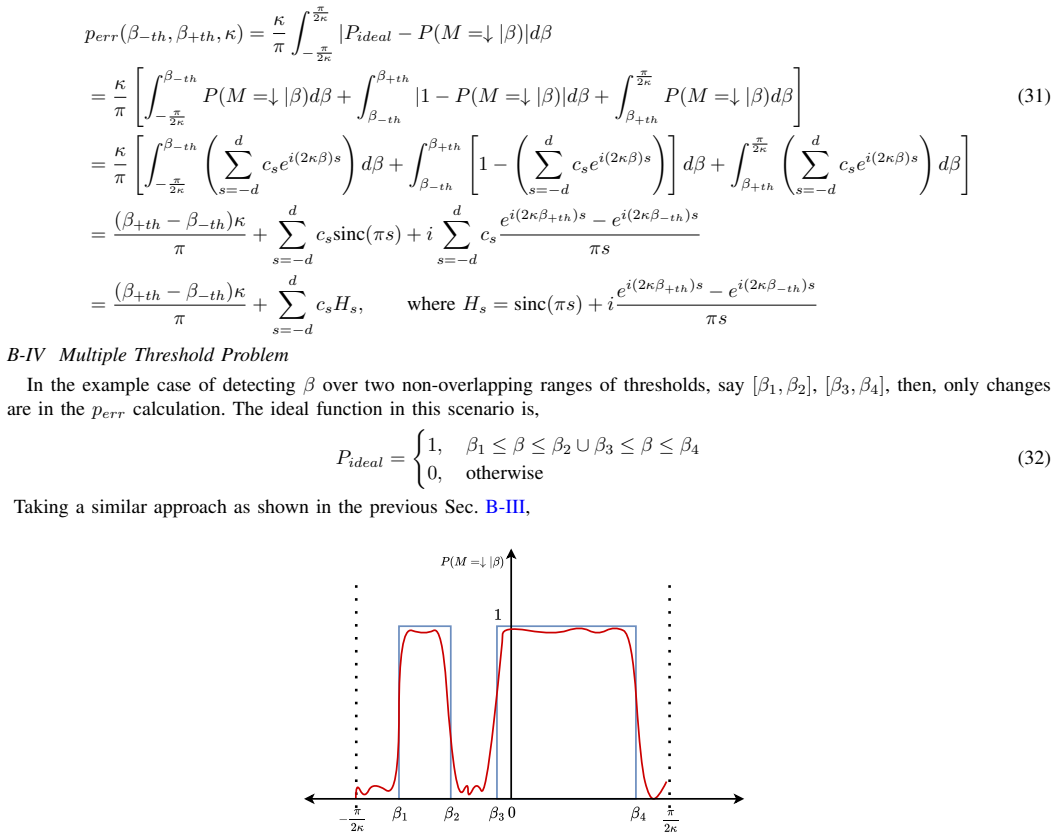
The generalized quantum signal processing interferometry protocol solves active binary hypothesis testing for Gaussian operators by recasting the threshold test as a polynomial approximation problem. For a real parameter beta embedded in a displacement or squeezing operator, the protocol determines membership in an interval bounded by asymmetric thresholds with error probability scaling as O(1/d log d) where d denotes circuit depth. The same performance is obtained for both deterministic beta and beta drawn randomly from a known prior distribution. The protocol remains robust under oscillator dephasing noise and extends directly to multi-threshold decision problems, allowing the task to be完成
What carries the argument
generalized quantum signal processing interferometry (GQSPI), the circuit that implements the polynomial approximation of the decision function directly on the quantum Gaussian operator.
If this is right
- Decision error probability reaches order O(1/d log d) for any fixed threshold pair.
- The same scaling holds when the embedded parameter is drawn from a known probability distribution.
- Performance is preserved under oscillator dephasing noise.
- The construction applies unchanged to problems with any number of thresholds.
- The entire decision requires only one or a few measurement shots.
Where Pith is reading between the lines
- The same recasting step may reduce measurement overhead in other continuous-variable sensing or estimation tasks.
- Combining the protocol with existing quantum error-correction codes could further improve noise tolerance without altering the core scaling.
- The polynomial-approximation viewpoint might generalize to decision problems on non-Gaussian quantum signals if suitable approximations can be found.
Load-bearing premise
The binary hypothesis testing task for parameters in Gaussian quantum operators can be recast exactly as a polynomial approximation problem that the interferometry protocol then executes.
What would settle it
An explicit circuit simulation or experiment in which the observed decision error fails to decrease proportionally to one over depth times log depth as circuit depth grows, or in which the protocol loses robustness once realistic dephasing noise is added.
Figures
read the original abstract
A relevant signal in the quantum domain may manifest as a displacement or a squeezing operator in the bosonic phase space. For a real parameter $\beta$ embedded in such a Gaussian operator, the task of determining if $\beta \in [\beta_{-th}, \beta_{+th}]$ for real asymmetric thresholds $(\beta_{-th} \ne -\beta_{+th})$ is a binary decision problem. We propose a framework, the \emph{generalized quantum signal processing interferometry} (GQSPI), to solve this parameter detection problem by recasting the practical task of active binary hypothesis testing on quantum systems to a polynomial approximation problem. We achieve a small decision error probability $p_{\text{err}}$ on the order of $\mathcal{O}(\frac{1}{d}\log{(d)})$, with $d$ as the circuit depth. We analyze the protocol when (i) $\beta$ is a deterministic parameter, and (ii) when $\beta$ is drawn randomly from a known prior distribution. The GQSPI protocol is also shown to be robust under oscillator dephasing noise. We further extend our protocol from two thresholds to more general multi-threshold cases. Overall, the proposed framework enables decision-making over arbitrary thresholds for any general Gaussian signal in a single or a few shots.
Editorial analysis
A structured set of objections, weighed in public.
Referee Report
Summary. The manuscript introduces generalized quantum signal processing interferometry (GQSPI) to solve binary decision problems for a real parameter β embedded in Gaussian operators (displacements or squeezing) with asymmetric thresholds β_{-th} ≠ -β_{+th}. The task is recast as a polynomial approximation problem implemented via GQSPI, yielding a decision error probability p_err scaling as O(1/d log d) with circuit depth d. The protocol is analyzed for deterministic β and for β drawn from a known prior, shown to be robust to oscillator dephasing, and extended to multi-threshold settings for single- or few-shot decisions.
Significance. If the claimed scaling and dephasing robustness are rigorously established, the framework would supply an efficient quantum protocol for active hypothesis testing on bosonic systems, potentially enabling practical few-shot decision-making in quantum sensing and metrology with continuous-variable encodings.
major comments (3)
- [§3, Theorem 4.1] §3 and Theorem 4.1: The central O(1/d log d) error scaling is asserted to follow from the polynomial approximation degree being linear in circuit depth d, yet the explicit polynomial family for asymmetric thresholds and the approximation theorem establishing the precise 1/d log d rate are not derived in sufficient detail; without these steps the scaling claim cannot be verified and is load-bearing for the main result.
- [§4.2] §4.2, GQSPI construction: The recasting of binary hypothesis testing to a polynomial approximation problem is presented as exact, but the mapping from the decision function (with asymmetric thresholds) to the specific polynomial implemented by the interferometry circuit is not shown explicitly, leaving open whether additional assumptions on the signal or thresholds are required.
- [§5] §5, noise analysis: Robustness to oscillator dephasing is claimed for the GQSPI protocol, but the derivation does not compare the error under the dephasing channel to the noiseless case or to standard QSP, nor does it quantify the noise strength regime in which the O(1/d log d) scaling is preserved.
minor comments (3)
- [Abstract] The abstract and introduction use “a few shots” without defining the precise shot count or relating it to the circuit depth d.
- [Introduction] Notation for the thresholds (β_{-th}, β_{+th}) and the prior distribution should be introduced with explicit definitions before the main claims.
- [Figures] Figure captions lack labels for the plotted error curves and noise parameters, reducing clarity.
Simulated Author's Rebuttal
We thank the referee for their careful reading and constructive comments on our manuscript. We address each major comment below and have revised the manuscript to provide the requested details and clarifications.
read point-by-point responses
-
Referee: [§3, Theorem 4.1] §3 and Theorem 4.1: The central O(1/d log d) error scaling is asserted to follow from the polynomial approximation degree being linear in circuit depth d, yet the explicit polynomial family for asymmetric thresholds and the approximation theorem establishing the precise 1/d log d rate are not derived in sufficient detail; without these steps the scaling claim cannot be verified and is load-bearing for the main result.
Authors: We agree that the explicit polynomial family and the full derivation of the approximation rate require additional detail to make the scaling claim fully verifiable. In the revised manuscript, Section 3 now includes the explicit construction of the polynomial family adapted to asymmetric thresholds β_{-th} ≠ -β_{+th}. Theorem 4.1 has been expanded with a complete proof showing that the circuit depth d corresponds to a polynomial degree yielding the O(1/d log d) rate via standard minimax approximation bounds. The full derivation appears in the new Appendix A. revision: yes
-
Referee: [§4.2] §4.2, GQSPI construction: The recasting of binary hypothesis testing to a polynomial approximation problem is presented as exact, but the mapping from the decision function (with asymmetric thresholds) to the specific polynomial implemented by the interferometry circuit is not shown explicitly, leaving open whether additional assumptions on the signal or thresholds are required.
Authors: We acknowledge that the explicit mapping step was insufficiently detailed. The recasting is exact for known fixed thresholds and Gaussian signals. The revised Section 4.2 now contains a step-by-step derivation showing how the asymmetric decision function is realized by the sequence of generalized signal-processing operations in the interferometry circuit. This holds under the assumptions already stated in the manuscript, with no further restrictions required. revision: yes
-
Referee: [§5] §5, noise analysis: Robustness to oscillator dephasing is claimed for the GQSPI protocol, but the derivation does not compare the error under the dephasing channel to the noiseless case or to standard QSP, nor does it quantify the noise strength regime in which the O(1/d log d) scaling is preserved.
Authors: The referee correctly notes that direct comparisons and a quantified regime were missing. The revised Section 5 now includes an analytical comparison of the decision error under the dephasing channel to both the noiseless case and standard QSP. We derive that the O(1/d log d) scaling is preserved for dephasing strengths satisfying γ = o(1/d) and support this with explicit bounds and numerical results in a new figure. revision: yes
Circularity Check
No circularity in derivation chain; claims rest on independent approximation and interferometry constructions
full rationale
The paper recasts active binary hypothesis testing for Gaussian signals into a polynomial approximation problem that is then solved using the GQSPI framework. The O(1/d log d) error scaling is stated as resulting from the circuit depth d in this construction, and robustness to dephasing is analyzed as a separate property. No equations or steps reduce by construction to fitted parameters, self-definitions, or load-bearing self-citations; the derivation remains self-contained against external polynomial approximation bounds and quantum signal processing techniques without the target result being presupposed in the inputs.
Axiom & Free-Parameter Ledger
free parameters (1)
- circuit depth d
axioms (1)
- domain assumption A relevant signal manifests as a displacement or squeezing operator in the bosonic phase space.
Reference graph
Works this paper leans on
-
[1]
Wald.Statistical Decision Functions
A. Wald.Statistical Decision Functions. Wiley publications in statistics. Wiley, 1950
work page 1950
-
[2]
Van Trees.Detection, Estimation, and Modulation Theory
H.L. Van Trees.Detection, Estimation, and Modulation Theory. Wiley, 1971
work page 1971
-
[3]
Vincent Poor.An introduction to signal detection and estimation
H. Vincent Poor.An introduction to signal detection and estimation. Springer, 1994
work page 1994
-
[4]
Jerzy Neyman and Egon Sharpe Pearson. IX. On the problem of the most efficient tests of statistical hypotheses.Philosophical Transactions of the Royal Society of London, Series A: Containing Papers of a Mathematical or Physical Character, 231(694-706):289–337, 02 1933
work page 1933
-
[5]
Abraham Wald. Contributions to the theory of statistical estimation and testing hypotheses.The Annals of Mathematical Statistics, 10(4):299– 326, 1939
work page 1939
-
[6]
W. Peterson, T. Birdsall, and W. Fox. The theory of signal detectability. Transactions of the IRE Professional Group on Information Theory, 4(4):171–212, 1954
work page 1954
-
[7]
Detection and extraction of signals in noise from the point of view of statistical decision theory
David Middleton and David Van Meter. Detection and extraction of signals in noise from the point of view of statistical decision theory. I. Journal of the Society for Industrial and Applied Mathematics, 3(4):192– 253, 1955
work page 1955
-
[8]
Detection and extraction of signals in noise from the point of view of statistical decision theory
David Middleton and David Van Meter. Detection and extraction of signals in noise from the point of view of statistical decision theory. II. Journal of the Society for Industrial and Applied Mathematics, 4(2):86– 119, 1956
work page 1956
- [9]
- [10]
-
[11]
Statistical decision theory for quantum systems.Journal of Multivariate Analysis, 3(4):337–394, 1973
A.S Holevo. Statistical decision theory for quantum systems.Journal of Multivariate Analysis, 3(4):337–394, 1973
work page 1973
-
[12]
A. S. Holevo. On asymptotically optimal hypothesis testing in quantum statistics.Theory of Probability & Its Applications, 23(2):411–415, 1979
work page 1979
-
[13]
C. L. Degen, F. Reinhard, and P. Cappellaro. Quantum sensing.Rev. Mod. Phys., 89:035002, Jul 2017
work page 2017
-
[14]
Vittorio Giovannetti, Seth Lloyd, and Lorenzo Maccone. Quantum metrology.Phys. Rev. Lett., 96:010401, Jan 2006
work page 2006
-
[15]
Steven D. Bass and Michael Doser. Quantum sensing for particle physics. Nature Reviews Physics, 6(5):329–339, 05 2024
work page 2024
-
[16]
Quantum enhancement in dark matter detection with quantum computation.Phys
Shion Chen, Hajime Fukuda, Toshiaki Inada, Takeo Moroi, Tatsumi Nitta, and Thanaporn Sichanugrist. Quantum enhancement in dark matter detection with quantum computation.Phys. Rev. Lett., 133:021801, Jul 2024
work page 2024
-
[17]
Beyond qubits: Multilevel quantum sensing for dark matter, 2025
Xiaolin Ma, V olodymyr Takhistov, Norikazu Mizuochi, and Ernst David Herbschleb. Beyond qubits: Multilevel quantum sensing for dark matter, 2025
work page 2025
-
[18]
Direc- tional searching for light dark matter with quantum sensors.Phys
Hajime Fukuda, Yuichiro Matsuzaki, and Thanaporn Sichanugrist. Direc- tional searching for light dark matter with quantum sensors.Phys. Rev. Lett., 135:241802, Dec 2025
work page 2025
-
[19]
Adriel I. Santoso and Le Bin Ho. Optimized quantum sensor networks for ultralight dark matter detection.Phys. Rev. D, 112:L081301, Oct 2025
work page 2025
-
[20]
M. Tse, Haocun Yu, N. Kijbunchoo, A. Fernandez-Galiana, P. Dupej, L. Barsotti, C. D. Blair, D. D. Brown, S. E. Dwyer, A. Effler, et al. Quantum-enhanced advanced LIGO detectors in the era of gravitational- wave astronomy.Phys. Rev. Lett., 123:231107, Dec 2019
work page 2019
-
[21]
Tobias Bothwell, Colin J Kennedy, Alexander Aeppli, Dhruv Kedar, John M Robinson, Eric Oelker, Alexander Staron, and Jun Ye. Resolving the gravitational redshift across a millimetre-scale atomic sample.Nature, 602(7897):420–424, 2022
work page 2022
-
[22]
Observation of gravitational waves from a binary black hole merger.Phys
LIGO Scientific Collaboration and Virgo Collaboration. Observation of gravitational waves from a binary black hole merger.Phys. Rev. Lett., 116:061102, Feb 2016
work page 2016
-
[23]
von Neumann.Mathematical Foundations of Quantum Mechanics
J. von Neumann.Mathematical Foundations of Quantum Mechanics. Goldstine Printed Materials. Princeton University Press, 1955
work page 1955
-
[24]
Cambridge University Press, USA, 1st edition, 2018
John Watrous.The Theory of Quantum Information. Cambridge University Press, USA, 1st edition, 2018
work page 2018
-
[25]
Wilde.Quantum Information Theory
M. Wilde.Quantum Information Theory. Quantum Information Theory. Cambridge University Press, 2013
work page 2013
-
[26]
M.A. Nielsen and I.L. Chuang.Quantum Computation and Quantum Information. Cambridge Series on Information and the Natural Sciences. Cambridge University Press, 2000
work page 2000
- [27]
- [28]
-
[29]
Benjamin Schumacher. Quantum coding.Phys. Rev. A, 51:2738–2747, Apr 1995
work page 1995
-
[30]
Enhanced sensitivity of photodetection via quantum illumi- nation.Science, 321(5895):1463–1465, 2008
Seth Lloyd. Enhanced sensitivity of photodetection via quantum illumi- nation.Science, 321(5895):1463–1465, 2008
work page 2008
-
[31]
Si-Hui Tan, Baris I. Erkmen, Vittorio Giovannetti, Saikat Guha, Seth Lloyd, Lorenzo Maccone, Stefano Pirandola, and Jeffrey H. Shapiro. Quantum illumination with gaussian states.Phys. Rev. Lett., 101:253601, Dec 2008
work page 2008
-
[32]
Detection of quantum signals free of classical noise via quantum correlation.Phys
Yang Shen, Ping Wang, Chun Tung Cheung, Jörg Wrachtrup, Ren-Bao Liu, and Sen Yang. Detection of quantum signals free of classical noise via quantum correlation.Phys. Rev. Lett., 130:070802, Feb 2023
work page 2023
-
[33]
Hashir Kuniyil, Helin Ozel, Hasan Yilmaz, and Kadir Durak. Noise- tolerant object detection and ranging using quantum correlations.Journal of Optics, 24(10):105201, aug 2022
work page 2022
-
[34]
C. J. Myatt, B. E. King, Q. A. Turchette, C. A. Sackett, D. Kielpinski, W. M. Itano, C. Monroe, and D. J. Wineland. Decoherence of quan- tum superpositions through coupling to engineered reservoirs.Nature, 403(6767):269–273, jan 2000
work page 2000
-
[35]
Łukasz Cywi ´nski, Roman M. Lutchyn, Cody P. Nave, and S. Das Sarma. How to enhance dephasing time in superconducting qubits.Phys. Rev. B, 77:174509, May 2008
work page 2008
-
[36]
Generalized quantum signal process- ing.PRX Quantum, 5:020368, Jun 2024
Danial Motlagh and Nathan Wiebe. Generalized quantum signal process- ing.PRX Quantum, 5:020368, Jun 2024
work page 2024
-
[37]
Jasmine Sinanan-Singh, Gabriel L. Mintzer, Isaac L. Chuang, and Yuan Liu. Single-shot Quantum Signal Processing Interferometry.Quantum, 8:1427, July 2024
work page 2024
-
[38]
Methodology of resonant equiangular composite quantum gates.Physical Review X, 6(4):041067, 2016
Guang Hao Low, Theodore J Yoder, and Isaac L Chuang. Methodology of resonant equiangular composite quantum gates.Physical Review X, 6(4):041067, 2016
work page 2016
-
[39]
Hamiltonian simulation by qubitization.Quantum, 3:163, 2019
Guang Hao Low and Isaac L Chuang. Hamiltonian simulation by qubitization.Quantum, 3:163, 2019
work page 2019
-
[40]
Guang Hao Low and Isaac L. Chuang. Optimal hamiltonian simulation by quantum signal processing.Phys. Rev. Lett., 118:010501, Jan 2017
work page 2017
-
[41]
Yuan Liu, Shraddha Singh, Kevin C. Smith, Eleanor Crane, John M. Martyn, Alec Eickbusch, Alexander Schuckert, Richard D. Li, Jasmine Sinanan-Singh, Micheline B. Soley, Takahiro Tsunoda, Isaac L. Chuang, Nathan Wiebe, and Steven M. Girvin. Hybrid oscillator-qubit quantum processors: Instruction set architectures, abstract machine models, and applications.P...
work page 2026
-
[42]
Grand unification of quantum algorithms.PRX Quantum, 2(4):040203, 2021
John M Martyn, Zane M Rossi, Andrew K Tan, and Isaac L Chuang. Grand unification of quantum algorithms.PRX Quantum, 2(4):040203, 2021
work page 2021
-
[43]
Jungsoo Hong, Seong Ho Kim, Seung Kyu Min, and Joonsuk Huh. Oscillator-qubit generalized quantum signal processing for vibronic mod- els: a case study of uracil cation, 2025
work page 2025
-
[44]
Guang Hao Low and Isaac L. Chuang. Hamiltonian simulation by uniform spectral amplification, 2017
work page 2017
-
[45]
Finding angles for quantum signal processing with machine precision, 2020
Rui Chao, Dawei Ding, Andras Gilyen, Cupjin Huang, and Mario Szegedy. Finding angles for quantum signal processing with machine precision, 2020
work page 2020
-
[46]
Jeongwan Haah. Product Decomposition of Periodic Functions in Quan- tum Signal Processing.Quantum, 3:190, October 2019
work page 2019
-
[47]
Generalized quantum signal processing and non-linear fourier transform are equivalent, 2025
Lorenzo Laneve. Generalized quantum signal processing and non-linear fourier transform are equivalent, 2025
work page 2025
-
[48]
Github repository.https://github.com/amajumd4/GQSPI-Codes. APPENDIXA GENERALIZEDQUANTUMSIGNALPROCESSING FORHYBRIDQUBIT-OSCILLATORSYSTEMS A-I Nature of Polynomials Assume^𝜔=𝑒 𝑖𝜅^𝑥for simplicity of calculation. For GQSP of degree 1, the polynomials obtained by simply multiplying one iteration of the qubit rotation gates and the conditional displacement gate...
-
[49]
= [︂ 𝑒𝑖𝜑𝑑+1 cos𝜃 𝑑+1𝑒𝑖𝜅^𝑥 𝑒𝑖𝜑𝑑+1 sin𝜃 𝑑+1𝑒−𝑖𝜅^𝑥 sin𝜃 𝑑+1𝑒𝑖𝜅^𝑥 −cos𝜃 𝑑+1𝑒−𝑖𝜅^𝑥 ]︂ (23) Thus the recursive relationship between the polynomials are: 𝑃𝑑+1(^𝑥) =𝑒𝑖𝜑𝑑+1 cos𝜃 𝑑+1𝑒𝑖𝜅^𝑥𝑃𝑑(^𝑥) +𝑒𝑖𝜑𝑑+1 sin𝜃 𝑑+1𝑒−𝑖𝜅^𝑥𝑄𝑑(^𝑥)(24) 𝑄𝑑+1(^𝑥) = sin𝜃𝑑+1𝑒𝑖𝜅^𝑥𝑃𝑑(^𝑥)−cos𝜃 𝑑+1𝑒−𝑖𝜅^𝑥𝑄𝑑(^𝑥)(25) Combining the Eq. (24), (25) and Eq. (21), (22), and calculating the polynomial𝑃for d...
-
[50]
+ sin𝜃1 sin𝜃 0𝒟(−𝛼′ 1) )︀ 𝑄1(⃗ 𝛾) =𝑒𝑖𝜆0 (︀ 𝑒𝑖𝜑0 sin𝜃 1 cos𝜃 0𝒟(𝛼′ 1)−cos𝜃 1 sin𝜃 0𝒟(−𝛼′ 1) )︀ Similarly, polynomial obtained for degree 2 are: 𝑃2(⃗ 𝛾) =𝑝2𝑝2𝒟(𝛼′ 2 +𝛼 ′ 1)𝑒−𝑖 𝜅2 2 sin(Γ2−Γ1) +𝑝 −2𝒟(−(𝛼′ 2 +𝛼 ′ 1))𝑒−𝑖 𝜅2 2 sin(Γ2−Γ1) +𝑝 1𝒟(𝛼′ 2 −𝛼 ′ 1)𝑒𝑖 𝜅2 2 sin(Γ2−Γ1) +𝑝 −1𝒟(−(𝛼′ 2 −𝛼 ′ 1))𝑒𝑖 𝜅2 2 sin(Γ2−Γ1) and 𝑄2(⃗ 𝛾) = sin𝜃2𝒟(𝛼′ 2)𝑃1(𝛼1)−cos𝜃 2𝒟(−𝛼′ 2)...
discussion (0)
Sign in with ORCID, Apple, or X to comment. Anyone can read and Pith papers without signing in.