REVIEW 5 major objections 6 minor 44 references
Scene Modeling of Autonomous Vehicles Avoiding Stationary and Moving Vehicles on Narrow Roads
T0 review · 5 major / 6 minor · reviewed 2026-08-11 · deepseek-v4-flash
Pith's one-line read A narrow-road scene model lets an autonomous vehicle identify meeting gaps and choose cut-in, meet, or back-up maneuvers, with high pass rates in simulation and small-scale tests.
desk verdict A transparent geometric model for narrow-road meetings, but the robustness claim rests on an unverified assumption about oncoming-vehicle behavior; worth a serious referee with stiffer tests. read the letter →
The pith
A machine-rendered reading of the paper's core claim, the machinery that carries it, and where it could break.
The reading
What carries the argument
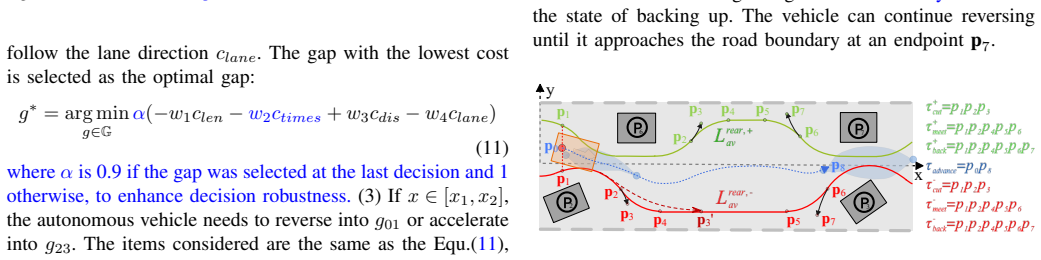
The load-bearing object is the pair of expanded boundaries $L_{av}^{model}$ and $L_{mv}^{model}$, rear-center paths inflated by the vehicle's width and length, constructed by connecting circular detours of radius equal to the minimum turning radius around the corner points of stationary vehicles. Where the two inflated boundaries overlap along the road axis, the paper defines a non-meeting area; every remaining interval is a candidate meeting gap, with cutting-in and backing-up maneuvers generating additional gaps. A homology-class test, taken from the cited criterion, labels each candidate trajectory by the quadrant of its endpoint and requires the optimization to stay within that class, so the seven strategies (advance, meet, cut, and back up on each side) keep their intended meaning while being smoothed and time-optimized. The gap-selection cost in Eq. (11) and the hierarchical trajectory evaluation carry the decision-making.
What would settle it
Drive an oncoming vehicle at a fixed lateral offset from the assumed boundary-hugging path, in simulation and on the small-scale platform, through a scenario where the model predicts a meeting gap, and record whether the vehicles collide or the gap shrinks below the vehicle widths. If the pass rate falls sharply with offset, the gap-identification claim is conditional on that assumption.
Extended reading notes
Core claim
The central discovery is that the entire meeting problem on a narrow road can be expressed as a one-dimensional comparison along the road axis: expand the rear-center path of each vehicle by its body model, and wherever the autonomous vehicle's expanded boundary lies above the oncoming vehicle's expanded boundary at the same longitudinal coordinate, mark a non-meeting area; the complement is a candidate meeting gap. Under the assumption that both vehicles advance tightly alongside stationary vehicles and road edges, these boundaries are built from circular detours around the corner points of parked vehicles, merged into smooth curves. The paper further claims that distinguishing maneuvers by homology class, whether the trajectory's endpoint lies in a given quadrant relative to the gap, preserves the semantic meaning of a maneuver through optimization, so a cut-in stays a cut-in and a back-up stays a back-up. Together these pieces let the vehicle decide where to wait, whether to back up for safety, or cut in for efficiency.
Load-bearing premise
The gap computation assumes both the autonomous vehicle and the oncoming vehicle advance tightly alongside stationary vehicles and road edges, so that two expanded boundaries form; if the oncoming vehicle drives down the middle or away from the edge, the computed meeting gaps may not exist.
Editorial extensions
If this is right
- On a road where the boundary-hugging assumption holds, the model identifies meeting gaps that spatial-margin methods miss, such as gaps reachable only by cutting in or backing up, and therefore lets the vehicle advance farther before yielding.
- If the oncoming vehicle accelerates mid-meeting or refuses to cooperate, the cost function's memory terms ($c_{times}$ and the repeat-selection factor) keep the vehicle's gap choice stable, while the flexible endpoint constraints in the cut-in and back-up strategies let it deepen its maneuver adaptively.
- Because each maneuver carries a homology-class label through optimization, the planner can deliberately choose between semantically distinct behaviors (meet versus back up versus cut in) instead of sampling trajectories blindly, reducing decision oscillation.
- In the reported comparisons, the approach achieves higher scene pass rates and lower additional travel time than the TEB and P2EG baselines across single-gap, two-gap, tiny-gap, and oncoming-lane scenarios.
Reading between the lines
- If the boundary-hugging assumption fails, the gap geometry is computed wrong; a natural extension is to model the oncoming vehicle's lateral offset as an uncertainty and re-plan conservatively. This is an inference from the paper's stated assumption, not a claim the paper makes.
- The same gap-versus-homology recipe could transfer to other bottleneck encounters, such as two robots passing in a corridor or vehicles meeting at a narrow bridge, where the environment can be flattened into two boundary curves.
- A quantitative stress test would sweep the oncoming vehicle's lateral deviation and its speed noise and plot SM-NR's success rate, revealing how much the robustness claim depends on the tight-alongside assumption.
Editorial analysis
A structured set of objections, weighed in public.
Referee Report
Summary. The paper presents SM-NR, a scene-modeling and decision-making framework for autonomous vehicles navigating narrow roads with stationary and oncoming vehicles. The method constructs expanded boundaries of the road by modeling detours around stationary vehicles under the assumption that both the autonomous vehicle and the oncoming vehicle advance tightly alongside stationary vehicles and road edges. These boundaries are used to identify meeting gaps and non-meeting areas. An optimal gap is selected via a weighted cost function, and seven candidate trajectories belonging to different homology classes are initialized, optimized, and evaluated. Validation is carried out in four simulation scenarios with 25 runs each against TEB and P2EG, plus small-scale real-vehicle experiments with volunteer-controlled oncoming vehicles. The central claims are that the geometric scene model enables robust gap identification, efficient trajectory selection, and high scene pass rates.
Significance. If the results hold, the paper makes a useful contribution by offering a detailed geometric model of narrow-road meeting scenarios, including explicit derivations for detour boundaries, meeting-gap identification, and homology-class-based trajectory initialization. The authors provide open-source code and a supplemental video, and the real-vehicle experiments with volunteer drivers are a valuable addition beyond pure simulation. The main limitations are the hand-tuned parameters in the gap-selection cost, the lack of a rigorous kinodynamic feasibility proof for optimized trajectories, and the limited statistical power of 25 runs per scenario. Overall, the contribution is promising but not yet fully substantiated.
major comments (5)
- [§V-B, Eq. (14)] The kinematic constraint H(pi, pi+1)=0 enforces that the chord between adjacent waypoints is orthogonal to the average orientation, but the paper does not show that the optimized trajectory satisfies the minimum turning radius R. The objective in Eq. (12) minimizes path length at maximum speed and does not include a curvature bound or steering-angle constraint. Since the geometric boundary construction in Sec. IV relies on turns of radius R, the optimized trajectory could have curvature larger than 1/R, making the trajectories kinodynamically infeasible for the Ackermann vehicle described in Sec. III. Please add an explicit curvature constraint to the optimization or prove that the discrete constraint (14), together with the initialization, guarantees a bound on the turning radius.
- [§VI-A, Table I] The quantitative evaluation uses only 25 runs per scenario, and no confidence intervals or statistical significance tests are reported. For a binary success rate, 25 runs gives a standard error of up to 10 percentage points, so differences such as 80% vs. 92% may not be meaningful. Furthermore, the rendering of Table I in the manuscript is garbled, with column headers and numbers interleaved in a way that prevents the reader from verifying the reported values. Please provide a clean table and report confidence intervals or additional runs, and clarify what the numerical entries in each cell represent.
- [§IV-D and §VI-A] The entire meeting-gap identification depends on the assumption stated in Sec. IV-D that both the autonomous vehicle and the oncoming vehicle advance tightly alongside stationary vehicles and road edges. If the oncoming vehicle deviates laterally, for example by hugging the centerline or leaving extra margin, the boundary Lmodel_mv is not the true swept boundary and the identified gap g* may be too short or incorrectly placed. The qualitative conflict experiment in Fig. 9 shows adaptive behavior when the oncoming vehicle does not cooperate, but the quantitative replay data in Sec. VI-A are recorded from volunteers performing smooth meetings after practice, so the data likely conform to the tight-boundary assumption. The claim of robust gap selection is therefore not tested against the behavior that would invalidate the model. Please include quantitative experiments in which the oncoming vehicle trajectory includes controlled lateral offsets or other deviations, or provide an analysis of gap-validity under such deviations.
- [§IV-E, Eq. (11)] The optimal-gap selection depends on weights w1–w4, the reversal discount factor, and the history factor alpha, but these are hand-chosen free parameters and no sensitivity analysis is provided. Since the paper claims decision robustness partly on the basis of this cost function, please include an ablation or sensitivity study showing that the selected gap and the overall pass rate are stable across reasonable variations of these weights.
- [§V-B, Eqs. (18)–(19)] The endpoint constraints for the cut-in and back-up strategies require the final waypoint to lie on or outside a circle of radius R around a corner point, but they do not guarantee that the entire path from the current state to that endpoint is feasible with the minimum turning radius R. The optimization uses only the finite-difference constraint H(pi, pi+1)=0, which, as noted above, does not bound curvature. Please demonstrate that the generated paths respect the kinematic limits, or add an explicit feasibility check and discuss what happens when the endpoint is unreachable.
minor comments (6)
- [Abstract and Introduction] The term 'passible' in the Introduction should be 'passable', and the acronym SM-NR is used without being defined in the abstract or the conclusion; please define it at first use in each section where it appears.
- [§IV-A, Eq. (3)] The quantities A and B are used in Eq. (3) before they are defined; please define them immediately before the display, or move their definitions earlier.
- [§IV-D, Fig. 4] The figure caption refers to colors (red, green, blue) but the printed version may not render colors distinctly; please add hatching or line styles so that the meeting gaps, non-meeting areas, and different boundaries are distinguishable in grayscale.
- [References] References [17] and [41] appear to be the same paper by Rösman, Hoffmann, and Bertram; please consolidate these citations.
- [§V-B, Eq. (15)] The inequality signs in the stationary-vehicle avoidance constraint should be checked against the coordinate convention of the SL frame, since the meaning of 'between' depends on which curve is the upper boundary; please clarify the sign convention.
- [§VI-B and §VI-C] The text refers to colors such as 'marked in red', 'marked in blue', and 'stark red' in Figs. 8 and 9, but the vehicle colors described in Sec. VI-A are orange, black, and green; please ensure the color references are consistent and visible.
Circularity Check
No significant circularity: the geometric boundary construction and gap identification are self-contained derivations from stated kinematic and geometric inputs, and the simulations do not fit the model's parameters.
full rationale
The paper's central derivation, the expanded boundaries Lrear and Lmodel, is built from explicit geometric equations (Sec. IV-A through IV-C, Eqs. 1-10) that solve for detour endpoints using only the vehicle width W, length L, minimum turning radius R, road width Wr, and stationary-vehicle corner positions. No quantity needed to produce the claimed meeting-gap identification is fitted to the experimental success rates; the weights in the gap-selection cost (Eq. 11) are hand-chosen free parameters, which is a reproducibility/robustness concern rather than a circular step. The meeting-gap condition in Sec. IV-D is a definitional comparison of the two expanded boundaries, not a prediction that is equivalent to its inputs by construction. The homology-class criterion is cited from external prior work [17], and the trajectory optimization uses standard kinematic constraints and objective functions; the authors' own prior work is used only as a comparison baseline [4] and for a standard time-optimal objective [42], neither of which is load-bearing for the novel claim. The explicit assumption that both vehicles advance tightly alongside stationary vehicles and road edges is an idealization that limits external validity, and the quantitative replay data may conform to that behavior, but the paper does not fit the model to that data, so the high pass rates are not forced by the derivation. Overall, the derivation chain is self-contained and no specific circular reduction can be exhibited.
Assumptions & free parameters
free parameters (3)
- Gap-selection cost weights w1-w4 =
Not reported
- Reversal discount factor =
Not reported (stated as less than 1)
- History factor alpha =
0.9
assumptions (5)
- domain assumption Road boundaries are straight, with Bup(x) = Wr/2 and Bdown(x) = -Wr/2.
- ad hoc to paper Both the autonomous vehicle and the oncoming vehicle advance tightly alongside stationary vehicles and road edges, forming expanded boundaries.
- domain assumption Stationary vehicles can be represented as rectangles with at most three valid corner points, and detours around those corners are sufficient to build the boundary.
- domain assumption The oncoming vehicle's future motion is estimated at constant current speed via Kalman filter for meeting-point prediction.
- ad hoc to paper The optimization's finite-difference constraint H(pi, pi+1)=0 in Equ (14) is sufficient for kinodynamic feasibility.
Cite this review
Pith. "Pith review of Scene Modeling of Autonomous Vehicles Avoiding Stationary and Moving Vehicles on Narrow Roads." pith.science (2026). https://pith.science/paper/CRGIG3SB
@misc{pith2026241213305,
  author       = {Pith},
  title        = {Pith review of: Scene Modeling of Autonomous Vehicles Avoiding Stationary and Moving Vehicles on Narrow Roads},
  year         = {2026},
  howpublished = {\url{https://pith.science/paper/CRGIG3SB}},
  note         = {Machine review of arXiv:2412.13305}
}
read the original abstract
Navigating narrow roads with oncoming vehicles is a significant challenge that has garnered considerable public interest. These scenarios often involve sections that cannot accommodate two moving vehicles simultaneously due to the presence of stationary vehicles or limited road width. Autonomous vehicles must therefore profoundly comprehend their surroundings to identify passable areas and execute sophisticated maneuvers. To address this issue, this paper presents a comprehensive model for such an intricate scenario. The primary contribution is the principle of road width occupancy minimization, which models the narrow road problem and identifies candidate meeting gaps. Additionally, the concept of homology classes is introduced to help initialize and optimize candidate trajectories, while evaluation strategies are developed to select the optimal gap and most efficient trajectory. Qualitative and quantitative simulations demonstrate that the proposed approach, SM-NR, achieves high scene pass rates, efficient movement, and robust decisions. Experiments conducted in tiny gap scenarios and conflict scenarios reveal that the autonomous vehicle can robustly select meeting gaps and trajectories, compromising flexibly for safety while advancing bravely for efficiency.
Figures


Figures from the paper (10 more)




Reference graph
Works this paper leans on
-
[1]
Uncertainty-aware decision-making for autonomous driving at uncon- trolled intersections,
X. Tang, G. Zhong, S. Li, K. Yang, K. Shu, D. Cao, and X. Lin, “Uncertainty-aware decision-making for autonomous driving at uncon- trolled intersections,” IEEE Transactions on Intelligent Transportation Systems, vol. 24, no. 9, pp. 9725–9735, 2023
work page 2023
-
[2]
L. Chen, Y . Li, C. Huang, Y . Xing, D. Tian, L. Li, Z. Hu, S. Teng, C. Lv, J. Wang, D. Cao, N. Zheng, and F.-Y . Wang, “Milestones in autonomous driving and intelligent vehicles—part i: Control, computing system design, communication, hd map, testing, and human behaviors,” IEEE Transactions on Systems, Man, and Cybernetics: Systems , vol. 53, no. 9, pp. ...
work page 2023
-
[3]
Deep learning in robotics: Survey on model structures and training strategies,
A. I. K ´aroly, P. Galambos, J. Kuti, and I. J. Rudas, “Deep learning in robotics: Survey on model structures and training strategies,” IEEE Transactions on Systems, Man, and Cybernetics: Systems, vol. 51, no. 1, pp. 266–279, 2021
work page 2021
-
[4]
Q. Zhang, X. Li, E. He, S. Ding, N. Wang, and J. Liu, “P2eg: Prediction and planning integrated robust decision-making for automated vehicle negotiating in narrow lane with explorative game,” in 2022 IEEE/RSJ International Conference on Intelligent Robots and Systems (IROS) , 2022, pp. 4819–4826
work page 2022
-
[5]
A convex optimal control framework for autonomous vehicle intersection crossing,
X. Pan, B. Chen, S. Timotheou, and S. A. Evangelou, “A convex optimal control framework for autonomous vehicle intersection crossing,” IEEE Transactions on Intelligent Transportation Systems , vol. 24, no. 1, pp. 163–177, 2023
work page 2023
-
[6]
X. He, B. Lou, H. Yang, and C. Lv, “Robust decision making for autonomous vehicles at highway on-ramps: A constrained adversarial reinforcement learning approach,” IEEE Transactions on Intelligent Transportation Systems, vol. 24, no. 4, pp. 4103–4113, 2023
work page 2023
-
[7]
Epsilon: An efficient planning system for automated vehicles in highly interactive environments,
W. Ding, L. Zhang, J. Chen, and S. Shen, “Epsilon: An efficient planning system for automated vehicles in highly interactive environments,” IEEE Transactions on Robotics , vol. 38, no. 2, pp. 1118–1138, 2022
work page 2022
-
[8]
Autonomous vehicles security: Challenges and solutions using blockchain and artificial intelligence,
G. Bendiab, A. Hameurlaine, G. Germanos, N. Kolokotronis, and S. Shi- aeles, “Autonomous vehicles security: Challenges and solutions using blockchain and artificial intelligence,” IEEE Transactions on Intelligent Transportation Systems, vol. 24, no. 4, pp. 3614–3637, 2023
work page 2023
Show all 44 references
-
[9]
Reinforce- ment learning based negotiation-aware motion planning of autonomous vehicles,
Z. Wang, Y . Zhuang, Q. Gu, D. Chen, H. Zhang, and W. Liu, “Reinforce- ment learning based negotiation-aware motion planning of autonomous vehicles,” in 2021 IEEE/RSJ International Conference on Intelligent Robots and Systems (IROS) , 2021, pp. 4532–4537
2021
-
[10]
Multi-agent path integral control for interaction-aware motion planning in urban canals,
L. Streichenberg, E. Trevisan, J. J. Chung, R. Siegwart, and J. Alonso- Mora, “Multi-agent path integral control for interaction-aware motion planning in urban canals,” in 2023 IEEE International Conference on Robotics and Automation (ICRA) , 2023, pp. 1379–1385
2023
-
[11]
Modeling the pedestrian flow before bottleneck through learning-based method,
N. Jiang, L. Yang, R. K. K. Yuen, and C. Zhai, “Modeling the pedestrian flow before bottleneck through learning-based method,” IEEE Transactions on Intelligent Transportation Systems , vol. 24, no. 7, pp. 7035–7047, 2023
2023
-
[12]
Viewing robot navigation in human environment as a cooperative activity,
H. Khambhaita and R. Alami, “Viewing robot navigation in human environment as a cooperative activity,” in Robotics Research , N. M. Amato, G. Hager, S. Thomas, and M. Torres-Torriti, Eds. Cham: Springer International Publishing, 2020, pp. 285–300
2020
-
[13]
Human- centered x–y–t space path planning for mobile robot in dynamic envi- ronments,
I. Nishitani, T. Matsumura, M. Ozawa, and M. Takahashi, “Human- centered x–y–t space path planning for mobile robot in dynamic envi- ronments,” Robotics and Autonomous Systems, vol. 66, pp. 18–26, 2015
2015
-
[14]
Comet: Modeling group cohesion for socially compliant robot navigation in crowded scenes,
A. J. Sathyamoorthy, U. Patel, M. Paul, N. K. S. Kumar, Y . Savle, and D. Manocha, “Comet: Modeling group cohesion for socially compliant robot navigation in crowded scenes,” IEEE Robotics and Automation Letters, vol. 7, no. 2, pp. 1008–1015, 2022
2022
-
[15]
Chassis global dynamics-oriented trajectory planning for automated vehicles,
S. Cheng, H.-N. Peng, X.-X. Dong, Z.-J. Liu, and L. Li, “Chassis global dynamics-oriented trajectory planning for automated vehicles,” IEEE Transactions on Systems, Man, and Cybernetics: Systems, vol. 54, no. 2, pp. 950–959, 2024
2024
-
[16]
A dynamic evolution method for autonomous vehicle groups in an urban scene,
G. Yuan, J. Cheng, M. Zhou, S. Cheng, S. Gao, C. Jiang, and A. Abu- sorrah, “A dynamic evolution method for autonomous vehicle groups in an urban scene,” IEEE Transactions on Systems, Man, and Cybernetics: Systems, vol. 53, no. 6, pp. 3450–3460, 2023
2023
-
[17]
Integrated online trajec- tory planning and optimization in distinctive topologies,
C. R ¨osmann, F. Hoffmann, and T. Bertram, “Integrated online trajec- tory planning and optimization in distinctive topologies,” Robotics and Autonomous Systems, vol. 88, 11 2016
2016
-
[18]
Nomad: Goal masked diffusion policies for navigation and exploration,
A. Sridhar, D. Shah, C. Glossop, and S. Levine, “Nomad: Goal masked diffusion policies for navigation and exploration,” in 2024 IEEE Inter- national Conference on Robotics and Automation (ICRA) . IEEE, 2024, pp. 63–70
2024
-
[19]
Vectornet: Encoding hd maps and agent dynamics from vectorized rep- resentation,
J. Gao, C. Sun, H. Zhao, Y . Shen, D. Anguelov, C. Li, and C. Schmid, “Vectornet: Encoding hd maps and agent dynamics from vectorized rep- resentation,” in Proceedings of the IEEE/CVF conference on computer vision and pattern recognition , 2020, pp. 11 525–11 533
2020
-
[20]
Marc: Multipolicy and risk- aware contingency planning for autonomous driving,
T. Li, L. Zhang, S. Liu, and S. Shen, “Marc: Multipolicy and risk- aware contingency planning for autonomous driving,” IEEE Robotics and Automation Letters , 2023
2023
-
[21]
nuplan: A closed-loop ml- based planning benchmark for autonomous vehicles,
H. Caesar, J. Kabzan, K. S. Tan, W. K. Fong, E. Wolff, A. Lang, L. Fletcher, O. Beijbom, and S. Omari, “nuplan: A closed-loop ml- based planning benchmark for autonomous vehicles,” arXiv preprint arXiv:2106.11810, 2021
2021 arXiv
-
[22]
Human-centered robot navi- gation—towards a harmoniously human-robot coexisting environment,
C.-P. Lam, C.-T. Chou, and L.-C. Fu, “Human-centered robot navi- gation—towards a harmoniously human-robot coexisting environment,” IEEE Transactions on Robotics , vol. 27, no. 1, pp. 99–112, 2011
2011
-
[23]
A survey on motion prediction and risk assessment for intelligent vehicles,
S. Lefevre, D. Vasquez, and C. Laugier, “A survey on motion prediction and risk assessment for intelligent vehicles,” Robomech Journal, vol. 1, 07 2014
2014
-
[24]
Assessing the social criteria for human- robot collaborative navigation: A comparison of human-aware naviga- tion planners,
H. Khambhaita and R. Alami, “Assessing the social criteria for human- robot collaborative navigation: A comparison of human-aware naviga- tion planners,” in 2017 26th IEEE International Symposium on Robot and Human Interactive Communication (RO-MAN) , 2017, pp. 1140– 1145
2017
-
[25]
Hateb-2: Reactive planning and decision making in human-robot co-navigation,
P. Teja S. and R. Alami, “Hateb-2: Reactive planning and decision making in human-robot co-navigation,” in 2020 29th IEEE International Conference on Robot and Human Interactive Communication (RO- MAN), 2020, pp. 179–186
2020
-
[26]
Efficient and trustworthy social navigation via explicit and implicit robot–human communication,
Y . Che, A. Okamura, and D. Sadigh, “Efficient and trustworthy social navigation via explicit and implicit robot–human communication,” IEEE Transactions on Robotics , vol. PP, pp. 1–16, 01 2020
2020
-
[27]
The combinatorial aspect of motion planning: Maneuver variants in structured environments,
P. Bender, O. S. Tas, J. Ziegler, and C. Stiller, “The combinatorial aspect of motion planning: Maneuver variants in structured environments,” in 2015 IEEE Intelligent Vehicles Symposium (IV) , 2015, pp. 1386–1392
2015
-
[28]
Time dependent plan- ning on a layered social cost map for human-aware robot navigation,
M. Kollmitz, K. Hsiao, J. Gaa, and W. Burgard, “Time dependent plan- ning on a layered social cost map for human-aware robot navigation,” in 2015 European Conference on Mobile Robots (ECMR) , 2015, pp. 1–6
2015
-
[29]
Reactive, proactive, and inducible proximal crowd robot navigation method based on inducible social force model,
M. Kamezaki, Y . Tsuburaya, T. Kanada, M. Hirayama, and S. Sugano, “Reactive, proactive, and inducible proximal crowd robot navigation method based on inducible social force model,” IEEE Robotics and Automation Letters, vol. 7, no. 2, pp. 3922–3929, 2022
2022
-
[30]
An optimization-based motion planner for car-like logistics robots on narrow roads,
L. Yu, H. Wu, and H. Jiao, “An optimization-based motion planner for car-like logistics robots on narrow roads,” Sensors, vol. 22, no. 22, 2022
2022
-
[31]
Learning to robustly negotiate bi-directional lane usage in high-conflict driving scenarios,
C. Killing, A. Villaflor, and J. M. Dolan, “Learning to robustly negotiate bi-directional lane usage in high-conflict driving scenarios,” in 2021 IEEE International Conference on Robotics and Automation (ICRA) , 2021, pp. 8090–8096
2021
-
[32]
Strategy: An introduction to game theory,
J. Watson, “Strategy: An introduction to game theory,” Journal of Economic Theory, 2013
2013
-
[33]
Potential game-based decision-making for autonomous driving,
M. Liu, I. Kolmanovsky, H. E. Tseng, S. Huang, D. Filev, and A. Girard, “Potential game-based decision-making for autonomous driving,” IEEE Transactions on Intelligent Transportation Systems , vol. 24, no. 8, pp. 8014–8027, 2023
2023
-
[34]
Prediction based trajec- tory planning for safe interactions between autonomous vehicles and moving pedestrians in shared spaces,
B. Yang, S. Yan, Z. Wang, and K. Nakano, “Prediction based trajec- tory planning for safe interactions between autonomous vehicles and moving pedestrians in shared spaces,” IEEE Transactions on Intelligent Transportation Systems, vol. 24, no. 10, pp. 10 513–10 524, 2023
2023
-
[35]
Fac- torization of dynamic games over spatio-temporal resources,
A. Zanardi, S. Bolognani, A. Censi, F. Dorfler, and E. Frazzoli, “Fac- torization of dynamic games over spatio-temporal resources,” in 2022 IEEE/RSJ International Conference on Intelligent Robots and Systems (IROS), 2022, pp. 13 159–13 166
2022
-
[36]
Game-theoretic planning for autonomous driving among risk-aware human drivers,
R. Chandra, M. Wang, M. Schwager, and D. Manocha, “Game-theoretic planning for autonomous driving among risk-aware human drivers,” in 2022 International Conference on Robotics and Automation (ICRA) , 2022, pp. 2876–2883
2022
-
[37]
Hierar- chical motion planning for autonomous driving in large-scale complex scenarios,
S. Zhang, Z. Jian, X. Deng, S. Chen, Z. Nan, and N. Zheng, “Hierar- chical motion planning for autonomous driving in large-scale complex scenarios,” IEEE Transactions on Intelligent Transportation Systems , vol. 23, no. 8, pp. 13 291–13 305, 2022
2022
-
[38]
Unfreezing the robot: Navigation in dense, interacting crowds,
P. Trautman and A. Krause, “Unfreezing the robot: Navigation in dense, interacting crowds,” in 2010 IEEE/RSJ International Conference on Intelligent Robots and Systems , 2010, pp. 797–803
2010
-
[39]
Sur les courbes `a double courbure,
F. Frenet, “Sur les courbes `a double courbure,” Journal de math´ematiques pures et appliqu ´ees, vol. 17, pp. 437–447, 1852
-
[40]
The frenet frame as a generalization of the park transform,
F. Milano, “The frenet frame as a generalization of the park transform,” IEEE Transactions on Circuits and Systems I: Regular Papers , vol. 70, no. 2, pp. 966–976, 2022
2022
-
[41]
Integrated online trajec- tory planning and optimization in distinctive topologies,
C. R ¨osmann, F. Hoffmann, and T. Bertram, “Integrated online trajec- tory planning and optimization in distinctive topologies,” Robotics and Autonomous Systems, vol. 88, 11 2016. 15
2016
-
[42]
Improve computing efficiency and motion safety by analyzing environment with graphics,
Q. Zhang, S. Wu, Y . Jia, Y . Xu, and J. Liu, “Improve computing efficiency and motion safety by analyzing environment with graphics,” IEEE Transactions on Automation Science and Engineering , pp. 1–14, 2023
2023
-
[43]
Kinodynamic trajectory optimization and control for car-like robots,
C. R ¨osmann, F. Hoffmann, and T. Bertram, “Kinodynamic trajectory optimization and control for car-like robots,” in 2017 IEEE/RSJ Inter- national Conference on Intelligent Robots and Systems (IROS) , 2017, pp. 5681–5686
2017
-
[44]
Efficient constrained path planning via search in state lattices,
M. Pivtoraiko and A. Kelly, “Efficient constrained path planning via search in state lattices,” in International Symposium on Artificial Intel- ligence, Robotics, and Automation in Space . Munich Germany, 2005, pp. 1–7
2005
Reviewed August 11, 2026 · model on record in the stance chip above.
Discussion (0). Continue with ORCID to comment.