Searching for odderon in exclusive reactions: p p to p p p {bar p}, p p to p p φ φ and p p to p p φ
Pith reviewed 2026-05-24 18:52 UTC · model grok-4.3
The pith
Three exclusive proton-proton reactions are proposed as sources of information on odderon exchange.
A machine-rendered reading of the paper's core claim, the machinery that carries it, and where it could break.
Core claim
The central claim is that the three listed exclusive reactions can serve as a source of information for odderon exchange because their kinematics and particle content allow the C-odd contribution to be distinguished from the dominant C-even Pomeron exchange; the authors sketch the relevant amplitudes, apply them to WA102 data, and extrapolate to LHC energies.
What carries the argument
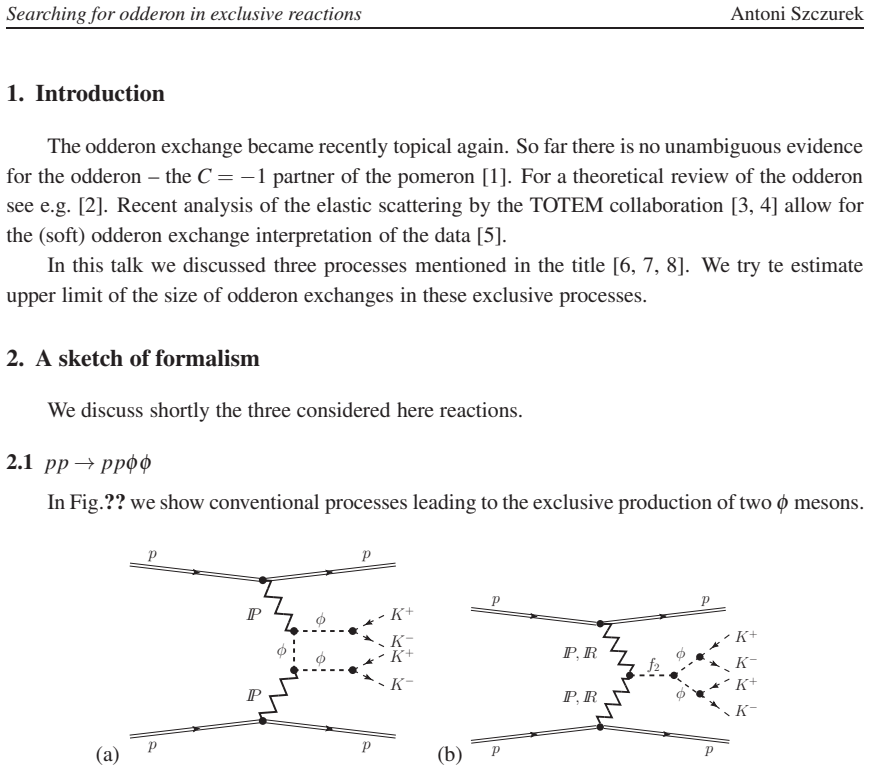
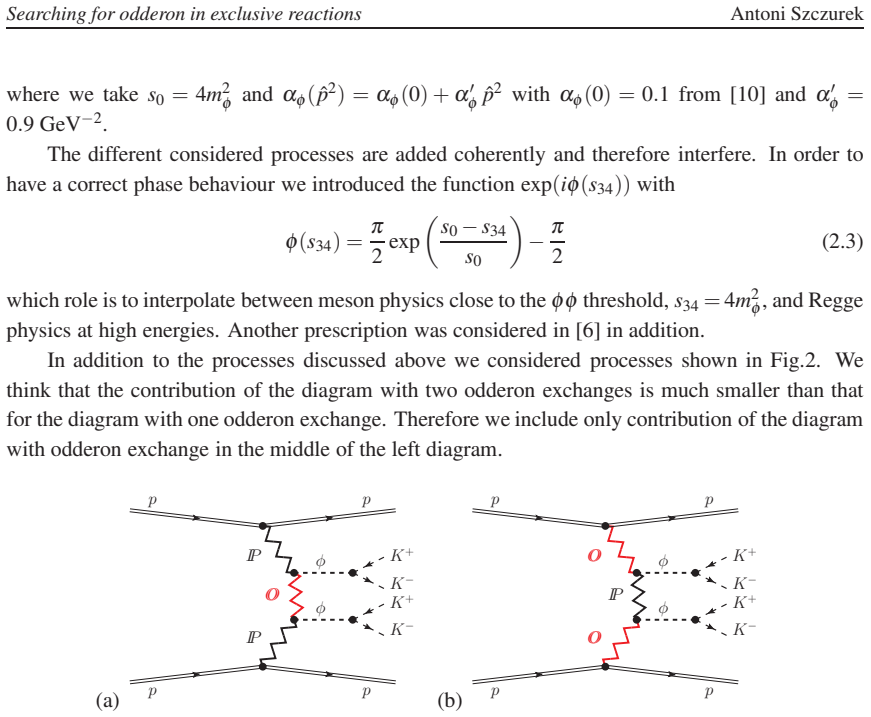
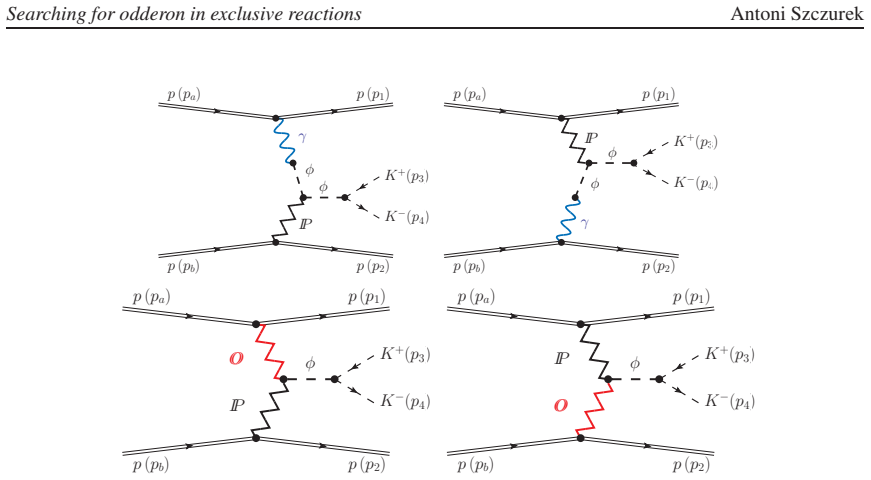
Odderon exchange amplitudes in the t-channel of the exclusive reactions, treated alongside Pomeron exchange in a Regge-inspired formalism.
If this is right
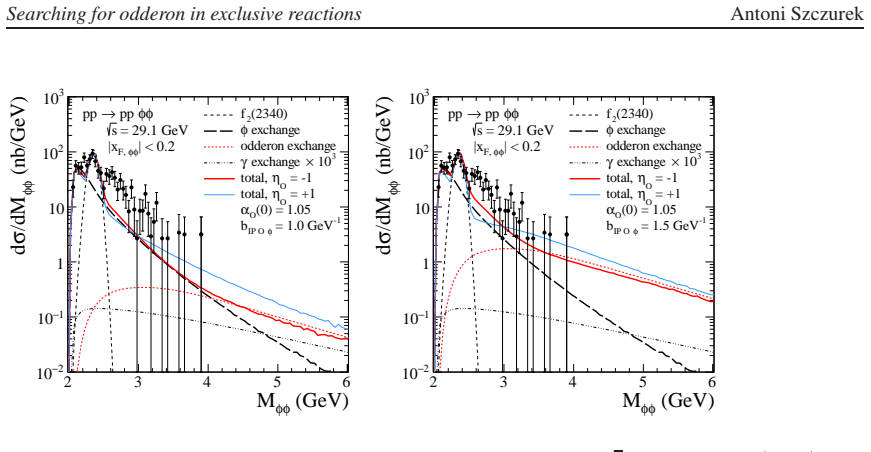
- Low-energy WA102 data can be reinterpreted to place limits on odderon strength in phi production.
- LHC measurements of these exclusive channels would provide independent evidence for or against the odderon seen in elastic scattering analyses.
- If observed, the odderon would appear in both four-body and two-body final states with characteristic interference patterns.
Where Pith is reading between the lines
- Similar exclusive channels with other vector mesons could be added to enlarge the data set for odderon searches.
- The approach could be extended to central exclusive production at lower energies to test energy dependence of the odderon intercept.
Load-bearing premise
Odderon contributions can be cleanly isolated from Pomeron and other exchanges in the kinematics and energies considered.
What would settle it
Measurement at the LHC showing that the cross sections or angular distributions for the three processes remain consistent with pure Pomeron exchange and exhibit no excess attributable to C-odd exchange.
Figures
read the original abstract
There seem to be recently an evidence for $C =$ -1 exchanges in $p p$ and $p \bar p$ elastic scattering at high energies. The analysis there is difficult as the two processes were not measured at the same (large) energies. Here we discuss three different exclusive processes given in the title as a possible source of information for odderon exchange. A sketch of the formalism is presented for each of the reactions. We consider low energy processes measured in the past by the WA102 collaboration and try to make predictions for the LHC. We discuss possible evidences at the low energies and try to make suggestions for the LHC.
Editorial analysis
A structured set of objections, weighed in public.
Referee Report
Summary. The manuscript proposes three exclusive proton-proton reactions (pp → p p p p-bar, pp → p p ϕ ϕ, and pp → p p ϕ) as potential sources of information on odderon (C = -1) exchange. It sketches the Regge-theory formalism (amplitudes, propagators, and vertices) for each process, references low-energy WA102 data for qualitative discussion, and offers suggestions for isolating odderon effects at LHC energies.
Significance. If the sketched formalisms can be extended to explicit calculations demonstrating separable odderon contributions, the paper would provide useful guidance for experimental searches at the LHC, complementing the difficult analysis of elastic pp vs p p-bar scattering at mismatched energies.
major comments (2)
- [Formalism sketches for the three reactions] The central claim that these processes allow isolation of odderon exchange rests on the sketched formalisms, but no explicit differential cross sections, interference terms between C = -1 and Pomeron amplitudes, or kinematic windows are derived or tabulated for any of the three reactions (see the formalism sketches in the sections following the abstract).
- [Low-energy processes and WA102 references] The discussion of WA102 low-energy data references existing measurements but does not compute or show the energy dependence or observables that would establish separability from Pomeron background, leaving the extrapolation to LHC unverified.
minor comments (2)
- [Title] The title notation 'p p p {bar p}' is nonstandard; use consistent LaTeX for p p p p-bar throughout.
- [Abstract] The abstract states 'there seem to be recently an evidence' without citing the specific elastic-scattering analyses; add references.
Simulated Author's Rebuttal
We thank the referee for the careful reading of our manuscript and the constructive comments. We address each major point below, clarifying the scope of the work while agreeing where additional clarification or discussion can improve the presentation.
read point-by-point responses
-
Referee: [Formalism sketches for the three reactions] The central claim that these processes allow isolation of odderon exchange rests on the sketched formalisms, but no explicit differential cross sections, interference terms between C = -1 and Pomeron amplitudes, or kinematic windows are derived or tabulated for any of the three reactions (see the formalism sketches in the sections following the abstract).
Authors: The manuscript is conceived as an exploratory proposal that outlines three exclusive reactions and sketches the Regge-theory amplitudes (including the structure of C = -1 exchanges) to indicate in principle how odderon contributions could be isolated. Explicit numerical evaluation of differential cross sections, full interference terms, or tabulated kinematic windows lies outside the stated scope, which is limited to sketching the formalism and referencing existing low-energy data. We agree that adding a short discussion of possible kinematic regions or qualitative interference patterns derivable from the sketched amplitudes would make the isolation argument more concrete. We will revise the relevant sections to include such guidance without performing new full calculations. revision: partial
-
Referee: [Low-energy processes and WA102 references] The discussion of WA102 low-energy data references existing measurements but does not compute or show the energy dependence or observables that would establish separability from Pomeron background, leaving the extrapolation to LHC unverified.
Authors: The WA102 references are used only to provide qualitative context for possible odderon signals observed at lower energies in exclusive channels. No new energy-dependent calculations or separability studies are performed, consistent with the paper's focus on proposing the reactions and sketching the formalism rather than carrying out a global phenomenological analysis. We acknowledge that a quantitative extrapolation to LHC energies would require additional work. In revision we will make the qualitative character of the WA102 discussion explicit and note how the sketched amplitudes could serve as input for future separability studies. revision: partial
Circularity Check
No significant circularity; derivation uses external WA102 data and sketched formalism without reduction to inputs
full rationale
The manuscript sketches amplitudes, Regge propagators and vertex factors for the three listed exclusive channels, references external WA102 low-energy data as input, and extrapolates to LHC kinematics. No equations, fitted parameters or self-citations are exhibited that reduce any claimed prediction or isolation of the C = -1 term to the paper's own inputs by construction. The central claim therefore remains independent of the patterns that would trigger a circularity finding.
Axiom & Free-Parameter Ledger
axioms (1)
- domain assumption Odderon exchange contributes measurably to the listed exclusive reactions at LHC energies
Lean theorems connected to this paper
-
IndisputableMonolith/Cost/FunctionalEquation.leanwashburn_uniqueness_aczel unclear?
unclearRelation between the paper passage and the cited Recognition theorem.
Our ansatz for the effective propagator of C = −1 odderon follows [9] i∆(O)μν(s,t) = −igμν ηO/M0² (sα′O)αO(t)−1
-
IndisputableMonolith/Foundation/AlexanderDuality.leanalexander_duality_circle_linking unclear?
unclearRelation between the paper passage and the cited Recognition theorem.
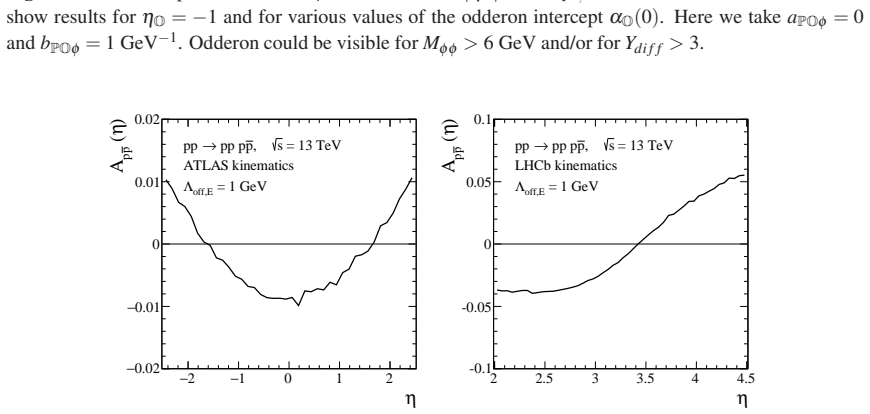
The exchange of C = -1 objects leads to specific asymmetries... Ã(2)(η,η′)
What do these tags mean?
- matches
- The paper's claim is directly supported by a theorem in the formal canon.
- supports
- The theorem supports part of the paper's argument, but the paper may add assumptions or extra steps.
- extends
- The paper goes beyond the formal theorem; the theorem is a base layer rather than the whole result.
- uses
- The paper appears to rely on the theorem as machinery.
- contradicts
- The paper's claim conflicts with a theorem or certificate in the canon.
- unclear
- Pith found a possible connection, but the passage is too broad, indirect, or ambiguous to say the theorem truly supports the claim.
Reference graph
Works this paper leans on
- [1]
-
[2]
The Odderon in Quantum Chromodynamics
C. Ewerz, hep-ph/0306137
work page internal anchor Pith review Pith/arXiv arXiv
-
[3]
[TOTEM collaboration], CERN-EP-2017-33 5
Antchev et al. [TOTEM collaboration], CERN-EP-2017-33 5
work page 2017
-
[4]
[TOTEM collaboration], CERN-EP-2018-34 1, arXiv:1812.08610[hep-ex]
Antchev et al. [TOTEM collaboration], CERN-EP-2018-34 1, arXiv:1812.08610[hep-ex]. 5 Searching for odderon in exclusive reactions Antoni Szczurek (GeV)4KM 2 4 6 8 10 (nb/GeV)4K/dMσd 3−10 2−10 1−10 1 10 210 ) - K+K - K+ K→ φ φ pp (→pp > 0.2 GeV t,K | < 2.5, p K η = 13 TeV, |s (2340)2f exchangeφ (0) = 1.05Oαtotal, (0) = 1.00Oαtotal, (0) = 0.95Oαtotal, -1= 1...
- [5]
-
[6]
P . Lebiedowicz, O. Nachtmann and A. Szczurek, Phys. Rev. D99, 094034 (2019)
work page 2019
-
[7]
P . Lebiedowicz, O. Nachtmann and A. Szczurek, Phys. Rev. D97, 094027 (2018)
work page 2018
- [8]
- [9]
-
[10]
P .D.B. Collins, An Introduction to Regge Theory and Hig h Energy Physics, (Cambridge University Press, Cambridge, England, 1977)
work page 1977
-
[11]
Barberis, (W A102 collaboration), Phys
D. Barberis, (W A102 collaboration), Phys. Lett. B432, 436 (1998)
work page 1998
-
[12]
Kirk (W A102 collaboration), Phys
A. Kirk (W A102 collaboration), Phys. Lett. B489, 29 (20 00). 6 γ φ I P I P φ p p p p K + K − K + K − 4 - Y3 = YdiffY 4− 2− 0 2 4 (nb)diff/dYσd 3−10 2−10 1−10 1 10 210 ) - K+K - K+ K→ φφ pp (→pp > 0.2 GeV t,K | < 2.5, p K η = 13 TeV, |s
discussion (0)
Sign in with ORCID, Apple, or X to comment. Anyone can read and Pith papers without signing in.