REVIEW 2 major objections 36 references
From Prompt to Service: An SLM-Based Agent Orchestration Gateway for AI-Driven Virtual Worlds
T0 review · 2 major / 0 minor · reviewed 2026-06-28 · grok-4.3
Pith's one-line read A fine-tuned sub-billion SLM on edge hardware can classify user prompt intents to route them to the right AI backend services in virtual worlds.
desk verdict This paper describes a practical gateway architecture that routes virtual-world prompts via an edge SLM to different AI backends, but the evaluation provides no metrics or cross-context tests. read the letter →
The pith
A machine-rendered reading of the paper's core claim, the machinery that carries it, and where it could break.
The reading
What carries the argument
The SLM-based Agent Orchestration Gateway, which performs intent classification via a fine-tuned sub-billion-parameter SLM on edge hardware and resolves the decision through a service registry to invoke distributed AI backends.
What would settle it
Routing accuracy falling substantially below testbed levels when the same fine-tuned model processes prompts drawn from different virtual world scenarios or user interaction styles.
Extended reading notes
Core claim
An SLM-based Agent Orchestration Gateway uses an edge-deployed compact SLM to classify prompt semantic intent, routes the request through a configurable service registry to the selected heterogeneous AI backend, and thereby enables new capabilities without modifying the virtual world client. In the InterwovenXR testbed, fine-tuned sub-billion-parameter models function as reliable low-latency intent routers, and a layered configuration of fine-tuned router plus larger responder model proves deployable on mid-range edge hardware while consuming fewer resources than a single model performing both routing and generation.
Load-bearing premise
Semantic intent classification by the edge SLM produces accurate enough routing decisions for varied prompts and virtual world contexts outside the specific museum testbed.
Editorial extensions
If this is right
- Virtual world clients remain unmodified when new AI services are introduced through the registry.
- AI capabilities can be distributed across edge and cloud without embedding models directly in the virtual world system.
- Task-specific fine-tuning enables sub-billion models to handle routing with lower latency than larger alternatives.
- Layered router-plus-responder setups reduce computational demand on mid-range edge hardware compared with monolithic models.
Reading between the lines
- The same gateway pattern could apply to other real-time interactive systems such as games or augmented-reality environments that need dynamic AI service selection.
- Intent classification at the edge may shorten response times in multimodal interfaces by avoiding unnecessary calls to large cloud models.
- Extending the registry with context-aware rules could improve routing when user prompts contain references to specific virtual world objects or states.
Editorial analysis
A structured set of objections, weighed in public.
Referee Report
Summary. The manuscript presents an SLM-Based Agent Orchestration Gateway architecture that decouples virtual-world clients from heterogeneous AI backends by using an edge-deployed compact SLM to classify semantic intent of user prompts, a service registry to resolve routing, and invocation of selected backends. It is implemented and evaluated in the InterwovenXR virtual museum testbed, with the central claim that fine-tuned sub-billion-parameter SLMs can serve as reliable, low-latency intent routers and that a layered router-plus-responder configuration is more efficient on mid-range edge hardware than a single larger model.
Significance. If the evaluation claims hold with proper quantitative support, the architecture would offer a practical mechanism for extensible, edge-supported AI service orchestration in virtual worlds, addressing maintenance and coordination challenges when embedding generative capabilities directly into client systems.
major comments (2)
- [Abstract] Abstract: the assertion that 'the evaluation shows that compact SLMs can serve as reliable intent routers on edge hardware' and that the layered configuration 'is shown to be deployable on mid-range edge hardware and more efficient' is unsupported by any reported quantitative metrics, latency numbers, accuracy rates, baseline comparisons, error analysis, or dataset details.
- [Evaluation] Evaluation (throughout): the testbed is restricted to the single InterwovenXR museum environment with no reported cross-domain prompts, varied virtual-world contexts, or failure-mode analysis, so the claim that task-specific fine-tuning transforms sub-billion models into practical routers cannot be assessed for generalization beyond this specific setting.
Simulated Author's Rebuttal
We thank the referee for the constructive feedback. The comments correctly identify areas where quantitative support and scope clarification are needed. We will revise the manuscript to incorporate explicit metrics and moderate claims accordingly.
read point-by-point responses
-
Referee: [Abstract] Abstract: the assertion that 'the evaluation shows that compact SLMs can serve as reliable intent routers on edge hardware' and that the layered configuration 'is shown to be deployable on mid-range edge hardware and more efficient' is unsupported by any reported quantitative metrics, latency numbers, accuracy rates, baseline comparisons, error analysis, or dataset details.
Authors: We agree that the abstract and evaluation sections would be strengthened by explicit quantitative details. The evaluation was performed in the InterwovenXR testbed and supports the claims, but the manuscript does not report the specific numbers. In the revised version we will add intent classification accuracy, measured latencies on the target edge hardware, baseline comparisons (including single larger models), error analysis, and dataset details for the fine-tuning process. revision: yes
-
Referee: [Evaluation] Evaluation (throughout): the testbed is restricted to the single InterwovenXR museum environment with no reported cross-domain prompts, varied virtual-world contexts, or failure-mode analysis, so the claim that task-specific fine-tuning transforms sub-billion models into practical routers cannot be assessed for generalization beyond this specific setting.
Authors: We acknowledge the single-environment limitation. The work is presented as a feasibility demonstration in a representative virtual-world setting rather than a broad generalization study. In revision we will expand the evaluation section with details on the prompt set used, observed failure modes, and an explicit limitations paragraph discussing scope and the need for future cross-domain validation, while adjusting the abstract and conclusion to avoid overclaiming generalization. revision: partial
Circularity Check
No significant circularity; architecture description and empirical evaluation are self-contained.
full rationale
The paper describes an SLM-based Agent Orchestration Gateway architecture and reports empirical results from implementation and testing inside the InterwovenXR virtual museum testbed. No equations, derivations, fitted parameters presented as predictions, or self-referential definitions appear in the provided text. Claims about compact SLMs as intent routers rest on direct evaluation rather than reduction to inputs by construction. No load-bearing self-citations, uniqueness theorems, or ansatzes imported via citation are present. This matches the default expectation for an empirical systems paper with independent content.
Assumptions & free parameters
assumptions (1)
- domain assumption An edge-deployed SLM can classify the semantic intent of user prompts with sufficient accuracy to enable correct service routing
invented entities (1)
-
SLM-Based Agent Orchestration Gateway
Cite this review
Pith. "Pith review of From Prompt to Service: An SLM-Based Agent Orchestration Gateway for AI-Driven Virtual Worlds." pith.science (2026). https://pith.science/paper/CRKMF5YC
@misc{pith2026260603557,
  author       = {Pith},
  title        = {Pith review of: From Prompt to Service: An SLM-Based Agent Orchestration Gateway for AI-Driven Virtual Worlds},
  year         = {2026},
  howpublished = {\url{https://pith.science/paper/CRKMF5YC}},
  note         = {Machine review of arXiv:2606.03557}
}
read the original abstract
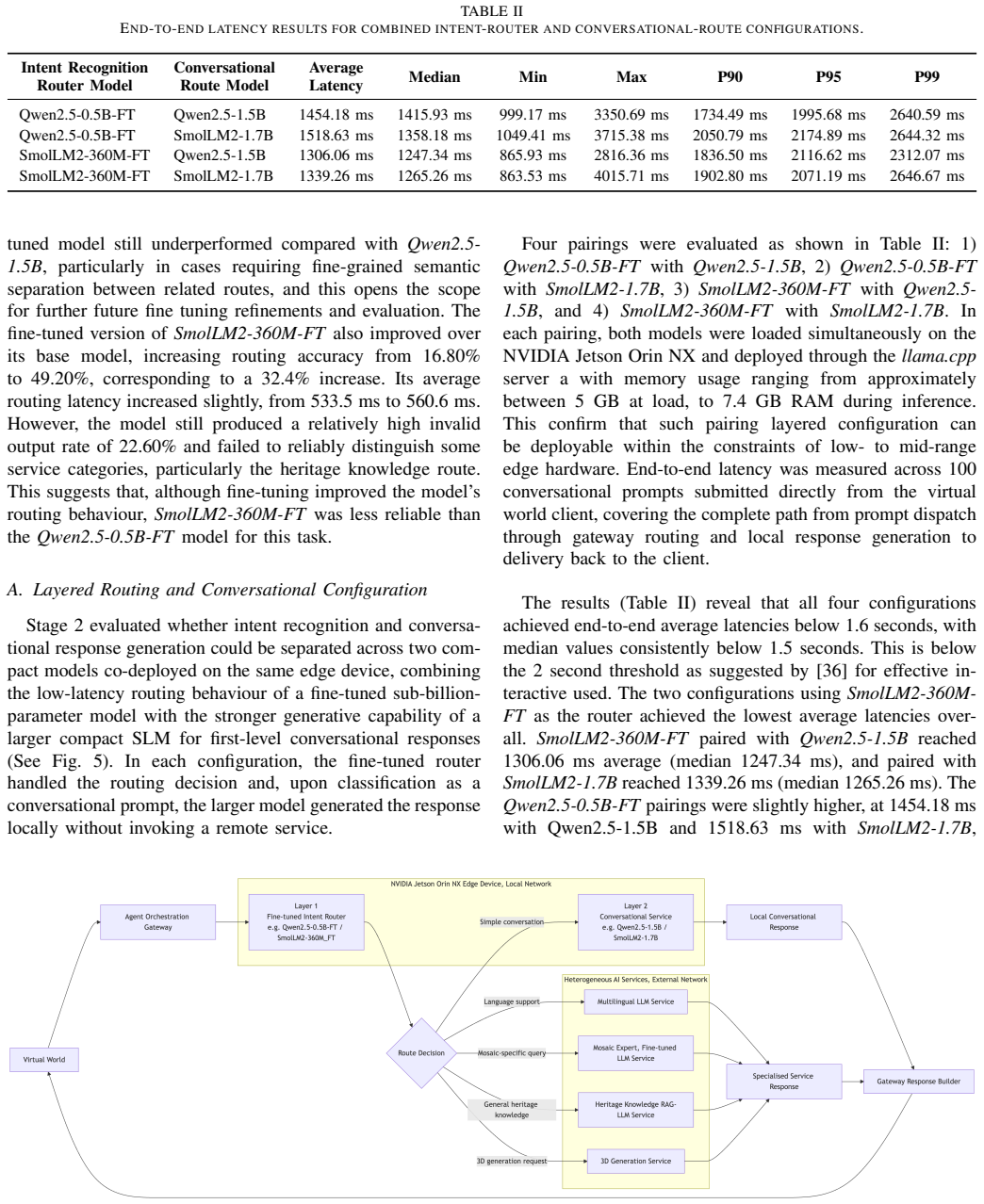
As generative AI capabilities expand, AI-driven virtual worlds face a growing architectural challenge. Users interact through in-world interfaces in multimodal ways, yet their requests demand fundamentally different AI backend models and computational resources. Embedding these capabilities directly into virtual world systems reduces extensibility, complicates maintenance, and limits the ability to coordinate services distributed across edge and cloud infrastructure. This paper presents an SLM-based Agent Orchestration Gateway, a lightweight runtime coordination mechanism that decouples a virtual world client from heterogeneous AI backends through intent-driven service routing. An edge-deployed SLM classifies the semantic intent of each user prompt, a configurable service registry validates and resolves the routing decision, and the selected backend is invoked transparently, enabling new AI capabilities to be introduced in the virtual world without modifying the client application. The gateway is implemented and evaluated within the InterwovenXR virtual museum testbed. The evaluation shows that compact SLMs can serve as reliable intent routers on edge hardware, and that task-specific fine-tuning can transform sub-billion-parameter models into practical, low-latency routers. A layered configuration pairing a fine-tuned sub billion-parameter model as router with a larger SLM for conversational response generation is shown to be deployable on mid-range edge hardware and more efficient than delegating both responsibilities to a single model. The findings show that SLMs can support practical AI service orchestration in virtual worlds and the work contributes an evaluated architecture for scalable, extensible, and edge-supported AI interaction, enabling virtual agents become access points to distributed generative AI services.
Figures


Figures from the paper (2 more)

Reference graph
Works this paper leans on
-
[1]
State-of-the-art human-computer-interaction in metaverse,
Z. Lyu, “State-of-the-art human-computer-interaction in metaverse,” International Journal of Human–Computer Interaction, vol. 40, no. 21, pp. 6690–6708, 2024
2024
-
[2]
Interoper- ability of the metaverse: A digital ecosystem perspective review,
L. Yang, S.-T. Ni, Y . Wang, A. Yu, J.-A. Lee, and P. Hui, “Interoper- ability of the metaverse: A digital ecosystem perspective review,”IEEE Engineering Management Review, vol. 53, no. 3, pp. 29–54, 2025
2025
-
[3]
A survey on large language model based autonomous agents,
L. Wang, C. Ma, X. Feng, Z. Zhang, H. Yang, J. Zhang, Z. Chen, J. Tang, X. Chen, Y . Lin,et al., “A survey on large language model based autonomous agents,”Frontiers of Computer Science, vol. 18, no. 6, 2024
2024
-
[4]
Developing a cyber-physical-social metaverse system for interactive cultural heritage experiences,
L. Nisiotis, C. Nikolaou, N. Markov, and A. Hadjiliasi, “Developing a cyber-physical-social metaverse system for interactive cultural heritage experiences,” in2025 IEEE 49th Annual Computers, Software, and Applications Conference (COMPSAC), pp. 654–663, IEEE, 2025
2025
-
[5]
LLMR: Real-time prompting of interactive worlds using large language models,
F. De La Torre, C. M. Fang, H. Huang, A. Banburski-Fahey, J. Amores Fernandez, and J. Lanier, “LLMR: Real-time prompting of interactive worlds using large language models,” inCHI ’24, ACM, 2024
2024
-
[6]
Meshgpt: Generating triangle meshes with decoder-only transformers,
Y . Siddiqui, A. Alliegro, A. Artemov, T. Tommasi, D. Sirigatti, V . Rosov, A. Dai, and M. Nießner, “Meshgpt: Generating triangle meshes with decoder-only transformers,” inProceedings of the IEEE/CVF conference on computer vision and pattern recognition, pp. 19615–19625, 2024
2024
-
[7]
A survey on text-to-3d contents generation in the wild.arXiv preprint arXiv:2405.09431, 2024
C. Jiang, “A survey on text-to-3d contents generation in the wild,”arXiv preprint arXiv:2405.09431, 2024
-
[8]
Generative ai-driven virtual worlds: Toward the next generation of immersive interactive environments,
L. Nisiotis and C. Z. Patrikakis, “Generative ai-driven virtual worlds: Toward the next generation of immersive interactive environments,”IT Professional, vol. 27, no. 6, pp. 4–9, 2025
2025
Show all 36 references
-
[9]
Beyond reality: The pivotal role of generative ai in the metaverse,
V . Chamola, G. Bansal, T. K. Das, V . Hassija, S. Sai, J. Wang, S. Zeadally, A. Hussain, F. R. Yu, M. Guizani, and D. Niyato, “Beyond reality: The pivotal role of generative ai in the metaverse,”IEEE Internet of Things Magazine, vol. 7, no. 4, pp. 126–135, 2024
2024
-
[10]
Advancements in generative ai: A comprehensive review of gans, gpt, autoencoders, diffusion model, and transformers,
S. Bengesi, H. El-Sayed, M. K. Sarker, Y . Houkpati, J. Irungu, and T. Oladunni, “Advancements in generative ai: A comprehensive review of gans, gpt, autoencoders, diffusion model, and transformers,”IEEE Access, vol. 12, pp. 69812–69837, 2024
2024
-
[11]
3d virtual worlds and the metaverse: Current status and future possibilities,
J. D. N. Dionisio, W. G. Burns, and R. Gilbert, “3d virtual worlds and the metaverse: Current status and future possibilities,”ACM Computing Surveys, vol. 45, no. 3, pp. 1–38, 2013
2013
-
[12]
Metaverse,
S. Mystakidis, “Metaverse,”Encyclopedia, vol. 2, no. 1, pp. 486–497, 2022
2022
-
[13]
Constructing an edu-metaverse ecosystem: A new and innovative framework,
M. Wang, H. Yu, Z. Bell, and X. Chu, “Constructing an edu-metaverse ecosystem: A new and innovative framework,”IEEE Transactions on Learning Technologies, vol. 15, no. 6, pp. 685–696, 2022
2022
-
[14]
Metaverse in education: Contributors, cooperations, and research themes,
X. Chen, D. Zou, H. Xie, and F. L. Wang, “Metaverse in education: Contributors, cooperations, and research themes,”IEEE Transactions on Learning Technologies, vol. 16, no. 6, pp. 1111–1129, 2023
2023
-
[15]
On the use of virtual agents in eduverse: A survey of embodied virtual agent types and future research directions in eduverse applications,
A. Hadjiliasi, L. Nisiotis, and I. Polycarpou, “On the use of virtual agents in eduverse: A survey of embodied virtual agent types and future research directions in eduverse applications,” in2025 IEEE International Symposium on Emerging Metaverse (ISEMV), 2025
2025
-
[16]
Towards aircraft maintenance metaverse using speech interactions with virtual objects in mixed reality,
A. Siyaev and G.-S. Jo, “Towards aircraft maintenance metaverse using speech interactions with virtual objects in mixed reality,”Sensors, vol. 21, no. 6, p. 2066, 2021
-
[17]
A survey on digital twins: Architecture, enabling technologies, security and privacy, and future prospects,
Y . Wang, Z. Su, S. Guo, M. Dai, T. H. Luan, and Y . Liu, “A survey on digital twins: Architecture, enabling technologies, security and privacy, and future prospects,”IEEE Internet of Things Journal, vol. 10, no. 17, pp. 14965–14987, 2023
2023
-
[18]
Prospects and challenges of metaverse application in data-driven intelligent trans- portation systems,
J. N. Njoku, C. I. Nwakanma, G. C. Amaizu, and D. Kim, “Prospects and challenges of metaverse application in data-driven intelligent trans- portation systems,”IET Intelligent Transport Systems, vol. 17, pp. 1–21, 2023
2023
-
[19]
Social interaction with agents and avatars in immersive virtual environments: A survey,
C. Kyrlitsias and D. Michael-Grigoriou, “Social interaction with agents and avatars in immersive virtual environments: A survey,”Frontiers in Virtual Reality, vol. 2, 2022
2022
-
[20]
Navigat- ing the edge-cloud continuum: A state-of-practice survey,
L. Belcastro, F. Marozzo, A. Orsino, D. Talia, and P. Trunfio, “Navigat- ing the edge-cloud continuum: A state-of-practice survey,”IEEE Access, vol. 14, pp. 40622–40647, 2026
2026
-
[21]
Next Generation Virtual Worlds: Societal, Technological, Economic and Policy Challenges for the EU,
I. Hupont Torres, V . Charisi, G. De Prato, K. Pogorzelska, S. Schade, A. Kotsev, M. Sobolewski, N. Duch Brown, E. Calza, C. Dunker, F. Di Girolamo, M. Bellia, J. Hledik, I. Nai Fovino, and M. Vespe, “Next Generation Virtual Worlds: Societal, Technological, Economic and Policy...
2023
-
[22]
Edge ai: A survey,
R. Singh and S. S. Gill, “Edge ai: A survey,”Internet of Things and Cyber-Physical Systems, vol. 3, pp. 71–92, 2023
2023
-
[23]
Mobile edge intelligence for large language models: A contemporary survey,
G. Qu, Q. Chen, W. Wei, Z. Lin, X. Chen, and K. Huang, “Mobile edge intelligence for large language models: A contemporary survey,”IEEE Comms. Surveys & Tutorials, vol. 27, no. 6, pp. 3820–3860, 2025
2025
-
[24]
5g/6g-enabled metaverse technologies: Taxonomy, applications, and open challenges,
M. Adilet al., “5g/6g-enabled metaverse technologies: Taxonomy, applications, and open challenges,”Journal of Network and Computer Applications, vol. 226, p. 103872, 2024
2024
-
[25]
Beyond reality: The pivotal role of generative ai in the metaverse,
V . Chamola, G. Bansal, T. K. Das, V . Hassija, N. S. Sai, J. Wang, S. Zeadally, A. Hussain, F. R. Yu, M. Guizani, and D. Niyato, “Beyond reality: The pivotal role of generative ai in the metaverse,”IEEE Internet of Things Magazine, vol. 7, no. 4, pp. 126–135, 2024
2024
-
[26]
Generative artificial intelligence: A systematic review and applications,
S. S. Sengar, A. B. Hasan, S. Kumar, and F. Carroll, “Generative artificial intelligence: A systematic review and applications,”Multimedia Tools and Applications, vol. 84, pp. 23661–23700, 2025
2025
-
[27]
A review on large language models: Architectures, applications, taxonomies, open issues and challenges,
M. A. K. Raiaan, M. S. H. Mukta, K. Fatema, N. M. Fahad, S. Sakib, M. M. J. Mim, J. Ahmad, M. E. Ali, and S. Azam, “A review on large language models: Architectures, applications, taxonomies, open issues and challenges,”IEEE Access, vol. 12, pp. 26839–26874, 2024
2024
-
[28]
Evaluating usability and engagement of large language models in virtual reality for traditional scottish curling,
K. H. C. Lau, E. Bozkir, H. Gao, and E. Kasneci, “Evaluating usability and engagement of large language models in virtual reality for traditional scottish curling,” inECCV 2024 Workshops, pp. 177–195, 2025
2024
-
[29]
Beyond chatgpt: A conceptual framework and systematic review of speech-recognition chatbots for language learning,
J. Jeon, S. Lee, and H. Choe, “Beyond chatgpt: A conceptual framework and systematic review of speech-recognition chatbots for language learning,”Computers & Education, p. 104898, 2023
2023
-
[30]
A survey on hallucination in large language models: Principles, taxonomy, challenges, and open questions,
L. Huang, W. Yu, W. Ma, W. Zhong, Z. Feng, H. Wang, Q. Chen, W. Peng, X. Feng, B. Qin, and T. Liu, “A survey on hallucination in large language models: Principles, taxonomy, challenges, and open questions,” ACM Transactions on Information Systems, vol. 43, no. 2, 2025
2025
-
[31]
A survey on large language model security and privacy: The good, the bad, and the ugly,
Y . Yao, J. Duan, K. Xu, Y . Cai, Z. Sun, and Y . Zhang, “A survey on large language model security and privacy: The good, the bad, and the ugly,”High-Confidence Computing, vol. 4, no. 2, p. 100211, 2024
2024
-
[32]
Enhancing digital heritage experiences: Evaluating fine-tuned llm integration within a cyber-physical-social virtual museum system,
L. Nisiotis, N. Markov, C. Nikolaou, A. Hadjiliasi, and M. Raspopou- los, “Enhancing digital heritage experiences: Evaluating fine-tuned llm integration within a cyber-physical-social virtual museum system,” in 2025 IEEE International Symposium on Emerging Metaverse (ISEMV), p...
2025
-
[33]
InterwovenXR: A cyber-physical- social testbed system for robotics, digital twins, and hyper-automation,
L. Nisiotis and M. Raspopoulos, “InterwovenXR: A cyber-physical- social testbed system for robotics, digital twins, and hyper-automation,” Computer, 2026. In press
2026
-
[34]
A prototype that fuses virtual reality, robots, and social networks to create a new cyber–physical–social eco-society system for cultural heritage,
L. Nisiotis, L. Alboul, and M. Beer, “A prototype that fuses virtual reality, robots, and social networks to create a new cyber–physical–social eco-society system for cultural heritage,”Sustainability, vol. 12, no. 2, p. 645, 2020
2020
-
[35]
Interwoven Spaces with XR, AI, and Robots: Merging Realities in Space and Time,
L. Nisiotis, A. Hadjiliasi, F. Alexandrou, and L. Alboul, “Interwoven Spaces with XR, AI, and Robots: Merging Realities in Space and Time,” inMuseums & Technologies of Presence, pp. 243–261, Routledge, 2023
2023
-
[36]
Mitigating response delays in free-form conversations with llm-powered intelligent virtual agents,
M. Maslych, M. Katebi, C. Lee, Y . Hmaiti, A. Ghasemaghaei, C. Pumarada, J. Palmer, E. Segarra Martinez, M. Emporio, W. Snipes, R. P. McMahan, and J. J. LaViola Jr., “Mitigating response delays in free-form conversations with llm-powered intelligent virtual agents,” inProceedi...
2025
Reviewed June 28, 2026 · model on record in the stance chip above.
Discussion (0). Continue with ORCID to comment.