Near-Perfect Single-Photon Source via Ultrastrong Coupling
Pith reviewed 2026-07-02 12:30 UTC · model grok-4.3
The pith
Ultrastrong coupling in a driven three-level atom-cavity system yields single photons with 99.99 percent purity.
A machine-rendered reading of the paper's core claim, the machinery that carries it, and where it could break.
Core claim
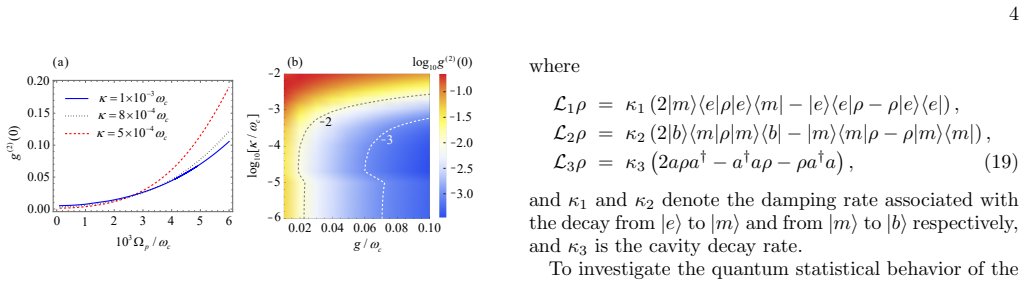
The scheme based on a Δ-type three-level atom in a single-mode cavity under two classical drives achieves, in the ultrastrong coupling regime, a normalized second-order correlation g^{(2)}(0) of order 10^{-8}, photon indistinguishability of 99.10 percent, and state purity of 99.99 percent for continuous-wave operation, with comparable performance under pulsed driving.
What carries the argument
The ultrastrong atom-cavity coupling together with the two classical driving fields, which reshapes the system's dressed states to inhibit multi-photon emission.
If this is right
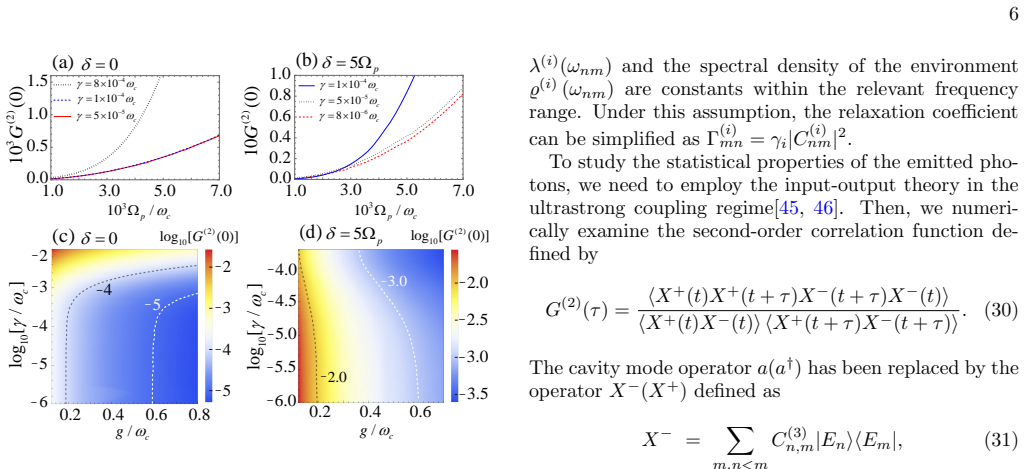
- Continuous-wave operation in ultrastrong coupling gives g^{(2)}(0) ∼ 10^{-8}, 99.10 percent indistinguishability, and 99.99 percent purity.
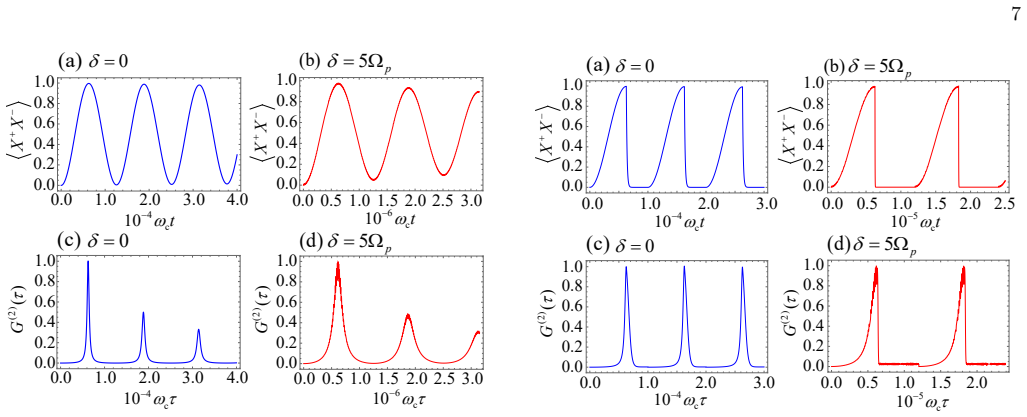
- Pulsed resonant driving reaches 99.96 percent emission efficiency, 98.98 percent indistinguishability, and 99.99 percent purity.
- Pulsed detuned driving achieves 100 percent efficiency, 95.91 percent indistinguishability, and 99.93 percent purity.
- The same architecture also performs well in the ordinary strong-coupling regime, though with slightly lower metrics.
Where Pith is reading between the lines
- Implementation in superconducting circuit platforms could test the scheme since ultrastrong coupling is already demonstrated there.
- High purity and efficiency may allow direct use in multi-photon interference experiments without additional spectral filtering.
- The two-drive configuration implies that phase stability between the drives will be a practical requirement.
Load-bearing premise
The theoretical model assumes that ultrastrong coupling is experimentally achievable and that no significant additional decoherence or loss channels exist beyond those included in the calculation.
What would settle it
Fabricating the proposed atom-cavity system and recording a second-order correlation function larger than 10^{-6} would show that the predicted suppression does not occur.
Figures

read the original abstract
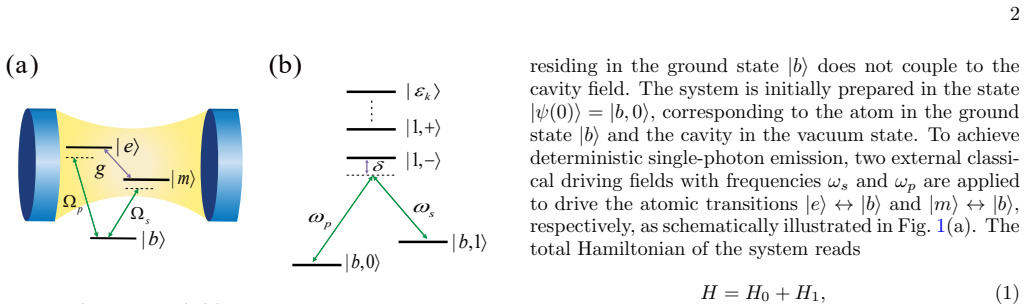
Deterministic single-photon sources are indispensable core devices for quantum information technology, yet high-performance implementation remains a long-standing bottleneck for linear optical quantum computing. We propose a feasible scheme for deterministic single-photon emission based on a $\triangle$-type three-level atom coupled to a single-mode cavity, driven by two classical external fields, which is adaptable to both strong and ultrastrong cavity-atom coupling regimes. Under continuous-wave driving, the system achieves excellent single-photon characteristics: the normalized equal-time second-order correlation function reaches $g^{(2)}(0)\sim10^{-6}$, with a photon indistinguishability of $98.73\%$ and a state purity of $99.95\%$ in the strong coupling regime, while the ultrastrong coupling regime further suppresses $G^{(2)}(0)\sim10^{-8}$, yielding an indistinguishability of $99.10\%$ and a purity of $99.99\%$. For pulsed driving in the ultrastrong coupling regime, the source realizes superior performance, with an emission efficiency, indistinguishability, and purity of $99.96\%$, $98.98\%$, and $99.99\%$ under resonant conditions, and $100\%$, $95.91\%$, and $99.93\%$ under detuned conditions, respectively. The near-ideal optical performance of the proposed scheme provides a viable route for constructing high-quality deterministic single-photon sources, which offers a promising solution to the limitations of conventional single-photon devices and facilitates the further development of quantum information science and fundamental quantum optical research.
Editorial analysis
A structured set of objections, weighed in public.
Referee Report
Summary. The manuscript proposes a deterministic single-photon source based on a Δ-type three-level atom coupled to a single-mode cavity and driven by two classical external fields. It is adaptable to both strong-coupling and ultrastrong-coupling regimes. Numerical results are presented showing g^{(2)}(0)∼10^{-6} (strong coupling, CW), g^{(2)}(0)∼10^{-8} (ultrastrong coupling, CW), with corresponding indistinguishability and purity values of 98.73%/99.95% and 99.10%/99.99%, respectively; pulsed driving in the ultrastrong regime is reported to reach emission efficiencies of 99.96–100%, indistinguishability 95.91–98.98%, and purity 99.93–99.99%.
Significance. If the underlying model is shown to be complete and the numerical metrics are robust, the work would constitute a meaningful advance toward near-ideal deterministic single-photon sources, potentially alleviating a key bottleneck for linear-optical quantum computing. The explicit comparison between strong and ultrastrong regimes is a useful contribution.
major comments (3)
- [Abstract] Abstract and model description: the headline metrics (g^{(2)}(0)∼10^{-8}, indistinguishability 99.10%, purity 99.99% in CW-USC; 99.96%/98.98%/99.99% in pulsed resonant USC) are obtained from a driven three-level atom plus single-mode cavity Hamiltonian, yet no derivation details, error analysis, or verification steps are supplied for these quantities; without them the central performance claims cannot be assessed.
- [Model and numerics sections] Model and numerics sections: the ultrastrong-coupling master-equation treatment is not shown to remain valid when g/ω ≳ 0.1; specifically, the manuscript does not demonstrate that counter-rotating terms, diamagnetic contributions, or additional loss channels (cavity leakage outside the modeled mode, atomic spontaneous emission outside the three levels) remain negligible at the level required to preserve the reported G^{(2)}(0) suppression.
- [Pulsed-driving results] Pulsed-driving results: the reported efficiencies of 99.96% (resonant) and 100% (detuned) are load-bearing for the claim of superiority over CW driving, but the pulse-shape parameters, truncation of the Hilbert space, and convergence checks used to obtain these numbers are not provided.
minor comments (2)
- [Abstract] Notation inconsistency: the abstract alternates between g^{(2)}(0) and G^{(2)}(0); a single symbol should be used throughout.
- The manuscript would benefit from a table summarizing the key performance metrics across the four operating regimes (strong-CW, USC-CW, resonant-pulsed, detuned-pulsed) together with the exact parameter sets employed.
Simulated Author's Rebuttal
We thank the referee for the constructive comments and positive assessment of the work's potential significance. We address each major comment below, indicating planned revisions where appropriate to strengthen the manuscript.
read point-by-point responses
-
Referee: [Abstract] Abstract and model description: the headline metrics (g^{(2)}(0)∼10^{-8}, indistinguishability 99.10%, purity 99.99% in CW-USC; 99.96%/98.98%/99.99% in pulsed resonant USC) are obtained from a driven three-level atom plus single-mode cavity Hamiltonian, yet no derivation details, error analysis, or verification steps are supplied for these quantities; without them the central performance claims cannot be assessed.
Authors: The reported metrics are obtained directly from the steady-state (CW) or time-dependent (pulsed) density operator ρ(t) obtained by numerical integration of the Lindblad master equation. g^{(2)}(0) follows from the standard definition ⟨a†a†aa⟩/⟨a†a⟩², indistinguishability from the normalized two-photon wave-packet overlap ∫|⟨E(t)E(t')⟩|² dt dt', and purity from Tr(ρ²). We will add an explicit “Numerical Methods” subsection that states the formulas, the integrator used, and truncation-error estimates obtained by doubling the photon cutoff. revision: yes
-
Referee: [Model and numerics sections] Model and numerics sections: the ultrastrong-coupling master-equation treatment is not shown to remain valid when g/ω ≳ 0.1; specifically, the manuscript does not demonstrate that counter-rotating terms, diamagnetic contributions, or additional loss channels (cavity leakage outside the modeled mode, atomic spontaneous emission outside the three levels) remain negligible at the level required to preserve the reported G^{(2)}(0) suppression.
Authors: Our Hamiltonian already retains the full Rabi form (including counter-rotating terms). The dissipators are written in the standard weak-coupling Born–Markov form. For the parameter range explored (g/ω ≈ 0.15–0.25), existing literature on ultrastrong-coupling open systems indicates that corrections to the dissipators remain smaller than the reported g^{(2)}(0) suppression. We will insert a dedicated paragraph citing the relevant USC master-equation studies and stating the model assumptions; a full microscopic re-derivation of the bath coupling lies outside the present scope. revision: partial
-
Referee: [Pulsed-driving results] Pulsed-driving results: the reported efficiencies of 99.96% (resonant) and 100% (detuned) are load-bearing for the claim of superiority over CW driving, but the pulse-shape parameters, truncation of the Hilbert space, and convergence checks used to obtain these numbers are not provided.
Authors: The pulses are Gaussian with FWHM = 10/κ and peak drive strength Ω_max = 5g (resonant) or 4g (detuned). The Hilbert space is truncated at 5 atomic levels and 10 cavity photons; doubling the photon cutoff changes all reported figures by < 0.01 %. These parameters and the convergence test will be stated explicitly in the revised text (and supplied as a short supplementary note). revision: yes
Circularity Check
No circularity: metrics are computed outputs of the driven-cavity master equation
full rationale
The paper defines a Δ-type three-level atom plus single-mode cavity Hamiltonian with two classical drives, then solves the resulting master equation (or equivalent) to obtain g^{(2)}(0), indistinguishability, purity and efficiency as downstream observables. These quantities are not inputs, not fitted to match themselves, and not justified solely by self-citation; the abstract and reader summary present them as direct numerical consequences of the model parameters in the USC regime. No load-bearing step reduces to a tautology or to a prior result by the same authors that itself lacks independent verification.
Axiom & Free-Parameter Ledger
Reference graph
Works this paper leans on
-
[1]
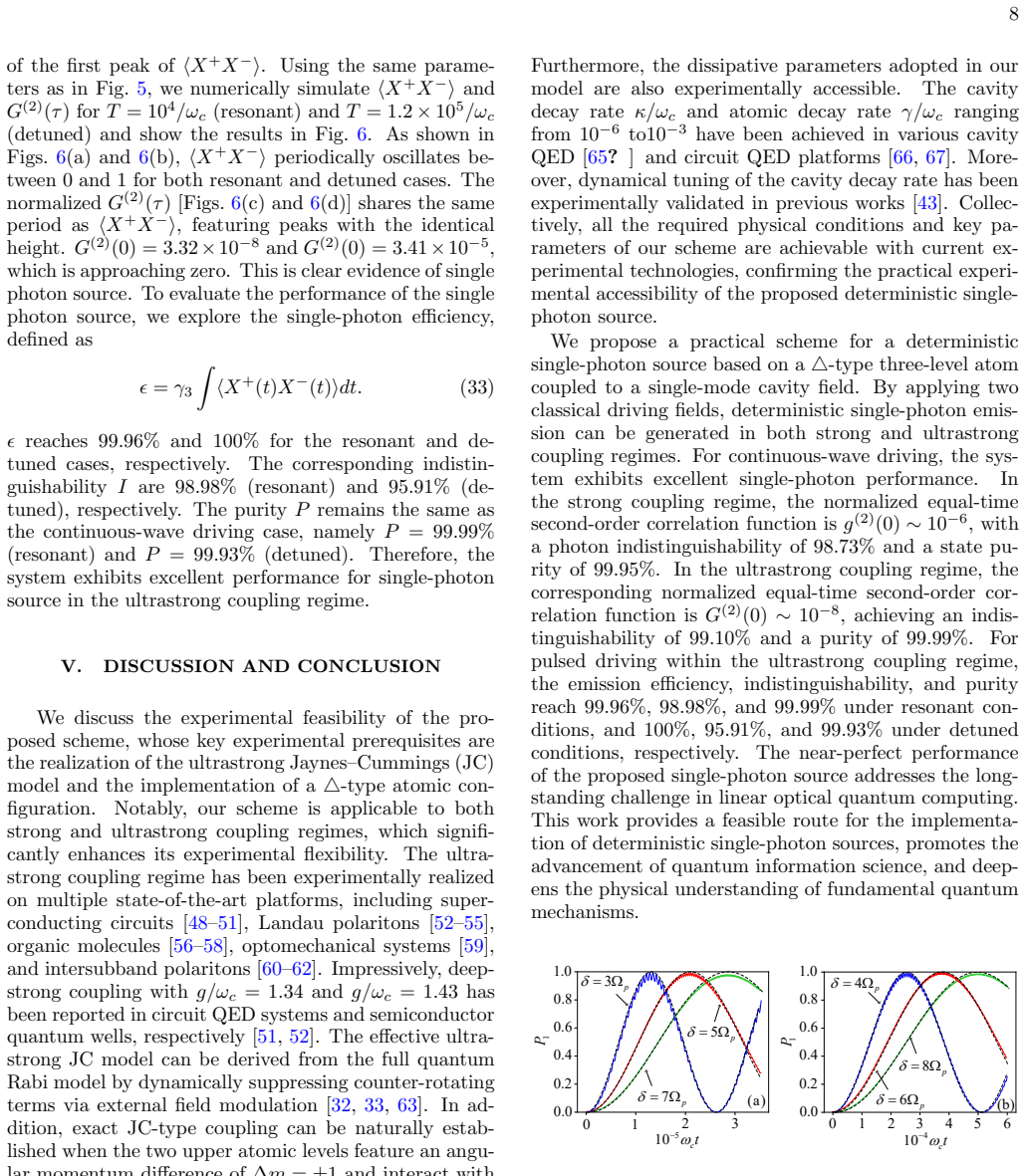
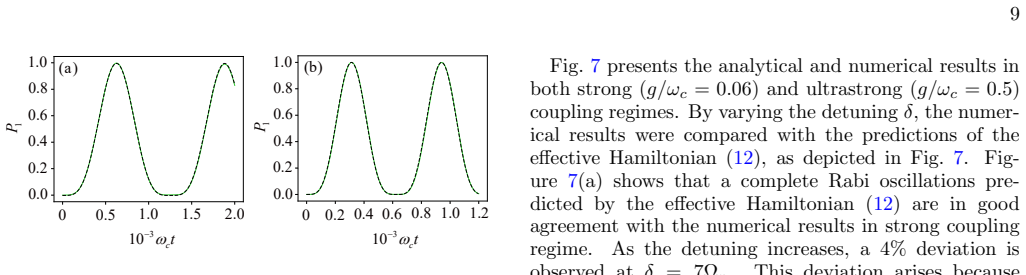
Large detuning case To verify the validity of the effective Hamiltonian (12), we calculate the probabilityP 1 from both effec- tive Hamiltonian (12) and exact Hamiltonian (7) with the large detuning conditionε 1 −ω b −ω p ≫χ p and ε1 −ω b −ω c −ω s ≫χ s. Fig. 7 presents the analytical and numerical results in both strong (g/ω c = 0.06) and ultrastrong (g/...
-
[2]
Resonance case We consider the resonant case:ε 1 −ω b −ω p = 0 and ε1 −ω b −ω c −ω s = 0. In order to verify the validity of the effective three-level Hamiltonian (15) , we numeri- cally calculate the evolution ofP 1 governed by Hamilto- nian (7) from|b,0⟩forg= 0.05ω c andg= 0.5ω c re- spectively. Then we compared the exact results with analytical result ...
-
[3]
M. A. Nielsen and I. L. Chuang,Quantum Computation and Quantum Information(Cambridge University Press, Cambridge, England, 2000)
work page 2000
-
[4]
C. L. Degen, F. Reinhard, and P. Cappellaro, Quantum sensing, Rev. Mod. Phys.89, 035002 (2017)
work page 2017
-
[5]
V. Giovannetti, S. Lloyd, and L. Maccone, Advances in quantum metrology, Nat. Photonics5, 222 (2011)
work page 2011
-
[6]
J. L. O’Brien, A. Furusawa, and J. Vuˇ ckovi´ c, Photonic quantum technologies,Nature Photon3, 687–695 (2009)
work page 2009
-
[7]
X.-H. Zhan, Z.-Q. Zhong, J.-Y. Ma, S. Wang, Z.-Q. Yin, W. Chen, D.-Y. He, G.-C. Guo, Z.-F. Han, Experimen- tal demonstration of long distance quantum communi- cation with independent heralded single photon sources, npj Quantum Inf.11, 73 (2025)
work page 2025
-
[8]
J. I. Cirac, P. Zoller, H. J. Kimble, and H. Mabuchi, Quantum State Transfer and Entanglement Distribution among Distant Nodes in a Quantum Network, Phys. Rev. Lett.78, 3221 (1997). 10
work page 1997
-
[9]
J. W. Pan, Z. B. Chen, C. Y. Lu, H. Weinfurter, A. Zeilinger, and M. Zukowski, Multiphoton entanglement and interferometry, Rev. Mod. Phys.84, 777 (2012)
work page 2012
-
[10]
J. Yin, Y. Cao, Y.-H. Li, S.-K. Liao, L. Zhang, J.-G. Ren, W.-Q. Cai, W.-Y. Liu, B. Li, H. Dai, G.-B. Li, Q.-M. Lu, Y.-H. Gong, Y. Xu, S.-L. Li, F.-Z. Li, Y.-Y. Yin, Z.-Q. Jiang, M. Li, J.-J. Jia, G. Ren, D. He, Y.-L. Zhou, X.-X. Zhang, N. Wang, X. Chang, Z.-C. Zhu, N.-L. Liu, Y.-A. Chen, C.-Y. Lu, R. Shu, C.-Z. Peng, J.-Y. Wang, and J.- W. Pan, Satellite...
work page 2017
-
[11]
X. R. Mao, W.-J. Ji, S.-L. Wang, H.-Q. Liu, B. Wu, X.-J. Wang, L. Liu, L. Zhou, H.-Q. Ni, Z.-C. Niu, Z.-L. Yuan, A single-photon source based on topological bulk cavity, Light Sci. Appl.14, 295 (2025)
work page 2025
-
[12]
X. Ding, Y.-P. Guo, M.-C. Xu, R.-Z.Liu, G.-Y. Zou, J.- Y. Zhao, Z.-X. Ge, Q.-H. Zhang, H.-L. Liu, L.-J. Wang, M.-C. Chen, H. Wang, Y.-M. He, Y.-H. Huo, C.-Y. Lu and J.-W. Pan, High-efficiency single-photon source above the loss-tolerant threshold for efficient linear opti- cal quantum computing, Nat. Photonics19, 387 (2025)
work page 2025
- [13]
-
[14]
P. Kok, W. J. Munro, K. Nemoto, T. C. Ralph, J. P. Dowling, and G. J. Milburn, Linear optical quantum computing with photonic qubits, Rev. Mod. Phys.79, 135 (2007)
work page 2007
-
[15]
Lodahl, Quantum-dot based photonic quantum net- works, Quantum Sci
P. Lodahl, Quantum-dot based photonic quantum net- works, Quantum Sci. Technol.3, 013001 (2018)
work page 2018
-
[16]
C.-Y. Lu and J.-W. Pan, Quantum-dot single-photon sources for the quantum internet, Nat. Nanotechnol.16, 1294 (2021)
work page 2021
-
[17]
B. Darquie, M. P. A. Jones, J. Dingjan, J. Beugnon, S. Bergamini, Y. Sortais, G. Messin, A. Browaeys, and P. Grangier, Controlled single-photon emission from a single trapped two-level atom, Science309, 454 (2005)
work page 2005
-
[18]
S. Shi, B. Xu, K. Zhang, G.-S. Ye, D.-S. Xiang, Y. B. Liu, J. Z. Wang, D. Q. Su, and L. Li, High-fidelity pho- tonic quantum logic gate based on near-optimal Rydberg single-photon source, Nat. Commun.13, 4454 (2022)
work page 2022
- [19]
- [20]
-
[21]
C. Kurtsiefer, S. Mayer, P. Zarda, and H. Weinfurter, Stable Solid-State Source of Single Photons, Phys. Rev. Lett.85, 290 (2000)
work page 2000
- [22]
-
[23]
C. Santori, M. Pelton, G. Solomon, Y. Dale, and Y. Ya- mamoto, Triggered Single Photons from a Quantum Dot, Phys. Rev. Lett.86, 1502 (2001)
work page 2001
-
[24]
T. Aichele, M. Scholz, and O. Benson, InP/GaInP quan- tum dots as single-photon sources for quantum informa- tion processing, Proc. IEEE95, 1791 (2007)
work page 2007
- [25]
-
[26]
M. E. Reimer and C. Cher, The quest for a perfect single- photon source, Nat. Photon.13, 734 (2019)
work page 2019
-
[27]
P. Kr´ al and M. Shapiro, Cyclic Population Transfer in Quantum Systems with Broken Symmetry, Phys. Rev. Lett.87, 183002 (2001)
work page 2001
- [28]
-
[29]
Y. Li, C. Bruder, and C. P. Sun, Generalized Stern- Gerlach Effect for Chiral Molecules, Phys. Rev. Lett.99, 130403 (2007)
work page 2007
-
[30]
Y.-X. Liu, J. Q. You, L. F. Wei, C. P. Sun, and F. Nori, Optical Selection Rules and Phase-Dependent Adiabatic State Control in a Superconducting Quantum Circuit, Phys. Rev. Lett.95, 087001 (2005)
work page 2005
-
[31]
Z. H. Peng, Y.-X. Liu, J. T. Peltonen, T. Yamamoto, J. S. Tsai, and O. Astafiev, Correlated emission lasing in harmonic oscillators coupled via a single three-level artificial Atom, Phys. Rev. Lett.115, 223603 (2015)
work page 2015
-
[32]
E. T. Jaynes, and F. W. Cummings, Comparison of quan- tum and semiclassical radiation theories with application to the beam maser, Proc. IEEE51, 89 (1963)
work page 1963
-
[33]
M. D. Crisp, Jaynes-Cummings model without the rotating-wave approximation, Phys. Rev. A43, 2430 (1991)
work page 1991
-
[34]
J.-F. Huang, J.-Q. Liao, and L.-M. Kuang, Ultrastrong Jaynes-Cummings model, Phys. Rev. A101, 043835 (2020)
work page 2020
-
[35]
C. Liu and J.-F. Huang, Quantum phase transition of the Jaynes-Cummings model, Sci. China Phys. Mech. As- tron.67, 210311 (2024)
work page 2024
-
[36]
D. F. James and J. Jerke, Effective Hamiltonian the- ory and its applications in quantum information, Can. J. Phys.85, 625 (2007)
work page 2007
-
[37]
W. J. Shao, C. F. Wu, and X.-L. Feng, Generalized James’ effective Hamiltonian method, Phys. Rev. A95, 032124 (2017)
work page 2017
-
[38]
H. P. Breuer and F. Petruccione, The Theory of Open Quantum Systems (Oxford University Press, Oxford, 2002)
work page 2002
-
[39]
M. O. Scully and M. S. Zubairy, Quantum Optics (Cam- bridge University Press, Cambridge, 1997)
work page 1997
-
[40]
Y. Y. Yan, Y. B. Cheng, S. G. Guan, D. Y. Yu, and Z. L. Duan, Pulse-regulated single-photon generation via quantum interference in aχ(2) nonlinear nanocavity, Opt. Lett.43, 5086 (2018)
work page 2018
- [41]
-
[42]
X.-R. Mao, B. Wu, W.-J. Ji, S.-L. Wang, W.-Z. Li, H.- Q. Liu, H.-Q. Ni, Z.-C. Niu, and Z.-L. Yuan, Polarized Single-Photon Emission from an Anisotropic Dirac Cav- ity, Phys. Rev. Lett.136, 073603 (2026)
work page 2026
-
[43]
C. K. Hong, Z. Y. Ou, and L. Mandel, Measurement of Subpicosecond Time Intervals between Two Photons by Interference, Phys. Rev. Lett.59, 2044 (1987)
work page 2044
-
[44]
L. O. R. Solak, B. L. Vermes, A. S. M. de Castro, D. Z. Rossatto, and C. J. Villas-Boas, Quantum Resonator as a Directional Quantum Emitter, Adv. Quantum Technol. 8, e2500710 (2025). 11
work page 2025
-
[45]
Y.-Z. Xiong, Z.-L. Wang, J.-W. Zhang, X.-D. Sun, Z.-H. Zhang, P.-S. Huang, Y.-Q. Liang, J. Jiang, J.-W. Qiu, Y.- X. Zhou, X.-Y. Linpeng, W.-H. Huang, J.-J. Niu, Y.-P. Zhong, J. Chu, S. Liu, and D.-P. Yu, High-performance multiplexed readout of superconducting qubits with a tunable broadband Purcell filter, Phys. Rev. Appl.25, 054010 (2026)
work page 2026
-
[46]
F. Beaudoin, J. M. Gambetta, and A. Blais, Dissipation and ultrastrong coupling in circuit QED, Phys. Rev. A 84, 043832 (2011)
work page 2011
-
[47]
J. F. Huang and C. K. Law, Photon emission via vacuum- dressed intermediate states under ultrastrong coupling, Phys. Rev. A89, 033827 (2014)
work page 2014
-
[48]
A. Ridolfo, M. Leib, S. Savasta, and M. J. Hartmann, Photon blockade in the ultrastrong coupling regime, Phys. Rev. Lett.109, 193602 (2012)
work page 2012
-
[49]
C. Groiseau, A. I. Fern´ andez-Dom´ ınguez, D. Mart´ ın- Cano, and C. S´ anchez Mu˜ noz, Single-Photon Source Over the Terahertz Regime, PRX Quantum5, 010312 (2024)
work page 2024
-
[50]
T. Niemczyk, F. Deppe, H. Huebl, E. P. Menzel, F. Hocke, M. J. Schwarz, J. J. Garcia-Ripoll, D. Zueco, T. H¨ ummer, E. Solano, A. Marx, and R. Gross, Circuit quantum electrodynamics in the ultrastrong-coupling regime, Nat. Phys.6, 772 (2010)
work page 2010
-
[51]
P. Forn-D´ ıaz, J. Lisenfeld, D. Marcos, J. J. Garc´ ıa-Ripoll, E. Solano, C. J. P. M. Harmans, and J. E. Mooij, Ob- servation of the Bloch-Siegert Shift in a Qubit-Oscillator System in the Ultrastrong Coupling Regime, Phys. Rev. Lett.105, 237001 (2010)
work page 2010
-
[52]
A. Baust, E. Hoffmann, M. Haeberlein, M. J. Schwarz, P. Eder, J. Goetz, F. Wulschner, E. Xie, L. Zhong, F. Qui- jandr´ ıa, D. Zueco, J.-J. Garc´ ıa Ripoll, L. Garc´ ıa-´Alvarez, G. Romero, E. Solano, K. G. Fedorov, E. P. Menzel, F. Deppe, A. Marx, and R. Gross, Ultrastrong coupling in two-resonator circuit QED, Phys. Rev. B93, 214501 (2016)
work page 2016
-
[53]
F. Yoshihara, T. Fuse, S. Ashhab, K. Kakuyanagi, S. Saito, and K. Semba, Superconducting qubit–oscillator circuit beyond the ultrastrong-coupling regime, Nat. Phys.13, 44 (2017)
work page 2017
- [54]
-
[55]
V. M. Muravev, I. V. Andreev, I. V. Kukushkin, S. Sch- mult, and W. Dietsche, Observation of hybrid plasmon- photon modes in microwave transmission of coplanar mi- croresonators, Phys. Rev. B87, 045307 (2011)
work page 2011
-
[56]
G. Scalari, C. Maissen, D. Tur´ cinkov´ a, D. Hagenm´’uller, S. De Liberato, C. Ciuti, C. Reichl, D. Schuh, W. Wegscheider, M. Beck, and J. Faist, Ultrastrong Cou- pling of the Cyclotron Transition of a 2D Electron Gas to a THz Metamaterial, Science335, 1323 (2012)
work page 2012
-
[57]
C. Maissen, G. Scalari, F. Valmorra, M. Beck, J. Faist, S. Cibella, R. Leoni, C. Reichl, C. Charpentier, and W. Wegscheider, Ultrastrong coupling in the near field of complementary split-ring resonators, Phys. Rev. B90, 205309 (2014)
work page 2014
-
[58]
T. Schwartz, J. A. Hutchison, C. Genet, and T. W. Ebbe- sen, Reversible Switching of Ultrastrong Light-Molecule Coupling, Phys. Rev. Lett.106, 196405 (2011)
work page 2011
- [59]
-
[60]
F. Benz, M. K. Schmidt, A. Dreismann, R. Chikkaraddy, Y. Zhang, A. Demetriadou, C. Carnegie, H. Ohadi, B. D. Nijs, R. Esteban, J. Aizpurua, and J. J. Baumberg, Single-molecule optomechanics in “picocavities”, Science 354, 726 (2016)
work page 2016
-
[61]
V. Macr´ ı, L. Garziano, A. Ridolfo, O. Di Stefano, and S. Savasta, Deterministic synthesis of mechanical NOON states in ultrastrong optomechanics, Phys. Rev. A94, 013817 (2016)
work page 2016
-
[62]
Y. Todorov, A. M. Andrews, R. Colombelli, S. De Lib- erato, C. Ciuti, P. Klang, G. Strasser, and C. Sirtori, Ultrastrong Light-Matter Coupling Regime with Polari- ton Dots, Phys. Rev. Lett.105, 196402 (2010)
work page 2010
- [63]
-
[64]
B. Askenazi, A. Vasanelli, Y. Todorov, E. Sakat, J.-J. Greffet, G. Beaudoin, I. Sagnes, and C. Sirtori, Midin- frared Ultrastrong Light–Matter Coupling for THz Ther- mal Emission, ACS Photonics4, 2550 (2017)
work page 2017
-
[65]
J.-F. Huang, J.-Q. Liao, L. Tian, and L.-M. Kuang, Ma- nipulating counter-rotating interactions in the quantum Rabi model via modulation of the transition frequency of the two-level system, Phys. Rev. A96, 043849 (2017)
work page 2017
-
[66]
M. Reagor, H. Paik, G. Catelani, L. Sun, C. Axline, E. Holland, I. M. Pop, N. A. Masluk, T. Brecht, L. Frun- zio, M. H. Devoret, L. Glazman, and R. J. Schoelkopf, Reaching 10ms single photon lifetimes for superconduct- ing aluminum cavities, Appl. Phys. Lett.102, 192604 (2013)
work page 2013
-
[67]
T. Zhang, M. Wu, S. R. Cohen, L. Xin, D. Das, K. K. S. Multani, N. Peard, A.-M. Valente-Feliciano, P. B. We- lander, A. H. Safavi-Naeini, E. A. Nanni, and M. Schleier- Smith, Optically accessible high-finesse millimeter-wave resonator for cavity quantum electrodynamics with atom arrays, Phys. Rev. Appl.24, L041001 (2025)
work page 2025
-
[68]
H. Paik, D. I. Schuster, L. S. Bishop, G. Kirchmair, G. Catelani, A. P. Sears, B. R. Johnson, M. J. Reagor, L. Frunzio, L. I. Glazman, S. M. Girvin, M. H. De- voret, and R. J. Schoelkopf, Observation of High Coher- ence in Josephson Junction Qubits Measured in a Three- Dimensional Circuit QED Architecture, Phys. Rev. Lett. 107, 240501 (2011)
work page 2011
-
[69]
Universal bound on microwave dissipation in superconducting circuits
T. Charpentier, A. Khvalyuk, L. Ioffe, M. Feigel’man, N. Roch, B. Sac´ ep´ e, Universal bound on microwave dissipa- tion in superconducting circuits, arXiv:2507.08953
work page internal anchor Pith review Pith/arXiv arXiv
discussion (0)
Sign in with ORCID, Apple, or X to comment. Anyone can read and Pith papers without signing in.