REVIEW 4 major objections 6 minor 71 references
A Reward-Directed Diffusion Framework for Generative Design Optimization
T0 review · 4 major / 6 minor · reviewed 2026-08-06 · deepseek-v4-flash
Pith's one-line read The paper argues that a two-stage reward-directed diffusion pipeline—reward-weighted fine-tuning followed by soft value-based decoding—can generate ship hulls and airfoils whose simulated performance exceeds the training-data maximum…
desk verdict A competent combination of reward-weighted MLE fine-tuning and soft-value decoding applied to airfoil and ship hull design, but the headline gains are measured by the optimizing surrogate and the ship numbers are not displacement-normalized. read the letter →
The pith
A machine-rendered reading of the paper's core claim, the machinery that carries it, and where it could break.
The reading
What carries the argument
The central object is the soft value function $v_t(x_t)$, defined through the soft Bellman recursion $\exp(v_t(x_t)/\alpha) = \mathbb{E}[\exp(r(x_0)/\alpha) \mid x_t]$ under the pretrained reverse process. It turns each denoising step into a soft optimal policy $p^*_t(x_{t-1} \mid x_t) \propto \exp(v_{t-1}(x_{t-1})/\alpha)\, p^{\mathrm{pre}}_t(x_{t-1} \mid x_t)$, so earlier states with higher expected terminal reward receive more probability. The paper approximates the soft value without reward gradients using the posterior mean $\hat{x}_0 = (x_t - \sqrt{1-\bar{\alpha}_t}\,\epsilon_\theta(x_t,t))/\sqrt{\bar{\alpha}_t}$: at each reverse step it samples $M$ candidate states, scores them with $\exp(r(\hat{x}_0)/\alpha)$, and selects one by categorical sampling. The same soft-value weighting appears in the fine-tuning loss, so training and inference optimize the same objective.
What would settle it
A decisive check would be to take the full set of reward-directed hulls and airfoils and measure their resistance and lift-to-drag with high-fidelity CFD or experiment; if the median measured gains fall well below the surrogate-reported 25% and 10%, or if no generated design beats the best training design once re-scored, the extrapolation claim is refuted.
Extended reading notes
Core claim
The central claim is that pushing a pretrained diffusion model toward high reward in two stages, reward-weighted maximum-likelihood fine-tuning followed by soft value-based decoding, produces engineering designs whose performance exceeds the best designs in the training data without differentiating the reward function. The paper demonstrates this on 2D airfoils (over 10 percent improvement in lift-to-drag ratio) and 3D ship hulls (over 25 percent reduction in calm-water resistance). The improvement is attributed to the iterative coupling: fine-tuning shifts the generative distribution toward high-reward regions, and soft value decoding concentrates each denoising step on candidate states with high expected terminal reward, so the final samples land outside the training reward envelope while staying near the pretrained distribution.
Load-bearing premise
The load-bearing premise is that the fast stand-in model used to score designs is accurate precisely in the extrapolated region where the claimed 25% and 10% gains occur, because only single generated designs, not the whole improved distribution, were re-checked with independent simulation software.
Editorial extensions
If this is right
- Designers can optimize shapes whose performance is rated by non-differentiable simulators or tree-based surrogates, without building a differentiable proxy for the objective.
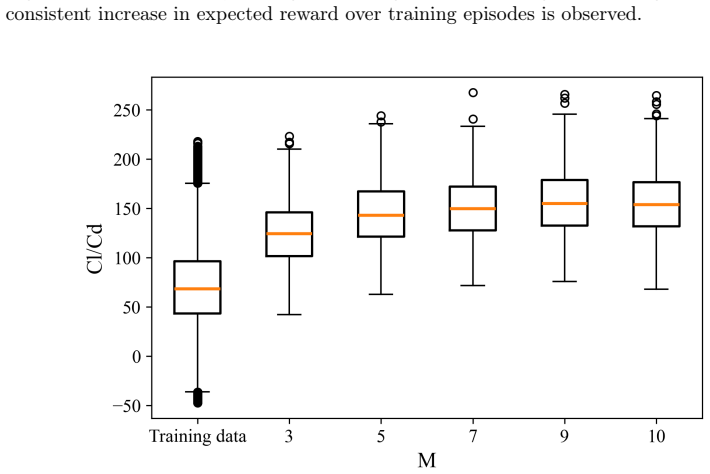
- Because fine-tuning absorbs part of the alignment cost, the inference-time candidate budget $M$ can stay small (10 in the experiments), which limits memory and GPU time compared with decoding that only reweights samples.
- The generated designs fall outside the training reward envelope, so the method acts as an extrapolation tool rather than an interpolation tool, even in design spaces that are already highly optimized.
- The same two-stage pipeline should transfer to other parametric engineering geometries as long as a reward function can be queried, since the framework never needs the reward's gradient.
Reading between the lines
- My inference: the headline gains should be re-scored with an ensemble or uncertainty-aware surrogate, because the same XGBoost model both guides generation and measures the claimed 25% and 10% improvements; a biased surrogate could inflate both numbers together.
- My inference: the soft-value formulation suggests a natural multi-objective extension, replacing the scalar reward $r(x_0)$ with a weighted combination or Pareto reward while keeping the same fine-tune-then-decode pipeline, which the paper does not explore.
- My inference: ablating the reward temperature $\alpha$ and the noise schedule would clarify how much of the gain comes from fine-tuning versus decoding, since both stages use the same exponential weighting and the paper does not separate their contributions.
Editorial analysis
A structured set of objections, weighed in public.
Referee Report
Summary. The paper proposes a reward-directed diffusion framework for generative design optimization. A pre-trained DDPM is fine-tuned with reward-weighted maximum likelihood estimation, and at inference time reward-based importance sampling (soft value-based decoding) is applied. The method is gradient-free and intended for non-differentiable reward functions such as tree-based surrogates. Experiments are conducted on 2D airfoil design (38,000 UIUC-derived airfoils, XGBoost surrogate, R²=0.994) and 3D ship hull design (10,000 parametric hulls, XGBoost surrogate, R²=0.985), with claims of over 10% improvement in Cl/Cd and over 25% reduction in calm-water resistance relative to training data. Partial external validation is provided for one airfoil via XFOIL and one hull via Maxsurf, but the headline improvements are measured with the same surrogate used for guidance.
Significance. If the claims hold, the framework would be a practical contribution: it extends diffusion-based optimization to non-differentiable and expensive reward models while distributing the cost of reward alignment across fine-tuning and inference, and it demonstrates results in two realistic engineering design tasks. The paper also ships a clear algorithmic description and two case studies with some external validation. However, the empirical evidence as presented does not yet establish the headline 'beyond training data' improvements, because the central metrics are evaluated with the same surrogate that guides generation and because the ship resistance objective is not normalized by displacement.
major comments (4)
- [§5.1, §5.2 (Figs. 10, 16; Abstract)] The claimed improvements of over 10% in Cl/Cd and over 25% in resistance are computed using the XGBoost surrogate that also serves as the reward model during generation. Because tree ensembles are piecewise constant outside the training hull, the generated 'beyond-distribution' samples can be adversarial inputs to the surrogate rather than genuinely superior physical designs. The XFOIL check of a single airfoil and the Maxsurf check of a single hull are illustrative but do not re-measure the headline improvements on a sample of generated designs against a baseline. Please provide a distribution-level high-fidelity evaluation (or, at minimum, multiple seeds plus a clear statement that the reported numbers are surrogate-based and should be interpreted accordingly).
- [§4, §5.2 (Eqs. 21–24, Fig. 16)] The ship resistance objective aggregates total resistance over eight speeds and four drafts without normalizing by displacement or a fixed size proxy. Since the frictional and wave components scale with LOA² and wetted surface area, the optimizer can reduce resistance simply by shrinking the hull. The Maxsurf validation reports displacement for the single selected hull (95.160 t) but does not compare at matched displacement against a baseline design, so the claimed >25% resistance reduction is confounded with size change. Please either fix displacement in the reward or report displacement/wetted-area distributions for the training and generated sets and re-evaluate the comparison at matched displacement.
- [§3.4 (Eq. 15, Algorithm 1)] The fine-tuning loss replaces the soft-value expectation E[exp(r(x₀)/α) | x_t] with the single-sample weight exp(r(x₀⁽ⁱ⁾)/α) in Eq. 15 and Algorithm 1. This is a high-variance Monte Carlo approximation, and its validity is not assessed: the paper does not report the variance or effective sample size of these weights, nor a comparison against multi-sample estimates. If the weights concentrate on a few samples, the fine-tuning signal may be dominated by noise rather than by a stable reward direction. Please add a diagnostic of the weight distribution and, ideally, an ablation with a multi-sample approximation to justify this substitution.
- [§5 (Figs. 7–17)] All reported results come from a single run of the full pipeline (pre-training, fine-tuning, and sampling) without multiple seeds or confidence intervals. Because both fine-tuning and stochastic sampling are random processes, the observed boxplot shifts and the claimed improvement percentages could be within run-to-run variability. Please report results over at least 3–5 independent seeds (or a bootstrap over generated samples) and specify the statistic used for the improvement (e.g., median or mean relative to the training-data median or mean).
minor comments (6)
- [Eq. (16)] Equation (16) appears to contain a typesetting error: the loss expression subtracts both ϵ(·; θ_pre) and ϵ(·; θ) and includes an ambiguous '{σ⋄t}²' term, making the definition unreadable. Algorithm 1 presents a cleaner loss and could be used as the canonical form.
- [§5.1, §5.2, Conclusion] The '10% improvement' and '25% reduction' are not tied to a precise baseline in the text (e.g., training-data mean or median, or the pre-trained DDPM). Please state the exact statistic, the baseline value, and the achieved value for each case.
- [§5.1 (Fig. 13)] The statement that the XFOIL-validated airfoil with Cl/Cd = 275.56 is 'well beyond the highest value in the training data' would be substantiated by reporting the training-data maximum Cl/Cd value.
- [§4, §5.1 (surrogate training)] The XGBoost surrogates are described only by in-sample or single-split R² values (0.994 and 0.985). Please describe the train/test split or cross-validation, and report additional error metrics such as RMSE or MAE, especially for the low-resistance/high-reward region that is targeted by optimization.
- [§3.4 (Algorithm 1)] The algorithm collects samples using a mixture of the current fine-tuned policy and the pre-trained policy without an importance-correction term. Reward-weighted maximum likelihood in this off-policy setting is known to be biased; the paper neither discusses this nor justifies the omission, which is worth clarifying.
- [§3.5, §5 (hyperparameters)] The sensitivity of the results to the temperature parameter α and the number of candidates M is only partially examined (M is swept in Fig. 8 and Fig. 14, but α is not). A brief sensitivity study or selection procedure for α would strengthen the empirical claims.
Circularity Check
Headline 'beyond-training' improvements (25% ship resistance, >10% airfoil Cl/Cd) are measured by the same fitted XGBoost reward model used to guide generation; the Maxsurf and XFOIL checks validate only single designs, not the reported distribution-level gains.
-
fitted input called prediction
[Section 4 (Data Processing and Geometry Representation) and Section 5.2 (3D Ship Hull Design Optimization)]
"The aggregated RT on eight different velocities (Froude numbers ranging from 0.1 to 0.45) and four different drafts (0.25, 0.33, 0.5, and 0.67) is considered the performance criterion and is used in this study as an objective function in the RDD model. An XGBoost surrogate model [71] is trained to accelerate resistance prediction, achieving an R2 value of 0.985, which facilitates faster design generation and reward evaluation. ... further fine-tuning and iterative soft value guidance reduce the resistance of the generated samples even more, achieving over 25% reduction in resistance."
The XGBoost surrogate is simultaneously the reward model that guides reward-weighted MLE fine-tuning and soft-value sampling and the evaluator used to report the 'over 25% reduction in resistance.' The claimed improvement is therefore a value of the very function being maximized, not an independent physical prediction. The MAXSURF validation of one hull checks hydrostatics, stability, and produces a resistance curve, but it does not compare the generated hull against a baseline at matched displacement; hence the distribution-level 'beyond training data' reduction is not re-measured by an independent model.
-
fitted input called prediction
[Section 5.1 (2D Airfoil Generative Design) and Section 6 (Conclusion)]
"An XGBoost is trained as a regression model to predict Cl/Cd value for each airfoil design. The coefficient of determination (R2 value) of the trained model is equal to 0.994 which shows high prediction performance. This regression model was used to act as a reward model during fine-tuning. ... Our empirical results show that the iterative reward-directed framework achieves ... an improvement of over 10% in Cl/Cd for airfoil designs."
The reward-weighted MLE loss weights samples by w(i,t)=exp(r(x0)/alpha) with r being the XGBoost Cl/Cd prediction, and the reported 'over 10% improvement' is computed from that same fitted model. The single XFOIL validation reports one design with Cl/Cd=275.56, which supports extrapolation for one sample, but it does not re-measure the distribution-level 10% improvement stated in the Conclusion. Thus the headline airfoil gain is a self-report of the surrogate used as the optimization objective.
full rationale
The central methodological contribution — iterative reward-weighted MLE plus soft-value importance sampling for non-differentiable rewards — is not itself circular: it cites external derivations (Uehara et al.; Li et al.) and the pipeline would work for any reward oracle. No load-bearing self-citation was found: the authors' prior works [21,35] appear only as background. The circularity concern is narrower but real: the paper's headline empirical claims are evaluated by the same fitted XGBoost reward that guides generation. For ships, Section 4 defines the objective as aggregated total resistance from a simplified integral and an XGBoost surrogate with R2=0.985; Section 5.2 reports 'over 25% reduction in resistance' from that surrogate, and the MAXSURF validation does not recompute the reduction against a matched-displacement baseline (it reports displacement 95.160 t for one hull without a baseline comparison). For airfoils, Section 5.1 reports R2=0.994 and uses the same model as reward; the distribution-level 'over 10% improvement' is surrogate-generated, with only one XFOIL-validated sample. This makes the 'beyond training data' claims partially reductions to the fitted reward function rather than independently established physical gains. The external checks prevent a score of 8-10, but the absence of distribution-level independent validation keeps the headline claim partially circular.
Assumptions & free parameters
free parameters (7)
- Temperature alpha for soft value weighting
- Candidate count M per reverse step =
10
- Diffusion noise schedule and timesteps T
- Fine-tuning hyperparameters (learning rate gamma, iterations S, batch size m)
- XGBoost surrogate hyperparameters
- Ship dataset composition (10,000 point subset)
- Reward normalization and feasibility penalty weights
assumptions (6)
- domain assumption Optimal soft policy form p*_t(x_{t-1}|x_t) = exp(v_{t-1}/alpha) p_pre / exp(v_t/alpha) holds for the reverse diffusion MDP
- ad hoc to paper Single-sample reward exp(r(x0)/alpha) is a valid substitute for the soft-value expectation E[exp(r(x0)/alpha)|x_t] in fine-tuning
- domain assumption XGBoost surrogate (R2=0.994 for airfoil, R2=0.985 for ship) is sufficiently accurate to guide optimization and to measure improvements beyond the training distribution
- domain assumption Simplified physics (Michell integral for wave resistance and ITTC friction formula) adequately represents true calm-water resistance for hull optimization
- domain assumption Feasibility constraints from [52] for all 44 ship parameters prevent unrealistic hulls
- standard math Standard DDPM Gaussian forward and reverse process assumptions
Cite this review
Pith. "Pith review of A Reward-Directed Diffusion Framework for Generative Design Optimization." pith.science (2026). https://pith.science/paper/CSC6FJYF
@misc{pith2026250801509,
  author       = {Pith},
  title        = {Pith review of: A Reward-Directed Diffusion Framework for Generative Design Optimization},
  year         = {2026},
  howpublished = {\url{https://pith.science/paper/CSC6FJYF}},
  note         = {Machine review of arXiv:2508.01509}
}
read the original abstract
This study presents a generative optimization framework that builds on a fine-tuned diffusion model and reward-directed sampling to generate high-performance engineering designs. The framework adopts a parametric representation of the design geometry and produces new parameter sets corresponding to designs with enhanced performance metrics. A key advantage of the reward-directed approach is its suitability for scenarios in which performance metrics rely on costly engineering simulations or surrogate models (e.g. graph-based, ensemble models, or tree-based) are non-differentiable or prohibitively expensive to differentiate. This work introduces the iterative use of a soft value function within a Markov decision process framework to achieve reward-guided decoding in the diffusion model. By incorporating soft-value guidance during both the training and inference phases, the proposed approach reduces computational and memory costs to achieve high-reward designs, even beyond the training data. Empirical results indicate that this iterative reward-directed method substantially improves the ability of the diffusion models to generate samples with reduced resistance in 3D ship hull design and enhanced hydrodynamic performance in 2D airfoil design tasks. The proposed framework generates samples that extend beyond the training data distribution, resulting in a greater 25 percent reduction in resistance for ship design and over 10 percent improvement in the lift-to-drag ratio for the 2D airfoil design. Successful integration of this model into the engineering design life cycle can enhance both designer productivity and overall design performance.
Figures


Figures from the paper (17 more)






Reference graph
Works this paper leans on
-
[1]
ElMaraghy, H
W. ElMaraghy, H. ElMaraghy, T. Tomiyama, L. Monostori, Complexity in engineering design and manufacturing, CIRP annals 61 (2) (2012) 793–814
2012
-
[2]
H. M. Gaspar, D. H. Rhodes, A. M. Ross, S. Ove Erikstad, Addressing complexity aspects in conceptual ship design: A systems engineering approach, Journal of Ship Production and Design 28 (04) (2012) 145– 159. 34
2012
-
[3]
Misra, Design Principles of Ships and Marine Structures, Taylor & Francis Limited, 2020
S. Misra, Design Principles of Ships and Marine Structures, Taylor & Francis Limited, 2020
2020
-
[4]
Zhang, S.-L
B.-J. Zhang, S.-L. Zhang, Research on ship design and optimization based on simulation-based design (SBD) technique, Springer, 2019
2019
-
[5]
Kumar, S
A. Kumar, S. Levine, Model inversion networks for model-based opti- mization, Advances in neural information processing systems 33 (2020) 5126–5137
2020
-
[6]
S.L.Brunton, J.N.Kutz, Data-drivenscienceandengineering: Machine learning, dynamical systems, and control, Cambridge University Press, 2022
2022
-
[7]
Regenwetter, A
L. Regenwetter, A. H. Nobari, F. Ahmed, Deep generative models in engineering design: A review, Journal of Mechanical Design 144 (7) (2022) 071704
2022
-
[8]
Jouhaud, P
J.-C. Jouhaud, P. Sagaut, B. Labeyrie, A kriging approach for cfd/wind- tunnel data comparison (2006)
2006
Show all 71 references
-
[9]
Park, P.-K
K. Park, P.-K. Oh, H.-J. Lim, The application of the cfd and kriging method to an optimization of heat sink, International Journal of Heat and Mass Transfer 49 (19-20) (2006) 3439–3447
2006
-
[10]
Kawai, K
S. Kawai, K. Shimoyama, Kriging-model-based uncertainty quantifica- tion in computational fluid dynamics, in: 32nd AIAA Applied Aerody- namics Conference, 2014, p. 2737
2014
-
[11]
Alizadehdakhel, M
A. Alizadehdakhel, M. Rahimi, J. Sanjari, A. A. Alsairafi, Cfd and ar- tificial neural network modeling of two-phase flow pressure drop, In- ternational Communications in Heat and Mass Transfer 36 (8) (2009) 850–856
2009
-
[12]
X. Guo, W. Li, F. Iorio, Convolutional neural networks for steady flow approximation, in: Proceedings of the 22nd ACM SIGKDD interna- tional conference on knowledge discovery and data mining, 2016, pp. 481–490
2016
-
[13]
Í. A. Fonseca, H. M. Gaspar, P. C. de Mello, H. A. U. Sasaki, A standards-based digital twin of an experiment with a scale model ship, Computer-Aided Design 145 (2022) 103191. 35
2022
-
[14]
J. A. Bronson, Í. Fonseca, H. M. Gaspar, Challenges towards an in- tegrated digital twin platform for maritime systems: Tackling shifts in data ownership, in: International Conference on Offshore Mechanics and Arctic Engineering, Vol. 87783, American Society of Mechanical Engi...
2024
-
[15]
Raissi, P
M. Raissi, P. Perdikaris, G. E. Karniadakis, Physics-informed neural networks: A deep learning framework for solving forward and inverse problems involving nonlinear partial differential equations, Journal of Computational physics 378 (2019) 686–707
2019
-
[16]
Z. Li, N. Kovachki, K. Azizzadenesheli, B. Liu, K. Bhattacharya, A. Stu- art, A. Anandkumar, Fourier neural operator for parametric partial dif- ferential equations, arXiv preprint arXiv:2010.08895 (2020)
2020 arXiv
-
[17]
X. Zhao, Z. Gong, Y. Zhang, W. Yao, X. Chen, Physics-informed convo- lutional neural networks for temperature field prediction of heat source layout without labeled data, Engineering Applications of Artificial In- telligence 117 (2023) 105516
2023
-
[18]
G.R.Bokil, T.F.Geyer, S.Merbold, S.Kazula, Physics-guidedconvolu- tional neural network for flow prediction in heat exchangers in electrified aircraft, in: AIAA AVIATION FORUM AND ASCEND 2024, 2024, p. 4108
2024
-
[19]
A. J. Lew, M. J. Buehler, Encoding and exploring latent design space of optimal material structures via a vae-lstm model, Forces in Mechanics 5 (2021) 100054
2021
-
[20]
W. Chen, K. Chiu, M. Fuge, Aerodynamic design optimization and shape exploration using generative adversarial networks, in: AIAA Scitech 2019 forum, 2019, p. 2351
2019
-
[21]
Keramati, F
H. Keramati, F. Hamdullahpur, Generative thermal design through boundary representation and multi-agent cooperative environment, arXiv preprint arXiv:2208.07952 (2022)
2022 arXiv
-
[22]
K. C. Giannakoglou, D. I. Papadimitriou, Adjoint methods for shape optimization, Optimization and computational fluid dynamics (2008) 79–108. 36
2008
-
[23]
Baque, E
P. Baque, E. Remelli, F. Fleuret, P. Fua, Geodesic convolutional shape optimization, in: International Conference on Machine Learning, PMLR, 2018, pp. 472–481
2018
-
[24]
Regenwetter, C
L. Regenwetter, C. Weaver, F. Ahmed, Framed: An automl approach forstructuralperformancepredictionofbicycleframes, Computer-Aided Design 156 (2023) 103446
2023
-
[25]
M. Y. Wang, X. Wang, D. Guo, A level set method for structural topol- ogy optimization, Computer methods in applied mechanics and engi- neering 192 (1-2) (2003) 227–246
2003
-
[26]
D. Da, L. Xia, G. Li, X. Huang, Evolutionary topology optimization of continuum structures with smooth boundary representation, Structural and Multidisciplinary Optimization 57 (2018) 2143–2159
2018
-
[27]
X.Wang, M.Wang, D.Guo, Structuralshapeandtopologyoptimization in a level-set-based framework of region representation, Structural and Multidisciplinary Optimization 27 (2004) 1–19
2004
-
[28]
Azizzadenesheli, N
K. Azizzadenesheli, N. Kovachki, Z. Li, M. Liu-Schiaffini, J. Kossaifi, A. Anandkumar, Neural operators for accelerating scientific simulations and design, Nature Reviews Physics (2024) 1–9
2024
-
[29]
Shukla, V
K. Shukla, V. Oommen, A. Peyvan, M. Penwarden, N. Plewacki, L. Bravo, A. Ghoshal, R. M. Kirby, G. E. Karniadakis, Deep neural operators as accurate surrogates for shape optimization, Engineering Applications of Artificial Intelligence 129 (2024) 107615
2024
-
[30]
Shukla, V
K. Shukla, V. Oommen, A. Peyvan, M. Penwarden, L. Bravo, A. Ghoshal, R. M. Kirby, G. E. Karniadakis, Deep neural operators can serve as accurate surrogates for shape optimization: a case study for airfoils, arXiv preprint arXiv:2302.00807 (2023)
2023 arXiv
-
[31]
J. Suk, P. de Haan, P. Lippe, C. Brune, J. M. Wolterink, Equivariant graph neural networks as surrogate for computational fluid dynamics in 3d artery models, in: Fourth workshop on machine learning and the physical sciences (NeurIPS 2021), 2021. 37
2021
-
[32]
Horie, N
M. Horie, N. Mitsume, Physics-embedded neural networks: Graph neu- ral pde solvers with mixed boundary conditions, Advances in Neural Information Processing Systems 35 (2022) 23218–23229
2022
-
[33]
X. Shao, Z. Liu, S. Zhang, Z. Zhao, C. Hu, Pignn-cfd: A physics- informed graph neural network for rapid predicting urban wind field defined on unstructured mesh, Building and Environment 232 (2023) 110056
2023
-
[34]
Hadizadeh, W
F. Hadizadeh, W. Mallik, R. K. Jaiman, A graph neural network surro- gate model for multi-objective fluid-acoustic shape optimization, arXiv preprint arXiv:2412.16817 (2024)
2024 arXiv
-
[35]
H.Keramati, F.Hamdullahpur, M.Barzegari, Deepreinforcementlearn- ing for heat exchanger shape optimization, International Journal of Heat and Mass Transfer 194 (2022) 123112
2022
-
[36]
W. Chen, F. Ahmed, Mo-padgan: Reparameterizing engineering designs for augmented multi-objective optimization, Applied Soft Computing 113 (2021) 107909
2021
-
[37]
Mirza, Conditional generative adversarial nets, arXiv preprint arXiv:1411.1784 (2014)
M. Mirza, Conditional generative adversarial nets, arXiv preprint arXiv:1411.1784 (2014)
2014 arXiv
-
[38]
D. P. Kingma, Auto-encoding variational bayes, arXiv preprint arXiv:1312.6114 (2013)
2013 arXiv
-
[39]
Zhang, Z
W. Zhang, Z. Yang, H. Jiang, S. Nigam, S. Yamakawa, T. Furuhata, K. Shimada, L. B. Kara, 3d shape synthesis for conceptual design and optimization using variational autoencoders, in: International Design Engineering Technical Conferences and Computers and Information in Engine...
2019
-
[40]
Sohl-Dickstein, E
J. Sohl-Dickstein, E. Weiss, N. Maheswaranathan, S. Ganguli, Deep unsupervised learning using nonequilibrium thermodynamics, in: Inter- national conference on machine learning, PMLR, 2015, pp. 2256–2265
2015
-
[41]
J. Ho, A. Jain, P. Abbeel, Denoising diffusion probabilistic models, Ad- vances in neural information processing systems 33 (2020) 6840–6851. 38
2020
-
[42]
Kotelnikov, D
A. Kotelnikov, D. Baranchuk, I. Rubachev, A. Babenko, Tabddpm: Modelling tabular data with diffusion models, in: International Con- ference on Machine Learning, PMLR, 2023, pp. 17564–17579
2023
-
[45]
Y. Song, J. Sohl-Dickstein, D. P. Kingma, A. Kumar, S. Ermon, B. Poole, Score-based generative modeling through stochastic differen- tial equations, arXiv preprint arXiv:2011.13456 (2020)
2020 arXiv
-
[46]
Dhariwal, A
P. Dhariwal, A. Nichol, Diffusion models beat gans on image synthesis, Advances in neural information processing systems 34 (2021) 8780–8794
2021
-
[47]
Z. Li, H. Yuan, K. Huang, C. Ni, Y. Ye, M. Chen, M. Wang, Dif- fusion model for data-driven black-box optimization, arXiv preprint arXiv:2403.13219 (2024)
2024 arXiv
-
[48]
Krishnamoorthy, S
S. Krishnamoorthy, S. M. Mashkaria, A. Grover, Diffusion models for black-box optimization, in: International Conference on Machine Learn- ing, PMLR, 2023, pp. 17842–17857
2023
-
[49]
J. Ho, T. Salimans, Classifier-free diffusion guidance (2022). arXiv: 2207.12598. URL https://arxiv.org/abs/2207.12598
2022 arXiv
-
[50]
N. J. Bagazinski, F. Ahmed, C-shipgen: a conditional guided diffusion model for parametric ship hull design, in: International Marine Design Conference, 2024
2024
-
[51]
Dhariwal, A
P. Dhariwal, A. Nichol, Diffusion models beat gans on image synthesis (2021). arXiv:2105.05233
2021 arXiv
-
[52]
N. J. Bagazinski, F. Ahmed, Shipgen: A diffusion model for parametric ship hull generation with multiple objectives and constraints, Journal of Marine Science and Engineering 11 (12) (2023) 2215. 39
2023
-
[53]
S. S. Sajjadinia, B. Carpentieri, D. Shriram, G. A. Holzapfel, Multi- fidelity surrogate modeling through hybrid machine learning for biome- chanical and finite element analysis of soft tissues, Computers in Biology and Medicine 148 (2022) 105699
2022
-
[54]
M. A. Arie, A. H. Shooshtari, V. V. Rao, S. V. Dessiatoun, M. M. Ohadi, Air-side heat transfer enhancement utilizing design optimization and an additive manufacturing technique, Journal of Heat Transfer 139 (3) (2017) 031901
2017
-
[55]
M. A. Ganaie, M. Hu, A. K. Malik, M. Tanveer, P. N. Suganthan, En- semble deep learning: A review, Engineering Applications of Artificial Intelligence 115 (2022) 105151
2022
-
[56]
J. Wen, W. Zhu, X. Jia, F. Ma, Q. Liu, Spectral domain graph convolu- tional deep neural network for predicting unsteady and nonlinear flows, Physics of Fluids 35 (9) (2023)
2023
-
[57]
Norouzi, S
M. Norouzi, S. Bengio, N. Jaitly, M. Schuster, Y. Wu, D. Schuurmans, et al., Reward augmented maximum likelihood for neural structured pre- diction, Advances In Neural Information Processing Systems 29 (2016)
2016
-
[58]
Peters, K
J. Peters, K. Mulling, Y. Altun, Relative entropy policy search, in: Pro- ceedings of the AAAI Conference on Artificial Intelligence, Vol. 24, 2010, pp. 1607–1612
2010
-
[59]
Uehara, Y
M. Uehara, Y. Zhao, E. Hajiramezanali, G. Scalia, G. Eraslan, A. Lal, S. Levine, T. Biancalani, Bridging model-based optimization and gener- ativemodelingviaconservativefine-tuningofdiffusionmodels, Advances in Neural Information Processing Systems 37 (2024) 127511–127535
2024
-
[60]
Uehara, Y
M. Uehara, Y. Zhao, E. Hajiramezanali, G. Scalia, G. Eraslan, A. Lal, S. Levine, T. Biancalani, Bridging model-based optimization and gener- ative modeling via conservative fine-tuning of diffusion models (2024). arXiv:2405.19673
2024 arXiv
-
[62]
X. B. Peng, A. Kumar, G. Zhang, S. Levine, Advantage-weighted re- gression: Simple and scalable off-policy reinforcement learning, arXiv preprint arXiv:1910.00177 (2019)
2019 arXiv
-
[63]
Y. Fan, O. Watkins, Y. Du, H. Liu, M. Ryu, C. Boutilier, P. Abbeel, M. Ghavamzadeh, K. Lee, K. Lee, Dpok: Reinforcement learning for fine-tuning text-to-image diffusion models, Advances in Neural Infor- mation Processing Systems 36 (2023) 79858–79885
2023
-
[64]
Zhang, T
H. Zhang, T. Xu, Towards controllable diffusion models via reward- guided exploration (2023). arXiv:2304.07132
2023 arXiv
-
[65]
Uehara, Y
M. Uehara, Y. Zhao, T. Biancalani, S. Levine, Understanding reinforce- ment learning-based fine-tuning of diffusion models: A tutorial and re- view, arXiv preprint arXiv:2407.13734 (2024)
2024 arXiv
-
[66]
X. Li, Y. Zhao, C. Wang, G. Scalia, G. Eraslan, S. Nair, T. Biancalani, S. Ji, A. Regev, S. Levine, et al., Derivative-free guidance in continu- ous and discrete diffusion models with soft value-based decoding, arXiv preprint arXiv:2408.08252 (2024)
2024 arXiv
-
[67]
Heyrani Nobari, W
A. Heyrani Nobari, W. Chen, F. Ahmed, Pcdgan: A continuous condi- tional diverse generative adversarial network for inverse design, in: Pro- ceedings of the 27th ACM SIGKDD conference on knowledge discovery & data mining, 2021, pp. 606–616
2021
-
[68]
N. J. Bagazinski, F. Ahmed, Ship-d: Ship hull dataset for design op- timization using machine learning, in: International Design Engineer- ing Technical Conferences and Computers and Information in Engineer- ing Conference, Vol. 87301, American Society of Mechanical Engineers,...
2023
-
[69]
E. O. Tuck, The wave resistance formula of jh michell (1898) and its significance to recent research in ship hydrodynamics, The ANZIAM Journal 30 (4) (1989) 365–377
1989
-
[70]
J. H. Michell, Xi. the wave-resistance of a ship, The London, Edinburgh, and Dublin Philosophical Magazine and Journal of Science 45 (272) (1898) 106–123. 41
-
[71]
T. Chen, C. Guestrin, Xgboost: A scalable tree boosting system, in: Proceedings of the 22nd ACM SIGKDD International Conference on Knowledge Discovery and Data Mining, KDD ’16, ACM, 2016, p. 785–794
2016
-
[72]
Shwartz-Ziv, A
R. Shwartz-Ziv, A. Armon, Tabular data: Deep learning is not all you need, Information Fusion 81 (2022) 84–90
2022
-
[73]
McElfresh, S
D. McElfresh, S. Khandagale, J. Valverde, V. Prasad C, G. Ramakrish- nan, M. Goldblum, C. White, When do neural nets outperform boosted trees on tabular data?, Advances in Neural Information Processing Sys- tems 36 (2023) 76336–76369
2023
-
[74]
Bentley Systems, Maxsurf Stability Program and User Manual, Bentley Systems, windows Version 20 (2013). 42
2013
Reviewed August 6, 2026 · model on record in the stance chip above.
Discussion (0). Sign in to comment.