REVIEW 3 major objections 4 minor 66 references
Open-Set Heterogeneous Domain Adaptation: Theoretical Analysis and Algorithm
T0 review · 3 major / 4 minor · reviewed 2026-08-11 · deepseek-v4-flash
Pith's one-line read A new three-term error bound for open-set heterogeneous domain adaptation shows exactly what a model must optimize, and a method built on that bound outperforms all baselines on 56 tasks.
desk verdict Fresh DA setting with a very solid benchmark, but the central finite-sample bound has a proof error that should not be ignored. read the letter →
The pith
A machine-rendered reading of the paper's core claim, the machinery that carries it, and where it could break.
The reading
What carries the argument
The load-bearing object is the error decomposition in Theorem 1, which separates target error into source error, open-set difference, and known-class domain distance. The open-set difference $E(P^u_t,h\circ f_t)-\lambda E(P^u_s,h\circ f_s)$ is the term unique to open-set settings; Proposition 1's lower bound motivates the segregation term by showing that separating the unknown-class target distribution from the source distribution lowers the floor on target error. The finite-sample Theorem 2 adds two pieces of machinery: Natarajan-dimension complexity terms from Lemma 5, and a pseudo-label noise $N(P_{t,k},g)$ that enters the bound through the triangle inequality for JS divergence. On the algorithm side, these terms are implemented with centroid-based MMD distances for $L_{inv}$ and $L_{seg}$, and with the non-negative risk estimator of Eq. (5) for $L_{osd}$. Together the bound and its finite-sample refinement tell the method what to optimize and why.
What would settle it
Run a synthetic OSHeDA task with oracle labels for unknown-class target samples, train a variant of RL-OSHeDA that uses those oracle labels to compute the true open-set difference, and compare its target error against the version using the non-negative risk estimator in Eq. (5); if the two diverge when the unknown-class loss on known samples is nonzero, the finite-sample guarantee's reliance on unavailable empirical errors is exposed.
Extended reading notes
Core claim
On its own terms, the paper claims that target-domain error in OSHeDA obeys a three-term decomposition. With $\lambda=P_t(Y\in\mathcal{Y}_s)$ the share of target samples from known classes and $C$ the loss bound, Theorem 1 gives $E(P_t,h\circ f_t)\le \lambda E(P_s,h\circ f_s)+\bigl(E(P^u_t,h\circ f_t)-\lambda E(P^u_s,h\circ f_s)\bigr)+\sqrt{2\lambda C}\bigl(D_{JS}(P_s(Z)\|P_{t,k}(Z))^{1/2}+D_{JS}(P_s(Z,Y)\|P_{t,k}(Z,Y))^{1/2}\bigr)$. The three terms are the source error, the open-set difference, and the known-class domain distance in representation space. The proposed method, Representation Learning for OSHeDA (RL-OSHeDA), is constructed to minimize exactly these quantities: classification loss on labeled data, MMD alignment of marginal and label-conditioned known-class representations, a segregation term for the unknown class, and a non-negative risk estimator whose optimum is the open-set difference. The finite-sample version of the bound adds a pseudo-label noise term, which the two-stage pseudo-labeling procedure is designed to reduce. The empirical claim is that this combination outperforms prior HeDA, OSDA, and OS-SSL methods on all 56 evaluated tasks.
Load-bearing premise
The finite-sample guarantee depends on being able to measure the classifier's error on the very unknown-class target samples that come unlabeled, and the algorithm's substitute estimator only matches that measure under a condition the setup does not guarantee.
Editorial extensions
If this is right
- If Theorem 1 is right, a successful OSHeDA method must simultaneously reduce source error, control the open-set difference, and align known-class marginal and joint distributions; dropping any one of these terms should raise target error.
- Because the joint-distribution term includes the target label distribution, labeled target data or high-quality pseudo-labels are necessary in OSHeDA; unlabeled target data alone cannot minimize the bound.
- The lower bound implies that separating unknown-class representations from known-class ones is a requirement, not a heuristic, because it directly prevents the lower bound on target error from growing.
- The finite-sample bound shows pseudo-label noise enters additively, so the two-stage pseudo-labeling scheme is not an engineering convenience but a way to make the bound tighter.
- The reported consistent ranking advantage over eight baselines, with pairwise significance p-values below 0.05 on 56 tasks, is the empirical consequence predicted by the theory.
Reading between the lines
- A testable extension the paper leaves implicit: the three-term decomposition predicts that RL-OSHeDA's margin over baselines should grow as the unknown-class fraction $1-\lambda$ increases and as feature-space heterogeneity grows, because both enlarge the open-set difference and the JS-distance terms; sweeping $\lambda$ on a fixed benchmark would check this.
- The theory collapses all unknown classes into one 'unk' label; extending the bound to multiple unknown classes with their own conditional distributions would change the open-set difference term and likely require per-class segregation terms.
- Equation (5) is the only component that estimates the open-set difference without unknown-class labels; on a synthetic task with oracle unknown labels, comparing its value with the true open-set difference would show how tightly the finite-sample motivation tracks the implemented loss.
- Because open-set domain adaptation and positive-unlabeled learning are special cases of the same decomposition, the analysis could serve as a template for unifying those neighboring problems.
Signed reviews
Editorial analysis
A structured set of objections, weighed in public.
Referee Report
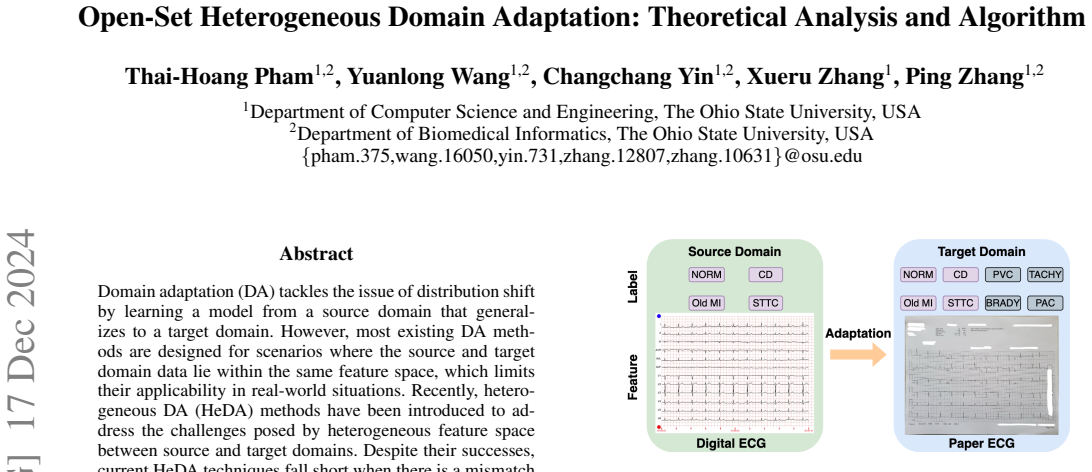
Summary. The paper formalizes open-set heterogeneous domain adaptation (OSHeDA), in which source and target feature spaces differ and the target label space strictly contains the source label space. It develops infinite-sample upper and lower bounds for the target error (Theorem 1 and Proposition 1), a finite-sample bound with pseudo-label noise (Theorem 2), and a homogeneous-DA comparison (Proposition 3). Guided by these bounds, it proposes RL-OSHeDA, a representation-learning method with two feature mappings, MMD-based alignment and segregation terms, a non-negative open-set risk estimator, and a two-stage pseudo-labeling scheme. The method is evaluated on 56 tasks across seven datasets, where it reports consistent improvements over baselines and releases code.
Significance. The OSHeDA scenario is timely, and the empirical evaluation is broad, spanning clinical, vision, and text data. The theoretical decomposition into source error, open-set difference, and known-class domain distance is a useful organizing principle, and the lower-bound argument for segregating unknown classes is intuitive. The paper also makes a concrete algorithmic contribution and publicly releases code, which strengthens reproducibility. However, the theoretical narrative currently contains a false inequality in the proof of the main finite-sample theorem and a statement-level typo in the proof of Proposition 1; these need repair before the bounds can be cited as proven.
major comments (3)
- [Appendix A.2, Eq. (21)] Equation (21) in the proof of Theorem 2 invokes a triangle inequality for Jensen–Shannon divergence, DJS(A||B) ≤ DJS(A||C)+DJS(C||B), which is false. For example, with point masses A=(1,0), B=(0,1), C=(0.8,0.2), DJS(A||B)=0.693 while DJS(A||C)+DJS(C||B)=0.498. The inequality holds for the square root of JS divergence: sqrt(DJS(A||B)) ≤ sqrt(DJS(A||C))+sqrt(DJS(C||B)). Since the final bound in Theorem 2 is exactly of the square-root form, the theorem can be repaired by applying the metric property of sqrt(DJS) in place of the current Eq. (21), but the proof as written is not valid.
- [Appendix A.2, Proposition 1 proof] The final displayed inequality in the proof of Proposition 1 reads λ E(Pt,u,h∘ft), whereas the theorem statement and the preceding Eqs. (19)–(20) imply λ E(Pt,k,h∘ft). As written, the proof does not match the proposition; this should be corrected.
- [Section 4.2 / Section 5.2] Theorem 2 treats the pseudo-label model g as a fixed object and states a bound for all h with N(Pt,k,g) appearing in the bound. In the algorithm of Section 5.2, g is re-derived from the current h and the unlabeled target data at every stage-2 update. The theorem therefore does not, as stated, cover the adaptively coupled (g,h) used by RL-OSHeDA. The authors should either restrict the theoretical claim to a fixed g and state that the algorithm is an approximation, or provide a fixed-point argument.
minor comments (4)
- [Appendix A.1, Lemma 5 proof] In the proof of Lemma 5, the text says 'because of Assumption 2' when bounding the squared losses by C^2; this should cite Assumption 1 instead.
- [Table 1] The KPG row reports N/A for PTB-XL but KPG is included in the average row; the authors should state explicitly that the average excludes the N/A entry.
- [Tables 12 and 19] The dataset names in these tables use the typo 'Reset-50' for ResNet-50; this should be corrected throughout.
- [Section 4.1] The notation P^u_t is easy to confuse with Pt,u; the authors should add a one-sentence reminder in Section 4.2 when empirical errors are introduced, since P^u_t is the surrogate-unk distribution, not the unknown-class conditional.
Circularity Check
No significant circularity; the learning bounds are derived from independent JS-divergence and Rademacher arguments, and the self-citations are peripheral rather than load-bearing.
full rationale
The central derivation chain is self-contained. Theorem 1 is obtained by decomposing the target risk as λE(Pt,k,h∘ft)+(1−λ)E(Pt,u,h∘ft) (Eq. 16), then applying Lemma 1 to the known-class pair and Lemma 2 to the induced unknown-label distributions; the resulting bound contains a source-error term, an open-set difference, and JS-divergence domain distances. Theorem 2 adds a finite-sample Rademacher analysis (Lemmas 4 and 5) and a pseudo-label noise term N(Pt,k,g); this is an upper bound stated in terms of the model's own pseudo-label quality, not a fitted parameter renamed as a prediction. The algorithm's objective L=Lcls+Linv−Lseg+Losd is explicitly motivated by the bound, and Losd in Eq. (5) is exactly an empirical, non-negative version of the open-set difference E(Pu_t,h∘ft)−λE(Pu_s,h∘fs) from Theorem 2; this is theory-to-algorithm design, not circularity. The self-citations to Pham, Zhang, and Zhang (2023) for representation learning and conditional alignment, and to Pham, Zhang, and Zhang (2024) for making cross-entropy bounded under Assumption 1, are not load-bearing: the theorems rest on standard divergence inequalities and Rademacher bounds, and the cited works provide background techniques rather than the target result. The reader's concern about needing unknown-class labels misreads P^u_t: by definition f^u_t(X_t,Y)=(X_t,unk), so bE(P^u_t,h∘ft) is computable from all unlabeled target data; Eq. (5) is a valid empirical estimate of the open-set difference. The separate concern that the proof of Theorem 2 uses a triangle inequality for DJS is a mathematical-correctness issue, not a circular derivation, and therefore does not affect the circularity score. Overall, no claimed prediction reduces by construction to its own input, and no load-bearing argument depends on an unverified self-citation chain.
Assumptions & free parameters
free parameters (2)
- lambda (known class prior) =
estimated per dataset via PU learning (Zeiberg et al. 2020)
- T (stage-switch threshold)
assumptions (4)
- standard math Loss function L is upper bounded by a constant C (Assumption 1)
- domain assumption Sufficient representation: Is(Z,Y)=Is(Xs,Y) (Assumption 2)
- domain assumption Shared representation space Z and a single classifier h over Z work for both domains
- ad hoc to paper Bounded density ratio pt(x,y)/ps(x,y) in Lemma 3's proof
Cite this review
Pith. "Pith review of Open-Set Heterogeneous Domain Adaptation: Theoretical Analysis and Algorithm." pith.science (2026). https://pith.science/paper/CSCRQCOZ
@misc{pith2026241213036,
  author       = {Pith},
  title        = {Pith review of: Open-Set Heterogeneous Domain Adaptation: Theoretical Analysis and Algorithm},
  year         = {2026},
  howpublished = {\url{https://pith.science/paper/CSCRQCOZ}},
  note         = {Machine review of arXiv:2412.13036}
}
read the original abstract
Domain adaptation (DA) tackles the issue of distribution shift by learning a model from a source domain that generalizes to a target domain. However, most existing DA methods are designed for scenarios where the source and target domain data lie within the same feature space, which limits their applicability in real-world situations. Recently, heterogeneous DA (HeDA) methods have been introduced to address the challenges posed by heterogeneous feature space between source and target domains. Despite their successes, current HeDA techniques fall short when there is a mismatch in both feature and label spaces. To address this, this paper explores a new DA scenario called open-set HeDA (OSHeDA). In OSHeDA, the model must not only handle heterogeneity in feature space but also identify samples belonging to novel classes. To tackle this challenge, we first develop a novel theoretical framework that constructs learning bounds for prediction error on target domain. Guided by this framework, we propose a new DA method called Representation Learning for OSHeDA (RL-OSHeDA). This method is designed to simultaneously transfer knowledge between heterogeneous data sources and identify novel classes. Experiments across text, image, and clinical data demonstrate the effectiveness of our algorithm. Model implementation is available at \url{https://github.com/pth1993/OSHeDA}.
Figures


Figures from the paper (1 more)

Reference graph
Works this paper leans on
-
[1]
, " * write output.state after.block = add.period write newline
ENTRY address archivePrefix author booktitle chapter edition editor eid eprint howpublished institution isbn journal key month note number organization pages publisher school series title type volume year label extra.label sort.label short.list INTEGERS output.state before.all mid.sentence after.sentence after.block FUNCTION init.state.consts #0 'before.a...
-
[2]
write newline
" write newline "" before.all 'output.state := FUNCTION n.dashify 't := "" t empty not t #1 #1 substring "-" = t #1 #2 substring "--" = not "--" * t #2 global.max substring 't := t #1 #1 substring "-" = "-" * t #2 global.max substring 't := while if t #1 #1 substring * t #2 global.max substring 't := if while FUNCTION word.in bbl.in capitalize " " * FUNCT...
-
[3]
Albuquerque, I.; Monteiro, J.; Darvishi, M.; Falk, T. H.; and Mitliagkas, I. 2019. Generalizing to unseen domains via distribution matching. arXiv preprint arXiv:1911.00804
arXiv 2019
-
[4]
R.; Usunier, N.; and Goutte, C
Amini, M. R.; Usunier, N.; and Goutte, C. 2009. Learning from multiple partially observed views-an application to multilingual text categorization. Advances in neural information processing systems, 22
work page 2009
-
[5]
Ben-David, S.; Blitzer, J.; Crammer, K.; Kulesza, A.; Pereira, F.; and Vaughan, J. W. 2010. A theory of learning from different domains. Machine learning, 79: 151--175
2010
-
[6]
Biau, G.; Cadre, B.; Sangnier, M.; and Tanielian, U. 2020. Some theoretical properties of GANS . The Annals of Statistics, 48(3): 1539 -- 1566
work page 2020
-
[7]
Bucci, S.; Loghmani, M. R.; and Tommasi, T. 2020. On the effectiveness of image rotation for open set domain adaptation. In European conference on computer vision, 422--438. Springer
work page 2020
-
[8]
Chen, Y.; Zhu, X.; Li, W.; and Gong, S. 2020. Semi-supervised learning under class distribution mismatch. In Proceedings of the AAAI Conference on Artificial Intelligence, volume 34, 3569--3576
work page 2020
Show all 66 references
-
[9]
Chua, T.-S.; Tang, J.; Hong, R.; Li, H.; Luo, Z.; and Zheng, Y. 2009. Nus-wide: a real-world web image database from national university of singapore. In Proceedings of the ACM international conference on image and video retrieval, 1--9
2009
-
[10]
Cortes, C.; and Mohri, M. 2014. Domain adaptation and sample bias correction theory and algorithm for regression. Theoretical Computer Science, 519: 103--126
2014
-
[11]
Dem s ar, J. 2006. Statistical comparisons of classifiers over multiple data sets. The Journal of Machine learning research, 7: 1--30
2006
-
[12]
Deng, J.; Dong, W.; Socher, R.; Li, L.-J.; Li, K.; and Fei-Fei, L. 2009. Imagenet: A large-scale hierarchical image database. In 2009 IEEE conference on computer vision and pattern recognition, 248--255. Ieee
2009
-
[13]
Donahue, J.; Jia, Y.; Vinyals, O.; Hoffman, J.; Zhang, N.; Tzeng, E.; and Darrell, T. 2014. Decaf: A deep convolutional activation feature for generic visual recognition. In International conference on machine learning, 647--655. PMLR
2014
-
[14]
Du, P.; Zhao, S.; Sheng, Z.; Li, C.; and Chen, H. 2023. Semi-Supervised Learning via Weight-aware Distillation under Class Distribution Mismatch. In Proceedings of the IEEE/CVF International Conference on Computer Vision, 16410--16420
2023
-
[15]
Fang, Z.; Lu, J.; Liu, F.; Xuan, J.; and Zhang, G. 2020. Open set domain adaptation: Theoretical bound and algorithm. IEEE transactions on neural networks and learning systems, 32(10): 4309--4322
2020
-
[16]
Fang, Z.; Lu, J.; Liu, F.; and Zhang, G. 2022. Semi-supervised heterogeneous domain adaptation: Theory and algorithms. IEEE Transactions on Pattern Analysis and Machine Intelligence, 45(1): 1087--1105
2022
-
[17]
Ganin, Y.; Ustinova, E.; Ajakan, H.; Germain, P.; Larochelle, H.; Laviolette, F.; Marchand, M.; and Lempitsky, V. 2016. Domain-adversarial training of neural networks. The journal of machine learning research, 17(1): 2096--2030
2016
-
[18]
Goodfellow, I.; Pouget-Abadie, J.; Mirza, M.; Xu, B.; Warde-Farley, D.; Ozair, S.; Courville, A.; and Bengio, Y. 2014. Generative adversarial nets. Advances in neural information processing systems, 27
2014
-
[19]
N.; Patel, J.; Kochendorfer, K
Grief, S. N.; Patel, J.; Kochendorfer, K. M.; Green, L. A.; Lussier, Y. A.; Li, J.; Burton, M.; and Boyd, A. D. 2016. Simulation of ICD-9 to ICD-10-CM transition for family medicine: simple or convoluted? The Journal of the American Board of Family Medicine, 29(1): 29--36
2016
-
[20]
Griffin, G.; Holub, A.; Perona, P.; et al. 2007. Caltech-256 object category dataset. Technical report, Technical Report 7694, California Institute of Technology Pasadena
2007
-
[21]
Gu, X.; Yang, Y.; Zeng, W.; Sun, J.; and Xu, Z. 2022. Keypoint-guided optimal transport with applications in heterogeneous domain adaptation. Advances in Neural Information Processing Systems, 35: 14972--14985
2022
-
[22]
Guo, L.-Z.; Zhang, Z.-Y.; Jiang, Y.; Li, Y.-F.; and Zhou, Z.-H. 2020. Safe deep semi-supervised learning for unseen-class unlabeled data. In International conference on machine learning, 3897--3906. PMLR
2020
-
[23]
He, R.; Han, Z.; Lu, X.; and Yin, Y. 2022. Safe-student for safe deep semi-supervised learning with unseen-class unlabeled data. In Proceedings of the IEEE/CVF Conference on Computer Vision and Pattern Recognition, 14585--14594
2022
-
[24]
Hoffman, J.; Rodner, E.; Donahue, J.; Darrell, T.; and Saenko, K. 2013. Efficient learning of domain-invariant image representations. arXiv preprint arXiv:1301.3224
2013 arXiv
-
[25]
Hoffman, J.; Rodner, E.; Donahue, J.; Kulis, B.; and Saenko, K. 2014. Asymmetric and category invariant feature transformations for domain adaptation. International journal of computer vision, 109: 28--41
2014
-
[26]
Huang, J.; Fang, C.; Chen, W.; Chai, Z.; Wei, X.; Wei, P.; Lin, L.; and Li, G. 2021. Trash to treasure: Harvesting ood data with cross-modal matching for open-set semi-supervised learning. In Proceedings of the IEEE/CVF International Conference on Computer Vision, 8310--8319
2021
-
[27]
Huang, Z.; Yang, J.; and Gong, C. 2022. They are not completely useless: Towards recycling transferable unlabeled data for class-mismatched semi-supervised learning. IEEE Transactions on Multimedia, 25: 1844--1857
2022
-
[28]
C.; and Sugiyama, M
Kiryo, R.; Niu, G.; Du Plessis, M. C.; and Sugiyama, M. 2017. Positive-unlabeled learning with non-negative risk estimator. Advances in neural information processing systems, 30
2017
-
[29]
Kolesnikov, A.; Beyer, L.; Zhai, X.; Puigcerver, J.; Yung, J.; Gelly, S.; and Houlsby, N. 2019. Big transfer (BiT): General visual representation learning. arXiv 2020. arXiv preprint arXiv:1912.11370
2019 arXiv
-
[30]
Koltchinskii, V.; and Panchenko, D. 2000. Rademacher processes and bounding the risk of function learning. In High dimensional probability II, 443--457. Springer
2000
-
[31]
Krizhevsky, A. 2009. Learning Multiple Layers of Features from Tiny Images. Master's thesis, University of Tront
2009
-
[32]
LeCun, Y.; Bengio, Y.; and Hinton, G. 2015. Deep learning. nature, 521(7553): 436--444
2015
-
[33]
Li, G.; Kang, G.; Zhu, Y.; Wei, Y.; and Yang, Y. 2021. Domain consensus clustering for universal domain adaptation. In Proceedings of the IEEE/CVF conference on computer vision and pattern recognition, 9757--9766
2021
-
[34]
Li, J.; Lu, K.; Huang, Z.; Zhu, L.; and Shen, H. T. 2018. Heterogeneous domain adaptation through progressive alignment. IEEE transactions on neural networks and learning systems, 30(5): 1381--1391
2018
-
[35]
H.; and Ding, Z
Li, S.; Xie, B.; Wu, J.; Zhao, Y.; Liu, C. H.; and Ding, Z. 2020. Simultaneous semantic alignment network for heterogeneous domain adaptation. In Proceedings of the 28th ACM international conference on multimedia, 3866--3874
2020
-
[36]
Li, W.; Duan, L.; Xu, D.; and Tsang, I. W. 2013. Learning with augmented features for supervised and semi-supervised heterogeneous domain adaptation. IEEE Transactions on Pattern analysis and machine intelligence, 36(6): 1134--1148
2013
-
[37]
Liang, P. 2016. CS229T/STAT231: Statistical learning theory (Winter 2016)
2016
-
[38]
Liu, F.; Zhang, G.; and Lu, J. 2020. Heterogeneous domain adaptation: An unsupervised approach. IEEE transactions on neural networks and learning systems, 31(12): 5588--5602
2020
-
[39]
Liu, H.; Cao, Z.; Long, M.; Wang, J.; and Yang, Q. 2019. Separate to adapt: Open set domain adaptation via progressive separation. In Proceedings of the IEEE/CVF conference on computer vision and pattern recognition, 2927--2936
2019
-
[40]
Luo, Y.; Wang, Z.; Huang, Z.; and Baktashmotlagh, M. 2020. Progressive graph learning for open-set domain adaptation. In International Conference on Machine Learning, 6468--6478. PMLR
2020
-
[41]
Mansour, Y.; Mohri, M.; and Rostamizadeh, A. 2009. Domain adaptation: Learning bounds and algorithms. arXiv preprint arXiv:0902.3430
2009 arXiv
-
[42]
Natarajan, B. K. 1989. On learning sets and functions. Machine Learning, 4: 67--97
1989
-
[43]
T.; Tran, T.; Gal, Y.; Torr, P.; and Baydin, A
Nguyen, A. T.; Tran, T.; Gal, Y.; Torr, P.; and Baydin, A. G. 2021. KL Guided Domain Adaptation. In International Conference on Learning Representations
2021
-
[44]
Pham, T.-H.; Zhang, X.; and Zhang, P. 2023. Fairness and Accuracy under Domain Generalization. In The Eleventh International Conference on Learning Representations
2023
-
[45]
Pham, T.-H.; Zhang, X.; and Zhang, P. 2024. Non-stationary Domain Generalization: Theory and Algorithm. In The 40th Conference on Uncertainty in Artificial Intelligence
2024
-
[46]
Qui \ n onero-Candela, J.; Sugiyama, M.; Schwaighofer, A.; and Lawrence, N. D. 2022. Dataset shift in machine learning. Mit Press
2022
-
[47]
R.; Levy, R.; and Vasconcelos, N
Rasiwasia, N.; Costa Pereira, J.; Coviello, E.; Doyle, G.; Lanckriet, G. R.; Levy, R.; and Vasconcelos, N. 2010. A new approach to cross-modal multimedia retrieval. In Proceedings of the 18th ACM international conference on Multimedia, 251--260
2010
-
[48]
Russakovsky, O.; Deng, J.; Su, H.; Krause, J.; Satheesh, S.; Ma, S.; Huang, Z.; Karpathy, A.; Khosla, A.; Bernstein, M.; et al. 2015. Imagenet large scale visual recognition challenge. International journal of computer vision, 115: 211--252
2015
-
[49]
Saenko, K.; Kulis, B.; Fritz, M.; and Darrell, T. 2010. Adapting visual category models to new domains. In Computer Vision--ECCV 2010: 11th European Conference on Computer Vision, Heraklion, Crete, Greece, September 5-11, 2010, Proceedings, Part IV 11, 213--226. Springer
2010
-
[50]
Saito, K.; Kim, D.; and Saenko, K. 2021. Openmatch: Open-set semi-supervised learning with open-set consistency regularization. Advances in Neural Information Processing Systems, 34: 25956--25967
2021
-
[51]
Saito, K.; Yamamoto, S.; Ushiku, Y.; and Harada, T. 2018. Open set domain adaptation by backpropagation. In Proceedings of the European conference on computer vision (ECCV), 153--168
2018
-
[52]
Shalev-Shwartz, S.; and Ben-David, S. 2014. Understanding machine learning: From theory to algorithms. Cambridge university press
2014
-
[53]
Shen, C.; and Guo, Y. 2018. Unsupervised heterogeneous domain adaptation with sparse feature transformation. In Asian conference on machine learning, 375--390. PMLR
2018
-
[54]
Simonyan, K.; and Zisserman, A. 2014. Very deep convolutional networks for large-scale image recognition. arXiv preprint arXiv:1409.1556
2014 arXiv
-
[55]
Van der Maaten, L.; and Hinton, G. 2008. Visualizing data using t-SNE. Journal of machine learning research, 9(11)
2008
-
[56]
I.; Samek, W.; and Schaeffter, T
Wagner, P.; Strodthoff, N.; Bousseljot, R.-D.; Kreiseler, D.; Lunze, F. I.; Samek, W.; and Schaeffter, T. 2020. PTB-XL, a large publicly available electrocardiography dataset. Scientific data, 7(1): 1--15
2020
-
[57]
Wang, Y.; Qiao, P.; Liu, C.; Song, G.; Zheng, X.; and Chen, J. 2023. Out-of-distributed semantic pruning for robust semi-supervised learning. In Proceedings of the IEEE/CVF Conference on Computer Vision and Pattern Recognition, 23849--23858
2023
-
[58]
Xu, R.; Liu, P.; Zhang, Y.; Cai, F.; Wang, J.; Liang, S.; Ying, H.; and Yin, J. 2020. Joint Partial Optimal Transport for Open Set Domain Adaptation. In IJCAI, 2540--2546
2020
-
[59]
Yao, Y.; Zhang, Y.; Li, X.; and Ye, Y. 2019. Heterogeneous domain adaptation via soft transfer network. In Proceedings of the 27th ACM MM, 1578--1586
2019
-
[60]
Yao, Y.; Zhang, Y.; Li, X.; and Ye, Y. 2020. Discriminative distribution alignment: A unified framework for heterogeneous domain adaptation. Pattern Recognition, 101: 107165
2020
-
[61]
Yu, Q.; Ikami, D.; Irie, G.; and Aizawa, K. 2020. Multi-task curriculum framework for open-set semi-supervised learning. In Computer Vision--ECCV 2020: 16th European Conference, Glasgow, UK, August 23--28, 2020, Proceedings, Part XII 16, 438--454. Springer
2020
-
[62]
A.; Ainslie, J.; Alberti, C.; Ontanon, S.; Pham, P.; Ravula, A.; Wang, Q.; Yang, L.; et al
Zaheer, M.; Guruganesh, G.; Dubey, K. A.; Ainslie, J.; Alberti, C.; Ontanon, S.; Pham, P.; Ravula, A.; Wang, Q.; Yang, L.; et al. 2020. Big bird: Transformers for longer sequences. Advances in neural information processing systems, 33: 17283--17297
2020
-
[63]
Zeiberg, D.; Jain, S.; and Radivojac, P. 2020. Fast nonparametric estimation of class proportions in the positive-unlabeled classification setting. In Proceedings of the AAAI Conference on Artificial Intelligence, volume 34, 6729--6736
2020
-
[64]
T.; Zhang, K.; and Gordon, G
Zhao, H.; Des Combes, R. T.; Zhang, K.; and Gordon, G. 2019. On learning invariant representations for domain adaptation. In International conference on machine learning, 7523--7532. PMLR
2019
-
[65]
H.; Cao, W.; Wang, X.; and Tian, S
Zhao, Y.; Li, S.; Zhang, R.; Liu, C. H.; Cao, W.; Wang, X.; and Tian, S. 2022. Semantic correlation transfer for heterogeneous domain adaptation. IEEE Transactions on Neural Networks and Learning Systems
2022
-
[66]
Zou, Y.; Yu, Z.; Kumar, B.; and Wang, J. 2018. Unsupervised domain adaptation for semantic segmentation via class-balanced self-training. In Proceedings of the European conference on computer vision (ECCV), 289--305
2018
Reviewed August 11, 2026 · model on record in the stance chip above.
Discussion (0). Continue with ORCID to comment.