REVIEW 1 major objections 5 minor 134 references
Quantum Coordination and Nonlocal Games: Theory and Applications
T0 review · 1 major / 5 minor · reviewed 2026-08-11 · deepseek-v4-flash
Pith's one-line read Empirical quantum coordination costs the full entropy rate.
desk verdict A clear, useful review of quantum coordination whose main game-theoretic example oversteps the theorems it quotes; fix the CHSH section and the table swap and it deserves refereeing. read the letter →
The pith
A machine-rendered reading of the paper's core claim, the machinery that carries it, and where it could break.
The reading
What carries the argument
The machinery is a set of exact coordination rate regions expressed in conditional von Neumann entropies, computed for classical–quantum target states of the form $\omega_{XYSAB}$ and for pure states $|\omega\rangle_{ABC}$. The main proof tools are quantum channel resolvability and random binning for classical links, and quantum state redistribution, Schumacher compression, and the decoupling theorem for quantum links. Negative conditional entropy—the phenomenon the paper calls 'knowing less than nothing'—is what permits cascade rates to reverse ordering, and the independence assumption $\omega_{XYS}=\omega_{XY}\otimes\omega_S$ is what keeps the broadcast formulas simple.
What would settle it
Search for a protocol that achieves empirical coordination of the pure bipartite state $|\omega\rangle_{AB}$ with a quantum communication rate strictly below $H(\omega_B)$ while keeping the average state within vanishing trace distance of the target; existence of even one asymptotic protocol would falsify the theorem's claimed optimality. The same check can be done numerically by optimizing over all blocklength-$n$ encodings and verifying whether the $n\to\infty$ rate can dip below the entropy.
Extended reading notes
Core claim
The paper's most consequential claim is that, for a two-node quantum network, weak 'empirical' coordination—matching only the average statistics of a repeated experiment—does not reduce the communication cost below that of strong coordination. For a pure bipartite target $|\omega\rangle_{AB}$, both tasks require the source to send qubits at rate at least $H(\omega_B)$, the von Neumann entropy of Bob's reduced state, so lossless compression stays optimal even when only averages matter. In the broadcast network with classical inputs $X,Y$ and quantum outputs $A,B$, the paper states necessary and sufficient conditions $Q_{1\to2}\ge H(A|X)_\omega$ and $Q_{1\to3}\ge H(B|Y)_\omega$ for both strong and empirical coordination. The cascade results show the reverse of classical intuition: for entangled targets the Alice–Bob link can carry fewer qubits than the Bob–Charlie link. The review also derives classical-link results that restrict achievable correlations to separable states, and connects the rate formulas to CHSH-winning thresholds and DI-QKD key rates.
Load-bearing premise
The broadcast-network rate formulas hold only while the source register $S$ stays uncorrelated with the classical inputs $X$ and $Y$ (Remark 3, Eq. (37)); when that independence fails, the simple bounds $H(A|X)$ and $H(B|Y)$ cease to apply.
Editorial extensions
If this is right
- In the two-node case, empirical coordination of a pure bipartite state demands the same qubit rate $H(\omega_B)$ as strong coordination, so no asymptotic protocol saves communication by settling for average statistics.
- In quantum-linked broadcast networks, the strong and empirical coordination rate regions coincide, so game strategies based on repeated rounds are not cheaper than those that reproduce the full i.i.d. sequence.
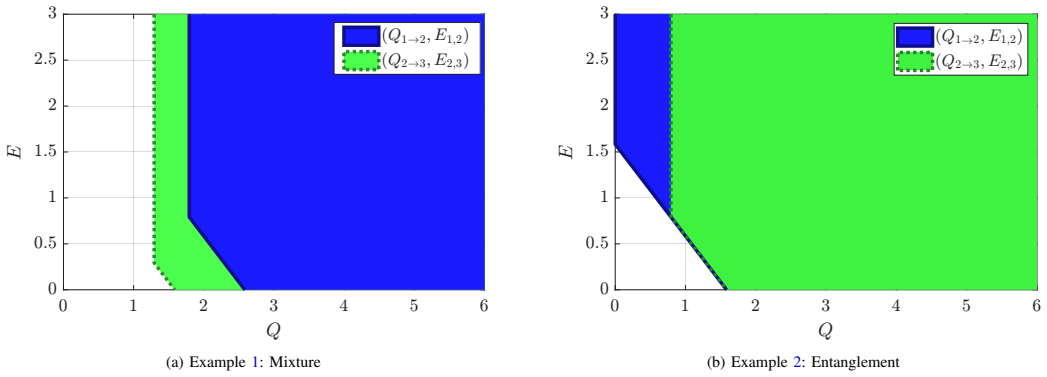
- In cascade networks with entangled targets, the Alice-to-Bob link may require fewer qubits than Bob-to-Charlie, because conditional entropy can be negative.
- Classical links can only coordinate separable correlations, so entanglement targets are impossible without quantum links or pre-shared entanglement.
- The coordination rates set the exact threshold for Bell violation in the CHSH game and for a positive device-independent key rate under depolarizing noise.
Reading between the lines
- This inference goes beyond the paper: if the equality of strong and empirical rates holds for arbitrary network topologies, then finite blocklength and noisy-channel models are where any discount for empirical coordination would have to appear, making those regimes the natural next test.
- The cascade rate reversal suggests a routing principle the paper does not state: in quantum networks, link-rate requirements are not monotone along a path, so intermediate nodes may need more capacity than upstream ones whenever entanglement is being generated.
- A testable extension would be to run CHSH-type games with protocols that only enforce empirical coordination—without round-wise independence—and measure whether the winning probability still reaches $0.8535$ at the predicted rate.
Editorial analysis
A structured set of objections, weighed in public.
Referee Report
Summary. The manuscript is a review of quantum coordination in multi-user networks. It defines strong and empirical coordination for classical and quantum systems, reviews two-node, broadcast, cascade, multiple-access, and no-communication network models, and quotes exact rate characterizations from the authors' prior papers (Theorems 1–8, attributed to [21], [55], and [86]). The paper then applies the broadcast coordination framework to the CHSH game, deriving communication-rate thresholds for Bell violation, and discusses device-independent QKD and quantum repeaters as further applications. The review is clearly organized and the distinction between empirical and strong coordination is presented as a central theme, with the claimed quantum phenomenon that empirical coordination does not reduce the communication rate for bipartite pure states.
Significance. The paper fills a useful expository niche by collecting recent coordination results and connecting them to nonlocal games and quantum networking. The cascade examples (Example 1 versus Example 2) nicely illustrate how entangled targets can reverse the classical rate ordering, and the DI-QKD and repeater sections provide accessible context. The review does not contain new proofs; all technical statements are referenced to the authors' own prior work. The one new application, the CHSH coordination-rate calculation, contains a domain error described in the major comments, so the advertised bridge between coordination theory and nonlocal games is not yet established. If the CHSH discussion is restricted to the constant-α case, which is within the theorem domain, the qualitative conclusions about Bell-violation thresholds survive, but the general parameterized formulas must be removed or corrected.
major comments (1)
- [Sec. III.E, Remark 3, Theorems 1 and 7] The parameterized CHSH example is outside the domain of the quoted broadcast-coordination theorems. In the broadcast model, Remark 3 requires the target state to obey non-signaling constraints: Alice's marginal of the source-output state may depend on x but not on y, and Bob's marginal may depend on y but not on x. For the state in Eq. (34), the reduced states on A and B are both diagonal with conditional probabilities α_{x,y} and 1−α_{x,y}; hence independence of y for Alice and independence of x for Bob force α_{x,y} to be constant in both arguments. Consequently, the rate formulas preceding Remark 1, which average different α values per question pair, do not follow from Theorems 1 and 7, and neither does Remark 1's assertion that strong and empirical rates coincide for the general parameterized family. The special case α_{x,y}=α, yielding Q_{i→j} ≥ h_2(α), is valid, and the threshold discussion can be stated for that case; as written, the general formulas and the threshold condition α_{x,y}>0.04491 are unsupported.
minor comments (5)
- [Fig. 7 / Sec. I.C.1] Figure 7 swaps the strong-coordination entries for CR and no-CR relative to the text in Section I.C.1: the text says that with CR the rate is I(X;Y) and without CR it is C(X;Y), while the table lists C(X;Y) under CR and I(X;Y) under no CR. Please correct the table.
- [Eq. (35)] The displayed formula for π_CHSH(P) appears garbled in typesetting; as printed, it does not evaluate to 0.8535 for α_{x,y}=1/2. Please check the expression and ensure that the stated numerical values follow.
- [Sec. III.D–III.E] Section III.D states that S is null and A and B are classical, but Section III.E immediately treats qubit states on A and B; please clarify that Section III.E considers the quantum-resource target state for the broadcast network rather than the final classical answer registers.
- [Sec. I.C.2] The claim that empirical coordination of a bipartite pure state requires the same rate H(ω_B) as strong coordination is presented as a recent result from [55] without any intuitive explanation; a short remark on why the quantum case differs from the classical case would improve readability.
- [Sec. VII.B] In the DI-QKD example, the depolarized state in Eq. (63) appears to satisfy the broadcast network's non-signaling constraints because α is constant; I recommend stating this explicitly when applying Theorem 1 in Eq. (69).
Circularity Check
No significant circularity: quoted theorems are independently stated with explicit assumptions, and no prediction reduces to its inputs by construction.
full rationale
This is a review paper whose technical core consists of theorems quoted from the authors' own prior work ([21], [55], [86]) with explicit references. That is not circular: each theorem is stated as a parameter-free rate characterization with stated hypotheses (e.g., Remark 3, Eq. (37), for the broadcast network), and the rate formulas do not include the target rates as assumed inputs. The strongest claim, that empirical coordination of a bipartite pure state requires the same entropy rate H(omega_B) as strong coordination, is explicitly attributed to [55], an external ITW publication with a stated model; the manuscript does not redefine the quantity in terms of the conclusion. The classical/quantum comparison in Section I.C.2 and the later theorems are therefore supported by prior peer-reviewed proofs rather than by the review's own assumptions. I also checked for self-definitional or ansatz-smuggling patterns: the network models and rate regions in Sections V and VI are not defined in terms of the predicted rates, and no auxiliary variable is chosen specifically to force the stated answer. The one notable internal issue is that Section III.E applies Theorems 1 and 7 to the CHSH example, where the Source state |omega^{(x,y)}> depends on the classical registers X and Y, while Remark 3/Eq. (37) requires omega_{XY S} = omega_{XY} tensor omega_S, i.e., S uncorrelated with XY. This is a genuine support gap and a correctness concern for the quoted game rates, but it is not a circular reduction: the example does not define the rates in terms of themselves, nor does it fit a parameter and then rename it a prediction. Accordingly, the circularity score is 0.
Assumptions & free parameters
assumptions (4)
- domain assumption Theorems 1-8 quoted from [21,55,86] are correct.
- domain assumption Memoryless i.i.d. source and noiseless link model.
- domain assumption Non-signaling independence ω_{XY S} = ω_{XY} ⊗ ω_S in broadcast networks.
- standard math Finite-dimensional Hilbert spaces and standard quantum information facts (no-cloning, quantum reverse Shannon theorem, decoupling theorem).
Cite this review
Pith. "Pith review of Quantum Coordination and Nonlocal Games: Theory and Applications." pith.science (2026). https://pith.science/paper/CSNU3M5G
@misc{pith2026260809540,
  author       = {Pith},
  title        = {Pith review of: Quantum Coordination and Nonlocal Games: Theory and Applications},
  year         = {2026},
  howpublished = {\url{https://pith.science/paper/CSNU3M5G}},
  note         = {Machine review of arXiv:2608.09540}
}
read the original abstract
Coordination is a fundamental primitive in communication and information theory, in which distributed systems must collectively generate correlated behavior rather than merely exchange messages. In quantum networks, the nature of entanglement, quantum measurements, and nonclassical correlations introduces coordination possibilities unavailable classically. This article reviews recent advances in coordination over classical and quantum communication networks, focusing on empirical and strong coordination in multi-user settings. We consider the implications of coordination for nonlocal games, showing how it provides a natural framework for understanding the correlations that enable spatially separated players to improve their probability of winning. We present a unified framework for coordination using classical or quantum communication and pre-shared correlation resources. The review covers simulation of both entanglement and separable correlations across a variety of network architectures, including two-node, cascade, broadcast, and multiple-access networks. We study the operational differences between empirical and strong coordination, and the tradeoffs between communication and correlation resources, such as pre-shared randomness and entanglement. Coordination plays a major role in device-independent quantum key distribution (DI-QKD) schemes, in which parties can generate a secret key even if the devices used in the process have been prepared by an adversary. Furthermore, we examine the role of coordination in quantum repeaters, where distributed entanglement serves as a resource for long-distance quantum communication. The review highlights connections between coordination theory and applications such as distributed quantum systems, quantum internet architectures, and future communication networks.
Figures


Figures from the paper (16 more)




Reference graph
Works this paper leans on
-
[55]
Empirical coordination of quantum correlations,
H. Natur and U. Pereg, “Empirical coordination of quantum correlations,” in2025 IEEE Information Theory Workshop (ITW). IEEE, 2025, pp. 1–7
work page 2025
-
[21]
Quantum coordination rates in multi-user networks,
H. Natur and U. Pereg, “Quantum coordination rates in multi-user networks,”IEEE Trans. Inf. Theory, 2025
2025
-
[86]
Empirical coordination of separable quantum correlations,
H. Natur and U. Pereg, “Empirical coordination of separable quantum correlations,”AIMS Mathematics, vol. 10, no. 4, 2025
work page 2025
-
[1]
Coordination capacity,
P. W. Cuff, H. H. Permuter, and T. M. Cover, “Coordination capacity,”IEEE Trans. Inf. Theory, vol. 56, no. 9, pp. 4181–4206, 2010
2010
-
[2]
Communication for generating correlation: A unifying survey,
M. Sudan, H. Tyagi, and S. Watanabe, “Communication for generating correlation: A unifying survey,”IEEE Trans. Inf. Theory, vol. 66, no. 1, pp. 5–37, 2019
2019
-
[3]
Real-time communication and coordination in embedded sensor networks,
J. A. Stankovic, T. Abdelzaher, C. Lu, L. Sha, and J. C. Hou, “Real-time communication and coordination in embedded sensor networks,”Proc. IEEE, vol. 91, no. 7, pp. 1002–1022, 2003
2003
-
[4]
A survey of autonomous vehicles: Enabling communication technologies and challenges,
M. N. Ahangar, Q. Z. Ahmed, F. A. Khan, and M. Hafeez, “A survey of autonomous vehicles: Enabling communication technologies and challenges,”Sensors, vol. 21, no. 3, p. 706, 2021
2021
-
[5]
Coordination using implicit communication,
P. Cuff and L. Zhao, “Coordination using implicit communication,” in2011 IEEE Inf. Theory Workshop (ITW 2011). IEEE, 2011, pp. 467–471
2011
Show all 134 references
-
[6]
Cooperative computing for distributed embedded systems,
C. Borcea, D. Iyer, P. Kang, A. Saxena, and L. Iftode, “Cooperative computing for distributed embedded systems,” in Proc. 22nd Int. Conf. Distrib. Comput. Syst.IEEE, 2002, pp. 227–236
2002
-
[7]
Remote empirical coordination,
M. Mylonakis, P. A. Stavrou, and M. Skoglund, “Remote empirical coordination,” in2020 Int. Symp. Inf. Theory Appl. (ISITA 2020). IEEE, 2020, pp. 31–35
2020
-
[8]
Internet-of-Things enabled supply chain planning and coordination with big data services: Certain theoretic implications,
L. He, M. Xue, and B. Gu, “Internet-of-Things enabled supply chain planning and coordination with big data services: Certain theoretic implications,”J. Manage. Sci. Eng., vol. 5, no. 1, pp. 1–22, 2020
2020
-
[9]
Message identification for task-oriented communications: Exploiting an exponential increase in the number of connected devices,
L. Torres-Figueroa, R. Ferrara, C. Deppe, and H. Boche, “Message identification for task-oriented communications: Exploiting an exponential increase in the number of connected devices,”IEEE Internet of Things Mag., vol. 6, no. 4, pp. 42–47, 2023
2023
-
[10]
Secure communication with unreliable entanglement assistance,
M. Lederman and U. Pereg, “Secure communication with unreliable entanglement assistance,” in2024 IEEE Int. Symp. Inf. Theory (ISIT), 2024, pp. 1017–1022
2024
-
[11]
A. E. Gamal and Y .-H. Kim,Network Information Theory. Cambridge University Press, 2011
2011
-
[12]
Linear multiuser receivers: Effective interference, effective bandwidth and user capacity,
D. N. C. Tse and S. V . Hanly, “Linear multiuser receivers: Effective interference, effective bandwidth and user capacity,” IEEE Trans. Inf. theory, vol. 45, no. 2, pp. 641–657, 1999
1999
-
[13]
Identification over quantum broadcast channels,
J. Rosenberger, C. Deppe, and U. Pereg, “Identification over quantum broadcast channels,”Quantum Inf. Process., vol. 22, no. 10, p. 361, 2023
2023
-
[14]
The multiple-access channel with entangled transmitters,
U. Pereg, C. Deppe, and H. Boche, “The multiple-access channel with entangled transmitters,” inProc. Global Commun. Conf. (GLOBECOM’2023). IEEE, 2023, pp. 3173–3178
2023
-
[15]
Covert communication over ak-user multiple-access channel,
K. S. K. Arumugam and M. R. Bloch, “Covert communication over ak-user multiple-access channel,”IEEE Trans. Inf. Theory, vol. 65, no. 11, pp. 7020–7044, 2019
2019
-
[16]
Joint empirical coordination of source and channel,
M. Le Treust, “Joint empirical coordination of source and channel,”IEEE Trans. Inf. Theory, vol. 63, no. 8, pp. 5087– 5114, 2017
2017
-
[17]
Entanglement-enabled communication,
J. N ¨otzel, “Entanglement-enabled communication,”IEEE J. Sel. Areas Inf. Theory, vol. 1, no. 2, pp. 401–415, 2020
2020
-
[18]
Entanglement-enabled communication for the Internet of things,
J. N ¨otzel and S. DiAdamo, “Entanglement-enabled communication for the Internet of things,” in2020 Int. Conf. Comput., Inf. Telecommun. Syst. (CITS), 2020, pp. 1–6
2020
-
[19]
Practical quantum-enhanced receivers for classical communication,
I. Burenkov, M. Jabir, and S. Polyakov, “Practical quantum-enhanced receivers for classical communication,”AVS quantum sci., vol. 3, no. 2, 2021
2021
-
[20]
A novel architecture for future classical-quantum communication networks,
F. Granelli, R. Bassoli, J. N ¨otzel, F. H. Fitzek, H. Boche, N. L. da Fonsecaet al., “A novel architecture for future classical-quantum communication networks,”Wireless Commun. Mobile Comput., vol. 2022, 2022
2022
-
[22]
Trading classical communication, quantum communication, and entanglement in quantum Shannon theory,
M. Hsieh and M. M. Wilde, “Trading classical communication, quantum communication, and entanglement in quantum Shannon theory,”IEEE Trans. Inf. Theory, vol. 56, no. 9, pp. 4705–4730, Sep 2010
2010
-
[23]
The quantum illumination story,
J. H. Shapiro, “The quantum illumination story,”IEEE Aerospace and Electronic Systems Magazine, vol. 35, no. 4, pp. 8–20, 2020
2020
-
[24]
R. B. Myerson,Game Theory: Analysis of Conflict. Cambridge, MA: Harvard University Press, 1997
1997
-
[25]
The quantum multiple-access channel with cribbing encoders,
U. Pereg, C. Deppe, and H. Boche, “The quantum multiple-access channel with cribbing encoders,”IEEE Trans. Inf. Theory, vol. 68, no. 6, pp. 3965–3988, 2022
2022
-
[26]
Bell nonlocality,
N. Brunner, D. Cavalcanti, S. Pironio, V . Scarani, and S. Wehner, “Bell nonlocality,”Rev. modern phys., vol. 86, no. 2, pp. 419–478, 2014
2014
-
[27]
Nonlocality and communication complexity,
H. Buhrman, R. Cleve, S. Massar, and R. de Wolf, “Nonlocality and communication complexity,”Reviews of Modern Physics, vol. 82, no. 1, pp. 665–698, 2010
2010
-
[28]
Proposed experiment to test local hidden-variable theories,
J. F. Clauser, M. A. Horne, A. Shimony, and R. A. Holt, “Proposed experiment to test local hidden-variable theories,” Phys. rev. lett., vol. 23, no. 15, p. 880, 1969
1969
-
[29]
On the Einstein Podolsky Rosen paradox,
J. S. Bell, “On the Einstein Podolsky Rosen paradox,”Phys. Phys. Fiz., vol. 1, no. 3, p. 195, 1964
1964
-
[30]
Coin flipping by telephone a protocol for solving impossible problems,
M. Blum, “Coin flipping by telephone a protocol for solving impossible problems,”ACM SIGACT News, vol. 15, no. 1, pp. 23–27, 1983
1983
-
[31]
On the commitment capacity of unfair noisy channels,
C. Cr ´epeau, R. Dowsley, and A. C. Nascimento, “On the commitment capacity of unfair noisy channels,”IEEE Transactions on Information Theory, vol. 66, no. 6, pp. 3745–3752, 2020
2020
-
[32]
How to play any mental game, or a completeness theorem for protocols with honest majority,
O. Goldreich, S. Micali, and A. Wigderson, “How to play any mental game, or a completeness theorem for protocols with honest majority,” inProviding Sound Foundations for Cryptography: On the Work of Shafi Goldwasser and Silvio Micali, 2019, pp. 307–328
2019
-
[33]
Multiparty computations ensuring privacy of each party’s input and correctness of the result,
D. Chaum, I. B. Damg ˚ard, and J. Van de Graaf, “Multiparty computations ensuring privacy of each party’s input and correctness of the result,” inAdvances in Cryptology—CRYPTO’87: Proceedings 7. Springer, 1988, pp. 87–119
1988
-
[34]
A randomized protocol for signing contracts,
S. Even, O. Goldreich, and A. Lempel, “A randomized protocol for signing contracts,”Communications of the ACM, vol. 28, no. 6, pp. 637–647, 1985
1985
-
[35]
Proofs that yield nothing but their validity or all languages in np have zero-knowledge proof systems,
O. Goldreich, S. Micali, and A. Wigderson, “Proofs that yield nothing but their validity or all languages in np have zero-knowledge proof systems,”Journal of the ACM (JACM), vol. 38, no. 3, pp. 690–728, 1991
1991
-
[36]
Minimum disclosure proofs of knowledge,
G. Brassard, D. Chaum, and C. Cr ´epeau, “Minimum disclosure proofs of knowledge,”Journal of computer and system sciences, vol. 37, no. 2, pp. 156–189, 1988
1988
-
[37]
Is quantum bit commitment really possible?
H.-K. Lo and H. F. Chau, “Is quantum bit commitment really possible?”Phys. Rev. Lett., vol. 78, no. 17, p. 3410, 1997
1997
-
[38]
Unconditionally secure quantum bit commitment is impossible,
D. Mayers, “Unconditionally secure quantum bit commitment is impossible,”Phys. rev. lett., vol. 78, no. 17, p. 3414, 1997
1997
-
[39]
Why quantum bit commitment and ideal quantum coin tossing are impossible,
H.-K. Lo and H. F. Chau, “Why quantum bit commitment and ideal quantum coin tossing are impossible,”Physica D: Nonlinear Phenomena, vol. 120, no. 1-2, pp. 177–187, 1998
1998
-
[40]
Commitment capacity of discrete memoryless channels,
A. Winter, A. C. Nascimento, and H. Imai, “Commitment capacity of discrete memoryless channels,” inCryptography and Coding: 9th IMA Int. Conf., Cirencester, UK, December 16-18, 2003. Proc. 9. Springer, 2003, pp. 35–51
2003
-
[41]
Quantum cryptography: Public key distribution and coin tossing,
C. H. Bennett and G. Brassard, “Quantum cryptography: Public key distribution and coin tossing,” inProceedings of the IEEE International Conference on Computers, Systems and Signal Processing, Bangalore, India, 1984, pp. 175–179
1984
-
[42]
Quantum cryptography based on bell’s theorem,
A. K. Ekert, “Quantum cryptography based on bell’s theorem,”Physical review letters, vol. 67, no. 6, p. 661, 1991
1991
-
[43]
Device-independent security of quantum cryptography against collective attacks,
A. Ac ´ın, N. Brunner, N. Gisin, S. Massar, S. Pironio, and V . Scarani, “Device-independent security of quantum cryptography against collective attacks,”Phys. Rev. Lett., vol. 98, no. 23, p. 230501, 2007
2007
-
[44]
Device-independent quantum key distribution secure against collective attacks,
S. Pironio, A. Ac ´ın, N. Brunner, N. Gisin, S. Massar, and V . Scarani, “Device-independent quantum key distribution secure against collective attacks,”New J. Phys., vol. 11, no. 4, p. 045021, 2009
2009
-
[45]
Distillation of secret key and entanglement from quantum states,
I. Devetak and A. Winter, “Distillation of secret key and entanglement from quantum states,”Proc. Royal Society A: Math. Phys. Engin. Scien., vol. 461, no. 2053, pp. 207–235, 2005
2005
-
[46]
Quantum key distribution protocols,
R. Wolf, “Quantum key distribution protocols,” inQuantum Key Distribution: An Introduction with Exercises. Springer, 2021, pp. 91–116
2021
-
[47]
The common information of two dependent random variables,
A. Wyner, “The common information of two dependent random variables,”IEEE Transactions on Information Theory, vol. 21, no. 2, pp. 163–179, 1975
1975
-
[48]
Communication requirements for generating correlated random variables,
P. Cuff, “Communication requirements for generating correlated random variables,” in2008 IEEE Int. Symp. Inf. Theory, 2008, pp. 1393–1397
2008
-
[49]
Quantum-state disturbance versus information gain: Uncertainty relations for quantum information,
C. A. Fuchs and A. Peres, “Quantum-state disturbance versus information gain: Uncertainty relations for quantum information,”Phys. Rev. A, vol. 53, no. 4, p. 2038, 1996
1996
-
[50]
Quantum theory needs no ‘interpretation’,
——, “Quantum theory needs no ‘interpretation’,”Phys. today, vol. 53, no. 3, pp. 70–71, 2000
2000
-
[51]
Bricmont,Making sense of quantum mechanics
J. Bricmont,Making sense of quantum mechanics. Springer, 2016, vol. 37
2016
-
[52]
Entanglement-assisted capacity of a quantum channel and the reverse Shannon theorem,
C. H. Bennett, P. W. Shor, J. A. Smolin, and A. V . Thapliyal, “Entanglement-assisted capacity of a quantum channel and the reverse Shannon theorem,”IEEE trans. Inf. Theory, vol. 48, no. 10, pp. 2637–2655, 2002
2002
-
[53]
Second-order asymptotics of conversions of distributions and entangled states based on rayleigh-normal probability distributions,
W. Kumagai and M. Hayashi, “Second-order asymptotics of conversions of distributions and entangled states based on rayleigh-normal probability distributions,”IEEE Trans. Inf. Theory, vol. 63, no. 3, pp. 1829–1857, 2016
2016
-
[54]
Quantum coding,
B. Schumacher, “Quantum coding,”Phys. Rev. A, vol. 51, no. 4, p. 2738, 1995
1995
-
[56]
The quantum reverse Shannon theorem and resource tradeoffs for simulating quantum channels,
C. H. Bennett, I. Devetak, A. W. Harrow, P. W. Shor, and A. Winter, “The quantum reverse Shannon theorem and resource tradeoffs for simulating quantum channels,”IEEE Trans. Inf. Theory, vol. 60, no. 5, pp. 2926–2959, 2014
2014
-
[57]
Hayashi,Quantum Information Theory: Mathematical Foundation
M. Hayashi,Quantum Information Theory: Mathematical Foundation. Springer, 2016
2016
-
[58]
Communication cost of entanglement transformations,
P. Hayden and A. Winter, “Communication cost of entanglement transformations,”Phys. Rev. A, vol. 67, no. 1, p. 012326, 2003
2003
-
[59]
A tight lower bound on the classical communication cost of entanglement dilution,
A. W. Harrow and H.-K. Lo, “A tight lower bound on the classical communication cost of entanglement dilution,”IEEE Trans. Inf. Theory, vol. 50, no. 2, pp. 319–327, 2004
2004
-
[60]
Partial quantum information,
M. Horodecki, J. Oppenheim, and A. Winter, “Partial quantum information,”Nature, vol. 436, no. 7051, pp. 673–676, 2005
2005
-
[61]
Quantum state merging and negative information,
——, “Quantum state merging and negative information,”Commun. Math. Phys., vol. 269, pp. 107–136, 2007
2007
-
[62]
Exact cost of redistributing multipartite quantum states,
I. Devetak and J. Yard, “Exact cost of redistributing multipartite quantum states,”Phys. Rev. Lett., vol. 100, no. 23, p. 230501, 2008
2008
-
[63]
Optimal quantum source coding with quantum side information at the encoder and decoder,
J. T. Yard and I. Devetak, “Optimal quantum source coding with quantum side information at the encoder and decoder,” IEEE Trans. Inf. Theory, vol. 55, no. 11, pp. 5339–5351, 2009
2009
-
[64]
Channel simulation with quantum side information,
Z. Luo and I. Devetak, “Channel simulation with quantum side information,”IEEE Trans. Inf. Theory, vol. 55, no. 3, pp. 1331–1342, 2009
2009
-
[65]
The mother of all protocols: Restructuring quantum information’s family tree,
A. Abeyesinghe, I. Devetak, P. Hayden, and A. Winter, “The mother of all protocols: Restructuring quantum information’s family tree,”Proc. Roy. Soc. A: Math., Phys. Eng. Sci., vol. 465, no. 2108, pp. 2537–2563, 2009
2009
-
[66]
On the distributed compression of quantum information,
C. Ahn, A. C. Doherty, P. Hayden, and A. J. Winter, “On the distributed compression of quantum information,”IEEE transactions on information theory, vol. 52, no. 10, pp. 4349–4357, 2006
2006
-
[67]
Distributed compression of correlated classical-quantum sources or: The price of ignorance,
Z. Baghali Khanian and A. Winter, “Distributed compression of correlated classical-quantum sources or: The price of ignorance,”IEEE Trans. Inf. Theory, vol. 66, no. 9, pp. 5620–5633, 2020
2020
-
[68]
Quantum rate-distortion coding of relevant information,
S. Salek, D. Cadamuro, P. Kammerlander, and K. Wiesner, “Quantum rate-distortion coding of relevant information,” IEEE Trans. Inf. Theory, vol. 65, no. 4, pp. 2603–2613, 2018
2018
-
[69]
Faithful simulation of distributed quantum measurements with applications in distributed rate-distortion theory,
T. A. Atif, M. Heidari, and S. S. Pradhan, “Faithful simulation of distributed quantum measurements with applications in distributed rate-distortion theory,”IEEE Trans. Inf. Theory, vol. 68, no. 2, pp. 1085–1118, 2022
2022
-
[70]
Rates of multipartite entanglement transformations,
A. Streltsov, C. Meignant, and J. Eisert, “Rates of multipartite entanglement transformations,”Phys. Rev. Lett., vol. 125, no. 8, p. 080502, 2020
2020
-
[71]
Coherent distributed source simulation as multipartite quantum state splitting,
I. George and H.-C. Cheng, “Coherent distributed source simulation as multipartite quantum state splitting,” in2024 IEEE Int. Symp. Inf. Theory (ISIT). IEEE, 2024, pp. 1221–1226
2024
-
[72]
Quantum broadcast channel simulation via multipartite convex splitting,
H.-C. Cheng, L. Gao, and M. Berta, “Quantum broadcast channel simulation via multipartite convex splitting,”arXiv preprint arXiv:2304.12056, 2023
2023 arXiv
-
[73]
Channel simulation: Finite blocklengths and broadcast channels,
M. X. Cao, N. Ramakrishnan, M. Berta, and M. Tomamichel, “Channel simulation: Finite blocklengths and broadcast channels,”IEEE Trans. Inf. Theory, 2024
2024
-
[74]
One-shot multiple access channel simulation,
A. Nema, S. Sreekumar, and M. Berta, “One-shot multiple access channel simulation,” in2024 IEEE Int. Symp. Inf. Theory (ISIT). IEEE, 2024, pp. 2981–2986
2024
-
[75]
Distributed channel synthesis,
P. Cuff, “Distributed channel synthesis,”IEEE Transactions on Information Theory, vol. 59, no. 11, pp. 7071–7096, 2013
2013
-
[76]
M. M. Wilde,Quantum Information Theory, 2nd ed. Cambridge University Press, 2017
2017
-
[77]
Can quantum-mechanical description of physical reality be considered complete?
A. Einstein, B. Podolsky, and N. Rosen, “Can quantum-mechanical description of physical reality be considered complete?”Phys. rev., vol. 47, no. 10, p. 777, 1935
1935
-
[78]
On the problem of hidden variables in quantum mechanics,
J. S. Bell, “On the problem of hidden variables in quantum mechanics,”Rev. Modern phys., vol. 38, no. 3, p. 447, 1966
1966
-
[79]
The set of quantum correlations is not closed,
W. Slofstra, “The set of quantum correlations is not closed,” inForum Math., Pi, vol. 7. Cambridge University Press, 2019, p. e1
2019
-
[80]
Quantum generalizations of Bell’s inequality,
B. S. Cirel’son, “Quantum generalizations of Bell’s inequality,”Lett. Math. Phys., vol. 4, pp. 93–100, 1980
1980
-
[81]
Quantum pseudo-telepathy,
G. Brassard, A. Broadbent, and A. Tapp, “Quantum pseudo-telepathy,”Found. Phys., vol. 35, pp. 1877–1907, 2005
1907
-
[82]
Entanglement in non-local games and the hyperlinear profile of groups,
W. Slofstra and T. Vidick, “Entanglement in non-local games and the hyperlinear profile of groups,”Annales Henri Poincar´e, vol. 19, no. 10, pp. 2979–3005, 2018
2018
-
[83]
More nonlocality with less entanglement in clauser-horne-shimony-holt experiments using inefficient detectors,
D. Dilley and E. Chitambar, “More nonlocality with less entanglement in clauser-horne-shimony-holt experiments using inefficient detectors,”Physical Review A, vol. 97, no. 6, p. 062313, 2018
2018
-
[84]
Classical data compression with quantum side information,
I. Devetak and A. Winter, “Classical data compression with quantum side information,”Phys. Rev. A, vol. 68, no. 4, p. 042301, 2003
2003
-
[85]
A mathematical theory of communication,
C. E. Shannon, “A mathematical theory of communication,”The Bell system technical journal, vol. 27, no. 3, pp. 379–423, 1948
1948
-
[87]
Approximation theory of output statistics,
T. S. Han and S. Verd ´u, “Approximation theory of output statistics,”IEEE Transactions on Information Theory, vol. 39, no. 3, pp. 752–772, 1993
1993
-
[88]
General formulas for fixed-length quantum entanglement concentration,
M. Hayashi, “General formulas for fixed-length quantum entanglement concentration,”IEEE Transactions on Information Theory, vol. 52, no. 5, pp. 1904–1921, 2006
1904
-
[89]
Quantum soft-covering lemma with applications to rate-distortion coding, resolvability and identification via quantum channels,
T. A. Atif, S. S. Pradhan, and A. Winter, “Quantum soft-covering lemma with applications to rate-distortion coding, resolvability and identification via quantum channels,”arXiv preprint arXiv:2306.12416, 2023
2023 arXiv
-
[90]
Smooth entropy bounds on one-shot quantum state redistribution,
M. Berta, M. Christandl, and D. Touchette, “Smooth entropy bounds on one-shot quantum state redistribution,”IEEE Transactions on Information Theory, vol. 62, no. 3, pp. 1425–1439, 2016
2016
-
[91]
Noiseless coding of correlated information sources,
D. Slepian and J. Wolf, “Noiseless coding of correlated information sources,”IEEE Trans. inf. Theory, vol. 19, no. 4, pp. 471–480, 1973
1973
-
[92]
The rate-distortion function for source coding with side information at the decoder,
A. Wyner and J. Ziv, “The rate-distortion function for source coding with side information at the decoder,”IEEE Trans. inf. Theory, vol. 22, no. 1, pp. 1–10, 1976
1976
-
[93]
Achievability proof via output statistics of random binning,
M. H. Yassaee, M. R. Aref, and A. Gohari, “Achievability proof via output statistics of random binning,”IEEE Trans. Inf. Theory, vol. 60, no. 11, pp. 6760–6786, 2014
2014
-
[94]
Strong coordination of signals and actions over noisy channels with two-sided state information,
G. Cervia, L. Luzzi, M. Le Treust, and M. R. Bloch, “Strong coordination of signals and actions over noisy channels with two-sided state information,”IEEE Trans. Inf. Theory, vol. 66, no. 8, pp. 4681–4708, 2020
2020
-
[95]
A new proof of the quantum noiseless coding theorem,
R. Jozsa and B. Schumacher, “A new proof of the quantum noiseless coding theorem,”J. Modern Opt., vol. 41, no. 12, pp. 2343–2349, 1994
1994
-
[96]
General fidelity limit for quantum channels,
H. Barnum, C. A. Fuchs, R. Jozsa, and B. Schumacher, “General fidelity limit for quantum channels,”Phys. Rev. A, vol. 54, no. 6, p. 4707, 1996
1996
-
[97]
Inevitability of knowing less than nothing,
G. Gour, M. M. Wilde, S. Brandsen, and I. J. Geng, “Inevitability of knowing less than nothing,”2208.14424, 2022
2022 arXiv
-
[98]
One-shot bounds on state generation using correlated resources and local encoders,
I. George, M.-H. Hsieh, and E. Chitambar, “One-shot bounds on state generation using correlated resources and local encoders,” in2023 IEEE Int. Symp. Inf. Theory (ISIT). IEEE, 2023, pp. 96–101
2023
-
[99]
Inside quantum repeaters,
W. J. Munro, K. Azuma, K. Tamaki, and K. Nemoto, “Inside quantum repeaters,”IEEE Journal of Selected Topics in Quantum Electronics, vol. 21, no. 3, pp. 78–90, 2015
2015
-
[100]
Communication with unreliable entanglement assistance,
U. Pereg, C. Deppe, and H. Boche, “Communication with unreliable entanglement assistance,”IEEE Trans. Inf. Theory, vol. 69, no. 7, pp. 4579–4599, 2023
2023
-
[101]
A single quantum cannot be cloned,
W. K. Wootters and W. H. Zurek, “A single quantum cannot be cloned,”Nature, vol. 299, no. 5886, pp. 802–803, 1982
1982
-
[102]
Teleporting an unknown quantum state via dual classical and einstein-podolsky-rosen channels,
C. H. Bennett, G. Brassard, C. Cr ´epeau, R. Jozsa, A. Peres, and W. K. Wootters, “Teleporting an unknown quantum state via dual classical and einstein-podolsky-rosen channels,”Physical Review Letters, vol. 70, no. 13, pp. 1895–1899, 1993
1993
-
[103]
Quantum repeaters: the role of imperfect local operations in quantum communication,
H.-J. Briegel, W. D ¨ur, J. I. Cirac, and P. Zoller, “Quantum repeaters: the role of imperfect local operations in quantum communication,”Phys. Rev. Lett., vol. 81, no. 26, p. 5932, 1998
1998
-
[104]
Quantum repeaters based on atomic ensembles and linear optics,
N. Sangouard, C. Simon, H. de Riedmatten, and N. Gisin, “Quantum repeaters based on atomic ensembles and linear optics,”Reviews of Modern Physics, vol. 83, no. 1, pp. 33–80, 2011
2011
-
[105]
Optimizing repeater schemes for the quantum internet,
K. Goodenough, D. Elkouss, and S. Wehner, “Optimizing repeater schemes for the quantum internet,”Phys. Rev. A, vol. 103, no. 3, p. 032610, 2021
2021
-
[106]
Gate-based protocol simulations for quantum repeaters using quantum-dot molecules in switchable electric fields,
S. Wilksen, F. Lohof, I. Willmann, F. Bopp, M. Lienhart, C. Thalacker, J. Finley, M. Florian, and C. Gies, “Gate-based protocol simulations for quantum repeaters using quantum-dot molecules in switchable electric fields,”Adv. Quantum Technol., vol. 7, no. 3, p. 2300280, 2024
2024
-
[107]
Quantum dot technology for quantum repeaters: from entangled photon generation toward the integration with quantum memories,
J. Neuwirth, F. B. Basset, M. B. Rota, E. Roccia, C. Schimpf, K. D. J ¨ons, A. Rastelli, and R. Trotta, “Quantum dot technology for quantum repeaters: from entangled photon generation toward the integration with quantum memories,” Materials Quantum Technol., vol. 1, no. 4, p. ...
2021
-
[108]
Quantum repeater node with free-space coupled trapped ions,
M. Bergerhoff, O. Elshehy, S. Kucera, M. Kreis, and J. Eschner, “Quantum repeater node with free-space coupled trapped ions,”Phys. Rev. A, vol. 110, no. 3, p. 032603, 2024
2024
-
[109]
Multiplexed quantum repeaters based on dual-species trapped-ion systems,
P. Dhara, N. M. Linke, E. Waks, S. Guha, and K. P. Seshadreesan, “Multiplexed quantum repeaters based on dual-species trapped-ion systems,”Phys. Rev. A, vol. 105, no. 2, p. 022623, 2022
2022
-
[110]
Quantum light sources based on color centers in diamond and silicon carbide,
N. Mizuochi and N. Morioka, “Quantum light sources based on color centers in diamond and silicon carbide,” in Quantum Photon.Elsevier, 2024, pp. 339–368
2024
-
[111]
Quantum repeaters: From quantum networks to the quantum internet,
K. Azuma, S. E. Economou, D. Elkouss, P. Hilaire, L. Jiang, H.-K. Lo, and I. Tzitrin, “Quantum repeaters: From quantum networks to the quantum internet,”Rev. Modern Phys., vol. 95, no. 4, p. 045006, 2023
2023
-
[112]
Materials challenges for quantum technologies based on color centers in diamond,
L. V . Rodgers, L. B. Hughes, M. Xie, P. C. Maurer, S. Kolkowitz, A. C. Bleszynski Jayich, and N. P. de Leon, “Materials challenges for quantum technologies based on color centers in diamond,”MRS Bulletin, vol. 46, no. 7, pp. 623–633, 2021
2021
-
[113]
Extending quantum links: modules for fiber-and memory-based quantum repeaters,
P. van Loock, W. Alt, C. Becher, O. Benson, H. Boche, C. Deppe, J. Eschner, S. H ¨ofling, D. Meschede, P. Michler et al., “Extending quantum links: modules for fiber-and memory-based quantum repeaters,”Adv. quantum technol., vol. 3, no. 11, p. 1900141, 2020
2020
-
[114]
The quantum reverse Shannon theorem based on one-shot information theory,
M. Berta, M. Christandl, and R. Renner, “The quantum reverse Shannon theorem based on one-shot information theory,” Comm. Math. Phys., vol. 306, pp. 579–615, 2011
2011
-
[115]
Quantum soft-covering lemma with applications to rate-distortion coding, resolvability and identification via quantum channels,
T. A. Atif, S. S. Pradhan, and A. Winter, “Quantum soft-covering lemma with applications to rate-distortion coding, resolvability and identification via quantum channels,”International Journal of Quantum Information, vol. 22, no. 5, p. 2440013, 2024
2024
-
[116]
A one-shot achievability result for quantum state redistribution,
A. Anshu, R. Jain, and N. A. Warsi, “A one-shot achievability result for quantum state redistribution,”IEEE Transactions on Information Theory, vol. 64, no. 3, pp. 1425–1435, 2018
2018
-
[117]
Quantum resource theories,
E. Chitambar and G. Gour, “Quantum resource theories,”Reviews of Modern Physics, vol. 91, no. 2, p. 025001, 2019
2019
-
[118]
One-shot hybrid state redistribution,
E. Wakakuwa, Y . Nakata, and M.-H. Hsieh, “One-shot hybrid state redistribution,”Quantum, vol. 6, p. 724, 2022
2022
-
[119]
Quantum channel simulation and the channel’s smooth max- information,
K. Fang, X. Wang, M. Tomamichel, and M. Berta, “Quantum channel simulation and the channel’s smooth max- information,” in2018 IEEE International Symposium on Information Theory (ISIT). IEEE, 2018, pp. 2326–2330
2018
-
[120]
Channel resolvability and the soft covering lemma: A comprehensive survey,
M. Bloch and J. N. Laneman, “Channel resolvability and the soft covering lemma: A comprehensive survey,”Foundations and Trends in Communications and Information Theory, vol. 12, no. 2-3, pp. 219–313, 2015
2015
-
[121]
Resolvability of classical-quantum channels,
M. Hayashi, H.-C. Cheng, and L. Gao, “Resolvability of classical-quantum channels,”IEEE Transactions on Information Theory, vol. 71, no. 8, pp. 6061–6074, 2025
2025
-
[122]
Quantum relay channels,
U. Pereg, “Quantum relay channels,”arXiv preprint arXiv:2411.16263, 2024
2024 arXiv
-
[123]
New protocols for conference key and multipartite entanglement distillation,
F. Salek and A. Winter, “New protocols for conference key and multipartite entanglement distillation,”arXiv preprint arXiv:2308.01134, 2023
2023 arXiv
-
[124]
Second-order asymptotics for source coding, dense coding, and pure-state entanglement conversions,
N. Datta and F. Leditzky, “Second-order asymptotics for source coding, dense coding, and pure-state entanglement conversions,”IEEE Transactions on Information Theory, vol. 61, no. 1, pp. 582–608, 2015
2015
-
[125]
Moderate deviation expansion for fully quantum tasks,
N. Ramakrishnan, M. Tomamichel, and M. Berta, “Moderate deviation expansion for fully quantum tasks,”IEEE Transactions on Information Theory, vol. 69, no. 8, pp. 5041–5059, 2023
2023
-
[126]
Simulating quantum correlations with finite communication,
O. Regev and B. Toner, “Simulating quantum correlations with finite communication,”SIAM Journal on Computing, vol. 39, no. 4, pp. 1562–1580, 2009
2009
-
[127]
Universal security for randomness expansion from the spot-checking protocol,
C. A. Miller and Y . Shi, “Universal security for randomness expansion from the spot-checking protocol,”SIAM Journal on Computing, vol. 46, no. 4, pp. 1304–1335, 2017
2017
-
[128]
Fully device-independent quantum key distribution,
U. Vazirani and T. Vidick, “Fully device-independent quantum key distribution,”Physical Review Letters, vol. 113, no. 14, p. 140501, 2014
2014
-
[129]
Coherent control of quantum systems as a resource theory,
J. M. Matera, D. Egloff, N. Killoran, and M. B. Plenio, “Coherent control of quantum systems as a resource theory,” Quantum Sci. Tech., vol. 1, no. 1, p. 01LT01, 2016
2016
-
[130]
Task-oriented communication design in cyber-physical systems: A survey on theory and applications,
A. Mostaani, T. X. Vu, S. K. Sharma, V .-D. Nguyen, Q. Liao, and S. Chatzinotas, “Task-oriented communication design in cyber-physical systems: A survey on theory and applications,”IEEE Access, vol. 10, pp. 133 843–133 868, 2022
2022
-
[131]
Practical distributed quantum information processing with loccnet,
Z. Xuanqiang, Z. Benchi, Z. Wang, Z. Song, and X. Wang, “Practical distributed quantum information processing with loccnet,”npj Quantum Information, vol. 7, no. 1, 2021
2021
-
[132]
QuantumFed: A federated learning framework for collaborative quantum training,
Q. Xia and Q. Li, “QuantumFed: A federated learning framework for collaborative quantum training,” in2021 IEEE Global Communications Conference (GLOBECOM), 2021, pp. 1–6
2021
-
[133]
Quantum multi-agent reinforcement learning via variational quantum circuit design,
W. J. Yun, Y . Kwak, J. P. Kim, H. Cho, S. Jung, J. Park, and J. Kim, “Quantum multi-agent reinforcement learning via variational quantum circuit design,” in2022 IEEE 42nd International Conference on Distributed Computing Systems (ICDCS), 2022, pp. 1332–1335
2022
-
[134]
Multiparameter estimation in networked quantum sensors,
T. J. Proctor, P. A. Knott, and J. A. Dunningham, “Multiparameter estimation in networked quantum sensors,”Phys. Rev. Lett., vol. 120, no. 8, p. 080501, 2018
2018
Reviewed August 11, 2026 · model on record in the stance chip above.
Discussion (0). Continue with ORCID to comment.