JWST Advanced Deep Extragalactic Survey (JADES) Data Release 5: stellar population catalogue for galaxies in GOODS-N and GOODS-S
Pith reviewed 2026-05-22 09:02 UTC · model grok-4.3
The pith
JADES DR5 supplies stellar parameters for half a million galaxies
A machine-rendered reading of the paper's core claim, the machinery that carries it, and where it could break.
Core claim
The JADES DR5 stellar population catalogue delivers homogeneous Bayesian inferences of galaxy physical properties such as stellar masses, SFRs, SFHs, dust attenuation, metallicities, and AGN contributions for sources in GOODS-N and GOODS-S. Deep JWST/NIRCam and MIRI imaging combined with ancillary data and the use of an evolving SFMS prior in non-parametric modelling enable robust measurements to low mass limits and reduce degeneracies, particularly for faint high-redshift sources.
What carries the argument
The evolving star-forming main sequence prior that shapes the long-term form of non-parametric star formation histories while permitting substantial deviations where data support them.
If this is right
- The catalogue supplies a uniform set of stellar population parameters for statistical studies of galaxy growth, quenching, and stellar mass build-up.
- It supports improved constraints on recent star-formation activity for approximately 350,000 galaxies at redshifts 1 to 9.
- The approach reduces unphysical solutions and degeneracies that commonly affect faint sources.
- The public release enables large-scale analyses of how galaxies evolve across cosmic time.
Where Pith is reading between the lines
- The catalogue could be cross-matched with other JWST or ground-based datasets to test consistency of mass and SFR estimates at the faint end.
- Similar evolving priors might improve parameter recovery in upcoming wide-field surveys that reach even lower masses.
- Direct comparison of the inferred SFHs against outputs from cosmological simulations would test whether the prior reproduces realistic scatter at high redshift.
Load-bearing premise
The evolving star-forming main sequence prior provides a physically-motivated long-term shape of star formation histories while retaining non-parametric flexibility and mitigating degeneracies between redshift, age, dust, and metallicity.
What would settle it
A systematic mismatch between the catalogue's stellar masses or star formation histories and independent measurements from spectroscopy or hydrodynamical simulations would show that the prior or modelling choices do not hold.
Figures





read the original abstract
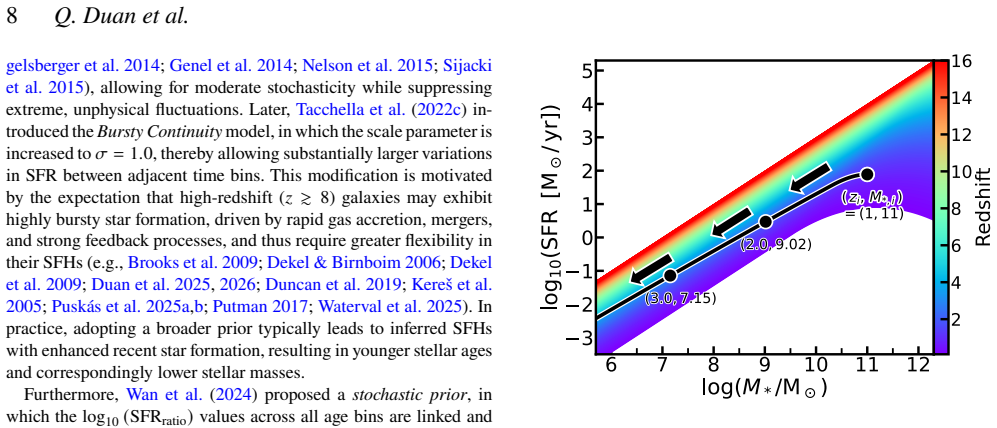
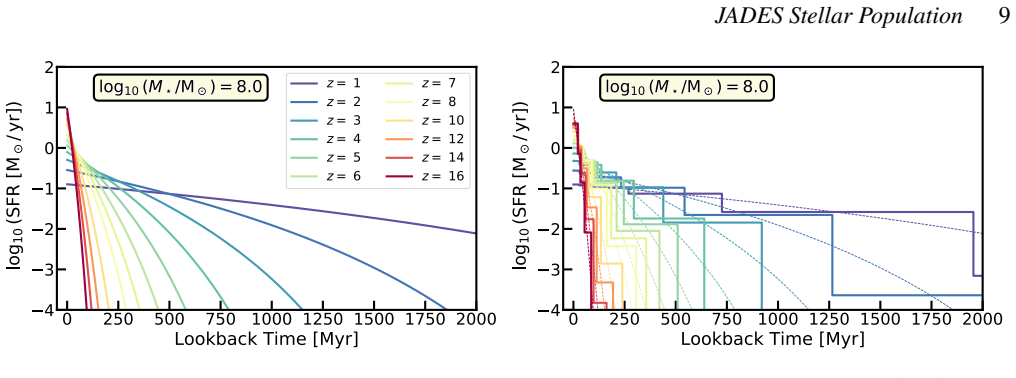
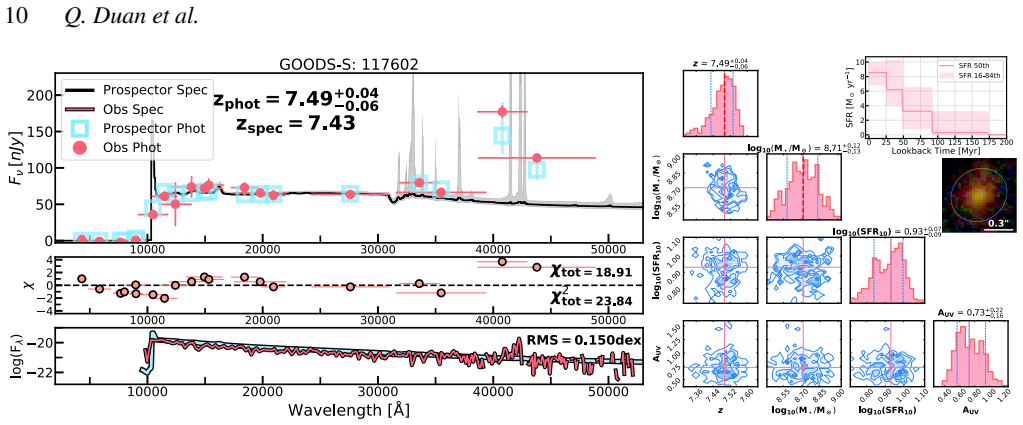
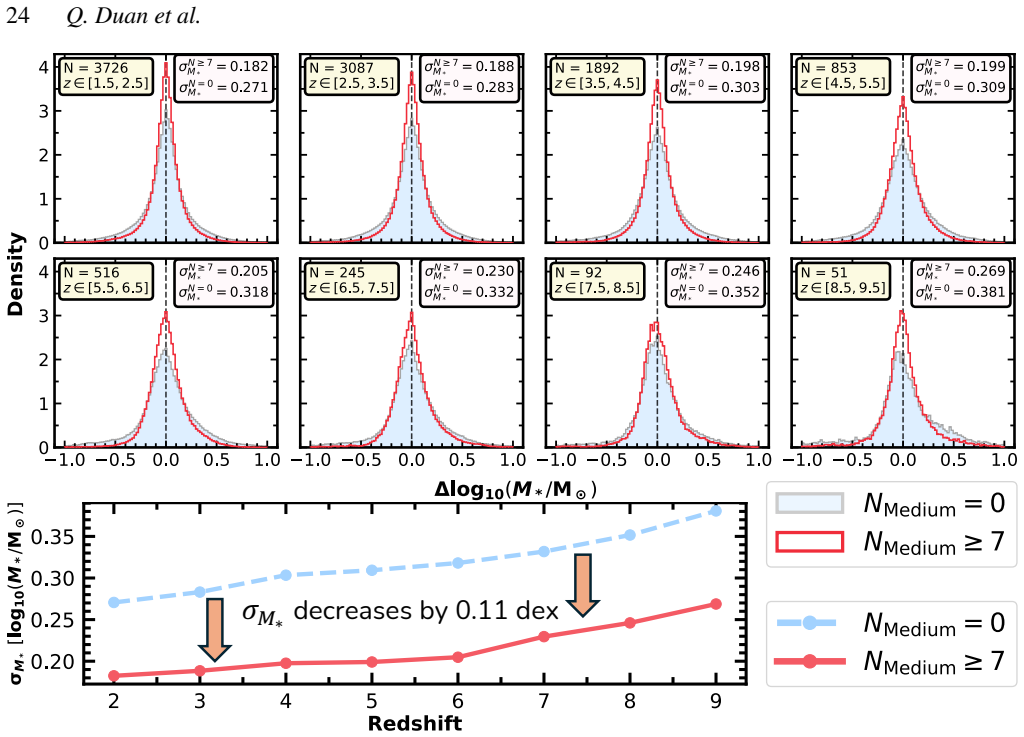
We present the galaxy stellar population catalogue from the JWST Advanced Deep Extragalactic Survey (JADES) Data Release 5 (DR5), providing homogeneous Bayesian inference of physical galaxy properties in GOODS-N and GOODS-S. Using deep JWST/NIRCam and MIRI imaging combined with ancillary multi-wavelength data, we model the spectral energy distributions of ~500,000 sources with the Prospector framework. Our modelling incorporates flexible non-parametric star-formation histories (SFHs), nebular emission, dust attenuation, metallicities, and mid-infrared AGN and dust emission. We adopt an evolving star-forming main sequence (SFMS) prior for modelling the SFHs, which provides a physically-motivated long-term shape of SFHs while retaining non-parametric flexibility. The prior links stellar mass growth and SFR through the observed redshift-dependent SFMS, shaping the global behaviour of the inferred SFHs but allowing substantial deviations and scatters wherever supported by the data. We derive posterior distributions for stellar masses, SFRs, SFHs, dust attenuation, metallicities, and AGN contributions. The depth and wavelength coverage of JADES enable robust stellar mass measurements down to low-mass limits, as well as improved constraints on recent star-formation activity for ~350,000 galaxies at z = 1 - 9. The adoption of a physically motivated prior mitigates unphysical solutions and reduces degeneracies between redshift, age, dust, and metallicity, particularly for faint sources. We validate the catalogue through consistency checks and comparison to spectroscopic redshifts where available. The resulting value-added catalogue provides a uniform set of stellar population parameters suitable for statistical studies of galaxy growth, quenching, and the build-up of stellar mass across cosmic time. The full catalogue and posterior summaries are publicly released as part of JADES DR5.
Editorial analysis
A structured set of objections, weighed in public.
Referee Report
Summary. The manuscript presents the JADES DR5 stellar population catalogue for galaxies in GOODS-N and GOODS-S. It uses the Prospector framework to perform Bayesian SED fitting on ~500,000 sources with deep JWST/NIRCam and MIRI imaging plus ancillary data. The modelling includes flexible non-parametric star-formation histories shaped by an evolving star-forming main sequence (SFMS) prior, along with nebular emission, dust attenuation, metallicities, and AGN contributions. Posterior distributions for stellar masses, SFRs, SFHs, and other parameters are derived and publicly released, with validation against spectroscopic redshifts.
Significance. This large, homogeneous catalogue of stellar population parameters for galaxies up to z~9 would be a valuable resource for studies of galaxy growth, quenching, and stellar mass assembly if the modelling approach, particularly the SFMS prior, can be shown to deliver reliable constraints for faint sources. The public release of the full catalogue and posterior summaries enhances its utility for the community.
major comments (1)
- Abstract: The statement that 'the adoption of a physically motivated prior mitigates unphysical solutions and reduces degeneracies between redshift, age, dust, and metallicity, particularly for faint sources' is not accompanied by quantitative evidence. The manuscript does not present comparisons of posterior distributions with and without the SFMS prior, information gain metrics, or recovery tests using mock galaxies at the faint end (e.g., m_F444W > 28). This evidence is necessary to support the claim that the catalogue provides parameters 'suitable for statistical studies' of galaxy evolution.
minor comments (1)
- Methods: Additional details on posterior convergence diagnostics, criteria for data exclusion, and quantitative bias assessments would strengthen the reproducibility and reliability assessment of the catalogue.
Simulated Author's Rebuttal
We thank the referee for their thoughtful review of our manuscript on the JADES DR5 stellar population catalogue. We appreciate the recognition of its potential value and address the major comment regarding evidence for the SFMS prior in detail below. We have made revisions to the manuscript to provide the requested quantitative support.
read point-by-point responses
-
Referee: Abstract: The statement that 'the adoption of a physically motivated prior mitigates unphysical solutions and reduces degeneracies between redshift, age, dust, and metallicity, particularly for faint sources' is not accompanied by quantitative evidence. The manuscript does not present comparisons of posterior distributions with and without the SFMS prior, information gain metrics, or recovery tests using mock galaxies at the faint end (e.g., m_F444W > 28). This evidence is necessary to support the claim that the catalogue provides parameters 'suitable for statistical studies' of galaxy evolution.
Authors: We thank the referee for this important observation. The SFMS prior is designed to provide a physically motivated constraint on the overall shape of the SFH based on the observed main sequence evolution, while the non-parametric nature allows flexibility. Although the current manuscript focuses on the methodology and public release with validation against spectroscopic redshifts, we agree that explicit quantitative demonstrations would strengthen the abstract claim. In the revised version, we have added a dedicated subsection in the results section presenting: (1) comparisons of posterior distributions for faint sources with and without the prior, showing reduced parameter degeneracies; (2) information gain metrics indicating improved constraints on key parameters; and (3) mock galaxy recovery tests specifically for sources with m_F444W > 28, demonstrating better recovery of stellar masses and SFRs. These additions confirm that the prior mitigates unphysical solutions and supports the use of the catalogue for statistical studies of galaxy evolution. We have also updated the abstract to reference these new analyses. revision: yes
Circularity Check
No circularity: observational catalogue derived from external JWST data and literature-based prior
full rationale
The paper describes production of a stellar population catalogue by applying the external Prospector SED-fitting code to ~500k sources using deep JWST/NIRCam+MIRI imaging plus ancillary data. The evolving SFMS prior is stated to be drawn from the observed redshift-dependent main sequence and is explicitly described as allowing substantial data-driven deviations and scatters. No equations, fitted parameters, or self-citations are shown to reduce the reported posteriors (stellar masses, SFRs, SFHs, etc.) to quantities defined by the same fit or by a self-referential chain. Validation is performed via consistency checks and spectroscopic redshifts, keeping the derivation chain independent of the catalogue outputs themselves.
Axiom & Free-Parameter Ledger
free parameters (1)
- evolving SFMS prior parameters
axioms (1)
- domain assumption Prospector framework with flexible non-parametric SFHs, nebular emission, dust attenuation, metallicities, and mid-IR AGN/dust components accurately recovers galaxy properties from the photometry.
Lean theorems connected to this paper
-
IndisputableMonolith/Cost/FunctionalEquation.leanwashburn_uniqueness_aczel unclear?
unclearRelation between the paper passage and the cited Recognition theorem.
We adopt an evolving star-forming main sequence (SFMS) prior for modelling the SFHs, which provides a physically-motivated long-term shape of SFHs while retaining non-parametric flexibility.
-
IndisputableMonolith/Foundation/RealityFromDistinction.leanreality_from_one_distinction unclear?
unclearRelation between the paper passage and the cited Recognition theorem.
The resulting value-added catalogue provides a uniform set of stellar population parameters suitable for statistical studies of galaxy growth, quenching, and the build-up of stellar mass across cosmic time.
What do these tags mean?
- matches
- The paper's claim is directly supported by a theorem in the formal canon.
- supports
- The theorem supports part of the paper's argument, but the paper may add assumptions or extra steps.
- extends
- The paper goes beyond the formal theorem; the theorem is a base layer rather than the whole result.
- uses
- The paper appears to rely on the theorem as machinery.
- contradicts
- The paper's claim conflicts with a theorem or certificate in the canon.
- unclear
- Pith found a possible connection, but the passage is too broad, indirect, or ambiguous to say the theorem truly supports the claim.
Reference graph
Works this paper leans on
-
[1]
An analytic expression for the luminosity function for galaxies. , year = 1976, month = jan, volume =. doi:10.1086/154079 , adsurl =
-
[2]
GA-NIFS: Dissecting The Alchemised: NIRSpec/IFU reveals turbulent gas inflows in a complex system at z=10.17. arXiv e-prints , keywords =. doi:10.48550/arXiv.2603.00232 , archivePrefix =. 2603.00232 , primaryClass =
-
[3]
The confinement of star-forming galaxies into a main sequence through episodes of gas compaction, depletion and replenishment. , keywords =. doi:10.1093/mnras/stw131 , archivePrefix =. 1509.02529 , primaryClass =
work page internal anchor Pith review Pith/arXiv arXiv doi:10.1093/mnras/stw131
-
[4]
Gas Regulation of Galaxies: The Evolution of the Cosmic Specific Star Formation Rate, the Metallicity-Mass-Star-formation Rate Relation, and the Stellar Content of Halos. , keywords =. doi:10.1088/0004-637X/772/2/119 , archivePrefix =. 1303.5059 , primaryClass =
work page internal anchor Pith review Pith/arXiv arXiv doi:10.1088/0004-637x/772/2/119
-
[5]
Toy Models for Galaxy Formation versus Simulations
Toy models for galaxy formation versus simulations. , keywords =. doi:10.1093/mnras/stt1338 , archivePrefix =. 1303.3009 , primaryClass =
work page internal anchor Pith review Pith/arXiv arXiv doi:10.1093/mnras/stt1338
-
[6]
Uncovering Early Galaxy Evolution in the ALMA and JWST Era , year = 2020, editor =
JWST advanced deep extragalactic survey: NIRCam imaging to z > 10. Uncovering Early Galaxy Evolution in the ALMA and JWST Era , year = 2020, editor =. doi:10.1017/S1743921319008950 , adsurl =
-
[7]
A massive quiescent galaxy at redshift 4.658. , keywords =. doi:10.1038/s41586-023-06158-6 , archivePrefix =. 2301.11413 , primaryClass =
-
[8]
A Redshift-independent Efficiency Model: Star Formation and Stellar Masses in Dark Matter Halos at z 4. , keywords =. doi:10.3847/1538-4357/aae8e0 , archivePrefix =. 1806.03299 , primaryClass =
work page internal anchor Pith review Pith/arXiv arXiv doi:10.3847/1538-4357/aae8e0
-
[9]
On the ages of bright galaxies 500 Myr after the big bang: insights into star formation activity at z 15 with JWST. , keywords =. doi:10.1093/mnras/stac3535 , archivePrefix =. 2208.01599 , primaryClass =
-
[10]
Uncovering Early Galaxy Evolution in the ALMA and JWST Era , year = 2020, editor =
Spectroscopy with the JWST Advanced Deep Extragalactic Survey (JADES) - the NIRSpec/NIRCAM GTO galaxy evolution project. Uncovering Early Galaxy Evolution in the ALMA and JWST Era , year = 2020, editor =. doi:10.1017/S1743921319009463 , archivePrefix =. 2112.15207 , primaryClass =
-
[11]
JWST NIRCam + NIRSpec: interstellar medium and stellar populations of young galaxies with rising star formation and evolving gas reservoirs. , keywords =. doi:10.1093/mnras/stad1408 , archivePrefix =. 2208.03281 , primaryClass =
-
[12]
The rise and fall of the star formation histories of blue galaxies at redshifts 0.2<z<1.4
The Rise and Fall of the Star Formation Histories of Blue Galaxies at Redshifts 0.2 < z < 1.4. , keywords =. doi:10.1088/2041-8205/762/1/L15 , archivePrefix =. 1210.0543 , primaryClass =
work page internal anchor Pith review Pith/arXiv arXiv doi:10.1088/2041-8205/762/1/l15 2041
-
[13]
The Way We Tally Becomes the Tale: the Impact of Selection Strategies on the Inferred Evolution of Little Red Dots Across Cosmic Time. arXiv e-prints , keywords =. doi:10.48550/arXiv.2604.07138 , archivePrefix =. 2604.07138 , primaryClass =
work page internal anchor Pith review Pith/arXiv arXiv doi:10.48550/arxiv.2604.07138
-
[14]
A fast-rotator post-starburst galaxy quenched by supermassive black-hole feedback at z = 3. Nature Astronomy , keywords =. doi:10.1038/s41550-024-02345-1 , archivePrefix =. 2308.06317 , primaryClass =
-
[15]
Double trouble: Two spectroscopically confirmed low-mass quiescent galaxies at z > 5 in overdensities. , keywords =. doi:10.1051/0004-6361/202557207 , archivePrefix =. 2509.09761 , primaryClass =
-
[16]
When relics were made: vigorous stellar rotation and low dark matter content in the massive ultra-compact galaxy GS-9209 at z = 4.66. , keywords =. doi:10.1093/mnras/stag210 , archivePrefix =. 2505.06349 , primaryClass =
-
[17]
JWST Advanced Deep Extragalactic Survey (JADES) Data Release 5: Catalogs of inferred morphological properties of galaxies from JWST/NIRCam imaging in GOODS-N and GOODS-S. arXiv e-prints , keywords =. doi:10.48550/arXiv.2601.15957 , archivePrefix =. 2601.15957 , primaryClass =
-
[18]
Color--Mass-to-Light Ratio Relations for Disk Galaxies
Color-Mass-to-light-ratio Relations for Disk Galaxies. , keywords =. doi:10.1088/0004-6256/148/5/77 , archivePrefix =. 1407.1839 , primaryClass =
work page internal anchor Pith review Pith/arXiv arXiv doi:10.1088/0004-6256/148/5/77
-
[19]
Reconstructing the Stellar Mass Distributions of Galaxies Using S ^ 4 G IRAC 3.6 and 4.5 m Images. II. The Conversion from Light to Mass. , keywords =. doi:10.1088/0004-637X/788/2/144 , archivePrefix =. 1402.5210 , primaryClass =
work page internal anchor Pith review Pith/arXiv arXiv doi:10.1088/0004-637x/788/2/144
-
[20]
2009, MNRAS, 394, 2255, doi: 10.1111/j.1365-2966.2009.14499.x 24
Resolved stellar mass maps of galaxies - I. Method and implications for global mass estimates. , keywords =. doi:10.1111/j.1365-2966.2009.15528.x , archivePrefix =. 0904.4252 , primaryClass =
-
[21]
Stellar mass-to-light ratios and the Tully-Fisher relation
Stellar Mass-to-Light Ratios and the Tully-Fisher Relation. , keywords =. doi:10.1086/319728 , archivePrefix =. astro-ph/0011493 , primaryClass =
work page internal anchor Pith review Pith/arXiv arXiv doi:10.1086/319728
-
[22]
Cue: A Fast and Flexible Photoionization Emulator for Modeling Nebular Emission Powered by Almost Any Ionizing Source. , keywords =. doi:10.3847/1538-4357/adcab4 , archivePrefix =. 2405.04598 , primaryClass =
-
[23]
COSMOS2025: The COSMOS-Web galaxy catalog of photometry, morphology, redshifts, and physical parameters from JWST, HST, and ground-based imaging. , keywords =. doi:10.1051/0004-6361/202555799 , archivePrefix =. 2506.03243 , primaryClass =
-
[24]
The UNCOVER Survey: A First-look HST+JWST Catalog of Galaxy Redshifts and Stellar Population Properties Spanning 0.2 z 15. , keywords =. doi:10.3847/1538-4365/ad0846 , archivePrefix =. 2310.01276 , primaryClass =
-
[25]
Mergers lighting the early Universe: enhanced star formation, AGN triggering, and Ly α emission in close pairs at z=3-9. arXiv e-prints , keywords =. doi:10.48550/arXiv.2510.14743 , archivePrefix =. 2510.14743 , primaryClass =
-
[26]
Equation of State Calculations by Fast Computing Machines. , year = 1953, month = jun, volume =. doi:10.1063/1.1699114 , adsurl =
-
[27]
Biometrika , year = 1970, month = apr, volume =
Monte Carlo Sampling Methods using Markov Chains and their Applications. Biometrika , year = 1970, month = apr, volume =. doi:10.1093/biomet/57.1.97 , adsurl =
-
[28]
emcee: The MCMC Hammer , journal =. 1202.3665 , doi =
work page internal anchor Pith review Pith/arXiv arXiv
-
[29]
dynesty: A Dynamic Nested Sampling Package for Estimating Bayesian Posteriors and Evidences
DYNESTY: a dynamic nested sampling package for estimating Bayesian posteriors and evidences. , keywords =. doi:10.1093/mnras/staa278 , archivePrefix =. 1904.02180 , primaryClass =
work page internal anchor Pith review Pith/arXiv arXiv doi:10.1093/mnras/staa278 1904
-
[30]
The Las Campanas Infrared Survey. IV. The Photometric Redshift Survey and the Rest-Frame R-Band Galaxy Luminosity Function at 0.5<=z<=1.5. , keywords =. doi:10.1086/367787 , archivePrefix =. astro-ph/0212147 , primaryClass =
work page internal anchor Pith review Pith/arXiv arXiv doi:10.1086/367787
-
[31]
Stellar mass functions: methods, systematics and results for the local Universe
Stellar mass functions: methods, systematics and results for the local Universe. , keywords =. doi:10.1093/mnras/stw756 , archivePrefix =. 1604.00008 , primaryClass =
work page internal anchor Pith review Pith/arXiv arXiv doi:10.1093/mnras/stw756
-
[32]
COSMOS-Web: Stellar mass assembly in relation to dark matter halos across 0.2 < z < 12 of cosmic history. , keywords =. doi:10.1051/0004-6361/202452570 , archivePrefix =. 2410.08290 , primaryClass =
-
[33]
Galaxy build-up in the first 1.5 Gyr of cosmic history: insights from the stellar mass function at z 4-9 from JWST NIRCam observations. , keywords =. doi:10.1093/mnras/stae1891 , archivePrefix =. 2403.08872 , primaryClass =
-
[34]
JADES NIRSpec initial data release for the Hubble Ultra Deep Field: Redshifts and line fluxes of distant galaxies from the deepest JWST Cycle 1 NIRSpec multi-object spectroscopy. , keywords =. doi:10.1051/0004-6361/202347094 , archivePrefix =. 2306.02467 , primaryClass =
-
[35]
The Near Infrared Imager and Slitless Spectrograph for the James Webb Space Telescope. III. Single Object Slitless Spectroscopy. , keywords =. doi:10.1088/1538-3873/acd7a3 , archivePrefix =. 2306.04572 , primaryClass =
-
[36]
The Near Infrared Imager and Slitless Spectrograph for the James Webb Space Telescope. IV. Aperture Masking Interferometry. , keywords =. doi:10.1088/1538-3873/acaebd , archivePrefix =. 2210.17434 , primaryClass =
-
[37]
The Near-infrared Imager and Slitless Spectrograph for the James Webb Space Telescope. II. Wide Field Slitless Spectroscopy. , keywords =. doi:10.1088/1538-3873/ac5158 , archivePrefix =. 2202.01714 , primaryClass =
-
[38]
The Near Infrared Imager and Slitless Spectrograph for the James Webb Space Telescope. I. Instrument Overview and In-flight Performance. , keywords =. doi:10.1088/1538-3873/acd41b , archivePrefix =. 2306.03277 , primaryClass =
-
[39]
The Near-Infrared Spectrograph (NIRSpec) on the James Webb Space Telescope. II. Multi-object spectroscopy (MOS). , keywords =. doi:10.1051/0004-6361/202142673 , archivePrefix =. 2202.03306 , primaryClass =
-
[40]
The Near-Infrared Spectrograph (NIRSpec) on the James Webb Space Telescope. I. Overview of the instrument and its capabilities. , keywords =. doi:10.1051/0004-6361/202142663 , archivePrefix =. 2202.03305 , primaryClass =
work page internal anchor Pith review Pith/arXiv arXiv doi:10.1051/0004-6361/202142663
-
[41]
A Cosmic Miracle: A Remarkably Luminous Galaxy at z_ spec =14.44 Confirmed with JWST. arXiv e-prints , keywords =. doi:10.48550/arXiv.2505.11263 , archivePrefix =. 2505.11263 , primaryClass =
-
[42]
CEERS Key Paper. I. An Early Look into the First 500 Myr of Galaxy Formation with JWST , author=. The Astrophysical Journal Letters , volume=. 2023 , publisher=
work page 2023
-
[43]
Two Remarkably Luminous Galaxy Candidates at z 10-12 Revealed by JWST. , keywords =. doi:10.3847/2041-8213/ac9b22 , archivePrefix =. 2207.09434 , primaryClass =
-
[44]
Early Results from GLASS-JWST. III. Galaxy Candidates at z 9-15. , keywords =. doi:10.3847/2041-8213/ac94d0 , archivePrefix =. 2207.09436 , primaryClass =
-
[45]
The star formation burstiness and ionizing efficiency of low-mass galaxies. , keywords =. doi:10.1093/mnras/stac360 , archivePrefix =. 2202.04081 , primaryClass =
-
[46]
GOLDRUSH. IV. Luminosity Functions and Clustering Revealed with 4,000,000 Galaxies at z 2-7: Galaxy-AGN Transition, Star Formation Efficiency, and Implication for Evolution at z > 10. , keywords =. doi:10.3847/1538-4365/ac3dfc , archivePrefix =. 2108.01090 , primaryClass =
-
[47]
COSMOS-Web: Intrinsically Luminous z 10 Galaxy Candidates Test Early Stellar Mass Assembly. , keywords =. doi:10.3847/1538-4357/ad2075 , archivePrefix =. 2308.10932 , primaryClass =
-
[48]
Accelerated formation of ultra-massive galaxies in the first billion years. , keywords =. doi:10.1038/s41586-024-08094-5 , archivePrefix =. 2309.02492 , primaryClass =
-
[49]
A population of red candidate massive galaxies 600 Myr after the Big Bang. , keywords =. doi:10.1038/s41586-023-05786-2 , archivePrefix =. 2207.12446 , primaryClass =
-
[50]
Unveiling the hidden Universe with JWST: the contribution of dust-obscured galaxies to the stellar mass function at z 3 - 8. , keywords =. doi:10.1093/mnras/stae754 , archivePrefix =. 2310.03787 , primaryClass =
-
[51]
Unveiling the nature of infrared bright, optically dark galaxies with early JWST data. , keywords =. doi:10.1093/mnras/stad947 , archivePrefix =. 2207.14733 , primaryClass =
-
[52]
Evolution of the galaxy stellar mass functions and UV luminosity functions at z = 6-9 in the Hubble Frontier Fields. , keywords =. doi:10.1093/mnras/stz866 , archivePrefix =. 1807.07580 , primaryClass =
work page internal anchor Pith review Pith/arXiv arXiv doi:10.1093/mnras/stz866
-
[53]
The JADES Origins Field: A New JWST Deep Field in the JADES Second NIRCam Data Release. arXiv e-prints , keywords =. doi:10.48550/arXiv.2310.12340 , archivePrefix =. 2310.12340 , primaryClass =
-
[54]
GLACiAR, an Open-Source Python Tool for Simulations of Source Recovery and Completeness in Galaxy Surveys. , keywords =. doi:10.1017/pasa.2018.17 , archivePrefix =. 1805.08985 , primaryClass =
work page internal anchor Pith review Pith/arXiv arXiv doi:10.1017/pasa.2018.17 2018
-
[55]
A quantitative assessment of completeness correction methods and public release of a versatile simulation code. , keywords =. doi:10.1093/mnras/stab3265 , archivePrefix =. 2111.08528 , primaryClass =
-
[56]
B. Efron and C. Stein , journal =. The Jackknife Estimate of Variance , urldate =
-
[57]
B. Efron , journal =. Bootstrap Methods: Another Look at the Jackknife , urldate =
-
[58]
The PANORAMIC Survey: Pure Parallel Wide Area Legacy Imaging with JWST/NIRCam. , keywords =. doi:10.3847/1538-4357/ad97bc , archivePrefix =. 2410.01875 , primaryClass =
-
[59]
A consistent measure of the merger histories of massive galaxies using close-pair statistics - I. Major mergers at z < 3.5. , keywords =. doi:10.1093/mnras/stx1238 , archivePrefix =. 1705.07986 , primaryClass =
work page internal anchor Pith review Pith/arXiv arXiv doi:10.1093/mnras/stx1238
-
[60]
What Shapes the Luminosity Function of Galaxies?
What Shapes the Luminosity Function of Galaxies?. , keywords =. doi:10.1086/379160 , archivePrefix =. astro-ph/0302450 , primaryClass =
work page internal anchor Pith review Pith/arXiv arXiv doi:10.1086/379160
-
[61]
2003, MNRAS, 344, 1000, doi: 10.1046/j.1365-8711.2003.06897.x
Virial shocks in galactic haloes?. , keywords =. doi:10.1046/j.1365-8711.2003.06955.x , archivePrefix =. astro-ph/0302161 , primaryClass =
-
[62]
The Global Schmidt Law in Star Forming Galaxies
The Global Schmidt Law in Star-forming Galaxies. , keywords =. doi:10.1086/305588 , archivePrefix =. astro-ph/9712213 , primaryClass =
work page internal anchor Pith review Pith/arXiv arXiv doi:10.1086/305588
-
[63]
, year = 1974, month = nov, volume =
Effects of supernovae on the early evolution of galaxies. , year = 1974, month = nov, volume =. doi:10.1093/mnras/169.2.229 , adsurl =
-
[64]
2005, ARA&A, 43, 769, doi: 10.1146/annurev.astro.43.072103.150610
Galactic Winds. , keywords =. doi:10.1146/annurev.astro.43.072103.150610 , archivePrefix =. astro-ph/0504435 , primaryClass =
-
[65]
The Evolution of the Stellar Mass Function of Galaxies from z = 4.0 and the First Comprehensive Analysis of its Uncertainties: Evidence for Mass-Dependent Evolution. , keywords =. doi:10.1088/0004-637X/701/2/1765 , archivePrefix =. 0811.1773 , primaryClass =
work page internal anchor Pith review Pith/arXiv arXiv doi:10.1088/0004-637x/701/2/1765
-
[66]
Galaxy Stellar Mass Assembly between 0.2<z<2 from the S-COSMOS survey
Galaxy Stellar Mass Assembly Between 0.2 < z < 2 from the S-COSMOS Survey. , keywords =. doi:10.1088/0004-637X/709/2/644 , archivePrefix =. 0903.0102 , primaryClass =
work page internal anchor Pith review Pith/arXiv arXiv doi:10.1088/0004-637x/709/2/644
-
[67]
The mass evolution of the first galaxies: stellar mass functions and star formation rates at 4 < z < 7 in the CANDELS GOODS-South field. , keywords =. doi:10.1093/mnras/stu1622 , archivePrefix =. 1408.2527 , primaryClass =
work page internal anchor Pith review Pith/arXiv arXiv doi:10.1093/mnras/stu1622
-
[68]
The high mass end of the stellar mass function: Dependence on stellar population models and agreement between fits to the light profile. , keywords =. doi:10.1093/mnras/stx176 , archivePrefix =. 1604.01036 , primaryClass =
work page internal anchor Pith review Pith/arXiv arXiv doi:10.1093/mnras/stx176
-
[69]
The Evolution of the Galaxy Stellar Mass Function at z = 4-8: A Steepening Low-mass-end Slope with Increasing Redshift. , keywords =. doi:10.3847/0004-637X/825/1/5 , archivePrefix =. 1507.05636 , primaryClass =
work page internal anchor Pith review Pith/arXiv arXiv doi:10.3847/0004-637x/825/1/5
-
[70]
Deconstructing the galaxy stellar mass function with UKIDSS and CANDELS: the impact of colour, structure and environment. , keywords =. doi:10.1093/mnras/stu2403 , archivePrefix =. 1411.3339 , primaryClass =
work page internal anchor Pith review Pith/arXiv arXiv doi:10.1093/mnras/stu2403
-
[71]
The galaxy stellar mass function at 3.5<z<7.5 in the CANDELS/UDS, GOODS-South, and HUDF fields
The galaxy stellar mass function at 3.5 z 7.5 in the CANDELS/UDS, GOODS-South, and HUDF fields. , keywords =. doi:10.1051/0004-6361/201424750 , archivePrefix =. 1412.0532 , primaryClass =
work page internal anchor Pith review Pith/arXiv arXiv doi:10.1051/0004-6361/201424750
-
[72]
The Evolution of the Stellar Mass Functions of Star-forming and Quiescent Galaxies to z = 4 from the COSMOS/UltraVISTA Survey. , keywords =. doi:10.1088/0004-637X/777/1/18 , archivePrefix =. 1303.4409 , primaryClass =
work page internal anchor Pith review Pith/arXiv arXiv doi:10.1088/0004-637x/777/1/18
-
[73]
The galaxy stellar mass function and its evolution with time show no dependence on global environment. , keywords =. doi:10.1051/0004-6361/201118388 , archivePrefix =. 1111.0830 , primaryClass =
work page internal anchor Pith review Pith/arXiv arXiv doi:10.1051/0004-6361/201118388
-
[74]
2011, MNRAS, 416, 1654, doi: 10.1111/j.1365-2966.2011.19113.x
A deep probe of the galaxy stellar mass functions at z 1-3 with the GOODS NICMOS Survey. , keywords =. doi:10.1111/j.1365-2966.2011.18357.x , archivePrefix =. 1101.2867 , primaryClass =
-
[75]
The Intriguing Life of Massive Galaxies , year = 2013, editor =
Gas Accretion and Mergers in Massive Galaxies at z -0.5ex 2. The Intriguing Life of Massive Galaxies , year = 2013, editor =. doi:10.1017/S1743921313004225 , adsurl =
-
[76]
The Galaxy mass function up to z =4 in the GOODS-MUSIC sample: into the epoch of formation of massive galaxies. , keywords =. doi:10.1051/0004-6361:20065475 , archivePrefix =. astro-ph/0609068 , primaryClass =
work page internal anchor Pith review Pith/arXiv arXiv doi:10.1051/0004-6361:20065475
-
[77]
Spectroscopic Confirmation of a Population of Normal Star-Forming Galaxies at Redshifts z>3
Spectroscopic Confirmation of a Population of Normal Star-forming Galaxies at Redshifts Z > 3. , keywords =. doi:10.1086/310029 , archivePrefix =. astro-ph/9602024 , primaryClass =
work page internal anchor Pith review Pith/arXiv arXiv doi:10.1086/310029
-
[78]
High Redshift Galaxies in the Hubble Deep Field. Color Selection and Star Formation History to z=4
High-redshift galaxies in the Hubble Deep Field: colour selection and star formation history to z -0.5ex 4. , keywords =. doi:10.1093/mnras/283.4.1388 , archivePrefix =. astro-ph/9607172 , primaryClass =
work page internal anchor Pith review Pith/arXiv arXiv doi:10.1093/mnras/283.4.1388
-
[79]
The 2dF galaxy redshift survey: near-infrared galaxy luminosity functions. , keywords =. doi:10.1046/j.1365-8711.2001.04591.x , archivePrefix =. astro-ph/0012429 , primaryClass =
-
[80]
The Optical and Near-Infrared Properties of Galaxies. I. Luminosity and Stellar Mass Functions. , keywords =. doi:10.1086/378847 , archivePrefix =. astro-ph/0302543 , primaryClass =
work page internal anchor Pith review Pith/arXiv arXiv doi:10.1086/378847
discussion (0)
Sign in with ORCID, Apple, or X to comment. Anyone can read and Pith papers without signing in.