REVIEW 4 major objections 5 minor 41 references
Quantum machine learning interatomic potential: Application of variational quantum algorithm
T0 review · 4 major / 5 minor · reviewed 2026-08-01 · deepseek-v4-flash
Pith's one-line read Inserting a small variational quantum circuit into the readout of a classical interatomic potential improves molecular-energy predictions over an equivalent classical layer, but only when the pretrained network has room to improve.
desk verdict A careful, modest numerical study of quantum transfer learning for ANI that shows a small, possibly significant RMSE gain in a low-data regime; the effect is real-looking but not yet statistically pinned down. read the letter →
The pith
A machine-rendered reading of the paper's core claim, the machinery that carries it, and where it could break.
The reading
What carries the argument
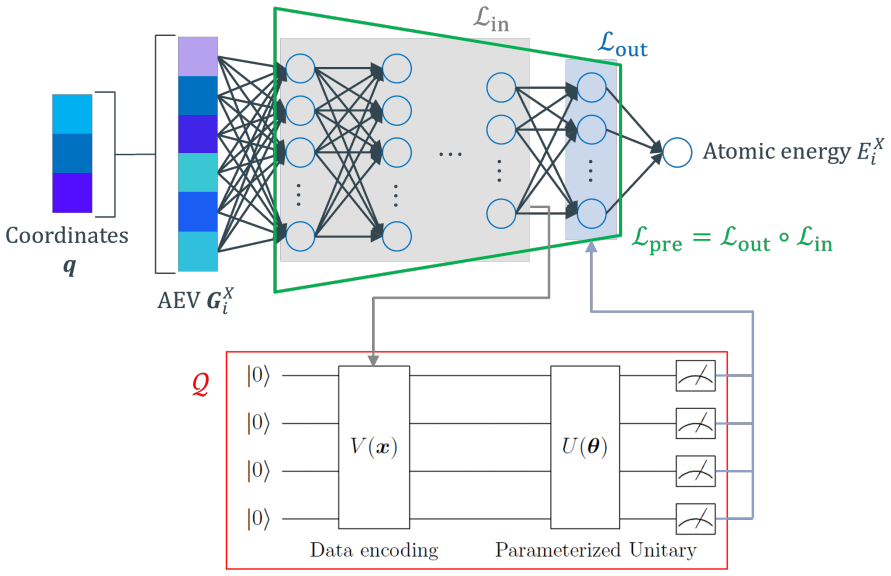
The load-bearing object is the quantum transfer-learning architecture in which a pretrained classical ANI network is split into L_in and L_out, and a variational circuit Q—the quantum circuit learning module—is inserted between them. Q maps the n_q-dimensional embedding to itself using single-qubit rotations; the two encodings tested are Ry(-arcsin(x))H and Rz(arccos(x))Ry(arccos(x)), followed by parameterized single-qubit rotations with all parameters initialized to zero so Q starts as the identity. The controls are a fully classical network with an identity-initialized single layer L_mid in place of Q, and the original pretrained network itself. The identity-at-init trick is what makes the
What would settle it
Train an identity-initialized classical layer with the same Fourier feature spectrum as the RzRy circuit (e.g., random Fourier features with matching frequencies) on the D1, l=1, n_q=4 task, and run paired trials: if its test RMSE meets or beats 1.48 kcal/mol, or if the 1.48-vs-1.80 gap is not significant across paired seeds, the quantum-layer advantage is not established.
Extended reading notes
Core claim
On its own terms, the discovery is that a variational quantum circuit placed in the readout path of the ANI interatomic potential outperforms a classically equivalent layer under precisely those conditions where the classical pretraining is not already at its ceiling. The headline number is the D1, l=1, n_q=4 case: the RzRy circuit gets 1.48 kcal/mol test RMSE while the classical single-layer control gets 1.80 kcal/mol, and improvements over the pretrained models are 1.55, 0.39, 0.14, and 0.13 kcal/mol for embedding depths l=1 through 4. On cholesterol, epicholesterol, cholestanol, and 7-dehydrocholesterol, the quantum-transfer model beats the original ANI potential on three of the four and
Load-bearing premise
The central comparison assumes that an identity-initialized classical fully connected layer is the right null model for what a classical layer can do; if a classical layer with the quantum circuit's Fourier-style features matches its accuracy, the claimed quantum benefit disappears.
Editorial extensions
If this is right
- A frozen classical embedding plus a small trained quantum layer is a viable architecture for molecular-energy prediction, with the qubit count set by the compressed embedding rather than by molecular size.
- Quantum-enhanced MLIPs give their largest gains in low-data, underparameterized regimes; once pretraining is accurate, the insertion of Q adds little.
- The RzRy encoding is systematically better than Ry, indicating that the choice of quantum feature map matters more than the number of circuit parameters.
- Because classical networks improve faster with width than the quantum circuits do with qubits, the practical advantage is condition-dependent and currently narrow.
- Energy ordering among closely related sterol isomers is correctly captured by the quantum-transfer model, supporting use of such hybrid potentials for relative-stability screening.
Reading between the lines
- The paper does not test a classical layer with the same Fourier/trigonometric inductive bias as the RzRy circuit; if random Fourier features match the quantum circuit's 1.48 kcal/mol, the observed gain is a function-class effect, not a quantum effect.
- A natural extension left implicit is to apply the same identity-initialized quantum correction at earlier layers of any MLIP, not only the final readout, to see whether the correction is additive across representational bottlenecks.
- The zero-initialization protocol makes Q a residual correction term; this suggests the practical niche for near-term quantum hardware is small, shallow circuits patching specific underperforming classical models rather than full quantum replacements.
- The data-dependence pattern (D1 benefit, D3/D4 no benefit) predicts that the advantage should reappear whenever a pretrained model is deliberately undertrained or data is scarce; this is a testable, quantifiable prediction.
Editorial analysis
A structured set of objections, weighed in public.
Referee Report
Summary. The paper proposes a hybrid quantum-classical machine learning interatomic potential (MLIP) by inserting a quantum circuit learning (QCL) module into a pretrained ANI network, following the transfer-learning scheme of Mari et al. The classical network is first pretrained, then a parameterized quantum circuit is inserted between the final two classical layers and trained while the classical parameters are frozen. Using a noiseless quantum circuit simulator, the authors compare this quantum-transfer model against a classical-transfer model with an identity-initialized dense layer, varying the number of qubits n_q, the number of pretrained layers l, the circuit depth d, and the dataset D1–D4. The headline result is that on D1 with l=1, n_q=4, d=1, the RzRy circuit reaches a test RMSE of 1.48 kcal/mol versus 1.80 kcal/mol for the classical layer (Sec. 3.4.1). The authors also report that the improvement is largest when the pretrained model has less capacity, and they demonstrate transferability to cholesterol and isomers by comparing against B3LYP/6-31G(d) DFT energies.
Significance. If the statistical comparison is robust, the paper makes a useful empirical contribution: it shows a concrete, small-scale architecture in which a frozen classical embedding plus a trainable quantum circuit improves MLIP accuracy in a low-data or shallow-pretraining regime. The claims in the abstract and conclusion are appropriately hedged, and the paper does not overclaim a practical quantum advantage. The use of an external dataset (ANI-1x via TorchANI) and DFT reference calculations is appropriate. The main value is as a feasibility study for quantum transfer learning in MLIPs; its significance depends on whether the reported improvement is distinguishable from noise and whether the classical baseline is the right comparator.
major comments (4)
- [Sec. 3.3 and Sec. 3.4.1, Fig. 3a]
- [Sec. 3.3 and Sec. 3.4.1]
- [Sec. 3.4.2 and Sec. 3.4.4]
- [Sec. 3.5, Fig. 7]
minor comments (5)
- [Sec. 2.2]
- [Sec. 3.1 and Table 1]
- [Eq. (3)]
- [Sec. 3.4.3 and Fig. 4]
- [Sec. 3.3]
Circularity Check
No significant circularity: the central quantum-vs-classical accuracy comparison is an empirical benchmark, not a constructed identity.
full rationale
The paper's central claim—that inserting a QCL circuit into the ANI readout yields slightly higher RMSE than a classical layer under certain conditions—is an empirical result obtained by training both models on the same ANI-derived data and comparing held-out RMSE. There is no step in which a fitted parameter is renamed as a prediction, no uniqueness theorem is imported from the authors' prior work, and no ansatz is smuggled in as an external fact. The identity initialization is applied symmetrically to both the quantum circuit and the classical L_mid layer, so the comparison is not forced by construction; the quantum model could have performed worse. The architecture follows Mari et al. and QCL follows Mitarai et al., but those citations provide background methods, not the evidence for the claimed improvement. The concern raised by the reviewer—that the 1.48 vs 1.80 kcal/mol gap lacks a significance test across five trials—is a statistical robustness issue, not circularity. The claim is externally benchmarked against the ANI-1x dataset and B3LYP/6-31G(d) DFT calculations, giving it independent content. No self-referential or load-bearing reduction to inputs was found.
Assumptions & free parameters
free parameters (2)
- Circuit/transfer hyperparameter scan (n_q, d, ansatz) =
n_q in {4, 8, 12}; d in {1, 5}; V(x) in {Ry, RzRy}
- Optimization schedule =
learning rate 0.001; 100 pretraining epochs; transfer-set epochs not stated
assumptions (3)
- domain assumption ANI-1x energies from the TorchANI library are accurate ground-truth labels for molecular energies.
- domain assumption B3LYP/6-31G(d) DFT values for cholesterol and isomers are the correct reference for the transferability test.
- domain assumption PennyLane StateVectorSimulator exactly represents the noiseless variational quantum circuit.
Cite this review
Pith. "Pith review of Quantum machine learning interatomic potential: Application of variational quantum algorithm." pith.science (2026). https://pith.science/paper/CT5TDOUW
@misc{pith2026260727841,
  author       = {Pith},
  title        = {Pith review of: Quantum machine learning interatomic potential: Application of variational quantum algorithm},
  year         = {2026},
  howpublished = {\url{https://pith.science/paper/CT5TDOUW}},
  note         = {Machine review of arXiv:2607.27841}
}
read the original abstract
This study applied quantum circuit learning, a commonly used hybrid quantum-classical machine learning algorithm, to a machine learning interatomic potential (MLIP) for predicting the energies of molecules in molecular datasets. We retrained the ANI model using the quantum transfer learning architecture [Mari et al., Quantum, 4:340, 2020] and evaluated numerical accuracy with a quantum circuit simulator. The evaluation confirmed that inserting a quantum circuit into the classical neural network of the MLIP yielded slightly higher accuracy than the fully classical neural network under certain conditions. In particular, the model incorporating a quantum circuit was more effective when the pretraining model had room for improvement in accuracy. These findings may contribute to advancing the application of quantum machine learning for MLIPs.
Figures


Figures from the paper (4 more)


Reference graph
Works this paper leans on
-
[1]
J¨ org Behler and Michele Parrinello. Generalized neural-network representation of high- dimensional potential-energy surfaces.Physical review letters, 98(14):146401, 2007.https: //doi.org/10.1103/PhysRevLett.98.146401
-
[2]
Albert P. Bart´ ok, Mike C. Payne, Risi Kondor, and G´ abor Cs´ anyi. Gaussian approximation potentials: The accuracy of quantum mechanics, without the electrons.Physical Review Letters, 104(13):136403, 2010.https://doi.org/10.1103/PhysRevLett.104.136403
-
[3]
Unke, Stefan Chmiela, Huziel E
Oliver T. Unke, Stefan Chmiela, Huziel E. Sauceda, Michael Gastegger, Igor Poltavsky, Kristof T. Sch¨ utt, Alexandre Tkatchenko, and Klaus-Robert M¨ uller. Machine learning force fields.Chemical Reviews, 121(16):10142–10186, 2021.https://doi.org/10.1021/acs.chemrev.0c01111
-
[4]
Ryan Jacobs, Dane Morgan, Siamak Attarian, Jun Meng, Chen Shen, Zhenghao Wu, Clare Yijia Xie, Julia H. Yang, Nongnuch Artrith, Ben Blaiszik, Gerbrand Ceder, Kamal Choudhary, Gabor Csanyi, Ekin Dogus Cubuk, Bowen Deng, Ralf Drautz, Xiang Fu, Jonathan Godwin, Vasant Honavar, Olexandr Isayev, et al. A practical guide to machine learning interatomic potential...
arXiv 2025
-
[5]
Simon Batzner, Albert Musaelian, Lixin Sun, Mario Geiger, Jonathan P Mailoa, Mordechai Ko- rnbluth, Nicola Molinari, Tess E Smidt, and Boris Kozinsky. E (3)-equivariant graph neural net- 11 works for data-efficient and accurate interatomic potentials.Nature communications, 13(1):2453, 2022.https://doi.org/10.1038/s41467-022-29939-5
-
[6]
Ilyes Batatia, David Peter Kovacs, Gregor N. C. Simm, Christoph Ortner, and Gabor Csanyi. MACE: Higher order equivariant message passing neural networks for fast and accurate force fields. In Alice H. Oh, Alekh Agarwal, Danielle Belgrave, and Kyunghyun Cho, editors,Ad- vances in Neural Information Processing Systems, 2022.https://openreview.net/forum?id= ...
2022
-
[7]
Ilyes Batatia, Simon Batzner, D´ avid P´ eter Kov´ acs, Albert Musaelian, Gregor N. C. Simm, Ralf Drautz, Christoph Ortner, Boris Kozinsky, and G´ abor Cs´ anyi. The design space of e(3)- equivariant atom-centered interatomic potentials, 2022.https://arxiv.org/abs/2205.06643
arXiv 2022
-
[8]
Chi Chen and Shyue Ping Ong. A universal graph deep learning interatomic potential for the periodic table.Nature Computational Science, 2(11):718–728, November 2022.https://doi. org/10.1038/s43588-022-00349-3
Show all 41 references
-
[9]
Bartel, and Gerbrand Ceder
Bowen Deng, Peichen Zhong, KyuJung Jun, Janosh Riebesell, Kevin Han, Christopher J. Bartel, and Gerbrand Ceder. CHGNet as a pretrained universal neural network potential for charge- informed atomistic modelling.Nature Machine Intelligence, 5:1031–1041, 2023.https://doi. org/10...
2023 doi
-
[10]
Elena, D´ avid P
Ilyes Batatia, Philipp Benner, Yuan Chiang, Alin M. Elena, D´ avid P. Kov´ acs, Janosh Riebesell, et al. A foundation model for atomistic materials chemistry.The Journal of Chemical Physics, 163(18):184110, 2025.https://doi.org/10.1063/5.0297006
2025 doi
-
[11]
Schoenholz, Muratahan Aykol, Gowoon Cheon, and Ekin Dogus Cubuk
Amil Merchant, Simon Batzner, Samuel S. Schoenholz, Muratahan Aykol, Gowoon Cheon, and Ekin Dogus Cubuk. Scaling deep learning for materials discovery.Nature, 2023.https://doi. org/10.1038/s41586-023-06735-9
2023 doi
-
[12]
Orb: A fast, scalable neural network potential, 2024
Mark Neumann, James Gin, Benjamin Rhodes, Steven Bennett, Zhiyi Li, Hitarth Choubisa, Arthur Hussey, and Jonathan Godwin. Orb: A fast, scalable neural network potential, 2024. https://arxiv.org/abs/2410.22570
2024 arXiv
-
[13]
Orb-v3: Atomistic simulation at scale, 2025.https://arxiv
Benjamin Rhodes, Sander Vandenhaute, Vaidotas ˇSimkus, James Gin, Jonathan Godwin, Tim Duignan, and Mark Neumann. Orb-v3: Atomistic simulation at scale, 2025.https://arxiv. org/abs/2504.06231
2025 arXiv
-
[14]
Mattersim: A deep learning atomistic model across elements, temperatures and pressures, 2024.https://arxiv.org/abs/2405.04967
Han Yang, Chenxi Hu, Yichi Zhou, Xixian Liu, Yu Shi, Jielan Li, Guanzhi Li, Zekun Chen, Shuizhou Chen, Claudio Zeni, Matthew Horton, Robert Pinsler, Andrew Fowler, Daniel Z¨ ugner, Tian Xie, Jake Smith, Lixin Sun, Qian Wang, Lingyu Kong, Chang Liu, Hongxia Hao, and Ziheng Lu. ...
2024 arXiv
-
[15]
Elena, Sam Walton Norwood, Thomas Wolf, and G´ abor Cs´ anyi
Ilyes Batatia, Chen Lin, Joseph Hart, Elliott Kasoar, Alin M. Elena, Sam Walton Norwood, Thomas Wolf, and G´ abor Cs´ anyi. Cross learning between electronic structure theories for unifying molecular, surface, and inorganic crystal foundation force fields, 2025.https://arxiv.o...
2025
-
[16]
Taming multi-domain, -fidelity data: Towards foundation models for atomistic scale simulations, 2024
Tomoya Shiota, Kenji Ishihara, Tuan Minh Do, Toshio Mori, and Wataru Mizukami. Taming multi-domain, -fidelity data: Towards foundation models for atomistic scale simulations, 2024. https://arxiv.org/abs/2412.13088. 12
2024
-
[17]
Expanding universal machine learning interatomic potentials to 97 elements towards nuclear applications, 2026.https: //arxiv.org/abs/2603.03223
Naoya Kuroda, Kenji Ishihara, Tomoya Shiota, and Wataru Mizukami. Expanding universal machine learning interatomic potentials to 97 elements towards nuclear applications, 2026.https: //arxiv.org/abs/2603.03223
2026
-
[18]
Wood, Misko Dzamba, Xiang Fu, Meng Gao, Muhammed Shuaibi, Luis Barroso- Luque, Kareem Abdelmaqsoud, Vahe Gharakhanyan, John R
Brandon M. Wood, Misko Dzamba, Xiang Fu, Meng Gao, Muhammed Shuaibi, Luis Barroso- Luque, Kareem Abdelmaqsoud, Vahe Gharakhanyan, John R. Kitchin, Daniel S. Levine, et al. UMA: A family of universal models for atoms, 2025.https://arxiv.org/abs/2506.23971
2025
-
[19]
Janosh Riebesell, Rhys E. A. Goodall, Philipp Benner, Yuan Chiang, Bowen Deng, Gerbrand Ceder, Mark Asta, Alpha A. Lee, Anubhav Jain, and Kristin A. Persson. A framework to evaluate machine learning crystal stability predictions.Nature Machine Intelligence, 7:836–847, 2025.htt...
2025 doi
-
[20]
Supervised learning with quantum-enhanced feature spaces.Nature, 567(7747):209–212, 2019.https://doi.org/10.1038/s41586-019-0980-2
Vojtˇ ech Havl ´ ıˇ cek, Antonio D C´ orcoles, Kristan Temme, Aram W Harrow, Abhinav Kandala, Jerry M Chow, and Jay M Gambetta. Supervised learning with quantum-enhanced feature spaces.Nature, 567(7747):209–212, 2019.https://doi.org/10.1038/s41586-019-0980-2
2019 doi
-
[21]
Quantum neural networks force fields generation.Machine Learning: Science and Technology, 3(3):035004, 2022.https: //doi.org/10.1088/2632-2153/ac7d3c
Oriel Kiss, Francesco Tacchino, Sofia Vallecorsa, and Ivano Tavernelli. Quantum neural networks force fields generation.Machine Learning: Science and Technology, 3(3):035004, 2022.https: //doi.org/10.1088/2632-2153/ac7d3c
2022 doi
-
[22]
Symmetry-invariant quantum machine learning force fields, 2023.https://arxiv.org/abs/ 2311.11362
Isabel Nha Minh Le, Oriel Kiss, Julian Schuhmacher, Ivano Tavernelli, and Francesco Tacchino. Symmetry-invariant quantum machine learning force fields, 2023.https://arxiv.org/abs/ 2311.11362
2023 arXiv
-
[23]
Gabriele Lo Monaco, Marco Bertini, Salvatore Lorenzo, and G Massimo Palma. Quantum extreme learning of molecular potential energy surfaces and force fields.Machine Learning: Science and Technology, 5(3):035014, 2024.https://doi.org/10.1088/2632-2153/ad6120
2024 doi
-
[24]
Harnessing disordered-ensemble quantum dynamics for machine learning.Phys
Keisuke Fujii and Kohei Nakajima. Harnessing disordered-ensemble quantum dynamics for machine learning.Phys. Rev. Appl., 8:024030, Aug 2017.https://doi.org/10.1103/ PhysRevApplied.8.024030
2017
-
[25]
Ma- chine learning with controllable quantum dynamics of a nuclear spin ensemble in a solid, 2018
Makoto Negoro, Kosuke Mitarai, Keisuke Fujii, Kohei Nakajima, and Masahiro Kitagawa. Ma- chine learning with controllable quantum dynamics of a nuclear spin ensemble in a solid, 2018. https://arxiv.org/abs/1806.10910
2018 arXiv
-
[26]
Boost- ing computational power through spatial multiplexing in quantum reservoir computing.Phys
Kohei Nakajima, Keisuke Fujii, Makoto Negoro, Kosuke Mitarai, and Masahiro Kitagawa. Boost- ing computational power through spatial multiplexing in quantum reservoir computing.Phys. Rev. Appl., 11:034021, Mar 2019.https://doi.org/10.1103/PhysRevApplied.11.034021
2019 doi
-
[27]
ChangMo Yang, and Chang Woo Myung
Soohaeng Yoo Willow, D. ChangMo Yang, and Chang Woo Myung. Hybrid quantum–classical machine learning potential with variational quantum circuits, 2025.https://arxiv.org/abs/ 2508.04098
2025 arXiv
-
[28]
Ani-1: an extensible neural network potential with dft accuracy at force field computational cost.Chemical science, 8(4):3192–3203, 2017.https://doi.org/10.1039/C6SC05720A
Justin S Smith, Olexandr Isayev, and Adrian E Roitberg. Ani-1: an extensible neural network potential with dft accuracy at force field computational cost.Chemical science, 8(4):3192–3203, 2017.https://doi.org/10.1039/C6SC05720A
2017 doi
-
[29]
Quantum circuit learn- ing.Physical Review A, 98(3):032309, 2018.https://doi.org/10.1103/PhysRevA.98.032309
Kosuke Mitarai, Makoto Negoro, Masahiro Kitagawa, and Keisuke Fujii. Quantum circuit learn- ing.Physical Review A, 98(3):032309, 2018.https://doi.org/10.1103/PhysRevA.98.032309. 13
2018 doi
-
[30]
Variational quan- tum algorithms.Nature Reviews Physics, 3(9):625–644, 2021.https://doi.org/10.1038/ s42254-021-00348-9
Marco Cerezo, Andrew Arrasmith, Ryan Babbush, Simon C Benjamin, Suguru Endo, Keisuke Fujii, Jarrod R McClean, Kosuke Mitarai, Xiao Yuan, Lukasz Cincio, et al. Variational quan- tum algorithms.Nature Reviews Physics, 3(9):625–644, 2021.https://doi.org/10.1038/ s42254-021-00348-9
2021
-
[31]
Transfer learning in hybrid classical-quantum neural networks.Quantum, 4:340, 2020.https://doi.org/ 10.22331/q-2020-10-09-340
Andrea Mari, Thomas R Bromley, Josh Izaac, Maria Schuld, and Nathan Killoran. Transfer learning in hybrid classical-quantum neural networks.Quantum, 4:340, 2020.https://doi.org/ 10.22331/q-2020-10-09-340
2020 doi
-
[32]
Benjamin, and Xiao Yuan
Sam McArdle, Suguru Endo, Al´ an Aspuru-Guzik, Simon C. Benjamin, and Xiao Yuan. Quantum computational chemistry.Reviews of Modern Physics, 92(1):015003, 2020.https://doi.org/ 10.1103/RevModPhys.92.015003
2020 doi
-
[33]
Olson, Matthias Degroote, Peter D
Yudong Cao, Jonathan Romero, Jonathan P. Olson, Matthias Degroote, Peter D. Johnson, M´ aria Kieferov´ a, Ian D. Kivlichan, Tim Menke, Borja Peropadre, Nicolas P. D. Sawaya, Sukin Sim, Libor Veis, and Al´ an Aspuru-Guzik. Quantum chemistry in the age of quantum computing.Chemi...
2019 doi
-
[34]
Quantum algorithms for quantum chemistry and quantum materials science.Chemical Reviews, 120(22):12685–12717, 2020.https://doi.org/10.1021/acs.chemrev.9b00829
Bela Bauer, Sergey Bravyi, Mario Motta, and Garnet Kin-Lic Chan. Quantum algorithms for quantum chemistry and quantum materials science.Chemical Reviews, 120(22):12685–12717, 2020.https://doi.org/10.1021/acs.chemrev.9b00829
2020 doi
-
[35]
A rigorous and robust quantum speed-up in supervised machine learning.Nature Physics, 17:1013–1017, jul 2021.https://doi
Yunchao Liu, Srinivasan Arunachalam, and Kristan Temme. A rigorous and robust quantum speed-up in supervised machine learning.Nature Physics, 17:1013–1017, jul 2021.https://doi. org/10.1038/s41567-021-01287-z
2021 doi
-
[36]
Sohaib Alam, Guillermo Alonso-Linaje, B
Ville Bergholm, Josh Izaac, Maria Schuld, Christian Gogolin, Shahnawaz Ahmed, Vishnu Ajith, M. Sohaib Alam, Guillermo Alonso-Linaje, B. AkashNarayanan, Ali Asadi, Juan Miguel Arrazola, Utkarsh Azad, Sam Banning, Carsten Blank, Thomas R Bromley, Benjamin A. Cordier, Jack Ceroni...
2022 arXiv
-
[37]
Xiang Gao, Farhad Ramezanghorbani, Olexandr Isayev, Justin S Smith, and Adrian E Roitberg. Torchani: a free and open source pytorch-based deep learning implementation of the ani neural network potentials.Journal of chemical information and modeling, 60(7):3408–3415, 2020.https...
2020 doi
-
[38]
Decoupled weight decay regularization.arXiv preprint arXiv:1711.05101, 2017.https://arxiv.org/abs/1711.05101
Ilya Loshchilov and Frank Hutter. Decoupled weight decay regularization.arXiv preprint arXiv:1711.05101, 2017.https://arxiv.org/abs/1711.05101
2017 arXiv
-
[39]
A stochastic approximation method.The annals of mathe- matical statistics, pages 400–407, 1951.https://doi.org/10.1214/aoms/1177729586
Herbert Robbins and Sutton Monro. A stochastic approximation method.The annals of mathe- matical statistics, pages 400–407, 1951.https://doi.org/10.1214/aoms/1177729586. 14
1951
-
[40]
McClean, Masoud Mohseni, Patrick van der Smagt, and Martin Leib
Andrea Skolik, Jarrod R. McClean, Masoud Mohseni, Patrick van der Smagt, and Martin Leib. Layerwise learning for quantum neural networks.Quantum Machine Intelligence, 3(1), January 2021.https://doi.org/10.1007/s42484-020-00036-4
2021 doi
-
[41]
M. J. Frisch, G. W. Trucks, H. B. Schlegel, G. E. Scuseria, M. A. Robb, J. R. Cheeseman, G. Scal- mani, V. Barone, G. A. Petersson, H. Nakatsuji, X. Li, M. Caricato, A. V. Marenich, J. Bloino, B. G. Janesko, R. Gomperts, B. Mennucci, H. P. Hratchian, J. V. Ortiz, A. F. Izmaylo...
2016
Reviewed August 1, 2026 · model on record in the stance chip above.
Discussion (0). Continue with ORCID to comment.