REVIEW 4 major objections 5 minor 43 references
Efficient quantum state tomography with auxiliary Hilbert space
T0 review · 4 major / 5 minor · reviewed 2026-08-14 · deepseek-v4-flash
Pith's one-line read One camera image of a light beam's intensity pattern reconstructs the full density matrix of high-dimensional orbital-angular-momentum states without any prior rotations.
desk verdict AHST is a genuinely new single-shot OAM tomography idea, convincingly demonstrated to d=13; the finite-window and out-of-subspace error analysis is the one real gap. read the letter →
The pith
A machine-rendered reading of the paper's core claim, the machinery that carries it, and where it could break.
The reading
What carries the argument
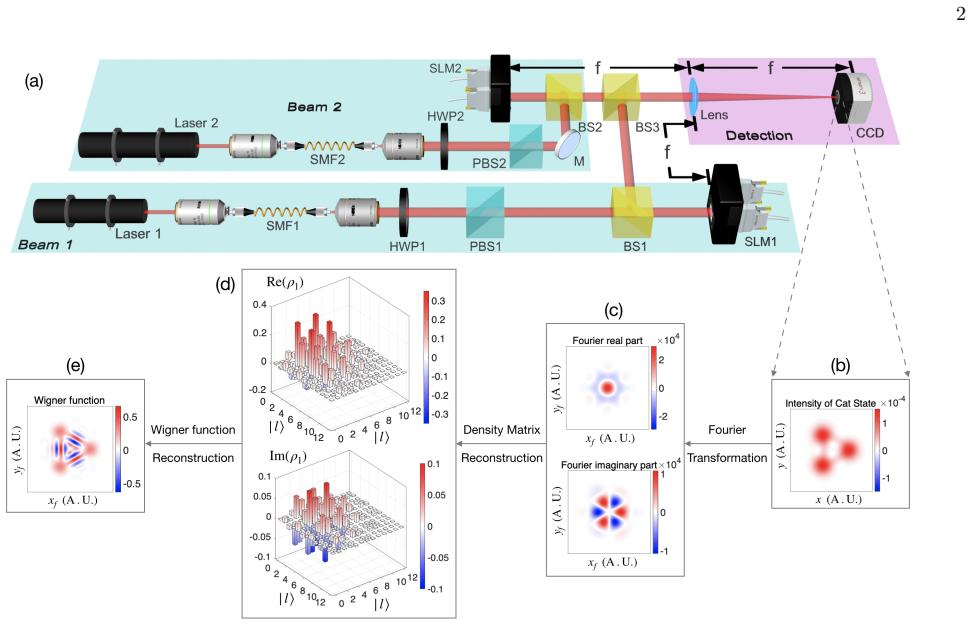
The load-bearing object is the orthogonality relation for the Fourier-transformed Laguerre-Gaussian mode products, Eq. (4): the integral of $P_{l_1,l_2}(r_f,\phi_f)P^*_{l'_1,l'_2}(r_f,\phi_f)$ against the weight $e^{\pi^2 r_f^2\sigma^2/2}$ gives Kronecker deltas $\delta_{l_1,l'_1}\delta_{l_2,l'_2}$ up to normalization. This identity converts one continuous position-basis intensity pattern into an informationally complete POVM on the truncated OAM subspace. The known beam waist $\sigma$ enters the reconstruction, and the finite-pixel CCD sampling makes the continuous orthogonality only approximate.
What would settle it
Prepare a known state with a small $p>0$ component, run the AHST inversion assuming only $p=0$ modes, and check whether the reconstructed density matrix in the $\{|0\rangle,\dots,|12\rangle\}$ basis acquires spurious weights proportional to the injected radial content; equivalently, reconstruct a known state with an intentionally wrong $\sigma$ and measure how the fidelity drops.
Extended reading notes
Core claim
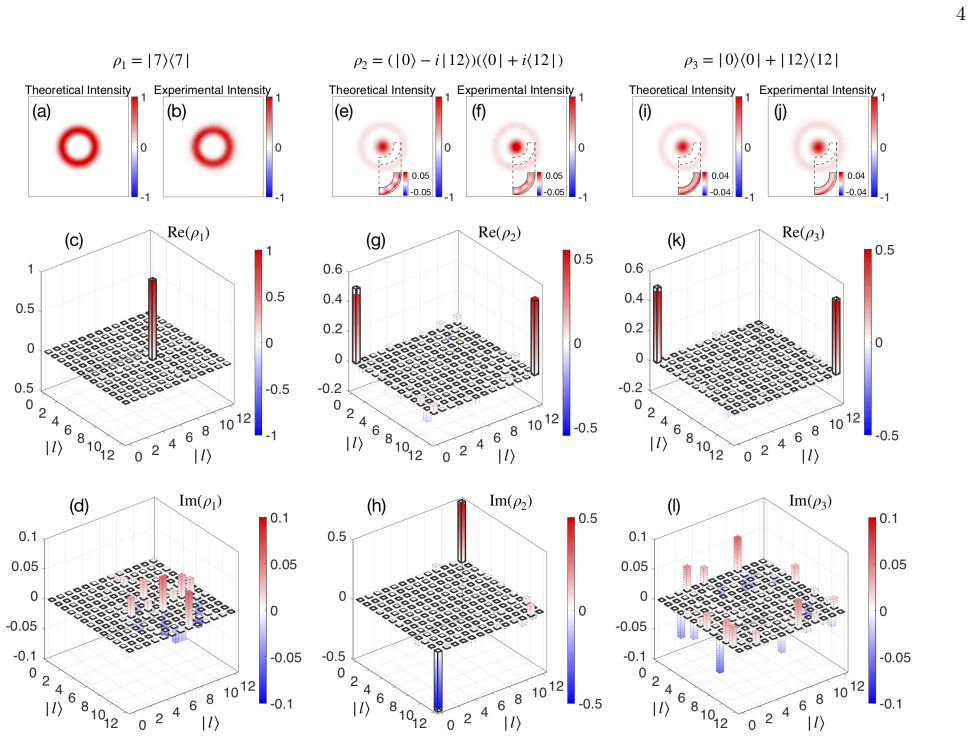
The central claim is that projective measurements in a larger Hilbert space can form an informationally complete POVM on a smaller prepared-state subspace, so no pre-rotations are needed. In the OAM realization, the subspace is spanned by Laguerre-Gaussian modes with $p=0$ and $l\ge 0$, and the larger space is the continuous position basis $|r,\phi\rangle$ on the beam cross section. The measured intensity $I(r,\phi)=A\langle r,\phi|\hat{\rho}|r,\phi\rangle$ is Fourier transformed and inverted using the known Fourier transforms of the mode products, yielding each density-matrix element through Eq. (5). The authors experimentally reconstruct states with $d=13$ using a $200\times200$ pixel camera, satisfying the requirement $D\ge d^2$ with $D=40000$, and report fidelities greater than 0.95 for all tested states.
Load-bearing premise
The inversion assumes the true state has zero support outside the $p=0, l\ge 0$ subspace and that the beam waist $\sigma$ used in the reconstruction is known and constant, while the camera only samples a finite window.
Editorial extensions
If this is right
- Full quantum state tomography of $p=0, l\ge 0$ OAM states requires no wave plates, interferometers, or sequential mode projections; one intensity image suffices.
- Mixed states are reconstructed directly because the recorded intensity is linear in the density matrix, so the same formula applies to classical mixtures without extra steps.
- The protocol should transfer to other quantum systems where a coordinate-basis measurement has known overlap functions with a chosen computational basis satisfying a similar orthogonality relation.
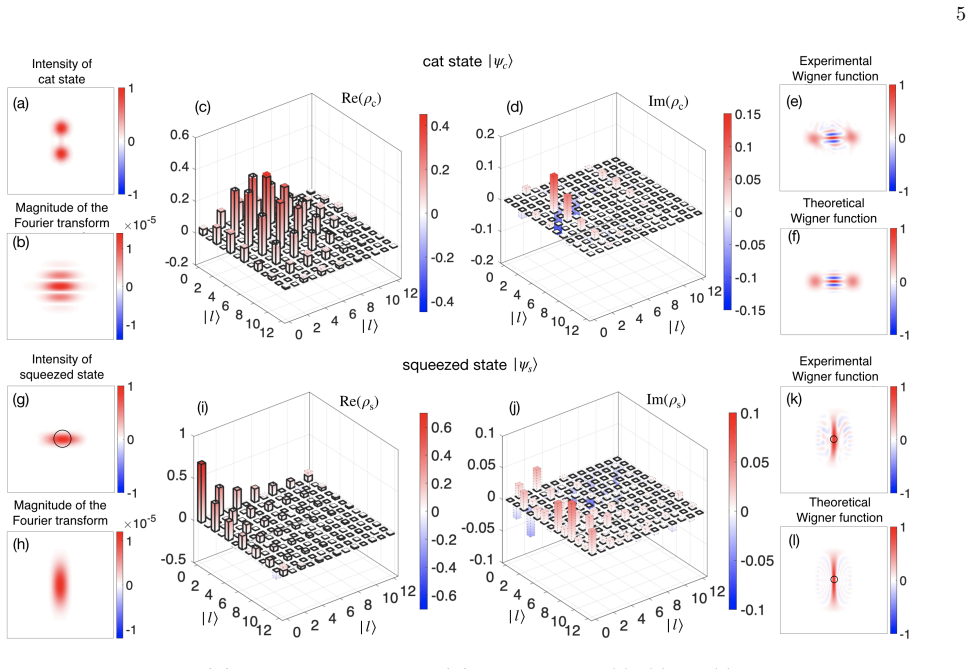
- The demonstrated OAM cat and squeezed states, together with their reconstructed Wigner functions, offer a tabletop platform for simulating harmonic-oscillator quantum optics.
- Higher-order OAM eigenstates show lower fidelities, attributed to lens astigmatism and SLM flatness, indicating that optical aberration correction is the practical scaling limit.
Reading between the lines
- A quantitative error model linking pixel pitch, camera window size, beam-waist uncertainty, and out-of-subspace population to fidelity would let future users choose hardware specifications; the paper does not provide such a bound.
- The method could plausibly be extended to the full Laguerre-Gaussian $(p,l)$ space by acquiring multiple images at different defocus planes or by using a known radial-mode series, provided the out-of-subspace leakage is characterized.
- Because the reconstruction factor $e^{\pi^2 r_f^2\sigma^2/2}$ amplifies high spatial frequencies, camera noise and pixel saturation may set a practical dimension limit well before the $D\ge d^2$ condition is violated.
- The self-referenced interference view suggests a testable analogy with in-line holography: reconstructing known states with intentionally aberrated values of $\sigma$ should produce predictable fidelity loss, giving a direct diagnostic of systematic errors.
Signed reviews
Editorial analysis
A structured set of objections, weighed in public.
Referee Report
Summary. The paper proposes "auxiliary Hilbert space tomography" (AHST), a quantum state tomography method in which a state living in a d-dimensional subspace is reconstructed from projective measurements in a larger D-dimensional Hilbert space, avoiding the usual pre-rotations. For OAM-carrying paraxial beams, the proposal is made concrete: the position-basis intensity pattern recorded by a CCD camera is Fourier-transformed and inverted using known Laguerre-Gaussian mode functions. The authors derive a linear inversion formula (Eqs. (4)-(5)) for states supported in the subspace p=0, l>=0, and demonstrate the protocol experimentally for OAM dimensions up to d=13, reporting state fidelities above 95% for eigenstates, superposition states, "cat" and "squeezed" states, and two mixed states. They also draw a formal analogy between the Fourier-transformed intensity pattern and the Wigner function of a one-dimensional harmonic oscillator, and use the reconstructed density matrices to plot Wigner functions of the generated OAM states.
Significance. If the protocol is robust, it is a conceptually attractive and experimentally simple tomography method: a single intensity image replaces the d^2 projective measurements of standard QST, and the reconstruction is a parameter-free linear inversion once the beam waist sigma is known. The paper makes this concrete with explicit formulas and reports consistently high fidelities across a dimension-13 subspace, including coherence-sensitive superposition and mixed states. The self-referenced reconstruction and the analogy to Wigner functions are appealing and potentially useful for OAM-based quantum information. However, the central claim depends on unquantified approximations (finite pixel sampling, truncation of the mode basis, out-of-subspace leakage) and on a post-selected mixed-state preparation, so the significance of the experimental demonstration is conditional on additional robustness analysis.
major comments (4)
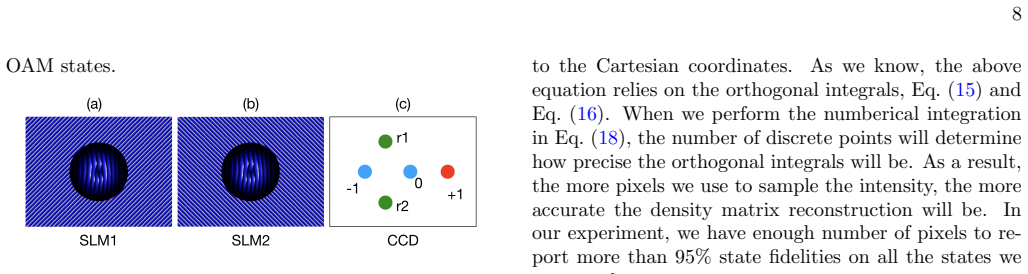
- [Methods, Eq. (18)] The implemented reconstruction replaces the continuous integrals of Eq. (5) with a 200x200 discrete Fourier sum, even though Eq. (4) is an exact orthogonality relation over the infinite plane. The paper gives no quantitative bound on the discretization and windowing error, and Eq. (18) multiplies each Fourier component by exp(pi^2[(p*DeltaX_f)^2+(q*DeltaY_f)^2]sigma^2/2), which grows exponentially with radial frequency. Consequently, high-spatial-frequency noise and truncated tails are exponentially amplified, and no condition number, SNR threshold, or convergence-with-pixel-count study is provided. I request an explicit error analysis (e.g., a condition-number estimate, simulations with added noise, or a pixel-convergence study) or an explicit discussion of the regime in which the approximation is controlled; without this, the claim that a single CCD image performs full QST is not quantitatively established.
- [Methods, Measurement] All demonstrated states are engineered to have support only in the p=0, l>=0 subspace with l<=12, but the paper does not quantify residual population outside this subspace (p>0, negative l, or l>=13). The Zernike aberration correction is assessed only by fitting goodness, not by a mode-purity or background measurement. If any out-of-subspace component is present, Eq. (18) folds it into the reconstructed 13x13 matrix because the functions P_{l1,l2} for l1,l2 in 0..12 are not orthogonal to higher-order modes after finite-window sampling. Please provide a quantitative leakage bound or a robustness test with injected out-of-subspace components; without this, the experimental fidelities do not stress the most fragile assumption of the method.
- [Methods, Fourier transform of LG modes, Eq. (4)] Equation (4) is the mathematical foundation of the inversion, but the derivation is only sketched: the text cites Eqs. (15)-(16) for the azimuthal and radial orthogonality integrals without showing how the normalization constant C and the Gaussian weight exp(pi^2 r_f^2 sigma^2/2) arise from the Fourier transform of the LG-mode product. This is load-bearing because Eq. (5) and its discrete implementation depend on the exact form of this orthogonality relation; please present the full derivation or provide a source that contains it.
- [Methods, Measurement and Data analysis] The mixed-state demonstration uses post-selection on the measured power ratio between the two arms (text: 'we then pose-select the data with desired power ratio between the two arms'). The reconstructed density matrices for rho_m1 and rho_m2 therefore characterize a conditional ensemble selected by the measured relative power, not necessarily the unconditional output of the two independent lasers. Since the relative weights of the two components are correlated with the measured power ratio, the post-selection can bias the reconstructed state relative to the nominal mixture; please discuss this selection bias and, if the unconditional state is the intended object, estimate the fidelity against the unconditioned distribution.
minor comments (5)
- [Introduction] There are several typos that should be corrected, including 'brute-froce' instead of 'brute-force', 'sates' instead of 'states', and 'Hillbert' instead of 'Hilbert'.
- [Methods, Measurement] 'pose-select' should be 'post-select' in the paragraph describing the mixed-state power monitoring.
- [Methods, Data analysis, Eq. (17)] The summation limits in Eq. (17) are written as M/2,N/2 over m,n but the subsequent variable ranges are given for p,q; the notation should be clarified so that the indices and bounds match the stated 200x200 pixel grid.
- [Methods, Data analysis] The statement 'the more pixels we use to sample the intensity, the more accurate the density matrix reconstruction will be' is too vague; please replace it with a specific statement about the expected scaling of the reconstruction error with pixel count or with the result of a pixel-convergence test.
- [Introduction] The sentence 'It is obvious that the minimum number of rank-1 elements of an IC-POVM for rho is d^2' is standard for discrete POVMs, but in the present continuous-measurement setting the statement should be phrased more carefully, since infinitely many position-basis projectors are used and information completeness is achieved by the continuum of measurement outcomes.
Circularity Check
No circularity: AHST is a parameter-free linear inversion against independently known LG mode functions; the reported fidelities are independent checks against prepared targets.
full rationale
The paper's central derivation, Eq. (5), is a linear inversion of the measured intensity using the known Laguerre-Gaussian mode functions and the orthogonality identity Eq. (4). The mode functions are independently defined, the beam waist sigma is measured by a separate TEM00 Gaussian fit and not adjusted to reproduce the tomography targets, and the Cholesky least-squares step enforces physicality of the reconstructed matrix without fitting it to the theoretical states. The reported fidelities compare the reconstructed density matrices to independently defined target states generated by the holograms, so the agreement is evidence rather than a tautology. The finite 200x200 pixel window and the restriction to the p=0, l>=0 subspace introduce accuracy limitations, but these are correctness risks, not circular reasoning. No load-bearing self-citation or imported uniqueness theorem appears. The AHST reconstruction is therefore self-contained and not circular.
Assumptions & free parameters
free parameters (3)
- Beam waist sigma =
0.114 +/- 0.001 mm
- Cholesky least-squares parameters t_i =
n^2 = 169 real variables, values not reported
- Cat and squeezed state parameters alpha, gamma =
alpha = 2, gamma = 1.5
assumptions (5)
- domain assumption Prepared states are supported on the p=0, l>=0 OAM subspace (Eq. 1).
- domain assumption CCD intensity is proportional to the position-basis diagonal <r,phi|rho|r,phi> with no background, saturation, or shot-noise floor.
- domain assumption Discrete 200x200 pixel sampling (D=40000) is sufficient to approximate the continuous orthogonality in Eq. (4).
- domain assumption The two independent He-Ne lasers are mutually incoherent, so the combined beam is a classical mixture.
- standard math Standard Fourier-optics and Laguerre polynomial identities (Eqs. 12-16) hold.
Cite this review
Pith. "Pith review of Efficient quantum state tomography with auxiliary Hilbert space." pith.science (2026). https://pith.science/paper/CT6RH7XP
@misc{pith2026190800577,
  author       = {Pith},
  title        = {Pith review of: Efficient quantum state tomography with auxiliary Hilbert space},
  year         = {2026},
  howpublished = {\url{https://pith.science/paper/CT6RH7XP}},
  note         = {Machine review of arXiv:1908.00577}
}
abstract
Quantum state tomography is an important tool for quantum communication, computation, metrology, and simulation. Efficient quantum state tomography on a high dimensional quantum system is still a challenging problem. Here, we propose a novel quantum state tomography method, auxiliary Hilbert space tomography, to avoid pre-rotations before measurement in a quantum state tomography experiment. Our method requires projective measurements in a higher dimensional space that contains the subspace that includes the prepared states. We experimentally demonstrate this method with orbital angular momentum states of photons. In our experiment, the quantum state tomography measurements are as simple as taking a photograph with a camera. We experimentally verify our method with near-pure- and mixed-states of orbital angular momentum with dimension up to $d=13$, and achieve greater than 95 % state fidelities for all states tested. This method dramatically reduces the complexity of measurements for full quantum state tomography, and shows potential application in various high dimensional quantum information tasks.
Figures
Figures from the paper (1 more)
Reference graph
Works this paper leans on
-
[42]
Re- vealing the order of a vortex through its intensity record,
S. Prabhakar, A. Kumar, J. Banerji, and R. Singh, “Re- vealing the order of a vortex through its intensity record,” Optics letters , vol. 36, no. 22, pp. 4398–4400, 2011
work page 2011
-
[1]
M. Paris and J. Rehacek, Quantum state estimation , vol. 649. Springer Science & Business Media, 2004
work page 2004
-
[2]
T. Y. Siah, Introduction to quantum-state estimation . World Scientific, 2015
work page 2015
-
[3]
Scalable multiparticle entanglement of trapped ions,
H. H¨ affner, W. H¨ ansel, C. Roos, J. Benhelm, M. Chwalla, T. K¨ orber, U. Rapol, M. Riebe, P. Schmidt, C. Becher, et al. , “Scalable multiparticle entanglement of trapped ions,” Nature, vol. 438, no. 7068, p. 643, 2005. 9
work page 2005
-
[4]
Q. P. Stefano, L. Reb´ on, S. Ledesma, and C. Iemmi, “De- termination of any pure spatial qudits from a minimum number of measurements by phase-stepping interferome- try,” Physical Review A , vol. 96, no. 6, p. 062328, 2017
work page 2017
-
[5]
Tomography and purification of the temporal- mode structure of quantum light,
V. Ansari, J. M. Donohue, M. Allgaier, L. Sansoni, B. Brecht, J. Roslund, N. Treps, G. Harder, and C. Sil- berhorn, “Tomography and purification of the temporal- mode structure of quantum light,” Physical review let- ters, vol. 120, no. 21, p. 213601, 2018
work page 2018
-
[6]
Scalable on-chip quantum state tomography,
J. G. Titchener, M. Gr¨ afe, R. Heilmann, A. S. Solntsev, A. Szameit, and A. A. Sukhorukov, “Scalable on-chip quantum state tomography,” npj Quantum Information , vol. 4, no. 1, p. 19, 2018
work page 2018
-
[7]
Experimental demonstra- tion of adaptive quantum state estimation,
R. Okamoto, M. Iefuji, S. Oyama, K. Yamagata, H. Imai, A. Fujiwara, and S. Takeuchi, “Experimental demonstra- tion of adaptive quantum state estimation,” Physical re- view letters , vol. 109, no. 13, p. 130404, 2012
work page 2012
Show all 43 references
-
[8]
Efficient method for computing the maximum-likelihood quantum state from measurements with additive gaussian noise,
J. A. Smolin, J. M. Gambetta, and G. Smith, “Efficient method for computing the maximum-likelihood quantum state from measurements with additive gaussian noise,” Physical review letters , vol. 108, no. 7, p. 070502, 2012
2012
-
[9]
Adaptive quan- tum state tomography improves accuracy quadratically,
D. Mahler, L. A. Rozema, A. Darabi, C. Ferrie, R. Blume-Kohout, and A. Steinberg, “Adaptive quan- tum state tomography improves accuracy quadratically,” Physical review letters , vol. 111, no. 18, p. 183601, 2013
2013
-
[10]
Full re- construction of a 14-qubit state within four hours,
Z. Hou, H.-S. Zhong, Y. Tian, D. Dong, B. Qi, L. Li, Y. Wang, F. Nori, G.-Y. Xiang, C.-F. Li, et al. , “Full re- construction of a 14-qubit state within four hours,” New Journal of Physics , vol. 18, no. 8, p. 083036, 2016
2016
-
[11]
Experimental quantum to- mography assisted by multiply symmetric states in higher dimensions,
D. Mart´ ınez, M. Sol´ ıs-Prosser, G. Ca˜ nas, O. Jim´ enez, A. Delgado, and G. Lima, “Experimental quantum to- mography assisted by multiply symmetric states in higher dimensions,” Physical Review A, vol. 99, no. 1, p. 012336, 2019
2019
-
[12]
Detection of entan- glement with polarized photons: Experimental realiza- tion of an entanglement witness,
M. Barbieri, F. De Martini, G. Di Nepi, P. Mataloni, G. DAriano, and C. Macchiavello, “Detection of entan- glement with polarized photons: Experimental realiza- tion of an entanglement witness,” Physical review letters, vol. 91, no. 22, p. 227901, 2003
2003
-
[13]
Experimental detection of multi- partite entanglement using witness operators,
M. Bourennane, M. Eibl, C. Kurtsiefer, S. Gaertner, H. Weinfurter, O. G¨ uhne, P. Hyllus, D. Bruß, M. Lewen- stein, and A. Sanpera, “Experimental detection of multi- partite entanglement using witness operators,” Physical review letters, vol. 92, no. 8, p. 087902, 2004
2004
-
[14]
Purity estimation with separable mea- surements,
E. Bagan, M. Ballester, R. Munoz-Tapia, and O. Romero-Isart, “Purity estimation with separable mea- surements,” Physical review letters , vol. 95, no. 11, p. 110504, 2005
2005
-
[15]
Direct fidelity estimation from few pauli measurements,
S. T. Flammia and Y.-K. Liu, “Direct fidelity estimation from few pauli measurements,” Physical Review Letters , vol. 106, no. 23, p. 230501, 2011
2011
-
[16]
Separability- entanglement classifier via machine learning,
S. Lu, S. Huang, K. Li, J. Li, J. Chen, D. Lu, Z. Ji, Y. Shen, D. Zhou, and B. Zeng, “Separability- entanglement classifier via machine learning,” Physical Review A, vol. 98, no. 1, p. 012315, 2018
2018
-
[17]
Experimental machine learning of quantum states,
J. Gao, L.-F. Qiao, Z.-Q. Jiao, Y.-C. Ma, C.-Q. Hu, R.- J. Ren, A.-L. Yang, H. Tang, M.-H. Yung, and X.-M. Jin, “Experimental machine learning of quantum states,” Physical review letters , vol. 120, no. 24, p. 240501, 2018
2018
-
[18]
Permutationally in- variant quantum tomography,
G. T´ oth, W. Wieczorek, D. Gross, R. Krischek, C. Schwemmer, and H. Weinfurter, “Permutationally in- variant quantum tomography,” Physical review letters , vol. 105, no. 25, p. 250403, 2010
2010
-
[19]
Quantum state tomography via compressed sens- ing,
D. Gross, Y.-K. Liu, S. T. Flammia, S. Becker, and J. Eis- ert, “Quantum state tomography via compressed sens- ing,” Physical review letters , vol. 105, no. 15, p. 150401, 2010
2010
-
[20]
Experimental quantum state tomography via compressed sampling,
W.-T. Liu, T. Zhang, J.-Y. Liu, P.-X. Chen, and J.- M. Yuan, “Experimental quantum state tomography via compressed sampling,” Physical review letters , vol. 108, no. 17, p. 170403, 2012
2012
-
[21]
Adaptive compressive tomography with no a priori information,
D. Ahn, Y. Teo, H. Jeong, F. Bouchard, F. Hufnagel, E. Karimi, D. Koutn` y, J.ˇReh´ aˇ cek, Z. Hradil, G. Leuchs, et al. , “Adaptive compressive tomography with no a priori information,” Physical Review Letters , vol. 122, no. 10, p. 100404, 2019
2019
-
[22]
Exact solution to simultaneous intensity and phase encryption with a single phase-only hologram,
E. Bolduc, N. Bent, E. Santamato, E. Karimi, and R. W. Boyd, “Exact solution to simultaneous intensity and phase encryption with a single phase-only hologram,” Optics letters , vol. 38, no. 18, pp. 3546–3549, 2013
2013
-
[23]
Gribbin, In search of Schrodinger’s cat: Quantum physics and reality
J. Gribbin, In search of Schrodinger’s cat: Quantum physics and reality . Bantam, 2011
2011
-
[24]
Deterministically encoding quantum information using 100-photon schr¨ odinger cat states,
B. Vlastakis, G. Kirchmair, Z. Leghtas, S. E. Nigg, L. Frunzio, S. M. Girvin, M. Mirrahimi, M. H. De- voret, and R. J. Schoelkopf, “Deterministically encoding quantum information using 100-photon schr¨ odinger cat states,” Science, vol. 342, no. 6158, pp. 607–610, 2013
2013
-
[25]
Classical analogy of a cat state using vortex light,
S.-L. Liu, Q. Zhou, S.-K. Liu, Y. Li, Y.-H. Li, Z.-Y. Zhou, G.-C. Guo, and B.-S. Shi, “Classical analogy of a cat state using vortex light,” Communications Physics, vol. 2, no. 1, p. 75, 2019
2019
-
[26]
Orbital angular momentum of light and the transformation of laguerre-gaussian laser modes,
L. Allen, M. W. Beijersbergen, R. Spreeuw, and J. Wo- erdman, “Orbital angular momentum of light and the transformation of laguerre-gaussian laser modes,” Phys- ical Review A , vol. 45, no. 11, p. 8185, 1992
1992
-
[27]
Twisted photons: new quantum perspectives in high dimensions,
M. Erhard, R. Fickler, M. Krenn, and A. Zeilinger, “Twisted photons: new quantum perspectives in high dimensions,” Light: Science & Applications , vol. 7, p. 17146, Oct 2017
2017
-
[28]
Optimal quantum cloning of orbital angular mo- mentum photon qubits through hong–ou–mandel coales- cence,
E. Nagali, L. Sansoni, F. Sciarrino, F. De Martini, L. Marrucci, B. Piccirillo, E. Karimi, and E. Santam- ato, “Optimal quantum cloning of orbital angular mo- mentum photon qubits through hong–ou–mandel coales- cence,” Nature Photonics, vol. 3, no. 12, p. 720, 2009
2009
-
[29]
Free- space information transfer using light beams carrying or- bital angular momentum,
G. Gibson, J. Courtial, M. J. Padgett, M. Vasnetsov, V. Pasko, S. M. Barnett, and S. Franke-Arnold, “Free- space information transfer using light beams carrying or- bital angular momentum,” Optics express, vol. 12, no. 22, pp. 5448–5456, 2004
2004
-
[30]
Free-space propagation of high-dimensional structured optical fields in an urban environment,
M. P. Lavery, C. Peuntinger, K. G¨ unthner, P. Banzer, D. Elser, R. W. Boyd, M. J. Padgett, C. Marquardt, and G. Leuchs, “Free-space propagation of high-dimensional structured optical fields in an urban environment,” Sci- ence advances, vol. 3, no. 10, p. e1700552, 2017
2017
-
[31]
Secure information capacity of photons entangled in many dimensions,
J. Leach, E. Bolduc, D. J. Gauthier, and R. W. Boyd, “Secure information capacity of photons entangled in many dimensions,” Physical Review A , vol. 85, no. 6, p. 060304, 2012
2012
-
[32]
Factoring with qutrits: Shor’s algorithm on ternary and metaplec- tic quantum architectures,
A. Bocharov, M. Roetteler, and K. M. Svore, “Factoring with qutrits: Shor’s algorithm on ternary and metaplec- tic quantum architectures,” Physical Review A , vol. 96, no. 1, p. 012306, 2017
2017
-
[33]
Quantum cryptography using larger alphabets,
H. Bechmann-Pasquinucci and W. Tittel, “Quantum cryptography using larger alphabets,” Physical Review A, vol. 61, no. 6, p. 062308, 2000
2000
-
[34]
Structure of multidimen- sional entanglement in multipartite systems,
M. Huber and J. I. de Vicente, “Structure of multidimen- sional entanglement in multipartite systems,” Physical review letters, vol. 110, no. 3, p. 030501, 2013. 10
2013
-
[35]
Wavelength-multiplexed quantum net- works with ultrafast frequency combs,
J. Roslund, R. M. de Ara´ ujo, S. Jiang, C. Fabre, and N. Treps, “Wavelength-multiplexed quantum net- works with ultrafast frequency combs,” Nature Photon- ics, vol. 8, pp. 109–112, Dec 2013
2013
-
[36]
Multi-photon entanglement in high di- mensions,
M. Malik, M. Erhard, M. Huber, M. Krenn, R. Fickler, and A. Zeilinger, “Multi-photon entanglement in high di- mensions,” Nature Photonics , vol. 10, pp. 248–252, Feb 2016
2016
-
[37]
Security of quantum key distribution using d-level sys- tems,
N. J. Cerf, M. Bourennane, A. Karlsson, and N. Gisin, “Security of quantum key distribution using d-level sys- tems,” Physical Review Letters, vol. 88, no. 12, p. 127902, 2002
2002
-
[38]
Closing the de- tection loophole in bell experiments using qudits,
T. V´ ertesi, S. Pironio, and N. Brunner, “Closing the de- tection loophole in bell experiments using qudits,” Phys- ical review letters , vol. 104, no. 6, p. 060401, 2010
2010
-
[39]
Quantum state tomography of orbital angular momentum photonic qubits via a projection-based tech- nique,
A. Nicolas, L. Veissier, E. Giacobino, D. Maxein, and J. Laurat, “Quantum state tomography of orbital angular momentum photonic qubits via a projection-based tech- nique,” New Journal of Physics , vol. 17, no. 3, p. 033037, 2015
2015
-
[40]
Characterization of high- dimensional entangled systems via mutually unbiased measurements,
D. Giovannini, J. Romero, J. Leach, A. Dudley, A. Forbes, and M. J. Padgett, “Characterization of high- dimensional entangled systems via mutually unbiased measurements,” Physical review letters , vol. 110, no. 14, p. 143601, 2013
2013
-
[41]
Experi- mental realization of quantum tomography of photonic qudits via symmetric informationally complete positive operator-valued measures,
N. Bent, H. Qassim, A. Tahir, D. Sych, G. Leuchs, L. L. S´ anchez-Soto, E. Karimi, and R. Boyd, “Experi- mental realization of quantum tomography of photonic qudits via symmetric informationally complete positive operator-valued measures,” Physical Review X , vol. 5, no. 4, p....
2015
-
[43]
Quantum optics,
M. O. Scully and M. S. Zubairy, “Quantum optics,” 1999
1999
Reviewed August 14, 2026 · model on record in the stance chip above.
Discussion (0). Continue with ORCID to comment.