REVIEW 4 major objections 4 minor 37 references
V-Trans4Style: Visual Transition Recommendation for Video Production Style Adaptation
T0 review · 4 major / 4 minor · reviewed 2026-08-10 · deepseek-v4-flash
Pith's one-line read V-Trans4Style recommends a sequence of visual transitions that adapts an input video to a desired production style, using a transformer encoder-decoder plus an inference-time style conditioning module.
desk verdict Reasonable incremental extension of AutoTransition with a useful dataset, but the central style-adaptation claim is validated with the same cosine-similarity objective the method explicitly optimizes, making the headline 12% number mostly a self-consistency check. read the letter →
The pith
A machine-rendered reading of the paper's core claim, the machinery that carries it, and where it could break.
The reading
What carries the argument
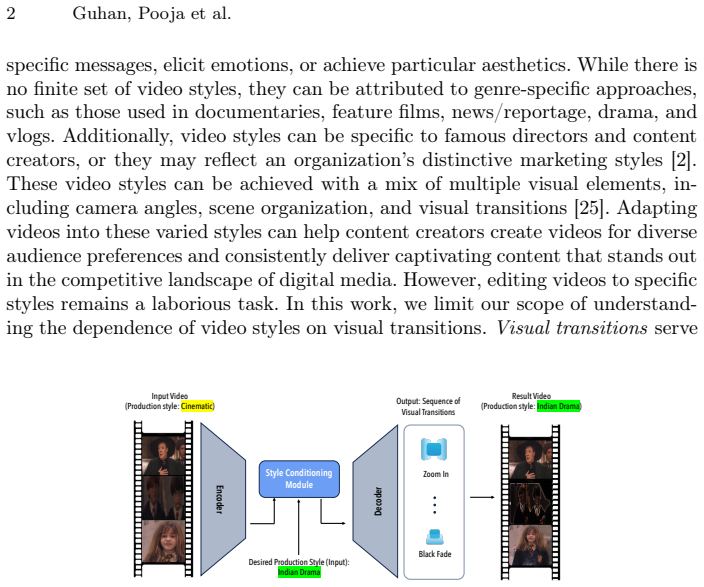
The load-bearing components are a pretrained multitask network (MLN) whose shared unit vector is used both to classify transitions and to predict video style, producing embeddings for 30 transition classes and 5 styles; a transformer encoder-decoder that generates transitions one step at a time with masked self-attention, so each recommendation is causal and temporally consistent; and a style conditioning module (SCM) that, at inference, backpropagates through the decoder to adjust the latent code $z$ via activation maximization, with a reconstruction loss $L_R$ guarding against drift from the input video's content. An optional finetuning step, inspired by the RRT path-planning algorithm, replaces each recommended transition with one of its $K$ nearest pretrained embeddings to move the mean transition embedding closer to the desired style embedding.
What would settle it
Swap the style labels among videos before training MLN, then rerun the SCM evaluation; if cosine similarity to the permuted style embeddings still rises by roughly 12%, the reported style gain is an artifact of the embedding geometry rather than a property of the five production styles.
Extended reading notes
Core claim
On the paper's own terms, the central claim is that visual transitions alone can carry a substantial part of video production style, and that the right transition sequence for a desired style can be recommended automatically from the input clips and a style label. The system, V-Trans4Style, first trains a transformer encoder-decoder to map ordered clips to a causally masked sequence of transition classes, using cross-entropy plus a masked triplet loss against pretrained transition embeddings. Then, at inference, the style conditioning module repeatedly updates the latent code by activation maximization, balancing an embedding loss that pulls the mean of the decoder's transition embeddings toward the desired style embedding against a reconstruction loss that preserves the input video's identity. On AutoTransition++, the encoder-decoder is reported to improve Recall@1, Recall@5, and mean rank over the AutoTransition baseline by margins from roughly 10% to 80%, and the style conditioning module is reported to improve cosine similarity to the target style embedding by about 12% on average.
Load-bearing premise
The whole style-adaptation result rests on the assumption that the five manually defined style categories (vlog, influencer, nature/urban, photo slideshow, anime) are real production styles and that cosine similarity to a style embedding learned from those same labels measures style adaptation.
Editorial extensions
If this is right
- Because the style conditioning module runs at inference time, applying the method to a new style does not require retraining the encoder-decoder; only a style embedding for the new style is needed.
- Because the decoder is causal, the recommended transition sequence can be generated online during editing, one transition at a time, rather than requiring the full target sequence in advance.
- AutoTransition++ provides a style-labeled transition dataset, enabling further study of how transition choices vary across the five production styles.
- If the reported margins hold, transition recommenders that ignore temporal dependencies between transitions are leaving substantial accuracy on the table.
Reading between the lines
- Beyond the paper's claims, the five styles in AutoTransition++ are closer to content/genre labels than to purely visual style descriptors, so the phrase 'style adaptation' here means matching transition-usage patterns of those genres, not altering color, lighting, or camera work.
- Because the style embedding serves as both the optimization target and the evaluation metric, the roughly 12% gain is best read as an internal consistency check; an external test would require independent raters comparing the adapted videos.
- A natural extension is to feed SCM a style embedding derived from a few example videos of an unseen style; if the same decoder adapts without retraining, the method is a general style adapter rather than a five-class classifier.
- Varying the number of SCM optimization iterations should produce a trade-off curve between style match and content preservation, which editors could use to set the reconstruction-loss weight.
Editorial analysis
A structured set of objections, weighed in public.
Referee Report
Summary. V-Trans4Style trains a transformer encoder-decoder on a new 6k-video subset of AutoTransition, called AutoTransition++, to recommend sequences of visual transitions, and then applies a style conditioning module (SCM) that updates the latent embedding via activation maximization toward a target style embedding, optionally followed by an RRT-based refinement. The paper reports large Recall@K and mean-rank gains over the AutoTransition baseline for the encoder-decoder component, and reports roughly 12% average improvement in cosine similarity to the desired style embedding for the full system. The central concern is that the style-adaptation evaluation uses exactly the objective that SCM and RRT optimize, so the headline style claim is not independently validated.
Significance. If the encoder-decoder results are robust, the architectural improvements over AutoTransition are a useful contribution to video transition recommendation, and AutoTransition++ with style labels is a potentially valuable dataset for future work. However, the paper's main claimed contribution, style-conditional adaptation, is currently supported only by a circular metric and a user study that lacks the necessary controls. The paper also does not provide code, error bars, or significance tests, which limits the strength of the quantitative claims. The dataset contribution and the bottom-up formulation are the strongest parts; the style-conditioning claim needs substantial additional validation before the paper can be accepted.
major comments (4)
- [Sec. 5.3, Eq. (5); Sec. 6.1, Table 3] The style-conditioning evaluation is circular. The SCM loss is LE = 1 - cos(e_mu, estyle_k), and the RRT post-processing explicitly selects transitions whose e_mu is closest to estyle_k; Table 3 then reports exactly this cosine similarity as the evaluation metric. The comparison against AutoTransition and E+D, which do not optimize this quantity, therefore measures how well SCM+RRT solves its own objective, not whether the recommended transitions adapt the video to the target production style. Please add a content-agnostic baseline (e.g., the most frequent transitions per style from the training set), evaluate with independently obtained style judgments, and report a forced-choice perceptual test in which users must identify which of two adapted videos matches the requested style label.
- [Appendix, Sec. 3.2] The user study does not resolve the circularity. It compares only SCM w/ RRT against E+D, asks whether a video 'shows signs of adaptation to a different video production style' rather than whether it matches the requested style, and reports no statistical test for the 75.33% vs 24.67% split. Without a control condition that applies transitions sampled independently of the style embedding, the result could simply reflect that SCM+RRT produces transitions that look more edited or more distinctive, not that they convey the intended production style.
- [Sec. 4.1; Appendix Sec. 1] The five annotated categories (vlog, influencer, nature/urban, photo slideshow, anime) are content categories rather than the documentary/drama/feature-film production styles advertised in the abstract and introduction. The paper's only justification for equating them with styles is that the content and transition distributions differ, and no inter-annotator agreement or other reliability measure is reported. Since the style embeddings and the SCM objective are derived from these labels, the taxonomy should be validated as a production-style taxonomy, or the claims should be restricted to content-conditional transition recommendation.
- [Sec. 5.3; Table 3] The RRT neighborhood size K is never specified, even though K controls the search strength behind the SCM w/ RRT results; without K the headline style-improvement numbers are not reproducible. Please report K, a sensitivity analysis, and, if possible, error bars across the test videos.
minor comments (4)
- [Sec. 6.2, Table 1] The encoder-decoder improvements over AutoTransition are substantial, but no confidence intervals or significance tests are reported; adding them would strengthen the claim.
- [Eq. (7); Sec. 6.1] Equation (7) defines e_mu as a sum, while the text and evaluation describe it as a mean; the cosine is scale-invariant for positive scalars, so the discrepancy is not numerically critical, but the notation should be made consistent.
- [Sec. 6.1] The paper states that all code was implemented in PyTorch but does not release the code; releasing code, or at least the exact hyperparameters (including the RRT K value), would substantially improve reproducibility.
- [Fig. 5(b)] The t-SNE panels (A) and (B) are described only in the caption; for clarity, the caption should state explicitly which method produced each panel.
Circularity Check
Style-adaptation claim is evaluated with the cosine-similarity metric that SCM (Eq. 5) and RRT finetuning explicitly optimize, so the reported ~12% improvement largely re-states the method's own objective; a content-agnostic selector baseline is missing.
-
fitted input called prediction
[Sec. 5.3, Eq. (5); Sec. 6.1, Metrics and Baselines; Sec. 6.2, Style conditioning Module]
"LE = 1− σcos(eµ, estyle k ) (5) ... For SCM, we consider cosine similarity, which informs us about how relevant a method’s recommended transitions are for the video production style we wish to achieve. ... we computed the cosine-similarity between eµ, i.e. the mean embedding of all the transitions predicted for a video and the desired video production style embedding. Table 3 shows the mean of the cosine similarity scores obtained across the100 samples for each of the baseline methods."
The SCM optimization objective is exactly 1 minus the cosine similarity between the mean recommended-transition embedding and the target style embedding. The headline style-adaptation result is then measured with that same cosine similarity. Reporting that SCM improves this score is therefore largely a statement that the optimization moves the quantity it was designed to move; it does not independently validate that the recommended transitions adapt the video to a perceived production style. A method trained or tuned to maximize metric M cannot be validated by metric M alone.
-
fitted input called prediction
[Sec. 5.3, Finetuning the transition sequence]
"For RRT instead, we consider its K nearest pre-trained embeddings using a distance metric. ... Each of theK transitions is then iteratively evaluated to compute eµ that is closest to the desired video style embedding, i.e.,estyle k ."
The RRT post-processing step explicitly searches over candidate transitions at each position and selects the ones whose resulting mean embedding e_mu is closest to the target style embedding. The evaluation in Table 3 then measures exactly the cosine similarity between e_mu and the target style embedding. Thus the reported gains for 'SCM w/ RRT' are, by construction, the output of a direct search over the evaluation criterion. Without a content-agnostic selector baseline, the experiment cannot distinguish genuine style adaptation from simply picking transitions that score well on the metric being optimized.
full rationale
The encoder-decoder contribution is largely self-contained: its Recall@K and Mean Rank numbers are compared against AutoTransition [23], an external baseline, and do not reduce to the method's own objective. However, the paper's distinctive style-adaptation claim is circular in a specific, quotable way. The SCM loss in Eq. (5) minimizes 1 - cos(e_mu, estyle_k), and the evaluation in Table 3 (and Appendix Table 1) computes the cosine similarity between exactly the same quantities. RRT then makes the reduction even more direct by selecting transitions whose e_mu is closest to estyle_k, so the method is explicitly tuning the reported metric. The style embeddings themselves are learned from the authors' own five-style labels via MLN, which makes the metric an internal consistency check rather than an external validation of production-style perception. The user study provides some external evidence, but it only pits SCM w/ RRT against the E+D variant and does not include a content-agnostic control; it also does not verify that viewers perceived the specifically requested style. The RRT K value is unspecified, so the search strength behind the reported numbers is not reproducible. Overall, the central style-adaptation result is substantially forced by construction, while the non-style transition recommendation results retain independent content; hence a score of 7 rather than 8-10.
Assumptions & free parameters
free parameters (6)
- RRT neighborhood size K =
not reported
- SCM optimization learning rate beta =
0.1
- SCM iteration count =
5000
- SCM loss weights alpha_E, alpha_R =
1, 1
- E-D loss weight lambda =
not reported
- Triplet loss margin m =
0.5
assumptions (6)
- domain assumption Annotator style labels are correct ground truth
- domain assumption Cosine similarity to a learned style embedding measures production style capture
- domain assumption MLN embeddings preserve necessary visual and style information
- domain assumption Reconstruction via D_p si preserves input video content
- domain assumption AutoTransition++ is representative of AutoTransition
- domain assumption SlowFast features are adequate for transition recommendation
Cite this review
Pith. "Pith review of V-Trans4Style: Visual Transition Recommendation for Video Production Style Adaptation." pith.science (2026). https://pith.science/paper/CTM5UHSQ
@misc{pith2026250107983,
  author       = {Pith},
  title        = {Pith review of: V-Trans4Style: Visual Transition Recommendation for Video Production Style Adaptation},
  year         = {2026},
  howpublished = {\url{https://pith.science/paper/CTM5UHSQ}},
  note         = {Machine review of arXiv:2501.07983}
}
read the original abstract
We introduce V-Trans4Style, an innovative algorithm tailored for dynamic video content editing needs. It is designed to adapt videos to different production styles like documentaries, dramas, feature films, or a specific YouTube channel's video-making technique. Our algorithm recommends optimal visual transitions to help achieve this flexibility using a more bottom-up approach. We first employ a transformer-based encoder-decoder network to learn recommending temporally consistent and visually seamless sequences of visual transitions using only the input videos. We then introduce a style conditioning module that leverages this model to iteratively adjust the visual transitions obtained from the decoder through activation maximization. We demonstrate the efficacy of our method through experiments conducted on our newly introduced AutoTransition++ dataset. It is a 6k video version of AutoTransition Dataset that additionally categorizes its videos into different production style categories. Our encoder-decoder model outperforms the state-of-the-art transition recommendation method, achieving improvements of 10% to 80% in Recall@K and mean rank values over baseline. Our style conditioning module results in visual transitions that improve the capture of the desired video production style characteristics by an average of around 12% in comparison to other methods when measured with similarity metrics. We hope that our work serves as a foundation for exploring and understanding video production styles further.
Figures


Figures from the paper (10 more)


Reference graph
Works this paper leans on
-
[23]
Shen, Y., Zhang, L., Xu, K., Jin, X.: Autotransition: Learning to recommend videotransitioneffects.In:EuropeanConferenceonComputerVision.pp.285–300. Springer (2022)
work page 2022
-
[1]
Adobe Creative Cloud: Types of visual transitions. https://www.adobe.com/ creativecloud/video/discover/types- of- film- transitions.html , accessed: 2023-11-13
work page 2023
-
[2]
Foreign Language Annals (2024)
Alghamdi, E.A.: What makes video-based academic lectures difficult for language learners to comprehend? the role of multimodal complexity. Foreign Language Annals (2024)
work page 2024
-
[3]
In: Proceedings of the Asian Conference on Computer Vision (2020)
Bain, M., Nagrani, A., Brown, A., Zisserman, A.: Condensed movies: Story based retrieval with contextual embeddings. In: Proceedings of the Asian Conference on Computer Vision (2020)
work page 2020
-
[4]
In: Proceedings of the IEEE/CVF Winter Conference on Appli- cations of Computer Vision
Chen, B., Ziai, A., Tucker, R.S., Xie, Y.: Match cutting: Finding cuts with smooth visual transitions. In: Proceedings of the IEEE/CVF Winter Conference on Appli- cations of Computer Vision. pp. 2115–2125 (2023)
work page 2023
-
[5]
línea) Disponible en: http://www
Cloud, A.C.: Adobe premiere pro cc. línea) Disponible en: http://www. adobe. com/mx/products/premiere. html (2014)
work page 2014
-
[6]
University of Montreal1341(3), 1 (2009)
Erhan, D., Bengio, Y., Courville, A., Vincent, P.: Visualizing higher-layer features of a deep network. University of Montreal1341(3), 1 (2009)
2009
-
[7]
In: Proceedings of the IEEE/CVF international conference on computer vision
Feichtenhofer, C., Fan, H., Malik, J., He, K.: Slowfast networks for video recog- nition. In: Proceedings of the IEEE/CVF international conference on computer vision. pp. 6202–6211 (2019)
2019
Show all 37 references
-
[8]
In: Proceedings of the IEEE/CVF Conference on Computer Vision and Pattern Recognition
Frühstück, A., Sarafianos, N., Xu, Y., Wonka, P., Tung, T.: Vive3d: Viewpoint- independent video editing using 3d-aware gans. In: Proceedings of the IEEE/CVF Conference on Computer Vision and Pattern Recognition. pp. 4446–4455 (2023)
2023
-
[9]
In: Proceedings of the IEEE/CVF Conference on Computer Vision and Pattern Recognition
Gao, Y., Cao, Y., Kou, T., Sun, W., Dong, Y., Liu, X., Min, X., Zhai, G.: Vdpve: Vqa dataset for perceptual video enhancement. In: Proceedings of the IEEE/CVF Conference on Computer Vision and Pattern Recognition. pp. 1474–1483 (2023)
2023
-
[10]
arXiv preprint arXiv:1705.03281 (2017)
Hassanien,A.,Elgharib,M.,Selim,A.,Bae,S.H.,Hefeeda,M.,Matusik,W.:Large- scale, fast and accurate shot boundary detection through spatio-temporal convo- lutional neural networks. arXiv preprint arXiv:1705.03281 (2017)
2017 arXiv
-
[11]
87–104 (2021)
Imambi,S.,Prakash,K.B.,Kanagachidambaresan,G.:Pytorch.Programmingwith TensorFlow: Solution for Edge Computing Applications pp. 87–104 (2021)
2021
-
[12]
In: Proceedings of the IEEE/CVF Winter Conference on Applications of Computer Vision
Kalluri, T., Pathak, D., Chandraker, M., Tran, D.: Flavr: Flow-agnostic video representations for fast frame interpolation. In: Proceedings of the IEEE/CVF Winter Conference on Applications of Computer Vision. pp. 2071–2082 (2023)
2023
-
[13]
In: 2011 IEEE international conference on robotics and automation
Karaman, S., Walter, M.R., Perez, A., Frazzoli, E., Teller, S.: Anytime motion planning using the rrt. In: 2011 IEEE international conference on robotics and automation. pp. 1478–1483. IEEE (2011)
2011
-
[14]
arXiv preprint arXiv:1412.6980 (2014)
Kingma, D.P., Ba, J.: Adam: A method for stochastic optimization. arXiv preprint arXiv:1412.6980 (2014)
2014 arXiv
-
[15]
arXiv preprint arXiv:2304.06818 (2023)
Lee, S.H., Kim, S., Yoo, I., Yang, F., Cho, D., Kim, Y., Chang, H., Kim, J., Kim, S.: Soundini: Sound-guided diffusion for natural video editing. arXiv preprint arXiv:2304.06818 (2023)
2023 arXiv
-
[16]
IEEE Transactions on Multimedia7(4), 667–679 (2005) 16 Guhan, Pooja et al
Nam, J., Tewfik, A.H.: Detection of gradual transitions in video sequences using b-spline interpolation. IEEE Transactions on Multimedia7(4), 667–679 (2005) 16 Guhan, Pooja et al
2005
-
[17]
Advances in Neural Information Processing Systems34, 13988–14000 (2021)
Narasimhan, M., Rohrbach, A., Darrell, T.: Clip-it! language-guided video sum- marization. Advances in Neural Information Processing Systems34, 13988–14000 (2021)
2021
-
[18]
In: Proceedings of the IEEE/CVF Winter Conference on Applications of Computer Vision
Niklaus, S., Hu, P., Chen, J.: Splatting-based synthesis for video frame interpo- lation. In: Proceedings of the IEEE/CVF Winter Conference on Applications of Computer Vision. pp. 713–723 (2023)
2023
-
[19]
In: European Conference on Computer Vision
Pardo, A., Heilbron, F.C., Alcázar, J.L., Thabet, A., Ghanem, B.: Moviecuts: A new dataset and benchmark for cut type recognition. In: European Conference on Computer Vision. pp. 668–685. Springer (2022)
2022
-
[20]
arXiv preprint arXiv:2303.09535 (2023)
Qi, C., Cun, X., Zhang, Y., Lei, C., Wang, X., Shan, Y., Chen, Q.: Fatezero: Fusing attentions for zero-shot text-based video editing. arXiv preprint arXiv:2303.09535 (2023)
2023 arXiv
-
[21]
arXiv preprint arXiv:2210.08737 (2022)
Rao, A., Jiang, X., Wang, S., Guo, Y., Liu, Z., Dai, B., Pang, L., Wu, X., Lin, D., Jin, L.: Temporal and contextual transformer for multi-camera editing of tv shows. arXiv preprint arXiv:2210.08737 (2022)
2022 arXiv
-
[22]
The annals of math- ematical statistics pp
Robbins, H., Monro, S.: A stochastic approximation method. The annals of math- ematical statistics pp. 400–407 (1951)
1951
-
[24]
In: Asian Conference on Computer Vision
Tang, S., Feng, L., Kuang, Z., Chen, Y., Zhang, W.: Fast video shot transition lo- calization with deep structured models. In: Asian Conference on Computer Vision. pp. 577–592. Springer (2018)
2018
-
[25]
com/editing-transforms-genre/
Viewinder: Film school: How editing can transform genre.https://viewinder. com/editing-transforms-genre/
-
[26]
arXiv preprint arXiv:2303.17599 (2023)
Wang, W., Xie, K., Liu, Z., Chen, H., Cao, Y., Wang, X., Shen, C.: Zero-shot video editing using off-the-shelf image diffusion models. arXiv preprint arXiv:2303.17599 (2023)
2023 arXiv
-
[27]
Neural Computing and Applications35(7), 4881–4902 (2023)
Yasmin, G., Chowdhury, S., Nayak, J., Das, P., Das, A.K.: Key moment extraction for designing an agglomerative clustering algorithm-based video summarization framework. Neural Computing and Applications35(7), 4881–4902 (2023)
2023
-
[28]
In: 2018 International Conference on Audio, Language and Image Processing (ICALIP)
Zhang, T., Tian, F., Hou, X., Xie, Q., Yi, F.: Evaluating the effect of transitions on the viewing experience for vr video. In: 2018 International Conference on Audio, Language and Image Processing (ICALIP). pp. 273–277. IEEE (2018)
2018
-
[29]
arXiv preprint arXiv:1807.06677 (2018)
Zhang, Y., Kampffmeyer, M., Liang, X., Tan, M., Xing, E.P.: Query-conditioned three-player adversarial network for video summarization. arXiv preprint arXiv:1807.06677 (2018)
2018 arXiv
-
[30]
In: 2nd Inter- national Conference on Education, Language and Art (ICELA 2022)
Zhou, J.: The analysis of short film shooting and editing techniques. In: 2nd Inter- national Conference on Education, Language and Art (ICELA 2022). pp. 322–329. Atlantis Press (2023) V-Trans4Style: Visual Transition Recommendation for Video-Production Style Adaptation —Appen...
2023
-
[31]
The content often revolves around the human subject, offering 2 Guhan, Pooja et al
Vlog: A vlog is a video format that primarily centers around documenting and sharing aspects of human experiences, including life, stories, or day-to- day events. The content often revolves around the human subject, offering 2 Guhan, Pooja et al. viewers a personal and relatab...
-
[32]
Anime: These typically consist of compiled segments or scenes from anime shows
-
[33]
Influencer:Thesetypicallyrevolvearoundcontentrelatedtofashion,lifestyle, andpersonalexperiences.Thismayencompasselementssuchasphotoshoots, selfies, and videos that highlight the influencer’s unique style and interests
-
[34]
These videos may showcase the beauty of nature, including animals, and provide glimpses into the diverse landscapes of urban areas
Nature/Urban Scenes: These feature content centered around natural envi- ronments, encompassing landscapes, wildlife, and even urban settings. These videos may showcase the beauty of nature, including animals, and provide glimpses into the diverse landscapes of urban areas
-
[35]
These videos may be a seamless slideshow, weaving the images together to present a cohesive narrative of a specific day or event
Photo Slideshow: These videos cover a range of themes, including images commemoratingsignificantlifemoments,compilingcherishedmemories(from outings or important events), promoting a brand, or offering glimpses into a forthcoming drama series by showcasing scenes captured durin...
-
[36]
The style information claimed by [23] is not publicly available
-
[37]
photos slideshow
The styles discussed in [23] seems to focus more on creating visually appeal and emotions. The labels introduced by us on the other hand are more to do with the format and content delivery than a specific visual or emotional style. They describe the type of content and the way...
Reviewed August 10, 2026 · model on record in the stance chip above.
Discussion (0). Continue with ORCID to comment.