REVIEW 4 major objections 5 minor 64 references
TeSO: Representing and Compressing 3D Point Cloud Scenes with Textured Surfel Octree
T0 review · 4 major / 5 minor · reviewed 2026-08-05 · deepseek-v4-flash
Pith's one-line read A new 3D representation, the textured surfel octree, is claimed to deliver higher rendering quality at lower bit-rates than existing point-cloud and 3D-Gaussian pipelines.
desk verdict TeSO is a genuine new representation with measured R-D gains, but the Poisson-mesh ground truth and sole LPIPS metric keep me from fully trusting the headline numbers. read the letter →
The pith
A machine-rendered reading of the paper's core claim, the machinery that carries it, and where it could break.
The reading
What carries the argument
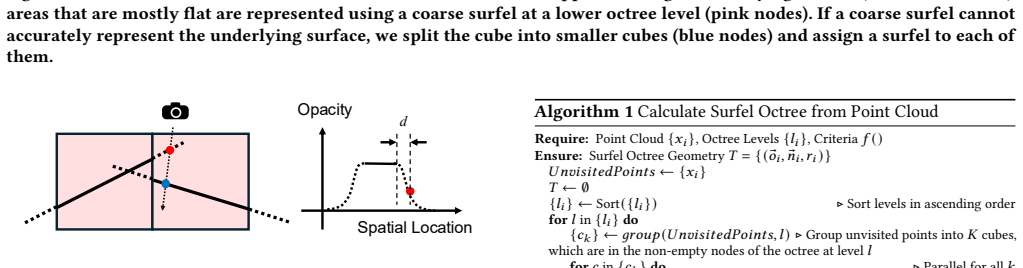
The central object is the textured surfel octree: each cube-bounded surfel is a plane with a center offset, normal, and radius, clipped to its octree cube; a soft semi-transparent border extends beyond the cube and blends with neighbors to hide cracks. Each surfel carries a small M×M texture patch in its tangent frame, computed from the original point colors. The compression chain quantizes the geometry attributes, losslessly codes octree occupancy, leaf flags, and attributes with a learned sparse-convolutional entropy model conditioned on previously coded levels and attributes, then codes texture patches either as a packed image with AV1 or as point colors with G-PCC. This machinery keeps t
What would settle it
Render the same bitstreams for the 8iVFB scenes at 1920x1920 and run a human pairwise-preference study between TeSO and G-PCC+P2ENet at matched bpp; if viewers do not prefer TeSO, or if a different objective metric such as DISTS reverses the ordering, the claim of higher rendering quality at lower bit-rates would be refuted. Alternatively, re-run the R-D comparison with ground truth taken from a high-quality multi-view capture rather than Poisson reconstruction; if TeSO's advantage shrinks or reverses, the result depends on the ground-truth choice.
Extended reading notes
Core claim
The paper's core claim is that decoupling geometry from texture in a hierarchical surfel representation improves the rate-distortion frontier for streaming 3D scenes. A scene is encoded as a set of cube-bounded planes — each with an offset, normal, and radius — stored on the leaves and selected internal nodes of an octree, with a small texture patch per surfel. Construction starts from a point cloud: points are grouped by cube at coarse levels, and a cube is kept as one surfel if a sampled grid on the surfel reconstructs the points with D1-PSNR above a threshold; otherwise the cube splits. On the 8iVFB benchmark, the compressed representation is reported to yield lower LPIPS at equal bits-pe
Load-bearing premise
The headline improvement is measured only with LPIPS against ground-truth views that are rasterizations of a Poisson surface reconstruction of the source point cloud; if LPIPS does not match human perception for these artifacts, or if Poisson reconstruction systematically favors smooth parametric surfaces, the reported rate-distortion advantage may not carry over to real captures or to human viewers.
Editorial extensions
If this is right
- Directly renderable streaming: a receiver decodes TeSO into surfel primitives and rasters them immediately, eliminating the surface-reconstruction or learned-rendering step that point-cloud pipelines require.
- Bit-rate can be spent on texture instead of geometry in smooth areas, so scenes with flat regions and high-frequency color keep their appearance even when geometry is aggressively simplified.
- The same octree structure supports partial and viewport-adaptive streaming: texture patches are local, so a client can fetch only the surfels and patches that are visible.
- The geometry bitstream is lossless once attributes are quantized, so coding distortion is controlled entirely by geometry quantization, splitting threshold, and texture quantization.
Reading between the lines
- Because TeSO rendering is differentiable, the hand-tuned splitting threshold and quantizer steps could be replaced by a learned rate-distortion optimization, a direction the paper names but does not pursue.
- The ground-truth evaluation uses Poisson-reconstructed meshes, which are smooth; if real multi-view captures are used instead, the comparison with point-based renderers might shift, so the reported margin is likely tied to the smoothness of the reference.
- The soft-blending width is fixed to the finest cube width; scenes mixing very different object scales might need an adaptive blending range, which the current method does not address.
- Since texture coding via G-PCC outperforms AV1 image packing, a learned texture codec that respects the 3D adjacency of patches would likely improve the rate-distortion curve further.
Signed reviews
Editorial analysis
A structured set of objections, weighed in public.
Referee Report
Summary. The paper proposes Textured Surfel Octree (TeSO), a 3D representation constructed from point clouds: an octree whose leaf nodes carry cube-bounded planar surfels, each with an attached texture patch. It describes a CUDA-accelerated construction algorithm, a rasterization-based renderer with soft blending, and a compression scheme that losslessly codes the octree geometry with a learned entropy model while coding texture either by packing patches into AV1 images or by rasterizing the TeSO into a colored point cloud and coding colors with G-PCC. The central claim is that TeSO plus this compression achieves lower LPIPS at equal or lower bit-rates than G-PCC+OpenGL, G-PCC+P2ENet, and B2P on the 8iVFB dataset, at both 1024x1024 and 1920x1920.
Significance. If the rate-distortion claim holds, TeSO is a practically interesting representation: it combines explicit surface geometry with high-frequency texture, is directly renderable without decoder-side surface reconstruction, and is compressible with a mixture of learned and standard codecs. The construction-speed and decoding-latency numbers are also useful engineering results, and the ablation in Table 1 gives some insight into the entropy model. However, the current evidence is not yet sufficient to establish the headline superiority: the evaluation rests on a single perceptual metric against a Poisson-derived ground truth, on only four sequences without variance reporting, and on baselines that include two of the authors' own prior systems.
major comments (4)
- [Sec. 6.1.1, Fig. 15] The R-D claim is measured only as LPIPS against views rasterized from a Poisson surface reconstruction of the source point cloud. TeSO is itself a smooth-surfel representation built from that same point cloud, so it may be systematically favored by this ground truth over point-splat and Gaussian baselines. The acknowledgment in Sec. 7 about LPIPS does not address this ground-truth confound. I request additional evidence: (i) a reference that is not derived from surface reconstruction (e.g., original multi-view captures if available, or a high-quality EWA/surfel rendering of the original point cloud), (ii) at least one additional distortion metric (PSNR/SSIM or a small subjective study), and (iii) per-scene R-D curves. Without this, the reported advantage could be an artifact of the evaluation protocol rather than a property of the representation.
- [Sec. 6.4 / Fig. 15] The headline comparison is averaged over only four 8iVFB sequences with no error bars or per-sequence breakdown. Two of the three baselines (P2ENet and B2P) are the authors' own prior methods, which increases the need for transparent reporting. Please provide per-sequence rates and distortions, standard deviations or confidence intervals, and the exact operating points that form the convex hulls. The introduction promises open-source code, but no code or data link is provided; releasing the implementation and bitstreams is important for independent verification of the R-D curves.
- [Sec. 5.3, 'Coding as Colored Point Cloud'] The description says that after the TeSO geometry is coded, 'we only need to transmit the bits for the color attributes in the point cloud bit-stream.' Since G-PCC TMC13 normally encodes geometry and attributes in a joint bitstream, it is not clear how attribute-only decoding with pre-existing geometry is performed. If a modified or non-default configuration is used, the exact software configuration and bitstream-size accounting must be described; otherwise the reported bpp for the G-PCC-texture variant may omit geometry-related overhead. Please clarify this step and, if possible, provide a bitrate breakdown by geometry and texture.
- [Sec. 6.1.2 / Fig. 15] The P2ENet baseline is reported as trained for 1024x1024 rendering, yet it is also evaluated at 1920x1920. If the learned renderer is resolution-dependent, this may disadvantage it at the higher resolution and inflate the apparent gap. Please state whether P2ENet was retrained or adapted for 1920x1920, or discuss its resolution generalization. The same level of detail should be provided for B2P's configuration and training data.
minor comments (5)
- [Sec. 3.3] The decision function f is described as comparing D1-PSNR between grid points on the surfel and the point set, but the number and placement of grid points are not specified. Please make this precise for reproducibility.
- [Eq. (4)] The notation Sgn is undefined; use sign(·) or define it at first use.
- [Table 2] Typo: 'geoemetry' should be 'geometry'. Also, the table reports decoding times but not the standard deviation or the exact machine configuration beyond CPU/GPU model.
- [References] References [49] and [50] appear to be the same paper with identical titles; one should be removed or corrected. Reference [1] is missing a closing period.
- [Fig. 15] The caption does not state how many R-D points are averaged, what the curve construction procedure is, or whether shaded regions (if any) denote variance. Please clarify.
Circularity Check
No derivation-level circularity: the rate-distortion claim is measured and anchored by an external standard; only minor non-load-bearing self-citations appear.
full rationale
The paper's central claim is an empirical rate-distortion comparison, not a derived identity. TeSO geometry is constructed from point clouds by a thresholded surfel-fitting algorithm; texture patches are resampled from the same points; compression uses a learned entropy model trained on a different dataset plus standard codecs (AV1, G-PCC). None of these steps defines the reported rendering quality in terms of a fitted parameter or a self-cited result. The two strongest non-standard baselines (B2P [20], P2ENet [19]) are the authors' own prior works, so the comparison setup could be biased if those baselines are under-tuned; however, the claim also includes G-PCC, an external MPEG standard, and the ranking is obtained by rendering and measuring LPIPS, not by construction. The Poisson-mesh ground truth and LPIPS-only evaluation are genuine threats to external validity (acknowledged in Sec. 7 for LPIPS), but they are evaluation confounds, not circular reductions. Accordingly, no circular step is identified; the score reflects one minor non-load-bearing self-citation cluster.
Assumptions & free parameters
free parameters (6)
- D1-PSNR split threshold tau =
{60, 62, 64, 66}
- Texture patch resolution M per level =
(12, 8, 4) for levels (6, 7, 8)
- Quantization steps for offset, normal, radius =
0.5, 1/64, 1/16
- Nearest-neighbor count K for texture interpolation =
3
- Soft-area blending sigma =
width of the smallest bounding cube
- Octree levels range =
lmin=6, lmax=8
assumptions (4)
- domain assumption Input point clouds have reliable per-point normals and colors (normals estimated via Hoppe et al. when absent).
- domain assumption LPIPS against Poisson-mesh-rasterized views is a valid perceptual rendering-quality metric for this comparison.
- domain assumption A single plane with averaged normal and max radius is a sufficient local surface model when D1-PSNR exceeds tau on sampled grid points.
- domain assumption Poisson surface reconstruction of the source point cloud yields the correct appearance ground truth.
Cite this review
Pith. "Pith review of TeSO: Representing and Compressing 3D Point Cloud Scenes with Textured Surfel Octree." pith.science (2026). https://pith.science/paper/CTN7EQU6
@misc{pith2026250807083,
  author       = {Pith},
  title        = {Pith review of: TeSO: Representing and Compressing 3D Point Cloud Scenes with Textured Surfel Octree},
  year         = {2026},
  howpublished = {\url{https://pith.science/paper/CTN7EQU6}},
  note         = {Machine review of arXiv:2508.07083}
}
read the original abstract
3D visual content streaming is a key technology for emerging 3D telepresence and AR/VR applications. One fundamental element underlying the technology is a versatile 3D representation that is capable of producing high-quality renders and can be efficiently compressed at the same time. Existing 3D representations like point clouds, meshes and 3D Gaussians each have limitations in terms of rendering quality, surface definition, and compressibility. In this paper, we present the Textured Surfel Octree (TeSO), a novel 3D representation that is built from point clouds but addresses the aforementioned limitations. It represents a 3D scene as cube-bounded surfels organized on an octree, where each surfel is further associated with a texture patch. By approximating a smooth surface with a large surfel at a coarser level of the octree, it reduces the number of primitives required to represent the 3D scene, and yet retains the high-frequency texture details through the texture map attached to each surfel. We further propose a compression scheme to encode the geometry and texture efficiently, leveraging the octree structure. The proposed textured surfel octree combined with the compression scheme achieves higher rendering quality at lower bit-rates compared to multiple point cloud and 3D Gaussian-based baselines.
Figures


Figures from the paper (13 more)


Reference graph
Works this paper leans on
-
[1]
2020. OpenGL Primitive. https://www.khronos.org/opengl/wiki/primitive Ac- cessed on April 22, 2025
work page 2020
-
[2]
2023. MPEG G-PCC TMC13. https://github.com/MPEGGroup/mpeg-pcc-tmc13 Accessed on April 22, 2025
work page 2023
-
[3]
2023. MPEG V-PCC TMC2 . https://github.com/MPEGGroup/mpeg-pcc-tmc2 Accessed on April 22, 2025
work page 2023
-
[4]
Kara-Ali Aliev, Artem Sevastopolsky, Maria Kolos, Dmitry Ulyanov, and Victor Lempitsky. 2020. Neural point-based graphics. In ECCV. Springer, 696–712
work page 2020
-
[5]
Thomas Bird, Johannes Ballé, Saurabh Singh, and Philip A Chou. 2021. 3d scene compression through entropy penalized neural representation functions. In 2021 Picture Coding Symposium (PCS) . IEEE, 1–5
work page 2021
-
[6]
Jen-Hao Rick Chang, Wei-Yu Chen, Anurag Ranjan, Kwang Moo Yi, and Oncel Tuzel. 2023. Pointersect: Neural Rendering with Cloud-Ray Intersection. In Proceedings of the IEEE/CVF Conference on Computer Vision and Pattern Recognition. 8359–8369
work page 2023
-
[7]
Anthony Chen, Shiwen Mao, Zhu Li, Minrui Xu, Hongliang Zhang, Dusit Niyato, and Zhu Han. 2023. An Introduction to Point Cloud Compression Standards. GetMobile: Mobile Computing and Communications 27, 1 (2023), 11–17
work page 2023
-
[8]
Julian Chibane, Gerard Pons-Moll, et al. 2020. Neural unsigned distance fields for implicit function learning. Advances in Neural Information Processing Systems 33 (2020), 21638–21652
work page 2020
Show all 64 references
-
[9]
Mingyue Cui, Junhua Long, Mingjian Feng, Boyang Li, and Huang Kai. 2023. OctFormer: Efficient octree-based transformer for point cloud compression with local enhancement. In Proceedings of the AAAI Conference on Artificial Intelligence, Vol. 37. 470–478
2023
-
[10]
Eugene d’Eon, Harrison Bob, Taos Myers, and Philip A. Chou. 2017. 8i Vox- elized Full Bodies - A Voxelized Point Cloud Dataset. In ISO/IEC JTC1/SC29 Joint WG11/WG1 (MPEG/JPEG) input document WG11M40059/WG1M74006
2017
-
[11]
Chunyang Fu, Ge Li, Rui Song, Wei Gao, and Shan Liu. 2022. Octattention: Octree- based large-scale contexts model for point cloud compression. In Proceedings of the AAAI Conference on Artificial Intelligence , Vol. 36. 625–633
2022
-
[12]
Markus Funk, Mareike Kritzler, and Florian Michahelles. 2017. HoloCollab: a shared virtual platform for physical assembly training using spatially-aware head-mounted displays. In Proceedings of the Seventh International Conference on the Internet of Things . 1–7. Preprint, Aug...
2017
-
[13]
Guillaume Gautier, Alexandre Mercat, Louis Fréneau, Mikko Pitkänen, and Jarno Vanne. 2023. UVG-VPC: voxelized point cloud dataset for visual volumetric video-based coding. In 2023 15th international conference on quality of Multimedia experience (QoMEX). IEEE, 244–247
2023
-
[14]
Danillo Graziosi, Ohji Nakagami, Shinroku Kuma, Alexandre Zaghetto, Teruhiko Suzuki, and Ali Tabatabai. 2020. An overview of ongoing point cloud compression standardization activities: Video-based (V-PCC) and geometry-based (G-PCC). APSIPA Transactions on Signal and Informatio...
2020
-
[15]
Yongjie Guan, Xueyu Hou, Nan Wu, Bo Han, and Tao Han. 2023. Metastream: Live volumetric content capture, creation, delivery, and rendering in real time. In Proceedings of the 29th Annual International Conference on Mobile Computing and Networking. 1–15
2023
-
[16]
Jingning Han, Bohan Li, Debargha Mukherjee, Ching-Han Chiang, Adrian Grange, Cheng Chen, Hui Su, Sarah Parker, Sai Deng, Urvang Joshi, et al. 2021. A technical overview of AV1. Proc. IEEE 109, 9 (2021), 1435–1462
2021
-
[17]
Yun He, Xinlin Ren, Danhang Tang, Yinda Zhang, Xiangyang Xue, and Yanwei Fu. 2022. Density-preserving deep point cloud compression. In CVPR
2022
-
[18]
Hugues Hoppe, Tony DeRose, Tom Duchamp, John McDonald, and Werner Stuetzle. 1992. Surface reconstruction from unorganized points. In Proceedings of the 19th annual conference on computer graphics and interactive techniques . 71–78
1992
-
[19]
Yueyu Hu, Ran Gong, Qi Sun, and Yao Wang. 2024. Low Latency Point Cloud Rendering with Learned Splatting. In Proceedings of the IEEE/CVF Conference on Computer Vision and Pattern Recognition . 5752–5761. TeSO: Representing and Compressing 3D Point Cloud Scenes with Textured Su...
2024
-
[20]
Yueyu Hu, Ran Gong, and Yao Wang. 2024. Bits-to-photon: End-to-end learned scalable point cloud compression for direct rendering. arXiv preprint arXiv:2406.05915 (2024)
2024 arXiv
-
[21]
Lila Huang, Shenlong Wang, Kelvin Wong, Jerry Liu, and Raquel Urtasun. 2020. Octsqueeze: Octree-structured entropy model for lidar compression. In CVPR. 1313–1323
2020
-
[22]
Yili Jin, Xize Duan, Kaiyuan Hu, Fangxin Wang, and Xue Liu. 2024. 3D Video Conferencing via On-hand Devices. IEEE Transactions on Circuits and Systems for Video Technology (2024)
2024
-
[23]
Dorota Kamińska, Grzegorz Zwoliński, Anna Laska-Leśniewicz, Rui Raposo, Mário Vairinhos, Elisabeth Pereira, Frane Urem, Martina Ljubić Hinić, Rain Eric Haamer, and Gholamreza Anbarjafari. 2023. Augmented reality: Current and new trends in education. Electronics 12, 16 (2023), 3531
2023
-
[24]
Michael Kazhdan and Hugues Hoppe. 2013. Screened poisson surface reconstruc- tion. TOG 32, 3 (2013), 1–13
2013
-
[25]
Bernhard Kerbl, Georgios Kopanas, Thomas Leimkühler, and George Drettakis
-
[26]
Leif Kobbelt and Mario Botsch. 2004. A survey of point-based techniques in computer graphics. Computers & Graphics 28, 6 (2004), 801–814
2004
-
[27]
Jason Lawrence, Ryan Overbeck, Todd Prives, Tommy Fortes, Nikki Roth, and Brett Newman. 2024. Project starline: A high-fidelity telepresence system. In ACM SIGGRAPH 2024 Emerging Technologies. 1–2
2024
-
[28]
Kyungjin Lee, Juheon Yi, Youngki Lee, Sunghyun Choi, and Young Min Kim
-
[29]
Chen Li, Tongyu Zong, Yueyu Hu, Yao Wang, and Yong Liu. 2024. Spatial Visibility and Temporal Dynamics: Revolutionizing Field of View Prediction in Adaptive Point Cloud Video Streaming. arXiv preprint arXiv:2409.18236 (2024)
2024 arXiv
-
[30]
Qing Li, Huifang Feng, Kanle Shi, Yue Gao, Yi Fang, Yu-Shen Liu, and Zhizhong Han. 2024. Learning signed hyper surfaces for oriented point cloud normal estimation. IEEE Transactions on Pattern Analysis and Machine Intelligence (2024)
2024
-
[31]
Zhicheng Liang, Junhua Liu, Mallesham Dasari, and Fangxin Wang. 2024. Fumos: Neural compression and progressive refinement for continuous point cloud video streaming. IEEE Transactions on Visualization and Computer Graphics (2024)
2024
-
[32]
David B Lindell, Dave Van Veen, Jeong Joon Park, and Gordon Wetzstein. 2022. Bacon: Band-limited coordinate networks for multiscale scene representation. In Proceedings of the IEEE/CVF conference on computer vision and pattern recognition . 16252–16262
2022
-
[33]
Stefan Lionar, Xiangyu Xu, Min Lin, and Gim Hee Lee. 2023. Nu-mcc: Multiview compressive coding with neighborhood decoder and repulsive udf. Advances in Neural Information Processing Systems 36 (2023), 63011–63022
2023
-
[34]
Junhua Liu, Boxiang Zhu, Fangxin Wang, Yili Jin, Wenyi Zhang, Zihan Xu, and Shuguang Cui. 2023. Cav3: Cache-assisted viewport adaptive volumetric video streaming. In 2023 IEEE Conference Virtual Reality and 3D User Interfaces (VR) . IEEE, 173–183
2023
-
[35]
Yixiang Mao, Yueyu Hu, and Yao Wang. 2022. Learning to predict on octree for scalable point cloud geometry coding. In 2022 IEEE 5th International Conference on Multimedia Information Processing and Retrieval (MIPR) . IEEE, 96–102
2022
-
[36]
Quirin Meyer, Jochen Süßmuth, Gerd Sußner, Marc Stamminger, and Günther Greiner. 2010. On floating-point normal vectors. In Computer Graphics Forum, Vol. 29. Wiley Online Library, 1405–1409
2010
-
[37]
Ben Mildenhall, Pratul P Srinivasan, Matthew Tancik, Jonathan T Barron, Ravi Ramamoorthi, and Ren Ng. 2021. Nerf: Representing scenes as neural radiance fields for view synthesis. Commun. ACM 65, 1 (2021), 99–106
2021
-
[38]
Andre Mühlenbrock, Rene Weller, and Gabriel Zachmann. 2024. BlendPCR: Seamless and Efficient Rendering of Dynamic Point Clouds captured by Multiple RGB-D Cameras. InICAT-EGVE 2024 - International Conference on Artificial Reality and Telexistence and Eurographics Symposium on V...
2024 doi
-
[39]
Ohji Nakagami, Sebastien Lasserre, Sugio Toshiyasu, and Marius Preda. 2023. White paper on G-PCC. In ISO/IEC JTC 1/SC 29/AG 03 N0111 . https://www.mpeg. org/wp-content/uploads/mpeg_meetings/142_Antalya/w22804.zip
2023
-
[40]
Simon Niedermayr, Josef Stumpfegger, and Rüdiger Westermann. 2024. Com- pressed 3d gaussian splatting for accelerated novel view synthesis. InProceedings of the IEEE/CVF Conference on Computer Vision and Pattern Recognition . 10349– 10358
2024
-
[41]
Hanspeter Pfister, Matthias Zwicker, Jeroen Van Baar, and Markus Gross. 2000. Surfels: Surface elements as rendering primitives. InProceedings of the 27th annual conference on Computer graphics and interactive techniques . 335–342
2000
-
[42]
Zizheng Que, Guo Lu, and Dong Xu. 2021. Voxelcontext-net: An octree based framework for point cloud compression. In CVPR. 6042–6051
2021
-
[43]
Patrick Reipschläger and Raimund Dachselt. 2019. Designar: Immersive 3d- modeling combining augmented reality with interactive displays. In Proceedings of the 2019 ACM international conference on interactive surfaces and spaces . 29–41
2019
-
[44]
Helmrich, and Thomas Wiegand
Heiko Schwarz, Muhammed Coban, Marta Karczewicz, Tzu-Der Chuang, Frank Bossen, Alexander Alshin, Jani Lainema, Christian R. Helmrich, and Thomas Wiegand. 2021. Quantization and Entropy Coding in the Versatile Video Coding (VVC) Standard. IEEE Transactions on Circuits and Syste...
2021
-
[45]
Michael Stengel, Koki Nagano, Chao Liu, Matthew Chan, Alex Trevithick, Shalini De Mello, Jonghyun Kim, and David Luebke. 2023. Ai-mediated 3d video confer- encing. In ACM SIGGRAPH 2023 Emerging Technologies. 1–2
2023
-
[46]
Towaki Takikawa, Alex Evans, Jonathan Tremblay, Thomas Müller, Morgan McGuire, Alec Jacobson, and Sanja Fidler. 2022. Variable bitrate neural fields. In ACM SIGGRAPH 2022 Conference Proceedings . 1–9
2022
-
[47]
Stephen Lombardi, et al
Ayush Tewari, Justus Thies, Ben Mildenhall, Pratul Srinivasan, Edgar Tretschk, Wang Yifan, Christoph Lassner, Vincent Sitzmann, Ricardo Martin-Brualla, Preprint, August 2025, Preprint Hu et al. Stephen Lombardi, et al . 2022. Advances in neural rendering. In Computer Graphics ...
2025
-
[48]
Jianqiang Wang, Dandan Ding, Zhu Li, Xiaoxing Feng, Chuntong Cao, and Zhan Ma. 2022. Sparse tensor-based multiscale representation for point cloud geometry compression. IEEE Transactions on Pattern Analysis and Machine Intelligence (2022)
2022
-
[50]
Jianqiang Wang, Ruixiang Xue, Jiaxin Li, Dandan Ding, Yi Lin, and Zhan Ma
-
[51]
Jianqiang Wang, Hao Zhu, Haojie Liu, and Zhan Ma. 2021. Lossy point cloud geometry compression via end-to-end learning. IEEE Transactions on Circuits and Systems for Video Technology 31, 12 (2021), 4909–4923
2021
-
[52]
Emin Zerman, Cagri Ozcinar, Pan Gao, and Aljosa Smolic. 2020. Textured mesh vs coloured point cloud: A subjective study for volumetric video compression. In 2020 Twelfth International Conference on Quality of Multimedia Experience (QoMEX). IEEE, 1–6
2020
-
[53]
Anlan Zhang, Chendong Wang, Bo Han, and Feng Qian. 2022. YuZu: Neural- Enhanced volumetric video streaming. In 19th USENIX Symposium on Networked Systems Design and Implementation (NSDI 22) . 137–154
2022
-
[54]
IEEE transactions on pattern analysis and machine intelligence (2024)
A versatile point cloud compressor using universal multiscale conditional coding–Part I: Geometry. IEEE transactions on pattern analysis and machine intelligence (2024)
2024
-
[55]
Richard Zhang, Phillip Isola, Alexei A Efros, Eli Shechtman, and Oliver Wang
-
[56]
Junsheng Zhou, Baorui Ma, Shujuan Li, Yu-Shen Liu, Yi Fang, and Zhizhong Han
-
[57]
Qian-Yi Zhou, Jaesik Park, and Vladlen Koltun. 2018. Open3D: A modern library for 3D data processing. arXiv preprint arXiv:1801.09847 (2018)
2018 arXiv
-
[58]
Junteng Zhang, Tong Chen, Dandan Ding, and Zhan Ma. 2023. YOGA: Yet Another Geometry-based Point Cloud Compressor. In Proceedings of the 31st ACM International Conference on Multimedia
2023
-
[59]
Matthias Zwicker, Hanspeter Pfister, Jeroen Van Baar, and Markus Gross. 2001. Surface splatting. In Proceedings of the 28th annual conference on Computer graph- ics and interactive techniques . 371–378
2001
-
[60]
Matthias Zwicker, Jussi Rasanen, Mario Botsch, Carsten Dachsbacher, and Mark Pauly. 2004. Perspective accurate splatting. In Proceedings-Graphics Interface. 247–254
2004
-
[62]
IEEE Transactions on Pattern Analysis and Machine Intelligence (2024)
CAP-UDF: Learning unsigned distance functions progressively from raw point clouds with consistency-aware field optimization. IEEE Transactions on Pattern Analysis and Machine Intelligence (2024)
2024
-
[64]
Matthias Zwicker, Hanspeter Pfister, Jeroen Van Baar, and Markus Gross. 2001. EWA volume splatting. In Proceedings Visualization, 2001. VIS’01. IEEE, 29–538
2001
-
[2018]
The unreasonable effectiveness of deep features as a perceptual metric. In CVPR. 586–595
-
[2020]
In Proceedings of the 26th Annual International Conference on Mobile Computing and Networking
GROOT: a real-time streaming system of high-fidelity volumetric videos. In Proceedings of the 26th Annual International Conference on Mobile Computing and Networking. 1–14
-
[2023]
ACM Transactions on Graphics 42, 4 (2023)
3D Gaussian Splatting for Real-Time Radiance Field Rendering. ACM Transactions on Graphics 42, 4 (2023)
2023
Reviewed August 5, 2026 · model on record in the stance chip above.
Discussion (0). Continue with ORCID to comment.