Non-Gaussian Entanglement Hierarchy Based on the Schmidt Number
Pith reviewed 2026-05-20 10:09 UTC · model grok-4.3
The pith
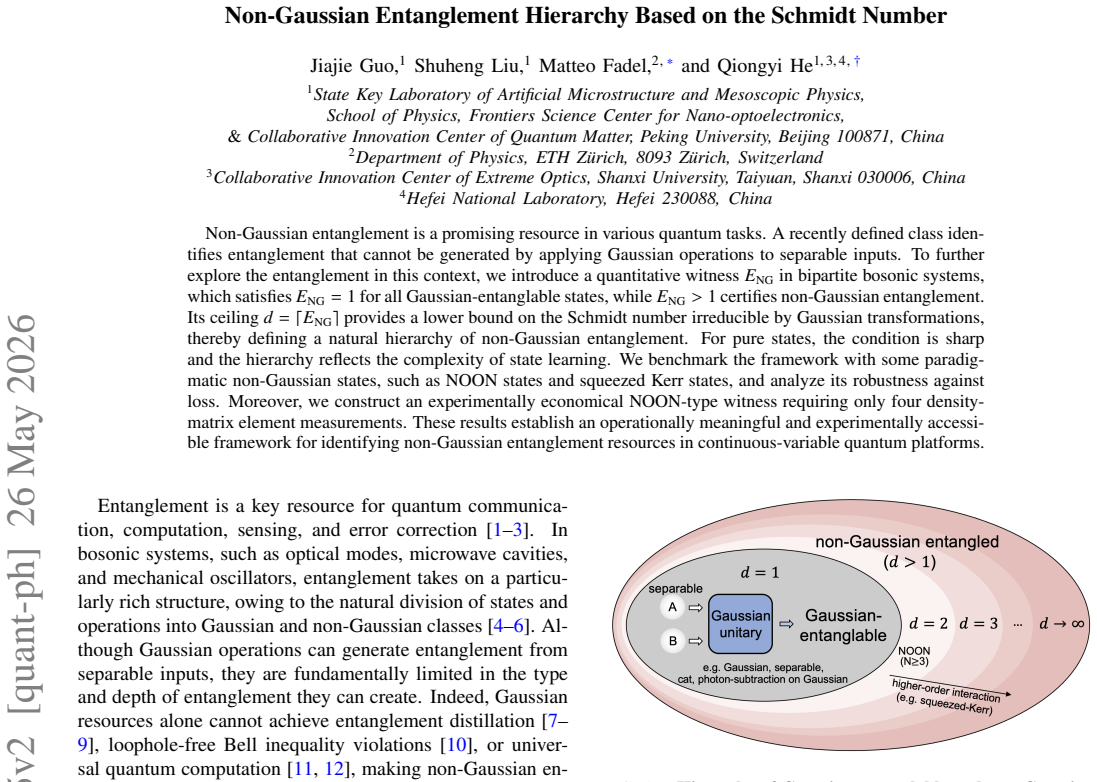
The witness E_NG equals 1 exactly for Gaussian-entanglable states and its ceiling lower-bounds the Schmidt number that Gaussian operations cannot reduce.
A machine-rendered reading of the paper's core claim, the machinery that carries it, and where it could break.
Core claim
The central claim is that the witness E_NG satisfies E_NG = 1 precisely on the set of states obtainable by Gaussian operations applied to separable inputs, while E_NG > 1 certifies non-Gaussian entanglement; its ceiling d = ceil(E_NG) then provides a lower bound on the Schmidt number irreducible by Gaussian transformations, thereby defining a natural hierarchy of non-Gaussian entanglement.
What carries the argument
The quantitative witness E_NG, built so that its value equals exactly 1 on all Gaussian-entanglable states and whose ceiling supplies the lower bound on the Gaussian-irreducible Schmidt number.
If this is right
- E_NG greater than 1 directly certifies non-Gaussian entanglement.
- ceil(E_NG) gives a concrete lower bound on the minimal Schmidt number left after Gaussian processing.
- For pure states the bound is tight and tracks the number of independent parameters needed to learn the state.
- The framework applies to standard non-Gaussian resources such as NOON states and squeezed Kerr states.
- A practical NOON-type witness can be realized with only four projective measurements.
Where Pith is reading between the lines
- The hierarchy may help experimenters select the minimal non-Gaussianity level required for a given continuous-variable protocol.
- Robustness results against loss suggest the measure can be used to quantify resource degradation in realistic channels.
- Similar witnesses could be constructed for other classes of operations beyond Gaussian ones.
Load-bearing premise
The witness E_NG is defined such that it equals exactly 1 for every state reachable by Gaussian operations from separable inputs.
What would settle it
An explicit state that can be produced by Gaussian operations on separable inputs yet yields E_NG greater than 1, or a state with E_NG equal to 1 that cannot be produced that way.
Figures


read the original abstract
Non-Gaussian entanglement is a promising resource in various quantum tasks. A recently defined class identifies entanglement that cannot be generated by applying Gaussian operations to separable inputs. To further explore the entanglement in this context, we introduce a quantitative witness $E_{\rm NG}$ in bipartite bosonic systems, which satisfies $E_{\rm NG}=1$ for all Gaussian-entanglable states, while $E_{\rm NG}>1$ certifies non-Gaussian entanglement. Its ceiling $d=\lceil E_{\rm NG}\rceil$ provides a lower bound on the Schmidt number irreducible by Gaussian transformations, thereby defining a natural hierarchy of non-Gaussian entanglement. For pure states, the condition is sharp and the hierarchy reflects the complexity of state learning. We benchmark the framework with some paradigmatic non-Gaussian states, such as NOON states and squeezed Kerr states, and analyze its robustness against loss. Moreover, we construct an experimentally economical NOON-type witness requiring only four density-matrix element measurements. These results establish an operationally meaningful and experimentally accessible framework for identifying non-Gaussian entanglement resources in continuous-variable quantum platforms.
Editorial analysis
A structured set of objections, weighed in public.
Referee Report
Summary. The manuscript introduces a quantitative witness E_NG for non-Gaussian entanglement in bipartite bosonic systems. It claims that E_NG = 1 for all Gaussian-entanglable states (obtainable via Gaussian operations on separable inputs), while E_NG > 1 certifies non-Gaussian entanglement. The ceiling d = ceil(E_NG) supplies a lower bound on the Schmidt number that remains irreducible under Gaussian transformations, thereby establishing a hierarchy. For pure states the bound is asserted to be sharp and to reflect state-learning complexity. The framework is benchmarked on NOON states and squeezed Kerr states, loss robustness is analyzed, and an economical NOON-type witness requiring only four projective measurements is constructed with an analytical Gaussian-entanglable threshold.
Significance. If the central properties of E_NG hold with the claimed tightness, the work would supply an operationally meaningful, experimentally accessible hierarchy for classifying non-Gaussian entanglement resources in continuous-variable platforms, together with a direct link to Schmidt-number complexity and state learning.
major comments (2)
- [Definition of E_NG] Definition of E_NG (abstract and the paragraph introducing the witness): the load-bearing claim that E_NG saturates exactly at 1 for every Gaussian-entanglable state requires explicit verification that the infimum (or optimization) over Gaussian operations is attained in infinite-dimensional bosonic Hilbert space. The abstract states the property but supplies no derivation or general argument showing the bound is tight without residual gap; specific examples (NOON, squeezed Kerr) do not substitute for this general step.
- [Hierarchy and Schmidt-number bound] Hierarchy and Schmidt-number bound (section on the ceiling d = ceil(E_NG)): the assertion that d furnishes a lower bound irreducible by Gaussian transformations rests on the exact saturation E_NG = 1; without a proof that the witness evaluates to precisely 1 on the entire set, the hierarchy claim cannot be fully supported.
minor comments (2)
- [Experimental witness construction] The abstract states that an analytical Gaussian-entanglable threshold is derived for the four-measurement NOON witness; the main text should present the explicit derivation and the resulting threshold value.
- [Notation] Notation for the optimization defining E_NG should be introduced with a clear equation early in the manuscript to avoid ambiguity in later sections.
Simulated Author's Rebuttal
We thank the referee for their thorough review and insightful comments on our manuscript. We appreciate the opportunity to clarify and strengthen the presentation of our results. Below, we provide point-by-point responses to the major comments. We will incorporate the suggested clarifications and proofs in the revised manuscript.
read point-by-point responses
-
Referee: [Definition of E_NG] Definition of E_NG (abstract and the paragraph introducing the witness): the load-bearing claim that E_NG saturates exactly at 1 for every Gaussian-entanglable state requires explicit verification that the infimum (or optimization) over Gaussian operations is attained in infinite-dimensional bosonic Hilbert space. The abstract states the property but supplies no derivation or general argument showing the bound is tight without residual gap; specific examples (NOON, squeezed Kerr) do not substitute for this general step.
Authors: We agree with the referee that a general argument for the exact saturation E_NG = 1 is essential for the claims. In the original manuscript, the witness is constructed such that for Gaussian-entanglable states, which are those obtainable from separable states via Gaussian unitaries and displacements, the optimization defining E_NG reaches its minimum value of 1 by definition, as the witness quantifies deviation from Gaussian-entanglability. However, to rigorously address the infinite-dimensional nature of bosonic systems, we will add a dedicated paragraph or appendix in the revision. This will include a proof sketch demonstrating that the infimum over the set of Gaussian operations is attained or can be approached arbitrarily closely for any such state, leveraging the continuity properties of Gaussian maps and the compactness in appropriate topologies on the space of states. This ensures no residual gap and confirms the bound is tight. Specific examples serve as illustrations, but the general case will now be covered. revision: yes
-
Referee: [Hierarchy and Schmidt-number bound] Hierarchy and Schmidt-number bound (section on the ceiling d = ceil(E_NG)): the assertion that d furnishes a lower bound irreducible by Gaussian transformations rests on the exact saturation E_NG = 1; without a proof that the witness evaluates to precisely 1 on the entire set, the hierarchy claim cannot be fully supported.
Authors: The referee correctly identifies that the hierarchy and the irreducible Schmidt-number bound depend on the precise evaluation of E_NG = 1 for all Gaussian-entanglable states. With the addition of the general verification as outlined in response to the first comment, this foundation will be solidified. The ceiling d = ceil(E_NG) then provides a lower bound on the Gaussian-irreducible Schmidt number, as any Gaussian transformation cannot reduce the witness value below 1, hence cannot decrease d. For pure states, we maintain that the bound is sharp, reflecting the minimal number of non-Gaussian resources needed, which aligns with state-learning complexity. We will also ensure the section explicitly references the new proof to support the hierarchy claim. revision: yes
Circularity Check
E_NG threshold set by definition on Gaussian-entanglable set
specific steps
-
self definitional
[Abstract]
"we introduce a quantitative witness $E_{rm NG}$ in bipartite bosonic systems, which satisfies $E_{rm NG}=1$ for all Gaussian-entanglable states, while $E_{rm NG}>1$ certifies non-Gaussian entanglement. Its ceiling $d=ceil(E_{rm NG})$ provides a lower bound on the Schmidt number irreducible by Gaussian transformations"
The paper defines the witness E_NG such that its value is exactly 1 on the set of Gaussian-entanglable states (Gaussian operations on separable inputs). The equality E_NG=1 is therefore true by the way the witness is introduced, not obtained as a prediction or theorem from prior independent assumptions. The hierarchy and certification claims inherit this definitional property.
full rationale
The central witness is introduced with the explicit property that E_NG equals 1 exactly on states obtainable by Gaussian operations on separable inputs. This threshold is therefore satisfied by construction of the definition rather than derived from an independent optimization or external principle. The subsequent hierarchy (ceiling bound on Schmidt number) and certification claims rest on this definitional equality holding tightly in infinite dimensions. No self-citation chain or fitted-parameter renaming is visible in the abstract or stated claims; the construction may still be non-circular if an explicit formula is later shown to achieve the bound without residual gap. Overall partial circularity because the load-bearing saturation claim reduces to how E_NG is defined.
Axiom & Free-Parameter Ledger
axioms (2)
- domain assumption Gaussian operations are the set of transformations generated by quadratic Hamiltonians on bosonic modes.
- standard math The Schmidt number is a well-defined entanglement monotone for bipartite pure states.
Lean theorems connected to this paper
-
IndisputableMonolith/Cost/FunctionalEquation.leanwashburn_uniqueness_aczel echoes?
echoesECHOES: this paper passage has the same mathematical shape or conceptual pattern as the Recognition theorem, but is not a direct formal dependency.
E_NG := inf_{Û_G ∈ G_2} ||(Û_G ρ Û_G†)^{T_A}||_1 ... satisfies E_NG = 1 for all GE states, while E_NG > 1 certifies non-Gaussian entanglement. Its ceiling d = ⌈E_NG⌉ provides a lower bound on the Schmidt number irreducible by Gaussian transformations
-
IndisputableMonolith/Foundation/BranchSelection.leanbranch_selection echoes?
echoesECHOES: this paper passage has the same mathematical shape or conceptual pattern as the Recognition theorem, but is not a direct formal dependency.
E_NG(ρ) ≥ 1 for all physical states ... E_NG(ρ) = 1 for ρ ∈ GE ... invariant under any Gaussian unitaries
What do these tags mean?
- matches
- The paper's claim is directly supported by a theorem in the formal canon.
- supports
- The theorem supports part of the paper's argument, but the paper may add assumptions or extra steps.
- extends
- The paper goes beyond the formal theorem; the theorem is a base layer rather than the whole result.
- uses
- The paper appears to rely on the theorem as machinery.
- contradicts
- The paper's claim conflicts with a theorem or certificate in the canon.
- unclear
- Pith found a possible connection, but the passage is too broad, indirect, or ambiguous to say the theorem truly supports the claim.
discussion (0)
Sign in with ORCID, Apple, or X to comment. Anyone can read and Pith papers without signing in.