REVIEW 4 major objections 5 minor 42 references
Phase transition from eigenstate thermalization: forbidden singularity and instanton proliferation via AGT correspondence
T0 review · 4 major / 5 minor · reviewed 2026-08-14 · deepseek-v4-flash
Pith's one-line read The forbidden singularity of CFT thermalization is an instanton-gas phase transition.
desk verdict A serious, inventive paper that recasts the forbidden singularity as a critical fugacity in an AGT instanton gas, but the central equality r = z* depends on an unproved exclusion of competing saddle-points in Section IV.D. read the letter →
The pith
A machine-rendered reading of the paper's core claim, the machinery that carries it, and where it could break.
The reading
What carries the argument
The load-bearing object is the AGT correspondence, which equates a Virasoro conformal block with the Nekrasov instanton partition function of an $\mathcal{N}=2$ supersymmetric $SU(2)$ gauge theory on the $\Omega$-background, mapping the cross-ratio $z$ to the instanton fugacity. In the heavy-light limit the central charge $c$ becomes the volume of the instanton gas, and the large-$c$ reduction of the instanton counting formula yields the effective action $I_0(Y_1,Y_2)$ for two Young tableaux. The analysis then passes to the large-$\nu$ statistical theory with the anisotropic ansatz $Y = \nu\, y$ (string-like tableaux); the saddle-point equation $\Delta^{1,1}_X / \Delta^{1,1}_{X-1} = e^{-\lambda} (X - i\alpha_H)/(X+1)$, together with normalization and boundary conditions, produces the discrete family $e^{-\lambda_n} = 1 - e^{-2\pi n/\alpha_H}$. The $n=1$ value sets the critical fugacity $z_*$.
What would settle it
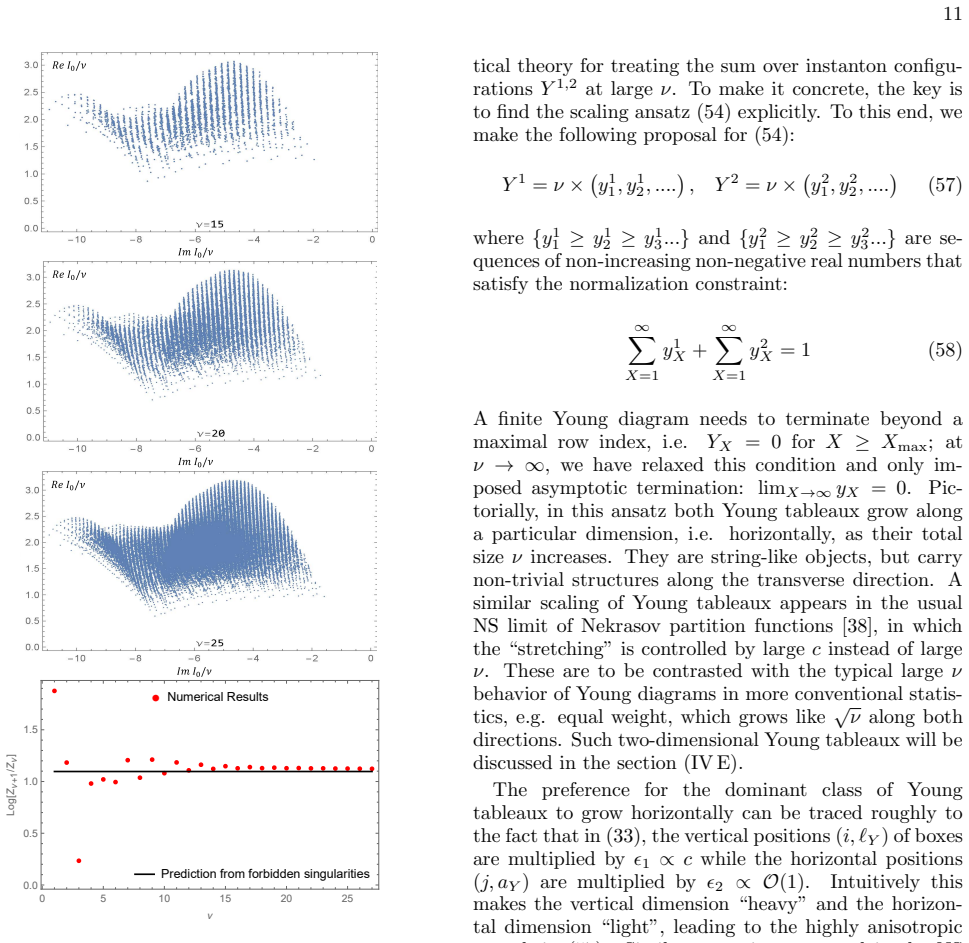
One could settle the claim by computing the Lefschetz thimbles of the symmetric saddle-point solutions (90) and checking whether any intersects the original contour (70); a single intersection would put a singularity with radius $r < z_*$ on the principal branch. Numerically, one can also extract the radius of convergence of the finite- but large-$c$ vacuum block from Zamolodchikov recursion and look for a first singularity below $z_* = 1 - e^{-2\pi/\alpha_H}$.
Extended reading notes
Core claim
The paper's central claim is that the forbidden singularity at $z_* = 1 - e^{-2\pi/\alpha_H}$ in the heavy-light vacuum Virasoro block is exactly the critical fugacity $r$ of a phase transition in the AGT-dual instanton gas. The transition is tied to the non-commutativity of the limits $c \to \infty$ and $\nu \to \infty$: after taking the large-central-charge limit first, the instanton sum is governed by a $c$-independent effective action $I_0(Y_1,Y_2)$ for a pair of Young tableaux. At large instanton number $\nu$, the dominant configuration is a string-like pair growing as $Y = \nu y$, and the saddle-point equations admit a complex solution with $y^2_X = 0$ and $y^1_X$ built from binomial series in $\alpha_H$. The boundary condition $y^1_\infty = 0$ forces $e^{-\lambda_n} = 1 - e^{-2\pi n/\alpha_H}$, and the $n=1$ saddle gives the radius of convergence of the fugacity expansion, reproducing $z_*$. Below $z_*$ the gas is dilute with $c$-independent free energy; above it the dominant string-like configurations have actions $\propto c\,\ln\nu$, and the same machinery reproduces the true OPE singularity at $z=1$.
Load-bearing premise
The conclusion that the radius of convergence is exactly $z_*$ rests on excluding the symmetric saddle-point solutions of Section IV.D, which have larger $\mathrm{Re}\,\lambda$ and would imply $r < z_*$, on the grounds that their Lefschetz thimbles do not meet the original integration contour; the paper asserts this exclusion but does not prove it.
Editorial extensions
If this is right
- The first forbidden singularity $z_* = 1 - e^{-2\pi/\alpha_H}$ is a genuine critical point of the instanton gas rather than an artifact of the large-$c$ limit, with the central charge acting as the system volume.
- The infinite tower of forbidden singularities $z_n = 1 - e^{-2\pi n/\alpha_H}$ reappears as an infinite family of saddle-point fugacities, connecting the vacuum block to the un-physical blocks.
- At finite but large $c$, the sharp transition is smoothed into a condensation of Virasoro-block zeros along an anti-Stokes curve, in direct analogy with Lee-Yang zeros.
- Above $z_*$, the instanton gas is dominated by string-like Young tableaux with action $\propto c\,\ln\nu$, and the same effective theory reproduces the heavy-light behavior at the true singularity $z=1$.
- The two limits $c \to \infty$ and $\nu \to \infty$ do not commute, so the forbidden singularity encodes the non-commutativity of the thermodynamic and large-central-charge limits.
Reading between the lines
- Not in the paper: perturbing the heavy-light ratio while keeping $c$ large should shift $z_*$ and the critical fugacity together; measuring that shift from the finite-$c$ block would test the robustness of the identification.
- Not in the paper: if the Lefschetz-thimble exclusion is right, the symmetric saddle-points should still contribute as trans-series terms somewhere in the complex-$c$ plane; a resurgence analysis in $1/c$ could reveal them.
- Not in the paper: the string-like Young-tableau saddle resembles the thermodynamic limit of a one-dimensional chain, suggesting a possible integrable/TBA description of the phase transition.
- Not in the paper: in the gauge-theory language the transition is a divergence of the average instanton number, so a localization-based computation of $\langle \nu \rangle$ as a function of $z$ could probe the transition without mentioning CFT.
Editorial analysis
A structured set of objections, weighed in public.
Referee Report
Summary. The paper argues that the forbidden singularity in the heavy-light vacuum Virasoro block at large central charge is exactly the critical fugacity of an instanton-gas phase transition. Using the AGT correspondence, the authors rewrite the vacuum block as an SU(2) Nekrasov partition function and derive a c-independent effective action I0 for pairs of Young tableaux in the heavy-light limit. At large instanton number ν they propose a string-like scaling ansatz, convert the tableau sum into a saddle-point integral, and solve the saddle-point equations with the maximally symmetry-breaking ansatz y2=0. This yields on-shell values λ_n and a radius of convergence r = 1 - e^{-2π/α_H} = z*, matching the known forbidden singularity. The paper also discusses the high-fugacity phase, reproduces the z→1 OPE singularity through a complex saddle in the total number of rows, and interprets the discontinuity at c=∞ as an essential singularity. Numerical checks include finite-c zeros against anti-Stokes curves, free-energy scaling changes across z*, and convergence of the ratio Z_{ν+1}/Zν toward z*. The central claim is explicit and falsifiable, but it depends on several unproven analytic-continuation and saddle-exclusion steps.
Significance. If the central claim holds, the paper provides a concrete statistical-mechanical mechanism for forbidden singularities in eigenstate thermalization: the singularity is not a kinematic artifact but an instability toward instanton proliferation, analogous to a Lee-Yang transition. This is an original and potentially influential connection between ETH signatures, Virasoro blocks, and 4d instanton gases. The manuscript contains several genuine non-trivial checks: the reproduced radius z*, the numerical convergence in Figure 5, and the finite-c zero distributions in Figure 1. The derivation is not parameter-fitted; the critical fugacity emerges from saddle-point equations. However, the main equality r = z* is load-bearing and currently rests on the unproven exclusion of competing symmetric saddle-points. The paper would be a strong contribution if that gap is closed; in its present form the central claim is defensible but not established.
major comments (4)
- [§IV.D, Eq. (90) and Figure 6] The symmetric saddle-point solutions displayed in Eq. (90) have numerically determined on-shell values with Re λ_sym > ln(1/z*), as shown in Figure 6. If they contributed to the path integral (64), their growth e^{ν Re λ_sym} would dominate Zν and force a radius of convergence r < z*, directly contradicting the central equality (84). The paper excludes them by asserting that their Lefschetz thimbles do not intersect the defining integration contour and by speculating that the associated z-singularity lies on another branch of F(z). No flow equations, no intersection check, and no branch-cut computation are supplied; the text itself calls this a future problem. This exclusion is load-bearing: the path integral is defined over a real cone, so every saddle with larger Re λ than the chosen one must be shown not to contribute before the growth of Zν can be claimed. The branch-of-F(z) argument cannot serve as a proof, because whether the singularity lies on the principal branch of F(z) is precisely what the saddle-point computation is meant to determine.
- [§IV.B–C, Eqs. (57), (64), (70)–(71)] The reduction of the Young-tableau sum to the saddle-point integral (64) relies on two unproven assumptions. First, the string-like scaling ansatz (57) is proposed rather than derived; Section IV.E gives a scaling argument that two-dimensional tableaux have I0 ∼ ν^{1/2}, but it does not exclude other growth patterns, and the integration measure is explicitly dropped. Second, the analytic continuation of the real-cone integral (70) to complex saddle-points is assumed to be unobstructed, with the text stating 'we assume that there is no subtle obstruction'. Since the final answer is a radius of convergence, the dominance of the chosen saddle over all other sectors and the validity of the deformation are essential, not technical, points. A Picard-Lefschetz analysis or a rigorous large-deviation estimate for the sum over all tableaux is needed.
- [Footnote 5 and §IV.A, Eqs. (48)–(49)] The physical vacuum block corresponds to internal dimension Δ = 0, but the effective action (47) contains terms such as 2 ln[Γ(Δ)/Γ(Y_2^1 + Δ)] and ln[Γ(2h_L + Δ − 1)/Γ(Y_2^2 + 2h_L + Δ − 1)] that are singular or delicate as Δ → 0. The paper avoids this by assuming a generic non-zero Δ of order one in the c → ∞ limit and states that the modification is negligible. No argument is given that the Δ → 0 limit commutes with the large-ν saddle-point analysis, nor that the saddle-point solution y2 = 0 makes the potential divergences harmless. Since the claim concerns the vacuum block at Δ = 0, this regulator issue must be resolved or explicitly shown to be irrelevant.
- [§IV.C, Eqs. (80)–(86)] The derivation of the normalization constant k in Eq. (85) interchanges sums and integrals and uses the identity (1 - e^{-λ})^{iα_H - 1} = 0 to discard a formally divergent factor involving ∑_{i=1}^∞ 1. This step is not justified, and while k does not enter the radius of convergence, the same resummation technique is used to obtain the boundary-condition equation (81) from which λ_n is determined. Please provide a careful justification of the order of summation and the treatment of the divergent intermediate expressions, or derive the boundary condition by an alternative method.
minor comments (5)
- [§II.A] The subsection heading contains a typo: 'Method of monodomy' should read 'Method of monodromy'.
- [Introduction] The phrase 'back hole information paradox' should be 'black hole information paradox', and the abstract's 'bare resemblance' should be 'bear resemblance'.
- [Figure 5] The caption describes the figure as the distribution of rescaled complex effective actions, but the horizontal axis is labeled Log[Z_{ν+1}/Zν]; please clarify what exactly is plotted and how the distribution relates to the ratio.
- [References] Reference [4] is missing the journal name and volume information, and reference [28] lists only an arXiv identifier with no journal reference; please complete these entries.
- [§V, Eqs. (104)–(106)] The high-fugacity analysis assumes that the total number of rows n can be analytically continued to a complex variable w with unspecified analytic properties of B_w(α_H,c); since this section is secondary to the main claim, a brief justification or a comment on the required analytic structure would suffice.
Circularity Check
The critical fugacity is imposed rather than derived: the more-dominant symmetric saddle is discarded solely because it disagrees with the known value r=z*.
-
fitted input called prediction
[Section IV.D, discussion following Eq. (90) and Figure 6]
"The fact that the symmetric solution can give a more dominant contribution than (74, 80) appears to suggest a smaller radius of convergence r < z∗. This is in conflict with the CFT prediction of r = z∗, which is verifiable numerically at large but finite c. It therefore must be the case that the symmetric solution as a saddle-point does not contribute to the path-integral (64), because its Lefschetz thimble in the configuration space of y1,2 do not intersect with the defining integration contour of (64)."
The saddle-point equations admit the symmetric solution (90), whose numerical roots have Re λ_sym > ln(1/z*), as shown in Figure 6. Such a solution would give a contribution e^{ν Re λ_sym} to Zbar_ν and hence a radius e^{-Re λ_sym} < z*, directly contradicting the claimed result (84). The paper does not compute the Lefschetz-thimble intersection or provide any contour argument; it excludes the competing saddle solely because it disagrees with the already-known CFT value r=z*. The target value is therefore used as the selection criterion among competing saddles, and the reported 'derivation' of r=z* recycles the input as the output. The text itself defers the required obstruction analysis to a 'fascinating future problem', confirming that the exclusion is not independently established.
full rationale
The derivation is largely self-contained and includes substantial independent content: the AGT map is an external correspondence, the effective action I0 is computed from the Nekrasov formula, the large-ν scaling analysis is performed explicitly, and the n=1 branch of the saddle-point equations does honestly reproduce 1 - e^{-2π/α_H}. However, the central equality r=z* is not established by the effective theory alone. A competing symmetric saddle with larger Re λ is explicitly exhibited and then discarded on the ground that it conflicts with the known CFT prediction, with no Lefschetz-thimble or branch-cut computation supplied. This is a quotable, specific step in which the predicted quantity is used as an input to select the saddle that reproduces it, so the first-principles claim is partially circular. There is no parameter fitting and no load-bearing self-citation chain; the circularity is localized to the saddle-selection step. Score 6 reflects a partial circularity in the central claim: the critical fugacity is not derived from the effective theory alone, but is imposed by discarding the disagreeing saddle.
Assumptions & free parameters
free parameters (1)
- Δ (OPE internal dimension regulator) =
generic O(1), not specified; vacuum block limit Δ→0
assumptions (6)
- domain assumption AGT correspondence between Virasoro blocks and Nekrasov partition functions
- domain assumption Semi-classical exponentiation and monodromy method for heavy-light Virasoro blocks
- ad hoc to paper No obstruction to analytic continuation of the Young-tableaux integral to complex saddle-points
- ad hoc to paper Non-contribution of symmetric saddle-points via Lefschetz thimbles
- ad hoc to paper String-like scaling ansatz Y=νy dominates the large-ν ensemble
- domain assumption Order of limits ν→∞ then c→∞
Cite this review
Pith. "Pith review of Phase transition from eigenstate thermalization: forbidden singularity and instanton proliferation via AGT correspondence." pith.science (2026). https://pith.science/paper/CTXXXFQ6
@misc{pith2026260813246,
  author       = {Pith},
  title        = {Pith review of: Phase transition from eigenstate thermalization: forbidden singularity and instanton proliferation via AGT correspondence},
  year         = {2026},
  howpublished = {\url{https://pith.science/paper/CTXXXFQ6}},
  note         = {Machine review of arXiv:2608.13246}
}
abstract
In theoretical physics, finding connections between problems that appear in distinct contexts is an important way to leapfrog progresses, often by illuminating deep aspects that may otherwise seem obscure. In this paper, we consider in 2d CFTs the phenomenon of forbidden singularities in auto-correlation functions -- a key signature of eigenstate thermalization. We show that they correspond to phase transitions in the context of eigenstates. The connection is made explicit by utilizing the AGT correspondence, which relates eigenstate auto-correlations to the Nekrasov partition functions describing an instanton gas of the $\mathcal{N}=2$ SUSY gauge theories. We show that by taking the counter-part of the heavy-light limit, two phases emerge for the instanton gas. They are dominated by configurations represented by string-like Young tableaux with distinct structures and thermodynamic properties, which bare resemblance to the confined and the deconfined phases. A phase transition occurs as instantons proliferate from one side, in a manner that mimics the Lee-Yang theory. We work out the critical fugacity and find it corresponding exactly to the forbidden singularity.
Figures


Figures from the paper (5 more)



Reference graph
Works this paper leans on
-
[19]
A. L. Fitzpatrick, J. Kaplan, D. Li, and J. Wang, On information loss in AdS 3/CFT2, JHEP05, 109, arXiv:1603.08925 [hep-th]
-
[1]
=ie −λαH y2 0 2 (76) This is satisfied by settingy 2 0 =y 2 1 = 0. The vanishing of y2 X can then be propagated to large indexXby requiring ∆2,2 X =y 2 X −y 2 X+1 = 0, which satisfies (75) for finiteλ. The remaining equations in (72) now simplifies to: ∆1,1 X ∆1,1 X−1 =e −λ X−iα H X+ 1 , X≥1 (77) with the constraints: ∞X X=1 y1 X = 1,lim X→∞ y1 X = 0 (78)...
-
[2]
We also mention that (72) is valid for any cross-pattern betweeny 1 and y2
and atX= 0 for (α= 2, β= 1). We also mention that (72) is valid for any cross-pattern betweeny 1 and y2. This is due to the general form (62) of ˜Θ, which invariably contribute a factor of (−1) cX ,dX = (−1) when taken variation w.r.t. anyy 1,2 X . Eq (72) is a system of coupled non-linear difference equations fory 1,2 X . A closer examination reveals tha...
-
[3]
This is a vast number of dis- crete symmetries. Such systems often dynamically prefer saddle-points that exhibit sharp symmetric properties – either symmetric or maximally symmetry-breaking. We focus on these solutions. In fact, the saddle-point (74,80) we have found is an ex- ample of a maximally symmetry-breaking solution. For- mally by performing the s...
-
[4]
S. W. Hawking, Particle Creation by Black Holes, Com- mun. Math. Phys.43, 199 (1975), [Erratum: Com- mun.Math.Phys. 46, 206 (1976)]
1975
-
[5]
S. W. Hawking, Breakdown of predictability in gravita- tional collapse, Phys. Rev. D14, 2460 (1976)
1976
-
[6]
M. Srednicki, Chaos and Quantum Thermaliza- tion 10.1103/PhysRevE.50.888 (1994), arXiv:cond- mat/9403051
arXiv 1994
-
[7]
J. M. Deutsch, Quantum statistical mechanics in a closed system,43, 2046, publisher: American Physical Society
Show all 42 references
-
[8]
Rigol, V
M. Rigol, V. Dunjko, and M. Olshanii, Thermalization and its mechanism for generic isolated quantum systems, Nature452, 854 (2008), arXiv:0708.1324 [cond-mat.stat- mech]
2008 arXiv
-
[9]
D’Alessio, Y
L. D’Alessio, Y. Kafri, A. Polkovnikov, and M. Rigol, From quantum chaos and eigenstate thermalization to statistical mechanics and thermodynamics, Adv. Phys. 65, 239 (2016), arXiv:1509.06411 [cond-mat.stat-mech]
2016 arXiv
-
[10]
Dymarsky, N
A. Dymarsky, N. Lashkari, and H. Liu, Subsystem ETH, Phys. Rev. E97, 012140 (2018), arXiv:1611.08764 [cond- mat.stat-mech]
2018 arXiv
-
[11]
V. V. Bazhanov, S. L. Lukyanov, and A. B. Zamolod- chikov, Integrable structure of conformal field theory, quantum KdV theory and thermodynamic Bethe ansatz, Commun. Math. Phys.177, 381 (1996), arXiv:hep- th/9412229
1996
-
[12]
V. V. Bazhanov, S. L. Lukyanov, and A. B. Zamolod- chikov, Integrable structure of conformal field theory. 2. Q operator and DDV equation, Commun. Math. Phys. 190, 247 (1997), arXiv:hep-th/9604044
1997 arXiv
-
[13]
V. V. Bazhanov, S. L. Lukyanov, and A. B. Zamolod- chikov, Integrable structure of conformal field theory. 3. The Yang-Baxter relation, Commun. Math. Phys.200, 297 (1999), arXiv:hep-th/9805008
1999 arXiv
-
[14]
Cardy, Quantum quenches to a critical point in one di- mension: some further results, Journal of Statistical Me- chanics: Theory and Experiment2016, 023103 (2016)
J. Cardy, Quantum quenches to a critical point in one di- mension: some further results, Journal of Statistical Me- chanics: Theory and Experiment2016, 023103 (2016)
2016
-
[15]
L. Chen, A. Dymarsky, J. Tian, and H. Wang, Subsystem entropy in 2d CFT and KdV ETH, Phys. Rev. Res.7, 023121 (2025), arXiv:2409.19046 [hep-th]
2025 arXiv
-
[16]
L. Chen, A. Dymarsky, J. Tian, and H. Wang, Holo- graphic Renyi entropy of 2d CFT in KdV generalized ensemble, JHEP01, 067, arXiv:2409.19271 [hep-th]
-
[17]
A. L. Fitzpatrick, J. Kaplan, and M. T. Walters, Uni- versality of Long-Distance AdS Physics from the CFT Bootstrap, JHEP08, 145, arXiv:1403.6829 [hep-th]
-
[18]
A. L. Fitzpatrick, J. Kaplan, and M. T. Walters, Virasoro Conformal Blocks and Thermality from Classical Back- ground Fields, JHEP11, 200, arXiv:1501.05315 [hep-th]
-
[20]
A. L. Fitzpatrick and J. Kaplan, On the Late-Time Be- havior of Virasoro Blocks and a Classification of Semi- 9 In deriving this, we have assumed that the piecewise integer func- tiong i(ai) only jumps by 1 across discontinuities. This is valid for generic non-identical real n...
-
[21]
H. Chen, C. Hussong, J. Kaplan, and D. Li, A Numer- ical Approach to Virasoro Blocks and the Information Paradox, JHEP09, 102, arXiv:1703.09727 [hep-th]
-
[22]
Faulkner and H
T. Faulkner and H. Wang, Probing beyond ETH at large c, JHEP06, 123, arXiv:1712.03464 [hep-th]
-
[23]
Collier, Y
S. Collier, Y. Gobeil, H. Maxfield, and E. Perlmutter, Quantum Regge Trajectories and the Virasoro Analytic Bootstrap, JHEP05, 212, arXiv:1811.05710 [hep-th]
-
[24]
L. F. Alday, D. Gaiotto, and Y. Tachikawa, Liouville Cor- relation Functions from Four-dimensional Gauge Theo- ries, Lett. Math. Phys.91, 167 (2010), arXiv:0906.3219 [hep-th]
2010 arXiv
-
[25]
N. A. Nekrasov, Seiberg-Witten prepotential from instan- ton counting, Adv. Theor. Math. Phys.7, 831 (2003), arXiv:hep-th/0206161
2003 arXiv
-
[26]
Nekrasov and A
N. Nekrasov and A. Okounkov, Seiberg-Witten theory and random partitions, Prog. Math.244, 525 (2006), arXiv:hep-th/0306238
2006 arXiv
-
[27]
Le Floch, A slow review of the AGT correspondence, J
B. Le Floch, A slow review of the AGT correspondence, J. Phys. A55, 353002 (2022), arXiv:2006.14025 [hep-th]
2022 arXiv
-
[28]
A. B. Zamolodchikov, Conformal symmetry in two- dimensions: an explicit recurrence formula for the con- formal partial wave amplitude, Commun. Math. Phys. 96, 419 (1984)
1984
-
[29]
A. B. Zamolodchikov, Conformal symmetry in two- dimensional space: Recursion representation of confor- mal block, Theor. Math. Phys.73, 1088 (1987)
1987
-
[30]
Kusuki, New Properties of Large-cConformal Blocks from Recursion Relation, JHEP07, 010, arXiv:1804.06171 [hep-th]
Y. Kusuki, New Properties of Large-cConformal Blocks from Recursion Relation, JHEP07, 010, arXiv:1804.06171 [hep-th]
-
[31]
Hartman, Entanglement Entropy at Large Central Charge, (2013), arXiv:1303.6955 [hep-th]
T. Hartman, Entanglement Entropy at Large Central Charge, (2013), arXiv:1303.6955 [hep-th]
2013 arXiv
-
[32]
Harlow, J
D. Harlow, J. Maltz, and E. Witten, Analytic Continua- tion of Liouville Theory, JHEP12, 071, arXiv:1108.4417 [hep-th]
-
[33]
H. Chen, A. L. Fitzpatrick, J. Kaplan, D. Li, and J. Wang, Degenerate Operators and the 1/cExpan- sion: Lorentzian Resummations, High Order Compu- tations, and Super-Virasoro Blocks, JHEP03, 167, arXiv:1606.02659 [hep-th]
-
[34]
Benjamin, S
N. Benjamin, S. Collier, A. Maloney, and V. Meruliya, Resurgence, conformal blocks, and the sum over geometries in quantum gravity, JHEP05, 166, arXiv:2302.12851 [hep-th]
-
[35]
Yang and T
C.-N. Yang and T. D. Lee, Statistical theory of equations of state and phase transitions. 1. Theory of condensation, Phys. Rev.87, 404 (1952)
1952
-
[36]
T. D. Lee and C.-N. Yang, Statistical theory of equations of state and phase transitions. 2. Lattice gas and Ising model, Phys. Rev.87, 410 (1952)
1952
-
[37]
Bissi, N
A. Bissi, N. Dondi, A. Piazza, T. Reis, and M. Serone, On the 1/cexpansion in 2dcfts with degenerate operators (2024), arXiv:2412.04387 [hep-th]
2024 arXiv
-
[38]
Akers and G
C. Akers and G. Penington, Leading order corrections to the quantum extremal surface prescription, JHEP04, 062, arXiv:2008.03319 [hep-th]
2008 arXiv
-
[39]
Tachikawa, A brief review of the 2d/4d correspon- dences, J
Y. Tachikawa, A brief review of the 2d/4d correspon- dences, J. Phys. A50, 443012 (2017), arXiv:1608.02964 [hep-th]. 25
2017 arXiv
-
[40]
N. A. Nekrasov and S. L. Shatashvili, Quantization of In- tegrable Systems and Four Dimensional Gauge Theories, in16th International Congress on Mathematical Physics (2010) pp. 265–289, arXiv:0908.4052 [hep-th]
2010 arXiv
-
[41]
Bourgine, Large n techniques for nekrasov parti- tion functions and agt conjecture, Journal of High Energy Physics2013, 10.1007/jhep05(2013)047 (2013)
J.-E. Bourgine, Large n techniques for nekrasov parti- tion functions and agt conjecture, Journal of High Energy Physics2013, 10.1007/jhep05(2013)047 (2013)
2013 doi
-
[42]
C. Tian, H. Wang, and Y. Xu, work in progress,
Reviewed August 14, 2026 · model on record in the stance chip above.
Discussion (0). Continue with ORCID to comment.