REVIEW 3 major objections 5 minor 90 references
From Geostrophic to Magnetically-Damped Turbulence in Liquid Metal Rotating Magnetoconvection
T0 review · 3 major / 5 minor · reviewed 2026-08-05 · deepseek-v4-flash
Pith's one-line read Direct velocity measurements of magnetostrophic liquid-metal convection show a sharp regime switch near N_ℓ ≈ 3, from geostrophic-turbulence scaling to a magnetically damped law — and Earth's core likely sits in the damped regime.
desk verdict First direct velocity measurements in liquid-metal RMC show a believable N_l ~ 3 damping transition; the core extrapolation leans on a shaky scale assumption. read the letter →
The pith
A machine-rendered reading of the paper's core claim, the machinery that carries it, and where it could break.
The reading
What carries the argument
The load-bearing object is the local interaction parameter, N_ℓ = σB^2ℓ/(ρU) — the ratio of quasi-static Lorentz force to fluid inertia evaluated on the convective eddy scale, built from the measured peak vertical velocity. Its input-only counterpart, the convective interaction parameter N_c ≈ Λ/Ro_c, tracks N_ℓ almost linearly (N_ℓ ≈ 1.11 N_c^1.14) away from onset, so the laboratory regime boundary can be projected onto planetary parameters without velocity data. The comparison baseline is the diffusivity-free rotating-convection Reynolds number Re_df = C_J^2/5 Ro_c Re_ff, built from the established diffusivity-free heat-transfer constant; the empirical collapse Re/Re_df ≈ 2 N_ℓ^-1/2 define
What would settle it
A decisive test: run rotating magnetoconvection at Ekman numbers below 10^-5 (or a DNS at such parameters) with Λ ≈ 1 and measure both the RMS velocity and the convective eddy scale directly in the N_ℓ ≥ 3 regime. If the eddy scale deviates from ℓ ≈ Ro_c H, or if Re/Re_df departs from the fitted 2 N_ℓ^-1/2 curve, the input-only scaling (23) — and with it the core Rayleigh-number estimate near 5×10^25 — would need revision.
Extended reading notes
Core claim
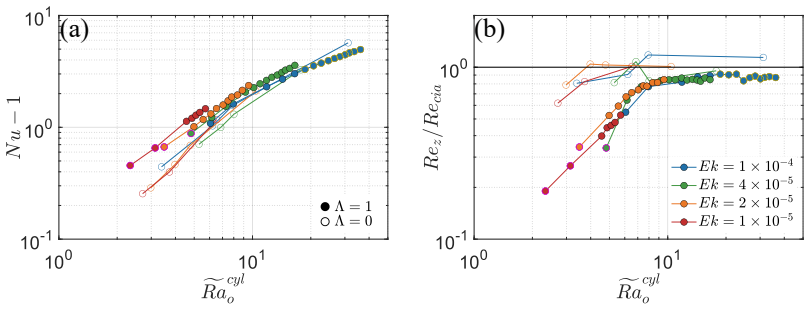
On its own terms, the paper's discovery is a regime boundary: rotating magnetoconvection in a quasi-static, low-Prandtl liquid metal crosses from geostrophic turbulence into a magnetically damped state at local interaction parameter N_ℓ ≈ 3 (fit values N_ℓ ≈ 4.0, N_c ≈ 3.1). Above the threshold, root-mean-square vertical velocities fall below the diffusivity-free rotating convection scaling Re_df and collapse onto Re_MD ≈ 2 N_ℓ^-1/2 Re_df — velocities decay roughly as the inverse square root of magnetic forcing. Purely in input parameters this is Re_MD = 4C_J^4/5 (Ra Ek / Pr)^3/2 Ek^1/2 / Λ, with 4C_J^4/5 ≈ 0.3. Applied to Earth's core (Ek = 10^-15, Pr = 0.1, Λ = 0.1–10), it predicts convect
Load-bearing premise
The core prediction assumes the convective eddies keep the size predicted by rotating-convection theory (a fraction of the layer depth set by the convective Rossby number, ℓ ≈ Ro_c H) even in the magnetically damped regime — exactly where that geostrophic scale estimate is least secure.
Editorial extensions
If this is right
- Rotating magnetoconvection velocities follow the diffusivity-free geostrophic scaling when N_ℓ ≲ 3 and drop below it as Re ≈ 2 N_ℓ^-1/2 Re_df when N_ℓ ≳ 3.
- In the damped regime convective velocities fall while heat transfer rises: the same axially aligned, more coherent flow both transports heat better and moves more slowly.
- Earth's core convection is predicted to lie in the magnetically damped regime, with Rayleigh number between 10^24 and 10^26 (center ≈ 5×10^25) and convective Rossby number ≈ 2×10^-2.
- The input-only form Re_MD = 4C_J^4/5 (Ra Ek / Pr)^3/2 Ek^1/2 / Λ lets core convective speeds be estimated from externally estimable parameters alone, without direct velocity measurements.
- Dynamo simulations at Ek ≳ 10^-5 (weak-field regime) should track the diffusivity-free rotating convection scaling, while strong-field models at Ek ≲ 10^-5 should show larger-scale, magnetically damped convective velocities.
Reading between the lines
- The N_ℓ ≈ 3 threshold transfers as a regime test: any rotating magnetized convective system — other planetary cores, subsurface oceans — with local interaction parameter above about 3 should be parameterized by magnetic damping rather than geostrophic turbulence.
- Whether the N_ℓ^-1/2 damping law survives at core-like magnetic Reynolds numbers, beyond the quasi-static limit this experiment operates in, is the open question that would firm up the geophysical extrapolation.
- A testable signature of the mechanism: in the damped regime the flow should become more anisotropic (preferentially axially coherent), measurable with multi-axis velocity diagnostics in future liquid-metal experiments.
- Because the input-only scaling (23) inherits the geostrophic scale assumption ℓ ≈ Ro_c H, a simulation that measures the true eddy scale in the damped regime would show whether the predicted core Rayleigh number shifts.
Editorial analysis
A structured set of objections, weighed in public.
Referee Report
Summary. The paper presents rotating magnetoconvection (RMC) experiments in liquid gallium at Ek = 10^-4-10^-5 and Elsasser number Lambda = 1, together with Lambda = 0 rotating-convection controls. Vertical velocities are measured with a single UDV chord and heat fluxes with thermistors. The central claim is that RMC velocities follow the geostrophic-turbulent CIA and diffusivity-free scalings when the local interaction parameter N_l is below about 3, and are magnetically damped, falling below those scalings as Re ~ 2 Re_df N_l^{-1/2}, when N_l is above about 3; this damping coexists with enhanced heat transfer attributed to axially coherent structures. The empirical fit is then recast into an 'input-only' scaling, Eq. (23), using the geostrophic scale l ~ Roc H, and extrapolated to Earth's core to predict convection-scale flow in the magnetically damped regime at Ra ~ 10^24-10^26.
Significance. If established, this would be the first direct velocity measurement of magnetostrophic liquid-metal convection and a valuable experimental anchor for rotating magnetoconvection scaling laws. The damping is visible in the raw data, the comparison against pre-existing CIA/DF scalings is appropriate, and the appendix data tables support reproducibility. The heat-transfer enhancement concurrent with velocity suppression is an interesting, falsifiable observation. The paper's main limitations are two load-bearing gaps: the length scale used to evaluate N_l is not stated, and the core extrapolation assumes the geostrophic scale l ~ Roc H holds in the damped regime, which is precisely where the paper's own data show larger, slower structures. In addition, Eq. (23) is described as input-only although its constants are calibrated on the same velocity data. With these points fixed or carefully qualified, the central result is likely to be a significant contribution.
major comments (3)
- [Sec. 5, Eq. (22)] The derivation of the input-only scaling (23) substitutes l = Roc H into Eq. (7). This scale relation is introduced in Sec. 2.1 before Eq. (8) under the explicit assumption that the flow is in or near the geostrophic-turbulence regime. It is then applied in Eq. (22) to the N_l >= 3 magnetically damped regime, whose defining property is Lorentz dominance. The paper's own Hovmoller data in Fig. 5(d) show larger, slower, axially coherent structures in the damped cases, so the geostrophic scale is least secure exactly where the prediction is made. This is not a cosmetic issue: with alpha = -1/2, Eq. (22) gives Re_MD ~ c^2 Re_df^2 / [Ch (l/H)], so a scale differing from Roc H changes Re_MD multiplicatively and shifts the Rayleigh-number range obtained from the intersection in Fig. 11(b). Please either justify l ~ Roc H in the damped regime with a scale measurement or a separate estimate, or p
- [Sec. 3.1 and Sec. 4.2.1, Eq. (7)] The local interaction parameter N_l is central to the regime transition and to the fits in Figs. 7-10, but the length scale l entering Eq. (7) is never defined. Sec. 3.1 states only that uz,max is used for U; the data tables list Re_z but not N_l or l. Without this information the reported threshold N_l ~ 3 and the fit Re_MD = c Re_df N_l^alpha cannot be reproduced or independently checked. The sentence after Fig. 8 that N_l 'makes no assumptions on flow velocities or scales' is also misleading: an operational choice of l, or a measured correlation length, is required. Please define l explicitly, state its value for each case (or table it), and if it is not measured, state the assumption.
- [Sec. 5, Eq. (23)] Eq. (23) is presented as a predictive formulation depending solely on externally estimable parameters, but the constants c ~ 2 and alpha ~ -1/2 in Eq. (19) are obtained by fitting the same RMC velocity data. Eq. (23) is therefore an algebraic rearrangement of an empirical fit, not an independent ab initio prediction. This does not make the damping observation circular, because the normalization Re_df and the threshold comparison use pre-existing scalings, but it should be stated transparently wherever 'input-only' or 'without direct velocity measurements' appears. The core Ra values inherit both the fit uncertainty and the scale assumption of the previous comment.
minor comments (5)
- [Abstract and Sec. 5] The abstract gives Ra in the range 10^24-10^26, while Sec. 5 and Fig. 11 state the overlap extends to 5 x 10^26. Please unify the quoted range.
- [Sec. 3.1 and Fig. 7 caption] Typographical errors: 'Elssaser number' should be 'Elsasser number' in Sec. 3.1; 'superficiality' in the Fig. 7 caption should be 'supercriticality'.
- [Sec. 5, Eq. (21)] Eq. (21) is called a unified prediction, but the piecewise form uses N_l, which depends on the measured velocity and scale. Clarify that Eq. (23) is the input-only form and state when each expression is intended to be used.
- [Sec. 3.1 and Sec. 4.2] The velocity measurement is axial-only and along a single chord at 2R/3, but Re_z is compared with scaling laws written for the total Reynolds number Re. A sentence justifying the substitution and noting the possible bias for anisotropic structures would help the reader judge the quantitative agreement.
- [Appendix tables] Several RMC entries list no Re_z value. Please state whether those velocities were too small to measure, and explicitly indicate which cases were included in the fits shown in Figs. 7-10.
Circularity Check
The measured magnetic damping is not circular, but the 'input-only' core prediction (Eq. 23) is an algebraic rearrangement of the same fitted relation and inherits its fitted constants.
-
fitted input called prediction
[Sec. 5, Eqs. (19)-(23), Figs. 10-11b]
"The best fit to (19) is shown as the black dotted line in Figure 10, with corresponding best fit parameter values of c = 1.72 ± 0.14 ≈ 2 and α = −0.46 ± 0.05 ≈ −1/2. ... ReM D = cRed f(σB^2 ℓ/ρU)^α = cRed f(σB^2(RocH)/ρU)^α = c(C^{2/5}_J RocRef f)(ChRo c/ReM D)^α ... Recasting (22) using our best-fit empirical values, c ≈ 2 and α ≈ −1/2, then yields: ReM D = 4C^{4/5}_J (RaEk/Pr)^{3/2} Ek^{1/2}/Λ ... Expression (23) captures the Nℓ ≳ 3 dependence of the magnetically damped Reynolds number solely using input parameters."
Equation (23) is not a new input-only derivation: it is obtained by substituting the definition of Nℓ into the empirical fit (19), replacing the velocity in Nℓ with ReM D itself via ChRoc/ReM D, and then inserting the same fitted constants c≈2 and α≈−1/2. The algebra simply inverts the measured ReM D vs Nℓ relation into a formula in Ra, Ek, Pr, Λ. Thus the 'prediction' for Earth's core in Fig. 11b is the laboratory fit evaluated at core parameters; it is statistically forced by the fit and contains no independent information beyond that fit. Calling Eq. (23) 'solely using input parameters' obscures that the prefactor 4C^{4/5}_J ≈ 0.3 encodes c² from the fit to the very velocity data that the formula is then used to predict.
full rationale
The core experimental finding — suppression of RMC velocities below geostrophic RC scalings for Nℓ ≳ 3 — is genuine empirical evidence: the data are compared against pre-existing, parameter-free CIA (Eq. 11) and DF (Eq. 13) scalings, and the damping itself is not an artifact of the comparison. The circularity is confined to the packaging of this fit as an input-only predictive law. Eq. (19) fits c and α to the Re/Re_df vs Nℓ data; Eq. (22) then rewrites Nℓ using ℓ=RocH and U=ReM D, which is an identity; combining this with the same fitted constants yields Eq. (23). Therefore Eq. (23) is a rearranged fit, not a first-principles prediction, and the headline core Ra ≈ 10^24–10^26 is the intersection of that rearranged fit with an assumed core Re range. The additional geostrophic-scale assumption ℓ=RocH is applied inside the damped regime where the paper's own Hovmöller data show larger-scale coherent structures; this is an extrapolation risk and a correctness concern, not itself a circular step. Self-citations to Horn and Aurnou (2022, 2025) and Aurnou et al. (2020) provide mode thresholds, DNS comparisons, and scale estimates, but they are not the load-bearing source of the damping result. Hence the score is 6: one central 'prediction' reduces by construction to the fitted empirical relation.
Assumptions & free parameters
free parameters (3)
- c (prefactor in Re_MD scaling) =
1.72 +/- 0.14, rounded to ~2
- alpha (exponent in Re_MD scaling) =
-0.46 +/- 0.05, rounded to ~-1/2
- Transition interaction parameter N_l (and N_c) =
N_l ~ 4.0, N_c ~ 3.1, reported as N_l ~ 3
assumptions (6)
- domain assumption Quasi-static Lorentz force density f_L ~ sigma U B^2 applies to the liquid gallium experiments (small magnetic Reynolds number).
- domain assumption Convection is in or near the geostrophic turbulence regime, so characteristic scales are ell ~ Roc H and U ~ U_Omega.
- domain assumption Julien et al. (2012a) diffusivity-free heat transport scaling Nu-1 = C_J Ra^{3/2} Ek^2 Pr^{-1/2} with C_J ~ 1/25 describes rotating convection in the experimental regime.
- domain assumption UDV measurements of uz along a single chord at 2R/3 are representative of the convective velocity scale used in Re and N_l.
- domain assumption Earth core parameter estimates: Ek = 10^-15, Pr = 0.1, Ra in [10^23, 10^29], Lambda in [0.1, 10], taken from prior geophysical estimates.
- domain assumption Linear-theory critical Rayleigh numbers from Horn and Aurnou (2022) classify supercriticality and active modes in the experiments.
Cite this review
Pith. "Pith review of From Geostrophic to Magnetically-Damped Turbulence in Liquid Metal Rotating Magnetoconvection." pith.science (2026). https://pith.science/paper/CUK6Z75M
@misc{pith2026250903689,
  author       = {Pith},
  title        = {Pith review of: From Geostrophic to Magnetically-Damped Turbulence in Liquid Metal Rotating Magnetoconvection},
  year         = {2026},
  howpublished = {\url{https://pith.science/paper/CUK6Z75M}},
  note         = {Machine review of arXiv:2509.03689}
}
abstract
Understanding planetary core convection dynamics requires the study of convective flows in which the Coriolis and Lorentz forces attain a leading-order, so-called magnetostrophic balance. Experimental investigations of rotating magnetoconvection (RMC) in the magnetostrophic regime are therefore essential to broadly characterize the properties of local-scale planetary core flow. Towards this end, we present here the first thermovelocimetric measurements of magnetostrophic, liquid metal convection, which are made using liquid gallium as the working fluid, at moderate rotation rates (Ekman numbers $10^{-4} \leq Ek\leq 10^{-5}$) and in the presence of dynamically strong magnetic fields (Elsasser number $\Lambda=1$). Complementary rotating convection (RC) experiments are performed at the same rotation rates to serve as reference cases. Our RMC velocity measurements adequately follow a geostrophic turbulent scaling for cases in which local-scale convective inertial forces exceed the Lorentz forces in the fluid bulk. In cases where Lorentz forces exceed local-scale inertia ($N_\ell \gtrsim 3$), the root-mean-square RMC velocities are magnetically damped, yielding values below the geostrophic turbulent RC scaling prediction. An enhancement in heat transfer is observed, which we attribute to the increased coherence of vertically aligned magnetostrophic convective flow. Extrapolating these laboratory results, we predict that convection-scale flows in Earth's core occur in the magnetically damped $N_\ell \gtrsim 3$ regime with Rayleigh number values between $10^{24}$ and $10^{26}$.
Figures


Figures from the paper (8 more)




Reference graph
Works this paper leans on
-
[1]
Jewel A. Abbate. Laboratory-Theoretical Investigations of Rotating Convection in Planetary Interiors. PhD thesis, 2024
2024
-
[2]
Jewel A. Abbate and Jonathan M. Aurnou. Rotating convective turbulence in moderate to high prandtl number fluids. Geophysical & Astrophysical Fluid Dynamics, 117 0 (6): 0 397--436, 2023. doi:10.1080/03091929.2023.2280874
-
[3]
Shadowgraph measurements of rotating convective planetary core-style flows
Jewel A Abbate and Jonathan M Aurnou. Shadowgraph measurements of rotating convective planetary core-style flows. Journal of Geophysical Research: Planets, 129 0 (9): 0 e2024JE008471, 2024
2024
-
[4]
Abbate, Yufan Xu, Tobias Vogt, Susanne Horn, Keith Julien, and Jonathan M
Jewel A. Abbate, Yufan Xu, Tobias Vogt, Susanne Horn, Keith Julien, and Jonathan M. Aurnou. Diffusivity-free turbulence in tabletop rotating rayleigh-b\'enard convection experiments. 2024
2024
-
[5]
A systematic experimental study of rapidly rotating spherical convection in water and liquid gallium
Julien Aubert, Daniel Brito, Henri-Claude Nataf, Philippe Cardin, and Jean-Paul Masson. A systematic experimental study of rapidly rotating spherical convection in water and liquid gallium. Physics of the Earth and Planetary Interiors, 128 0 (1): 0 51--74, 2001. ISSN 0031-9201. doi:https://doi.org/10.1016/S0031-9201(01)00277-1. Dynamics and Magnetic Field...
-
[6]
Onset of plane layer magnetoconvection at low ekman number
K \'e lig Aujogue, Alban Poth \'e rat, and Binod Sreenivasan. Onset of plane layer magnetoconvection at low ekman number. Physics of Fluids, 27 0 (10), 2015
2015
-
[7]
Experiments on convection in earth’s core tangent cylinder
Jonathan Aurnou, Steven Andreadis, Lixin Zhu, and Peter Olson. Experiments on convection in earth’s core tangent cylinder. Earth and Planetary Science Letters, 212 0 (1): 0 119--134, 2003. ISSN 0012-821X. doi:https://doi.org/10.1016/S0012-821X(03)00237-1
-
[8]
Aurnou and Eric M
Jonathan M. Aurnou and Eric M. King. The cross-over to magnetostrophic convection in planetary dynamo systems. Proceedings of the Royal Society A: Mathematical, Physical and Engineering Sciences, 473 0 (2199): 0 20160731, 2017
2017
Show all 90 references
-
[9]
Aurnou, Michael A
Jonathan M. Aurnou, Michael A. Calkins, Jonathan S. Cheng, Keith Julien, Eric M. King, David Nieves, Krista M. Soderlund, and Stephan Stellmach. Rotating convective turbulence in earth and planetary cores. Physics of the Earth and Planetary Interiors, 246: 0 52--71, 2015
2015
-
[10]
Rotating thermal convection in liquid gallium: multi-modal flow, absent steady columns
Jonathan M Aurnou, Vincent Bertin, Alexander M Grannan, Susanne Horn, and Tobias Vogt. Rotating thermal convection in liquid gallium: multi-modal flow, absent steady columns. Journal of Fluid Mechanics, 846: 0 846--876, 2018
2018
-
[11]
Aurnou, Susanne Horn, and Keith Julien
Jonathan M. Aurnou, Susanne Horn, and Keith Julien. Connections between nonrotating, slowly rotating, and rapidly rotating turbulent convection transport scalings. Phys. Rev. Res., 2: 0 043115, Oct 2020. doi:10.1103/PhysRevResearch.2.043115
2020 doi
-
[12]
Theory and simulations of rotating convection
Adrian J Barker, Adam M Dempsey, and Yoram Lithwick. Theory and simulations of rotating convection. The Astrophysical Journal, 791 0 (1): 0 13, 2014
2014
-
[13]
Experimental observation of the geostrophic turbulence regime of rapidly rotating convection
Vincent Bouillaut, Benjamin Miquel, Keith Julien, Sébastien Aumaître, and Basile Gallet. Experimental observation of the geostrophic turbulence regime of rapidly rotating convection. Proceedings of the National Academy of Sciences, 118 0 (44): 0 e2105015118, 2021. doi:10.1073/...
2021 doi
-
[14]
Ultrasonic doppler velocimetry in liquid gallium
Daniel Brito, Henri-Claude Nataf, Philippe Cardin, Julien Aubert, and Jean-Paul Masson. Ultrasonic doppler velocimetry in liquid gallium. Experiments in fluids, 31 0 (6): 0 653--663, 2001
2001
-
[15]
Turbulent viscosity measurements relevant to planetary core-mantle dynamics
Daniel Brito, Jonathan Aurnou, and Philippe Cardin. Turbulent viscosity measurements relevant to planetary core-mantle dynamics. Physics of the Earth and Planetary Interiors, 141 0 (1): 0 3--8, 2004
2004
-
[16]
A multiscale dynamo model driven by quasi-geostrophic convection
Michael A Calkins, Keith Julien, Steven M Tobias, and Jonathan M Aurnou. A multiscale dynamo model driven by quasi-geostrophic convection. Journal of Fluid Mechanics, 780: 0 143--166, 2015
2015
-
[17]
Solar-like to antisolar differential rotation: a geometric interpretation
Maria E Camisassa and Nicholas A Featherstone. Solar-like to antisolar differential rotation: a geometric interpretation. The Astrophysical Journal, 938 0 (1): 0 65, 2022
2022
-
[18]
Chaotic thermal convection in a rapidly rotating spherical shell: consequences for flow in the outer core
Philippe Cardin and Peter Olson. Chaotic thermal convection in a rapidly rotating spherical shell: consequences for flow in the outer core. Physics of the Earth and Planetary Interiors, 82 0 (3): 0 235--259, 1994. ISSN 0031-9201. doi:https://doi.org/10.1016/0031-9201(94)90075-2
1994 doi
-
[19]
Hydrodynamic and Hydromagnetic Stability
Subrahmanyan Chandrasekhar. Hydrodynamic and Hydromagnetic Stability. Clarendon Press, 1961
1961
-
[20]
: Elbert
Subrahmanyan Chandrasekhar and Donna D. : Elbert. The instability of a layer of fluid heated below and subject to coriolis forces. ii. Proceedings of the Royal Society of London. Series A. Mathematical and Physical Sciences, 231 0 (1185): 0 198--210, 1955. doi:10.1098/rspa.1955.0166
1955
-
[21]
Strong coupling of flow structure and heat transport in liquid metal thermal convection
Xin-Yuan Chen, Yi-Chao Xie, Juan-Cheng Yang, and Ming-Jiu Ni. Strong coupling of flow structure and heat transport in liquid metal thermal convection. Journal of Fluid Mechanics, 975: 0 A21, 2023
2023
-
[22]
A heuristic framework for next-generation models of geostrophic convective turbulence
Jonathan S Cheng, Jonathan M Aurnou, Keith Julien, and Rudie PJ Kunnen. A heuristic framework for next-generation models of geostrophic convective turbulence. Geophysical & Astrophysical Fluid Dynamics, 112 0 (4): 0 277--300, 2018
2018
-
[23]
Cheng, Ibrahim Mohammad, Bitong Wang, Declan F
Jonathan S. Cheng, Ibrahim Mohammad, Bitong Wang, Declan F. Keogh, Jarod M. Forer, and Douglas H. Kelley. Oscillations of the large-scale circulation in experimental liquid metal convection at aspect ratios 1.4–3. Journal of Fluid Mechanics, 949: 0 A42, 2022. doi:10.1017/jfm.2022.778
2022 doi
-
[24]
Kai Leong Chong, Yantao Yang, Shi-Di Huang, Jin-Qiang Zhong, Richard JAM Stevens, Roberto Verzicco, Detlef Lohse, and Ke-Qing Xia. Confined rayleigh-b \'e nard, rotating rayleigh-b \'e nard, and double diffusive convection: A unifying view on turbulent transport enhancement th...
2017
-
[25]
Strong-field spherical dynamos
Emmanuel Dormy. Strong-field spherical dynamos. Journal of Fluid Mechanics, 789: 0 500--513, 2016
2016
-
[26]
Rapidly rotating magnetohydrodynamics and the geodynamo
Emmanuel Dormy. Rapidly rotating magnetohydrodynamics and the geodynamo. Annual Review of Fluid Mechanics, 57, 2025
2025
-
[27]
Eltayeb and Subrahmanyan Chandrasekhar
Ibrahim A. Eltayeb and Subrahmanyan Chandrasekhar. Hydromagnetic convection in a rapidly rotating fluid layer. Proceedings of the Royal Society of London. A. Mathematical and Physical Sciences, 326 0 (1565): 0 229--254, 1972. doi:10.1098/rspa.1972.0007
1972
-
[28]
Finlay and Hagay Amit
Christopher C. Finlay and Hagay Amit. On flow magnitude and field-flow alignment at earth's core surface. Geophysical Journal International, 186 0 (1): 0 175--192, 07 2011. ISSN 0956-540X. doi:10.1111/j.1365-246X.2011.05032.x
2011 arXiv
-
[29]
Thomas Gastine, Johannes Wicht, and Jonathan M. Aurnou. Zonal flow regimes in rotating anelastic spherical shells: An application to giant planets. Icarus, 225 0 (1): 0 156--172, 2013 a
2013
-
[30]
From solar-like to antisolar differential rotation in cool stars
Thomas Gastine, Rakesh K Yadav, Julien Morin, Ansgar Reiners, and Johannes Wicht. From solar-like to antisolar differential rotation in cool stars. Monthly Notices of the Royal Astronomical Society: Letters, 438 0 (1): 0 L76--L80, 2013 b
2013
-
[31]
Fast torsional waves and strong magnetic field within the earth’s core
Nicolas Gillet, Dominique Jault, Elisabeth Canet, and Alexandre Fournier. Fast torsional waves and strong magnetic field within the earth’s core. Nature, 465 0 (7294): 0 74--77, 2010. ISSN 1476-4687. doi:10.1038/nature09010
2010 doi
-
[32]
H. F. Goldstein, E. Knobloch, I. Mercader, and M. Net. Convection in a rotating cylinder. part 2. linear theory for low prandtl numbers. Journal of Fluid Mechanics, 262: 0 293–324, 1994. doi:10.1017/S0022112094000510
1994 doi
-
[33]
Internally heated convection and Rayleigh-B \'e nard convection
David Goluskin. Internally heated convection and Rayleigh-B \'e nard convection . Springer, 2016
2016
-
[34]
Grannan, Jonathan S
Alexander M. Grannan, Jonathan S. Cheng, Ashna Aggarwal, Emily K. Hawkins, Yufan Xu, Susanne Horn, Jose Sánchez-Álvarez, and Jonathan M. Aurnou. Experimental pub crawl from rayleigh–bénard to magnetostrophic convection. Journal of Fluid Mechanics, 939: 0 R1, 2022. doi:10.1017/...
2022 doi
-
[35]
Greenspan
Harvey P. Greenspan. Theory of Rotating Fluids. Cambridge University Press, 1969
1969
-
[36]
The rayleigh number for convection in the earth’s core
David Gubbins. The rayleigh number for convection in the earth’s core. Physics of the Earth and Planetary Interiors, 128 0 (1): 0 3--12, 2001. ISSN 0031-9201. doi:https://doi.org/10.1016/S0031-9201(01)00273-4. Dynamics and Magnetic Fields of the Earth's and Planetary Interiors
2001 doi
-
[37]
Turbulent convective length scale in planetary cores
Céline Guervilly, Philippe Cardin, and Nathanaël Schaeffer. Turbulent convective length scale in planetary cores. Nature, 570: 0 368--371, 2019. doi:10.1038/s41586-019-1301-5
2019 doi
-
[38]
Rapidly rotating radiatively driven convection: experimental and numerical validation of the ‘geostrophic turbulence’ scaling predictions
Gabriel Hadjerci, Vincent Bouillaut, Benjamin Miquel, and Basile Gallet. Rapidly rotating radiatively driven convection: experimental and numerical validation of the ‘geostrophic turbulence’ scaling predictions. Journal of Fluid Mechanics, 998: 0 A9, 2024. doi:10.1017/jfm.2024.556
2024 doi
-
[39]
Hawkins, Jonathan S
Emily K. Hawkins, Jonathan S. Cheng, Jewel A. Abbate, Timothy Pilegard, Stephan Stellmach, Keith Julien, and Jonathan M. Aurnou. Laboratory models of planetary core-style convective turbulence. Fluids, 8 0 (4), 2023. ISSN 2311-5521. doi:10.3390/fluids8040106
2023 doi
-
[40]
Herrmann and Friedrich Hermann Busse
J. Herrmann and Friedrich Hermann Busse. Asymptotic theory of wall-attached convection in a rotating fluid layer. Journal of Fluid Mechanics, 255: 0 183–194, 1993. doi:10.1017/S0022112093002447
1993 doi
-
[41]
Evidence for turbulent magnetic diffusion in earth's core
D Holdenried-Chernoff and B\_A Buffett. Evidence for turbulent magnetic diffusion in earth's core. Geochemistry, Geophysics, Geosystems, 23 0 (12): 0 e2022GC010672, 2022
2022
-
[42]
Large-scale flow in the core
Richard Holme. Large-scale flow in the core. In Gerald Schubert, editor, Treatise on Geophysics, 2nd edition, volume 8, pages 107--130. Elsevier, 2015
2015
-
[43]
Susanne Horn and Jonathan M. Aurnou. The elbert range of magnetostrophic convection. i. linear theory. Proceedings of the Royal Society A: Mathematical, Physical and Engineering Sciences, 478 0 (2264): 0 20220313, 2022. doi:10.1098/rspa.2022.0313
2022
-
[44]
Susanne Horn and Jonathan M. Aurnou. The elbert range of magnetostrophic convection. ii. comparing linear theory to nonlinear low-<i>rm</i> simulations. Proceedings of the Royal Society A: Mathematical, Physical and Engineering Sciences, 481 0 (2310): 0 20240016, 2025. doi:10....
2025
-
[45]
Susanne Horn and Peter J. Schmid. Prograde, retrograde, and oscillatory modes in rotating rayleigh–bénard convection. Journal of Fluid Mechanics, 831: 0 182–211, 2017. doi:10.1017/jfm.2017.631
2017 doi
-
[46]
Unravelling the large-scale circulation modes in turbulent rayleigh-b \'e nard convection (a)
Susanne Horn, Peter J Schmid, and Jonathan M Aurnou. Unravelling the large-scale circulation modes in turbulent rayleigh-b \'e nard convection (a). Europhysics Letters, 136 0 (1): 0 14003, 2022
2022
-
[47]
Confinement-induced heat-transport enhancement in turbulent thermal convection
Shi-Di Huang, Matthias Kaczorowski, Rui Ni, and Ke-Qing Xia. Confinement-induced heat-transport enhancement in turbulent thermal convection. Phys. Rev. Lett., 111: 0 104501, Sep 2013
2013
-
[48]
Motion in the interiors and atmospheres of jupiter and saturn: Scale analysis, anelastic equations, barotropic stability criterion
Andrew P Ingersoll and David Pollard. Motion in the interiors and atmospheres of jupiter and saturn: Scale analysis, anelastic equations, barotropic stability criterion. Icarus, 52 0 (1): 0 62--80, 1982
1982
-
[49]
Chris A. Jones. Planetary magnetic fields and fluid dynamos. Annual Review of Fluid Mechanics, 43: 0 583--614, 2011. ISSN 1545-4479. doi:https://doi.org/10.1146/annurev-fluid-122109-160727
2011 doi
-
[50]
Strongly nonlinear convection cells in a rapidly rotating fluid layer: the tilted f-plane
Keith Julien and Edgar Knobloch. Strongly nonlinear convection cells in a rapidly rotating fluid layer: the tilted f-plane. Journal of Fluid Mechanics, 360: 0 141–178, 1998. doi:10.1017/S0022112097008446
1998 doi
-
[51]
Reduced equations for rotationally constrained convection
Keith Julien, Edgar Knobloch, and Joseph Werne. Reduced equations for rotationally constrained convection. In Turbulence and Shear Flows, I. Begell House, 1999
1999
-
[52]
Rubio, and Geoffrey M
Keith Julien, Edgar Knobloch, Antonio M. Rubio, and Geoffrey M. Vasil. Heat transport in low-rossby-number rayleigh-b\'enard convection. Phys. Rev. Lett., 109: 0 254503, Dec 2012 a . doi:10.1103/PhysRevLett.109.254503
2012 doi
-
[53]
Statistical and physical balances in low rossby number rayleigh--b \'e nard convection
Keith Julien, Antonio M Rubio, Ian Grooms, and Edgar Knobloch. Statistical and physical balances in low rossby number rayleigh--b \'e nard convection. Geophysical & Astrophysical Fluid Dynamics, 106 0 (4-5): 0 392--428, 2012 b
2012
-
[54]
King and Jonathan M
Eric M. King and Jonathan M. Aurnou. Magnetostrophic balance as the optimal state for turbulent magnetoconvection. Proceedings of the National Academy of Sciences, 112 0 (4): 0 990--994, 2015. doi:10.1073/pnas.1417741112
2015 doi
-
[55]
King and Bruce A
Eric M. King and Bruce A. Buffett. Flow speeds and length scales in geodynamo models: The role of viscosity . Earth and Planetary Science Letters, 371: 0 156--162, June 2013. doi:https://doi.org/10.1016/j.epsl.2013.04.001
2013 doi
-
[56]
Heat transfer by rapidly rotating rayleigh--b \'e nard convection
Eric M King, Stephan Stellmach, and Jonathan M Aurnou. Heat transfer by rapidly rotating rayleigh--b \'e nard convection. Journal of Fluid Mechanics, 691: 0 568--582, 2012
2012
-
[57]
Rudie P. J. Kunnen. The geostrophic regime of rapidly rotating turbulent convection. Journal of Turbulence, 22 0 (4-5): 0 267--296, 2021. doi:10.1080/14685248.2021.1876877
2021
-
[58]
Radiative heating achieves the ultimate regime of thermal convection
Simon Lepot, Sébastien Aumaître, and Basile Gallet. Radiative heating achieves the ultimate regime of thermal convection. Proceedings of the National Academy of Sciences, 115 0 (36): 0 8937--8941, 2018. doi:10.1073/pnas.1806823115
2018 doi
-
[59]
X. Liao, K. Zhang, and Y. Chang. On boundary-layer convection in a rotating fluid layer. Journal of Fluid Mechanics, 549: 0 375–384, 2006. doi:10.1017/S0022112005008189
2006 doi
-
[60]
An accelerating high-latitude jet in earth’s core
Philip W Livermore, Rainer Hollerbach, and Christopher C Finlay. An accelerating high-latitude jet in earth’s core. Nature Geoscience, 10 0 (1): 0 62--68, 2017
2017
-
[61]
Differential rotation in magnetized and non-magnetized stars
Jun Mabuchi, Youhei Masada, and Akira Kageyama. Differential rotation in magnetized and non-magnetized stars. The Astrophysical Journal, 806 0 (1): 0 10, 2015
2015
-
[62]
Niiler and Frederic E
Pearn P. Niiler and Frederic E. Bisshopp. On the influence of coriolis force on onset of thermal convection. Journal of Fluid Mechanics, 22 0 (4): 0 753–761, 1965. doi:10.1017/S002211206500112X
1965 doi
-
[63]
Experimental evidence of inertial waves in a precessing spheroidal cavity
J \'e r \^o me Noir, Daniel Brito, Keith Aldridge, and Philippe Cardin. Experimental evidence of inertial waves in a precessing spheroidal cavity. Geophysical Research Letters, 28 0 (19): 0 3785--3788, 2001
2001
-
[64]
Small scale quasigeostrophic convective turbulence at large rayleigh number
Tobias G Oliver, Adrienne S Jacobi, Keith Julien, and Michael A Calkins. Small scale quasigeostrophic convective turbulence at large rayleigh number. Physical Review Fluids, 8 0 (9): 0 093502, 2023
2023
-
[65]
On the motion of solids in a liquid possessing vorticity
Joseph Proudman and Horace Lamb. On the motion of solids in a liquid possessing vorticity. Proceedings of the Royal Society of London. Series A, Containing Papers of a Mathematical and Physical Character, 92 0 (642): 0 408--424, 1916. doi:10.1098/rspa.1916.0026
1916
-
[66]
On the genesis of the earth's magnetism
Paul H Roberts and Eric M King. On the genesis of the earth's magnetism. Reports on Progress in Physics, 76 0 (9): 0 096801, sep 2013. doi:10.1088/0034-4885/76/9/096801
2013 doi
-
[67]
Linear magnetoconvection in rotating fluid spheres permeated by a uniform axial magnetic field
Ataru Sakuraba. Linear magnetoconvection in rotating fluid spheres permeated by a uniform axial magnetic field. Geophysical & Astrophysical Fluid Dynamics, 96 0 (4): 0 291--318, 2002
2002
-
[68]
Turbulent geodynamo simulations: a leap towards earth’s core
Nathana \"e l Schaeffer, Dominique Jault, H-C Nataf, and Alexandre Fournier. Turbulent geodynamo simulations: a leap towards earth’s core. Geophysical Journal International, 211 0 (1): 0 1--29, 2017
2017
-
[69]
The competition between lorentz and coriolis forces in planetary dynamos
Krista M Soderlund, Andrey Sheyko, Eric M King, and Jonathan M Aurnou. The competition between lorentz and coriolis forces in planetary dynamos. Progress in Earth and Planetary Science, 2 0 (1): 0 24, 2015
2015
-
[70]
Magnetohydrodynamic control of differential rotation and dynamo transitions: rise of the local magnetic rossby number
Krista M Soderlund, Paula Wulff, Petri J Käpylä, and Jonathan M Aurnou. Magnetohydrodynamic control of differential rotation and dynamo transitions: rise of the local magnetic rossby number. Monthly Notices of the Royal Astronomical Society, 541 0 (2): 0 1816--1830, 07 2025. I...
2025 doi
-
[71]
Convection in stars: I
Edward A Spiegel. Convection in stars: I. basic boussinesq convection. Annual Review of Astronomy and Astrophysics, vol. 9, p. 323, 9: 0 323, 1971
1971
-
[72]
Turbulent thermal convection in the presence of rotation and a magnetic field: a heuristic theory
David J Stevenson. Turbulent thermal convection in the presence of rotation and a magnetic field: a heuristic theory. Geophysical & Astrophysical Fluid Dynamics, 12 0 (1): 0 139--169, 1979
1979
-
[73]
Velocity profile measurement by ultrasonic doppler method
Yasushi Takeda. Velocity profile measurement by ultrasonic doppler method. Experimental Thermal and Fluid Science, 10 0 (4): 0 444--453, 1995. ISSN 0894-1777. doi:https://doi.org/10.1016/0894-1777(94)00124-Q. Experimental methods in Thermal and Fluid Science
1995 doi
-
[74]
Motion of solids in fluids when the flow is not irrotational
Geoffrey Ingram Taylor and Horace Lamb. Motion of solids in fluids when the flow is not irrotational. Proceedings of the Royal Society of London. Series A, Containing Papers of a Mathematical and Physical Character, 93 0 (648): 0 99--113, 1917. doi:10.1098/rspa.1917.0007
1917
-
[75]
Scaling of strong-field spherical dynamos
Robert J Teed and Emmanuel Dormy. Scaling of strong-field spherical dynamos. arXiv preprint arXiv:2508.05639, 2025
2025 arXiv
-
[76]
Bridging the rossby number gap in rapidly rotating thermal convection
Adrian van Kan, Keith Julien, Benjamin Miquel, and Edgar Knobloch. Bridging the rossby number gap in rapidly rotating thermal convection. Journal of Fluid Mechanics, 1010: 0 A42, 2025
2025
- [77]
-
[78]
Grannan, and Jonathan M
Tobias Vogt, Susanne Horn, Alexander M. Grannan, and Jonathan M. Aurnou. Jump rope vortex in liquid metal convection. Proceedings of the National Academy of Sciences, 115 0 (50): 0 12674--12679, 2018. doi:10.1073/pnas.1812260115
2018 doi
-
[79]
Tobias Vogt, Susanne Horn, and Jonathan M. Aurnou. Oscillatory thermal–inertial flows in liquid metal rotating convection. Journal of Fluid Mechanics, 911: 0 A5, 2021 a . doi:10.1017/jfm.2020.976
2021 doi
-
[80]
Free-fall velocities and heat transport enhancement in liquid metal magneto-convection
Tobias Vogt, Juan-Cheng Yang, Felix Schindler, and Sven Eckert. Free-fall velocities and heat transport enhancement in liquid metal magneto-convection. Journal of Fluid Mechanics, 915: 0 A68, 2021 b
2021
-
[81]
Heat transport by turbulent rotating rayleigh--b \'e nard convection and its dependence on the aspect ratio
Stephan Weiss and Guenter Ahlers. Heat transport by turbulent rotating rayleigh--b \'e nard convection and its dependence on the aspect ratio. Journal of fluid mechanics, 684: 0 407--426, 2011
2011
-
[82]
Tuning heat transport via coherent structure manipulation: recent advances in thermal turbulence
Ke-Qing Xia, Shi-Di Huang, Yi-Chao Xie, and Lu Zhang. Tuning heat transport via coherent structure manipulation: recent advances in thermal turbulence. National Science Review, 10 0 (6): 0 nwad012, 2023
2023
-
[83]
Thermovelocimetric characterization of liquid metal convection in a rotating slender cylinder
Yufan Xu, Jewel Abbate, Cy David, Tobias Vogt, and Jonathan Aurnou. Thermovelocimetric characterization of liquid metal convection in a rotating slender cylinder. International Journal of Heat and Mass Transfer, 252: 0 127325, 2025
2025
-
[84]
Effect of shear and magnetic field on the heat-transfer efficiency of convection in rotating spherical shells
Rakesh K Yadav, Thomas Gastine, Ulrich R Christensen, Lucia DV Duarte, and Ansgar Reiners. Effect of shear and magnetic field on the heat-transfer efficiency of convection in rotating spherical shells. Geophysical Journal International, 204 0 (2): 0 1120--1133, 2016 a
2016
-
[85]
Yadav, Thomas Gastine, Ulrich R
Rakesh K. Yadav, Thomas Gastine, Ulrich R. Christensen, Scott J. Wolk, and Katja Poppenhaeger. Approaching a realistic force balance in geodynamo simulations. Proceedings of the National Academy of Sciences, 113 0 (43): 0 12065--12070, 2016 b . doi:10.1073/pnas.1608998113
2016 doi
-
[86]
Calkins, Stefano Maffei, Keith Julien, Steven M
Ming Yan, Michael A. Calkins, Stefano Maffei, Keith Julien, Steven M. Tobias, and Philippe Marti. Heat transfer and flow regimes in quasi-static magnetoconvection with a vertical magnetic field. Journal of Fluid Mechanics, 877: 0 1186–1206, 2019. doi:10.1017/jfm.2019.615
2019 doi
-
[87]
The onset of convection in rotating circular cylinders with experimental boundary conditions
Keke Zhang and Xinhao Liao. The onset of convection in rotating circular cylinders with experimental boundary conditions. Journal of Fluid Mechanics, 622: 0 63–73, 2009. doi:10.1017/S002211200800517X
2009 doi
-
[88]
Rotating rayleigh-bénard convection: Küppers-lortz transition
Fang Zhong, Robert Ecke, and Victor Steinberg. Rotating rayleigh-bénard convection: Küppers-lortz transition. Physica D: Nonlinear Phenomena, 51 0 (1): 0 596--607, 1991. ISSN 0167-2789. doi:https://doi.org/10.1016/0167-2789(91)90266-C
1991 doi
-
[89]
Combined measurement of velocity and temperature in liquid metal convection
Till Zürner, Felix Schindler, Tobias Vogt, Sven Eckert, and Jörg Schumacher. Combined measurement of velocity and temperature in liquid metal convection. Journal of Fluid Mechanics, 876: 0 1108–1128, 2019. doi:10.1017/jfm.2019.556
2019 doi
-
[90]
Appendix landscape 4pt 0.9 table [H] center 0 tabular cccccccccccccc & Ek 10^ 4 & Ra 10^ -6 & Ra _o^ & Ra _o^ cyl & Ra _w^ & Ra _ mac ^ & Ra _ s ^ & Pr & P(W) & T & Nu & Re_ z,rms & Ro_c \\[3pt] 0 & 1 & 0.335 & 10.55 & 3.39 & 1.40 & - & 0.18 & 0.0275 & 20 & 1.33 & 1.44 & 265 &...
1933
Reviewed August 5, 2026 · model on record in the stance chip above.
Discussion (0). Sign in to comment.