REVIEW 4 major objections 6 minor 23 references
Goal State Generation for Robotic Manipulation Based on Linguistically Guided Hybrid Gaussian Diffusion
T0 review · 4 major / 6 minor · reviewed 2026-08-11 · deepseek-v4-flash
Pith's one-line read A linguistically guided hybrid Gaussian diffusion model generates controllable, collision-free target poses for robotic mug hanging, and a gravity-drop overlap check repairs residual collisions.
desk verdict Plausible engineering contribution that overclaims: the language-conditioned pose diffusion and the translation-only overlap-removal trick are useful, but the 'collision-free' claim rests on an unmeasured rotation-error premise and a thin evaluation. read the letter →
The pith
A machine-rendered reading of the paper's core claim, the machinery that carries it, and where it could break.
The reading
What carries the argument
The central machinery is the pose-decoupled hybrid Gaussian diffusion: translation is diffused with a normal distribution $\varepsilon \sim \mathcal{N}(0,I)$ while rotation is diffused with an isotropic Gaussian distribution on SO(3), $\mathrm{IGSO}(3)$, whose density over rotation angle $\omega$ follows Equation (4) with axes sampled uniformly. The two components are recombined into a pose at each reverse step, preserving rigidity. A second mechanism is the gravitational descent coverage (GDC) coefficient, $C_{GDC}(z_{opt}) = \max_{z_i \in [0,z_{max}]} \mathrm{Vol}(R \cap M(z_i))/\mathrm{Vol}(R)$, which simulates the mug descending under gravity and evaluates how much of the rack is covered by overlap; the fine-tuning module injects small DDPM noise into the translation only and selects the pose that keeps the mug stable and non-overlapping.
What would settle it
Take predicted poses that pass the overlap-free test, then rotate the mug by 5–10 degrees around the handle axis while keeping translation fixed and rerun the GDC fine-tuner; if a substantial fraction still ends up overlapping the rack, the translation-only repair assumption fails.
Extended reading notes
Core claim
The central claim is that a hybrid Gaussian diffusion model, with pose decoupling and language conditioning, can generate feasible target poses for mug-hanging that are both semantically controllable and collision-free. The paper demonstrates that adding Gaussian noise directly to a pose matrix breaks rotation orthogonality and deforms rigid point clouds, so they randomize translation with a normal distribution and rotation with an isotropic Gaussian on SO(3), recombining the two at each denoising step. It further claims that a post-processing step based on the gravitational descent coverage coefficient—simulating the mug dropping under gravity and selecting the pose with the largest stabilized overlap ratio—eliminates overlaps between mug and rack, allowing the output to be used directly by downstream motion planning. The paper reports highest success rates across single-mode, multi-mode, and language-conditioned distribution tasks, including on five unseen mug models.
Load-bearing premise
The load-bearing premise is that collisions between mug and rack come almost entirely from translational error while rotation error is negligible, so the post-processor adjusts only the mug's position and keeps the predicted orientation fixed.
Editorial extensions
If this is right
- A robot can be told which hook to use (“place the mug on the higher rack”) and receive a target pose on that specific hook, rather than any feasible pose.
- The post-processor yields poses with zero point-cloud overlap between mug and rack, so downstream motion planning does not need an additional obstacle-avoidance stage.
- The hybrid noise scheme preserves rigid-body shape during diffusion, which makes the approach applicable to other rigid placement tasks where rotation must stay in SO(3).
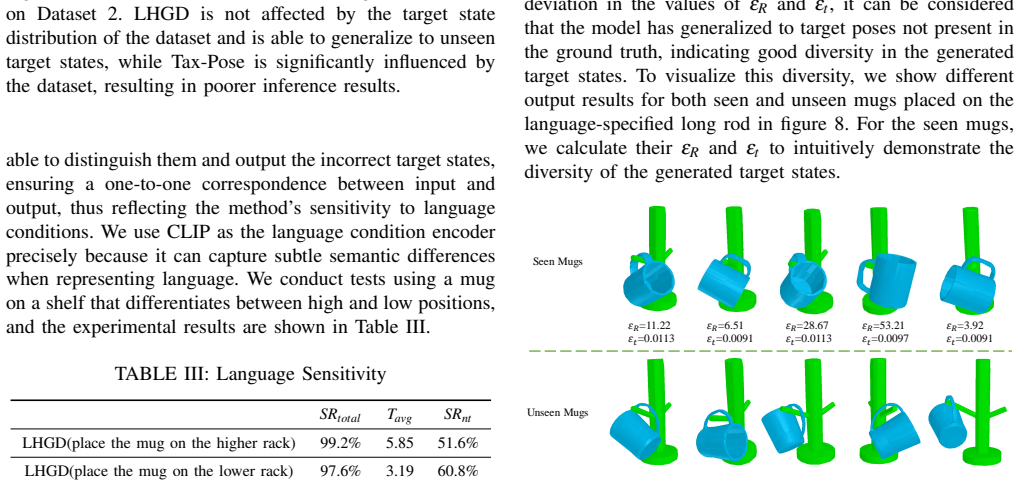
- Reported success rates exceed 90% in single-mode and multi-mode settings, and 97.6–99.2% in language-specified higher/lower rack tasks, including on five unseen mug models.
Reading between the lines
- The paper does not ablate rotation-error sensitivity in the post-processor; injecting controlled rotation noise and measuring success-rate decay would map where the translation-only assumption starts to fail.
- The ten fixed language phrases suggest a discrete control space; CLIP embeddings could in principle support continuous attribute control (e.g., “taller hook” or “red rack”), so the architecture may extend beyond the evaluated phrase set.
- Because the GDC coefficient uses mesh models, applying the method to real-world partial point clouds would require a learned overlap-volume surrogate; the paper acknowledges this mesh dependency as a limitation.
- The same pose-decoupled diffusion plus gravity-drop refinement could transfer to other contact-rich placement tasks, such as hanging tools, stacking cups, or inserting plugs, where language can specify the target location.
Editorial analysis
A structured set of objections, weighed in public.
Referee Report
Summary. The paper proposes LHGD, a language-conditioned hybrid Gaussian diffusion network for generating target poses in a mug-hanging manipulation task, and pairs it with a post-processing module based on a gravitational descent coverage (GDC) coefficient that fine-tunes predicted poses to remove point-cloud overlap. The pose diffusion is decoupled into a normal-distribution diffusion for translation and an isotropic-Gaussian (IGSO(3)) diffusion for rotation. Experiments are conducted in the Robosuite simulator on a custom dataset of 10 mug types, 5 racks, and 10 hooks, with 5 unseen mugs for generalization. The paper reports high success rates on single-mode, multi-mode, and language-specified tasks, and claims that the post-processor directly produces collision-free target states, eliminating the need for obstacle avoidance.
Significance. If the claims hold, the paper makes a useful step toward controllable target-state generation for contact-rich manipulation: it introduces a principled decoupling of rotation and translation in pose diffusion, uses language to select among multiple feasible placement modes, and proposes an explicit geometric post-processor for collision removal. The GDC coefficient is a concrete, falsifiable selection rule, and the custom dataset with unseen-mug validation is a strength. However, the significance is conditional: the evaluation is narrow (one baseline, simulation only, no error bars), the success criterion is changed to exactly what the post-processor optimizes, and the central collision-free claim rests on an untested assumption about rotation errors. The paper's own conclusion also concedes model dependency and limited language generalization, which should temper the abstract's unqualified claims.
major comments (4)
- [Section V.C, Eq. (15)] The post-processor fine-tunes only the translational component and keeps the predicted rotation fixed, based on the assertion that 'experimental testing reveals that collisions in the model are primarily caused by the translational vector of the mug, while the rotational matrix has negligible impact.' No experiment, table, or ablation is provided to support this claim. Table II reports rotation errors of 22-23 degrees, which are not obviously negligible for a task whose success criterion requires the hook to pass through the mug handle. If rotation error contributes to handle-hook misalignment or residual overlap for a non-negligible fraction of predictions, the post-processor cannot repair those poses because it never searches over SO(3). The high success rates therefore depend on an unmeasured premise. Please quantify the fraction of pre-correction failures attributable to rotation error versus translation error, or run an ablation in which rotation is also fine-tuned, and report how the collision-free and success rates change.
- [Section VI, success criterion and GDC coefficient] The success metric is defined as 'the hook must pass through the mug handle, and there must be no overlap between the mug and the rack.' This no-overlap condition is exactly the objective that the DDPM-based post-processor optimizes, so measuring success after post-processing is partially self-referential. The reported SRnt vs SRtotal values in Table II (e.g., 29.2% vs 94.0% for dataset1, 33.6% vs 92.8% for dataset2) show that most of the apparent success comes from the post-processor. Because the post-processor could in principle reduce overlap by moving the mug away from the rack, the GDC coefficient is used to prefer states that still engage the hook, but no independent validation (e.g., a physics-based hanging test or a downstream motion-planning success rate) confirms that a zero-overlap pose is actually a successful hang. Please report a metric that separates 'overlap removed' from 'task completed', or evaluate under the previous thresholds (<1 cm, <3 cm, infinity) used by RELDIST in addition to the zero-overlap criterion.
- [Section VI, Tables I-III] The experimental evidence for the headline claim 'achieves the highest success rates' is thin. Only one baseline, Tax-Pose, is used; no comparison is made to RPDiff, StructDiffusion, or TAX-PoseD, which are discussed in the related work. There are no error bars, confidence intervals, or multiple-seed results, and all experiments are in simulation with no real-robot validation. The paper also changes the success criterion relative to prior work, making direct numerical comparison with published numbers difficult. Please add at least one additional relevant baseline, report variance across seeds or trials, and clearly state which comparisons are apples-to-apples and which involve the post-processor.
- [Table II, single-mode distribution] The single-mode comparison is presented in a way that makes the source of the claimed improvement unclear. Tax-Pose is reported with SRnt and no SRtotal, while LHGD is reported with both SRnt and SRtotal; the text then says 'our accuracy is significantly improved' through target state correction. It is fair to compare SRnt values for raw generation, but the abstract's 'highest success rates' appears to rely on the post-processed SRtotal. In addition, it is surprising that Tax-Pose's raw success rate is 2.8% on dataset1 (uniform orientation) but 31.2% on dataset2 (multiple orientations); the experimental setup and the role of the post-processor in the comparison should be clarified, and the comparison should be made on the same footing for both methods.
minor comments (6)
- [Section V.C heading] The heading 'C. Pose Decoupling Diffusion Module' is repeated: the first V.C describes the decoupled diffusion, and the second V.C describes the GDC post-processor. The second section should have a distinct title, e.g., 'Target State Correction via Gravitational Descent Coverage'.
- [Section III, Eq. (3)] The text preceding Eq. (3) says 'we denote them by and , respectively' with the symbols missing, and the notation p(Tt), p(Tg), and epsilon_KL is not fully defined. Please complete the sentence and define all symbols.
- [Section V.C and Section VI] Section V.C states that the DDPM scheduler timestep is 'set ... to 0', while the ablation in Section VI (Figure 9) concludes that t=1 is optimal and reports results for t=1,3,6,10. This inconsistency should be resolved, and the relation between beta_start=0.00003 and the timestep sweep should be explained.
- [Table III, language sensitivity] Table III lists the condition 'place the mug on the red rack' three times with the same 0% result; presumably three different distractor conditions are intended. Please correct the table and the corresponding text.
- [Figures 5 and 9] Figure 5's caption contains the typo 'LNGD' for 'LHGD', and Figure 9's caption contains apparent unicode/encoding artifacts that should be cleaned. The captions should also define the axes and the meaning of the plotted quantities.
- [Eq. (15) and surrounding text] In Eq. (15), z_opt, z_i, z_max, and the descent range are not defined in the text; the notation 'Vol(R)' and the statement 'mug model at a descending distance' are incomplete. Please define all terms.
Circularity Check
No circularity: LHGD's pose prediction is trained against ground-truth poses, and the overlap-removal post-processor is an explicit system component whose effect is measured both before (SRnt) and after (SRtotal) correction.
full rationale
I walked the derivation chain. The network's target-pose prediction is trained with a Smooth L1 loss on the diffusion noise and compared to ground-truth target poses; no fitted constant is renamed as a prediction. The hybrid Gaussian diffusion on SO(3) is standard and cited to external work [18]. The post-processing module minimizes a defined overlap measure (GDC), and the success criterion includes an independent requirement (hook must pass through the mug handle) that is not optimized directly. The paper also reports SRnt, the success rate before fine-tuning, which is an independent measure of the generative model. The claim 'directly producing collision-free target states' is better read as the output of the proposed post-processor rather than a learned prediction; since the post-processor is part of the proposed system, this is not circular. The unsupported assertion in Section V.C that collisions are 'primarily caused by the translational vector of the mug, while the rotational matrix has negligible impact' is an empirical premise and a potential correctness risk, but it is not a circularity. The tuning of the correction timestep on an unseen mug is a mild evaluation-leakage concern, not a definitional reduction. No load-bearing self-citations or imported uniqueness theorems appear; references such as [16], [18], and [19] are external prior work.
Assumptions & free parameters
free parameters (4)
- DDPM correction scheduler initial noise coefficient beta_start =
0.00003
- DDPM correction timestep t =
1
- Maximum fine-tuning iterations =
100
- z_max descent range for GDC coefficient
assumptions (7)
- standard math Standard DDPM forward and reverse process equations apply to target poses (Eqs. 5, 8-11).
- standard math The IGSO(3) isotropic Gaussian on SO(3) with density in Eq. 4 correctly models rotation diffusion.
- domain assumption Translation and rotation can be diffused independently and recombined without loss of accuracy.
- domain assumption Collision error is almost entirely in translation; rotation error has negligible impact.
- domain assumption CLIP text embeddings distinguish the 10 hook labels well enough to control spatial target states.
- domain assumption Robosuite physics simulation faithfully represents real mug-rack contact for data collection and GDC evaluation.
- ad hoc to paper The GDC coefficient, defined as the maximum overlap ratio after a simulated gravity drop, is a valid score for selecting a successful hanging pose.
Cite this review
Pith. "Pith review of Goal State Generation for Robotic Manipulation Based on Linguistically Guided Hybrid Gaussian Diffusion." pith.science (2026). https://pith.science/paper/CUR5JQJL
@misc{pith2026241218877,
  author       = {Pith},
  title        = {Pith review of: Goal State Generation for Robotic Manipulation Based on Linguistically Guided Hybrid Gaussian Diffusion},
  year         = {2026},
  howpublished = {\url{https://pith.science/paper/CUR5JQJL}},
  note         = {Machine review of arXiv:2412.18877}
}
read the original abstract
In robotic manipulation tasks, achieving a designated target state for the manipulated object is often essential to facilitate motion planning for robotic arms. Specifically, in tasks such as hanging a mug, the mug must be positioned within a feasible region around the hook. Previous approaches have enabled the generation of multiple feasible target states for mugs; however, these target states are typically generated randomly, lacking control over the specific generation locations. This limitation makes such methods less effective in scenarios where constraints exist, such as hooks already occupied by other mugs or when specific operational objectives must be met. Moreover, due to the frequent physical interactions between the mug and the rack in real-world hanging scenarios, imprecisely generated target states from end-to-end models often result in overlapping point clouds. This overlap adversely impacts subsequent motion planning for the robotic arm. To address these challenges, we propose a Linguistically Guided Hybrid Gaussian Diffusion (LHGD) network for generating manipulation target states, combined with a gravity coverage coefficient-based method for target state refinement. To evaluate our approach under a language-specified distribution setting, we collected multiple feasible target states for 10 types of mugs across 5 different racks with 10 distinct hooks. Additionally, we prepared five unseen mug designs for validation purposes. Experimental results demonstrate that our method achieves the highest success rates across single-mode, multi-mode, and language-specified distribution manipulation tasks. Furthermore, it significantly reduces point cloud overlap, directly producing collision-free target states and eliminating the need for additional obstacle avoidance operations by the robotic arm.
Figures


Figures from the paper (5 more)



Reference graph
Works this paper leans on
-
[1]
Teach a robot to fish: Versa- tile imitation from one minute of demonstrations[J]
Haldar S, Pari J, Rai A, et al. Teach a robot to fish: Versa- tile imitation from one minute of demonstrations[J]. arXiv preprint arXiv:2303.01497, 2023
arXiv 2023
-
[2]
Learning fine-grained bimanual manipulation with low-cost hardware[J]
Zhao T Z, Kumar V , Levine S, et al. Learning fine-grained bimanual manipulation with low-cost hardware[J]. arXiv preprint arXiv:2304.13705, 2023
arXiv 2023
-
[3]
Furniturebench: Reproducible real-world benchmark for long-horizon complex manipulation[J]
Heo M, Lee Y , Lee D, et al. Furniturebench: Reproducible real-world benchmark for long-horizon complex manipulation[J]. arXiv preprint arXiv:2305.12821, 2023
arXiv 2023
-
[4]
Haldar S, Mathur V , Yarats D, et al. Watch and match: Supercharging imitation with regularized optimal transport[C]//Conference on Robot Learning. PMLR, 2023: 32-43
work page 2023
-
[5]
Videodex: Learning dexterity from internet videos[C]//Conference on Robot Learning
Shaw K, Bahl S, Pathak D. Videodex: Learning dexterity from internet videos[C]//Conference on Robot Learning. PMLR, 2023: 654-665
work page 2023
-
[6]
Denoising diffusion probabilistic models[J]
Ho J, Jain A, Abbeel P. Denoising diffusion probabilistic models[J]. Advances in neural information processing systems, 2020, 33: 6840- 6851
work page 2020
-
[7]
Learning structured output representation using deep conditional generative models[J]
Sohn K, Lee H, Yan X. Learning structured output representation using deep conditional generative models[J]. Advances in neural information processing systems, 2015, 28
work page 2015
-
[8]
Florence P R, Manuelli L, Tedrake R. Dense Object Nets: Learning Dense Visual Object Descriptors By and For Robotic Manipula- tion[C]//Conference on Robot Learning. PMLR, 2018: 373-385
work page 2018
Show all 23 references
-
[9]
Neural descriptor fields: Se (3)-equivariant object representations for manipulation[C]//2022 International Conference on Robotics and Automation (ICRA)
Simeonov A, Du Y , Tagliasacchi A, et al. Neural descriptor fields: Se (3)-equivariant object representations for manipulation[C]//2022 International Conference on Robotics and Automation (ICRA). IEEE, 2022: 6394-6400
2022
-
[10]
Tax-pose: Task-specific cross-pose estimation for robot manipulation[C]//Conference on Robot Learning
Pan C, Okorn B, Zhang H, et al. Tax-pose: Task-specific cross-pose estimation for robot manipulation[C]//Conference on Robot Learning. PMLR, 2023: 1783-1792
2023
-
[11]
Deep SE (3)-Equivariant Ge- ometric Reasoning for Precise Placement Tasks[J]
Eisner B, Yang Y , Davchev T, et al. Deep SE (3)-Equivariant Ge- ometric Reasoning for Precise Placement Tasks[J]. arXiv preprint arXiv:2404.13478, 2024
2024 arXiv
-
[12]
Learning Distributional Demonstration Spaces for Task-Specific Cross-Pose Estimation[J]
Wang J, Donca O, Held D. Learning Distributional Demonstration Spaces for Task-Specific Cross-Pose Estimation[J]. arXiv preprint arXiv:2405.04609, 2024
2024 arXiv
-
[13]
Genaug: Retargeting behaviors to unseen situations via generative augmentation[J]
Chen Z, Kiami S, Gupta A, et al. Genaug: Retargeting behaviors to unseen situations via generative augmentation[J]. arXiv preprint arXiv:2302.06671, 2023
2023 arXiv
-
[14]
Diffusion policy: Visuomotor policy learning via action diffusion[J]
Chi C, Xu Z, Feng S, et al. Diffusion policy: Visuomotor policy learning via action diffusion[J]. The International Journal of Robotics Research, 2023: 02783649241273668
2023
-
[15]
Scaling robot learning with semantically imagined experience[J]
Yu T, Xiao T, Stone A, et al. Scaling robot learning with semantically imagined experience[J]. arXiv preprint arXiv:2302.11550, 2023
2023 arXiv
-
[16]
Shelving, Stacking, Hanging: Relational Pose Diffusion for Multi-modal Rearrange- ment[C]//Conference on Robot Learning
Simeonov A, Goyal A, Manuelli L, et al. Shelving, Stacking, Hanging: Relational Pose Diffusion for Multi-modal Rearrange- ment[C]//Conference on Robot Learning. PMLR, 2023: 2030-2069
2023
-
[17]
StructDiffusion: Language-guided creation of physically-valid structures using unseen objects[J]
Liu W, Du Y , Hermans T, et al. StructDiffusion: Language-guided creation of physically-valid structures using unseen objects[J]. arXiv preprint arXiv:2211.04604, 2022
2022 arXiv
-
[18]
Denoising Diffusion Probabilistic Models on SO (3) for Rotational Alignment[C]//ICLR 2022 Workshop on Geometrical and Topological Representation Learning
Leach A, Schmon S M, Degiacomi M T, et al. Denoising Diffusion Probabilistic Models on SO (3) for Rotational Alignment[C]//ICLR 2022 Workshop on Geometrical and Topological Representation Learning
2022
-
[19]
Language-driven 6-dof grasp detection using negative prompt guidance[J]
Nguyen T, Vu M N, Huang B, et al. Language-driven 6-dof grasp detection using negative prompt guidance[J]. arXiv preprint arXiv:2407.13842, 2024
2024 arXiv
-
[20]
PointNet: Deep Learning on Point Sets for 3D Classifica- tion and Segmentation
Qi, C. et al. “PointNet: Deep Learning on Point Sets for 3D Classifica- tion and Segmentation.” 2017 IEEE Conference on Computer Vision and Pattern Recognition (CVPR) (2016): 77-85
2016
-
[21]
Learning transferable visual models from natural language supervision[C]//International conference on machine learning
Radford A, Kim J W, Hallacy C, et al. Learning transferable visual models from natural language supervision[C]//International conference on machine learning. PMLR, 2021: 8748-8763
2021
-
[22]
robosuite: A modular simula- tion framework and benchmark for robot learning[J]
Zhu Y , Wong J, Mandlekar A, et al. robosuite: A modular simula- tion framework and benchmark for robot learning[J]. arXiv preprint arXiv:2009.12293, 2020
2009 arXiv
-
[23]
ShapeNet: An Information-Rich 3D Model Repository
Chang, Angel X. et al. “ShapeNet: An Information-Rich 3D Model Repository.” ArXiv abs/1512.03012 (2015): n. pag
2015 arXiv
Reviewed August 11, 2026 · model on record in the stance chip above.
Discussion (0). Continue with ORCID to comment.