REVIEW 5 major objections 5 minor 24 references
MIND-CAVs: Multi-Intelligence Negotiation and Decision System for CAVs based on Intent-Driven Autonomy
T0 review · 5 major / 5 minor · reviewed 2026-08-02 · deepseek-v4-flash
Pith's one-line read Intent-driven edge arbitration beats isolated, FCFS, and MARL driving in highway tests.
desk verdict The architecture and audit-trail idea are worth taking seriously, but the performance comparison only clearly holds in S1; the paper needs significance tests, measured latency, and artifacts before I'd trust the headline. read the letter →
The pith
A machine-rendered reading of the paper's core claim, the machinery that carries it, and where it could break.
The reading
What carries the argument
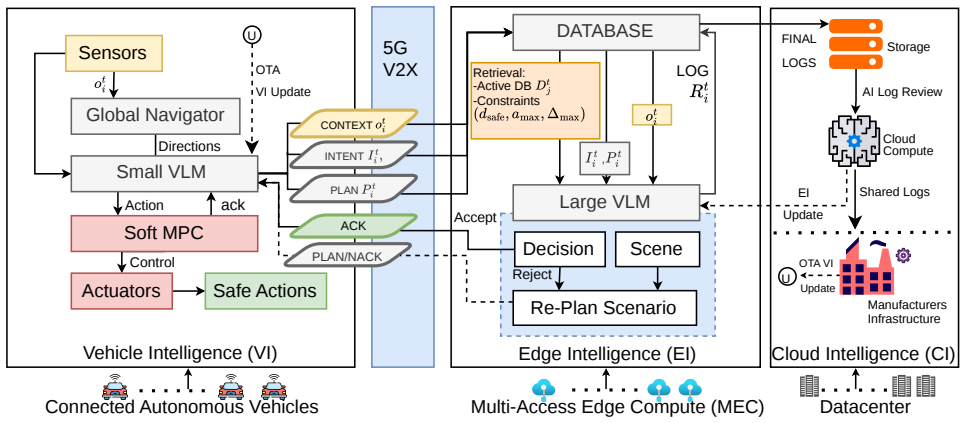
The load-bearing mechanism is the intent abstraction (goal, maneuver class, execution horizon, safety constraints) coupled with a constrained VLM arbitration loop: the MEC node merges incoming intents with active plans, applies lexicographic priority rules, generates at most one revised plan, and a deterministic spatiotemporal validator overrides any unsafe decision to NACK. This turns coordination into a gated, audit-trailed decision problem, with bounded latency achieved by single-pass reasoning and no multi-round negotiation.
What would settle it
Run S1–S3 at 100 km/h with no speed cap and compare completion time, gap violations, and braking against the three baselines; also instrument the full in-simulation negotiation loop end-to-end to check whether latency stays below the claimed ~700 ms bound.
Extended reading notes
Core claim
MIND-CAVs proposes that connected autonomous vehicles should exchange structured maneuver intents—goal, maneuver class, execution horizon, safety constraints—rather than only kinematic state, with roadside MEC servers arbitrating conflicting intents via a vision-language model under deterministic safety validation, returning ACK/PLAN/NACK, and logging every decision for audit. In CARLA highway scenarios this reduces maneuver completion time by 24–29% over the three baselines while cutting gap violations and unnecessary braking. The paper's central claim is that externalizing negotiation as an auditable, safety-gated protocol improves both efficiency and stability without sacrificing safety.
Load-bearing premise
The comparison is made under a fixed 50 km/h speed cap imposed to avoid external API rate limits, which the paper concedes does not reflect realistic highway speeds; if the efficiency gains vanish when the cap is removed, the central advantage is conditional, not general.
Editorial extensions
If this is right
- Intent-aware arbitration can reduce maneuver completion time by about 24–29% relative to isolated autonomy, FCFS, and MARL in multi-lane highway scenarios (S1).
- Gap violations and unnecessary braking approach zero in simple lane-change scenarios, indicating fewer unsafe proximity events and less oscillatory driving.
- Every arbitration outcome is recorded as a structured audit record, enabling deterministic replay and regulatory inspection—an architectural primitive, not a post-hoc tool.
- With at most one plan revision and a fixed priority rule, the negotiation loop can finish below 700 ms (about 20 m of travel at 100 km/h), making sub-second coordination plausible.
- Because the deterministic safety validator overrides unsafe suggestions, intent generators need not be perfect; the safety gate is the final authority.
Reading between the lines
- The audit-log pipeline could double as a dataset generator: large-scale logs of intents, revisions, and outcomes might be used to distill the VLM arbiter into a smaller onboard policy, sidestepping the API rate limits that forced the 50 km/h cap.
- The same Vehicle-MEC-Cloud split could apply to unsignalized intersections and ramp merging, but the paper's two-vehicle highway scenarios do not yet demonstrate that extension.
- If the speed cap is lifted and the arbitration advantage shrinks, the efficiency result may owe more to the cap than to intent reasoning; that is a testable boundary of the claim.
- The architecture externalizes negotiation so authorities can inspect why a maneuver was approved; that could change how regulators audit autonomous fleets, but the paper does not address liability or certification.
Editorial analysis
A structured set of objections, weighed in public.
Referee Report
Summary. The paper proposes MIND-CAVs, a hierarchical Vehicle-MEC-Cloud architecture in which vehicles generate structured intent–plan pairs, roadside MEC nodes arbitrate conflicting intents through a constrained VLM with deterministic safety validation, and cloud storage maintains audit records for transparency. The system is implemented in a CARLA-based AI-in-the-loop platform and compared against Isolated Autonomy, FCFS arbitration, and MARL in three two-vehicle highway scenarios. The central claims are improved maneuver completion time, reduced gap violations, reduced unnecessary braking, and sub-second bounded-latency negotiation.
Significance. If the claims held, the architecture would be a useful contribution to connected-vehicle coordination by making intent exchange, edge arbitration, and auditable decision records first-class design elements. The accountability-by-design logging and the AI-in-the-loop simulation platform are valuable engineering contributions. However, the empirical evidence as presented is not yet sufficient for the headline claims: statistical support is weak in two of three scenarios, the safety metric overlaps with a constraint the system enforces by construction, the latency claim is extrapolated rather than measured, and the baseline configuration for MARL is underspecified.
major comments (5)
- [§VII and Table I] The claim that MIND-CAVs achieves the lowest completion time across S1–S3 is not supported by significance testing. In S3, MIND-CAVs (39.56±2.49 s, CI [37.78,41.34]) and IA (40.73±4.71 s, CI [37.36,44.10]) have heavily overlapping 95% CIs; a direct comparison suggests the difference is not significant (t≈0.7). In S2 the difference vs IA is more promising (5.2 s, approximate t≈2.3) but still not formally tested. The abstract and conclusions state 'improved maneuver completion time' without restricting this to S1. Report per-scenario significance tests or effect sizes with bootstrap intervals, and adjust the claims to match the evidence.
- [§V-B.2 and §VI-D] The gap-violation metric uses the same threshold d_safe=5 m that the MIND-CAVs deterministic validator enforces as a hard constraint on approved plans. Thus near-zero gap violations for MIND-CAVs are largely a design consequence, not an empirical discovery. This makes the 'reduced unsafe proximity' claim partially circular as a comparative result. Please evaluate safety with at least one metric not directly gated by the system (e.g., time-to-collision, maximum deceleration, or distance below a stricter threshold), or compare against baselines augmented with the same safety filter, or explicitly reframe the result as an architectural guarantee.
- [§V-C and Abstract] The 'sub-second negotiation' and 'bounded-latency' claims are estimates, not measured results. The end-to-end latency of 335–690 ms is obtained by summing on-device inference throughput (Jetson ~270 ms), assumed 5G transmission times (<10 ms each way), and A100 inference throughput (45–400 ms). The paper does not report any end-to-end measurement from the implemented simulation loop, nor does it report latency distribution or worst case. Since this is an advertised contribution, either measure the actual loop latency in the platform or explicitly label the numbers as an analytical model and remove the unqualified 'sub-second negotiation' wording.
- [§VIII Limitations and §V-C] The fixed 50 km/h upper speed bound is a limitation that affects external validity, and the paper's extrapolation to 'highway speeds (100 km/h)' in §V-C is not justified. Although all scenarios initialize at 40 km/h, the results are only for low-speed driving and the speed cap was introduced for API rate-limit reasons unrelated to the method. The abstract and conclusions imply highway-relevant conclusions; please either remove the 100 km/h extrapolation or run at least one scenario without the cap at realistic highway speeds.
- [§VI-B, MARL baseline] The MARL baseline is described only as 'a multi-agent policy observes shared vehicle states and outputs maneuver decisions optimized to minimize delay and safety violations.' No algorithm, network architecture, training procedure, hyperparameters, or reward function is provided. Since the paper's central comparison is empirical, an underspecified baseline makes the results non-reproducible and risks an unrepresentative comparison. Provide full implementation details or cite a specific public implementation and configuration.
minor comments (5)
- [Abstract and Table I] The abstract states reduced unsafe proximity and unnecessary braking 'compared with ... FCFS'. In Table I, S2 shows MIND-CAVs unnecessary braking 0.40±0.70 vs FCFS 0.30±0.48, so this comparison is not uniformly improved. Please qualify or correct the claim.
- [Section III] The 'Optimization Objective 1' formalization is not numbered as an equation, and the footnote '2' appears in the text '∆max 2' rather than after 'bounded arbitration delay.' Clarify the notation and numbering.
- [Section V-C] The stated A100 inference throughput of 'approximately 22 tokens/s' seems unusually slow for the given hardware and model; if this is correct, specify the model size and quantization, and if it is a typo, correct it.
- [Figures 3–5] The right-hand panels use 'T otal' with a space; also the figures would benefit from error bars or box-plot overlays to show the per-run variability referenced in the text.
- [Throughout] The title and some headings contain 'MIND-CA Vs' with an unwanted space before 'Vs'. Standardize the name as 'MIND-CAVs'.
Circularity Check
Gap-violation metric is the system's own safety constraint, making the safety comparison partially tautological; completion-time and braking results remain independent.
-
self definitional
[Sec. IV-A; Sec. V-B2; Sec. VI-D]
"we apply a soft MPC-based safety filter that enforces control-barrier-style constraints (e.g., minimum gap and bounded acceleration), preventing execution of unsafe maneuvers even when upstream intent proposals are imperfect. ... A conflict exists if there is t′ such that ℓi(t′)=ℓk(t′) and |si(t′)−sk(t′)|<dsafe ... If the validator fails, the decision is overridden to NACK. ... Gap Violation occurs when the Euclidean distance between any pair of vehicles at a telemetry frame is below the safety threshold dsafe=5m."
The headline metric 'gap violation' is the same predicate as the arbitration validator's conflict condition and the MPC safety filter's minimum-gap constraint. MIND-CAVs rejects or revises any plan that violates dsafe and then prevents unsafe execution, so the reported zero (S1) or near-zero (S2/S3) gap counts are guaranteed by construction. Presenting these as evidence of 'reduced unsafe proximity' relative to baselines without such a hard gate is circular: the safety outcome is a restatement of the system's own constraint, not an emergent property measured independently.
full rationale
The paper is an empirical simulation comparison, not a derivation, so the classic circularity burden is low. No load-bearing self-citations, uniqueness theorems, or ansatz-imported results appear; parameters such as α, β, γ and dsafe are stated a priori and are not fitted to predict the reported outcomes. The only concrete reduction I can exhibit is the safety metric: the deterministic spatial–temporal validator rejects any plan whose inter-vehicle distance falls below dsafe, and the MPC safety filter enforces minimum gap, while Section VI-D defines a gap violation as exactly that same threshold. Consequently, MIND-CAVs's near-zero gap violations are by construction; this inflates the 'reduced unsafe proximity' claim, though it does not affect the completion-time or unnecessary-braking comparisons, which are not forced by the arbitration rules. The S2/S3 completion-time confidence intervals overlap, but that is a statistical robustness concern, not circularity. Overall score 4 reflects one partially tautological metric while the central coordination and efficiency claims retain independent content.
Assumptions & free parameters
free parameters (5)
- Safety threshold d_safe =
5 m
- Unnecessary-brake deceleration threshold δ_b =
5 km/h
- Conflict distance d_conf =
50 m
- Fixed 50 km/h upper speed bound =
50 km/h
- Utility weights α, β, γ =
unspecified
assumptions (4)
- domain assumption VLM outputs are semantically consistent enough to generate valid intents, plans, and arbitration rationales from structured prompts.
- domain assumption Deterministic spatial-temporal validation with point-mass occupancy (lane index + longitudinal position) is sufficient to guarantee conflict-free execution.
- domain assumption The arbitration model used for latency estimation (22 tokens/s on A100-class hardware, 270 ms per ~20-token intent on Jetson AGX-class) transfers to the actual simulation environment.
- domain assumption No background traffic and identical two-vehicle initial configurations isolate the coordination behavior as claimed.
invented entities (2)
-
MIND-CAVs audit record R_t^i
-
Intent abstraction I_t^i with plan P_t^i and occupancy map Ω_i
Cite this review
Pith. "Pith review of MIND-CAVs: Multi-Intelligence Negotiation and Decision System for CAVs based on Intent-Driven Autonomy." pith.science (2026). https://pith.science/paper/CUSBS4PX
@misc{pith2026260714688,
  author       = {Pith},
  title        = {Pith review of: MIND-CAVs: Multi-Intelligence Negotiation and Decision System for CAVs based on Intent-Driven Autonomy},
  year         = {2026},
  howpublished = {\url{https://pith.science/paper/CUSBS4PX}},
  note         = {Machine review of arXiv:2607.14688}
}
read the original abstract
Modern autonomous vehicles largely operate as isolated agents: they rely on on-board perception and decision modules and broadcast Basic Safety Messages (BSMs) that expose only low-level kinematic state. While existing cooperative driving frameworks enable limited sensor sharing, they rarely communicate high-level maneuver intentions, and edge computing is primarily used for content delivery rather than decision arbitration. As a result, current connected autonomy lacks a principled mechanism for making globally consistent, intent-aware coordination decisions across vehicles. To address this gap, we propose MIND-CAVs, a Multi-Intelligence Negotiation and Decision framework for connected autonomous vehicles (CAVs) based on intent-driven autonomy. Each vehicle abstracts raw sensor observations into structured intent representations, exchanges them over V2X links, and receives globally consistent coordination plans from roadside edge servers. Edge agents combine learned and rule-based arbitration mechanisms to negotiate conflicting intents among vehicles, while a cloud platform records decisions for auditing and continual retraining. We implement MIND-CAVs in a CARLA-based AI-in-the-loop platform and evaluate it in multi-lane highway scenarios involving conflicting maneuvers and route-constrained exits. Experimental results show improved maneuver completion time and reduced unsafe proximity and unnecessary braking compared with isolated autonomy, first-come-first-served arbitration, and multi-agent reinforcement learning baselines.
Figures


Figures from the paper (1 more)

Reference graph
Works this paper leans on
-
[1]
V2x mis- behavior in maneuver sharing and coordination service: Considerations for standardization,
J.-P. Monteuuis, J. Petit, M. R. Ansari, C. Chen, and S. Yang, “V2x mis- behavior in maneuver sharing and coordination service: Considerations for standardization,”arXiv preprint arXiv:2211.02579, 2022
arXiv 2022
-
[2]
V2x cooperative perception for autonomous driving: Recent advances and challenges,
T. Huang, J. Liu, X. Zhou, D. C. Nguyen, M. R. Azghadi, Y . Xia, Q.-L. Han, and S. Sun, “V2x cooperative perception for autonomous driving: Recent advances and challenges,”arXiv preprint arXiv:2310.03525, 2023
arXiv 2023
-
[3]
Vehicle-to-everything decision optimiza- tion and cloud control based on deep reinforcement learning,
Z. Gao, D. Liu, and C. Zheng, “Vehicle-to-everything decision optimiza- tion and cloud control based on deep reinforcement learning,”Scientific Reports, vol. 15, p. 29160, 2025
2025
-
[4]
Collaborative autonomous driving—a survey of solution approaches and future challenges,
S. Malik, M. A. Khan, and H. El-Sayed, “Collaborative autonomous driving—a survey of solution approaches and future challenges,”Sen- sors, vol. 21, no. 11, p. 3783, 2021
2021
-
[5]
Edge computing for vehicle to everything: A short review,
M. F. A. Abdullah, S. Yogarayan, S. F. A. Razak, A. Azman, A. H. M. Amin, and M. Salleh, “Edge computing for vehicle to everything: A short review,”F1000Research, vol. 10, p. 1104, 2023
2023
-
[6]
Toward fully connected vehicles: Edge computing for advanced automotive communications,
D. Sabella, H. Moustafa, P. Kuure, S. Kekki, Z. Zhou, A. Li, C. Thein, E. Fischer, I. Vukovic, J. Cardillo, V . Young, S. J. Tan, V . Park, M. Vanderveen, S. Runeson, and S. Sorrentino, “Toward fully connected vehicles: Edge computing for advanced automotive communications,” 5G Automotive Association (5GAA), Tech. Rep., 2017
2017
-
[7]
SAE J2735: V2x communications message set dictionary,
“SAE J2735: V2x communications message set dictionary,” SAE Inter- national Standard, 2020, accessed 2026-02-27
2020
-
[8]
ETSI EN 302 637-2: Intelligent transport systems (its); vehicular communications; basic set of applications; part 2: Specification of cooperative awareness basic service,
“ETSI EN 302 637-2: Intelligent transport systems (its); vehicular communications; basic set of applications; part 2: Specification of cooperative awareness basic service,” ETSI, Tech. Rep., 2019
2019
Show all 24 references
-
[9]
Multiagent traffic management: A reservation- based intersection control mechanism,
K. Dresner and P. Stone, “Multiagent traffic management: A reservation- based intersection control mechanism,” inProceedings of the Third International Joint Conference on Autonomous Agents and Multiagent Systems (AAMAS), 2004, pp. 530–537
2004
-
[10]
A survey on decentralized cooperative maneu- ver coordination,
D. Maksimovskiet al., “A survey on decentralized cooperative maneu- ver coordination,” inProceedings of (Scitepress) vehicle networking / cooperative driving venue, 2021
2021
-
[11]
Infrastructure support for cooperative maneuvers in connected and automated vehicles,
A. Correaet al., “Infrastructure support for cooperative maneuvers in connected and automated vehicles,” Tech. Rep., 2019
2019
-
[12]
ETSI TR 103 578 v2.1.1: Manoeuvre coordination service (mcs); overview and use cases,
“ETSI TR 103 578 v2.1.1: Manoeuvre coordination service (mcs); overview and use cases,” ETSI, Tech. Rep., 2024
2024
-
[13]
An extended maneuver coordination protocol with support for additional negotiation features,
M. B. Mertens, “An extended maneuver coordination protocol with support for additional negotiation features,” Ph.D. dissertation, 2021
2021
-
[14]
On the cooperative automatic lane change: Speed synchronization and v2x negotiation,
A. Lombardet al., “On the cooperative automatic lane change: Speed synchronization and v2x negotiation,” inDesign, Automation & Test in Europe (DATE), 2017
2017
-
[15]
Enabling a cooperative driver messenger system for lane change assistance,
G. Shahet al., “Enabling a cooperative driver messenger system for lane change assistance,” 2022
2022
-
[16]
Multi-agent reinforcement learning for cooperative lane changing of connected and autonomous vehicles in mixed traffic,
W. Zhouet al., “Multi-agent reinforcement learning for cooperative lane changing of connected and autonomous vehicles in mixed traffic,” Springer Nature, 2022
2022
-
[17]
V2x in 3gpp standardization: Nr sidelink in rel-16 and beyond,
M. Harounabadiet al., “V2x in 3gpp standardization: Nr sidelink in rel-16 and beyond,” arXiv:2104.11135, 2021
2021 arXiv
-
[18]
ETSI TR 137 985 v16.2.0: Lte; 5g; study on enhancement of 3gpp support for v2x services,
“ETSI TR 137 985 v16.2.0: Lte; 5g; study on enhancement of 3gpp support for v2x services,” ETSI, Tech. Rep., 2023
2023
-
[19]
3gpp nr v2x mode 2: Overview, models and system-level evaluation,
Z. Aliet al., “3gpp nr v2x mode 2: Overview, models and system-level evaluation,”Sensors, 2021
2021
-
[20]
Cooperative sensing, communication and computation with isac and mec for v2x systems,
Z. Liet al., “Cooperative sensing, communication and computation with isac and mec for v2x systems,”ScienceDirect, 2024
2024
-
[21]
Explainable ai for safe and trustworthy autonomous driving,
A. as listed in the survey, “Explainable ai for safe and trustworthy autonomous driving,” arXiv:2402.10086, 2024
2024 arXiv
-
[22]
Providing intelligible explanations in autonomous driving,
D. Omeizaet al., “Providing intelligible explanations in autonomous driving,” inIEEE Intelligent Vehicles Symposium (IV), 2021
2021
-
[23]
End-to-end v2x latency modeling and analysis in 5g networks,
B. Coll-Peraleset al., “End-to-end v2x latency modeling and analysis in 5g networks,”IEEE Transactions on Vehicular Technology, vol. 72, no. 4, pp. 5094–5109, 2023
2023
-
[24]
Multi-agent deep reinforcement learning for coop- erative and competitive autonomous vehicles,
T. Samaket al., “Multi-agent deep reinforcement learning for coop- erative and competitive autonomous vehicles,”IEEE Transactions on Intelligent Transportation Systems, 2023
2023
Reviewed August 2, 2026 · model on record in the stance chip above.
Discussion (0). Sign in to comment.