REVIEW 4 major objections 6 minor 27 references
A Framework for Analyzing Abnormal Emergence in Service Ecosystems Through LLM-based Agent Intention Mining
T0 review · 4 major / 6 minor · reviewed 2026-08-06 · deepseek-v4-flash
Pith's one-line read Mining the hidden intentions of LLM agents turns emergent collective outcomes into traceable causal timelines.
desk verdict A clever pipeline for mining agent intentions, but the causal-explanations claim is unvalidated and currently uncheckable. read the letter →
The pith
A machine-rendered reading of the paper's core claim, the machinery that carries it, and where it could break.
The reading
What carries the argument
The load-bearing mechanism is the dual-perspective thought stream combined with the emergence-decision function $g(\cdot)$. The Inspector Agent generates $c^{(i)}_s$ and $c^{(i)}_r$ for each agent, and the Analysis Agent compares these to memory $M^{(i)}$, returning a boolean that decides whether the intention enters the group repository. The Intention Temporal Emergence diagram then supplies the macroscopic link: by subtracting the previous time slice's intention clusters from the current one ($C_i \setminus C_{i-1}$), it marks the first appearance of an emergent intention and records which agents are influenced downstream. The ablation results show both components are load-bearing: removing the Inspector Agent loses bounded-rationality intentions such as jealousy and imitation, while removing the Analysis Agent leaves a gap with no recorded intention changes between days 10 and 25.
What would settle it
Give a simulated population hidden hand-coded intentions—for instance, 'always work the maximum hours'—and check whether EAMI recovers exactly those intentions from the thought traces; if the analyzed intentions diverge from the planted ones, the pipeline is reconstructing plausible stories rather than actual causes. Alternatively, remove the information that triggers the reported intention, such as hiding peer rankings from riders, and check whether the involution index still rises; if it does, peer imitation is not doing the causal work claimed.
Extended reading notes
Core claim
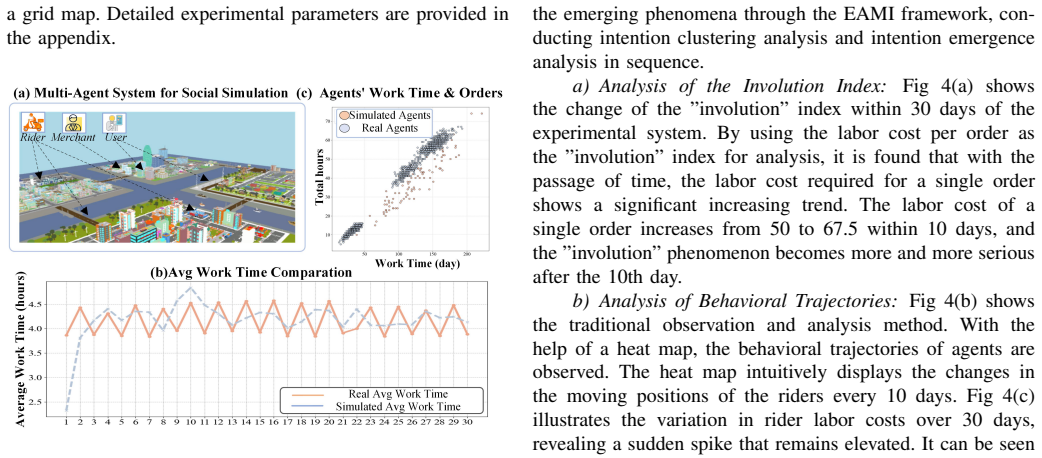
On the paper's own terms, the contribution is a method for converting hidden agent cognition into a legible causal chain for emergence. For each decision by each agent, EAMI first produces two thought streams: $c^{(i)}_s$, the bounded-rationality thought reflecting instinct and personality, and $c^{(i)}_r$, the perfect-rationality thought reflecting calculation and goal pursuit. A per-agent Analysis Agent then applies an LLM boolean function $g(c^{(i)}_s, c^{(i)}_r, M^{(i)})$ against the agent's stored memory to decide whether the intention is genuinely new and worth adding to the group repository. New intentions are embedded and k-means clustered into shared themes, and an Intention Temporal Emergence diagram records the first appearance of each intention, its originating agent, and its propagation to other agents. Applied to a 100-rider O2O delivery simulation, the diagram shows imitation and peer competition arising in the first ten days and consolidating into the pursuit of high-value and short-distance orders, which the paper identifies as a major cause of the observed involution; in a generative-agent village it tracks a hesitant-curious-supportive intention shift behind a collective election event. The central claim is that these intention-level tracks explain macro-emergence rather than merely correlating with it.
Load-bearing premise
The framework assumes that the thoughts an agent writes inside its reasoning tags are the true causes of its decisions, and that the analysis agent's LLM-based yes/no verdict reliably separates genuinely new intentions from restatements of past ones.
Editorial extensions
If this is right
- Emergence becomes timestamped: every abnormal outcome can be traced to a first-appearance moment and an adoption path through agents, so analysts can ask when and through whom it started.
- The delivery-platform result singles out concrete micro-causes—chasing high-value orders, favoring short-distance deliveries, and imitating peers—as drivers of involution, giving platform designers behaviors they could target and then re-measure.
- Any intention-mining pipeline restricted to rational chain-of-thought reasoning will miss socially and emotionally rooted intentions, so a bounded-rationality channel is needed for full coverage.
- Because the same pipeline reproduces an election-support transition in a village of generative agents, the method is claimed to transfer across domains rather than being fitted to the delivery scenario.
Reading between the lines
- If the extracted intentions are stable under counterfactual prompting, EAMI could serve as an early-warning instrument: a rising density of competition-intention clusters would predict involution before the cost-per-order index climbs.
- A stronger validation would ground $g(\cdot)$ in human annotations of what counts as a genuinely new intention, since currently the LLM is both the source of the thoughts and the judge of their novelty.
- The fixed cluster count in k-means makes the reported intention boundaries depend on the chosen $k$; a robustness sweep over $k$ would show which intention clusters are stable and which are artifacts of the partition.
- The same logic transfers to other LLM societies: whenever a collective anomaly appears, look for the intention cluster whose birth and diffusion in the temporal diagram precedes the anomalous macro-outcome.
Editorial analysis
A structured set of objections, weighed in public.
Referee Report
Summary. This paper introduces EAMI (Emergence Analysis based on Multi-Agent Intention), a framework intended to make the emergence of macroscopic phenomena in LLM-based agent simulations interpretable by mining agent intentions. The framework has four stages: an Inspector Agent extracts dual-perspective thoughts (bounded and perfect rationality) for each agent via Eq. (1); an Analysis Agent uses an LLM-based boolean function g() to decide whether an intention is new/emergent and adds it to a group intention repository via Eq. (2); all collected intentions are embedded with all-MiniLM-L6-v2 and clustered with k-means via Eqs. (3)-(4); and an Intention Temporal Emergence diagram is generated by Algorithm 1. The authors validate the framework in a custom O2O food-delivery simulation of 100 rider agents and in a replication of Stanford AI Town, and they run ablations removing the Inspector and Analysis Agents. The central empirical claim is in Section IV-B-d: the framework reveals that riders' pursuit of high-value orders and short-distance transportation are major causes of the observed involution phenomenon.
Significance. The proposed direction is timely and the framework is well structured. The paper's strengths are that the code is released, the O2O simulation is calibrated against real Zomato data, the AI Town election scenario is reproduced, and the ablation study targets the two key modules. If the emergent-intention labels and causal arrows were validated, the framework would provide a genuinely new way to connect micro-level cognitive states to macro-level system behavior in service ecosystems. However, the current evidence is almost entirely qualitative: the central detection step is an unvalidated LLM judgment, no ground truth or baseline is provided, and the causal conclusion is not supported by quantitative analysis.
major comments (4)
- [Section III-B, Eq. (2)] The boolean function g(c_s, c_r, M) is the load-bearing filter that decides which intentions enter the repository, yet the paper gives no definition of the prompt, no ground truth, no human annotation, and no reproducibility statistics for g(). Because the simulation has known generative rules (Section IV-A-c and Appendix B), the intentions that the riders actually optimize are known in advance, so the framework's output is checkable; the paper never performs this check.
- [Section III-C, Eq. (4) and Algorithm 1] k-means is applied separately to each time slice, and Algorithm 1 then compares clusters across time by the set difference Ci \ Ci-1. The paper does not specify how clusters from different time steps are matched (cluster IDs are arbitrary), nor does it report the value of k or any clustering quality metric. This makes the notion of an 'emergent intention' and the phase-transition points in Fig. 4(d-f) not well-defined.
- [Algorithm 1, line 12] The condition 'if agent b is influenced by intentions t' is never defined operationally. The Intention Temporal Emergence diagram therefore contains causal influence arrows whose semantics are unknown, and the claimed 'scope of influence' of an intention is not measurable from the described algorithm.
- [Section IV-B-d and Fig. 4] The central conclusion that riders' pursuit of high-value orders and short-distance transportation are major causes of involution is asserted from a qualitative reading of scatter plots and an LLM-generated diagram. There is no quantitative measure linking the emergent intention clusters to the involution index of Fig. 4(a), no counterfactual or intervention, and no baseline method. In addition, the rider thoughts (Appendix C) and the Analysis Agent's emergent/non-emergent labels (Section III-B) are produced by the same DeepSeek model, so a post-hoc rationalization path is present: the labels could reflect the model's retrospective story rather than a measured change in decision-relevant intentions. A concrete test would be to verify that the alleged emergent intentions are absent in the first time steps and that their appearance precedes the rise of the involution index.
minor comments (6)
- [Section IV-B-c] The text states that 'four types of intention clusters' are revealed but then lists five: 'Going to places with more orders to compete for orders', 'Imitation and competition among peers', 'Avoiding traffic congestion', 'Judgment of order cost-effectiveness', and 'Accepting algorithmic allocation'.
- [Section IV-B-c] The text refers to 'the first three steps of METEA'; the framework is called EAMI.
- [Contributions and Abstract] The contributions list says 'Though Temporal Evolution diagram' and should say 'Thought Temporal Evolution diagram'; the abstract also has the grammatically incorrect phrase 'a Intention Temporal Emergence diagram'.
- [Section IV-A-c and Limitations] The model name is given as 'DeepSeek-R1-Distill-Qwen-32B-FP8-Dynamic' in the experimental setup but as 'DeepSeek-R-Distill-Qwen-32B-FP8-Dynamic' in the Limitations section; please make the model name consistent.
- [Section III-C, Eq. (3)] Equation (3) uses ci and cj as vectors, but c(i) was introduced as a pair of thoughts (c_s, c_r); the relationship between the combined intention c(i) and the embedded vector used in the cosine similarity should be clarified.
- [Algorithm 1] Algorithm 1 initializes C0 to the empty set; for i=1 the set difference C1 \ C0 equals C1, which means all first-step intentions are labeled emergent. The authors should clarify whether this is intended.
Circularity Check
No significant circularity: the EAMI pipeline summarizes LLM-generated agent traces, and its causal narrative is an interpretation of those traces rather than an input-equivalent construct.
full rationale
The derivation chain is self-contained as a methodological pipeline. Equation (1) defines the Inspector Agent's thought extraction c(i) = LLM(q; M_i, T_i), and Equation (2) defines the Analysis Agent's boolean g() that decides whether an intention is 'emergent' by comparing with stored memory. The subsequent clustering (Eqs. 3-4) and Algorithm 1 operate on these extracted intentions. The final conclusion in Section IV-B-d — that riders' pursuit of high-value orders and short-distance transportation are major causes of involution — is a qualitative interpretation of the clustered intentions, not a quantity that was fitted from those intentions or defined as their equivalent. No parameter is fitted to the target claim, and no load-bearing result rests on the authors' self-citations, which appear only in background and motivation. The main threat to the framework's validity is that the LLM-generated Chain-of-Thought and the g() classifier are not validated against ground truth, and Algorithm 1's influence condition is underspecified; these are correctness risks, not circularity. The 'emergent' label is an operational definition via g(), and the causal narrative is the authors' reading of the diagram, not an equation that reduces to its own input by construction. Therefore, no specific circular step can be exhibited under the required standard.
Assumptions & free parameters
free parameters (3)
- number of clusters k in k-means =
not explicitly stated; five clusters shown in the O2O experiment
- threshold for emergent intention detection in g() =
not disclosed
- time-window size for cluster snapshots =
10-day intervals in O2O; not specified for AI Town
assumptions (4)
- domain assumption LLM-generated CoT thoughts faithfully represent the true decision-making intentions of agents
- domain assumption The Analysis Agent's boolean judgment g() correctly separates emergent from non-emergent intentions
- domain assumption k-means on all-MiniLM-L6-v2 embeddings yields semantically meaningful intention clusters
- domain assumption The simulated O2O system reproduces real rider behavior well enough to support emergence claims
Cite this review
Pith. "Pith review of A Framework for Analyzing Abnormal Emergence in Service Ecosystems Through LLM-based Agent Intention Mining." pith.science (2026). https://pith.science/paper/CUSDH6QL
@misc{pith2026250715770,
  author       = {Pith},
  title        = {Pith review of: A Framework for Analyzing Abnormal Emergence in Service Ecosystems Through LLM-based Agent Intention Mining},
  year         = {2026},
  howpublished = {\url{https://pith.science/paper/CUSDH6QL}},
  note         = {Machine review of arXiv:2507.15770}
}
read the original abstract
With the rise of service computing, cloud computing, and IoT, service ecosystems are becoming increasingly complex. The intricate interactions among intelligent agents make abnormal emergence analysis challenging, as traditional causal methods focus on individual trajectories. Large language models offer new possibilities for Agent-Based Modeling (ABM) through Chain-of-Thought (CoT) reasoning to reveal agent intentions. However, existing approaches remain limited to microscopic and static analysis. This paper introduces a framework: Emergence Analysis based on Multi-Agent Intention (EAMI), which enables dynamic and interpretable emergence analysis. EAMI first employs a dual-perspective thought track mechanism, where an Inspector Agent and an Analysis Agent extract agent intentions under bounded and perfect rationality. Then, k-means clustering identifies phase transition points in group intentions, followed by a Intention Temporal Emergence diagram for dynamic analysis. The experiments validate EAMI in complex online-to-offline (O2O) service system and the Stanford AI Town experiment, with ablation studies confirming its effectiveness, generalizability, and efficiency. This framework provides a novel paradigm for abnormal emergence and causal analysis in service ecosystems. The code is available at https://anonymous.4open.science/r/EAMI-B085.
Figures


Figures from the paper (3 more)


Reference graph
Works this paper leans on
-
[1]
Analysis and controlling of manufacturing service ecosystem: A research framework based on the parallel system theory,
X. Xue, Y . Guo, S. Chen, and S. Wang, “Analysis and controlling of manufacturing service ecosystem: A research framework based on the parallel system theory,” IEEE Transactions on Services Computing , vol. 14, no. 6, pp. 1598–1611, 2019
2019
-
[2]
Chatgpt chats on computational experiments: From interactive intelligence to imaginative intelligence for design of artificial societies and optimization of foundational models,
X. Xue, X. Yu, and F.-Y . Wang, “Chatgpt chats on computational experiments: From interactive intelligence to imaginative intelligence for design of artificial societies and optimization of foundational models,” IEEE/CAA Journal of Automatica Sinica, vol. 10, no. 6, pp. 1357–1360, 2023
2023
-
[3]
Com-putational experiments: Past, present and perspective,
X. Xiao, Y . Xiang-Ning, Z. De-Yu, P. Chao, W. Xiao, Z. Zhang- Bing, and W. Fei-Yue, “Com-putational experiments: Past, present and perspective,” Acta Automatica Sinica, vol. 49, no. 2, pp. 246–271, 2023
work page 2023
-
[4]
Research roadmap of service ecosystems: A crowd intelligence perspective,
X. Xue, G. Li, D. Zhou, Y . Zhang, L. Zhang, Y . Zhao, Z. Feng, L. Cui, Z. Zhou, X. Sun et al. , “Research roadmap of service ecosystems: A crowd intelligence perspective,” International Journal of Crowd Science, vol. 6, no. 4, pp. 195–222, 2022
2022
-
[5]
H. Kang and C. Lou, “Ai agency vs. human agency: understanding human–ai interactions on tiktok and their implications for user engage- ment,” Journal of Computer-Mediated Communication , vol. 27, no. 5, p. zmac014, 2022
work page 2022
-
[6]
Computational experiments for complex social systems: Experiment design and generative explanation,
X. Xue, D. Zhou, X. Yu, G. Wang, J. Li, X. Xie, L. Cui, and F.-Y . Wang, “Computational experiments for complex social systems: Experiment design and generative explanation,” IEEE/CAA Journal of Automatica Sinica, vol. 11, no. 4, pp. 1022–1038, 2024
2024
-
[7]
Computational experiments: A new analysis method for cyber-physical- social systems,
X. Xue, Y . Shen, X. Yu, D.-Y . Zhou, X. Wang, G. Wang, and F.-Y . Wang, “Computational experiments: A new analysis method for cyber-physical- social systems,” IEEE Transactions on Systems, Man, and Cybernetics: Systems, vol. 54, no. 2, pp. 813–826, 2023
2023
-
[8]
J. H. Holland, Emergence: From chaos to order . OUP Oxford, 2000
work page 2000
Show all 27 references
-
[9]
A theory of fads, fashion, custom, and cultural change as informational cascades,
S. Bikhchandani, D. Hirshleifer, and I. Welch, “A theory of fads, fashion, custom, and cultural change as informational cascades,” Journal of political Economy, vol. 100, no. 5, pp. 992–1026, 1992
1992
-
[10]
Analyzing developmental trajectories of distinct but related behaviors: a group-based method
D. S. Nagin and R. E. Tremblay, “Analyzing developmental trajectories of distinct but related behaviors: a group-based method.” Psychological methods, vol. 6, no. 1, p. 18, 2001
2001
-
[11]
Chain-of-thought prompting elicits reasoning in large language models,
J. Wei, X. Wang, D. Schuurmans, M. Bosma, F. Xia, E. Chi, Q. V . Le, D. Zhou et al. , “Chain-of-thought prompting elicits reasoning in large language models,” Advances in neural information processing systems , vol. 35, pp. 24 824–24 837, 2022
2022
-
[12]
Finding emergence in data by maximizing effective information,
M. Yang, Z. Wang, K. Liu, Y . Rong, B. Yuan, and J. Zhang, “Finding emergence in data by maximizing effective information,” National Science Review, vol. 12, no. 1, p. nwae279, 2025
2025
-
[13]
Generative agents: Interactive simulacra of human behavior,
J. S. Park, J. O’Brien, C. J. Cai, M. R. Morris, P. Liang, and M. S. Bernstein, “Generative agents: Interactive simulacra of human behavior,” in Proceedings of the 36th annual acm symposium on user interface software and technology , 2023, pp. 1–22
2023
-
[14]
Conceptualizing value: a service-ecosystem view,
S. L. Vargo, M. A. Akaka, and C. M. Vaughan, “Conceptualizing value: a service-ecosystem view,” Journal of creating value , vol. 3, no. 2, pp. 117–124, 2017
2017
-
[15]
How does innovation emerge in a service ecosystem?
J. D. Chandler, I. Danatzis, C. Wernicke, M. A. Akaka, and D. Reynolds, “How does innovation emerge in a service ecosystem?” Journal of Service Research, vol. 22, no. 1, pp. 75–89, 2019
2019
-
[16]
Heteropathic versus homopathic resource integration and value co-creation in service ecosystems,
L. D. Peters, “Heteropathic versus homopathic resource integration and value co-creation in service ecosystems,” Journal of Business Research, vol. 69, no. 8, pp. 2999–3007, 2016
2016
-
[17]
Scaling large-language-model-based multi-agent collaboration,
C. Qian, Z. Xie, Y . Wang, W. Liu, Y . Dang, Z. Du, W. Chen, C. Yang, Z. Liu, and M. Sun, “Scaling large-language-model-based multi-agent collaboration,” arXiv preprint arXiv:2406.07155 , 2024
2024 arXiv
-
[18]
React: Synergizing reasoning and acting in language models,
S. Yao, J. Zhao, D. Yu, N. Du, I. Shafran, K. Narasimhan, and Y . Cao, “React: Synergizing reasoning and acting in language models,” in International Conference on Learning Representations (ICLR) , 2023
2023
-
[19]
Tree of thoughts: Deliberate problem solving with large language models,
S. Yao, D. Yu, J. Zhao, I. Shafran, T. Griffiths, Y . Cao, and K. Narasimhan, “Tree of thoughts: Deliberate problem solving with large language models,” Advances in Neural Information Processing Systems , vol. 36, 2024
2024
-
[20]
Deepseek-r1: Incentivizing reasoning capability in llms via reinforcement learning,
DeepSeek-AI, “Deepseek-r1: Incentivizing reasoning capability in llms via reinforcement learning,” 2025. [Online]. Available: https: //arxiv.org/abs/2501.12948
2025 arXiv
-
[21]
Hypothet- ical minds: Scaffolding theory of mind for multi-agent tasks with large language models,
L. Cross, V . Xiang, A. Bhatia, D. L. Yamins, and N. Haber, “Hypothet- ical minds: Scaffolding theory of mind for multi-agent tasks with large language models,” arXiv preprint arXiv:2407.07086 , 2024
2024 arXiv
-
[22]
Graph of thoughts: Solving elaborate problems with large language models,
M. Besta, N. Blach, A. Kubicek, R. Gerstenberger, M. Podstawski, L. Gianinazzi, J. Gajda, T. Lehmann, H. Niewiadomski, P. Nyczyk et al. , “Graph of thoughts: Solving elaborate problems with large language models,” in Proceedings of the AAAI Conference on Artificial Intelligenc...
2024
-
[23]
Self-consistency improves chain of thought reasoning in language models,
X. Wang, J. Wei, D. Schuurmans, Q. Le, E. Chi, S. Narang, A. Chowdh- ery, and D. Zhou, “Self-consistency improves chain of thought reasoning in language models,” arXiv preprint arXiv:2203.11171 , 2022
2022 arXiv
-
[24]
Minilm: Deep self-attention distillation for task-agnostic compression of pre- trained transformers,
W. Wang, F. Wei, L. Dong, H. Bao, N. Yang, and M. Zhou, “Minilm: Deep self-attention distillation for task-agnostic compression of pre- trained transformers,” Advances in Neural Information Processing Sys- tems, vol. 33, pp. 5776–5788, 2020
2020
-
[25]
The online-to-offline (o2o) food delivery industry and its recent development in china,
X. Zhao, W. Lin, S. Cen, H. Zhu, M. Duan, W. Li, and S. Zhu, “The online-to-offline (o2o) food delivery industry and its recent development in china,” European journal of clinical nutrition, vol. 75, no. 2, pp. 232– 237, 2021
2021
-
[26]
A review of involution and its psychological interpretation,
L. Kang and Y . Jin, “A review of involution and its psychological interpretation,” Filozofia Publiczna i Edukacja Demokratyczna , vol. 9, no. 1, pp. 7–28, 2020
2020
-
[27]
Economic backwardness in historical perspective (1962),
A. Gerschenkron, “Economic backwardness in historical perspective (1962),” Cambridge MA, 2015. APPENDIX A. Agent Descriptions In our experimental setup, a total of 100 generative agents were deployed. Each of these agents was assigned the role of a delivery rider within the si...
1962
Reviewed August 6, 2026 · model on record in the stance chip above.
Discussion (0). Sign in to comment.