REVIEW 6 minor 25 references
Experimental nonlocal measurement of a product observable
T0 review · 0 major / 6 minor · reviewed 2026-08-14 · deepseek-v4-flash
Pith's one-line read A linear-optics experiment measures the nonlocal product observable $\sigma_z \otimes \sigma_z$ on two photonic qubits by synthesizing the von Neumann interaction locally with an entangled ancilla and quantum erasure, projecting the…
desk verdict Solid independent demonstration of Brodutch-Cohen nonlocal measurement; the flagged Section 2 inconsistency evaporates once the full ancilla state is tracked. read the letter →
The pith
A machine-rendered reading of the paper's core claim, the machinery that carries it, and where it could break.
The reading
What carries the argument
The central object is the effective von Neumann interaction Hamiltonian $e^{-i(\pi/4)\sigma_z^A\sigma_z^B\sigma_x^M}$, generated without contacting A and B. The two cascaded CNOTs at Bob implement the local coupling unitary $e^{-i(\pi/4)\sigma_z^B\sigma_z^{N_B}\sigma_x^M}$ up to single-qubit rotations, and the quantum erasure of ancilla $N_B$ in the $\{|\pm\rangle\}$ basis deletes the which-ancilla information, leaving the meter correlated with the relative phase between the parity subspaces. The machinery converts a nonlocal Hamiltonian into local CNOTs plus an entangled ancilla, so that a single meter readout can distinguish $\Pi_+$ from $\Pi_-$.
What would settle it
Prepare the input state $|\phi\rangle_4 = (2|HH\rangle + |VV\rangle)/\sqrt{5}$, run the full circuit, and tomographically reconstruct the system state conditioned on meter outcome 0 and on meter outcome 1; if the reconstructed states deviate from $(2|HH\rangle + |VV\rangle)/\sqrt{5}$ and $(|HV\rangle + |VH\rangle)/\sqrt{2}$ beyond the reported statistical errors, or if the outcome probabilities deviate from $|a_1|^2+|a_4|^2$ and $|a_2|^2+|a_3|^2$, the claimed nonlocal measurement equivalence is contradicted.
Extended reading notes
Core claim
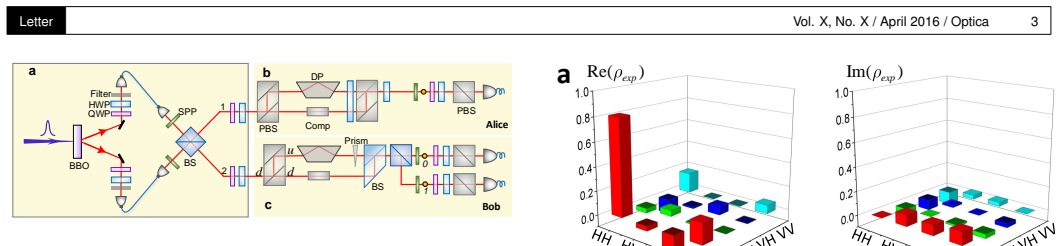
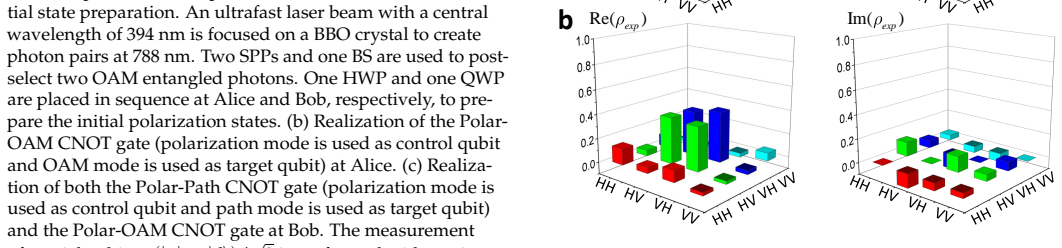
On its own terms, the paper claims that the von Neumann measurement of the product Pauli observable $\sigma_z \otimes \sigma_z$ on an arbitrary pure two-qubit state can be realized by local operations and a classical communication step, without direct coupling between qubits A and B. The system is coupled to a meter through three CNOT gates acting on the system, a shared entangled ancilla $|\psi\rangle_N = (|00\rangle + |11\rangle)/\sqrt{2}$, and a meter qubit initially in $|0\rangle$. After the first CNOT and postselection of the first ancilla on $|0\rangle$, the second and third CNOTs and an erasure measurement on the second ancilla in the $\{|\pm\rangle\}$ basis leave the composite state as $(a_1|00\rangle_{AB} + a_4|11\rangle_{AB})|0\rangle_M \pm (a_2|01\rangle_{AB} + a_3|10\rangle_{AB})|1\rangle_M$. Thus meter outcome 0 heralds projection onto $\Pi_+ = |00\rangle\langle 00| + |11\rangle\langle 11|$ and outcome 1 onto $\Pi_- = |01\rangle\langle 01| + |10\rangle\langle 10|$. The experiment encodes system qubits in photon polarization and ancillas in path and orbital angular momentum, and reports fidelities of the projected outputs between $0.740(9)$ and $0.891(5)$.
Load-bearing premise
The whole scheme rests on the equivalence between a local three-CNOT sequence with postselection and erasure and the nonlocal von Neumann interaction it is meant to replicate; if that equivalence fails, the meter readout no longer encodes the parity of the two-qubit system.
Editorial extensions
If this is right
- By local unitary rotations, the same setup can measure other product Pauli observables such as $\sigma_x \otimes \sigma_z$, since $\sigma_x$ is $\sigma_z$ in the $\{|\pm\rangle\}$ basis.
- Replacing one CNOT with a controlled rotation tunes the coupling strength, so the method extends to nonlocal weak measurements of $\sigma_z \otimes \sigma_z$.
- The meter readout projects the system into entangled parity subspaces $\Pi_+$ or $\Pi_-$, which local separate $\sigma_z$ measurements on each qubit cannot produce.
- Because the protocol is based on postselection and erasure, the nonlocal measurement is probabilistic, but it is a standard von Neumann measurement and therefore repeatable rather than destructive.
Reading between the lines
- A natural extension the paper does not explore is applying the same erasure construction to multi-partite product observables, where a shared multi-qubit entangled ancilla would let one readout encode the parity of more than two systems.
- The reported fidelities, all above 0.74, suggest the main experimental imperfection is decoherence or imperfect CNOT gates; a process-tomography characterization of the effective measurement channel would separate preparation errors from the protocol's inherent postselection cost.
- Because the scheme is conditional on ancilla outcomes, an open question is whether feed-forward can convert it into a deterministic nonlocal measurement without additional resources; the paper leaves this implicit.
Signed reviews
Editorial analysis
A structured set of objections, weighed in public.
Referee Report
Summary. The manuscript reports a proof-of-principle experiment, using linear optics, that implements the Brodutch-Cohen protocol for effectively performing a von Neumann measurement of the nonlocal product observable σz⊗σz. The scheme uses an entangled ancillary pair shared between Alice and Bob, local CNOT gates, a postselection on one ancillary qubit, and a quantum erasure on the other; the meter state then projects the two-qubit system onto the parity subspaces Π+ and Π−. Section 2 gives the circuit-level derivation, Section 3 describes a photonic implementation using polarization, path, and orbital-angular-momentum degrees of freedom, and Table 1 reports fidelities between 0.74 and 0.89 for the output states in each subspace for four input states.
Significance. If the demonstration is correct, it constitutes a valuable experimental validation of a previously theoretical proposal for nonlocal measurements without violating relativistic causality. The use of multiple degrees of freedom of single photons is a practical route to deterministic local CNOT gates, and the work is a step toward nonlocal weak measurements. The paper is careful to perform full state tomography and to report statistical error bars. A notable strength is that the ideal target states are fixed by the external protocol and by quantum mechanics rather than extracted from the data, so there is no fitting-induced circularity in the fidelity analysis. The main contribution is experimental: it shows that the Brodutch-Cohen protocol is implementable with current technology.
minor comments (6)
- [Section 2, Steps 3–4] The statement that the two cascaded CNOT gates are 'equivalent to' e^{−iπ/4 σz^B σz^NB σx^M} e^{iπ/4 σz^B σz^NB} e^{iπ/4 σx^M} is not correct as an operator identity: acting on |B=1,NB=0,M=0⟩, the CNOT sequence gives |1,1,1⟩ while the operator product gives e^{iπ/4}|1,0,1⟩. The equivalence holds only after the subsequent erasure of NB in the |+⟩ basis. The text should be rephrased so that the two CNOTs plus the erasure are identified with the effective interaction, rather than the CNOT pair alone.
- [Table 1, row |φ⟩1] For the input |φ⟩1 = (|HH⟩+|VH⟩)/√2, the state projected onto the Π− subspace is |VH⟩, not |HV⟩ as listed in the table. This is a label swap in the table; the reported fidelity of 0.891 is presumably against |VH⟩.
- [Table 1, row |φ⟩4] The measured probability for the Π+ subspace is 0.609(9), which is about 6σ above the ideal value 5/9 ≈ 0.556. The authors should discuss possible systematic causes, such as path-dependent detection efficiencies or imperfect state preparation, since a meter whose outcome statistics are biased would weaken the claim of a faithful nonlocal measurement.
- [Section 3, Bob's part] The sentence 'the notations of qubit NB and qubit M are swapped in the experiment' is not followed by an explicit mapping between the protocol's logical qubits (NA, NB, M) and the experimental degrees of freedom (OAM and path). A short table or a clear mapping in the text would help the reader verify that the implemented circuit matches Steps 1–6.
- [Section 2, Step 2] The postselection on NA=|0⟩ succeeds with probability 1/2 because the NA=1 branch of the entangled ancilla is discarded. The authors do not mention this success probability; stating it explicitly would make clear that the protocol is heralded and not deterministic.
- [Section 4] The word 'schme' in the concluding section should be 'scheme'.
Circularity Check
No significant circularity: ideal output states are fixed by the σz⊗σz eigenspaces and the external Brodutch–Cohen protocol; measured fidelities are compared against those external benchmarks, with no fitted parameter renamed as a prediction.
full rationale
No circularity found. The central claim — that the meter projects the two-qubit system onto the Π+ or Π− parity subspaces of σz⊗σz — is benchmarked against states fixed by quantum theory, not by the paper's own data. The ideal outputs |ψ>± = Π±|ψ>AB / ‖Π±|ψ>AB‖ are defined by the eigenspace projectors of the externally given observable; the Brodutch–Cohen protocol (Ref. 13, external authors) specifies the sequence, which the paper re-derives explicitly: Steps 1–5 yield the post-erasure state |ψ>5 = (a1|00> + a4|11>)|0>M + (a2|01> + a3|10>)|1>M (up to normalization), so the meter basis genuinely coincides with the parity subspaces. The reader's flagged postselection problem does not survive a correct CNOT application: with the control-to-target flips tracked, the NA=|0> branch retains a3|10> with NB=|1> and a4|11> with NB=|1>, which after Steps 3–4 recombine exactly as the displayed |ψ>4, and the |+>_NB erasure gives the parity-encoded meter state. Thus the Section 2 derivation is self-contained and matches the external protocol. The experimental fidelities (F = Tr(ρexp ρideal)) compare tomographically reconstructed density matrices against these externally determined ideal states, and probabilities are raw coincidence counts; no parameter is fitted to a subset of data and then renamed as a prediction. The paper's self-citations (Refs. 18 and 22) concern multi-degree-of-freedom encoding technology and downstream applications, not the load-bearing measurement equivalence, and the protocol citation is external; neither is load-bearing in a circular way. The only issues are presentational: the Section 2 operator identity is written as an equality of unitaries when it is really an equivalence at the level of the post-erasure meter state, and the Table 1 row for |φ>1 = |+>|H> labels the Π− output |HV> where the input predicts |VH>; both are correctness/typo matters, not circularity.
Assumptions & free parameters
assumptions (5)
- domain assumption Born rule and projective measurement postulates of quantum mechanics.
- domain assumption The Brodutch-Cohen protocol (reference [13]) correctly creates the nonlocal von Neumann measurement interaction via quantum erasure.
- domain assumption The linear optical elements (PBS, Dove prisms, SPPs, BS) implement ideal CNOT gates and ideal erasure measurements on the postselected subspace.
- domain assumption The SPDC source and the BS postselection prepare the intended polarization-OAM entangled state with the assumed form and perfect interference.
- ad hoc to paper The circuit equivalence stated in Section 2, in which postselecting NA=|0> still allows a3 and a4 amplitudes to survive, holds.
Cite this review
Pith. "Pith review of Experimental nonlocal measurement of a product observable." pith.science (2026). https://pith.science/paper/CVE4ZD66
@misc{pith2026190804515,
  author       = {Pith},
  title        = {Pith review of: Experimental nonlocal measurement of a product observable},
  year         = {2026},
  howpublished = {\url{https://pith.science/paper/CVE4ZD66}},
  note         = {Machine review of arXiv:1908.04515}
}
read the original abstract
Nonlocal measurement, or instantaneous measurement of nonlocal observables, is a considerably difficult task even for a simple form of product observable since relativistic causality prohibits interaction between spacelike separate subsystems. Following a recent proposal for effectively creating the von Neumann measurement Hamiltonian of nonlocal observables [Brodutch and Cohen, Phys. Rev. Lett. 116, 070404 (2016)], here we report a proof-of-principle demonstration of nonlocally measuring a product observable using linear optics without the violation of relativistic causality. Our scheme provides a feasible approach to perform nonlocal measurements via quantum erasure with linear optics.
Figures

Reference graph
Works this paper leans on
- [1]
- [2]
- [3]
- [4]
- [5]
- [6]
- [7]
-
[8]
J. F. Clauser, M. A. Horne, A. Shimony, and R. A. Holt, Physical review letters 23, 880 (1969)
1969
Show all 25 references
-
[9]
C. H. Bennett, D. P . DiVincenzo, C. A. Fuchs, T. Mor, E. Rains, P . W. Shor, J. A. Smolin, and W. K. Wootters, Phys- ical Review A 59, 1070 (1999)
1999
-
[10]
Beckman, D
D. Beckman, D. Gottesman, M. Nielsen, and J. Preskill, Physical Review A 64, 052309 (2001)
2001
-
[11]
Gottesman, Thesis, California Inst
D. Gottesman, Thesis, California Inst. of Technol. (1997)
1997
-
[12]
Joulain, J
K. Joulain, J. Drevillon, Y. Ezzahri, and J. Ordonez-Miranda, Physical Review Letters 116, 200601 (2016)
2016
-
[13]
Brodutch and E
A. Brodutch and E. Cohen, Phys. Rev. Lett. 116, 070404 (2016)
2016
-
[14]
M. O. Scully and K. Drühl, Phys. Rev. A 25, 2208 (1982)
1982
-
[15]
T. J. Herzog, P . G. Kwiat, H. Weinfurter, and A. Zeilinger, Phys. Rev. Lett. 75, 3034 (1995)
1995
-
[16]
Walborn, M
S. Walborn, M. T. Cunha, S. Pádua, and C. Monken, Phys. Rev. A 65, 033818 (2002)
2002
-
[17]
Peruzzo, P
A. Peruzzo, P . Shadbolt, N. Brunner, S. Popescu, and J. L. O‘Brien, Science338, 634 (2012)
2012
-
[18]
Wang, Y.-H
X.-L. Wang, Y.-H. Luo, H.-L. Huang, M.-C. Chen, Z.-E. Su, C. Liu, C. Chen, W. Li, Y.-Q. Fang, X. Jiang, J. Zhang, L. Li, N.-L. Liu, C.-Y. Lu, and J.-W. Pan, Phys. Rev. Lett.120, 260502 (2018)
2018
-
[19]
Agnew, J
M. Agnew, J. Leach, M. McLaren, F. S. Roux, and R. W. Boyd, Phys. Rev. A 84, 062101 (2011)
2011
-
[20]
J. L. O’Brien, G. J. Pryde, A. G. White, T. C. Ralph, and D. Branning, Nature 426, 264 (2003)
2003
-
[21]
Okamoto, H
R. Okamoto, H. F. Hofmann, S. Takeuchi, and K. Sasaki, Phys. Rev. Lett. 95, 210506 (2005)
2005
-
[22]
J.-W. Pan, C. Simon, ˇC. Brukner, and A. Zeilinger, Nature 410, 1067 (2001)
2001
-
[23]
Li, Phys
X.-H. Li, Phys. Rev. A 82, 044304 (2010)
2010
-
[24]
Z.-B. Chen, Q. Zhang, X.-H. Bao, J. Schmiedmayer, and J.-W. Pan, Phys. Rev. A73, 050302 (2006)
2006
-
[25]
Pan, X.-Y
W.-W. Pan, X.-Y. Xu, E. Cohen, Q.-Q. Wang, Z. Chen, M. Jan, Y.-J. Han, C.-F. Li, and G.-C. Guo, Nanophotonics8, 1109 (2019)
2019
Reviewed August 14, 2026 · model on record in the stance chip above.
Discussion (0). Continue with ORCID to comment.