REVIEW 3 major objections 5 minor 44 references
Select, Read, and Write: A Multi-Agent Framework of Full-Text-based Related Work Generation
T0 review · 3 major / 5 minor · reviewed 2026-08-07 · deepseek-v4-flash
Pith's one-line read The paper claims that a multi-agent pipeline that reads reference papers in citation-graph order generates better related-work sections than abstract-only, retrieval-based, or single-pass long-context baselines while reading about a…
desk verdict Useful multi-agent framework for related-work generation, but the graph-aware selector advantage is confounded with reading volume and needs a controlled experiment. read the letter →
The pith
A machine-rendered reading of the paper's core claim, the machinery that carries it, and where it could break.
The reading
What carries the argument
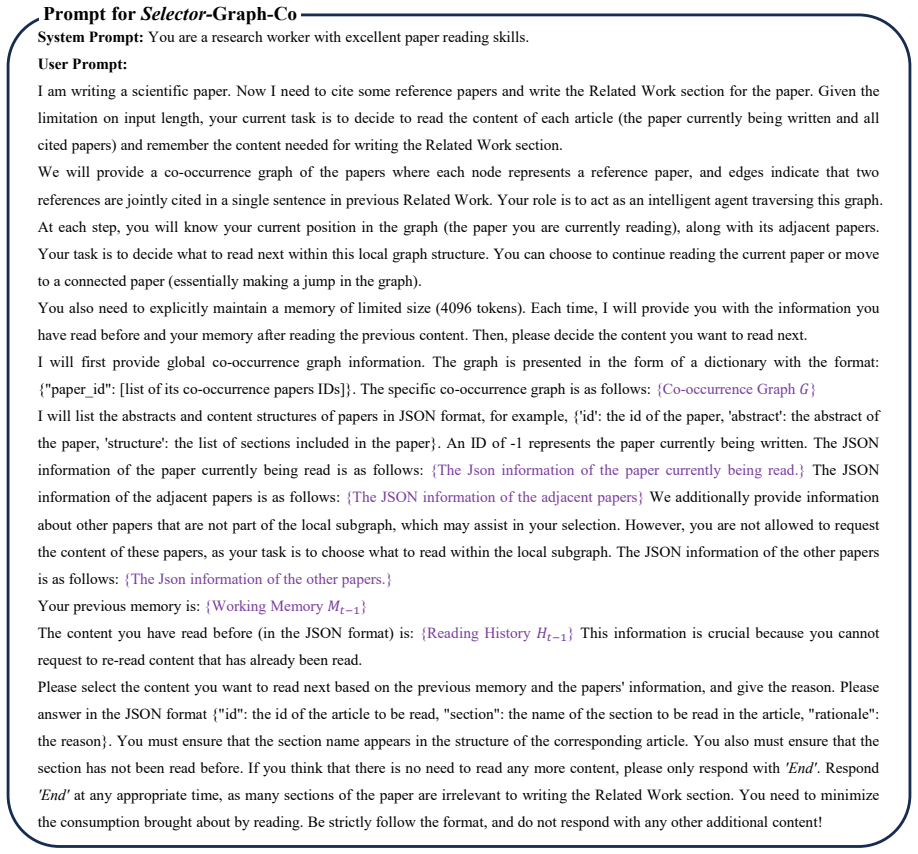
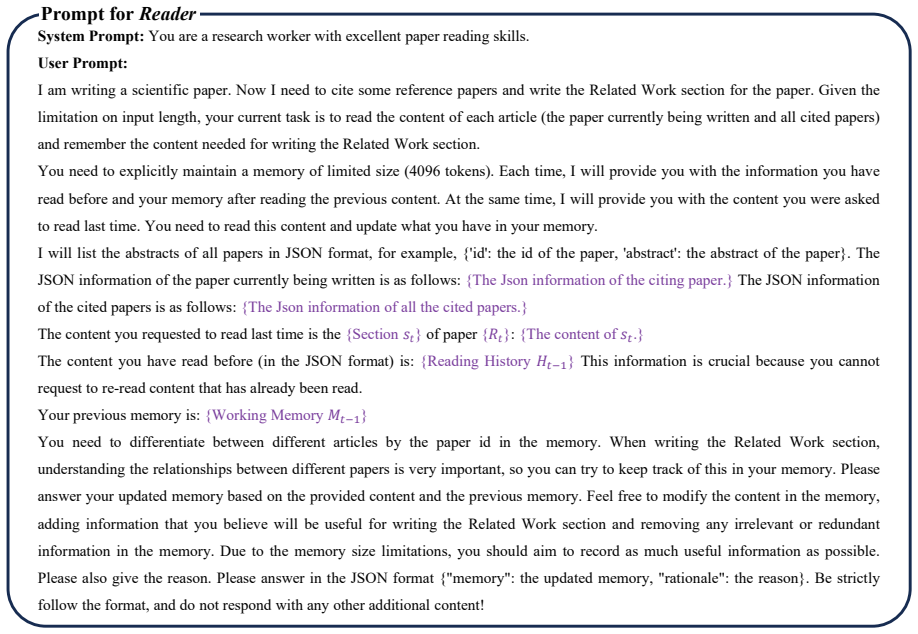
The machinery is a three-agent system with a shared working memory. The selector takes the abstracts of all papers, the current memory, and the reading history, and outputs the next section to read; the reader consumes that section and rewrites the memory to a fixed size; the writer generates the final related-work section from the curated memory. The graph-aware variants add a relationship graph over papers, either a co-occurrence graph (papers jointly cited in another paper's related-work section) or a citation graph, and restrict the selector to the one-hop neighborhood of the paper it is currently reading, forcing it to either stay or jump along an edge. This graph constraint is the mechanism claimed to make the reading order capture inter-paper relationships.
What would settle it
Take the exact set of sections selected by the citation-graph selector and give those same sections to the unconstrained LLM selector, the sequential reader, and a random reader, holding the writer and memory identical; if any of these matches or beats the citation-graph result, the graph structure itself is not the source of the improvement.
Extended reading notes
Core claim
The central claim is that full-text-based related-work generation should be treated as an iterative, relationship-aware reading problem rather than a single summarization pass. The authors propose a multi-agent framework in which a selector decides the next (paper, section) to read, a reader updates a working memory capped at 4096 tokens, and a writer produces the related-work section from the final memory. They further claim that explicitly constraining the selector's moves with a graph helps: a citation-graph selector, which can only continue with the current paper or jump to an adjacent paper in the citation graph, yields the best results across Llama3-8B, Claude-3-Haiku, and GPT-4o, improving over sequential, random, unconstrained LLM, and co-occurrence-graph ordering. The framework's generated sections show denser reference co-occurrence graphs and higher LLM-judged coverage, logic, and relevance scores, and human evaluators preferred the framework's outputs over the strongest baseline in pairwise comparisons.
Load-bearing premise
The load-bearing premise is that the quality gain comes from the graph-constrained reading order, but the experiments never hold reading volume or content fixed, and the best graph selector also reads the least, so reading less could be the real cause.
Editorial extensions
If this is right
- If the framework works as claimed, full-text related-work drafting no longer requires stuffing all references into one long context window; iterative agent reading can spread the input across many smaller steps.
- Reading order itself becomes a controllable design choice, and graph structure is a practical way to encode which papers should be compared side by side.
- The best configuration reads only about a quarter of the sections and spends most of its budget on other papers' related-work sections, suggesting large efficiency gains for practitioners.
- Because the improvements hold across weak, medium, and strong base models and across abstract, intro-conclusion, and related-work-only inputs, the method is presented as portable rather than tied to one model.
- If the graph-based evaluation metrics reflect true synthesis, then denser co-occurrence of references in a related-work section is a measurable proxy for how well the section connects the literature.
Reading between the lines
- The paper does not separate the effect of graph structure from the effect of reading less: the citation-graph selector reads the least content (25.81 percent) and performs the best, so part or all of its advantage could come from avoiding noise or memory corruption rather than from following citation edges. A control that fixes the reading volume across selectors would settle this.
- The selector's strong preference for reading other papers' related-work sections hints that a much simpler heuristic, such as 'read the related-work sections first, then follow shared citations', could capture many of the gains without building a graph at all.
- The same select-read-write loop could be applied to other long-document synthesis tasks, such as survey writing or systematic reviews, where the relationship structure among sources can be derived automatically from citations or embeddings.
- Since the reported memory retention and attribution accuracy are high but not perfect, further gains may come from improving the reader's memory discipline rather than from the selector alone.
Editorial analysis
A structured set of objections, weighed in public.
Referee Report
Summary. The paper proposes a multi-agent framework for full-text-based related work generation (RWG): a selector decides which paper section to read next, a reader updates a bounded shared memory, and a writer produces the related work section from the final memory. Five selector strategies are compared: sequential reading, random reading, a vanilla LLM selector, and two graph-aware selectors that traverse a co-occurrence or a citation graph. Experiments on 10% of OARelatedWork with Llama3-8B, Claude-3-Haiku, and GPT-4o report consistent improvements over abstract-based, retrieval-based, and long-context baselines, and the authors claim the graph-aware selectors are the best. The paper also includes a small human evaluation, an ablation of prompt variants, an ablation of section-level versus article-level graphs, and an error analysis of the working memory.
Significance. If the claims are established, the framework is a practical contribution: it shows that a well-structured multi-agent reading protocol can produce competitive related work drafts while reading only a fraction of the full text (25.81% of sections for the best GPT-4o configuration), and it releases code and data. The use of three base models of different capability tiers, on-site reproducibility for Llama3-8B, and a human evaluation are genuine strengths. However, the headline claim that graph-aware selectors are best is not currently isolated from a reading-volume confound, and the graph-based evaluation metric is partially aligned with the writer prompt and with the Graph-Co selector's own edge definition. These issues are load-bearing for the central claim and require additional controlled experiments.
major comments (3)
- [§5.5, Tables 8–9, Figure 3] The comparison supporting the claim that graph-aware selectors are best is confounded with reading volume. GPT-4o Graph-Ci reads 25.81% of sections, Graph-Co reads 28.53%, Vanilla reads 35.27%, and SR/RR read 100%; Graph-Ci reads least and performs best. The ordering SR < RR < Vanilla < Graph-Co < Graph-Ci is therefore equally consistent with a less-is-more effect (less noise or memory corruption from reading fewer sections) as with graph structure per se. No experiment holds reading volume or reading content fixed. I recommend a control condition: run Vanilla with a hard reading budget equal to Graph-Ci's 25.81%, or run Graph-Ci while forcing it to read the same section set as Vanilla, and report whether the graph advantage survives. Until this is done, the sentence in §5.5 attributing the ordering to graph constraints is not supported by the data.
- [§5.2, §4.2, Figure 10 (Writer prompt)] The graph-based evaluation metric is partially circular for the Graph-Co comparison. The metric constructs a co-occurrence graph from the generated related work section, where an edge means two references are jointly cited in a single sentence; the Graph-Co selector is built from exactly the same co-occurrence definition in prior related work sections; and the writer prompt explicitly instructs the model to incorporate multiple references within a single sentence, rather than introducing each reference in isolation. Thus part of the graph-metric improvement may reflect prompt adherence rather than relationship understanding, and for Graph-Co the reading signal and the evaluation signal are the same construct. The framework-level result is not invalidated by this, but the specific claim that graph constraints improve relationship comprehension needs a cleaner test, for example reporting graph metrics separately for outputs that do and do not follow the instruction, or using human judgments for the selector comparison. Currently Table 2 compares Graph-Ci only against the retrieval baseline, not against Vanilla.
- [Table 9, Figure 3] Differences among selectors are small and are reported without statistical significance or confidence intervals. For GPT-4o, the overall LLM score goes from 3.78 (Vanilla) to 3.79 (Graph-Co) to 3.87 (Graph-Ci); for Llama3-8B the differences are even smaller across several metrics. The only p-value reported in the paper is for Graph-Ci versus the strongest baseline in Table 1, not for the pairwise selector comparisons that support the ordering SR < RR < Vanilla < Graph-Co < Graph-Ci. I recommend reporting significance tests and variance across the evaluation samples for the selector comparison, since the claim that graph-aware selectors outperform alternative selectors depends on this ordering being stable.
minor comments (5)
- [§3, Eq. (1)] The notation (s0,1, …, sN,1) is used to denote abstracts, but Section 3 defines si,j as the j-th section of paper Ri; please clarify that si,1 is the abstract for every paper, or use a separate symbol to avoid ambiguity.
- [§4.2] The co-occurrence graph is introduced as a directed graph, but the edge definition is symmetric and no directionality is used by the selector; either drop the term directed or explain the intended orientation.
- [References, author name] The author name Furkan Şahinuç appears garbled as Furkan ¸ Sahinuç in the Introduction and References; please fix the encoding.
- [Appendix D, Figures 6–8] The phrase Respond End at any appropriate time contains a typo; it should read Respond End at any appropriate time, with quotes around End.
- [Table 3] The labels Intro. & Con. and Related Work appear in row cells rather than in the table header; moving them to column headers would make the two input configurations easier to read.
Circularity Check
No significant circularity: the multi-agent framework is evaluated against external benchmarks and the graph-constrained reading order is an empirical manipulation, not a re-statement of the evaluation metric.
full rationale
The paper's derivation chain is self-contained. The framework consists of selector, reader, and writer agents; the five selector variants differ only in reading-order strategy while the reader and writer prompts are held constant, so the internal ordering (SR < RR < Vanilla < Graph-Co < Graph-Ci) is not forced by the evaluation setup. The graph-based evaluation metric counts co-occurrence edges in the generated related-work section, whereas the Graph-Co reading graph is built from prior papers' related-work sections; these are distinct texts, so the metric does not equal the method's input by construction. The writer prompt does instruct the model to co-cite references in single sentences, which is aligned with the metric, but that instruction is identical across all selectors and across the framework variants, so it cannot by itself explain the between-selector differences. The claims are also supported by external evaluations: three independent LLM judges and a human study (Table 2) that compares against the strongest baseline. The lack of a control holding reading volume fixed (Graph-Ci reads 25.81% and performs best, Vanilla reads 35.27% in Table 8) is a genuine validity confound for the attribution of the gain to graph structure specifically, but it is a correctable experimental-design issue, not a circular re-statement of inputs as outputs. No load-bearing self-citation chain is present: metric and baseline citations are to prior external work (e.g., Martin-Boyle et al., 2024; Li and Ouyang, 2025). The derivation is therefore not circular, and the score is 0.
Assumptions & free parameters
free parameters (1)
- Working memory size limit =
4096 tokens
assumptions (4)
- domain assumption The reference list R for the citing paper is given and corresponds to the ground-truth references in the evaluation dataset; users must supply references in practice.
- domain assumption Full texts of all reference papers are available and segmented into named sections such as introduction, related work, methodology, and conclusion.
- domain assumption Co-occurrence of two papers in a sentence of another paper's related work, or a citation edge, is a reliable signal of relatedness for reading-order decisions.
- ad hoc to paper The citing paper R0 is connected to all reference nodes in both graphs to ensure accessibility.
Cite this review
Pith. "Pith review of Select, Read, and Write: A Multi-Agent Framework of Full-Text-based Related Work Generation." pith.science (2026). https://pith.science/paper/CVKBBITS
@misc{pith2026250519647,
  author       = {Pith},
  title        = {Pith review of: Select, Read, and Write: A Multi-Agent Framework of Full-Text-based Related Work Generation},
  year         = {2026},
  howpublished = {\url{https://pith.science/paper/CVKBBITS}},
  note         = {Machine review of arXiv:2505.19647}
}
read the original abstract
Automatic related work generation (RWG) can save people's time and effort when writing a draft of related work section (RWS) for further revision. However, existing methods for RWG always suffer from shallow comprehension due to taking the limited portions of references papers as input and isolated explanation for each reference due to ineffective capturing the relationships among them. To address these issues, we focus on full-text-based RWG task and propose a novel multi-agent framework. Our framework consists of three agents: a selector that decides which section of the papers is going to read next, a reader that digests the selected section and updates a shared working memory, and a writer that generates RWS based on the final curated memory. To better capture the relationships among references, we also propose two graph-aware strategies for selector, enabling to optimize the reading order with constrains of the graph structure. Extensive experiments demonstrate that our framework consistently improves performance across three base models and various input configurations. The graph-aware selectors outperform alternative selectors, achieving state-of-the-art results. The code and data are available at https://github.com/1190200817/Full_Text_RWG.
Figures


Figures from the paper (8 more)





Reference graph
Works this paper leans on
-
[1]
online" 'onlinestring :=
ENTRY address archivePrefix author booktitle chapter edition editor eid eprint eprinttype howpublished institution journal key month note number organization pages publisher school series title type volume year doi pubmed url lastchecked label extra.label sort.label short.list INTEGERS output.state before.all mid.sentence after.sentence after.block STRING...
-
[2]
write newline
" write newline "" before.all 'output.state := FUNCTION n.dashify 't := "" t empty not t #1 #1 substring "-" = t #1 #2 substring "--" = not "--" * t #2 global.max substring 't := t #1 #1 substring "-" = "-" * t #2 global.max substring 't := while if t #1 #1 substring * t #2 global.max substring 't := if while FUNCTION word.in bbl.in capitalize " " * FUNCT...
-
[3]
Ahmed AbuRa’ed, Horacio Saggion, Alexander Shvets, and \`A lex Bravo. 2020. Automatic related work section generation: experiments in scientific document abstracting. Scientometrics, 125:3159--3185
work page 2020
-
[4]
Iz Beltagy, Matthew E Peters, and Arman Cohan. 2020. Longformer: The long-document transformer. arXiv preprint arXiv:2004.05150
arXiv 2020
-
[5]
Howard Chen, Ramakanth Pasunuru, Jason Weston, and Asli Celikyilmaz. 2023 a . Walking down the memory maze: Beyond context limit through interactive reading. arXiv preprint arXiv:2310.05029
arXiv 2023
-
[6]
Jingqiang Chen and Hai Zhuge. 2019. Automatic generation of related work through summarizing citations. Concurrency and Computation: Practice and Experience, 31(3):e4261
work page 2019
-
[7]
Shouyuan Chen, Sherman Wong, Liangjian Chen, and Yuandong Tian. 2023 b . Extending context window of large language models via positional interpolation. arXiv preprint arXiv:2306.15595
arXiv 2023
-
[8]
Xiuying Chen, Hind Alamro, Mingzhe Li, Shen Gao, Rui Yan, Xin Gao, and Xiangliang Zhang. 2022. Target-aware abstractive related work generation with contrastive learning. In Proceedings of the 45th international ACM SIGIR conference on research and development in information retrieval, pages 373--383
work page 2022
Show all 44 references
-
[9]
Xiuying Chen, Hind Alamro, Mingzhe Li, Shen Gao, Xiangliang Zhang, Dongyan Zhao, and Rui Yan. 2021. Capturing relations between scientific papers: An abstractive model for related work section generation. In Proceedings of the 59th Annual Meeting of the Association for Computa...
2021
-
[10]
Xiuying Chen, Tairan Wang, Qingqing Zhu, Taicheng Guo, Shen Gao, Zhiyong Lu, Xin Gao, and Xiangliang Zhang. 2024. Rethinking scientific summarization evaluation: Grounding explainable metrics on facet-aware benchmark. arXiv preprint arXiv:2402.14359
2024 arXiv
-
[11]
Alexis Chevalier, Alexander Wettig, Anirudh Ajith, and Danqi Chen. 2023. Adapting language models to compress contexts. In Proceedings of the 2023 Conference on Empirical Methods in Natural Language Processing, pages 3829--3846
2023
-
[12]
Zekun Deng, Zixin Zeng, Weiye Gu, Jiawen Ji, and Bolin Hua. 2021. Automatic related work section generation by sentence extraction and reordering. In AII@ iConference, pages 101--110
2021
-
[13]
Martin Docekal, Martin Fajcik, and Pavel Smrz. 2024. Oarelatedwork: A large-scale dataset of related work sections with full-texts from open access sources. arXiv preprint arXiv:2405.01930
2024 arXiv
-
[14]
Yubin Ge, Ly Dinh, Xiaofeng Liu, Jinsong Su, Ziyao Lu, Ante Wang, and Jana Diesner. 2021. Baco: A background knowledge-and content-based framework for citing sentence generation. In Proceedings of the 59th Annual Meeting of the Association for Computational Linguistics and the...
2021
-
[15]
Mandy Guo, Joshua Ainslie, David C Uthus, Santiago Ontanon, Jianmo Ni, Yun-Hsuan Sung, and Yinfei Yang. 2022. Longt5: Efficient text-to-text transformer for long sequences. In Findings of the Association for Computational Linguistics: NAACL 2022, pages 724--736
2022
-
[16]
Cong Duy Vu Hoang and Min-Yen Kan. 2010. Towards automated related work summarization. In Coling 2010: Posters, pages 427--435
2010
-
[17]
Yue Hu and Xiaojun Wan. 2014. Automatic generation of related work sections in scientific papers: an optimization approach. In Proceedings of the 2014 Conference on Empirical Methods in Natural Language Processing (EMNLP), pages 1624--1633
2014
-
[18]
Gautier Izacard and \'E douard Grave. 2021. Leveraging passage retrieval with generative models for open domain question answering. In Proceedings of the 16th Conference of the European Chapter of the Association for Computational Linguistics: Main Volume, pages 874--880
2021
-
[19]
Xiangci Li, Yi-Hui Lee, and Jessica Ouyang. 2023. Cited text spans for citation text generation. arXiv preprint arXiv:2309.06365
2023 arXiv
-
[20]
Xiangci Li, Biswadip Mandal, and Jessica Ouyang. 2022. Corwa: A citation-oriented related work annotation dataset. In Proceedings of the 2022 Conference of the North American Chapter of the Association for Computational Linguistics: Human Language Technologies, pages 5426--5440
2022
-
[21]
Xiangci Li and Jessica Ouyang. 2024. Related work and citation text generation: A survey. In Proceedings of the 2024 Conference on Empirical Methods in Natural Language Processing, pages 13846--13864
2024
-
[22]
Xiangci Li and Jessica Ouyang. 2025. https://aclanthology.org/2025.coling-main.73/ Explaining relationships among research papers . In Proceedings of the 31st International Conference on Computational Linguistics, pages 1080--1105, Abu Dhabi, UAE. Association for Computational...
2025
-
[23]
Jiachang Liu, Qi Zhang, Chongyang Shi, Usman Naseem, Shoujin Wang, Liang Hu, and Ivor Tsang. 2023. Causal intervention for abstractive related work generation. In Findings of the Association for Computational Linguistics: EMNLP 2023, pages 2148--2159
2023
-
[24]
Nelson F Liu, Kevin Lin, John Hewitt, Ashwin Paranjape, Michele Bevilacqua, Fabio Petroni, and Percy Liang. 2024. Lost in the middle: How language models use long contexts. Transactions of the Association for Computational Linguistics, 12:157--173
2024
-
[25]
Yao Lu, Yue Dong, and Laurent Charlin. 2020. Multi-xscience: A large-scale dataset for extreme multi-document summarization of scientific articles. In Proceedings of the 2020 Conference on Empirical Methods in Natural Language Processing (EMNLP), pages 8068--8074
2020
-
[26]
Biswadip Mandal, Xiangci Li, and Jessica Ouyang. 2024. Contextualizing generated citation texts. In Proceedings of the 2024 Joint International Conference on Computational Linguistics, Language Resources and Evaluation (LREC-COLING 2024), pages 3849--3854
2024
-
[27]
Anna Martin-Boyle, Aahan Tyagi, Marti A Hearst, and Dongyeop Kang. 2024. Shallow synthesis of knowledge in gpt-generated texts: A case study in automatic related work composition. arXiv preprint arXiv:2402.12255
2024 arXiv
-
[28]
Alexander Miller, Adam Fisch, Jesse Dodge, Amir-Hossein Karimi, Antoine Bordes, and Jason Weston. 2016. Key-value memory networks for directly reading documents. In Proceedings of the 2016 Conference on Empirical Methods in Natural Language Processing, pages 1400--1409
2016
-
[29]
Reiichiro Nakano, Jacob Hilton, Suchir Balaji, Jeff Wu, Long Ouyang, Christina Kim, Christopher Hesse, Shantanu Jain, Vineet Kosaraju, William Saunders, et al. 2021. Webgpt: Browser-assisted question-answering with human feedback. arXiv preprint arXiv:2112.09332
2021 arXiv
-
[30]
Ramesh Nallapati, Feifei Zhai, and Bowen Zhou. 2017. Summarunner: A recurrent neural network based sequence model for extractive summarization of documents. In Proceedings of the AAAI conference on artificial intelligence, volume 31
2017
-
[31]
Ofir Press, Noah A Smith, and Mike Lewis. 2021. Train short, test long: Attention with linear biases enables input length extrapolation. arXiv preprint arXiv:2108.12409
2021 arXiv
-
[32]
Furkan S ahinu c , Ilia Kuznetsov, Yufang Hou, and Iryna Gurevych. 2024. Systematic task exploration with llms: A study in citation text generation. arXiv preprint arXiv:2407.04046
2024 arXiv
-
[33]
Huy Quoc To, Hung-Nghiep Tran, Andr'e Greiner-Petter, Felix Beierle, and Akiko Aizawa. 2024. Skt5scisumm-a hybrid generative approach for multi-document scientific summarization. arXiv preprint arXiv:2402.17311
2024 arXiv
-
[34]
Pancheng Wang, Shasha Li, Kunyuan Pang, Liangliang He, Dong Li, Jintao Tang, and Ting Wang. 2022. Multi-document scientific summarization from a knowledge graph-centric view. In Proceedings of the 29th International Conference on Computational Linguistics, pages 6222--6233
2022
-
[35]
Pancheng Wang, Shasha Li, Haifang Zhou, Jintao Tang, and Ting Wang. 2019. Toc-rwg: Explore the combination of topic model and citation information for automatic related work generation. IEEE Access, 8:13043--13055
2019
-
[36]
Yidong Wang, Qi Guo, Wenjin Yao, Hongbo Zhang, Xin Zhang, Zhen Wu, Meishan Zhang, Xinyu Dai, Min Zhang, Qingsong Wen, et al. 2024 a . Autosurvey: Large language models can automatically write surveys. arXiv preprint arXiv:2406.10252
2024 arXiv
-
[37]
Yongzhen Wang, Xiaozhong Liu, and Zheng Gao. 2018. Neural related work summarization with a joint context-driven attention mechanism. In Proceedings of the 2018 Conference on Empirical Methods in Natural Language Processing, pages 1776--1786
2018
-
[38]
Yu Wang, Nedim Lipka, Ryan A Rossi, Alexa Siu, Ruiyi Zhang, and Tyler Derr. 2024 b . Knowledge graph prompting for multi-document question answering. In Proceedings of the AAAI Conference on Artificial Intelligence, volume 38, pages 19206--19214
2024
-
[39]
Memorizing transformers
Yuhuai Wu, Markus Norman Rabe, DeLesley Hutchins, and Christian Szegedy. Memorizing transformers. In International Conference on Learning Representations
-
[40]
Wen Xiao, Iz Beltagy, Giuseppe Carenini, and Arman Cohan. 2022. Primera: Pyramid-based masked sentence pre-training for multi-document summarization. In Proceedings of the 60th Annual Meeting of the Association for Computational Linguistics (Volume 1: Long Papers), pages 5245--5263
2022
-
[41]
Xinyu Xing, Xiaosheng Fan, and Xiaojun Wan. 2020. Automatic generation of citation texts in scholarly papers: A pilot study. In Proceedings of the 58th Annual Meeting of the Association for Computational Linguistics, pages 6181--6190
2020
-
[42]
Ziwei Xu, Sanjay Jain, and Mohan Kankanhalli. 2024. Hallucination is inevitable: An innate limitation of large language models. arXiv preprint arXiv:2401.11817
2024 arXiv
-
[43]
Shunyu Yao, Howard Chen, John Yang, and Karthik Narasimhan. 2022. Webshop: Towards scalable real-world web interaction with grounded language agents. Advances in Neural Information Processing Systems, 35:20744--20757
2022
-
[44]
Zihan Yu, Liang He, Zhen Wu, Xinyu Dai, and Jiajun Chen. 2023. Towards better chain-of-thought prompting strategies: A survey. arXiv preprint arXiv:2310.04959
2023 arXiv
Reviewed August 7, 2026 · model on record in the stance chip above.
Discussion (0). Sign in to comment.