REVIEW 6 minor 33 references
Synthetic and Derived Training Images for Campus Waste Detection: A Multi-Seed Evaluation with YOLOv8n
T0 review · 0 major / 6 minor · reviewed 2026-08-01 · deepseek-v4-flash
Pith's one-line read Derived training images never beat real-only waste detection.
desk verdict A careful, honest negative-result study in a narrow subfield; the central claim is supported on its own scoped terms, and the paper is worth refereeing despite the single-split limitation. read the letter →
The pith
A machine-rendered reading of the paper's core claim, the machinery that carries it, and where it could break.
The reading
What carries the argument
The controlled comparison is the machinery: architecture (YOLOv8n), optimizer, epoch budget, validation criterion, and the 31-photo test set are held fixed while the training images vary. Seven principal settings are repeated with four matched seeds, and 95% percentile bootstrap intervals are computed over the four runs, with paired differences resampled seed-wise. The added-image pool consists of 695 derived images from roughly 100 base objects, which allows the paper to separate amount of data from source, and includes an approximately size-matched contrast between isolated-object and background-replacement images. A provenance-corrected hand-composite intervention isolates one deployment-
What would settle it
Collect or construct a group-disjoint test set in which no physical object appears in both training and test, then re-run the same configurations; if the real-only advantage over the 25%-derived mix (or over background replacement) does not reproduce with an independent 31+ photo test set, the paper's central ranking is split-dependent. A simpler check: run the same seven configurations on multiple new splits and see whether the 0.691 real-only reference changes by more than the reported intervals.
Extended reading notes
Core claim
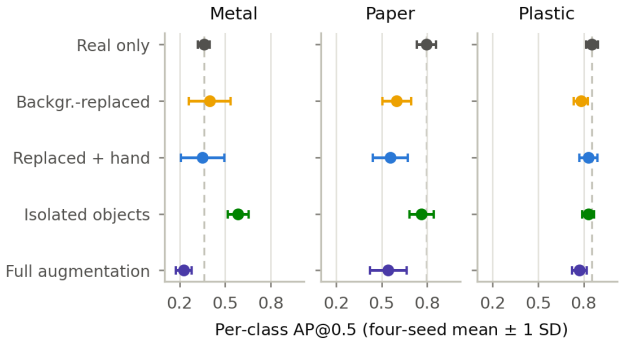
The central claim is stated in the conclusion: no evaluated synthetic/derived configuration surpassed real-only training on the fixed 31-photo test set. In the multi-seed comparison, the real-only model had mean mAP@0.5 of 0.691 [0.665, 0.722]; adding 25% derived images reduced it to 0.633 [0.608, 0.646] with a paired difference of -0.059 [-0.114, -0.020]; the full augmentation pipeline fell to 0.487 [0.438, 0.537]; the approximately size-matched isolated-object set gave 0.680 [0.644, 0.724], overlapping the baseline. The corrected hand-composite experiment, rebuilt after two test-split cutouts leaked into the initial set, showed a paired difference of +0.034 [-0.063, 0.199], so no reliable
Load-bearing premise
The load-bearing assumption is that the single class-stratified split of 148 photos into 86/31/31, which was not checked for repeated physical objects within source batches, fairly represents the deployment problem; all rankings and intervals rest on that one split, and the bootstrap intervals cover only four training seeds, not split-to-split or test-sample uncertainty.
Editorial extensions
If this is right
- Adding more transformations of the same base objects does not create deployment-relevant diversity; image count is not evidence of object diversity.
- Background replacement, the most aggressive contextual change, can hurt mean mAP by about 0.13 relative to real-only training and is less stable across seeds.
- Nominal training set size is not a reliable lever: larger derived-image pools produced the worst detector, and doubling added data did not restore performance.
- Hand-composite augmentation built from a tiny training-only library does not reliably restore real-scene behavior; the corrected run does not support a benefit.
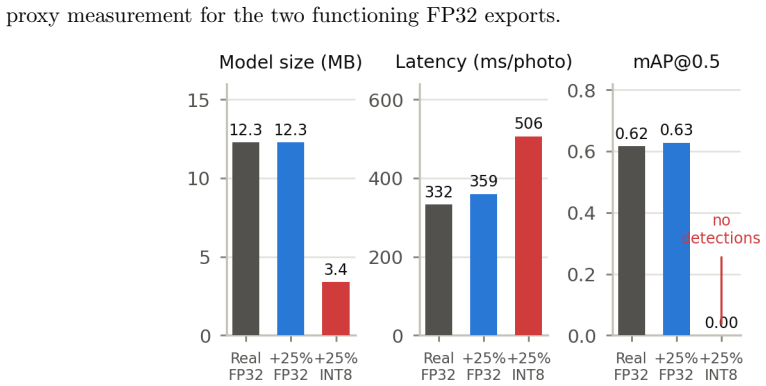
- Model size alone is not a deployability criterion: the INT8 export was slower and produced no class scores, so quantization must be validated on actual outputs.
Reading between the lines
- [Inference] The ranking would likely not survive a group-disjoint split that keeps the same physical object out of both training and test; the paper itself notes the split was not checked for repeated objects, so the -0.059 effect at 25% added data could shrink or reverse.
- [Inference] A strong testable extension is to repeat the size-matched contrast with several group-disjoint splits and paired class-level metrics; the metal class result (0.360 to 0.586 AP with isolated-object images) hints that aggregate mAP may hide per-class wins.
- [Inference] If the fixed test set is treated as a sample, the bootstrap intervals understate uncertainty; a reader betting on deployment performance should collect a larger held-out set before concluding synthetic data is useless for this view.
- [Inference] The result transfers a caution about 'more images' to the smart-bin setting: before investing in generative pipelines, a practitioner should verify that new synthetic instances add physical-object diversity rather than re-rendering the same instances.
Editorial analysis
A structured set of objections, weighed in public.
Referee Report
Summary. The paper evaluates whether synthetic and derived training images improve a YOLOv8n detector for a campus bin-mounted camera. The authors merge 148 real photographs (86 train / 31 validation / 31 test), create a 695-image derived pool from ~100 base objects, and compare 12 joint-training configurations against a real-only baseline on a fixed 31-photo test set. Seven principal settings are repeated with four matched seeds, and bootstrap percentile intervals over seeds are reported. The central finding is that no evaluated configuration exceeded the real-only baseline (mean mAP@0.5 = 0.691 [0.665, 0.722]). The paper also documents a corrected hand-composite experiment after discovering test-split leakage, exploratory transfer experiments, per-class and difficult-condition diagnostics, and a four-thread CPU benchmark.
Significance. The paper's main value is its careful, honestly scoped negative result. It explicitly distinguishes seed variation from test-split uncertainty, reports a leaked experiment and its correction, and avoids overclaiming: intervals are described as descriptive only, and class-level results are labeled tentative. The approximately size-matched comparison between isolated-object and background-replacement sources is a clean test of source effects. If the result withstands routine scrutiny, it provides a useful counterexample to the assumption that simply adding derived images from the same base objects improves small-data detection. The authors also provide seed-level data and code on request, and their limitation section (§6) is unusually thorough. The single-split concern is real but acknowledged; the central claim is explicitly scoped to the fixed 31-photo test set, so the absence of group-disjoint splits does not contradict the paper's stated conclusions.
minor comments (6)
- [§5.4] The text switches between four-seed means and seed-2026 values without explicit flags; e.g., 'isolated-object result from 0.683 to 0.618' uses seed 2026, while §5.2 reports the four-seed mean 0.680. Please clarify which value is used in each comparison.
- [§4.1] 'Automatic learning-rate selection' is vague; specify the exact learning rate or the Ultralytics default (e.g., lr0=0.01) to aid reproducibility.
- [§5.7] 'All 8,400 detection positions' is unexplained; define how this number derives from the 31 test images and network output.
- [Data Availability] No public repository is provided; while the authors state they will provide code on request, a permanent archive (e.g., Zenodo) would strengthen reproducibility.
- [Abstract / §7] The sentence 'None of the evaluated configurations exceeded the real-only baseline' could be misread as no individual seed ever exceeded; consider adding 'in mean across seeds' for precision.
- [§7] The practical recommendation to collect new object instances rather than transformations is reasonable but contingent on the single fixed split; consider explicitly noting that group-disjoint replication is required before adopting it for other deployments.
Circularity Check
No circularity: direct empirical comparison with self-contained stats; limitations concern generality, not derivation.
full rationale
The paper is an empirical comparison, not a derivation. The central claim ('No evaluated synthetic/derived configuration surpassed real-only training on the fixed 31-photo test set') is a measured outcome on a fixed split; real-only training is an independent baseline, and each synthetic/derived configuration is a separate training run. The bootstrap percentile intervals are explicitly described as descriptive summaries over four seeds and are not population-level tests, so no fitted parameter is renamed as a prediction. The added-image pool's reuse of ~100 base objects is disclosed and used as an interpretive limitation, not as a result derived from itself. The one contamination event (two hand-composite cutouts from test photos) was detected, discarded, and rerun with training-only cutouts; the paper reports the corrected experiment as its RQ2 answer and retains the discarded result only for traceability, so the final claim does not reduce to leaked test information. The acknowledged limitations (single split, unverified group-disjoint separation, small test set) concern generality and representativeness, not circularity. No load-bearing self-citation or uniqueness theorem is invoked. Therefore no circular step can be exhibited.
Assumptions & free parameters
free parameters (2)
- Training epoch budget (100 joint / 100+40 sequential) =
100 epochs; 100 synthetic + 40 real
- Operating-point thresholds (confidence 0.25, NMS IoU 0.7, mAP conf floor 0.001) =
0.25 / 0.7 / 0.001
assumptions (4)
- domain assumption The fixed 31-photo test split is an adequate basis for comparing configurations
- domain assumption The 100 base objects are genuine examples of the four target classes
- domain assumption YOLOv8n with COCO pretraining and Ultralytics default training is a controlled platform for comparing training sets
- standard math Bootstrap percentile intervals over four matched runs are used descriptively
Cite this review
Pith. "Pith review of Synthetic and Derived Training Images for Campus Waste Detection: A Multi-Seed Evaluation with YOLOv8n." pith.science (2026). https://pith.science/paper/CWGSWNTC
@misc{pith2026260719535,
  author       = {Pith},
  title        = {Pith review of: Synthetic and Derived Training Images for Campus Waste Detection: A Multi-Seed Evaluation with YOLOv8n},
  year         = {2026},
  howpublished = {\url{https://pith.science/paper/CWGSWNTC}},
  note         = {Machine review of arXiv:2607.19535}
}
read the original abstract
Incorrect disposal can contaminate campus recycling streams, and a bin-mounted camera could provide feedback as an item is discarded. We evaluated whether synthetic and derived images improve a YOLOv8n detector for this view. The real dataset contained 148 campus photographs: 86 for training, 31 for validation, and 31 for testing. Twelve joint-training configurations varied the amount and source of added images. We repeated seven principal settings with four matched seeds and computed bootstrap percentile intervals over those seeds. The real-only model reached a mean mAP@0.5 of 0.691 [0.665, 0.722]. Background replacement reduced the mean to 0.560 [0.499, 0.619], isolated-object images gave 0.680 [0.644, 0.724], and the full augmentation pool gave 0.487 [0.438, 0.537]. We also tested hand-and-forearm composites because every real photo showed a held object. Two cutouts in the initial composite set came from test photographs, so we discarded that experiment, rebuilt the set with training-split cutouts, and reran all four seeds. The corrected paired difference was +0.034 [-0.063, 0.199], which does not support a reliable hand-composite effect. Single-seed transfer experiments produced source-dependent rankings between joint mixing and sequential pretraining. None of the evaluated configurations exceeded the real-only baseline. The reported intervals quantify seed variation; the 31-photo test set remains too small for strong class-specific conclusions.
Figures


Figures from the paper (10 more)




Reference graph
Works this paper leans on
-
[1]
Artificial intelligence applications in solid waste management: A systematic research review,
M. Abdallah, M. Abu Talib, S. Feroz, Q. Nasir, H. Abdalla, and B. Mahfood, “Artificial intelligence applications in solid waste management: A systematic research review,”Waste Management, vol. 109, pp. 231–246, 2020
2020
-
[2]
A survey on image data augmentation for deep learning,
C. Shorten and T. M. Khoshgoftaar, “A survey on image data augmentation for deep learning,” Journal of Big Data, vol. 6, no. 1, Art. no. 60, 2019
2019
-
[3]
Cut, paste and learn: Surprisingly easy synthesis for instance detection,
D. Dwibedi, I. Misra, and M. Hebert, “Cut, paste and learn: Surprisingly easy synthesis for instance detection,” inProc. IEEE Int. Conf. Computer Vision (ICCV), 2017, pp. 1301–1310
2017
-
[4]
Synthesizing training data for object detection in indoor scenes,
G. Georgakis, A. Mousavian, A. C. Berg, and J. Kosecka, “Synthesizing training data for object detection in indoor scenes,” inRobotics: Science and Systems (RSS), 2017
2017
-
[5]
Simple copy-paste is a strong data augmentation method for instance segmentation,
G. Ghiasi, Y. Cui, A. Srinivas, R. Qian, T.-Y. Lin, E. D. Cubuk, Q. V. Le, and B. Zoph, “Simple copy-paste is a strong data augmentation method for instance segmentation,” inProc. IEEE/CVF Conf. Computer Vision and Pattern Recognition (CVPR), 2021, pp. 2918–2928
2021
-
[6]
Playing for data: Ground truth from computer games,
S. R. Richter, V. Vineet, S. Roth, and V. Koltun, “Playing for data: Ground truth from computer games,” inProc. European Conf. Computer Vision (ECCV), 2016, pp. 102–118
2016
-
[7]
The SYNTHIA dataset: A large collection of synthetic images for semantic segmentation of urban scenes,
G. Ros, L. Sellart, J. Materzynska, D. Vazquez, and A. M. Lopez, “The SYNTHIA dataset: A large collection of synthetic images for semantic segmentation of urban scenes,” inProc. IEEE Conf. Computer Vision and Pattern Recognition (CVPR), 2016, pp. 3234–3243
2016
-
[8]
Domain randomization for transferring deep neural networks from simulation to the real world,
J. Tobin, R. Fong, A. Ray, J. Schneider, W. Zaremba, and P. Abbeel, “Domain randomization for transferring deep neural networks from simulation to the real world,” inProc. IEEE/RSJ Int. Conf. Intelligent Robots and Systems (IROS), 2017, pp. 23–30
2017
Show all 33 references
-
[9]
Training deep networks with synthetic data: Bridging the reality gap by domain randomization,
J. Tremblayet al., “Training deep networks with synthetic data: Bridging the reality gap by domain randomization,” inProc. IEEE/CVF Conf. Computer Vision and Pattern Recognition Workshops (CVPR W), 2018, pp. 969–977
2018
-
[10]
Contextual priming for object detection,
A. Torralba, “Contextual priming for object detection,”International Journal of Computer Vision, vol. 53, no. 2, pp. 169–191, 2003
2003
-
[11]
An empirical study of context in object detection,
S. K. Divvala, D. Hoiem, J. H. Hays, A. A. Efros, and M. Hebert, “An empirical study of context in object detection,” inProc. IEEE Conf. Computer Vision and Pattern Recognition (CVPR), 2009, pp. 1271–1278
2009
-
[12]
The elephant in the room,
A. Rosenfeld, R. Zemel, and J. K. Tsotsos, “The elephant in the room,” arXiv:1808.03305, 2018
2018 arXiv
-
[13]
Modeling visual context is key to augmenting object detection datasets,
N. Dvornik, J. Mairal, and C. Schmid, “Modeling visual context is key to augmenting object detection datasets,” inProc. European Conf. Computer Vision (ECCV), 2018, pp. 364–380
2018
-
[14]
Classification of trash for recyclability status,
G. Thung and M. Yang, “Classification of trash for recyclability status,” CS229 Course Report, Stanford University, 2016
2016
-
[15]
TACO: Trash annotations in context for litter detection,
P. F. Proen¸ ca and P. Sim˜ oes, “TACO: Trash annotations in context for litter detection,” arXiv:2003.06975, 2020. 19
2003 arXiv
-
[16]
Hierarchical waste detection with weakly supervised segmentation in images from recycling plants,
D. Yudinet al., “Hierarchical waste detection with weakly supervised segmentation in images from recycling plants,”Engineering Applications of Artificial Intelligence, vol. 128, Art. no. 107542, 2024
2024
-
[17]
ZeroWaste dataset: Towards deformable object segmentation in clut- tered scenes,
D. Bashkirovaet al., “ZeroWaste dataset: Towards deformable object segmentation in clut- tered scenes,” inProc. IEEE/CVF Conf. Computer Vision and Pattern Recognition (CVPR), 2022, pp. 21147–21157
2022
-
[18]
Garbage detection and classifi- cation using a new deep learning-based machine vision system as a tool for sustainable waste recycling,
S. Jin, Z. Yang, G. Kr´ olczyk, X. Liu, P. Gardoni, and Z. Li, “Garbage detection and classifi- cation using a new deep learning-based machine vision system as a tool for sustainable waste recycling,”Waste Management, vol. 162, pp. 123–130, 2023
2023
-
[19]
Faster R-CNN: Towards real-time object detec- tion with region proposal networks,
S. Ren, K. He, R. Girshick, and J. Sun, “Faster R-CNN: Towards real-time object detec- tion with region proposal networks,” inAdvances in Neural Information Processing Systems (NeurIPS), 2015, pp. 91–99
2015
-
[20]
You only look once: Unified, real-time object detection,
J. Redmon, S. Divvala, R. Girshick, and A. Farhadi, “You only look once: Unified, real-time object detection,” inProc. IEEE Conf. Computer Vision and Pattern Recognition (CVPR), 2016, pp. 779–788
2016
-
[21]
SSD: Single shot multibox detector,
W. Liu, D. Anguelov, D. Erhan, C. Szegedy, S. Reed, C.-Y. Fu, and A. C. Berg, “SSD: Single shot multibox detector,” inProc. European Conf. Computer Vision (ECCV), 2016, pp. 21–37
2016
-
[22]
MobileNetV2: Inverted residuals and linear bottlenecks,
M. Sandler, A. Howard, M. Zhu, A. Zhmoginov, and L.-C. Chen, “MobileNetV2: Inverted residuals and linear bottlenecks,” inProc. IEEE/CVF Conf. Computer Vision and Pattern Recognition (CVPR), 2018, pp. 4510–4520
2018
-
[23]
Ultralytics YOLOv8,
G. Jocher, A. Chaurasia, and J. Qiu, “Ultralytics YOLOv8,” version 8.0, 2023. [Online]. Available:https://github.com/ultralytics/ultralytics
2023
-
[24]
Quantization and training of neural networks for efficient integer-arithmetic- only inference,
B. Jacobet al., “Quantization and training of neural networks for efficient integer-arithmetic- only inference,” inProc. IEEE/CVF Conf. Computer Vision and Pattern Recognition (CVPR), 2018, pp. 2704–2713
2018
-
[25]
Quantizing deep convolutional networks for efficient inference: A whitepa- per,
R. Krishnamoorthi, “Quantizing deep convolutional networks for efficient inference: A whitepa- per,” arXiv:1806.08342, 2018
2018 arXiv
-
[26]
On pre-trained image features and synthetic images for deep learning,
S. Hinterstoisser, V. Lepetit, P. Wohlhart, and K. Konolige, “On pre-trained image features and synthetic images for deep learning,” inProc. European Conf. Computer Vision Workshops (ECCVW), 2018, pp. 682–697
2018
-
[27]
Approximate statistical tests for comparing supervised classification learning algorithms,
T. G. Dietterich, “Approximate statistical tests for comparing supervised classification learning algorithms,”Neural Computation, vol. 10, no. 7, pp. 1895–1923, 1998
1923
-
[28]
Accounting for variance in machine learning benchmarks,
X. Bouthillieret al., “Accounting for variance in machine learning benchmarks,” inProceedings of Machine Learning and Systems (MLSys), vol. 3, 2021, pp. 747–769
2021
-
[29]
Efron and R
B. Efron and R. J. Tibshirani,An Introduction to the Bootstrap. New York, NY, USA: Chap- man & Hall, 1993
1993
-
[30]
Microsoft COCO: Common objects in context,
T.-Y. Linet al., “Microsoft COCO: Common objects in context,” inProc. European Conf. Computer Vision (ECCV), 2014, pp. 740–755. 20
2014
-
[31]
The PASCAL visual object classes (VOC) challenge,
M. Everingham, L. Van Gool, C. K. I. Williams, J. Winn, and A. Zisserman, “The PASCAL visual object classes (VOC) challenge,”International Journal of Computer Vision, vol. 88, no. 2, pp. 303–338, 2010
2010
-
[32]
MediaPipe Hands: On-device real-time hand tracking,
F. Zhang, V. Bazarevsky, A. Vakunov, A. Tkachenka, G. Sung, C.-L. Chang, and M. Grund- mann, “MediaPipe Hands: On-device real-time hand tracking,” arXiv:2006.10214, 2020
2006 arXiv
-
[33]
How transferable are features in deep neural networks?
J. Yosinski, J. Clune, Y. Bengio, and H. Lipson, “How transferable are features in deep neural networks?” inAdvances in Neural Information Processing Systems (NeurIPS), 2014, pp. 3320– 3328. 21
2014
Reviewed August 1, 2026 · model on record in the stance chip above.
Discussion (0). Sign in to comment.