REVIEW 3 major objections 4 minor 60 references
Deterministic generation of maximally discordant mixed states by dissipation
T0 review · 3 major / 4 minor · reviewed 2026-08-14 · deepseek-v4-flash
Pith's one-line read Two cavity-QED protocols use engineered dissipation to drive two qubits into the maximally discordant mixed state, the unique steady state in the subspace orthogonal to the singlet, with simulated fidelity above 99 percent.
desk verdict Solid dissipative-state-preparation paper with one real flaw: the first scheme's 87Rb parameters violate the paper's own interval condition, so the 99.41% fidelity is not a clean demonstration of the Trotterized effective dynamics. read the letter →
The pith
A machine-rendered reading of the paper's core claim, the machinery that carries it, and where it could break.
The reading
What carries the argument
The load-bearing object is the pair of collective decay operators $S_x=\sigma_x^1+\sigma_x^2$ and $S_y=\sigma_y^1+\sigma_y^2$: the target state is the common steady state of the Lindblad generators $L[S_x]$ and $L[S_y]$. The paper realizes these operators in two physical arrangements. In the single-cavity scheme, two four-level atoms driven by phase-controlled classical fields and coupled to a lossy cavity are reduced by large detunings to an effective coupling $G(J_-+J_+)a^\dagger$; strong cavity decay converts this into the collective decay $L[S_y]$ (or $L[S_x]$ with appropriate drive phases), and alternating the phases at a fast rate superposes the two generators through the Trotter product formula, giving Eq. (13). In the coupled-cavity scheme, the transformation to delocalized modes $m_1=(a_1-a_2)/\sqrt{2}$ and $m_2=(a_1+a_2)/\sqrt{2}$ makes one mode couple to $S_y$ and the other to $S_x$; adiabatic elimination of these lossy modes gives both Lindblad terms at once, with $\gamma_x=\gamma_y=4G^2/\kappa$, yielding Eq. (22).
What would settle it
Solve the full coupled-cavity master equation without the adiabatic-elimination approximation for the parameters of Fig. 7 ($\kappa=0.1g$, $\Omega=0.2g$, $\Delta=100g$) from the initial state $|00\rangle|00\rangle_c$: the central claim predicts a late-time super-fidelity above 99 percent to $\rho=(|\Psi^+\rangle\langle\Psi^+|+|00\rangle\langle00|+|11\rangle\langle11|)/3$; a substantial deviation, or a steady-state discord below $1/3$, would falsify it.
Extended reading notes
Core claim
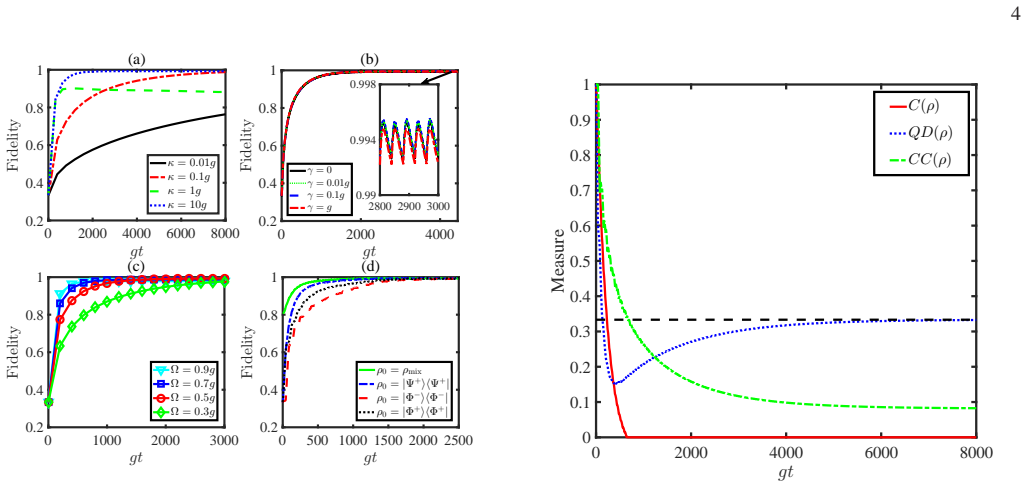
The central discovery is that collective dissipative dynamics generated by the two Lindblad operators $S_x=\sigma_x^1+\sigma_x^2$ and $S_y=\sigma_y^1+\sigma_y^2$ select the rank-3 maximally discordant mixed state $\rho=(|\Psi^+\rangle\langle\Psi^+|+|00\rangle\langle00|+|11\rangle\langle11|)/3$ as their unique steady state in the subspace orthogonal to the singlet $|\Psi^-\rangle$, and that these Lindblad terms can be realized physically. The single-cavity scheme alternates the phases of the two classical drives; the Trotter limit of fast switching yields $\dot\rho=\frac{1}{2} L_{\gamma_x}[S_x]\rho+\frac{1}{2} L_{\gamma_y}[S_y]\rho$ (Eq. 13). The coupled-cavity scheme uses delocalized cavity modes to couple to $S_x$ and $S_y$ simultaneously, giving $\dot\rho=L_{\gamma_x}[S_x]\rho+L_{\gamma_y}[S_y]\rho$ after adiabatic elimination (Eq. 22). In both cases the cavity decay rate $\kappa$ enters through $\gamma=4G^2/\kappa$ and is the engine of the protocol. Full master-equation simulations show the steady state has concurrence 0, quantum discord 1/3, and super-fidelity above 99 percent under realistic parameters, and is reached from any initial state that does not populate $|\Psi^-\rangle$.
Load-bearing premise
Both derivations collapse unless the cavity loses photons much faster than the atoms exchange excitations with it, and the phase-switched scheme additionally needs each dwell time to be longer than the cavity decay time yet shorter than the collective decay time, so the two decay mechanisms cleanly alternate.
Editorial extensions
If this is right
- Any initial state with zero overlap on the singlet $|\Psi^-\rangle$ converges to the same maximally discordant mixed state, so neither precise state preparation nor operation-time control is needed; this removes the main limitation of unitary MDMS generation.
- The prepared steady state has zero concurrence but quantum discord $1/3$, providing a deterministic source of non-classical correlations that do not rely on entanglement.
- Because the protocol is driven by cavity decay through $\gamma=4G^2/\kappa$, faster cavity loss accelerates convergence, while atomic spontaneous emission only weakly degrades the final fidelity (still above 99 percent at $\gamma\sim g$).
- Both schemes work with currently available cavity-QED parameters, with reported super-fidelities from 99.10 percent to 99.67 percent across three experimental platforms.
- The phase-mismatch analysis shows the target state remains the unique steady state for a broader family of collective Lindblad operators, except for the singular combination $\delta\phi_1=-\delta\phi_2=\pm0.5\pi$, so the drive phases need not be perfectly tuned.
Reading between the lines
- A natural testable extension is to apply the same Trotterized phase-switching construction to other pairs of collective decay operators, whose common fixed points would form new families of steady-state quantum-correlated states.
- The delocalized-mode trick suggests a general recipe: a cavity-hopping term can be converted into an engineered collective dissipator by working in symmetric and antisymmetric modes, a strategy that could carry over to multi-qubit and higher-dimensional systems.
- One could also add a third dissipative channel that damps the singlet, which would extend preparation to genuinely all initial states and remove the paper's stated restriction.
Signed reviews
Editorial analysis
A structured set of objections, weighed in public.
Referee Report
Summary. The paper proposes two cavity-QED schemes for the deterministic dissipative preparation of the two-qubit maximally discordant mixed state ρ = (|Ψ+⟩⟨Ψ+| + |00⟩⟨00| + |11⟩⟨11|)/3. In the first scheme, two four-level atoms in a single lossy cavity are driven by classical fields whose phases are switched alternately, and the authors use a Trotter product formula to derive the effective master equation (13), which is a sum of two collective Lindblad dissipators Sx and Sy with equal weights. In the second scheme, two atoms are placed in a lossy coupled-cavity array, and delocalized modes are used to realize the same two Lindblad terms simultaneously, yielding Eq. (22). The target state is shown to be a steady state of these Lindblad equations, and numerical simulations of the full master equations are compared with the effective dynamics for various parameters, atomic spontaneous emission rates, initial states, and phase mismatches. The paper also provides an experimental feasibility discussion based on 87Rb parameters and reports fidelities above 99% for both schemes.
Significance. The work is significant if the derivations hold, because it offers concrete cavity-QED implementations of a known but experimentally elusive target state, using dissipation as a resource rather than a nuisance. The paper has clear strengths: the full-model simulations reproduce the effective dynamics in Figs. 2 and 7, the microscopic Hamiltonians are given explicitly, no parameter is fitted to the target state, and the phase-mismatch analysis adds a useful practical perspective. The coupled-cavity scheme in Sec. IV is the more robust part of the paper, since it avoids the Trotterization step that is problematic in the first scheme. However, the first scheme's experimental-feasibility claim rests on a parameter regime where the Trotter timescale separation is violated, and the uniqueness of the steady state is asserted rather than proved. These issues are load-bearing for the paper's central claims and require a major revision.
major comments (3)
- [Sec. III and Sec. V] The Trotterization step that produces Eq. (13) is not justified in the experimental parameter window quoted for the first scheme. The text below Eq. (12) requires each switching interval I = T/(2N) to satisfy 1/κ ≪ I ≪ 1/γ. For the 87Rb numbers in Sec. V (g = 2π×14.4 MHz, κ = 2π×0.66 MHz, Ω = 0.3g, Δ = 76g, N = 200, and gt = 8000), one obtains G ≈ 0.00395g, γ = 4G²/κ ≈ 1.36×10⁻³g, so 1/κ ≈ 21.8/g, while I = 20/g. Thus κI ≈ 0.92, which is not ≫1; the cavity field has not relaxed within each phase interval, so the physical map is not a concatenation of e^{L_x I} and e^{L_y I} as in Eq. (12). The 99.41% fidelity quoted for the first scheme therefore does not demonstrate the dissipative-preparation mechanism of Eq. (13) in that parameter window. The authors should either choose parameters (for example, a longer total evolution time or a smaller N) that satisfy κI ≫ 1 and recompute the fidelity, or explicitly present the first scheme as a stroboscopic simulation of the full Hamiltonian and derive the corresponding validity conditions.
- [Appendix] The uniqueness claim that underlies the deterministic-preparation statement is asserted but not proved. The appendix states that Eq. (A.3) 'can be examined both numerically and analytically' to have a unique steady state except for δϕ1 = −δϕ2 = ±0.5π, but no analytic argument is given and the numerical check is not shown. Since independence of the initial state (except for the singlet |Ψ−⟩) is a central advertised advantage of both schemes, the authors should provide a complete proof of uniqueness for Eq. (23), and likewise for Eq. (13) where uniqueness is also stated without proof. Citing a known theorem for the uniqueness of steady states of Lindblad equations with a given set of jump operators would be a sufficient resolution.
- [Sec. III, Fig. 3(a)] The parameter scans include regimes where the adiabatic-elimination condition κ ≫ G is violated. With Δ = 100g and Ω = 0.5g, one has G = 0.005g, and the curve for κ = 0.01g in Fig. 3(a) therefore corresponds to κ/G = 2, so the effective master equation (10) is not valid in that regime. If the full master equation still reaches high fidelity there, the mechanism cannot be attributed to the dissipative dynamics described by Eq. (10), and the interpretation of that curve as a test of the effective model is misleading. The parameter discussion should be restricted to κ ≫ G, or the non-adiabatic regime should be analyzed separately.
minor comments (4)
- [Appendix, Eq. (A.2)] Equation (A.2) contains a stray ρ inside the Lindblad operator: the term '−ie^{iδϕ2}|2⟩⟨3|ρ' should read '−ie^{iδϕ2}|2⟩⟨3|', since the state ρ should only appear outside the Lindblad generator.
- [Sec. I] In the Introduction, 'Glave et al.' should be 'Galve et al.', as the reference is to F. Galve, G. L. Giorgi, and R. Zambrini.
- [Secs. III and V] The symbol γ is used for both the collective decay rate (e.g., γy = 4G²/κ in Eq. (10)) and the atomic spontaneous emission rate (γ = 2π×3 MHz in Sec. V). This overloading is confusing in Figs. 3(b), 5, and 8(d), and the authors should distinguish the two quantities, for example by using Γ for the collective rate.
- [Sec. II] The phrase 'V on neumann entrophy' in Sec. II is a typo for 'Von Neumann entropy'.
Circularity Check
No significant circularity: the target state is an external definition and the engineered master equations are derived from microscopic Hamiltonians, with full-model numerics as independent checks.
full rationale
The central claim is not circular. The target state rho = (|Psi+><Psi+| + |00><00| + |11><11|)/3 is taken from Galve et al. (Ref. 12) as an externally defined object, and its MDMS status is established by the discord formulas of Refs. 32 and 42, not by the present construction. In Sec. III, the authors start from the full atom-cavity Hamiltonian (Eqs. 5-6), apply a large-detuning elimination to obtain Eq. (8), then a cavity adiabatic elimination to obtain L_gamma_y[S_y] in Eq. (10); Eq. (12) uses a standard Trotter semigroup theorem to combine alternating Sx and Sy dissipative steps, and the resulting Eq. (13) is checked against direct integration of the full Hamiltonian in Fig. 2. The same holds in Sec. IV: Eq. (19) is derived from Eq. (16) by a detuned elimination, and Eq. (22) is benchmarked against the full model in Fig. 7. No Lindblad coefficient is fitted to the target state, and no self-citation carries a load-bearing premise; Refs. 24, 25, and 30 are only background dissipative-preparation work. The timescale issue raised by the reader (whether T/(2N) satisfies 1/kappa << T/(2N) << 1/gamma for the 87Rb parameters) is a validity/correctness question about the Trotter approximation, not a circular reduction of a prediction to an input.
Assumptions & free parameters
free parameters (3)
- Switching number N =
N = 200 (also tested 2, 4, 10, 40, 100, 640, 1000)
- Rabi frequency ratio Omega/g =
0.5g (first scheme); 0.2g (coupled cavity); examples 0.3g, 0.1g
- Detuning ratio Delta/g =
100g, 76g, 72g, 50g, 43g in examples
assumptions (7)
- domain assumption Markovian Lindblad master equation for the open atom-cavity system (Eqs. 9 and 21)
- domain assumption Large-detuning condition |Delta_1(2)| >> {g, Omega_1(2)}
- domain assumption Cavity decay much larger than effective coupling, kappa >> G, for adiabatic elimination of the cavity mode
- standard math Trotter product formula (Eq. 12) and the finite-switching approximation with 1/kappa << T/(2N) << 1/gamma
- ad hoc to paper Neglect of Stark shifts
- ad hoc to paper Equality G1 = G2 = G, i.e., Omega_1/Delta_1 = Omega_2/Delta_2
- domain assumption Dipole-forbidden |0> <-> |1> transition, so atoms remain in the ground-state manifold
Cite this review
Pith. "Pith review of Deterministic generation of maximally discordant mixed states by dissipation." pith.science (2026). https://pith.science/paper/CWHORXUL
@misc{pith2026190806594,
  author       = {Pith},
  title        = {Pith review of: Deterministic generation of maximally discordant mixed states by dissipation},
  year         = {2026},
  howpublished = {\url{https://pith.science/paper/CWHORXUL}},
  note         = {Machine review of arXiv:1908.06594}
}
abstract
Entanglement can be considered as a special quantum correlation, but not the only kind. Even for a separable quantum system, it is allowed to exist non-classical correlations. Here we propose two dissipative schemes for generating a maximally correlated state of two qubits in the absence of quantum entanglement, which was raised by [F. Galve, G. L. Giorgi, and R. Zambrini, {\color{blue}Phys. Rev. A {\bf 83}, 012102 (2011)}]. These protocols take full advantages of the interaction between four-level atoms and strongly lossy optical cavities. In the first scenario, we alternatively change the phases of two classical driving fields, while the second proposal introduces a strongly lossy coupled-cavity system. Both schemes can realize all Lindblad terms required by the dissipative dynamics, guaranteeing the maximally quantum dissonant state to be the unique steady state for a certain subspace of system. Moreover, since the target state is a mixed state, the performance of our method is evaluated by the definition of super-fidelity $G(\rho_{1},\rho_{2})$, and the strictly numerical simulations indicate that fidelity outstripping $99\%$ of the quantum dissonant state is achievable with the current cavity quantum electrodynamics parameters.
Figures


Figures from the paper (4 more)


Reference graph
Works this paper leans on
-
[42]
Super fidelity and related metrics,
Zhi-Hua Chen, Zhihao Ma, Fu-Lin Zhang, and Jing-Ling Ch en, “Super fidelity and related metrics,” Cent. Eur. J. Phys. 9, 1036– 1042 (2011)
work page 2011
-
[1]
The atoms are driven by the laser fields with complex Rabi frequencies Ω 1(2)eiϕ 1(2) , where ϕ1(2) is the phase of classical field, and simultaneously cou- pled to the quantized field with strength g. The Hamiltonian in the Schr¨ odinger picture can be written as (ℏ = 1): Hs = H0 + Vs, (5) H0 = 2∑ i=1 ω0|0⟩i⟨0| + ω1|1⟩i⟨1| + ωe|e⟩i⟨e| +ωr|r⟩i⟨r| + νa†a, Vs ...
-
[2]
Quantum cryptography based on bell’s th eo- 9 rem,
Artur K. Ekert, “Quantum cryptography based on bell’s th eo- 9 rem,” Phys. Rev. Lett. 67, 661–663 (1991)
work page 1991
-
[3]
However, it is difficult to find a natural system with the above form of the master equation
will be the steady state of this sys- tem. However, it is difficult to find a natural system with the above form of the master equation. Thence we consider to de- sign a physical model which is equivalent to Eq. (
-
[4]
under the appropriate approximations, and we will discuss our method detailedly in the next section. FIG. 1. Schematic view of the system and the configuration of t he atoms. (a) The system consists of two atoms collectively int eracting with a lossy cavity. (b) Level structure of a four-level atom which is simultaneously driven by two classical fields and ...
-
[5]
apart from a coefficient 1/2, as long as the phases of the classical fields ϕ1 and ϕ2 are interchanged fast enough. The result is obtained by 0 2000 4000 6000 8000 gt 0 0.05 0.1 0.15 0.2 0.25 0.3 0.35 0.4 Population effective master equation N = 10 N = 40 N = 640 N = 1000 FIG. 2. The populations of |Ψ +⟩ as functions of gt governed by the effective master eq...
work page 2000
-
[6]
1|Φ −⟩⟨Φ −| + 0. 8|Ψ +⟩⟨Ψ +|) ⊗ |0⟩c⟨0|. measure the distance between quantum states including mixed states, we here adopt the definition of super-fidelity [ 40] G(ρ, σ) = Tr[ρ(t)σ] + √ [1 − Trρ(t)2](1 − Trσ2), (14) with σ being the density operator of the target state as σ = (|Ψ +⟩⟨Ψ +| + |00⟩⟨00| + |11⟩⟨11|)/3. We initialize the sys- tem into state |00⟩|0...
work page 2000
-
[7]
The selections of numerical simu- lation parameters are κ = 0.1g, Ω = 0 .2g, and ∆ = 100 g
We can find that these two lines perfectly coincide with each other and t he state prepared by our scheme can maintain a high fidelity clos e to unity after gt = 10000 . The selections of numerical simu- lation parameters are κ = 0.1g, Ω = 0 .2g, and ∆ = 100 g. 0 0.5 1 1.5 2 gt × 104 0.2 0.4 0.6 0.8 1 Fidelity (a) κ = 0 . 1g κ = g κ = 10 g 0 0.5 1 1.5 2 gt ...
Show all 60 references
-
[8]
Can quantum- mechanical description of physical reality be considered c om- plete?
A. Einstein, B. Podolsky, and N. Rosen, “Can quantum- mechanical description of physical reality be considered c om- plete?” Phys. Rev. 47, 777–780 (1935)
1935
-
[9]
The classical-quantum boundary for cor - relations: Discord and related measures,
Kavan Modi, Aharon Brodutch, Hugo Cable, Tomasz Paterek , and Vlatko V edral, “The classical-quantum boundary for cor - relations: Discord and related measures,” Rev. Mod. Phys. 84, 1655–1707 (2012)
2012
-
[10]
Communicati on via one- and two-particle operators on einstein-podolsky- rosen states,
Charles H. Bennett and Stephen J. Wiesner, “Communicati on via one- and two-particle operators on einstein-podolsky- rosen states,” Phys. Rev. Lett. 69, 2881–2884 (1992)
1992
-
[11]
Teleporting an unknown quantum state via dual classical and einstein- podolsky-rosen channels,
Charles H. Bennett, Gilles Brassard, Claude Cr´ epeau, R ichard Jozsa, Asher Peres, and William K. Wootters, “Teleporting an unknown quantum state via dual classical and einstein- podolsky-rosen channels,” Phys. Rev. Lett. 70, 1895–1899 (1993)
1993
-
[12]
Experimental one-way quantum computing,
P . Walther, K. J. Resch, T. Rudolph, E. Schenck, H. Weinfurter, V . V edral, M. Aspelmeyer, and A. Zeilinger, “Experimental one-way quantum computing,” Nature 434, 169– (2005)
2005
-
[13]
The quantum dissipation characterized by a Lindblad gen- erator in Markovian quantum master equations originates from the weak coupling between quantum systems and envi- ronment
and gave an example of unitary dynamic process, which restricts the evolution time of system. The quantum dissipation characterized by a Lindblad gen- erator in Markovian quantum master equations originates from the weak coupling between quantum systems and envi- ronment. Trad...
-
[14]
Quantum states with einstein-podo lsky- rosen correlations admitting a hidden-variable model,
Reinhard F. Werner, “Quantum states with einstein-podo lsky- rosen correlations admitting a hidden-variable model,” Phys. Rev. A 40, 4277–4281 (1989)
1989
-
[15]
Werner state structure and entanglement classification,
David W. Lyons, Abigail M. Skelton, and Scott N. Walck, “Werner state structure and entanglement classification,” Adv. Math. Phys. 2012, 463610
2012
-
[16]
Quantum discord : A measure of the quantumness of correlations,
Harold Ollivier and Wojciech H. Zurek, “Quantum discord : A measure of the quantumness of correlations,” Phys. Rev. Lett. 88, 017901 (2001)
2001
-
[17]
Quantum discord protection from ampli- tude damping decoherence,
Jiwon Y une, Kang-Hee Hong, Hyang-Tag Lim, Jong-Chan Lee, Osung Kwon, Sang-Wook Han, Y ong-Su Kim, Sung Moon, and Y oon-Ho Kim, “Quantum discord protection from ampli- tude damping decoherence,” Opt. Express 23, 26012–26022 (2015)
2015
-
[18]
Observing the operational significance of dis - cord consumption,
Mile Gu, Helen M. Chrzanowski, Syed M. Assad, Thomas Symul, Kavan Modi, Timothy C. Ralph, Vlatko V edral, and Ping Koy Lam, “Observing the operational significance of dis - cord consumption,” Nat. Phys. 8, 671–675 (2012)
2012
-
[19]
Maximally discordant mixed states of two qubits,
Fernando Galve, Gian Luca Giorgi, and Roberta Zambrini , “Maximally discordant mixed states of two qubits,” Phys. Rev. A 83, 012102 (2011)
2011
-
[20]
Generation of maximally correlated states of ( d ⊗ d)- dimensional systems in the absence of entanglement,
C. E. L´ opez, F. Albarrn-Arriagada, S. Allende, and J. C . Re- tamal, “Generation of maximally correlated states of ( d ⊗ d)- dimensional systems in the absence of entanglement,” Euro- phys.Lett. 120, 10003 (2017)
2017
-
[21]
Ca vity- loss-induced generation of entangled atoms,
M. B. Plenio, S. F. Huelga, A. Beige, and P . L. Knight, “Ca vity- loss-induced generation of entangled atoms,” Phys. Rev. A 59, 2468–2475 (1999)
1999
-
[22]
Entangled light from whit e noise,
M. B. Plenio and S. F. Huelga, “Entangled light from whit e noise,” Phys. Rev. Lett. 88, 197901 (2002)
2002
-
[23]
Cooling atoms into e ntan- gled states,
Giovanni V acanti and Almut Beige, “Cooling atoms into e ntan- gled states,” New. J. Phys. 11, 083008 (2009)
2009
-
[24]
Dissip a- tive preparation of entanglement in optical cavities,
M. J. Kastoryano, F. Reiter, and A. S. Sørensen, “Dissip a- tive preparation of entanglement in optical cavities,” Phys. Rev. Lett. 106, 090502 (2011)
2011
-
[25]
Dissipative pr o- duction of a maximally entangled steady state of two quantum bits,
Y . Lin, J. P . Gaebler, F. Reiter, T. R. Tan, R. Bowler, A. S . Sørensen, D. Leibfried, and D. J. Wineland, “Dissipative pr o- duction of a maximally entangled steady state of two quantum bits,” Nature 504, 415–418 (2013)
2013
-
[26]
Preparation of entangled and an- tiferromagnetic states by dissipative rydberg pumping,
A. W. Carr and M. Saffman, “Preparation of entangled and an- tiferromagnetic states by dissipative rydberg pumping,” Phys. Rev. Lett. 111, 033607 (2013)
2013
-
[27]
Dissipative creation of three-dimensional entangled sta te in optical cavity via spontaneous emission,
Xiao-Qiang Shao, Tai-Y u Zheng, C. H. Oh, and Shou Zhang, “Dissipative creation of three-dimensional entangled sta te in optical cavity via spontaneous emission,” Phys. Rev. A 89, 012319 (2014)
2014
-
[28]
Preparation of two-qubit steady entan gle- ment through driving a single qubit,
Li-Tuo Shen, Rong-Xin Chen, Zhen-Biao Yang, Huai-Zhi W u, and Shi-Biao Zheng, “Preparation of two-qubit steady entan gle- ment through driving a single qubit,” Opt. Lett. 39, 6046–6049 (2014)
2014
-
[29]
Dissipation-based en- tanglement via quantum zeno dynamics and rydberg antiblock - ade,
X. Q. Shao, J. H. Wu, and X. X. Yi, “Dissipation-based en- tanglement via quantum zeno dynamics and rydberg antiblock - ade,” Phys. Rev. A 95, 062339 (2017)
2017
-
[30]
Engineering steady entanglement fo r trapped ions at finite temperature by dissipation,
Xiao-Qiang Shao, “Engineering steady entanglement fo r trapped ions at finite temperature by dissipation,” Phys. Rev. A 98, 042310 (2018)
2018
-
[31]
Unconventional rydberg pumping and applications in quantum information processing,
D. X. Li and X. Q. Shao, “Unconventional rydberg pumping and applications in quantum information processing,” Phys. Rev. A 98, 062338 (2018)
2018
-
[32]
Directional quantum state trans fer in a dissipative rydberg-atom-cavity system,
D. X. Li and X. Q. Shao, “Directional quantum state trans fer in a dissipative rydberg-atom-cavity system,” Phys. Rev. A 99, 032348 (2019)
2019
-
[33]
Scheme for entanglement generation in an atom-cavi ty system via dissipation,
Shi-Lei Su, Xiao-Qiang Shao, Hong-Fu Wang, and Shou Zhang, “Scheme for entanglement generation in an atom-cavi ty system via dissipation,” Phys. Rev. A 90, 054302 (2014)
2014
-
[34]
Simpl i- fied scheme for entanglement preparation with rydberg pump- ing via dissipation,
Shi-Lei Su, Qi Guo, Hong-Fu Wang, and Shou Zhang, “Simpl i- fied scheme for entanglement preparation with rydberg pump- ing via dissipation,” Phys. Rev. A 92, 022328 (2015)
2015
-
[35]
Exponentially enhanced light-matte r interaction, cooperativities, and steady-state entangle ment us- ing parametric amplification,
Wei Qin, Adam Miranowicz, Peng-Bo Li, Xin-Y ou L¨ u, J. Q. Y ou, and Franco Nori, “Exponentially enhanced light-matte r interaction, cooperativities, and steady-state entangle ment us- ing parametric amplification,” Phys. Rev. Lett. 120, 093601 (2018)
2018
-
[36]
Accelerated and noise-resistant generation o f high-fidelity steady-state entanglement with rydberg atom s,
Ye-Hong Chen, Zhi-Cheng Shi, Jie Song, Yan Xia, and Shi- Biao Zheng, “Accelerated and noise-resistant generation o f high-fidelity steady-state entanglement with rydberg atom s,” Phys. Rev. A 97, 032328 (2018)
2018
-
[37]
Dissipa- tive preparation of bell states with parallel quantum zeno d y- namics,
Chong Yang, DongXiao Li, and XiaoQiang Shao, “Dissipa- tive preparation of bell states with parallel quantum zeno d y- namics,” Science China Physics, Mechanics & Astronomy 62, 110312 (2019)
2019
-
[38]
Dissipative prepara tion of spin squeezed atomic ensembles in a steady state,
Emanuele G. Dalla Torre, Johannes Otterbach, Eugene De mler, Vladan Vuletic, and Mikhail D. Lukin, “Dissipative prepara tion of spin squeezed atomic ensembles in a steady state,” Phys. Rev. Lett. 110, 120402 (2013)
2013
-
[39]
Quantum discord f or two-qubit x states,
Mazhar Ali, A. R. P . Rau, and G. Alber, “Quantum discord f or two-qubit x states,” Phys. Rev. A 81, 042105 (2010)
2010
-
[40]
Engel and R
K.-J. Engel and R. Nagel, One-Parameter Semigroups for Lin- ear Evolution Equations (Springer, New Y ork, 2000)
2000
-
[41]
M. A. Nilsen and I. L. Chuang, Quantum computation and quantum information (Cambridge University Press, Cambridge, 2000)
2000
-
[43]
Quan- tifying entanglement,
V . V edral, M. B. Plenio, M. A. Rippin, and P . L. Knight, “Quan- tifying entanglement,” Phys. Rev. Lett. 78, 2275–2279 (1997)
1997
-
[44]
Entanglement measures and p u- rification procedures,
V . V edral and M. B. Plenio, “Entanglement measures and p u- rification procedures,” Phys. Rev. A 57, 1619–1633 (1998)
1998
-
[45]
Ro- bust quantum error correction via convex optimization,
Robert L. Kosut, Alireza Shabani, and Daniel A. Lidar, “ Ro- bust quantum error correction via convex optimization,” Phys. Rev. Lett. 100, 020502 (2008)
2008
-
[46]
Quantum chaos and oper ator fidelity metric,
Paolo Giorda and Paolo Zanardi, “Quantum chaos and oper ator fidelity metric,” Phys. Rev. E 81, 017203 (2010)
2010
-
[47]
Sub- and super-fidelity as bounds for quantum fidelity,
Jaroslaw Adam Miszczak, Zbigniew Puchala, Pawel Horodecki, Armin Uhlmann, and Karol Zyczkowski, “Sub- and super-fidelity as bounds for quantum fidelity,” Quantum Inf. Comput. 9, 103–130 (2009)
2009
-
[48]
Entanglement of formation and co ncur- rence,
William K. Wootters, “Entanglement of formation and co ncur- rence,” Quantum Inf. Comput. 1, 27–44 (2001)
2001
-
[49]
Classic al mem- oryless noise-induced maximally discordant mixed separab le 10 steady states,
Ferdi Altintas, Arzu Kurt, and Resul Eryigit, “Classic al mem- oryless noise-induced maximally discordant mixed separab le 10 steady states,” Phys. Lett. A 377, 53 – 59 (2012)
2012
-
[50]
Polaritonic char - acteristics of insulator and superfluid states in a coupled- cavity array,
E. K. Irish, C. D. Ogden, and M. S. Kim, “Polaritonic char - acteristics of insulator and superfluid states in a coupled- cavity array,” Phys. Rev. A 77, 033801 (2008)
2008
-
[51]
Frac- tional quantum hall state in coupled cavities,
Jaeyoon Cho, Dimitris G. Angelakis, and Sougato Bose, “ Frac- tional quantum hall state in coupled cavities,” Phys. Rev. Lett. 101, 246809 (2008)
2008
-
[52]
Multimode entanglement in cou- pled cavity arrays,
T C H Liew and V Savona, “Multimode entanglement in cou- pled cavity arrays,” New J. Phys. 15, 025015 (2013)
2013
-
[53]
Quantum many-body phenomena in coupled cavity arrays,
Michael Hartmann, Fernando G. S. L. Brand ˜ao, and M Plenio, “Quantum many-body phenomena in coupled cavity arrays,” Laser Photonics Rev. 2, 527 – 556 (2008)
2008
-
[54]
D is- tributed quantum computation via optical fibers,
Alessio Serafini, Stefano Mancini, and Sougato Bose, “D is- tributed quantum computation via optical fibers,” Phys. Rev. Lett. 96, 010503 (2006)
2006
-
[55]
Cavity qed wit h a bose-einstein condensate,
Ferdinand Brennecke, Tobias Donner, Stephan Ritter, T homas Bourdel, Michael Khl, and Tilman Esslinger, “Cavity qed wit h a bose-einstein condensate,” Nature 450, 268–271 (2007)
2007
-
[56]
Cavity quantum electrodynamics with a rydberg- blocked atomic ensemble,
Christine Guerlin, Etienne Brion, Tilman Esslinger, a nd Klaus Mølmer, “Cavity quantum electrodynamics with a rydberg- blocked atomic ensemble,” Phys. Rev. A 82, 053832 (2010)
2010
-
[57]
Rydberg polaritons in a cav - ity: A superradiant solid,
Xue-Feng Zhang, Qing Sun, Y u-Chuan Wen, Wu-Ming Liu, Se- bastian Eggert, and An-Chun Ji, “Rydberg polaritons in a cav - ity: A superradiant solid,” Phys. Rev. Lett. 110, 090402 (2013)
2013
-
[58]
Quantum statistics of light tran s- mitted through an intracavity rydberg medium,
A Grankin, E Brion, E Bimbard, R Boddeda, I Usmani, A Our- joumtsev, and P Grangier, “Quantum statistics of light tran s- mitted through an intracavity rydberg medium,” New J. Phys. 16, 043020 (2014)
2014
-
[59]
Ultrahigh- q toroidal microres- onators for cavity quantum electrodynamics,
S. M. Spillane, T. J. Kippenberg, K. J. V ahala, K. W. Goh, E. Wilcut, and H. J. Kimble, “Ultrahigh- q toroidal microres- onators for cavity quantum electrodynamics,” Phys. Rev. A 71, 013817 (2005)
2005
-
[60]
A photon turnstile dynamically regu - lated by one atom,
Barak Dayan, A. S. Parkins, Takao Aoki, E. P . Ostby, K. J. V a- hala, and H. J. Kimble, “A photon turnstile dynamically regu - lated by one atom,” Science 319, 1062–1065 (2008)
2008
Reviewed August 14, 2026 · model on record in the stance chip above.
Discussion (0). Continue with ORCID to comment.