REVIEW 4 major objections 3 minor 21 references
A Theoretical Framework for Virtual Power Plant Integration with Gigawatt-Scale AI Data Centers: Multi-Timescale Control and Stability Analysis
T0 review · 4 major / 3 minor · reviewed 2026-08-07 · deepseek-v4-flash
Pith's one-line read The paper claims that a four-layer hierarchical controller can keep gigawatt-scale AI data centers stable despite power pulses exceeding 1,000 MW/s, turning them from grid destabilizers into regulation assets.
desk verdict A timely, well-motivated framework whose quantitative claims rest on unverified fits and unproven assumptions; the architecture is worth considering, the headline numbers are not. read the letter →
The pith
A machine-rendered reading of the paper's core claim, the machinery that carries it, and where it could break.
The reading
What carries the argument
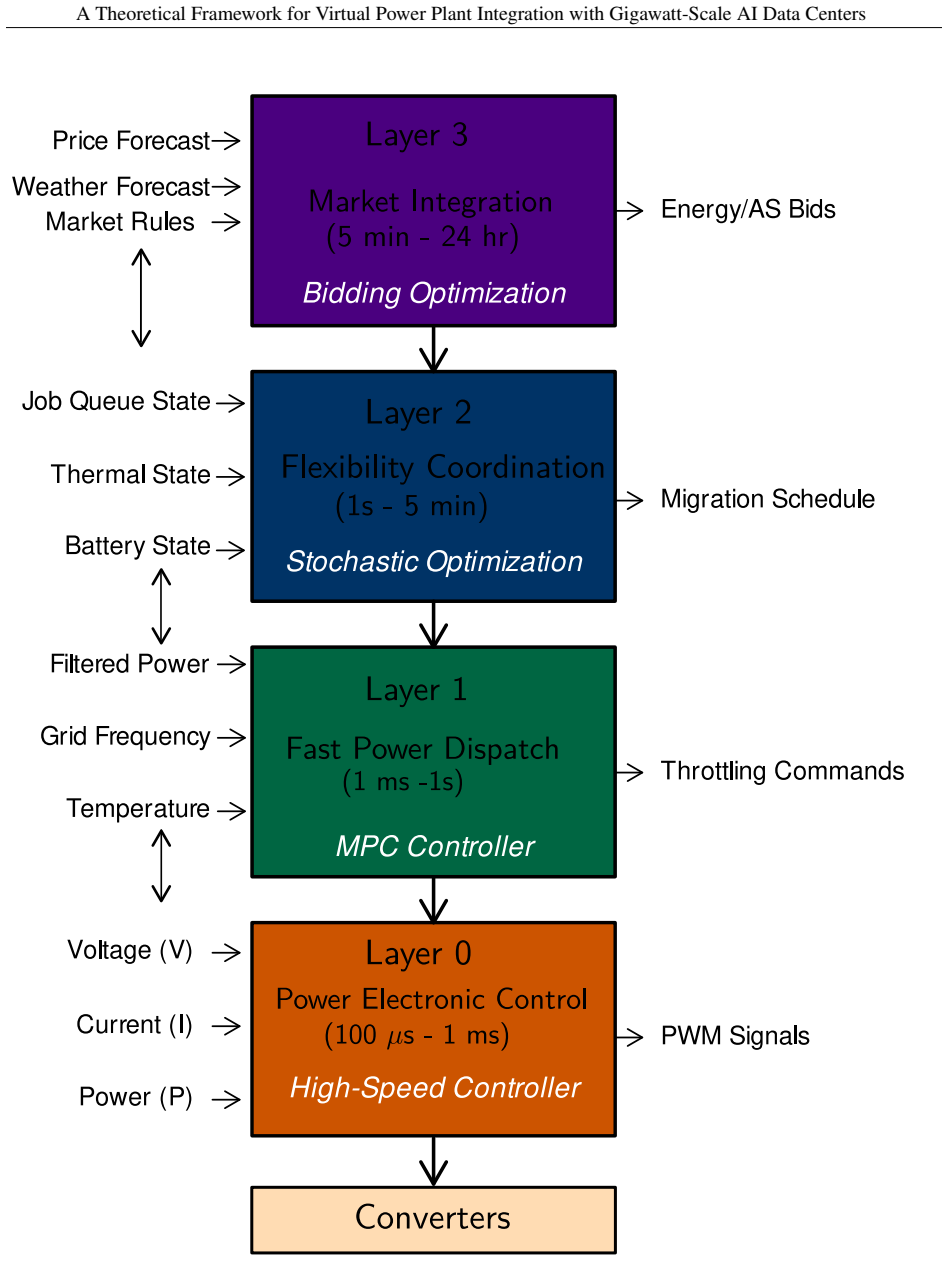
The load-bearing mechanism is the four-layer hierarchical control architecture combined with three stability theorems. Theorem 1 (hierarchical stability) uses a composite Lyapunov function: when each layer has a Lyapunov function with dissipation bound, the time-scale ratios satisfy $\tau_{i+1}/\tau_i \ge 10$, and the inter-layer consistency error $\|x_i^* - \pi_i(x_{i+1}^*)\|_2 \le \varepsilon_{\mathrm{coord}}$ is small, the weighted sum of layer Lyapunov functions proves input-to-state stability of the whole stack. Theorem 2 applies Floquet theory to the linearized periodic system $\Delta\dot{x} = (A_0 + A_p\cos(\omega_p t))\Delta x$ and derives the pulsing participation bound $p_{\mathrm{pulse}} < 2\zeta_{\min}\omega_0 / M_{\mathrm{pulse}}$. Theorem 3 modifies the transient energy function with pulsing and protection terms, giving the clearing-time reduction formula $t_{\mathrm{cr}} \approx t_{\mathrm{cr},0}(1 - k_p P_{\mathrm{pulse}}/P_{\mathrm{base}})$. Theorem 4 states the converter-stability impedance ratio condition $|Z_{DC}(j\omega)/Z_{grid}(j\omega)| < 1/G_m$. Together they translate the data center's extreme dynamics into explicit stability margins and quantitative performance bounds.
What would settle it
Run the proposed four-layer controller on a gigawatt-scale simulation with the actual MPC and stochastic optimizers and measure the critical clearing time and damping ratio; if the clearing time stays at 150 ms or the damping ratio stays near 0.02, the claimed stabilization does not occur. A second test: construct a scenario where the inter-layer consistency error $\|x_i^* - \pi_i(x_{i+1}^*)\|_2$ exceeds $\varepsilon_{\mathrm{coord}}$ and show the system loses stability despite the Theorem 1 conditions otherwise holding.
Extended reading notes
Core claim
The core claim is that a virtual power plant built on four coordinated control layers—power-electronic damping at 100 µs–1 ms, fast dispatch at 1 ms–1 s, flexibility optimization at 1 s–5 min, and market participation at 5 min–24 h—can keep a gigawatt-scale AI data center stable under pulsing loads that defeat traditional VPP designs. The paper states this as a theorem: if each layer is individually stable, the layer time constants differ by at least a factor of ten, and the layers' setpoints satisfy a bounded consistency condition, then the whole system is input-to-state stable. The same framework yields new stability limits: critical clearing time drops from 150 ms to 83 ms when protection-system dynamics are included, and workload deferability gives 30% peak reduction while keeping AI service availability above 99.95%. The intended message is that the mathematical basis exists for integrating the coming wave of gigawatt AI infrastructure without sacrificing grid reliability.
Load-bearing premise
The load-bearing premise is that every control layer actually has a Lyapunov function satisfying the paper's dissipation inequality, that the layer speeds are separated by at least a factor of ten, and that the setpoints passed between layers stay within a small error bound—none of which is verified for the proposed MPC, stochastic, and power-electronic controllers.
Editorial extensions
If this is right
- Gigawatt AI data centers can supply 200–300 MW of frequency regulation and 300 MW of spinning reserve for 15 minutes while keeping AI service availability above 99.95%.
- Protection systems must be coordinated to clear faults in about 83 ms instead of 150 ms, requiring protection margins of at least 50 ms at gigawatt scale.
- Workload deferability can reduce peak demand by 30% under the stated flexibility mix, converting power pulses into marketable grid services.
- Traditional virtual power plant architectures that assume second-to-minute response times are insufficient for loads with slew rates above 1,000 MW/s.
- The framework's peak-reduction bound is formally the minimum of flexibility-, battery-, ramp-, and stability-limited contributions, giving operators a concrete way to see which constraint binds.
Reading between the lines
- The same hierarchical timescale-separation argument could extend to other pulsing megawatt loads—electrolyzers, EV supercharger clusters, or radar arrays—provided their dynamics fit the $\tau_{i+1}/\tau_i \ge 10$ assumption.
- The 30% peak-reduction figure is tied to the assumed workload mix: an inference-dominated facility with no deferable batch traffic would see much smaller flexibility, so the headline number is not a general bound.
- A direct test of the paper's central claim would be a hardware-in-the-loop experiment where the proposed controllers run against real protection relay models; if the critical clearing time does not approach 83 ms, the stability theorems are not capturing the dominant dynamics.
- The paper's comparison that stability margin becomes positive for the proposed architecture suggests a measurable criterion—damping ratio—that operators could track in real time as a health indicator for the data-center-to-grid interface.
Editorial analysis
A structured set of objections, weighed in public.
Referee Report
Summary. This paper proposes a four-layer hierarchical control framework for virtual power plant (VPP) integration with gigawatt-scale AI data centers, spanning timescales from 100 microseconds to 24 hours. The claimed contributions include a multi-timescale control architecture, an enhanced stochastic load model with protection-system dynamics, stability criteria based on Floquet theory and transient energy functions, and quantified flexibility results such as a 30% peak demand reduction and an 83 ms critical clearing time. The paper asserts that traditional VPP architectures cannot maintain stability when confronted with AI data center slew rates exceeding 1,000 MW/s, and that the proposed framework transforms AI data centers into controllable grid assets. The technical development is presented through four theorems with proofs in appendices, and a case study illustrates the claimed performance metrics.
Significance. If the framework and its quantitative claims were rigorously supported, the paper would address a timely and important problem: the grid integration of gigawatt-scale AI data centers with extreme power dynamics. The multi-timescale architecture and the inclusion of protection-system dynamics and workload flexibility are relevant and potentially useful. The paper also builds on recent empirical studies and CIGRE guidance, and it proposes falsifiable, quantified predictions (e.g., 83 ms critical clearing time, 30% peak reduction) that could, in principle, be tested. However, the current manuscript does not deliver the promised theoretical and empirical support: the central stability theorems are conditional on unverified assumptions, one derived inequality is dimensionally inconsistent, and the headline quantitative results depend on a simulation-fitted constant whose data are never shown. These issues are load-bearing because the abstract and conclusions present the quantitative outcomes as proven and validated.
major comments (4)
- [Abstract; Section 1; Theorem 1 (Appendix A)] The unconditional claim that traditional VPP architectures cannot maintain stability under AI data center dynamics is not established by the paper. Theorem 1 proves only a conditional input-to-state stability result: if each layer satisfies the Lyapunov dissipation inequality (A.3), if timescale separation tau_{i+1}/tau_i >= 10 holds, and if the information consistency bound (A.10) is met, then the composite system is stable. The manuscript never verifies these conditions for the MPC, stochastic optimization, and power-electronic controllers of Sections 3.2-3.5, nor does it introduce or analyze a model of a 'traditional VPP architecture' to justify the impossibility claim. The abstract's central assertion therefore goes beyond what the theorem can support.
- [Theorem 2, Eq. (23); Appendix B] Equation (23) is dimensionally inconsistent. The quantity ppulse defined in (B.14) is dimensionless, while the right-hand side 2*zeta_min*omega_0/M_pulse has units of 1/s because omega_0 is in rad/s and M_pulse is a dimensionless ratio of matrix norms. Moreover, substituting ppulse = epsilon*omega_0*T/(2*pi) into (B.13) yields ppulse < (omega_0*T/(2*pi))*(exp(zeta_min*omega_0*T)-1)/|kappa_crit|, which is not the inequality in (23). The small-signal stability criterion must be re-derived and presented in a dimensionally consistent form before it can be used in Sections 4.1 and 6.2.
- [Theorem 3, Eq. (C.13); Section 6.2] The quantitative claim of an 83 ms critical clearing time rests on Eq. (C.13) with kp in [0.3, 0.5] described as 'determined from extensive simulations' that are never shown. The same fitted formula is then used to produce the reported 83 ms value, so the case study does not constitute an independent validation of the critical clearing time. The manuscript must either present the simulation data, state the fitted kp value, and verify the formula against an independent clearing-time calculation, or explicitly label the 83 ms result as an output of an assumed correction formula.
- [Abstract; Section 7.5] The paper claims validation against 'recent industry deployments' (Section 7.5) but provides no deployment data, no comparison with measured events, and no procedure that would allow a reader to reproduce the stated 200-300 MW frequency regulation, 300 MW spinning reserve, or 83 ms clearing time from actual deployments. Without such data, these quantitative claims are unsupported and the abstract's statement that the framework is 'validated against recent industry deployments' is misleading.
minor comments (3)
- [Section 2.1, Eq. (6)] Definition 1 does not specify the units of F(t, tau) or provide formal definitions of f_k(tau) and L_k(t, tau) before they appear in the formula; Table 1 gives numerical values but the functions are not defined in the text.
- [Section 3.6, Theorem 1] The theorem refers to 'Condition 1-3' but these conditions are not numbered in the text; explicit numbering in the statement would improve cross-referencing with the proof in Appendix A.
- [Section 6.1] The case study states 'Flexibility: Average 40% based on workload mix' without connecting this value to Definition 1, Table 1, or the later claim of 30% achievable peak reduction; the calculation should be made explicit.
Circularity Check
The headline critical-clearing-time reduction is produced by a simulation-fitted constant, making the 83 ms 'prediction' an input restated as a result.
-
fitted input called prediction
[Theorem 3, Eq. (25) and Appendix C, Eq. (C.13); case-study result in Section 6.2 and Abstract]
"tcr ≈ tcr,0(1 − kp Ppulse/Pbase), where kp ∈ [0.3, 0.5] is determined from extensive simulations accounting for: Pulsing amplitude and frequency; Protection system settings; System inertia distribution; Network topology. ... Critical clearing time: 83 ms (vs. 150 ms for traditional loads)."
Equation (C.13) is not derived from first principles; its only adjustable parameter kp is 'determined from extensive simulations' that are never shown or reproduced. The paper's headline quantitative result, the reduction from 150 ms to 83 ms, is simply the output of this same formula once kp is chosen. Thus the numerical content of the 'new stability criterion' is supplied by the fitted simulation constant, and the 83 ms 'demonstration' is the fitted input renamed as a prediction. Without the unseen simulations, Eq. (C.13) has no independent predictive content for the claimed 45% reduction.
full rationale
The principal circularity is confined to the critical-clearing-time claim. Appendix C develops a transient-energy framework from classical swing equations, but then inserts Eq. (C.13) with kp 'determined from extensive simulations'; the case study and abstract use exactly that fitted formula to announce 83 ms vs. 150 ms. That is a fitted input presented as a predicted stability result. The other stability statements are conditional or standard: Theorem 1 is a valid compositional theorem whose Conditions 1–3 are asserted rather than verified for the concrete controllers (a correctness gap, not a circular reduction), Theorem 2 restates the classical Floquet multiplier test, and Theorem 4 cites established impedance-stability practice. The flexibility and grid-service figures are substitutions into the paper's own definitions rather than independent predictions. Because one central quantitative prediction reduces by construction to a simulation-fitted parameter, the partial-circularity score is 6.
Assumptions & free parameters
free parameters (5)
- kp =
0.3 to 0.5 (from undisclosed simulations)
- omega_c (Layer 0 filter cutoff) =
not specified
- rho_i (intra-rack correlation) =
0.7 to 0.9
- Workload flexibility factors f_k(tau) =
Table 1 values (e.g., large model training 0.7 at 5 min)
- Damping ratios zeta=0.02 and 0.05 =
0.02 (without control), 0.05 (with control)
assumptions (6)
- domain assumption Each control layer has a Lyapunov function satisfying the dissipation inequality (A.3).
- domain assumption Time-scale separation tau_{i+1}/tau_i >= 10 holds across all layers.
- domain assumption Information consistency bound ||x*_i - pi_i(x*_{i+1})||_2 <= eps_coord holds.
- ad hoc to paper Pulsing strength epsilon = ||A_p||_2/||A_0||_2 is small enough for the first-order Floquet expansion (B.4).
- domain assumption Protection system model (Eq. 7) with voltage/frequency-dependent trip and delayed reconnection describes real gigawatt AI data centers.
- standard math Standard power system stability definitions (Kundur et al., Hatziargyriou et al.) and CIGRE impedance-stability criteria are applicable.
Cite this review
Pith. "Pith review of A Theoretical Framework for Virtual Power Plant Integration with Gigawatt-Scale AI Data Centers: Multi-Timescale Control and Stability Analysis." pith.science (2026). https://pith.science/paper/CWZDCSN2
@misc{pith2026250617284,
  author       = {Pith},
  title        = {Pith review of: A Theoretical Framework for Virtual Power Plant Integration with Gigawatt-Scale AI Data Centers: Multi-Timescale Control and Stability Analysis},
  year         = {2026},
  howpublished = {\url{https://pith.science/paper/CWZDCSN2}},
  note         = {Machine review of arXiv:2506.17284}
}
read the original abstract
The explosive growth of artificial intelligence has created gigawatt-scale data centers that fundamentally challenge power system operation, exhibiting power fluctuations exceeding 500 MW within seconds and millisecond-scale variations of 50-75% of thermal design power. This paper presents a comprehensive theoretical framework that reconceptualizes Virtual Power Plants (VPPs) to accommodate these extreme dynamics through a four-layer hierarchical control architecture operating across timescales from 100 microseconds to 24 hours. We develop control mechanisms and stability criteria specifically tailored to converter-dominated systems with pulsing megawatt-scale loads. We prove that traditional VPP architectures, designed for aggregating distributed resources with response times of seconds to minutes, cannot maintain stability when confronted with AI data center dynamics exhibiting slew rates exceeding 1,000 MW/s at gigawatt scale. Our framework introduces: (1) a sub-millisecond control layer that interfaces with data center power electronics to actively dampen power oscillations; (2) new stability criteria incorporating protection system dynamics, demonstrating that critical clearing times reduce from 150 ms to 83 ms for gigawatt-scale pulsing loads; and (3) quantified flexibility characterization showing that workload deferability enables 30% peak reduction while maintaining AI service availability above 99.95%. This work establishes the mathematical foundations necessary for the stable integration of AI infrastructure that will constitute 50-70% of data center electricity consumption by 2030.
Figures


Figures from the paper (2 more)


Reference graph
Works this paper leans on
- [1]
-
[2]
H. E. Jimenez-Ruiz and F. Milano. Data center model for transient stability analysis of power systems. arXiv preprint arXiv:2505.16575, May 2024
arXiv 2024
-
[3]
Data centres and data transmission networks
International Energy Agency . Data centres and data transmission networks. IEA, Paris, 2024
work page 2024
-
[4]
The era of flat power demand is over
Grid Strategies LLC . The era of flat power demand is over. Technical report, Grid Strategies Report, December 2024
work page 2024
-
[5]
Nvidia dgx superpod technical specifications
NVIDIA Corporation . Nvidia dgx superpod technical specifications. NVIDIA Documentation, 2024 a
work page 2024
-
[6]
Nvidia gb200 nvl72 system architecture
NVIDIA Corporation . Nvidia gb200 nvl72 system architecture. Technical report, 2024 b
work page 2024
-
[7]
Cloud tpu v5e and v5p technical specifications
Google Cloud . Cloud tpu v5e and v5p technical specifications. Google Cloud Documentation, 2024
work page 2024
-
[8]
Aws trainium2 ultraserver architecture guide
Amazon Web Services . Aws trainium2 ultraserver architecture guide. Technical report, 2024
work page 2024
Show all 21 references
-
[9]
Azure nd gb200 v6 series virtual machines
Microsoft Azure . Azure nd gb200 v6 series virtual machines. Azure Documentation, 2024
2024
-
[10]
Zhang et al
H. Zhang et al. Liquid cooling for data centers: A necessity for sustainable ai. IEEE Computer, 56 0 (8): 0 45--53, 2023
2023
-
[11]
2024 state of reliability report
North American Electric Reliability Corporation . 2024 state of reliability report. Technical report, NERC, Atlanta, 2024
2024
-
[12]
Chen et al
Y. Chen et al. Checkpoint strategies for large language model training: Performance and energy trade-offs. In Proc. International Conference on Learning Representations (ICLR), 2023
2023
-
[13]
Jain et al
A. Jain et al. Checkpointing strategies for distributed deep learning. arXiv preprint arXiv:2406.18820, 2024
2024 arXiv
-
[14]
He et al
G. He et al. Thermal management in liquid-cooled data centers: Time constants and control. Applied Thermal Engineering, 219: 0 119234, 2023
2023
-
[15]
Ni et al
J. Ni et al. A review of air conditioning and liquid cooling for data center applications. International Journal of Heat and Mass Transfer, 184: 0 122303, 2022
2022
-
[16]
G. Floquet. Sur les équations différentielles linéaires à coefficients périodiques. Annales scientifiques de l'École Normale Supérieure, 12: 0 47--88, 1883
-
[17]
Multi-frequency stability of converter-based modern power systems
CIGRE Working Group C4.52 . Multi-frequency stability of converter-based modern power systems. Technical report, CIGRE Technical Brochure 928, 2024
2024
-
[18]
Kundur et al
P. Kundur et al. Definition and classification of power system stability. IEEE Transactions on Power Systems, 19 0 (3): 0 1387--1401, 2004
2004
-
[19]
Hatziargyriou et al
N. Hatziargyriou et al. Definition and classification of power system stability – revisited & extended. IEEE Transactions on Power Systems, 37 0 (4): 0 3271--3281, 2022
2022
-
[20]
Milano, F
F. Milano, F. Dörfler, G. Hug, D. J. Hill, and G. Verbič. Foundations and challenges of low-inertia systems. In Proc. Power Systems Computation Conference (PSCC), pages 1--25, 2018
2018
-
[21]
Kroposki et al
B. Kroposki et al. Achieving a 100\ IEEE Power Energy Magazine, 15 0 (2): 0 61--73, 2017
2017
Reviewed August 7, 2026 · model on record in the stance chip above.
Discussion (0). Continue with ORCID to comment.