REVIEW 3 major objections 5 minor 79 references
Quantifying Memory Utilization with Effective State-Size
T0 review · 3 major / 5 minor · reviewed 2026-08-16 · deepseek-v4-flash
Pith's one-line read A rank-based metric measures how much memory a sequence model actually uses, not just how much it could.
desk verdict A useful, well-packaged memory-utilization metric whose LTI theory is solid and whose LIV interpretation rests on strong but fragile correlations; needs a revision that hardens the empirical bridge. read the letter →
The pith
A machine-rendered reading of the paper's core claim, the machinery that carries it, and where it could break.
The reading
What carries the argument
The central object is the strictly lower-triangular operator submatrix $\mathbf{H}_i = \mathbf{T}_{i:,:i-1}$ of the causal operator $\mathbf{T}$ realized by the model. The paper proves that $\mathrm{rank}(\mathbf{H}_i)$ is the minimal state size of any recurrent realization of an input-invariant linear system, and then computes two rank-smoothed versions of this quantity: tolerance-ESS, which counts singular values above a threshold $\tau$, and entropy-ESS, which exponentiates the spectral entropy of $\mathbf{H}_i$. The paper also defines theoretically realizable state-size (TSS) as the model-recurrent state dimension, which upper-bounds ESS and plays the role of a 'capacity' baseline throughout the comparisons.
What would settle it
Find a realistic input-varying sequence model for which ESS decreases or stays flat over training while recall accuracy rises substantially, and where a competing capacity-based measure explains the accuracy differences better across a held-out task-model sweep. Concretely: train a family of gated linear attention models on MQAR, sweep kv and TSS as in the paper, and compute the split-half correlation of length-normalized ESS/kv against accuracy; if TSS/kv or a simple attention-focused spectral statistic wins or ties across the randomized halves, the claim that ESS outperforms capacity as a memory-utilization proxy would fail.
Extended reading notes
Core claim
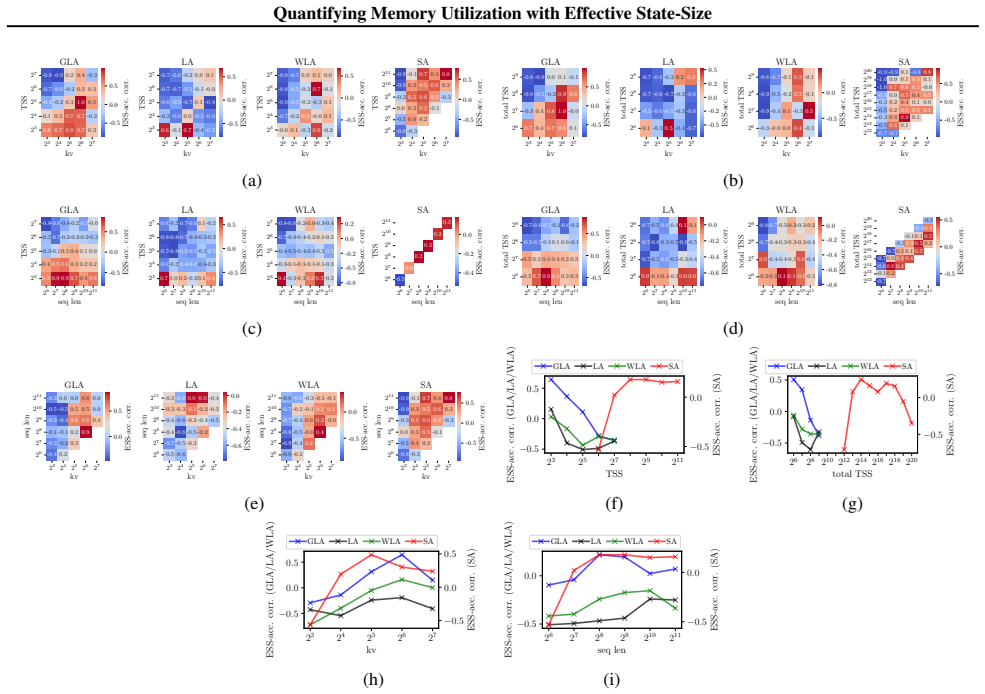
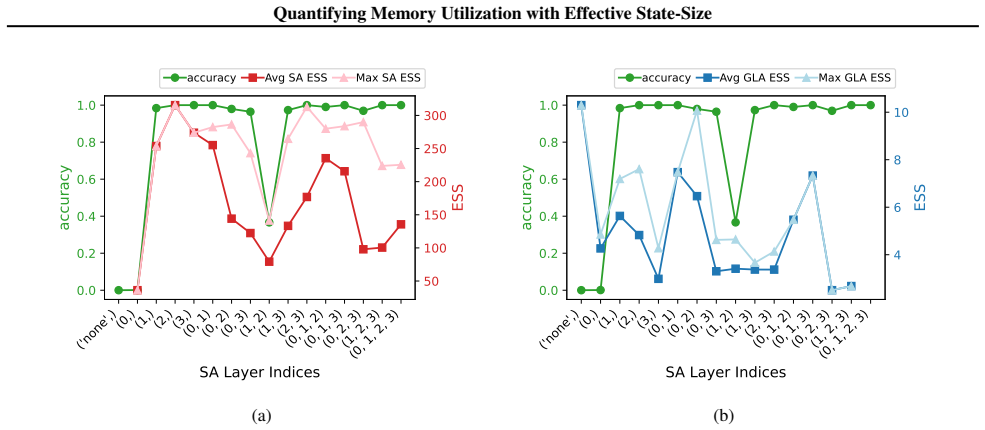
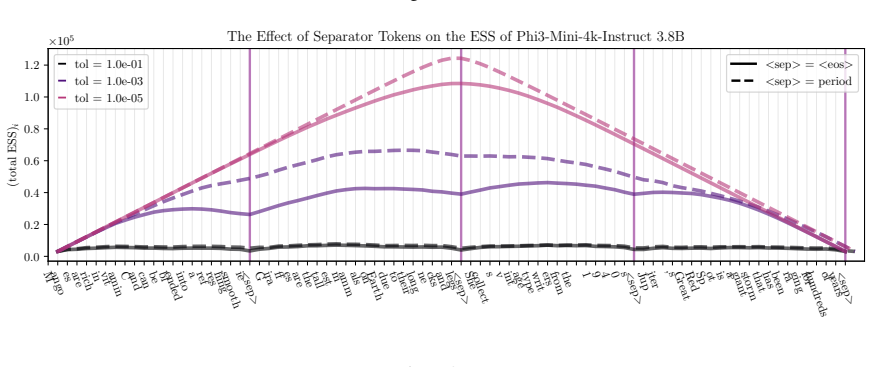
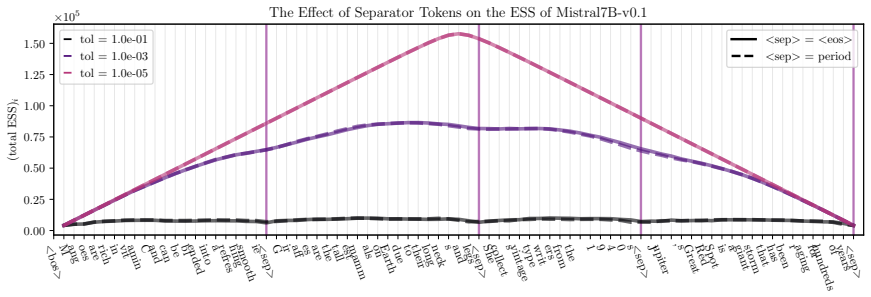
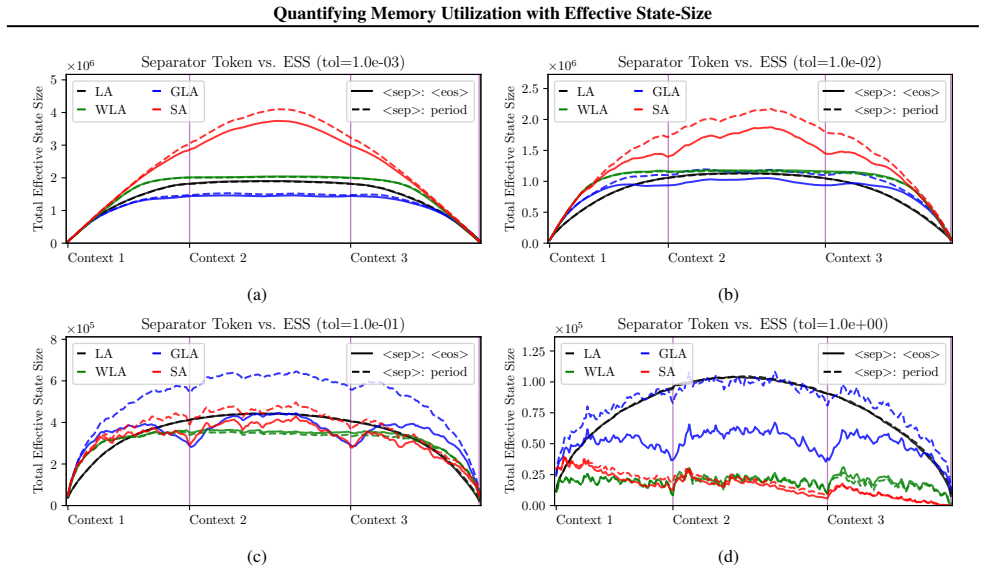
For a causal sequence model materialized as a linear operator $\mathbf{T}$, the effective state-size at sequence index $i$ is the rank of the submatrix $\mathbf{H}_i \equiv \mathbf{T}_{i:,:i-1}$, which collects the strictly causal part of the operator up to time $i$. By minimal realization theory, this rank exactly equals the minimal state size of any recurrence realizing the same input-invariant operator (Theorem 3.2); for input-varying linear systems it is a lower bound, requiring an empirical bridge. The paper's principal empirical discovery is that task-adjusted ESS ($\mathrm{ESS}/kv$ for associative recall) correlates with post-training accuracy across a sweep of four featurizer families (gated, weighted, and plain linear attention, plus softmax attention) substantially better than the corresponding cache-size measure $\mathrm{TSS}/kv$. It also identifies two failure modes: state saturation, where ESS is pinned near TSS because the state is too small; and state collapse, where a sufficiently large state is left largely unused. On language models, ESS exhibits dips when the model encounters end-of-speech tokens, a phenomenon the authors call state modulation, which they connect to recall performance on bigram tasks and to cross-architectural differences in handling context boundaries.
Load-bearing premise
That the numerical rank of a single forward pass's operator submatrix $\mathbf{H}_i$ tracks how much trainable memory a model actually engages when the model is input-varying, since the formal minimal-state-size theorem only covers input-invariant systems and LIVs are supported by an empirical correlation bridge.
Editorial extensions
If this is right
- ESS can serve as a diagnostic before and during training: measuring ESS at initialization can reveal whether an architecture is preconditioned to use all its states, as demonstrated by the poor ESS-TSS scaling of S6 at initialization.
- ESS can guide model-order reduction: a teacher layer with high ESS leads to larger distillation loss, so ESS is a predictor of compressibility that can steer the choice of student state sizes.
- ESS can be targeted by regularizers: pushing gated and weighted linear attention recurrences toward the identity, which increases ESS, cures state collapse and lets them outperform plain linear attention on recall tasks.
- ESS is a quantitative tool for studying language models: the dip in ESS at separator tokens (state modulation) can be used to compare architectures, and the hierarchy SA>GLA>WLA>LA in state modulation mirrors their bigram recall performance.
- ESS reconciles an apparent paradox in efficient sequence models: a model can have a large cache yet realize low memory utilization, which explains why capacity metrics alone mispredict recall behavior.
Reading between the lines
- ESS could be adapted to probe the per-layer or per-head distribution of memory use in very large models, potentially identifying which layers are redundant before any training run.
- The state modulation measurement suggests a testable design principle for hybrid architectures: place layers with unbounded state capacity after layers that need to reset, which is consistent with why attention-first hybrids fail in the paper's experiments.
- The task-normalization step (dividing by the number of key-value pairs) is a place where a deeper theory could be built: if ESS were grounded in a task-dependent information requirement, the same metric could be extended to natural-language recall without hand-picking the normalizer.
- Entropy-ESS and tolerance-ESS disagree on state collapse, which suggests that a spectrally graded version of ESS could sharpen failure-mode diagnosis beyond the paper's binary categorization.
Signed reviews
Editorial analysis
A structured set of objections, weighed in public.
Referee Report
Summary. This paper introduces effective state-size (ESS), a per-sequence-index measure of memory utilization computed as the rank (or its tolerance- or entropy-smoothed variant) of the submatrix H_i = T_{i:,:i-1} of the materialized causal operator T = f_T(u). The authors prove (Theorem 3.2, Appendix D) that for input-invariant linear systems, rank(H_i) is the minimal state size of any recurrent realization, and they argue that for input-varying linear operators (LIVs) it lower-bounds the state size. They validate ESS by training GLA/LA/WLA/SA models on MQAR, selective copying, and compression, showing that ESS/kv correlates with accuracy better than TSS/kv (Section 4.1), that ESS tracks within-task performance over training (Section 4.2), and that failure modes (state saturation, state collapse) are visible in ESS/TSS. Applications include ESS-informed featurizer analysis of S6 at initialization, an A-to-I regularizer, model-order reduction via distillation, and the observation of 'state modulation' in LLM states at separator tokens.
Significance. The central theoretical contribution—equating rank(H_i) with the minimal recurrent state size for input-invariant operators—is a clean application of classical minimal realization theory, and the proof sketches in D.2.4 and D.3 are plausible. The entropy-ESS default is parameter-free, the PyTorch implementation is shipped in E.1.3, and the analysis choices that affect the headline correlations (kv normalization, the accuracy>0.95 filter for SA, the epoch-0 drop) are disclosed in E.3 rather than hidden; this transparency is a genuine strength. If the empirical bridge for LIVs holds, ESS would be a useful, cheap diagnostic: it exposes that S6's state initialization under-utilizes added capacity (Section A) and that GLA/WLA suffer state collapse that an A-to-I regularizer can fix (Section B)—both falsifiable claims. The main risk is that every model in the validation set is an LIV, for which ESS is only a lower bound on causal state size, so the memory-utilization interpretation rests on the correlation evidence alone.
major comments (3)
- [§4.1 and §E.3] Section 4.1 states that 'measured over the entire task-model space, ESS/kv exhibits a significantly higher correlation with accuracy than TSS/kv,' but Section E.3 discloses three choices that materially shape this result: SA configurations with accuracy above 0.95 are filtered from the cross-task correlation, epoch 0 is dropped from the within-task correlations, and the kv normalization is called 'critical for observing the cross task-model correlations' (unnormalized ESS correlations 'break down,' per Figure 10g). Since this is the paper's principal validation of ESS for LIVs, the Section 4.1 claim should be re-scoped to the non-saturated task-model configurations, and the authors should report the number of points entering each correlation plus robustness checks such as unfiltered SA, alternative normalizations, or a partial correlation controlling for kv. The epoch-0 exclusion likewise deserves reporting alongside Figure 3, since Figure 25 shows a phase in which ESS decreases while accuracy is flat, which contradicts the 'ESS tracks performance' reading at initialization.
- [§3 'Interpreting effective state-size'; §D.2.2] The paper concedes that for LIVs the minimal realization of the materialized operator may be acausal, so ESS is only a lower bound on the state size required by a causal recurrence; the 'proxy for memory utilization' interpretation for LIVs is then justified only by the correlation evidence of Section 4. A direct test is available but not performed: Section D.2.2 defines the 'causally determinable minimal state-size (causal ESS)' as the rank of the causal projection [A_{i-1;1}B_0 ... A_{i-1}B_{i-2} B_{i-1}], which is computable from the trained features of GLA/LA/WLA and is exactly the state dimension a causal recurrence actually engages. Computing causal ESS on the sweep and comparing it with ESS (e.g., a scatter plot or the ratio ESS/causal-ESS) would quantify the acausality gap and either support or bound the memory-utilization interpretation. Without this comparison, the central claim cannot be distinguished from the weaker claim that ESS predicts performance.
- [§4.1, Figure 4] The headline comparison 'ESS/kv exhibits a significantly higher correlation with accuracy than TSS/kv' is reported without confidence intervals, standard errors, or a significance test, despite the large scatter in Figure 2 and the non-independence of the points (they are bucketed by featurizer, TSS, kv, and sequence length, with ESS averaged over only 8 samples). A bootstrap over task-model configurations, or at least a report of the sample size and a correlation-difference test, is needed to support the word 'significantly'; as presented, part of the gap in Figure 4 may reflect the discreteness of TSS (a hyperparameter taking a handful of values) rather than the greater informativeness of ESS.
minor comments (5)
- [§3.1 'Computational complexity of ESS'] The complexity is stated as O((dℓ)^3) per layer, but the per-sequence-index definition requires an SVD of H_i at every i, giving O(d · Σ_i (ℓ−i)·i·min(ℓ−i,i)) = O(dℓ^4) per layer if all indices are computed; please specify whether the stated bound refers to a single index and describe the protocol used for the (total ESS)_i plots in Section 5.2.
- [References] The reference list contains stray page annotations such as '(pages 1, 19)' after URLs (e.g., Abnar & Zuidema, Akaike, and most other entries); these appear to be leftover bibliography artifacts and should be removed.
- [Figure 6 / §4.2] Figure 6 and the state-saturation discussion use tolerance-ESS at tolerance 1e−3 (per Section E.3), but the main-text caption and prose do not state this; please add the tolerance to the figure caption.
- [§A, Eq. (A.0.1)] Equation (A.0.1) writes the GLA gate as diag(sigmoid(Wu)^{1/β}), which is inconsistent with Eq. (E.2.6) in Section E.2, diag(sigmoid(W_{A2}W_{A1}u_i)^{1/β}); the two formulations should be aligned.
- [§5.2 and §E.8] The 'preemptive state modulation' explanation attributes to SSMs a learned reliance on explicit EOS signals, but the evidence is descriptive ESS trajectories on a small fixed set of sentences; a control condition (e.g., non-semantic separator tokens) or a more cautious framing would strengthen the causal reading.
Circularity Check
No significant circularity: ESS is defined from the materialized operator independently of task accuracy, and the paper's correlations are empirical findings rather than reductions.
full rationale
The paper computes ESS as a rank functional of the operator submatrix Hi = Ti:,:i−1, with the entropy-ESS variant having no fitted constants and with no reference to the accuracies it later correlates with. The main validation claim, 'Measured over the entire task-model space, ESS/kv exhibits a significantly higher correlation with accuracy than TSS/kv', is an empirical correlation, not a derived equivalence. The theoretical result (Theorem 3.2) is a minimal-realization argument from classical linear system theory, and the proof rests on the rank-nullity theorem applied to factorizations of Hi, not on the paper's own conclusions. For LIVs, the paper explicitly concedes that the minimal realization process may not preserve causality and that ESS only lower-bounds the state size; the transition from lower bound to memory-utilization proxy is therefore an empirically tested interpretation, not a definitional tautology. The paper also discloses the sensitivity of the cross-task correlations to kv normalization, the SA accuracy filter, and the exclusion of epoch 0; these are analysis choices that bear on robustness and validity, not fitted parameters renamed as predictions. Citations to the authors' earlier MAD framework provide reproducible task definitions, and the core rank-to-state-size relation is not imported from those citations. Residual concerns about the LIV gap and the strength of the validation are correctness risks, not circularity.
Assumptions & free parameters
free parameters (6)
- kv normalization (ESS/kv) =
number of key-value pairs in the task
- SA accuracy filter threshold =
0.95
- epoch-0 exclusion =
drop epoch 0
- tolerance values (tolerance-ESS) =
1e-1, 1e-3, 1e-5 and 1e+0 across analyses
- entropy-ESS clip =
1e-12
- GLA-S6 arange normalization alpha =
1000 (default), swept upward
assumptions (6)
- domain assumption Most sequence models of interest can be faithfully expressed as y = Tu with input-invariant or input-varying linear operators (LIVs).
- standard math Classical minimal realization theory: the rank of the operator submatrix equals the minimal state dimension of a causal realization for input-invariant operators.
- domain assumption For LIVs, ESS only lower-bounds the state size because minimal realizations may be non-causal; the proxy interpretation is empirical.
- standard math Eckart-Young-Mirsky theorem justifies tolerance-ESS as the minimum state size for an approximation with spectral error below tolerance.
- domain assumption Performance on MAD synthetic tasks (MQAR, selective copying, compression) approximates performance on large-scale language tasks.
- domain assumption The four 1B models (LA, WLA, GLA, SA) are comparable because they are trained under identical conditions.
invented entities (2)
-
State modulation
-
Preemptive state modulation
Cite this review
Pith. "Pith review of Quantifying Memory Utilization with Effective State-Size." pith.science (2026). https://pith.science/paper/CX7N4YGB
@misc{pith2026250419561,
  author       = {Pith},
  title        = {Pith review of: Quantifying Memory Utilization with Effective State-Size},
  year         = {2026},
  howpublished = {\url{https://pith.science/paper/CX7N4YGB}},
  note         = {Machine review of arXiv:2504.19561}
}
read the original abstract
The need to develop a general framework for architecture analysis is becoming increasingly important, given the expanding design space of sequence models. To this end, we draw insights from classical signal processing and control theory, to develop a quantitative measure of \textit{memory utilization}: the internal mechanisms through which a model stores past information to produce future outputs. This metric, which we call \textbf{\textit{effective state-size}} (ESS), is tailored to the fundamental class of systems with \textit{input-invariant} and \textit{input-varying linear operators}, encompassing a variety of computational units such as variants of attention, convolutions, and recurrences. Unlike prior work on memory utilization, which either relies on raw operator visualizations (e.g. attention maps), or simply the total \textit{memory capacity} (i.e. cache size) of a model, our metrics provide highly interpretable and actionable measurements. In particular, we show how ESS can be leveraged to improve initialization strategies, inform novel regularizers and advance the performance-efficiency frontier through model distillation. Furthermore, we demonstrate that the effect of context delimiters (such as end-of-speech tokens) on ESS highlights cross-architectural differences in how large language models utilize their available memory to recall information. Overall, we find that ESS provides valuable insights into the dynamics that dictate memory utilization, enabling the design of more efficient and effective sequence models.
Figures


Figures from the paper (42 more)










Reference graph
Works this paper leans on
-
[1]
write newline
" write newline "" before.all 'output.state := FUNCTION n.dashify 't := "" t empty not t #1 #1 substring "-" = t #1 #2 substring "--" = not "--" * t #2 global.max substring 't := t #1 #1 substring "-" = "-" * t #2 global.max substring 't := while if t #1 #1 substring * t #2 global.max substring 't := if while FUNCTION format.date year duplicate empty "emp...
-
[2]
Abnar, S. and Zuidema, W. Quantifying attention flow in transformers, 2020. URL https://arxiv.org/abs/2005.00928
arXiv 2020
-
[3]
Stochastic theory of minimal realization
Akaike, H. Stochastic theory of minimal realization. IEEE Transactions on Automatic Control, 19 0 (6): 0 667--674, 1974. doi:10.1109/TAC.1974.1100707
arXiv 1974
-
[4]
In-context language learning: Architectures and algorithms, 2024
Akyürek, E., Wang, B., Kim, Y., and Andreas, J. In-context language learning: Architectures and algorithms, 2024. URL https://arxiv.org/abs/2401.12973
arXiv 2024
-
[5]
The hidden attention of mamba models, 2024
Ali, A., Zimerman, I., and Wolf, L. The hidden attention of mamba models, 2024. URL https://arxiv.org/abs/2403.01590
arXiv 2024
- [6]
-
[7]
Alzahrani, N., Alyahya, H. A., Alnumay, Y., Alrashed, S., Alsubaie, S., Almushaykeh, Y., Mirza, F., Alotaibi, N., Altwairesh, N., Alowisheq, A., Bari, M. S., and Khan, H. When benchmarks are targets: Revealing the sensitivity of large language model leaderboards, 2024. URL https://arxiv.org/abs/2402.01781
arXiv 2024
-
[8]
Zoology: Measuring and improving recall in efficient language models, 2023
Arora, S., Eyuboglu, S., Timalsina, A., Johnson, I., Poli, M., Zou, J., Rudra, A., and Ré, C. Zoology: Measuring and improving recall in efficient language models, 2023. URL https://arxiv.org/abs/2312.04927
arXiv 2023
Show all 79 references
-
[9]
Simple linear attention language models balance the recall-throughput tradeoff, 2024
Arora, S., Eyuboglu, S., Zhang, M., Timalsina, A., Alberti, S., Zinsley, D., Zou, J., Rudra, A., and Ré, C. Simple linear attention language models balance the recall-throughput tradeoff, 2024. URL https://arxiv.org/abs/2402.18668
2024 arXiv
-
[10]
Z., and Ionescu, C
Ba, J., Hinton, G., Mnih, V., Leibo, J. Z., and Ionescu, C. Using fast weights to attend to the recent past, 2016. URL https://arxiv.org/abs/1610.06258
2016 arXiv
-
[11]
Beliczynski, B., Kale, I., and Cain, G. D. Approximation of fir by iir digital filters: An algorithm based on balanced model reduction. IEEE Transactions on Signal Processing, 40 0 (3): 0 532--542, 1992
1992
-
[12]
Understanding in-context learning in transformers and llms by learning to learn discrete functions, 2023
Bhattamishra, S., Patel, A., Blunsom, P., and Kanade, V. Understanding in-context learning in transformers and llms by learning to learn discrete functions, 2023. URL https://arxiv.org/abs/2310.03016
2023 arXiv
-
[13]
S., Reddi, S
Bhojanapalli, S., Yun, C., Rawat, A. S., Reddi, S. J., and Kumar, S. Low-rank bottleneck in multi-head attention models, 2020. URL https://arxiv.org/abs/2002.07028
2020 arXiv
-
[14]
Y., Xing, E
Bick, A., Li, K. Y., Xing, E. P., Kolter, J. Z., and Gu, A. Transformers to ssms: Distilling quadratic knowledge to subquadratic models, 2024. URL https://arxiv.org/abs/2408.10189
2024 arXiv
-
[15]
Cammarata, N., Carter, S., Goh, G., Olah, C., Petrov, M., Schubert, L., Voss, C., Egan, B., and Lim, S. K. Thread: Circuits. Distill, 2020. doi:10.23915/distill.00024. https://distill.pub/2020/circuits
2020 doi
-
[16]
Linear System Theory and Design
Chen, C.-T. Linear System Theory and Design. Oxford University Press, Inc., USA, 3rd edition, 1998. ISBN 0195117778
1998
-
[17]
and Gu, A
Dao, T. and Gu, A. Transformers are ssms: Generalized models and efficient algorithms through structured state space duality, 2024. URL https://arxiv.org/abs/2405.21060
2024 arXiv
-
[18]
L., Fernando, A., Botev, A., Cristian-Muraru, G., Gu, A., Haroun, R., Berrada, L., Chen, Y., Srinivasan, S., Desjardins, G., Doucet, A., Budden, D., Teh, Y
De, S., Smith, S. L., Fernando, A., Botev, A., Cristian-Muraru, G., Gu, A., Haroun, R., Berrada, L., Chen, Y., Srinivasan, S., Desjardins, G., Doucet, A., Budden, D., Teh, Y. W., Pascanu, R., Freitas, N. D., and Gulcehre, C. Griffin: Mixing gated linear recurrences with local ...
2024 arXiv
-
[19]
and van der Veen, A
DeWilde, P. and van der Veen, A. Time-Varying Systems and Computations. Springer US, 1998. ISBN 9780792381891. URL https://books.google.co.jp/books?id=n3bEniJ2Wx8C
1998
-
[20]
Attention is not all you need: Pure attention loses rank doubly exponentially with depth, 2023
Dong, Y., Cordonnier, J.-B., and Loukas, A. Attention is not all you need: Pure attention loses rank doubly exponentially with depth, 2023. URL https://arxiv.org/abs/2103.03404
2023 arXiv
-
[21]
Dupont, E., Doucet, A., and Teh, Y. W. Augmented neural odes, 2019. URL https://arxiv.org/abs/1904.01681
2019 arXiv
-
[22]
A mathematical framework for transformer circuits
Elhage, N., Nanda, N., Olsson, C., Henighan, T., Joseph, N., Mann, B., Askell, A., Bai, Y., Chen, A., Conerly, T., DasSarma, N., Drain, D., Ganguli, D., Hatfield-Dodds, Z., Hernandez, D., Jones, A., Kernion, J., Lovitt, L., Ndousse, K., Amodei, D., Brown, T., Clark, J., Kaplan...
2021
-
[23]
Y., Dao, T., Saab, K
Fu, D. Y., Dao, T., Saab, K. K., Thomas, A. W., Rudra, A., and Ré, C. Hungry hungry hippos: Towards language modeling with state space models, 2023. URL https://arxiv.org/abs/2212.14052
2023 arXiv
-
[24]
and Juang, J.-N
Gawronski, W. and Juang, J.-N. Model reduction in limited time and frequency intervals. International Journal of Systems Science, 21 0 (2): 0 349--376, 1990. doi:10.1080/00207729008910366. URL https://doi.org/10.1080/00207729008910366
1990 doi
-
[25]
Zamba: A compact 7b ssm hybrid model, 2024
Glorioso, P., Anthony, Q., Tokpanov, Y., Whittington, J., Pilault, J., Ibrahim, A., and Millidge, B. Zamba: A compact 7b ssm hybrid model, 2024. URL https://arxiv.org/abs/2405.16712
2024 arXiv
-
[26]
and Bengio, Y
Glorot, X. and Bengio, Y. Understanding the difficulty of training deep feedforward neural networks. In Teh, Y. W. and Titterington, M. (eds.), Proceedings of the Thirteenth International Conference on Artificial Intelligence and Statistics, volume 9 of Proceedings of Machine ...
2010
-
[27]
and Dao, T
Gu, A. and Dao, T. Mamba: Linear-time sequence modeling with selective state spaces, 2024. URL https://arxiv.org/abs/2312.00752
2024 arXiv
-
[28]
Efficiently modeling long sequences with structured state spaces, 2022 a
Gu, A., Goel, K., and Ré, C. Efficiently modeling long sequences with structured state spaces, 2022 a . URL https://arxiv.org/abs/2111.00396
2022 arXiv
-
[29]
On the parameterization and initialization of diagonal state space models, 2022 b
Gu, A., Gupta, A., Goel, K., and Ré, C. On the parameterization and initialization of diagonal state space models, 2022 b . URL https://arxiv.org/abs/2206.11893
2022 arXiv
-
[30]
Liquid structural state-space models, 2022
Hasani, R., Lechner, M., Wang, T.-H., Chahine, M., Amini, A., and Rus, D. Liquid structural state-space models, 2022. URL https://arxiv.org/abs/2209.12951
2022 arXiv
-
[31]
Measuring massive multitask language understanding, 2021
Hendrycks, D., Burns, C., Basart, S., Zou, A., Mazeika, M., Song, D., and Steinhardt, J. Measuring massive multitask language understanding, 2021. URL https://arxiv.org/abs/2009.03300
2021 arXiv
-
[32]
Ho, B. L. and Kalman, R. E. Effective construction of linear state-variable models from input/output functions. at - Automatisierungstechnik, 14 0 (1-12): 0 545--548, 1966. doi:doi:10.1524/auto.1966.14.112.545
1966 doi
-
[33]
and Schmidhuber, J
Hochreiter, S. and Schmidhuber, J. Long short-term memory. Neural Comput., 9 0 (8): 0 1735–1780, nov 1997. ISSN 0899-7667. doi:10.1162/neco.1997.9.8.1735. URL https://doi.org/10.1162/neco.1997.9.8.1735
1997 doi
-
[34]
A., Welbl, J., Clark, A., Hennigan, T., Noland, E., Millican, K., van den Driessche, G., Damoc, B., Guy, A., Osindero, S., Simonyan, K., Elsen, E., Rae, J
Hoffmann, J., Borgeaud, S., Mensch, A., Buchatskaya, E., Cai, T., Rutherford, E., de Las Casas, D., Hendricks, L. A., Welbl, J., Clark, A., Hennigan, T., Noland, E., Millican, K., van den Driessche, G., Damoc, B., Guy, A., Osindero, S., Simonyan, K., Elsen, E., Rae, J. W., Vin...
2022 arXiv
-
[35]
Transformers are rnns: Fast autoregressive transformers with linear attention, 2020
Katharopoulos, A., Vyas, A., Pappas, N., and Fleuret, F. Transformers are rnns: Fast autoregressive transformers with linear attention, 2020. URL https://arxiv.org/abs/2006.16236
2020 arXiv
-
[36]
Kiranyaz, S., Avci, O., Abdeljaber, O., Ince, T., Gabbouj, M., and Inman, D. J. 1d convolutional neural networks and applications: A survey, 2019. URL https://arxiv.org/abs/1905.03554
2019 arXiv
-
[37]
Jamba: A hybrid transformer-mamba language model, 2024
Lieber, O., Lenz, B., Bata, H., Cohen, G., Osin, J., Dalmedigos, I., Safahi, E., Meirom, S., Belinkov, Y., Shalev-Shwartz, S., Abend, O., Alon, R., Asida, T., Bergman, A., Glozman, R., Gokhman, M., Manevich, A., Ratner, N., Rozen, N., Shwartz, E., Zusman, M., and Shoham, Y. Ja...
2024 arXiv
-
[38]
and Picci, G
Lindquist, A. and Picci, G. On the stochastic realization problem. SIAM J. Control Optim., 17 0 (3): 0 365–389, May 1979. ISSN 0363-0129. doi:10.1137/0317028. URL https://doi.org/10.1137/0317028
1979 doi
-
[39]
System Identification: Theory for the User
Ljung, L. System Identification: Theory for the User. Prentice Hall information and system sciences series. Prentice Hall PTR, 1999. ISBN 9780136566953. URL https://books.google.com/books?id=nHFoQgAACAAJ
1999
-
[40]
and Hutter, F
Loshchilov, I. and Hutter, F. Decoupled weight decay regularization, 2019. URL https://arxiv.org/abs/1711.05101
2019 arXiv
-
[41]
Lynn, P. A. and Fuerst, W. Introductory digital signal processing with computer applications (revised ed.). John Wiley & Sons, Inc., USA, 1994. ISBN 0471943746
1994
-
[42]
and Cundy, C
Martin, E. and Cundy, C. Parallelizing linear recurrent neural nets over sequence length, 2018. URL https://arxiv.org/abs/1709.04057
2018 arXiv
-
[43]
Dissecting neural odes, 2021
Massaroli, S., Poli, M., Park, J., Yamashita, A., and Asama, H. Dissecting neural odes, 2021. URL https://arxiv.org/abs/2002.08071
2021 arXiv
-
[44]
Y., Kumbong, H., Parnichkun, R
Massaroli, S., Poli, M., Fu, D. Y., Kumbong, H., Parnichkun, R. N., Timalsina, A., Romero, D. W., McIntyre, Q., Chen, B., Rudra, A., Zhang, C., Re, C., Ermon, S., and Bengio, Y. Laughing hyena distillery: Extracting compact recurrences from convolutions, 2023. URL https://arxi...
2023 arXiv
-
[45]
and Li, Z
Min, Z. and Li, Z. On the efficiency of transformers: The effect of attention rank, 2024. URL https://openreview.net/forum?id=U9sHVjidYH
2024
-
[46]
In-context learning and induction heads
Olsson, C., Elhage, N., Nanda, N., Joseph, N., DasSarma, N., Henighan, T., Mann, B., Askell, A., Bai, Y., Chen, A., Conerly, T., Drain, D., Ganguli, D., Hatfield-Dodds, Z., Hernandez, D., Johnston, S., Jones, A., Kernion, J., Lovitt, L., Ndousse, K., Amodei, D., Brown, T., Cla...
2022
-
[47]
In-context learning and induction heads
Olsson, C., Elhage, N., Nanda, N., Joseph, N., DasSarma, N., Henighan, T., Mann, B., Askell, A., Bai, Y., Chen, A., Conerly, T., Drain, D., Ganguli, D., Hatfield-Dodds, Z., Hernandez, D., Johnston, S., Jones, A., Kernion, J., Lovitt, L., Ndousse, K., Amodei, D., Brown, T., Cla...
2022
-
[48]
V., Willsky, A
Oppenheim, A. V., Willsky, A. S., and Nawab, S. H. Signals & systems (2nd ed.). Prentice-Hall, Inc., USA, 1996. ISBN 0138147574
1996
-
[49]
L., Gu, A., Fernando, A., Gulcehre, C., Pascanu, R., and De, S
Orvieto, A., Smith, S. L., Gu, A., Fernando, A., Gulcehre, C., Pascanu, R., and De, S. Resurrecting recurrent neural networks for long sequences, 2023. URL https://arxiv.org/abs/2303.06349
2023 arXiv
-
[50]
N., Massaroli, S., Moro, A., Smith, J
Parnichkun, R. N., Massaroli, S., Moro, A., Smith, J. T. H., Hasani, R., Lechner, M., An, Q., Ré, C., Asama, H., Ermon, S., Suzuki, T., Yamashita, A., and Poli, M. State-free inference of state-space models: The transfer function approach, 2024. URL https://arxiv.org/abs/2405.06147
2024 arXiv
-
[51]
On the difficulty of training recurrent neural networks, 2013
Pascanu, R., Mikolov, T., and Bengio, Y. On the difficulty of training recurrent neural networks, 2013. URL https://arxiv.org/abs/1211.5063
2013 arXiv
-
[52]
B., Lozhkov, A., Mitchell, M., Raffel, C., Werra, L
Penedo, G., Kydlíček, H., allal, L. B., Lozhkov, A., Mitchell, M., Raffel, C., Werra, L. V., and Wolf, T. The fineweb datasets: Decanting the web for the finest text data at scale, 2024
2024
-
[53]
Y., Dao, T., Baccus, S., Bengio, Y., Ermon, S., and Ré, C
Poli, M., Massaroli, S., Nguyen, E., Fu, D. Y., Dao, T., Baccus, S., Bengio, Y., Ermon, S., and Ré, C. Hyena hierarchy: Towards larger convolutional language models, 2023. URL https://arxiv.org/abs/2302.10866
2023 arXiv
-
[54]
W., Nguyen, E., Ponnusamy, P., Deiseroth, B., Kersting, K., Suzuki, T., Hie, B., Ermon, S., Ré, C., Zhang, C., and Massaroli, S
Poli, M., Thomas, A. W., Nguyen, E., Ponnusamy, P., Deiseroth, B., Kersting, K., Suzuki, T., Hie, B., Ermon, S., Ré, C., Zhang, C., and Massaroli, S. Mechanistic design and scaling of hybrid architectures, 2024. URL https://arxiv.org/abs/2403.17844
2024 arXiv
-
[55]
Grokking: Generalization beyond overfitting on small algorithmic datasets, 2022
Power, A., Burda, Y., Edwards, H., Babuschkin, I., and Misra, V. Grokking: Generalization beyond overfitting on small algorithmic datasets, 2022. URL https://arxiv.org/abs/2201.02177
2022 arXiv
-
[56]
K., Greiff, V., Kreil, D., Kopp, M., Klambauer, G., Brandstetter, J., and Hochreiter, S
Ramsauer, H., Schäfl, B., Lehner, J., Seidl, P., Widrich, M., Adler, T., Gruber, L., Holzleitner, M., Pavlović, M., Sandve, G. K., Greiff, V., Kreil, D., Kopp, M., Klambauer, G., Brandstetter, J., and Hochreiter, S. Hopfield networks is all you need, 2021. URL https://arxiv.or...
2021 arXiv
-
[57]
W., Kuzina, A., Bekkers, E
Romero, D. W., Kuzina, A., Bekkers, E. J., Tomczak, J. M., and Hoogendoorn, M. Ckconv: Continuous kernel convolution for sequential data, 2022. URL https://arxiv.org/abs/2102.02611
2022 arXiv
-
[58]
and Vetterli, M
Roy, O. and Vetterli, M. The effective rank: A measure of effective dimensionality. In 2007 15th European Signal Processing Conference, pp.\ 606--610, 2007
2007
-
[59]
Rumelhart, D. E. and McClelland, J. L. Learning Internal Representations by Error Propagation, pp.\ 318--362. 1987
1987
-
[60]
Glu variants improve transformer, 2020
Shazeer, N. Glu variants improve transformer, 2020. URL https://arxiv.org/abs/2002.05202
2020 arXiv
-
[61]
Mutual information scaling and expressive power of sequence models, 2019
Shen, H. Mutual information scaling and expressive power of sequence models, 2019. URL https://arxiv.org/abs/1905.04271
2019 arXiv
-
[62]
Smith, J. T. H., Warrington, A., and Linderman, S. W. Simplified state space layers for sequence modeling, 2023. URL https://arxiv.org/abs/2208.04933
2023 arXiv
-
[63]
Roformer: Enhanced transformer with rotary position embedding, 2023
Su, J., Lu, Y., Pan, S., Murtadha, A., Wen, B., and Liu, Y. Roformer: Enhanced transformer with rotary position embedding, 2023. URL https://arxiv.org/abs/2104.09864
2023 arXiv
-
[64]
Z., and Liu, Z
Sun, M., Chen, X., Kolter, J. Z., and Liu, Z. Massive activations in large language models, 2024. URL https://arxiv.org/abs/2402.17762
2024 arXiv
-
[65]
Retentive network: A successor to transformer for large language models, 2023
Sun, Y., Dong, L., Huang, S., Ma, S., Xia, Y., Xue, J., Wang, J., and Wei, F. Retentive network: A successor to transformer for large language models, 2023. URL https://arxiv.org/abs/2307.08621
2023 arXiv
-
[66]
H., Bai, S., Yamada, M., Morency, L.-P., and Salakhutdinov, R
Tsai, Y.-H. H., Bai, S., Yamada, M., Morency, L.-P., and Salakhutdinov, R. Transformer dissection: A unified understanding of transformer's attention via the lens of kernel, 2019. URL https://arxiv.org/abs/1908.11775
2019 arXiv
-
[67]
Leveraging low-rank and sparse recurrent connectivity for robust closed-loop control, 2023
Tumma, N., Lechner, M., Loo, N., Hasani, R., and Rus, D. Leveraging low-rank and sparse recurrent connectivity for robust closed-loop control, 2023. URL https://arxiv.org/abs/2310.03915
2023 arXiv
-
[68]
A note on the representation and definition of semiseparable matrices
Vandebril, R., Van Barel, M., and Mastronardi, N. A note on the representation and definition of semiseparable matrices. Numerical Linear Algebra with Applications, 12 0 (8): 0 839--858, 2005. doi:https://doi.org/10.1002/nla.455. URL https://onlinelibrary.wiley.com/doi/abs/10....
2005 doi
-
[69]
N., Kaiser, L., and Polosukhin, I
Vaswani, A., Shazeer, N., Parmar, N., Uszkoreit, J., Jones, L., Gomez, A. N., Kaiser, L., and Polosukhin, I. Attention is all you need, 2023. URL https://arxiv.org/abs/1706.03762
2023 arXiv
-
[70]
A multiscale visualization of attention in the transformer model, 2019
Vig, J. A multiscale visualization of attention in the transformer model, 2019. URL https://arxiv.org/abs/1906.05714
2019 arXiv
-
[71]
Mmlu-pro: A more robust and challenging multi-task language understanding benchmark, 2024
Wang, Y., Ma, X., Zhang, G., Ni, Y., Chandra, A., Guo, S., Ren, W., Arulraj, A., He, X., Jiang, Z., Li, T., Ku, M., Wang, K., Zhuang, A., Fan, R., Yue, X., and Chen, W. Mmlu-pro: A more robust and challenging multi-task language understanding benchmark, 2024. URL https://arxiv...
2024 arXiv
-
[72]
Willems, J. C. Models for Dynamics, pp.\ 171--269. Vieweg+Teubner Verlag, Wiesbaden, 1989. ISBN 978-3-322-96657-5. doi:10.1007/978-3-322-96657-5_5. URL https://doi.org/10.1007/978-3-322-96657-5_5
1989 doi
-
[73]
On the role of attention masks and layernorm in transformers, 2024
Wu, X., Ajorlou, A., Wang, Y., Jegelka, S., and Jadbabaie, A. On the role of attention masks and layernorm in transformers, 2024. URL https://arxiv.org/abs/2405.18781
2024 arXiv
-
[74]
Xia, J., Chandrasekaran, S., Gu, M., and Li, X. S. Fast algorithms for hierarchically semiseparable matrices. Numerical Linear Algebra with Applications, 17 0 (6): 0 953--976, 2010. doi:https://doi.org/10.1002/nla.691. URL https://onlinelibrary.wiley.com/doi/abs/10.1002/nla.691
2010 doi
-
[75]
Efficient streaming language models with attention sinks, 2024
Xiao, G., Tian, Y., Chen, B., Han, S., and Lewis, M. Efficient streaming language models with attention sinks, 2024. URL https://arxiv.org/abs/2309.17453
2024 arXiv
-
[76]
Gated linear attention transformers with hardware-efficient training, 2024 a
Yang, S., Wang, B., Shen, Y., Panda, R., and Kim, Y. Gated linear attention transformers with hardware-efficient training, 2024 a . URL https://arxiv.org/abs/2312.06635
2024 arXiv
-
[77]
Parallelizing linear transformers with the delta rule over sequence length, 2024 b
Yang, S., Wang, B., Zhang, Y., Shen, Y., and Kim, Y. Parallelizing linear transformers with the delta rule over sequence length, 2024 b . URL https://arxiv.org/abs/2406.06484
2024 arXiv
-
[78]
B'mojo: Hybrid state space realizations of foundation models with eidetic and fading memory, 2024
Zancato, L., Seshadri, A., Dukler, Y., Golatkar, A., Shen, Y., Bowman, B., Trager, M., Achille, A., and Soatto, S. B'mojo: Hybrid state space realizations of foundation models with eidetic and fading memory, 2024. URL https://arxiv.org/abs/2407.06324
2024 arXiv
-
[79]
Hellaswag: Can a machine really finish your sentence?, 2019
Zellers, R., Holtzman, A., Bisk, Y., Farhadi, A., and Choi, Y. Hellaswag: Can a machine really finish your sentence?, 2019. URL https://arxiv.org/abs/1905.07830
2019 arXiv
Reviewed August 16, 2026 · model on record in the stance chip above.
Discussion (0). Continue with ORCID to comment.