REVIEW 4 major objections 5 minor 4 cited by
Anisotropic neutron stars by gravitational decoupling
T0 review · 4 major / 5 minor · reviewed 2026-08-14 · deepseek-v4-flash
Pith's one-line read Extending a known perfect-fluid neutron-star model with minimal geometric deformation gives physically acceptable anisotropic stars whose stability against collapse and cracking decreases as compactness increases.
desk verdict Routine but competent MGD application; the headline stability ordering is real only for the chosen mimic closure, not for the θ-sector at large. read the letter →
The pith
A machine-rendered reading of the paper's core claim, the machinery that carries it, and where it could break.
The reading
What carries the argument
The Minimal Geometric Deformation (MGD) decoupling method: the radial metric is written $e^{-\lambda}=\mu+\alpha f$ while the temporal metric is left unchanged, and the anisotropic source $\theta_{\mu\nu}$ is solved from the resulting quasi-Einstein equations. The mimic constraint $\theta^1_1=p$ turns the junction condition into an algebraic equation for the deformation function $f$, giving a closed deformed solution. The stability analysis then uses the adiabatic index $\gamma=\frac{\tilde\rho+\tilde p_r}{\tilde p_r}\frac{d\tilde p_r}{d\tilde\rho}$ and the cracking condition $-1\le \frac{d\tilde p_\perp}{d\tilde\rho}-\frac{d\tilde p_r}{d\tilde\rho}\le 0$.
What would settle it
Compute the tidal Love number of the deformed solution for PSR J0348+0432 at the $\alpha$ values where the paper claims stability, then compare with gravitational-wave measurements of neutron-star tides: the stability verdict stands only if the model's prediction falls inside the measured band. A cheaper check is to redo the adiabatic-index and cracking analysis with a different closure replacing $\theta^1_1=p$; if the low-compactness stability ordering flips, it is an artifact of the mimic constraint.
Extended reading notes
Core claim
The central claim is that applying minimal geometric deformation with the mimic constraint $\theta^1_1=p$ to the isotropic seed solution of Ref. [68] produces an anisotropic neutron-star solution that is physically acceptable for all four compactness values tested, and whose stability is governed by compactness. For compactness $u=0.13$ (SAX J1808.4-3658) and $u=0.15478$ (Her X-1), the adiabatic index stays above $4/3$ and the cracking indicator stays within the stable window for every deformation parameter $\alpha$ considered. For $u=0.2035$ (Cen X-3) and $u=0.229365$ (PSR J0348+0432), the adiabatic index drops below $4/3$ for the largest $\alpha$ values and the cracking condition is violated at all $\alpha$ studied. The paper states this conclusion directly: the most stable anisotropic models are those with the smallest compactness parameters.
Load-bearing premise
The load-bearing premise is the mimic constraint $\theta^1_1=p$, which fixes the geometric deformation by equating the anisotropic source's radial stress to the seed pressure; it is chosen so the exterior junction condition is automatic, but it is not derived from microphysics, and real neutron-star matter need not obey it.
Editorial extensions
If this is right
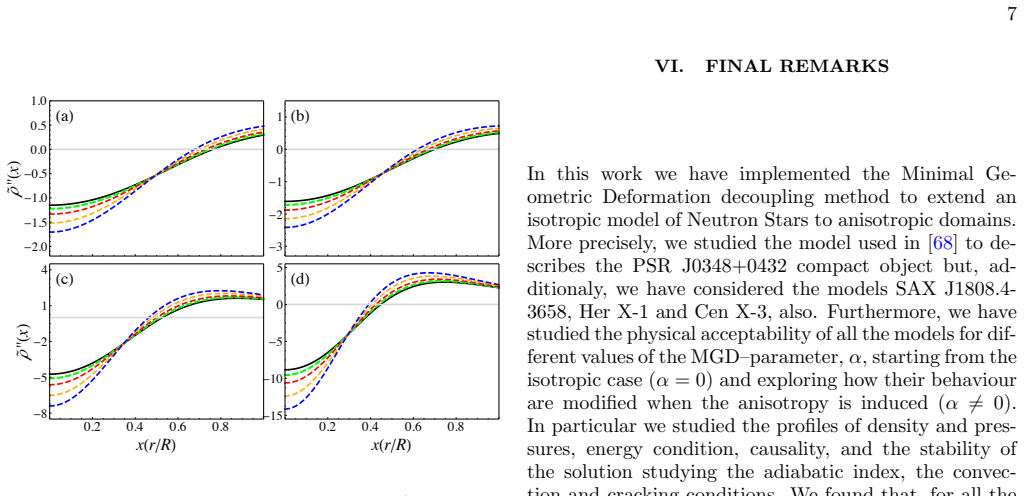
- For any of the four objects, the deformed model can describe anisotropy without sacrificing positive densities, positive pressures, the dominant and strong energy conditions, or causality for all values of $\alpha$ considered.
- Less compact stars tolerate the deformation: SAX J1808.4-3658 and Her X-1 remain stable by both the adiabatic-index and cracking criteria across all $\alpha$, while Cen X-3 and PSR J0348+0432 do not.
- The instability threshold moves with compactness: Cen X-3 and PSR J0348+0432 violate the $\gamma\ge 4/3$ condition only for the largest $\alpha$ values, but violate the cracking condition for every $\alpha$.
- The paper reports convection instability for all models, including the isotropic case $\alpha=0$, so anisotropy does not restore convective stability.
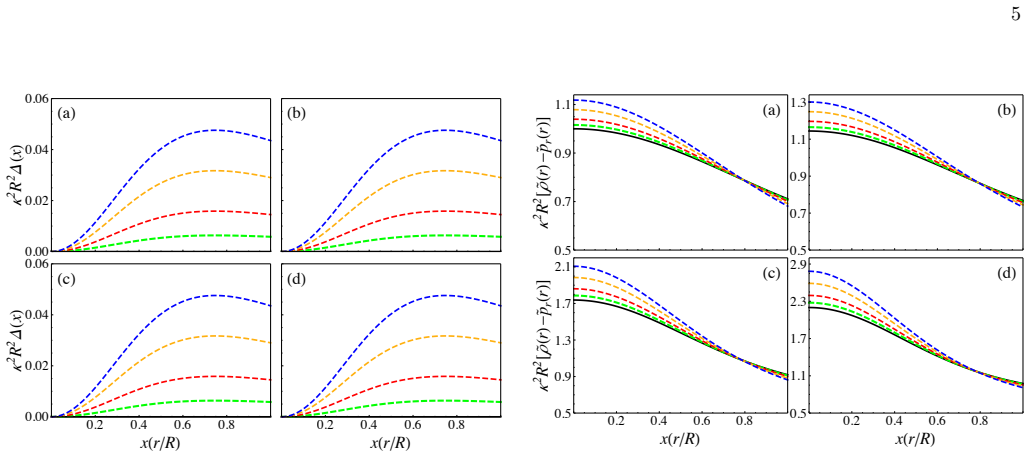
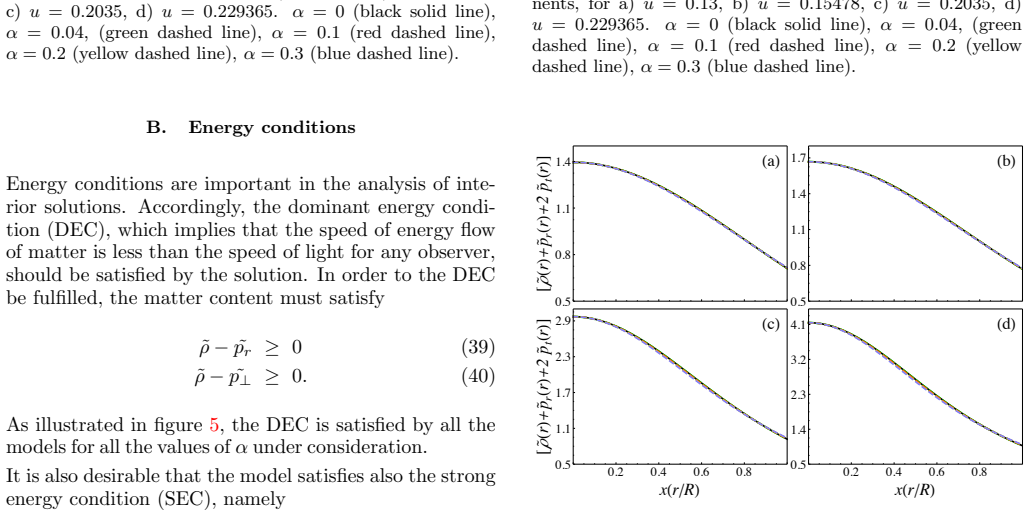
- Increasing the deformation parameter $\alpha$ raises the central density and lowers the effective pressures, driving the more compact models across the stability boundaries.
Reading between the lines
- Editorial inference: Because $\theta^1_1=p$ is one closure among many, the clean compactness-stability ordering is likely specific to this closure; repeating the analysis with an alternative closure such as $\theta^0_0=\rho$ would reveal which features are generic.
- Editorial inference: If the trend holds, neutron-star observations with measured masses and radii could constrain $\alpha$: any star denser than Cen X-3 that shows no sign of cracking would rule out the larger deformation parameters for this seed model.
- Editorial inference: The model's predicted anisotropy changes the star's tidal Love number, so gravitational-wave measurements of tidal deformability could indirectly test whether the mimic constraint is a good description of real neutron-star matter.
Editorial analysis
A structured set of objections, weighed in public.
Referee Report
Summary. The paper applies the Minimal Geometric Deformation (MGD) decoupling method to the isotropic perfect-fluid neutron star solution of Estevez-Delgado et al. [68], imposing the mimic constraint θ_1^1 = p (Eq. 27) to fix the deformation function f (Eq. 38). With the dimensionless parametrization r = xR, aR^2 = ω and the compactness relation (Eq. 37), the authors analyze the deformed solution for four observed compact objects (SAX J1808.4-3658, Her X-1, Cen X-3, PSR J0348+0432). They examine positivity and monotonicity of the effective density and pressures, anisotropy, energy conditions, causality, adiabatic index (Eq. 42), convection (Eq. 43), and gravitational cracking (Eq. 44). The paper concludes that the lower-compactness models are the most stable and that the MGD-deformed solution satisfies the same physical requirements as the isotropic seed.
Significance. The work is a standard MGD application with a concrete seed solution and four astrophysical compactness inputs. If the stability ordering is correct, the paper provides a useful worked example of how pressure anisotropy from gravitational decoupling shifts neutron-star stability. The construction is self-contained and the criteria are standard, and Eq. (37) gives a clean relation between the seed parameter and the compactness. The main caveat is that the conclusion is tied to the particular mimic closure; without checking alternative closures or clearly restricting the claim, the physical generality asserted in the abstract and conclusions is not established. Reproducibility is also limited by the absence of tabulated values for the seed parameter ω.
major comments (4)
- [§V.D, §VI, abstract] The central stability claim is obtained only under the mimic constraint θ_1^1 = p (Eq. 27). The junction condition (Eq. 26) does not fix the deformation uniquely: since p(R) = 0, any closure θ_1^1 = c p with constant c yields the same exterior matching, but different f from Eq. (18), different γ in Eq. (42), and different values of d p̃_t/dρ̃ − d p̃_r/dρ̃ in Eq. (44). The manuscript does not test this closure dependence, so the statement that 'the most stable anisotropic models are those with the smallest compactness parameters' overstates what has been shown. A test with alternative closures, or a qualified statement limiting the result to the mimic branch, is required.
- [§VI] The final remarks contain a sentence that directly contradicts the body of the paper: 'the configuration is stable for the most compact object considered and unstable for the other two models.' Section V.F and Fig. 11 show that the two most compact models, Cen X-3 (u = 0.2035) and PSR J0348+0432 (u = 0.229365), violate Eq. (44), while the least compact models are stable. This sentence must be corrected, otherwise the paper's main conclusion is internally inconsistent.
- [§IV] The parameter ω, obtained from Eq. (37), is an input to the deformation f in Eq. (38) and therefore to every quantity plotted in Figs. 1–11, but its numerical values for the four compactness parameters in Table I are never reported. Independent reproduction of the results requires solving Eq. (37), and the choice of root can matter for the plotted profiles. The authors should tabulate the ω values used and, ideally, provide the explicit matter-sector expressions or data files.
- [§V.B] The text states that the dominant energy condition is satisfied and cites both conditions (39) and (40), but Fig. 5 is explicitly labeled only for the radial component ρ̃ − p̃_r. The tangential condition ρ̃ − p̃_⊥ is not shown, so the DEC verification is incomplete as presented. The authors should either plot the tangential combination or state clearly that only the radial DEC was checked.
minor comments (5)
- [Figure 11] The caption begins with 'for α = −0.1' while the legend lists α = 0, 0.04, 0.1, 0.2, and 0.3; this appears to be a typographical artifact and should be corrected.
- [Eq. (42)] The adiabatic index is defined with the deformed density and radial pressure; the paper should clarify whether the standard γ ≥ 4/3 threshold remains directly applicable to anisotropic fluids or whether a modified bound is needed.
- [Table I] The compactness values are given to several significant figures, but the corresponding ω solutions from Eq. (37) are not reported; a short table or the inverse relation would improve transparency.
- [References] Several references are cited only as arXiv preprints, including the seed solution [68]; please add published journal details where they exist.
- [Figures] The figures are reproduced at low resolution and the line styles for different α values are difficult to distinguish; higher-resolution figures with clear legends would improve readability.
Circularity Check
No significant circularity: the MGD-deformed solution and stability conclusions are computed from an external seed, an explicit algebraic closure, and standard stability criteria, with no fitted quantity renamed as a prediction.
full rationale
The paper's derivation chain is self-contained given its stated inputs. The seed perfect-fluid solution and its compactness values are imported from external references [68] and [59]; the MGD deformation is implemented through the explicit geometric deformation (11)-(12) and the quasi-Einstein equations (17)-(19); the anisotropic sector is closed by the mimic constraint theta^1_1 = p (Eq. 27), which is an openly stated algebraic choice made so that the junction condition (Eq. 26) is automatically satisfied. The decoupling function f is then obtained by direct substitution into Eq. (18), yielding Eq. (38), and the effective density, pressures, and gradients used in the adiabatic index (Eq. 42) and cracking condition (Eq. 44) are computed from those closed expressions. No output quantity is fed back as an input, and no fitted parameter is later relabeled as a prediction. The stability ordering among SAX J1808.4-3658, Her X-1, Cen X-3, and PSR J0348+0432 is a graphical consequence of the resulting profiles for the chosen values of alpha, not a restatement of any prior fitted value. The mimic constraint is ad hoc and may limit the robustness of the conclusions, but arbitrariness of an ansatz is not circularity under the criteria used here. The paper contains many self-citations, but they are ordinary references to the MGD literature (e.g., [34] for the method, [52], [57], [58] for related applications) and none of the load-bearing steps reduces to an unverified self-citation. In particular, the paper does not invoke a uniqueness theorem from the authors' own prior work to forbid alternative closures. The claimed result is therefore not equivalent to its inputs by construction, and no specific circular reduction can be exhibited.
Assumptions & free parameters
free parameters (2)
- alpha (MGD deformation parameter) =
0, 0.04, 0.1, 0.2, 0.3 (not fitted)
- omega (seed dimensionless parameter) =
solved from Eq. (37) for each u; values not tabulated
assumptions (6)
- standard math Einstein field equations with total energy-momentum decomposed as perfect fluid plus theta-mu-nu source
- ad hoc to paper Mimic constraint theta^1_1 = p
- domain assumption Compactness parameters for the four stars taken from Table I of Ref. [59]
- standard math Schwarzschild exterior matching conditions (continuity of first and second fundamental forms)
- domain assumption Adiabatic index criterion gamma >= 4/3
- domain assumption Gravitational cracking criterion -1 <= dp_tilde_t/drho_tilde - dp_tilde_r/drho_tilde <= 0
Cite this review
Pith. "Pith review of Anisotropic neutron stars by gravitational decoupling." pith.science (2026). https://pith.science/paper/CY7VBQCH
@misc{pith2026190808194,
  author       = {Pith},
  title        = {Pith review of: Anisotropic neutron stars by gravitational decoupling},
  year         = {2026},
  howpublished = {\url{https://pith.science/paper/CY7VBQCH}},
  note         = {Machine review of arXiv:1908.08194}
}
read the original abstract
In this work we obtain an anisotropic neutron star solution by gravitational decoupling starting from a perfect fluid configuration which has been used to model the compact object PSR J0348+0432. Additionally, we consider the same solution to model the Binary Pulsar SAX J1808.4-3658 and X-ray Binaries Her X-1 and Cen X-3 ones. We study the acceptability conditions and obtain that the MGD--deformed solution obey the same physical requirements as its isotropic counterpart. Finally, we conclude that the most stable solutions, according to the adiabatic index and gravitational cracking criterion, are those with the smallest compactness parameters, namely SAX J1808.4-3658 and Her X-1.
Figures


Figures from the paper (5 more)



Forward citations
Cited by 4 Pith papers
-
Coherent quantum hairy black holes from gravitational decoupling: regularity, geodesics, and scalar ringdown
Gaussian-smearing the gravitational-decoupling hairy black hole produces a regular core and modified photon rings, lensing, and a claimed but absent ringdown spectrum.
-
Isotropization and change of complexity by gravitational decoupling
A gravitational decoupling technique that continuously isotropizes anisotropic stellar solutions and generates new solutions with controlled complexity factor, demonstrated on two exact examples.
-
Gravitational decoupling and regular hairy black holes: Geodesic stability, quasinormal modes, and thermodynamic properties
For the regular hairy black hole metric (29), larger β shrinks the ISCO and photon sphere, reduces QNM damping, and adds a canonical-ensemble stable phase.
-
Minimal Geometric Deformation in a Reissner-Nordstr\"om background
New exact Reissner-Nordström black hole solutions are built via minimal geometric deformation with a linear equation of state in the added source.
Reference graph
Works this paper leans on
-
[68]
the authors fixed the compactness parameter using data associated to PSR J0348+0432. IV. ANISOTROPIC NEUTRON ST AR BY MGD In what follows, we shall obtain the anisotropic solution implementing the mimic constraint studied in the pre- vious section. More precisely, from Eq. (27), we ob- tain f = −x2ω ( x2ω + 1 )( x2ω ( 2x2ω ( 36x2ω + 95 ) + 167 ) + 50 ) (4x...
-
[1]
and for a long time isotropic solutions have been broadly considered as suitable interior models of com- pact objects (see, for example, [2] and references therein). However, very few of these solutions can be considered as physically relevant because they violate some of the ele- mentary conditions that a realistic solution has to satisfy (for a list of ...
arXiv 1908
-
[2]
(10) Note that, at this point, the decomposition (2) seems as a simple separation of the constituents of the matter sec- tor. What is more, given the non–linearity of Einstein’s equations, such a decomposition does not lead to a decou- pling of two set of equations, one for each source involved. However, contrary to the broadly belief, the decoupling is p...
-
[3]
(20) which is a linear combination of Eqs
= 0. (20) which is a linear combination of Eqs. (17), (18) and (19). In this sense, there is no exchange of energy– momentum tensor between the perfect fluid and the anisotropic source and henceforth interaction is purely gravitational. As explained in previous sections, the MGD has been suc- cessfully used to extend isotropic solutions to anisotropic doma...
- [4]
-
[5]
K. Schwarzschild, Sitz. Deut. Akad. Wiss. Berlin K1. Math. Phys 1916, 189 (1916)
work page 1916
- [6]
-
[7]
B. V. Ivanov, Eur. Phys. J. C 77, 738 (2017)
work page 2017
Show all 75 references
-
[8]
Herrera, Phys.Lett
L. Herrera, Phys.Lett. A165, 206 1992
1992
-
[9]
Bowers and E
R. Bowers and E. Liang, Astrophys. J. 188, 657 (1974)
1974
-
[10]
Cosenza, M., Herrera, L., Esculpi, M., Witten, L, Journal of Mathematical Physics, 22, 118 (1981)
1981
-
[11]
Cosenza, M., Herrera, L., Esculpi, M., Witten, L, Phys. Rev. D 25, 2527 (1982)
1982
-
[12]
Herrera and N.O
L. Herrera and N.O. Santos, Phys. Rep. 286, 53 (1997)
1997
-
[13]
Bondi, Mon
H. Bondi, Mon. Not. R. Astron. Soc. 262, 1088 (1993). 8
1993
-
[14]
Barreto, Astrophys
W. Barreto, Astrophys. Space Sci. 201, 191 (1993)
1993
-
[15]
Mart´ ınez, D
J. Mart´ ınez, D. Pav´ on, and L. N´ u˜ nez, Mon. Not. R. As- tron. Soc. 271, 463 (1994)
1994
-
[16]
Herrera, A
L. Herrera, A. Di Prisco, J.Ospino, and E. Fuenmayor, J. Math. Phys. 42, 2129 (2001)
2001
-
[17]
Herrera, A
L. Herrera, A. Di Prisco, J. Hern´ andez-Pastora and N.O. Santos, Phys. Lett. A 237, 113 (1998)
1998
-
[18]
Bondi, Mon
H. Bondi, Mon. Not. R. Astron. Soc. 302, 337 (1999)
1999
-
[19]
Hern´ andez, L
H. Hern´ andez, L. N´ u˜ nez, and U.Percoco, Class. Quantum Grav. 16, 897 (1999)
1999
- [20]
-
[21]
P´ erez Mart´ ınez, H.P
A. P´ erez Mart´ ınez, H.P. Rojas, and H.M. Cuesta, Eur. Phys. J. C 29, 111 (2003)
2003
-
[22]
Herrera, J
L. Herrera, J. Ospino and A. Di Prisco, Phys. Rev. D 77, 027502 (2008)
2008
-
[23]
Hern´ andez, L
H. Hern´ andez, L. N´ u˜ nez, A. V´ azques, Eur. Phys. J. C 78, 883 (2018)
2018
-
[24]
Casadio, J
R. Casadio, J. Ovalle. Phys. Lett. B 715, 251 (2012)
2012
-
[25]
J. Ovalle. Mod. Phys. Lett. A 23, 3247 (2008)
2008
-
[26]
J. Ovalle. Int. J. Mod. Phys. D 18, 837 (2009)
2009
-
[27]
J. Ovalle. Mod. Phys. Lett. A 25, 3323 (2010)
2010
-
[28]
Casadio, J
R. Casadio, J. Ovalle. Class. Quantum Grav. 32, 215020 (2015)
2015
-
[29]
Ovalle, F
J. Ovalle, F. Linares. Phys. Rev. D 88, 104026 (2013)
2013
-
[30]
Ovalle, F
J. Ovalle, F. Linares, A. Pasqua, A. Sotomayor. Class. Quantum Grav. 30,175019 (2013)
2013
-
[31]
Quantum Grav
R Casadio, J Ovalle, R da Rocha, Class. Quantum Grav. 31, 045015 (2014)
2014
-
[32]
R. T. Cavalcanti, A. Goncalves da Silva, R. da Rocha. Class. Quantum Grav. 33, 215007(2016)
2016
-
[33]
Ovalle, L.A
J. Ovalle, L.A. Gergely, R. Casadio. Class. Quantum Grav. 32, 045015 (2015)
2015
-
[34]
Casadio, J
R. Casadio, J. Ovalle, R. da Rocha. EPL 110, 40003 (2015)
2015
-
[35]
J. Ovalle. Int. J. Mod. Phys. Conf. Ser. 41, 1660132 (2016)
2016
-
[36]
da Rocha
R. da Rocha. Eur. Phys. J. C 77, 355 (2017)
2017
-
[37]
Casadio, R
R. Casadio, R. da Rocha. Phys. Lett. B 763, 434 (2016)
2016
-
[38]
J. Ovalle. Phys. Rev. D 95, 104019 (2017)
2017
-
[39]
da Rocha
R. da Rocha. Phys. Rev. D 95, 124017 (2017)
2017
-
[40]
Estrada, F
M. Estrada, F. Tello-Ortiz. Eur. Phys. J. Plus 133, 453 (2018)
2018
-
[41]
Casadio, P
R. Casadio, P. Nicolini, R. da Rocha. Class. Quantum Grav. 35, 185001 (2018)
2018
-
[42]
Ovalle, R
J. Ovalle, R. Casadio, R. da Rocha, A. Sotomayor. Eur. Phys. J. C 78, 122 (2018)
2018
-
[43]
Ovalle, R
J. Ovalle, R. Casadio, R. da Rocha, A. Sotomayor and Z. Stuchlik, EPL 124, 20004 (2018)
2018
-
[44]
Sharif, S
M. Sharif, S. Sadiq, Eur. Phys. J. C 78, 410 (2018)
2018
-
[45]
Ovalle, R
J. Ovalle, R. Casadio, R. da Rocha, A. Sotomayor, Z. Stuchlik, Eur. Phys. J. C 78, 960 (2018)
2018
-
[46]
Las Heras, P
C. Las Heras, P. Leon. Fortschr. Phys. 66, 1800036 (2018)
2018
-
[47]
Gabbanelli, A
L. Gabbanelli, A. Rinc´ on, C. Rubio. Eur. Phys. J. C 78 370 (2018)
2018
-
[48]
Fernandes-Silva, R
A. Fernandes-Silva, R. da Rocha. Eur. Phys.J. C 78, 271 (2018)
2018
-
[49]
Sharif, S
M. Sharif, S. Saba, Eur. Phys. J. C 78, 921(2018)
2018
-
[50]
Sharif, S
M. Sharif, S. Sadiq, Eur. Phys. J. Plus 133, 245 (2018)
2018
-
[51]
Fernandes-Silva, A
A. Fernandes-Silva, A. J. Ferreira-Martins, R. da Rocha. Eur. Phys. J. C 78, 631 (2018)
2018
-
[52]
Contreras, Eur
E. Contreras, Eur. Phys. J. C 78, 678 (2018)
2018
-
[53]
Contreras and P
E. Contreras and P. Bargue˜ no. Eur. Phys. J. C 78, 558 (2018)
2018
-
[54]
Morales, F
E. Morales, F. Tello-Ortiz, Eur. Phys. J. C78, 841 (2018)
2018
-
[55]
Morales, F
E. Morales, F. Tello-Ortiz, Eur. Phys. J. C 78, 618 (2018)
2018
-
[56]
Estrada, R
M. Estrada, R. Prado, Eur. Phys. J. Plus 134, 168 (2019)
2019
-
[57]
Panotopoulos, ´A
G. Panotopoulos, ´A. Rinc´ on, Eur. Phys. J. C 78, 851 (2018)
2018
-
[58]
Ovalle, Phys
J. Ovalle, Phys. Lett. B 788, 213 (2019)
2019
-
[59]
Contreras and P
E. Contreras and P. Bargue˜ no, Eur. Phys. J. C 78, 985 (2018)
2018
- [60]
-
[61]
Contreras, Class
E. Contreras, Class. Quantum Grav 36, 095004 (2019)
2019
-
[62]
Contreras, ´A
E. Contreras, ´A. Rinc´ on and P. Bargue˜ no, Eur. Phys. J. C 79, 216 (2019)
2019
-
[63]
Maurya, F
S. Maurya, F. Tello, Eur. Phys. J. C 79, 85 (2019)
2019
-
[64]
Gabbanelli, J
L. Gabbanelli, J. Ovalle, A. Sotomayor, Z. Stuchlik, R. Casadio, Eur. Phys. J. C 79, 486 (2019)
2019
- [65]
- [66]
- [67]
- [69]
- [70]
- [71]
-
[72]
Estevez-Delgado, J
G. Estevez-Delgado, J. Estevez-Delgado, N. Montelongo and M. Pineda. arxiv: 1807.1036
-
[73]
Moustakidis, Gen
Ch.C. Moustakidis, Gen. Rel. and Grav. 49, 68 (2017)
2017
-
[74]
Herrera, Phys
L. Herrera, Phys. Lett. A 165, 206 (1992)
1992
-
[75]
Abreu, H
H. Abreu, H. Hern´ andez and L. Nu˜ nez, Class. Quantum Grav 24, 4631 (2007)
2007
Reviewed August 14, 2026 · model on record in the stance chip above.
Discussion (0). Continue with ORCID to comment.