Quantifying the Distribution of Biexciton Emission Efficiencies in Colloidal Quantum Shells
Pith reviewed 2026-06-27 08:26 UTC · model grok-4.3
The pith
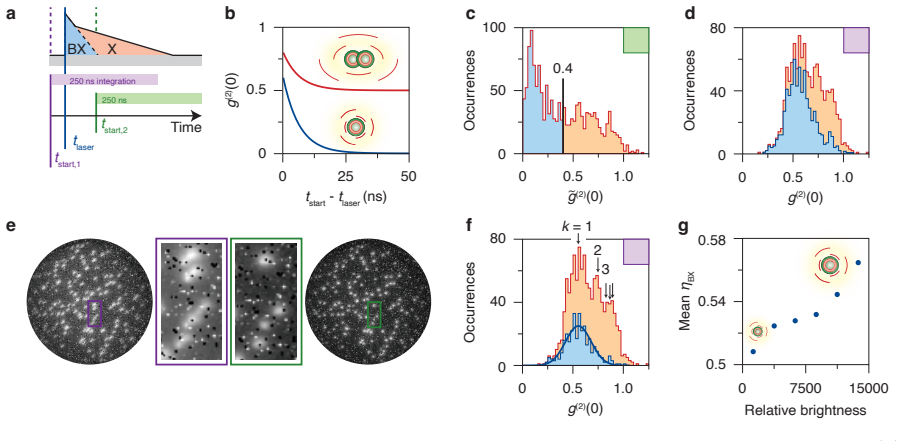
A crosstalk-suppressed SPAD-array method measures biexciton efficiencies across more than 1000 colloidal quantum shells and finds a near-Gaussian distribution with mean 0.55.
A machine-rendered reading of the paper's core claim, the machinery that carries it, and where it could break.
Core claim
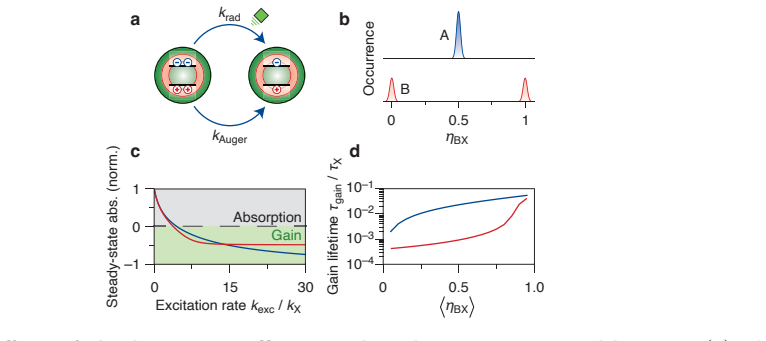
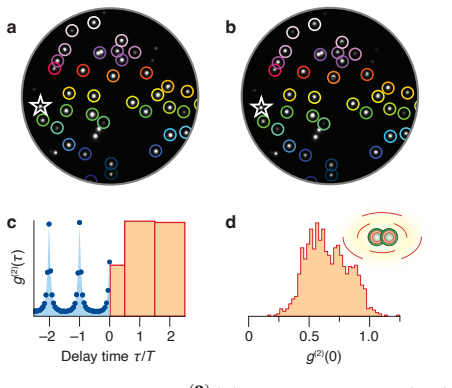
The crosstalk-suppressed SPAD-array photon-correlation approach projects two images onto distant regions of the detector array and uses time gating to suppress dark-count coincidences while distinguishing single emitters from clusters. Applied to colloidal quantum shells, this yields a near-Gaussian distribution of biexciton emission efficiencies with a mean of 0.55 and estimated intrinsic standard deviation of 0.12. Intra-batch correlations between biexciton efficiency and particle brightness are consistent with the volume scaling of Auger quenching.
What carries the argument
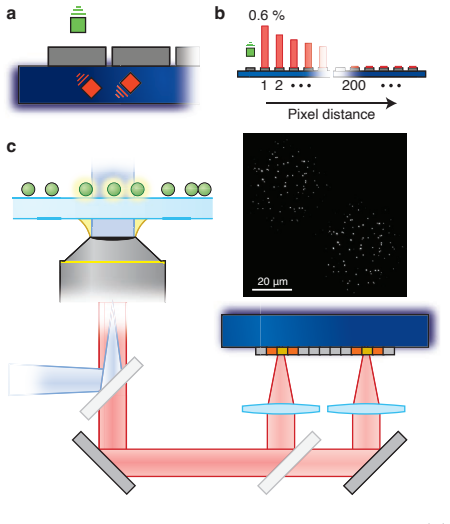
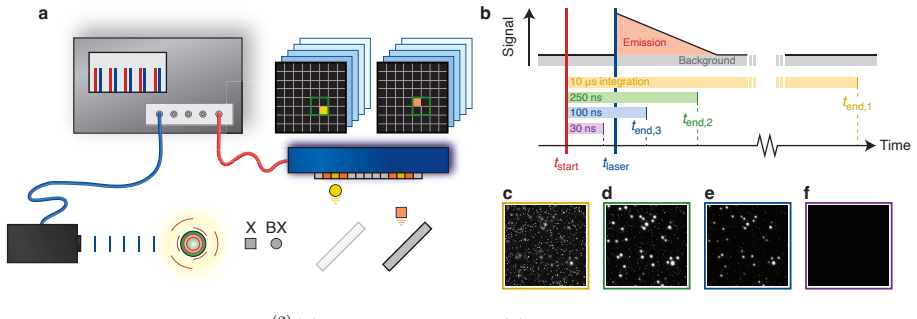
crosstalk-suppressed SPAD-array photon-correlation approach that projects duplicate images onto distant detector regions and applies time gating to remove short-range crosstalk and dark counts
If this is right
- Biexciton efficiencies across an ensemble of quantum shells can be quantified at high throughput without sequential single-particle measurements.
- The observed near-Gaussian spread indicates that most particles have efficiencies clustered around 0.55 rather than showing extreme outliers.
- Correlations between brightness and biexciton efficiency support Auger quenching as the dominant volume-dependent loss mechanism.
- The technique provides a scalable route to map multi-photon heterogeneities in other nanoparticle batches.
Where Pith is reading between the lines
- The same projection-and-gating strategy could be applied to characterize multi-photon emission in other colloidal systems such as perovskites or carbon dots.
- If brightness reliably predicts biexciton efficiency, post-synthesis sorting by brightness could raise the average performance of an entire batch.
- A consistent Gaussian shape across different synthesis batches would point to a statistical limit set by the growth process itself rather than random defects.
Load-bearing premise
Projecting two images onto distant regions of the SPAD array together with time gating fully removes short-range crosstalk and dark-count coincidences while correctly classifying individual emitters versus clusters without introducing systematic bias into the extracted efficiencies.
What would settle it
Repeating the experiment on the identical quantum-shell sample with a conventional single-particle confocal microscope setup and obtaining a mean biexciton efficiency differing by more than 0.1 or a clearly non-Gaussian shape.
Figures
read the original abstract
The efficiency of multi-photon emission is an important characteristic of quantum light sources. Bright multi-photon emission is desirable for high-power lighting and lasers, while its complete suppression is required for high-purity single-photon generation. In colloidal quantum emitters, multi-photon emission can vary significantly between individual particles. Resolving this heterogeneity remains challenging with conventional particle-by-particle approaches. Here, we introduce a crosstalk-suppressed SPAD-array photon-correlation approach for high-throughput quantification of multi-photon emission from more than 1000 colloidal quantum shells. By projecting two images of the same sample onto distant regions of the detector array, we avoid short-range crosstalk between detector pixels. Time gating suppresses dark-count coincidences and distinguishes individual emitters from clusters. Applying this method to quantum shells reveals a near-Gaussian distribution of biexciton emission efficiencies, with a mean of 0.55 and an estimated intrinsic standard deviation of 0.12. Intra-batch correlations between the biexciton efficiency and the particle brightness are consistent with the volume scaling of Auger quenching. These results establish SPAD-array photon correlation as a scalable route to resolve multi-photon heterogeneities in nanoparticle ensembles.
Editorial analysis
A structured set of objections, weighed in public.
Referee Report
Summary. The manuscript introduces a crosstalk-suppressed SPAD-array photon-correlation technique that projects two images of the sample onto distant detector regions and applies time gating to suppress short-range crosstalk and dark-count coincidences. Applied to more than 1000 colloidal quantum shells, the method yields a near-Gaussian distribution of biexciton emission efficiencies with mean 0.55 and estimated intrinsic standard deviation 0.12; intra-batch correlations between efficiency and brightness are interpreted as consistent with volume scaling of Auger quenching.
Significance. If validated, the high-throughput (>1000 particles) experimental approach provides a scalable route to quantify multi-photon emission heterogeneity in colloidal emitters, a quantity relevant to both single-photon sources and bright multi-photon devices. The reported distribution parameters and their correlation with brightness constitute concrete, falsifiable results that could benchmark models of Auger processes in quantum shells.
major comments (1)
- [Abstract, method description paragraph] Abstract, method description paragraph: the claim that dual-image projection onto distant SPAD regions plus time gating 'fully eliminates' short-range crosstalk and correctly classifies individual emitters versus clusters is not accompanied by quantitative bounds (e.g., measured coincidence rate on a blank sample, residual crosstalk fraction, or Monte-Carlo propagation of classification errors). Because the reported mean (0.55) and intrinsic σ (0.12) are extracted directly from the second-order correlation values, even a few-percent residual bias would shift both quantities and undermine the distribution shape.
Simulated Author's Rebuttal
We thank the referee for the constructive comment on the need for quantitative validation of crosstalk suppression. We address the point below and will revise the manuscript to incorporate the requested bounds.
read point-by-point responses
-
Referee: [Abstract, method description paragraph] Abstract, method description paragraph: the claim that dual-image projection onto distant SPAD regions plus time gating 'fully eliminates' short-range crosstalk and correctly classifies individual emitters versus clusters is not accompanied by quantitative bounds (e.g., measured coincidence rate on a blank sample, residual crosstalk fraction, or Monte-Carlo propagation of classification errors). Because the reported mean (0.55) and intrinsic σ (0.12) are extracted directly from the second-order correlation values, even a few-percent residual bias would shift both quantities and undermine the distribution shape.
Authors: We agree that the manuscript would be strengthened by explicit quantitative bounds rather than the qualitative claim of 'fully eliminates.' In the revision we will add: (i) measured coincidence rates from blank-sample controls under identical illumination and gating conditions, (ii) an upper-bound estimate of residual short-range crosstalk fraction derived from those controls, and (iii) a brief propagation of plausible residual bias through the g^(2) extraction pipeline to show its effect on the reported mean and intrinsic width. These additions will be placed in the methods section with a short discussion in the results. revision: yes
Circularity Check
No circularity: direct experimental measurement of biexciton efficiencies
full rationale
This is an experimental measurement paper that reports a distribution of biexciton emission efficiencies extracted from photon-correlation data on >1000 colloidal quantum shells. The mean (0.55) and intrinsic width (0.12) are obtained by applying the described SPAD-array projection, time-gating, and cluster-rejection procedure to raw coincidence counts; no equations, fits, or self-citations reduce these quantities to quantities defined by the same data or by prior self-referential results. The consistency check with volume scaling of Auger quenching is a post-hoc comparison, not a load-bearing derivation. The paper is therefore self-contained against external benchmarks and receives the default non-circularity score.
Axiom & Free-Parameter Ledger
axioms (2)
- standard math Photon arrival statistics for single emitters follow Poisson processes, allowing correlation functions to be interpreted as emission probabilities.
- domain assumption Spatial separation of images on the detector array plus time gating completely suppresses crosstalk and dark-count coincidences without biasing efficiency estimates.
Reference graph
Works this paper leans on
-
[1]
M.; Kholmicheva, N.; Kayira, B.; Waters, A
Harankahage, D.; Martin, W.; Elce, E.; Thennakoon, S.; Thennakoon, B.; Kan- nen, M. M.; Kholmicheva, N.; Kayira, B.; Waters, A. D.; Nazar, D.; Huang, J.; Anzenbacher, P.; Malko, A. V.; Zamkov, M. Eutectic processing of semiconduc- tor colloidal nanocrystals for energy applications.ACS Energy Letters 2026, 11, 2943–2951
2026
-
[2]
D.; Bondarchuk, M
Waters, A. D.; Bondarchuk, M. V.; Hicks, C. M.; Smith, S.; Nazar, D.; Kannen, M. M.; Harankahage, D.; Thennakoon, S.; Huang, J.; Anzenbacher, E.; Anzenbacher, P.; Tarnovsky, A. N.; Malko, A. V.; Zamkov, M. Stimulated emission from below the bandgap in giant quantum shells.J. Am. Chem. Soc. 2025, 147, 28454–28463
2025
-
[3]
B.; Marder, A.; Kayira, B.; Montemurri, M.; Anzenbacher, P.; Schaller, R
Harankahage, D.; Cassidy, J.; Beavon, J.; Huang, J.; Brown, N.; Berkinsky, D. B.; Marder, A.; Kayira, B.; Montemurri, M.; Anzenbacher, P.; Schaller, R. D.; Sun, L.; Bawendi, M. G.; Malko, A. V.; Diroll, B. T.; Zamkov, M. Quantum shell in a shell: engineering colloidal nanocrystals for a high-intensity excitation regime.J. Am. Chem. Soc.2023, 145, 13326–13334
2023
-
[4]
I.; Mikhailovsky, A.; Xu, S.; Malko, A.; Hollingsworth, J
Klimov, V. I.; Mikhailovsky, A.; Xu, S.; Malko, A.; Hollingsworth, J. A.; Leatherdale, C. A.; Eisler, H.-J.; Bawendi, M. Optical gain and stimulated emission in nanocrystal quantum dots.Science 2000, 290, 314–317
2000
-
[5]
Nair, G.; Zhao, J.; Bawendi, M. G. Biexciton quantum yield of single semiconductor nanocrystals from photon statistics.Nano Lett. 2011, 11, 1136–1140
2011
-
[6]
I.; Mikhailovsky, A
Klimov, V. I.; Mikhailovsky, A. A.; McBranch, D.; Leatherdale, C. A.; Bawendi, M. G. Quantization of multiparticle Auger rates in semiconductor quantum dots.Science 2000, 287, 1011–1013
2000
-
[7]
Quantum correlation measurement with single photon avalanche diode arrays.Opt
Lubin, G.; Tenne, R.; Michel Antolovic, I.; Charbon, E.; Bruschini, C.; Oron, D. Quantum correlation measurement with single photon avalanche diode arrays.Opt. Express 2019, 27, 32863–32882
2019
-
[8]
Optical crosstalk in single photon avalanche diode arrays: a new complete model
Rech, I.; Ingargiola, A.; Spinelli, R.; Labanca, I.; Marangoni, S.; Ghioni, M.; Cova, S. Optical crosstalk in single photon avalanche diode arrays: a new complete model. Opt. Express 2008, 16, 8381–8394
2008
-
[9]
Kuhn, H. W. The Hungarian method for the assignment problem.Nav. Res. Logist. Q. 1955, 2, 83–97
1955
-
[10]
Massively multiplexed wide-field photon correlation sensing.Optica 2025, 12, 451–458
Elmalem, S.; Lubin, G.; Wayne, M.; Bruschini, C.; Charbon, E.; Oron, D. Massively multiplexed wide-field photon correlation sensing.Optica 2025, 12, 451–458
2025
-
[11]
D.; Ghosh, Y.; Hollingsworth, J
Mangum, B. D.; Ghosh, Y.; Hollingsworth, J. A.; Htoon, H. Disentangling the effects of clustering and multi-exciton emission in second-order photon correlation experiments. Opt. Express 2013, 21, 7419–7426
2013
-
[12]
T.; Vaxenburg, R.; Bakulin, A
Rabouw, F. T.; Vaxenburg, R.; Bakulin, A. A.; van Dijk-Moes, R. J.; Bakker, H. J.; Rodina, A.; Lifshitz, E.; Efros, A. L.; Koenderink, A. F.; Vanmaekelbergh, D. Dy- namics of intraband and interband Auger processes in colloidal core–shell quantum dots. ACS nano 2015, 9, 10366–10376. 18
2015
discussion (0)
Sign in with ORCID, Apple, or X to comment. Anyone can read and Pith papers without signing in.