REVIEW 3 major objections 5 minor 12 references
Degradation and SEI Evolution in Alloy Anodes Revealed by Correlative Liquid-Cell Electrochemistry and Cryogenic Microscopy
T0 review · 3 major / 5 minor · reviewed 2026-08-07 · deepseek-v4-flash
Pith's one-line read Elemental lithium remains trapped inside a discharged platinum alloy anode, most likely at grain boundaries, and the authors offer this retained Li as a direct mechanism for irreversible capacity loss.
desk verdict A useful correlative characterization data set undercut by an overclaimed mechanistic conclusion—'direct evidence' of Li trapped at grain boundaries goes beyond what a single, manually cropped APT needle can show. read the letter →
The pith
A machine-rendered reading of the paper's core claim, the machinery that carries it, and where it could break.
The reading
What carries the argument
The central object is a frozen needle of the electrode-electrolyte interface, and the central mechanism is a two-stage correlative workflow. First, operando electrochemical liquid-cell transmission electron microscopy watches the polycrystalline Pt working electrode cycle in liquid LiPF₆/propylene carbonate, capturing mossy Li growth, swelling, cracking, and dead-Li detachment in real time. Then the chip is plunge-frozen, and a plasma focused-ion beam lifts out and sharpens a needle containing the frozen electrolyte, the SEI, and the Pt electrode, which is transferred under vacuum and cryogenic conditions into an atom probe that evaporates the needle atom-by-atom and builds a 3D chemical map. The argument runs on spatial correlation: Li appears inside the Pt electrode in 2D contour slices at successive depths, and the pattern stays consistent, which the authors read as confinement at grain boundaries rather than random residue; a control needle of uncycled frozen electrolyte shows almost no Li and no Li₃C, tying the interior Li to cycling. The authors also flag that pure-Li regions show 'plumes' associated with field-induced migration, so they restrict their conclusions to distortion-free regions of the reconstruction.
What would settle it
Cycle a polycrystalline Pt electrode, record its grain-boundary pattern with electron diffraction before freezing, then run cryo-atom-probe mapping on the same region; if the lithium-rich contours do not line up with the pre-mapped boundaries, the grain-boundary entrapment claim fails. A second check is to change the atom-probe analysis voltage or laser energy: if the interior lithium distribution moves with analysis conditions, part or all of the signal is a measurement artifact, not trapped lithium.
Extended reading notes
Core claim
The paper's central claim is that irreversible capacity loss in a platinum alloy anode is not only a surface problem. After four linear voltage sweeps in LiPF₆/propylene carbonate and a final discharge, the authors plunge-freeze the working electrode with electrolyte on it, lift out a needle of the frozen interface with a cryogenic focused-ion beam, and analyse it by atom probe tomography. The 3D reconstruction shows the Pt-rich electrode region still contains elemental Li, with the Li distribution staying consistently localized across successive depth slices rather than being spread uniformly; the authors interpret this as Li trapped along grain boundaries or similar structural defects, and on that basis they offer a mechanistic explanation for the roughly 30% first-cycle capacity loss previously attributed to retained inactive Li. Around the electrode, the same reconstruction shows a spatially heterogeneous solid-electrolyte interphase whose inner layer is lithium-carbonate-rich, a central core of pure Li interpreted as a mossy lithium deposit, and Pt-containing species in the electrolyte that indicate anodic dissolution of the Pt electrode itself. On the authors' account, the correlative workflow is what lets these features be assigned chemically and spatially in a native, frozen state.
Load-bearing premise
The load-bearing premise is that the lithium positions seen by the atomic-scale mapping technique were already inside the platinum before analysis, not lithium that the technique's own electric field moved around during the scan.
Editorial extensions
If this is right
- Irreversible capacity loss in alloy anodes has a third, internal source: elemental lithium retained inside the electrode at grain boundaries, on top of SEI formation and dead lithium.
- Because the inner SEI is lithium-carbonate-rich and grows unevenly at these voltages and scan rates, it does not form a uniform passivating layer, which favours the root-grown mossy lithium morphology seen in the liquid-cell movies.
- Retained Li confined at boundaries can build local strain over repeated cycling, providing a mechanism that connects Li entrapment to the progressive microstructural cracking observed across successive voltage sweeps.
- The frozen-interface workflow preserves the SEI and lithium deposits in something close to their native state, so the chemical assignments can be made spatially instead of inferred from bulk spectroscopy.
- The same correlative platform can be transferred to other alloy anodes and solid-liquid interfaces where interfacial chemistry governs performance, which is what the paper claims makes it a generalised tool.
Reading between the lines
- If grain-boundary Li entrapment is real and general, then alloy-anode capacity retention could be improved by controlling grain size and boundary character: a direct prediction is that fine-grained or nanocrystalline foils, with more boundary area, trap more Li and show larger first-cycle irreversible loss than coarse-grained foils.
- The same correlative workflow could be applied to Al, In, Zn, or Au foil anodes to test whether boundary-pinned Li is a common degradation route for elemental alloy anodes rather than a Pt-specific quirk.
- The observation of trace copper contamination in the liquid cell suggests microfluidic cleanliness is a variable in all such correlative studies; reinterpreting trace metal signals in prior liquid-cell battery experiments may be worthwhile.
- A quantitative version of this experiment, mapping retained Li mass fraction against cycle number while measuring capacity fade, would separate how much of the irreversible capacity comes from trapped Li versus dead Li and SEI formation.
Editorial analysis
A structured set of objections, weighed in public.
Referee Report
Summary. This manuscript reports a correlative study of a Pt alloy anode in LiPF6/propylene carbonate electrolyte using operando electrochemical liquid-cell transmission electron microscopy (E-LCTEM) followed by cryogenic atom probe tomography (cryo-APT). The authors observe mossy Li deposition, dead Li formation, electrode cracking, spatially heterogeneous SEI, a Li-rich inner SEI layer that they associate with Li2CO3, and the retention of elemental Li inside the Pt electrode after discharge, which they claim is trapped along grain boundaries. The paper proposes that these processes explain irreversible capacity loss in alloy anodes and argues that the correlative workflow is broadly applicable.
Significance. If the observations are robust, the work is significant for two reasons: it demonstrates a technically demanding correlative workflow (operando liquid-cell TEM followed by cryogenic FIB/APT on the same electrode) and it provides a candidate mechanistic explanation for irreversible lithium loss in platinum-based alloy anodes. Strengths include the candid discussion of APT artifacts, the inclusion of uncycled control specimens for both electrolyte and electrode (Supplementary Figs S8, S9), and detailed methods that should make the workflow reproducible. The central new mechanistic assertion, however, currently exceeds the evidence: the identification of grain boundaries as the trapping sites rests on morphological inference from a single manually curated APT reconstruction, and the acknowledged field-induced Li migration provides an alternative explanation for the Li-rich features. The paper is therefore of interest to the battery and atom-probe communities, but the claims need to be recalibrated or supported by additional data.
major comments (3)
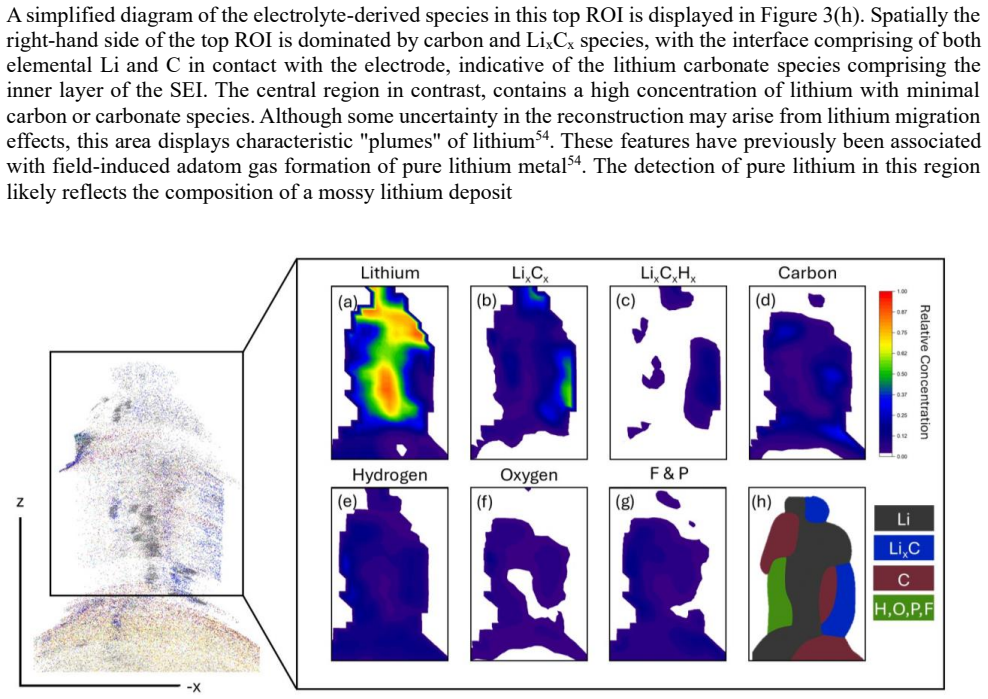
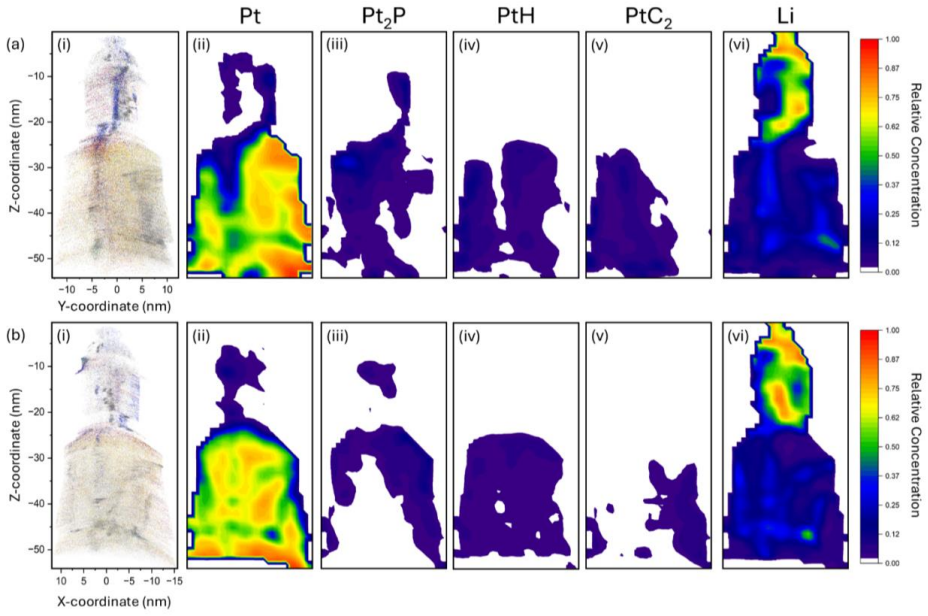
- [Cryogenic compositional mapping of the Pt-electrode (Figs 4, 5) and Conclusions] The claim of 'direct evidence of Li entrapment along grain boundaries' is not supported by the presented data. In the same section, the Li-enriched features are described as 'potentially grain boundaries or other structural defects,' and no independent microstructural measurement (e.g., EBSD, pre- or post-APT TEM of the same needle, or diffraction) is provided to show that the Li concentration correlates with actual grain boundaries. The paper itself acknowledges in 'Cryo-APT: perspective on accuracy and precision' that Li can migrate on the specimen surface under the intense electric field and reports 'plumes' of lithium attributed to field-induced adatom gas formation (Ref. 54). Surface migration can create or enhance Li-rich features that do not represent the original electrode microstructure. The load-bearing assumption that the measured Li distribution reflects trapped Li at grain boundaries is therefore unverified. Please either add a direct grain-boundary marker or revise the abstract, results, and conclusions to state that Li is retained within the electrode in features that may correspond to grain boundaries or other defects, removing 'direct evidence.'
- [Materials and Methods: Cryogenic Atom Probe Tomography; Figs 4, 5; Supplementary Fig. S7] The central observation rests on a single APT needle and on a manually selected region of the reconstruction. The methods state that 'only a subset of the full reconstruction was analysed' because of field-induced aberrations and migration, which introduces a risk of selection bias. The 2D contour plots and 1D concentration profiles in Figures 4, 5 and Supplementary Figure S7 are presented without counting statistics, error bars, or background levels, so the statistical significance of the Li-rich features cannot be assessed. Please report the number of detected ions in each slice, the background-subtraction procedure, and confidence intervals, and analyse at least one additional needle or provide an objective, pre-defined ROI-selection criterion.
- [Cryogenic compositional mapping of the SEI; Fig. 3] The identification of a 'lithium carbonate rich inner SEI layer' rests on the detection of Li-C species (e.g., Li3C) and an analogy to prior work, while the authors note that CO3+ may fragment and that neutral molecules can be lost (Ref. 52). In the absence of complementary spectroscopic or crystallographic confirmation on the same specimen, the evidence is consistent with, but not diagnostic of, Li2CO3. Please adjust the wording from 'reveals' or 'presence of lithium carbonate-rich inner SEI layers' to a more cautious formulation, or support the assignment with additional data such as EELS or XPS.
minor comments (5)
- [Introduction] The phrase 'a recently introduced correlative operando characterisation approach' (ref 37) should clarify which aspects are newly applied here as opposed to already demonstrated in ref 37, since ref 37 is the authors' own workflow paper.
- [Results: Operando Observation] The description 'four linear voltage sweeps from 0 to -4 V (vs. Pt)' should be accompanied by an explicit statement of the cell configuration (two-electrode vs three-electrode) and the open-circuit potential, because -4 V vs Pt is not a conventional lithiation potential.
- [Fig. 3(h)] The simplified diagram would be clearer if the orientation (X/Z axes) and the location of the electrode interface were marked.
- [Supplementary Fig. S7] The color assignments in the caption (pink Li, green F, dark pink P, etc.) are hard to follow; please add labels within the plot or a legend.
- [Results and Conclusions] The term 'discharged' used to describe the state of the electrode after the final voltage sweep is ambiguous; state the final applied voltage and hold time. Additionally, the mass-spectrum peak assignments (e.g., Pt2C+ and Pt2P+) should be justified with elemental/isotopic pattern modeling rather than by reference to 'ranged decomposed species' alone.
Circularity Check
No significant circularity: the paper's central observations are new experimental data, and its self-citations are methodological or interpretive context rather than load-bearing derivations.
full rationale
This is an experimental microscopy study, not a derivation or fitting paper. There are no equations, fitted parameters, or first-principles calculations whose outputs could reduce to their inputs. The main claims—mossy Li growth, SEI heterogeneity, Li retained in the Pt electrode, and Li-rich features persisting across depth slices—are presented as direct cryo-APT and LCTEM observations, not as restatements of prior work. The self-citations are used for the cryo-transfer workflow (Ref. 37) and for the field-induced Li adatom-gas artifact (Ref. 54); these support the methodology and data interpretation but do not by themselves force the grain-boundary entrapment conclusion. The comparison with an uncycled electrolyte and an uncycled Pt electrode provides external controls. The paper's stronger wording that Li is 'trapped along grain boundaries' goes beyond what the APT maps alone demonstrate, since no independent grain-boundary marker is provided and the authors themselves note that the Li-rich features are 'potentially grain boundaries or other structural defects.' That is an inference-strength or over-claiming concern, not a circularity concern, because the inference is not guaranteed by construction, by definition, or by a self-citation chain. No circular step meeting the required evidentiary standard is present.
Assumptions & free parameters
assumptions (4)
- domain assumption Mass spectral peak assignments in APT correctly separate Li, LixC, LixCxHx, and Pt-containing species from one another
- domain assumption Plunge freezing and cryogenic transfer preserve the native electrode-electrolyte interface without redistributing Li or altering SEI chemistry
- domain assumption The spatial distribution of Li in the APT reconstruction corresponds to the original crystallographic features, such as grain boundaries, rather than to APT reconstruction artifacts
- domain assumption The LCTEM voltage sweeps from 0 to -4 V vs Pt reproduce the early charging stages of a Pt alloy anode without introducing beam-induced artifacts
Cite this review
Pith. "Pith review of Degradation and SEI Evolution in Alloy Anodes Revealed by Correlative Liquid-Cell Electrochemistry and Cryogenic Microscopy." pith.science (2026). https://pith.science/paper/CZKC2QPA
@misc{pith2026250521434,
  author       = {Pith},
  title        = {Pith review of: Degradation and SEI Evolution in Alloy Anodes Revealed by Correlative Liquid-Cell Electrochemistry and Cryogenic Microscopy},
  year         = {2026},
  howpublished = {\url{https://pith.science/paper/CZKC2QPA}},
  note         = {Machine review of arXiv:2505.21434}
}
read the original abstract
Understanding solid liquid interfaces at high spatial and chemical resolution is crucial for advancing electrochemical energy storage technologies, yet this remains a persistent challenge due to the lack of characterisation techniques that can capture dynamic processes and preserve fragile interfacial chemistries. In lithium ion batteries, interfacial phenomena such as lithium alloying, solid electrolyte interphase formation, and electrode degradation play a decisive role in capacity retention and failure mechanisms but are difficult to observe in their native state due to high mobility, reactivity, and low atomic number of lithium. Here, we use a recently introduced correlative operando characterisation approach that integrates electrochemical liquid cell transmission electron microscopy with cryogenic atom probe tomography to resolve the evolution of a platinum alloy anode at the solid liquid interface during electrochemical cycling. This correlative, cryo enabled workflow reveals spatially heterogeneous SEI formation, the presence of lithium carbonate rich inner SEI layers, and the retention of elemental lithium within the platinum electrode, most likely trapped along grain boundaries. Additionally, we observe the formation of mossy lithium structures and irreversible lithium loss through dead lithium accumulation. Our results provide direct mechanistic insight into lithium alloying and degradation pathways in alloy based anodes and establish a generalised platform for probing dynamic electrochemical interfaces with complementary structural and chemical sensitivity. The methodology is broadly applicable to next generation electrode materials and electrochemical devices where interfacial dynamics dictate performance and stability.
Figures


Figures from the paper (2 more)
Reference graph
Works this paper leans on
-
[1]
J.; Tu, Z.; Choudhury, S.; Archer, L
(1) Zachman, M. J.; Tu, Z.; Choudhury, S.; Archer, L. A.; Kourkoutis, L. F . Cryo-STEM mapping of solid – liquid interfaces and dendrites in lithium-metal batteries. Nature 2018, 560 (7718), 345-349. (2) Kim, S.-H.; Antonov, S.; Zhou, X.; Stephenson, L. T.; Jung, C.; El-Zoka, A. A.; Schreiber, D. K.; Conroy, M.; Gault, B. Atom probe analysis of electrode ...
work page 2018
-
[7]
P .; Su, C.; Bai, P .; Kuriyama, N.; Maebashi, T.; Fujiwara, Y .; Bazant, M
(38) Kushima, A.; So, K. P .; Su, C.; Bai, P .; Kuriyama, N.; Maebashi, T.; Fujiwara, Y .; Bazant, M. Z.; Li, J. Liquid cell transmission electron microscopy observation of lithium metal growth and dissolution: Root growth, dead lithium and lithium flotsams. Nano Energy 2017, 32, 271-279. (39) Frenck, L.; Sethi, G. K.; Maslyn, J. A.; Balsara, N. P . Facto...
work page 2017
-
[12]
S.; Jung, C.; Zhang, S.; Büyükuslu, Ö
(55) Aota, L. S.; Jung, C.; Zhang, S.; Büyükuslu, Ö. K.; Saksena, A.; Hatipoglu, E.; Yadav, P .; Singh, M. P .; Chen, X.; Woods, E. Grain boundaries control lithiation of solid solution substrates in lithium metal batteries. Advanced Science 2025, 12 (4), 2409275. (56) Topalov, A. A.; Cherevko, S.; Zeradjanin, A. R.; Meier, J. C.; Katsounaros, I.; Mayrhof...
work page 2025
-
[24]
(42) Peled, E.; Menkin, S. SEI: past, present and future. Journal of The Electrochemical Society 2017, 164 (7), A1703. (43) Zeng, Z.; Liang, W. -I.; Chu, Y .-H.; Zheng, H. In situ TEM study of the Li –Au reaction in an electrochemical liquid cell. Faraday discussions 2014, 176, 95-107. (44) Awaludin, Z.; Okajima, T.; Ohsaka, T. Formation of Pt –Li alloy a...
work page 2017
-
[51]
(46) Woods, E. V .; Singh, M. P .; Kim, S.-H.; Schwarz, T. M.; Douglas, J. O.; El-Zoka, A. A.; Giulani, F .; Gault, B. A versatile and reproducible cryo -sample preparation methodology for atom probe studies. Microscopy and Microanalysis 2023, 29 (6), 1992-2003. (47) Douglas, J. O.; Conroy, M.; Giuliani, F .; Gault, B. In situ sputtering from the microman...
work page 2023
-
[115]
(40) Bai, P .; Li, J.; Brushett, F . R.; Bazant, M. Z. Transition of lithium growth mechanisms in liquid electrolytes. Energy & Environmental Science 2016, 9 (10), 3221-3229. (41) Han, X.; Zhong, H.; Li, K.; Xue, X.; Wu, W.; Hu, N.; Lu, X.; Huang, J.; Xiao, G.; Mai, Y . Operando monitoring of dendrite formation in lithium metal batteries via ultrasensitiv...
work page 2016
-
[186]
(21) Liu, D.-H.; Bai, Z.; Li, M.; Yu, A.; Luo, D.; Liu, W.; Yang, L.; Lu, J.; Amine, K.; Chen, Z. Developing high safety Li-metal anodes for future high-energy Li-metal batteries: strategies and perspectives. Chemical Society Reviews 2020, 49 (15), 5407-5445. (22) Heligman, B. T.; Manthiram, A. Elemental foil anodes for lithium -ion batteries. ACS Energy ...
work page 2020
-
[2013]
(35) Pu, S.; Gong, C.; Robertson, A. W. Liquid cell transmission electron microscopy and its applications. Royal Society open science 2020, 7 (1), 191204. (36) Evans, S. A.; Terry, J. G.; Plank, N. O.; Walton, A. J.; Keane, L. M.; Campbell, C. J.; Ghazal, P .; Beattie, J. S.; Su, T. -J.; Crain, J. Electrodeposition of platinum metal on TiN thin films. Ele...
work page Pith review arXiv 2020
Show all 12 references
-
[2024]
E-beam hardening SEM glue for fixation of small objects in the SEM
(49) Kleindiek, S.; Rummel, A.; Schock, K. E-beam hardening SEM glue for fixation of small objects in the SEM. In EMC 2008 14th European Microscopy Congress 1–5 September 2008, Aachen, Germany: Volume 1: Instrumentation and Methods, 2008; Springer: pp 565-566. (50) Gault, B.; ...
2008 arXiv
-
[2025]
(33) Kim, H. J. K.; Kaplan, K. E.; Schindler, P .; Xu, S.; Winterkorn, M. M.; Heinz, D. B.; English, T. S.; Provine, J.; Prinz, F . B.; Kenny, T. W. Electrical properties of ultrathin platinum films by plasma-enhanced atomic layer deposition. ACS applied materials & interfaces...
2019
-
[2118]
A.; Zhou, X.; Woods, E
(7) Kim, S.-H.; Dong, K.; Zhao, H.; El-Zoka, A. A.; Zhou, X.; Woods, E. V .; Giuliani, F .; Manke, I.; Raabe, D.; Gault, B. Understanding the degradation of a model Si anode in a Li -ion battery at the atomic scale. The journal of physical chemistry letters 2022, 13 (36), 8416...
2022
-
[5694]
J.; Wiaderek, K
(11) Borkiewicz, O. J.; Wiaderek, K. M.; Chupas, P . J.; Chapman, K. W. Best practices for operando battery experiments: influences of X -ray experiment design on observed electrochemical reactivity. ACS Publications: 2015; Vol. 6, pp 2081-2085. (12) Mishra, A. K.; Patial, B. ...
2015
Reviewed August 7, 2026 · model on record in the stance chip above.
Discussion (0). Sign in to comment.