REVIEW 4 major objections 6 minor 52 references
Unveiling the Secret of AdaLN-Zero in Diffusion Transformer
T0 review · 4 major / 6 minor · reviewed 2026-08-11 · deepseek-v4-flash
Pith's one-line read This paper argues that zero-initialization in DiT's adaLN-Zero wins because it puts the modulation weights at a good starting location, and that a small Gaussian start ($\mathrm{std}=10^{-3}$) works even better.
desk verdict The adaLN-Gaussian initialization trick is a real, cheap win for DiT training, but the causal story about why zero-init matters rests on an ablation that is never specified. read the letter →
The pith
A machine-rendered reading of the paper's core claim, the machinery that carries it, and where it could break.
The reading
What carries the argument
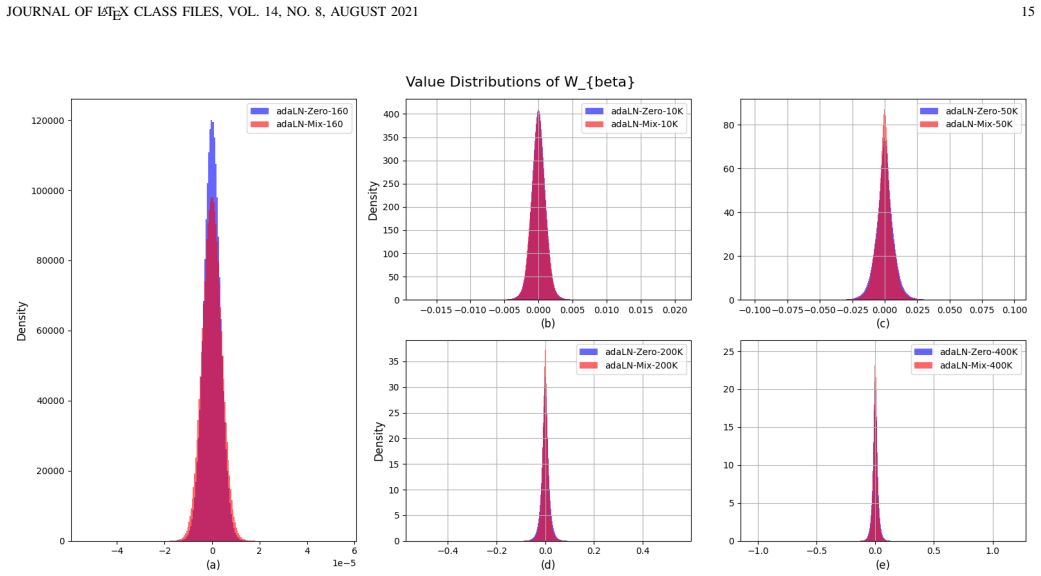
The load-bearing object is the adaLN-Zero conditioning block: the adaptive layer-norm style modulation in which a small MLP reads the conditioning embedding and outputs scale ($\gamma$), shift ($\beta$), and an extra per-block scaling factor ($\alpha$), with the linear layer producing $\alpha$ (and also $\gamma,\beta$ in DiT) zero-initialized. The paper's analysis instrument is the gradient table for the first iterations of a simplified DiT block, which shows that zero initialization makes weights update gradually—first the final layer, then patch embedding and $\alpha$ producers, then everything—and an experiment dubbed adaLN-Mix that tries to isolate this update order from the initial value. The proposed method replaces the zero start with $\mathcal{N}(0,10^{-3})$ for the modulation weights, matching the Gaussian-like distribution those weights converge to, which is what carries the claimed training-efficiency gain.
What would settle it
Train DiT-XL/2 with adaLN-Step1 initialization but with the update order enforced exactly as specified by the paper's own gradient table—only the final layer updates on step 1, then patch embedding, final-layer modulations, and $\alpha$ producers on step 2, then everything—implemented by freezing the parameter groups that the table marks as having zero gradient, with no other changes. If this transparently enforced schedule closes most of the gap to adaLN-Zero's FID 20.02 at 400K, the paper's claim that the starting value dominates would be wrong; if the gap stays near the adaLN-Mix level, the attribution holds. A second check: initialize only $W_\alpha$ from $\mathcal{N}(0,10^{-3})$ and keep $W_\gamma, W_\beta$ at zero; if the result does not match adaLN-Zero's 400K FID in the paper's setting, the claim that $W_\alpha$'s initial value is the decisive factor would be falsified.
Extended reading notes
Core claim
The central discovery is that adaLN-Zero's advantage comes from where its modulation weights start, not from the residual shortcut or the delayed update pattern it introduces. By comparing adaLN, adaLN-Step1 (scaling added, default initialization), adaLN-Mix (default initialization but with adaLN-Zero's update order enforced), and adaLN-Zero, the paper separates three candidate causes and finds that the near-zero initial value of the scale weights ($W_\alpha$, and similarly $W_\gamma, W_\beta$) accounts for most of the performance gap. It further observes that as training proceeds these weights converge to Gaussian-like distributions, so starting them from $\mathcal{N}(0, 10^{-3})$ (adaLN-Gaussian) places the model closer to where it is heading, which speeds convergence and improves FID at matched step counts. The paper claims this is evidence that zero-initialization is "a well-optimized location," not a special inductive bias of exact zero, and that a suitably chosen Gaussian is a better starting point.
Load-bearing premise
The whole attribution to "initial location" rests on the adaLN-Mix experiment, which the paper describes as using adaLN-Step1's initialization while enforcing adaLN-Zero's update order, but gives no mechanism, pseudocode, or code for how that enforcement is done; if the enforcement changes gradients on other weights (for example by masking or rescaling), the separation between starting point and update dynamics is not clean.
Editorial extensions
If this is right
- Initializing the modulation weights of DiT with $\mathcal{N}(0,10^{-3})$ consistently improves FID at matched training steps across DiT-B/2, DiT-L/2, DiT-L/4, and 512×512 ImageNet.
- At roughly 3,800K steps, adaLN-Gaussian reaches FID 2.27 that adaLN-Zero reaches at 7,000K, a roughly 46% saving in training steps at matched quality.
- The benefit transfers to training systems built on DiT (SiT, FasterDiT), to DiT-based models (LlamaVision, U-DiT), and to text-to-image generation, where adaLN-Gaussian lowers COCO FID-30K from 71.41 to 65.51 at 50K steps.
- SE-adaLN-Zero, an SE-inspired compression of the conditioning MLP, reduces parameters from 676M to 582M and improves FID from 20.02 to 19.13 at 400K steps; combining it with Gaussian initialization gives FID 18.76.
- The paper's diagnosis implies that exact zero is not special: any initialization that lands the modulation weights near their converged distribution should give similar or better early-training behavior.
Reading between the lines
- A testable extension suggested by the appendix is applying the same distribution-matching idea to ControlNet's zero convolutions, which also converge to Gaussian-like distributions; initializing those convolutions with small Gaussian noise could be measured for faster conditioning control.
- The paper's entropy reasoning suggests a general recipe: estimate the converged weight distribution of a modulation path early in training and initialize at that mean and standard deviation; the optimal std would then be architecture-specific rather than universally $10^{-3}$.
- Because adaLN-Gaussian does not change model capacity, the paper's own long-run tables imply the payoff is compute savings (reaching the same FID in fewer steps) rather than a higher final quality ceiling; in very long training regimes, the gap narrows.
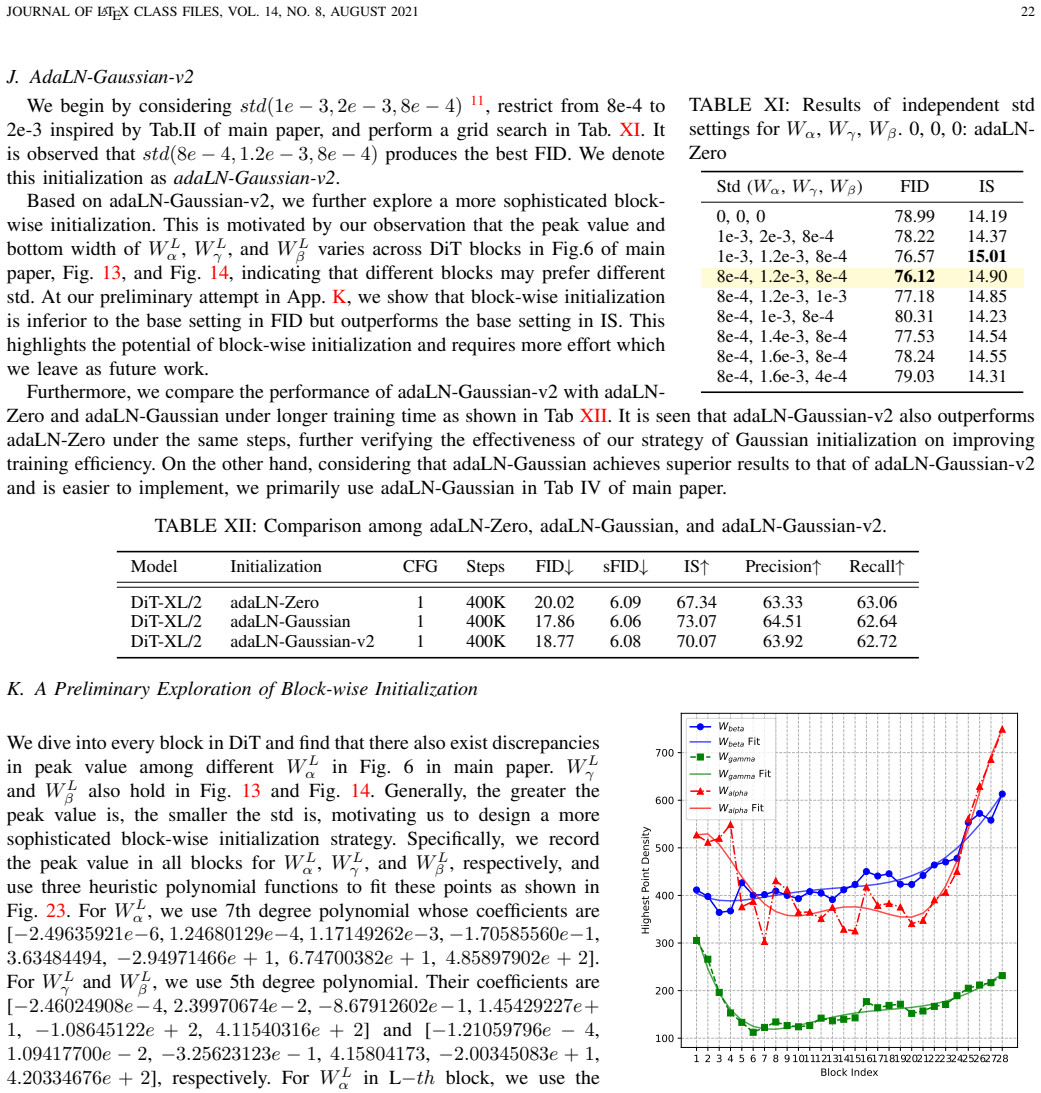
- The block-wise initialization experiments in the appendix hint that the optimal Gaussian std varies across blocks and across $W_\alpha, W_\gamma, W_\beta$, so a per-block, per-modulation initialization schedule is a natural next test of the same principle.
Signed reviews
Editorial analysis
A structured set of objections, weighed in public.
Referee Report
Summary. This paper investigates why the adaLN-Zero conditioning mechanism outperforms plain adaLN in diffusion transformers. It decomposes the difference into three candidate causes: an SE-like scaling structure, the zero-initialized starting location of the modulation weights, and the staggered 'gradual' update order induced by zero initialization. A simplified gradient derivation is given to explain the update order, and an adaLN-Mix experiment is introduced to separate location from update order. The paper then observes that the modulation weights W_alpha, W_gamma, and W_beta converge to Gaussian-like distributions and proposes adaLN-Gaussian (Gaussian initialization with std 1e-3), adaLN-Gaussian-v2 with per-module stds, and an SE-adaLN-Zero architecture with a compression ratio. Extensive experiments on ImageNet, additional datasets, and text-to-image generation report FID improvements at moderate training budgets and claim parity with the converged adaLN-Zero baseline at substantially fewer steps.
Significance. If the central attribution is accepted, the paper offers a simple, practical, and analysis-guided initialization that improves training efficiency without changing the architecture or learning algorithm. Strengths include the one-line PyTorch change, the breadth of experiments across model sizes, DiT variants, datasets, and text-to-image tasks, and the explicit falsifiable claim about initialization location. However, the main causal claim depends on the underspecified adaLN-Mix experiment, several long-horizon comparisons mix implementations, and the Gaussian std is tuned on the same benchmark used for the headline improvement. The empirical method may be useful, but the paper's central mechanistic conclusion needs stronger support before publication.
major comments (4)
- [Section III-B2, Fig. 1, Table III] The central conclusion that 'it is the zero-initialized location that accounts for the remarkable performance difference' rests on the adaLN-Mix experiment. The text says adaLN-Mix adopts adaLN-Step1's initialization while enforcing adaLN-Zero's update order 'simultaneously,' but no mechanism, pseudocode, or code is provided. Since adaLN-Step1's W_alpha is nonzero, the vanishing-gradient pattern in Table I does not occur naturally; the order must be imposed via freezing, gradient masking, or per-parameter learning-rate schedules. Any such intervention changes the optimization trajectory and can interact with the nonzero W_alpha, so the FID gap between adaLN-Mix and adaLN-Zero does not cleanly separate initial location from update dynamics. The Table III result that adaLN-Step1-Gaussian matches adaLN-Zero is supportive but does not by itself separate the two factors. Please specify the exact implementation and provide at least one alternative enforcement mechanism to show the conclusion is mechanism-independent.
- [Section IV, Tables II and IV] The Gaussian std for adaLN-Gaussian (and the per-module stds for v2) is selected by grid search on ImageNet 256x256 at 50K/400K steps, and the same benchmark and training length is then used as the headline evidence of improvement. This makes the comparison at 400K partially self-referential: the hyperparameter has been tuned on the testbed used for the claim. The paper should report performance on a held-out dataset or training budget without re-tuning, or provide sensitivity analysis demonstrating that the conclusion is robust across a range of std values. It would also help to report multiple seeds or confidence intervals; margins such as DiT-B/2 (42.72 vs 42.55) and U-DiT-L (10.87 vs 10.47) are small enough that run-to-run noise may affect the conclusion.
- [Section IV, Table IV and footnote 9] The long-horizon comparison is not apples-to-apples. The paper states that all experiments in Table IV use the fast-DiT implementation with gradient checkpointing, mixed precision, and pre-extracted VAE features, and that results 'may be slightly different from that of the original paper.' Yet the 2,352K and 7,000K adaLN-Zero baselines are borrowed from previous work and were not trained with this implementation. The headline claim that adaLN-Gaussian reaches 2.27 FID at 3,800K, matching adaLN-Zero at 7,000K, therefore mixes implementations across the comparison. The authors should either run the adaLN-Zero baseline under the identical fast-DiT pipeline for the long horizons, or clearly restrict the claim to the matched portions of the table.
- [Section III-C, Fig. 5, footnote 6] The entropy/thermodynamics argument is not a valid theoretical justification. The statement that systems evolve toward higher entropy (the second law) is applied to neural-network weight distributions without a closed system, a defined ensemble, or a connection between entropy increase and optimization ease. Moreover, the 'Gaussian-like' evidence in footnote 6 computes KL divergence by fitting a Gaussian to the same adaLN-Zero weights used for the comparison, so it measures the quality of a Gaussian fit rather than an independent target distribution. Please reframe this as a heuristic empirical observation, or provide a rigorous statement of the assumed dynamics.
minor comments (6)
- [Section IV, text-to-image paragraph] There is a typo: 'adaLN-Gaussin' should be 'adaLN-Gaussian'.
- [Section III-B1, text after Table I] The sentence listing zero gradients repeats W_gamma2 and W_beta2: 'dL/dW_gamma2, dL/dW_beta2, dL/dW_gamma2, and dL/dW_beta2' should list each weight once.
- [Eq. (1)] The identity map I in 'Sigmoid(I*c)' is not defined; aligning the notation with the element-wise multiplication and the 1-vector in Eq. (2) would make the SE analogy clearer.
- [Discussion section] There are typos: 'ensensially' should be 'essentially' and 'provid' should be 'provide'.
- [Footnote 9] The footnote should state which rows of Table IV use the fast-DiT implementation; the current phrasing 'all of which are employed in experiments of Tab. IV if not specified' leaves ambiguity about the 400K and 800K baseline rows.
- [Section V, SE-like variants] The sentence 'Our SE-like v2 user=4' should read 'uses r=4'.
Circularity Check
Minor self-referential Gaussian-likeness check; the main initial-location attribution is not circular.
-
self definitional
[Footnote 6 (Section III-C, page 6)]
"To demonstrate that adaLN-Zero exhibits a Gaussian-like distribution, we employ KL-Divergence to measure the distance between its distribution and a true Gaussian. We use the weights of adaLN-Zero at 50K steps to compute its mean and standard deviation. These parameters are then used to initialize a Gaussian distribution, from which we sample the same number of weight points as adaLN-Zero."
The 'true Gaussian' is not an independent reference distribution: its mean and standard deviation are computed from the very same adaLN-Zero weights whose Gaussian-likeness is being asserted. The reported KL divergence therefore measures deviation from the best-fitting Gaussian in that family, so the conclusion 'adaLN-Zero exhibits a Gaussian-like distribution' is partly manufactured by the fitting step rather than established against an external baseline. This self-referential check motivates adaLN-Gaussian, but it is not the load-bearing evidence for the paper's central attribution, which rests on the controlled adaLN, adaLN-Step1, adaLN-Mix, and adaLN-Step1-Gaussian comparisons.
full rationale
The paper's central claim, that the zero-initialized starting location of the modulation weights is the dominant factor, is supported by controlled variants whose definitions do not presuppose the conclusion. In particular, adaLN-Step1-Gaussian uses a small nonzero W_alpha initialization and matches adaLN-Zero, independently separating initial location from the staggered zero-init update order. The adaLN-Mix experiment is incompletely specified, but that is a reproducibility gap rather than a circular reduction. The only identifiable self-referential element is the KL-based 'Gaussian-like' verification, where the reference Gaussian is fitted to the same weights being tested; this is a methodological weakness in a supporting observation rather than a forced derivation of the main result. The proposed initialization is also evaluated across other datasets, model sizes, and DiT-based models with the same fixed std, providing out-of-sample evidence. Overall, the derivation chain is not equivalent to its inputs, and no load-bearing step reduces by construction.
Assumptions & free parameters
free parameters (4)
- Gaussian std for adaLN-Gaussian (uniform) =
0.001
- Per-module Gaussian stds for adaLN-Gaussian-v2 =
(W_alpha 8e-4, W_gamma 1.2e-3, W_beta 8e-4)
- SE-like compression ratio r =
2 (variant v2)
- Block-wise std polynomial coefficients =
7th/5th degree polynomial coefficients in App. K
assumptions (5)
- domain assumption The simplified DiT with one block, linear attention and FFN, and no bias terms preserves the gradient update order of the full DiT.
- standard math LayerNorm in DiT is learning-free and can be dropped from the gradient analysis.
- ad hoc to paper The trained conditioning weights are well approximated by a Gaussian, making Gaussian initialization suitable.
- ad hoc to paper Entropy changes of weight distributions follow the second law of thermodynamics, so a distribution that increases entropy is easier to optimize.
- standard math MSE loss on predicted noise is the training objective for the gradient derivation.
Cite this review
Pith. "Pith review of Unveiling the Secret of AdaLN-Zero in Diffusion Transformer." pith.science (2026). https://pith.science/paper/CZKFNGA4
@misc{pith2026260809438,
  author       = {Pith},
  title        = {Pith review of: Unveiling the Secret of AdaLN-Zero in Diffusion Transformer},
  year         = {2026},
  howpublished = {\url{https://pith.science/paper/CZKFNGA4}},
  note         = {Machine review of arXiv:2608.09438}
}
read the original abstract
Diffusion transformer (DiT), a rapidly emerging architecture for image generation, has gained much attention. However, despite ongoing efforts to improve its performance, the understanding of DiT remains superficial. In this work, we delve into and investigate a critical conditioning mechanism within DiT, adaLN-Zero, which achieves superior performance compared to adaLN. Our work studies three potential elements driving this performance, including an SE-like structure, zero-initialization, and a "gradual" update order, among which zero-initialization is proved to be the most influential. Building on this understanding, we propose an analysis-guided initialization strategy, termed adaLN-Gaussian, which serves both as an empirical validation of our analysis and as a practical initialization method that consistently improves optimization efficiency. On the other hand, inspired by the SE-like structure, we introduce an improved conditioning mechanism called SE-adaLN-Zero. Extensive experiments following DiT on four datasets, especially on ImageNet1K demonstrate the effectiveness and generalization of adaLN-Gaussian and SE-adaLN-Zero. Beyond class-to-image generation, we also evaluate the generalization of the two improved methods on text-to-image generation.
Figures


Figures from the paper (19 more)




Reference graph
Works this paper leans on
-
[1]
Scalable diffusion models with transformers,
W. Peebles and S. Xie, “Scalable diffusion models with transformers,” inProceedings of the IEEE/CVF International Conference on Computer Vision, 2023, pp. 4195–4205
2023
-
[2]
Diffusion models beat gans on image synthesis,
P. Dhariwal and A. Nichol, “Diffusion models beat gans on image synthesis,”Advances in neural information processing systems, vol. 34, pp. 8780–8794, 2021
2021
-
[3]
High- resolution image synthesis with latent diffusion models,
R. Rombach, A. Blattmann, D. Lorenz, P. Esser, and B. Ommer, “High- resolution image synthesis with latent diffusion models,” inProceedings of the IEEE/CVF conference on computer vision and pattern recognition, 2022, pp. 10 684–10 695
2022
-
[4]
Visionllama: A unified llama backbone for vision tasks,
X. Chu, J. Su, B. Zhang, and C. Shen, “Visionllama: A unified llama backbone for vision tasks,” inEuropean Conference on Computer Vision, vol. 3, 2024
work page 2024
-
[5]
Sit: Exploring flow and diffusion-based gen- erative models with scalable interpolant transformers,
N. Ma, M. Goldstein, M. S. Albergo, N. M. Boffi, E. Vanden- Eijnden, and S. Xie, “Sit: Exploring flow and diffusion-based gen- erative models with scalable interpolant transformers,”arXiv preprint arXiv:2401.08740, 2024
arXiv 2024
-
[6]
Fit: Flexible vision transformer for diffusion model,
Z. Lu, Z. Wang, D. Huang, C. Wu, X. Liu, W. Ouyang, and L. Bai, “Fit: Flexible vision transformer for diffusion model,”arXiv preprint arXiv:2402.12376, 2024
arXiv 2024
-
[7]
U-dits: Downsample tokens in u-shaped diffusion transformers,
Y . Tian, Z. Tu, H. Chen, J. Hu, C. Xu, and Y . Wang, “U-dits: Downsample tokens in u-shaped diffusion transformers,”arXiv preprint arXiv:2405.02730, 2024
arXiv 2024
-
[8]
SD-DiT: Unleashing the Power of Self-supervised Discrimination in Diffusion Transformer
R. Zhu, Y . Pan, Y . Li, T. Yao, Z. Sun, T. Mei, and C. W. Chen, “Sd- dit: Unleashing the power of self-supervised discrimination in diffusion transformer,”arXiv preprint arXiv:2403.17004, 2024
work page Pith review arXiv 2024
Show all 52 references
-
[9]
Fasterdit: Towards faster diffusion transformers training without architecture modification,
J. Yao, C. Wang, W. Liu, and X. Wang, “Fasterdit: Towards faster diffusion transformers training without architecture modification,” in The Thirty-eighth Annual Conference on Neural Information Processing Systems
-
[10]
Roformer: En- hanced transformer with rotary position embedding,
J. Su, M. Ahmed, Y . Lu, S. Pan, W. Bo, and Y . Liu, “Roformer: En- hanced transformer with rotary position embedding,”Neurocomputing, vol. 568, p. 127063, 2024
2024
-
[11]
Glu variants improve transformer,
N. Shazeer, “Glu variants improve transformer,”arXiv preprint arXiv:2002.05202, 2020
2002 arXiv
-
[12]
Scaling rectified flow transformers for high-resolution image synthesis,
P. Esser, S. Kulal, A. Blattmann, R. Entezari, J. M ¨uller, H. Saini, Y . Levi, D. Lorenz, A. Sauer, F. Boeselet al., “Scaling rectified flow transformers for high-resolution image synthesis,” inForty-first International Conference on Machine Learning, 2024
2024
-
[13]
Pixart-alpha: Fast training of diffusion transformer for photorealistic text-to-image synthesis,
J. Chen, J. Yu, C. Ge, L. Yao, E. Xie, Y . Wu, Z. Wang, J. Kwok, P. Luo, H. Luet al., “Pixart-alpha: Fast training of diffusion transformer for photorealistic text-to-image synthesis,”arXiv preprint arXiv:2310.00426, 2023
2023 arXiv
-
[14]
Pixart-\sigma: Weak-to-strong training of dif- fusion transformer for 4k text-to-image generation,
J. Chen, C. Ge, E. Xie, Y . Wu, L. Yao, X. Ren, Z. Wang, P. Luo, H. Lu, and Z. Li, “Pixart-\sigma: Weak-to-strong training of dif- fusion transformer for 4k text-to-image generation,”arXiv preprint arXiv:2403.04692, 2024
2024 arXiv
-
[15]
Exploring the role of large language models in prompt encoding for diffusion models,
B. Ma, Z. Zong, G. Song, H. Li, and Y . Liu, “Exploring the role of large language models in prompt encoding for diffusion models,”arXiv preprint arXiv:2406.11831, 2024
2024 arXiv
-
[16]
Hunyuan-dit: A powerful multi-resolution diffusion transformer with fine-grained chinese understanding,
Z. Li, J. Zhang, Q. Lin, J. Xiong, Y . Long, X. Deng, Y . Zhang, X. Liu, M. Huang, Z. Xiaoet al., “Hunyuan-dit: A powerful multi-resolution diffusion transformer with fine-grained chinese understanding,”arXiv preprint arXiv:2405.08748, 2024
2024 arXiv
-
[17]
Elucidating the design space of diffusion-based generative models,
T. Karras, M. Aittala, T. Aila, and S. Laine, “Elucidating the design space of diffusion-based generative models,”Advances in neural infor- mation processing systems, vol. 35, pp. 26 565–26 577, 2022
2022
-
[18]
Analyzing and improving the training dynamics of diffusion models,
T. Karras, M. Aittala, J. Lehtinen, J. Hellsten, T. Aila, and S. Laine, “Analyzing and improving the training dynamics of diffusion models,” inProceedings of the IEEE/CVF Conference on Computer Vision and Pattern Recognition, 2024, pp. 24 174–24 184
2024
-
[19]
Mole: En- hancing human-centric text-to-image diffusion via mixture of low-rank experts,
J. Zhu, Y . Chen, M. Ding, P. Luo, L. Wang, and J. Wang, “Mole: En- hancing human-centric text-to-image diffusion via mixture of low-rank experts,” inThe Thirty-eighth Annual Conference on Neural Information Processing Systems
-
[20]
Squeeze-and-excitation networks,
J. Hu, L. Shen, and G. Sun, “Squeeze-and-excitation networks,” in Proceedings of the IEEE conference on computer vision and pattern recognition, 2018, pp. 7132–7141
2018
-
[21]
ImageNet Large Scale Visual Recognition Challenge,
O. Russakovsky, J. Deng, H. Su, J. Krause, S. Satheesh, S. Ma, Z. Huang, A. Karpathy, A. Khosla, M. Bernstein, A. C. Berg, and L. Fei-Fei, “ImageNet Large Scale Visual Recognition Challenge,” International Journal of Computer Vision (IJCV), pp. 211–252, 2015
2015
-
[22]
Attention is all you need,
A. Vaswani, N. Shazeer, N. Parmar, J. Uszkoreit, L. Jones, A. N. Gomez, Ł. Kaiser, and I. Polosukhin, “Attention is all you need,”Advances in neural information processing systems, vol. 30, 2017
2017
-
[23]
An image is worth 16x16 words: Transformers for image recognition at scale,
A. Dosovitskiy, L. Beyer, A. Kolesnikov, D. Weissenborn, X. Zhai, T. Unterthiner, M. Dehghani, M. Minderer, G. Heigold, S. Gellyet al., “An image is worth 16x16 words: Transformers for image recognition at scale,”arXiv preprint arXiv:2010.11929, 2020
2010 arXiv
-
[24]
Layoutdm: Transformer-based diffusion model for layout generation,
S. Chai, L. Zhuang, and F. Yan, “Layoutdm: Transformer-based diffusion model for layout generation,” inProceedings of the IEEE/CVF Confer- ence on Computer Vision and Pattern Recognition, 2023, pp. 18 349– 18 358
2023
-
[25]
Masked diffusion trans- former is a strong image synthesizer,
S. Gao, P. Zhou, M.-M. Cheng, and S. Yan, “Masked diffusion trans- former is a strong image synthesizer,” inProceedings of the IEEE/CVF International Conference on Computer Vision, 2023, pp. 23 164–23 173
2023
-
[26]
Dit- 3d: Exploring plain diffusion transformers for 3d shape generation,
S. Mo, E. Xie, R. Chu, L. Hong, M. Niessner, and Z. Li, “Dit- 3d: Exploring plain diffusion transformers for 3d shape generation,” Advances in neural information processing systems, vol. 36, pp. 67 960– 67 971, 2023
2023
-
[27]
Diffuser: efficient transformers with multi-hop attention diffusion for long sequences,
A. Feng, I. Li, Y . Jiang, and R. Ying, “Diffuser: efficient transformers with multi-hop attention diffusion for long sequences,” inProceedings of the AAAI Conference on Artificial Intelligence, vol. 37, no. 11, 2023, pp. 12 772–12 780
2023
-
[28]
Latent diffusion transformer for probabilistic time series forecasting,
S. Feng, C. Miao, Z. Zhang, and P. Zhao, “Latent diffusion transformer for probabilistic time series forecasting,” inProceedings of the AAAI Conference on Artificial Intelligence, vol. 38, no. 11, 2024, pp. 11 979– 11 987
2024
-
[29]
All are worth words: A vit backbone for diffusion models,
F. Bao, S. Nie, K. Xue, Y . Cao, C. Li, H. Su, and J. Zhu, “All are worth words: A vit backbone for diffusion models,” inProceedings of the IEEE/CVF conference on computer vision and pattern recognition, 2023, pp. 22 669–22 679
2023
-
[30]
Scaling diffusion transformers to 16 billion parameters,
Z. Fei, M. Fan, C. Yu, D. Li, and J. Huang, “Scaling diffusion transformers to 16 billion parameters,”arXiv preprint arXiv:2407.11633, 2024
2024 arXiv
-
[31]
Gentron: Diffusion transformers for image and video generation,
S. Chen, M. Xu, J. Ren, Y . Cong, S. He, Y . Xie, A. Sinha, P. Luo, T. Xi- ang, and J.-M. Perez-Rua, “Gentron: Diffusion transformers for image and video generation,” inProceedings of the IEEE/CVF Conference on Computer Vision and Pattern Recognition, 2024, pp. 6441–6451
2024
-
[32]
Dlt: Conditioned layout generation with joint discrete-continuous diffusion layout trans- former,
E. Levi, E. Brosh, M. Mykhailych, and M. Perez, “Dlt: Conditioned layout generation with joint discrete-continuous diffusion layout trans- former,” inProceedings of the IEEE/CVF International Conference on Computer Vision, 2023, pp. 2106–2115
2023
-
[33]
Scalable high-resolution pixel-space image synthesis JOURNAL OF LATEX CLASS FILES, VOL. 14, NO. 8, AUGUST 2021 12 with hourglass diffusion transformers,
K. Crowson, S. A. Baumann, A. Birch, T. M. Abraham, D. Z. Kaplan, and E. Shippole, “Scalable high-resolution pixel-space image synthesis JOURNAL OF LATEX CLASS FILES, VOL. 14, NO. 8, AUGUST 2021 12 with hourglass diffusion transformers,” inForty-first International Con- ferenc...
2021
-
[34]
Diffit: Diffusion vision transformers for image generation,
A. Hatamizadeh, J. Song, G. Liu, J. Kautz, and A. Vahdat, “Diffit: Diffusion vision transformers for image generation,”arXiv preprint arXiv:2312.02139, 2023
2023 arXiv
-
[35]
A review on weight initialization strategies for neural networks,
M. V . Narkhede, P. P. Bartakke, and M. S. Sutaone, “A review on weight initialization strategies for neural networks,”Artificial intelligence re- view, pp. 291–322, 2022
2022
-
[36]
Understanding the difficulty of training deep feedforward neural networks,
X. Glorot and Y . Bengio, “Understanding the difficulty of training deep feedforward neural networks,” inProceedings of the thirteenth international conference on artificial intelligence and statistics. JMLR Workshop and Conference Proceedings, 2010, pp. 249–256
2010
-
[37]
Caffe: Convolutional architecture for fast feature embedding,
Y . Jia, E. Shelhamer, J. Donahue, S. Karayev, J. Long, R. Girshick, S. Guadarrama, and T. Darrell, “Caffe: Convolutional architecture for fast feature embedding,” inProceedings of the 22nd ACM international conference on Multimedia, 2014, pp. 675–678
2014
-
[38]
Rectified linear units improve restricted boltz- mann machines,
V . Nair and G. E. Hinton, “Rectified linear units improve restricted boltz- mann machines,” inProceedings of the 27th international conference on machine learning (ICML-10), 2010, pp. 807–814
2010
-
[39]
Delving deep into rectifiers: Surpassing human-level performance on imagenet classification,
K. He, X. Zhang, S. Ren, and J. Sun, “Delving deep into rectifiers: Surpassing human-level performance on imagenet classification,” in Proceedings of the IEEE international conference on computer vision, 2015, pp. 1026–1034
2015
-
[40]
Accurate, large minibatch sgd: Training imagenet in 1 hour,
P. Goyal, P. Doll ´ar, R. Girshick, P. Noordhuis, L. Wesolowski, A. Kyrola, A. Tulloch, Y . Jia, and K. He, “Accurate, large minibatch sgd: Training imagenet in 1 hour,”arXiv preprint arXiv:1706.02677, 2017
2017 arXiv
-
[41]
Denoising diffusion probabilistic models,
J. Ho, A. Jain, and P. Abbeel, “Denoising diffusion probabilistic models,” Advances in neural information processing systems, vol. 33, pp. 6840– 6851, 2020
2020
-
[42]
Gans trained by a two time-scale update rule converge to a local nash equilibrium,
M. Heusel, H. Ramsauer, T. Unterthiner, B. Nessler, and S. Hochreiter, “Gans trained by a two time-scale update rule converge to a local nash equilibrium,”Advances in neural information processing systems, vol. 30, 2017
2017
-
[43]
Improved techniques for training gans,
T. Salimans, I. Goodfellow, W. Zaremba, V . Cheung, A. Radford, and X. Chen, “Improved techniques for training gans,”Advances in neural information processing systems, vol. 29, 2016
2016
-
[44]
Deep residual learning for image recognition,
K. He, X. Zhang, S. Ren, and J. Sun, “Deep residual learning for image recognition,” inProceedings of the IEEE conference on computer vision and pattern recognition, 2016, pp. 770–778
2016
-
[45]
Adding conditional control to text-to-image diffusion models,
L. Zhang, A. Rao, and M. Agrawala, “Adding conditional control to text-to-image diffusion models,” inProceedings of the IEEE/CVF International Conference on Computer Vision, 2023, pp. 3836–3847
2023
-
[46]
Generating images with sparse representations,
C. Nash, J. Menick, S. Dieleman, and P. Battaglia, “Generating images with sparse representations,” inInternational Conference on Machine Learning. PMLR, 2021, pp. 7958–7968
2021
-
[47]
Im- proved precision and recall metric for assessing generative models,
T. Kynk ¨a¨anniemi, T. Karras, S. Laine, J. Lehtinen, and T. Aila, “Im- proved precision and recall metric for assessing generative models,” Advances in neural information processing systems, 2019
2019
-
[48]
Tiny imagenet visual recognition challenge,
Y . Le and X. Yang, “Tiny imagenet visual recognition challenge,”CS 231N, vol. 7, no. 7, p. 3, 2015
2015
-
[49]
Stargan v2: Diverse image synthesis for multiple domains,
Y . Choi, Y . Uh, J. Yoo, and J.-W. Ha, “Stargan v2: Diverse image synthesis for multiple domains,” inProceedings of the IEEE/CVF conference on computer vision and pattern recognition, 2020, pp. 8188– 8197
2020
-
[50]
Progressive growing of GANs for improved quality, stability, and variation,
T. Karras, T. Aila, S. Laine, and J. Lehtinen, “Progressive growing of GANs for improved quality, stability, and variation,” inInternational Conference on Learning Representations, 2018
2018
-
[51]
Learning transferable visual models from natural language supervision,
A. Radford, J. W. Kim, C. Hallacy, A. Ramesh, G. Goh, S. Agarwal, G. Sastry, A. Askell, P. Mishkin, J. Clarket al., “Learning transferable visual models from natural language supervision,” inInternational conference on machine learning. PmLR, 2021, pp. 8748–8763
2021
-
[52]
Computing higher order deriva- tives of matrix and tensor expressions,
S. Laue, M. Mitterreiter, and J. Giesen, “Computing higher order deriva- tives of matrix and tensor expressions,”Advances in neural information processing systems, vol. 31, 2018. Jie Zhuis currently working toward the Ph.D. degree in the School of Computer Science, Peking Univ...
2018
Reviewed August 11, 2026 · model on record in the stance chip above.
Discussion (0). Continue with ORCID to comment.