A Potential Signature of HD 7977's Passage Among Observed Long-Period Comet Orbits
Pith reviewed 2026-06-25 21:50 UTC · model grok-4.3
The pith
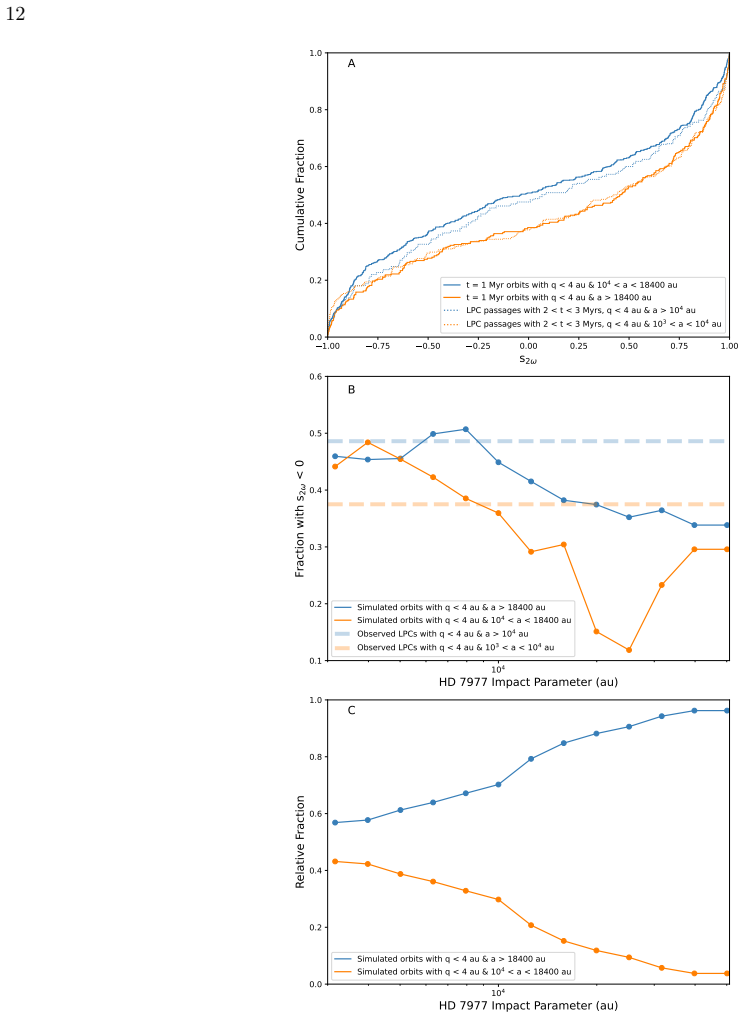
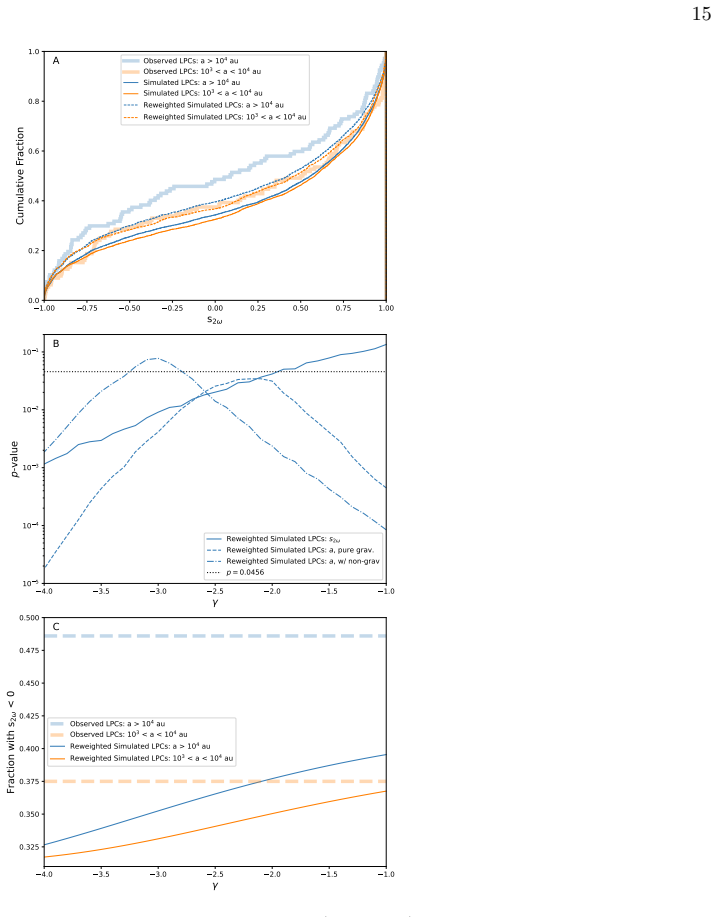
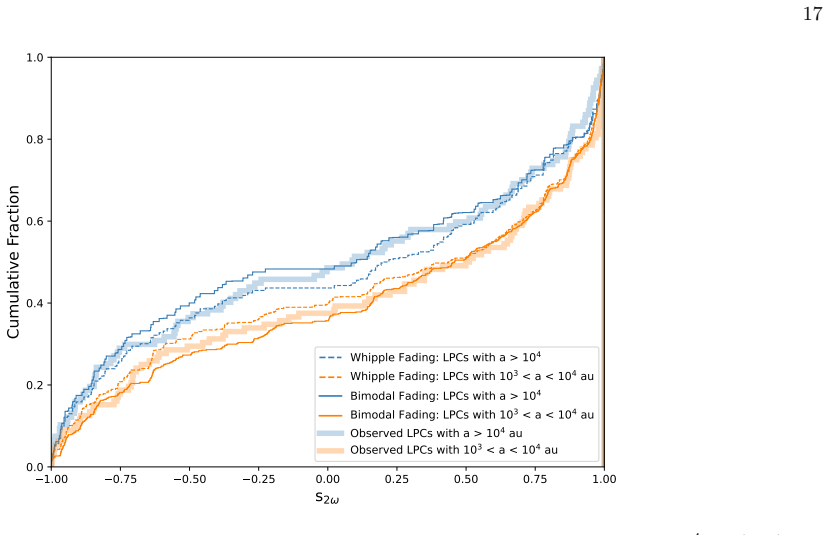
A close passage by star HD 7977 2.5 million years ago reproduces the observed argument-of-perihelion distributions of both new and returning long-period comets.
A machine-rendered reading of the paper's core claim, the machinery that carries it, and where it could break.
Core claim
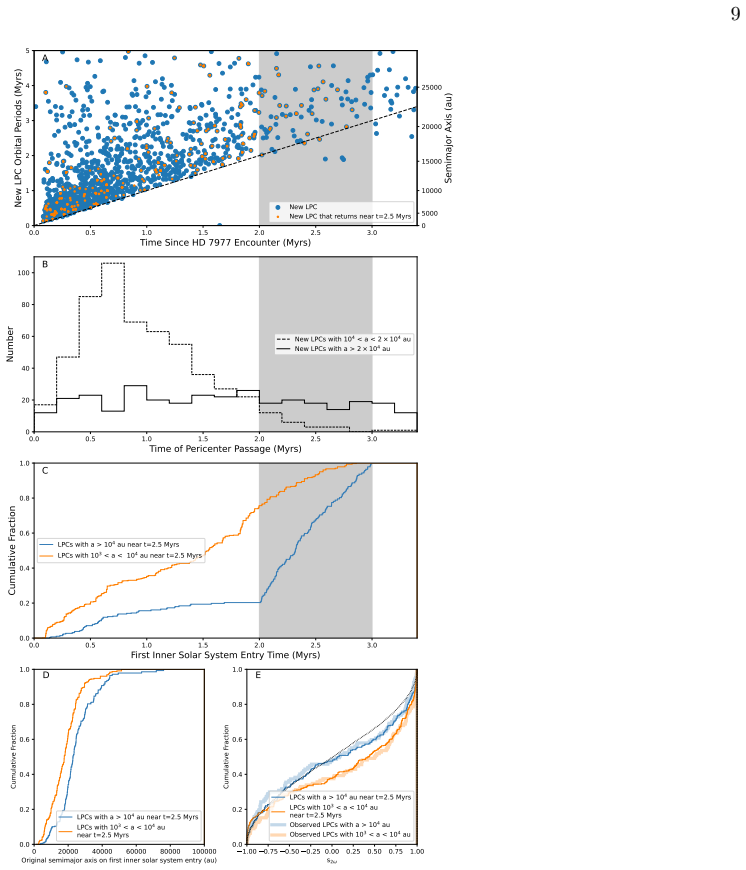
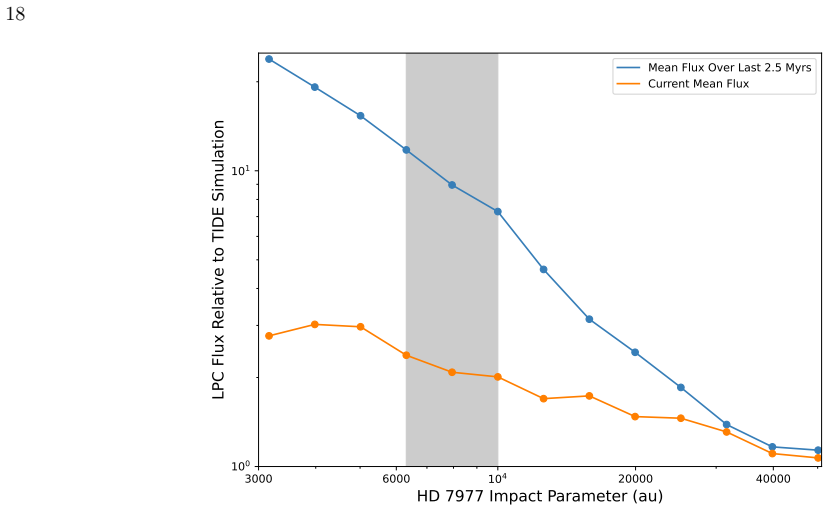
If HD 7977 passed within 6000-10000 au of the Sun about 2.5 million years ago, the resulting impulse on the Oort cloud produces the observed isotropy in the argument of perihelion for dynamically new long-period comets while preserving the anisotropy seen in returning comets, indicating that the modern LPC flux is roughly twice the long-term tide-dominated rate.
What carries the argument
The gravitational perturbation from the stellar flyby of HD 7977, which temporarily dominates over the Galactic tide and redistributes the arguments of perihelion of Oort-cloud comets.
If this is right
- The current observed LPC flux is approximately twice the longer-term tide-dominated rate.
- Oort-cloud population estimates should be lowered by a factor of roughly two.
- The solar system remains in the later stages of a comet shower triggered by the flyby.
- Upcoming Gaia data releases are predicted to favor an impact parameter of 6000-10000 au.
Where Pith is reading between the lines
- Other recent stellar encounters could have left similar but smaller signatures in the Oort cloud that future surveys might detect.
- The factor-of-two elevation in the present-day flux would shorten the estimated lifetime of the Oort cloud if the higher rate has persisted for longer than modeled.
- Larger samples of new LPCs from upcoming surveys could test whether the isotropy is uniform across semimajor-axis bins or shows residual structure from the flyby.
Load-bearing premise
Long-period comet production is dominated by the Galactic tide except during the proposed stellar passage, and the observed sample of new comets accurately reflects the underlying orbital distribution without major selection biases.
What would settle it
Gaia astrometry that places HD 7977's closest approach outside the 6000-10000 au range would rule out this explanation for the observed ω distributions.
Figures
read the original abstract
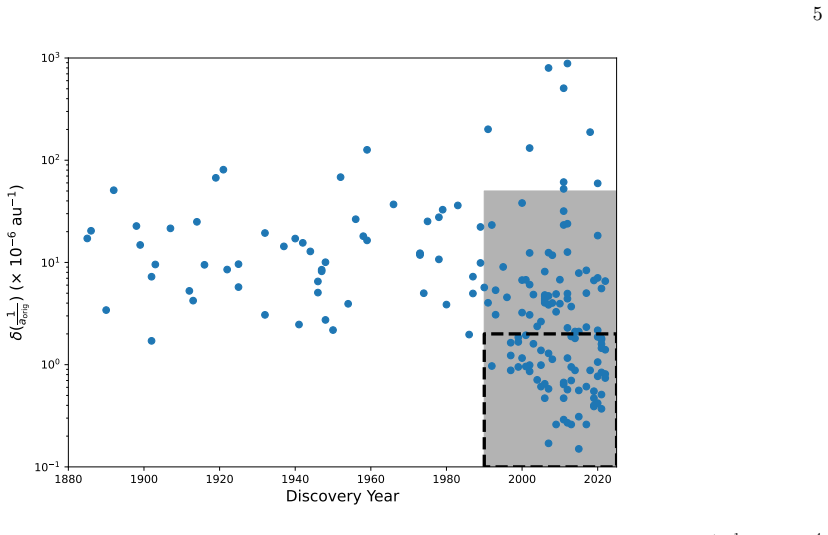
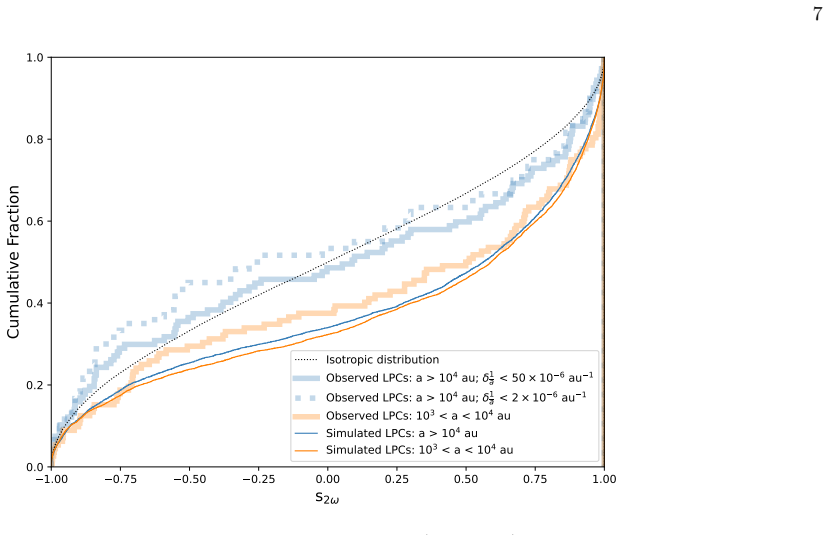
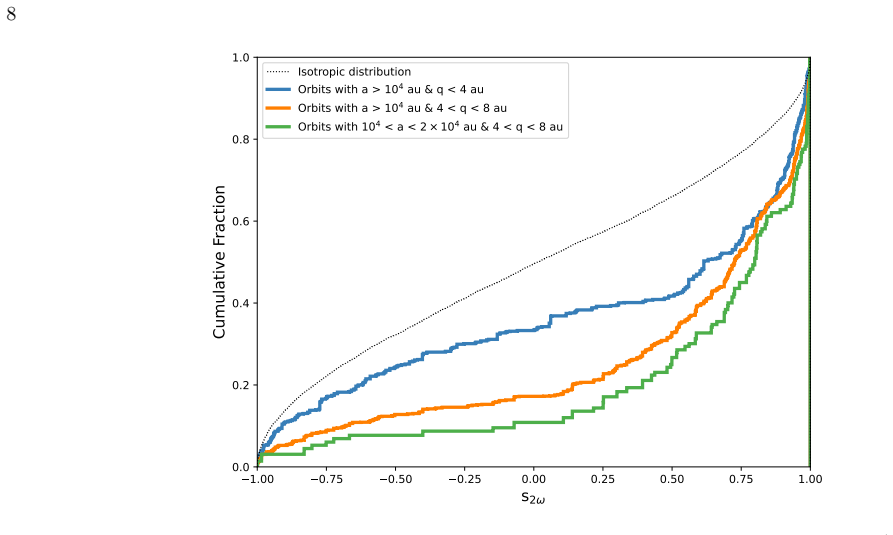
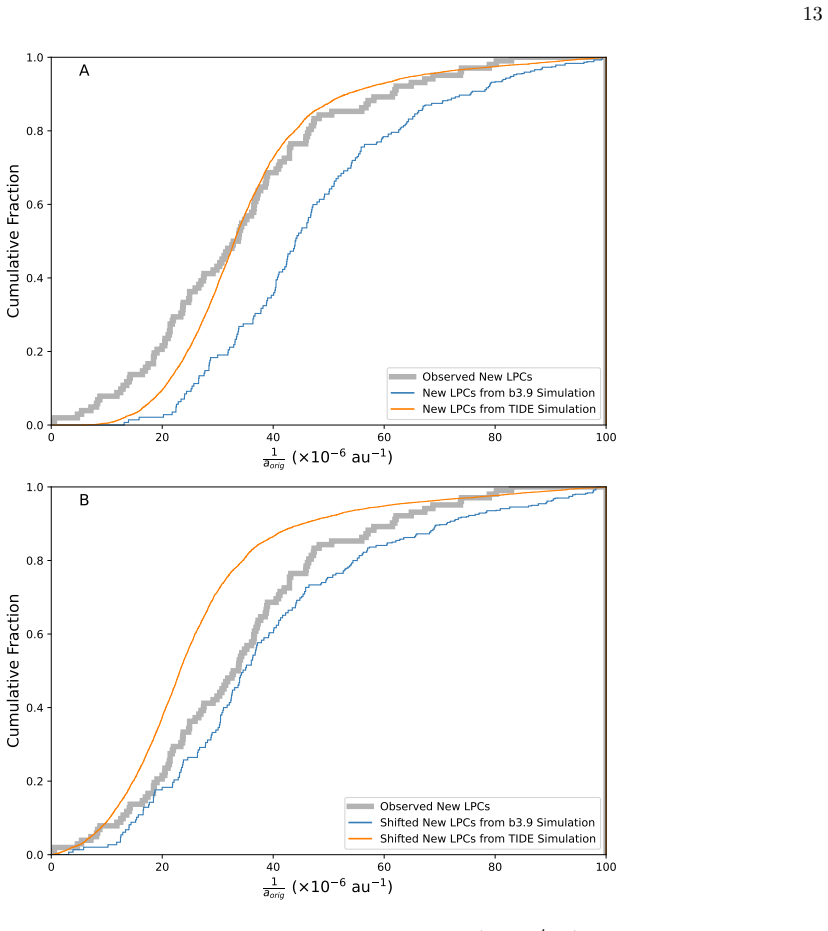
It is generally presumed that the tidal field of the Milky Way's disk is the main perturbation that has driven observed long-period comets (LPCs) from the Oort cloud into the inner solar system. The tide's influence on the Oort cloud should produce a distinct anisotropy in the arguments of perihelion ($\omega$) of dynamically new LPCs with semimajor axes ($a$) over 10$^4$ au. Simulating LPC production dominated by the Galactic tide, we find that observed dynamically new LPCs are more isotropic than expected. Meanwhile, our simulation exhibits much better agreement between simulated and observed ``returning'' LPCs that have made a handful of passages through the inner solar system prior to discovery. The isotropy of new LPCs can be explained if the Oort cloud is much less centrally concentrated than the conventional Oort cloud formation model predicts. However, a second possibility also exists. Additional simulations we perform show that the observed $\omega$ distributions of new and returning LPCs can both be well-replicated if the star HD 7977 passed within $\sim$6000--10000 au of the Sun $\sim$2.5 Myrs ago. In such a scenario, our solar system is still undergoing the latter stages of a comet shower. These simulations imply the modern observed LPC flux is $\sim$twice as high as the longer-term (tide-dominated) rate. This also implies that estimates of the Oort cloud's population should be revised downward by a factor of $\sim$2. Our LPC analysis predicts the upcoming Gaia data release will favor an HD 7977 impact parameter of $\sim$6000--10000 au.
Editorial analysis
A structured set of objections, weighed in public.
Referee Report
Summary. The paper claims that Galactic tide-dominated simulations of Oort cloud evolution produce anisotropic ω distributions for dynamically new LPCs (a > 10^4 au) that mismatch observations, while returning LPCs agree better. It shows that adding a stellar passage by HD 7977 at an impact parameter of ∼6000–10000 au ∼2.5 Myr ago reproduces the observed isotropic ω for new LPCs and the returning population, implying the modern LPC flux is ∼2× the tide-only rate and that Oort cloud population estimates should be revised downward by a factor of ∼2. The work predicts that upcoming Gaia data will favor the fitted impact parameter range.
Significance. If substantiated, the result would indicate that the solar system is still experiencing the tail of a comet shower triggered by a recent stellar encounter, with direct consequences for LPC rate estimates and Oort cloud normalization. The Gaia prediction supplies a concrete, falsifiable test. The work also highlights a tension between conventional Oort cloud formation models and the observed isotropy that could motivate revised formation scenarios even if the specific perturber identification is not adopted.
major comments (3)
- [Abstract] Abstract and simulation description: no information is supplied on the number of test particles, the numerical integrator, time-stepping criteria, or the initial semimajor-axis and eccentricity distribution of the Oort cloud. These quantities are required to assess whether the reported qualitative agreement with observed ω histograms is statistically robust or sensitive to resolution and initial conditions.
- [Abstract, final paragraph] The impact-parameter interval (6000–10000 au) and passage epoch (∼2.5 Myr) are chosen to reproduce the current observed ω distributions; the subsequent claim that Gaia will favor precisely these values is therefore circular and does not constitute an independent prediction.
- [Abstract, second paragraph] The central interpretation assumes that the observed sample of new LPCs directly traces the intrinsic ω distribution. No forward modeling of discovery biases (survey geometry, seasonal visibility, magnitude limits that may differ for new vs. returning comets) is described, leaving open the possibility that the apparent isotropy is an observational selection effect rather than dynamical evidence for the perturber.
minor comments (2)
- [Abstract] The phrase 'dynamically new LPCs' is used without an explicit operational definition (e.g., whether it is based on a > 10^4 au alone or on an additional criterion such as previous perihelion distance).
- [Abstract, penultimate sentence] The factor-of-two revision to the LPC flux and Oort cloud population is stated without an accompanying uncertainty or sensitivity analysis with respect to the assumed stellar mass or velocity.
Simulated Author's Rebuttal
We thank the referee for their constructive and detailed report. The comments raise valid points about simulation transparency, the nature of our Gaia prediction, and potential observational biases. We address each major comment below and will revise the manuscript to improve clarity and completeness.
read point-by-point responses
-
Referee: [Abstract] Abstract and simulation description: no information is supplied on the number of test particles, the numerical integrator, time-stepping criteria, or the initial semimajor-axis and eccentricity distribution of the Oort cloud. These quantities are required to assess whether the reported qualitative agreement with observed ω histograms is statistically robust or sensitive to resolution and initial conditions.
Authors: We agree that these parameters are needed to evaluate robustness. Although the methods section of the full manuscript describes the simulation setup, the abstract omits them for brevity. In the revised version we will add a concise statement of the key parameters (particle number, integrator, time-stepping, and initial a-e distribution) to the abstract so that the work is self-contained. revision: yes
-
Referee: [Abstract, final paragraph] The impact-parameter interval (6000–10000 au) and passage epoch (∼2.5 Myr) are chosen to reproduce the current observed ω distributions; the subsequent claim that Gaia will favor precisely these values is therefore circular and does not constitute an independent prediction.
Authors: We respectfully disagree that the Gaia statement is circular. The quoted impact-parameter range is obtained by fitting the stellar-perturber model to the present-day LPC ω data. The prediction is that independent Gaia astrometry of HD 7977 will return an impact parameter lying inside that same interval. Because the Gaia measurement is a separate observable, the statement remains a falsifiable, non-circular test. We will rephrase the final paragraph to make this distinction explicit. revision: partial
-
Referee: [Abstract, second paragraph] The central interpretation assumes that the observed sample of new LPCs directly traces the intrinsic ω distribution. No forward modeling of discovery biases (survey geometry, seasonal visibility, magnitude limits that may differ for new vs. returning comets) is described, leaving open the possibility that the apparent isotropy is an observational selection effect rather than dynamical evidence for the perturber.
Authors: The referee correctly notes a limitation: we have not performed explicit forward modeling of survey biases. Our analysis assumes that the ω distribution of newly discovered LPCs is close to the intrinsic distribution because these objects are detected at large heliocentric distances. In the revised manuscript we will add a dedicated paragraph that states this assumption, discusses why ω-dependent biases are expected to be weaker for new than for returning LPCs, and flags the lack of quantitative bias modeling as a caveat for future work. revision: yes
Circularity Check
Stellar passage parameters fitted to match LPC ω distributions then presented as Gaia prediction
specific steps
-
fitted input called prediction
[Abstract]
"Our LPC analysis predicts the upcoming Gaia data release will favor an HD 7977 impact parameter of ∼6000--10000 au."
The ∼6000--10000 au range and ∼2.5 Myr timing are the specific values identified in the additional simulations that replicate the observed ω distributions of new and returning LPCs. The Gaia statement therefore predicts that future data will match the parameter values already tuned to the current observations.
full rationale
The paper identifies a mismatch between tide-only simulations and observed new LPC ω isotropy, then shows that adding an HD 7977 passage with parameters in the 6000-10000 au range at ~2.5 Myr reproduces both new and returning distributions. The explicit forward claim is that Gaia will favor exactly this fitted range. This matches the fitted-input-called-prediction pattern because the 'prediction' is that future data will confirm the values already selected to fit the current sample; the central explanatory power therefore reduces to the fit itself rather than an independent derivation. No self-citation chains, self-definitional steps, or ansatz smuggling are present in the provided text. The result is partial circularity (score 6) but the underlying dynamical simulations retain independent content outside the Gaia forecast.
Axiom & Free-Parameter Ledger
free parameters (2)
- HD 7977 impact parameter =
6000-10000 au
- Time since HD 7977 passage =
~2.5 Myr
axioms (2)
- domain assumption Galactic tide is the main perturbation driving LPCs from the Oort cloud
- domain assumption Conventional Oort cloud formation model predicts a centrally concentrated cloud
Reference graph
Works this paper leans on
-
[1]
Bailer-Jones, C. A. L. 2022, ApJL, 935, L9, doi: 10.3847/2041-8213/ac816a
-
[2]
Brasser, R., Duncan, M. J., & Levison, H. F. 2006, Icarus, 184, 59, doi: 10.1016/j.icarus.2006.04.010
-
[3]
2026, Scientific Reports, 16, 115, doi: 10.1038/s41598-025-29033-y
Cao, Z., Loeb, A., & MacLeod, M. 2026, Scientific Reports, 16, 115, doi: 10.1038/s41598-025-29033-y
-
[4]
Quillen, A. C. 2021, ApJL, 907, L26, doi: 10.3847/2041-8213/abd635
-
[5]
R., Levison, H
Dones, L., Weissman, P. R., Levison, H. F., & Duncan, M. J. 2004, in Comets II, ed. M. C. Festou, H. U. Keller, & H. A. Weaver, 153
2004
-
[6]
The Astronomical Journal , keywords =
Duncan, M., Quinn, T., & Tremaine, S. 1987, AJ, 94, 1330, doi: 10.1086/114571 Dybczy´ nski, P. A. 2002, A&A, 396, 283, doi: 10.1051/0004-6361:20021400 —. 2005, A&A, 441, 783, doi: 10.1051/0004-6361:20053327 Dybczy´ nski, P. A., & Kr´ olikowska, M. 2015, MNRAS, 448, 588, doi: 10.1093/mnras/stv013 —. 2025, A&A, 702, A143, doi: 10.1051/0004-6361/202556678 Dy...
-
[7]
2020, PASP, 132, 064504, doi: 10.1088/1538-3873/ab8783
Errmann, R., Cook, N., Anglada-Escud´ e, G., et al. 2020, PASP, 132, 064504, doi: 10.1088/1538-3873/ab8783
-
[8]
Fernandez, J. A. 1981, A&A, 96, 26 Fern´ andez, J. A. 1997, Icarus, 129, 106, doi: 10.1006/icar.1997.5754
-
[9]
Fouchard, M., Froeschl´ e, C., Rickman, H., & Valsecchi, G. B. 2011, Icarus, 214, 334, doi: 10.1016/j.icarus.2011.04.012
-
[10]
2006, Celestial Mechanics and Dynamical Astronomy, 95, 299, doi: 10.1007/s10569-006-9027-8
Fouchard, M., Froeschl´ e, C., Valsecchi, G., & Rickman, H. 2006, Celestial Mechanics and Dynamical Astronomy, 95, 299, doi: 10.1007/s10569-006-9027-8
-
[11]
Fouchard, M., Higuchi, A., & Ito, T. 2023, A&A, 676, A104, doi: 10.1051/0004-6361/202243728
-
[12]
Francis, P. J. 2005, ApJ, 635, 1348, doi: 10.1086/497684 Gaia Collaboration, Vallenari, A., Brown, A. G. A., et al. 2023, A&A, 674, A1, doi: 10.1051/0004-6361/202243940 Garc´ ıa-S´ anchez, J., Weissman, P. R., Preston, R. A., et al. 2001, A&A, 379, 634, doi: 10.1051/0004-6361:20011330
-
[13]
1986, Icarus, 65, 13, doi: 10.1016/0019-1035(86)90060-6
Heisler, J., & Tremaine, S. 1986, Icarus, 65, 13, doi: 10.1016/0019-1035(86)90060-6
-
[14]
2020, AJ, 160, 134, doi: 10.3847/1538-3881/aba94d
Higuchi, A. 2020, AJ, 160, 134, doi: 10.3847/1538-3881/aba94d
-
[15]
Hills, J. G. 1981, AJ, 86, 1730, doi: 10.1086/113058
-
[16]
Hut, P., Alvarez, W., Elder, W. P., et al. 1987, Nature, 329, 118, doi: 10.1038/329118a0 Ivezi´ c,ˇZ., Kahn, S. M., Tyson, J. A., et al. 2019, ApJ, 873, 111, doi: 10.3847/1538-4357/ab042c
-
[17]
Kaib, N. A. 2022, Science Advances, 8, eabm9130, doi: 10.1126/sciadv.abm9130
-
[18]
Kaib, N. A., & Quinn, T. 2008, Icarus, 197, 221, doi: 10.1016/j.icarus.2008.03.020 —. 2009, Science, 325, 1234, doi: 10.1126/science.1172676
-
[19]
Kaib, N. A., Quinn, T., & Brasser, R. 2011a, AJ, 141, 3, doi: 10.1088/0004-6256/141/1/3
-
[20]
Kaib, N. A., & Raymond, S. N. 2024, ApJL, 962, L28, doi: 10.3847/2041-8213/ad24fb —. 2025, Icarus, 439, 116632, doi: 10.1016/j.icarus.2025.116632
-
[21]
Kaib, N. A., Roˇ skar, R., & Quinn, T. 2011b, Icarus, 215, 491, doi: 10.1016/j.icarus.2011.07.037 Kr´ olikowska, M. 2001, A&A, 376, 316, doi: 10.1051/0004-6361:20010945 —. 2020, A&A, 633, A80, doi: 10.1051/0004-6361/201936316 Kr´ olikowska, M., & Dones, L. 2023, A&A, 678, A113, doi: 10.1051/0004-6361/202347178 Kr´ olikowska, M., & Dybczy´ nski, P. A. 2019...
-
[22]
Levison, H. F., Dones, L., & Duncan, M. J. 2001, AJ, 121, 2253, doi: 10.1086/319943
-
[23]
Levison, H. F., & Duncan, M. J. 1994, Icarus, 108, 18, doi: 10.1006/icar.1994.1039
-
[24]
Levison, H. F., Duncan, M. J., Brasser, R., & Kaufmann, D. E. 2010, Science, 329, 187, doi: 10.1126/science.1187535
-
[25]
G., Sekanina, Z., & Yeomans, D
Marsden, B. G., Sekanina, Z., & Yeomans, D. K. 1973, AJ, 78, 211, doi: 10.1086/111402
-
[26]
Matese, J. J., & Lissauer, J. J. 2004, Icarus, 170, 508, doi: 10.1016/j.icarus.2004.03.019 21
-
[27]
Morris, D. E., & Muller, R. A. 1986, Icarus, 65, 1, doi: 10.1016/0019-1035(86)90059-X Nesluˇ san, L. 2007, A&A, 461, 741, doi: 10.1051/0004-6361:20065200
-
[28]
H., & Schmidt, M
Oort, J. H., & Schmidt, M. 1951, BAN, 11, 259
1951
-
[29]
Reid, I. N., Gizis, J. E., & Hawley, S. L. 2002, AJ, 124, 2721, doi: 10.1086/343777
-
[30]
Rickman, H., Fouchard, M., Froeschl´ e, C., & Valsecchi, G. B. 2008, Celestial Mechanics and Dynamical Astronomy, 102, 111, doi: 10.1007/s10569-008-9140-y
-
[31]
1998, AcA, 48, 547
Sitarski, G. 1998, AcA, 48, 547
1998
-
[32]
Sosa, A., & Fern´ andez, J. A. 2011, MNRAS, 416, 767, doi: 10.1111/j.1365-2966.2011.19111.x
-
[33]
1993, in Astronomical Society of the Pacific Conference Series, Vol
Tremaine, S. 1993, in Astronomical Society of the Pacific Conference Series, Vol. 36, Planets Around Pulsars, ed. J. A. Phillips, S. E. Thorsett, & S. R. Kulkarni, 335–344 Vokrouhlick´ y, D., Nesvorn´ y, D., & Dones, L. 2019, AJ, 157, 181, doi: 10.3847/1538-3881/ab13aa
-
[34]
Weissman, P. R. 1979, in IAU Symposium, Vol. 81, Dynamics of the Solar System, ed. R. L. Duncombe, 277
1979
-
[35]
Weissman, P. R. 1980, A&A, 85, 191
1980
-
[36]
Whipple, F. L. 1962, AJ, 67, 1, doi: 10.1086/108596
-
[37]
1999, Icarus, 137, 84, doi: 10.1006/icar.1998.6040
Wiegert, P., & Tremaine, S. 1999, Icarus, 137, 84, doi: 10.1006/icar.1998.6040
-
[38]
Yeomans, D. K., & Chamberlin, A. B. 2013, Acta Astronautica, 90, 3, doi: 10.1016/j.actaastro.2012.03.006
discussion (0)
Sign in with ORCID, Apple, or X to comment. Anyone can read and Pith papers without signing in.