REVIEW 1 major objections 4 minor 77 references
Fermionic entanglement in the Lipkin model
T0 review · 1 major / 4 minor · reviewed 2026-08-14 · deepseek-v4-flash
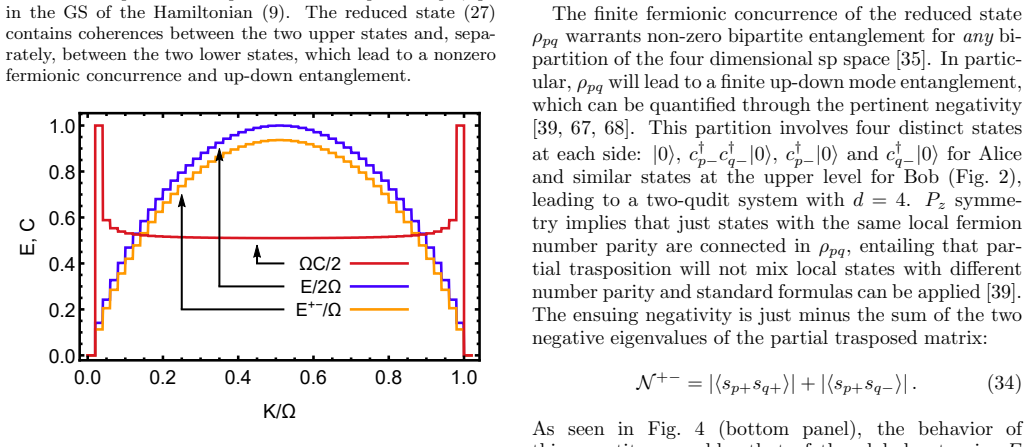
Pith's one-line read In the fermionic Lipkin model, the one-body entanglement entropy mirrors the mean-field order parameter and is essentially half the up-down bipartite entanglement; the pair concurrence peaks at the phase transition.
desk verdict Solid fermionic-entanglement analysis of the Lipkin model; the up-down partition and RPA benchmark are new and the main claims hold, with a minor finite-size gap in the E_+- ≈ E/2 estimate. read the letter →
The pith
A machine-rendered reading of the paper's core claim, the machinery that carries it, and where it could break.
The reading
What carries the argument
The central objects are the one-body entanglement entropy $E=\operatorname{Tr} h(\rho^{\mathrm{sp}})$, equal to the minimum over single-particle bases of the sum of one-mode entropies and to the minimum relative entropy to a fermionic Gaussian state, and the fermionic concurrence $C(\rho_A)=\max[2\lambda_{\max}-\operatorname{Tr}R(\rho_A),0]$ for a four-mode reduced state. Because the ground state has definite $S_z$-parity and translational invariance, $\rho^{\mathrm{sp}}$ consists of $\Omega$ identical two-by-two blocks, so $E$ is fixed solely by the average upper-level occupation $\langle S_z\rangle/\Omega$. The proportionality $E_{+-}\simeq E/2$ is carried by the binomial identity $\log_2\binom{\Omega}{K}\simeq -\Omega[k\log_2 k+(1-k)\log_2(1-k)]$ from Stirling's approximation. The approximate calculations use a symmetry-projected mean-field ansatz and a Holstein-Primakoff bosonization of the collective spin operators (the RPA), which yields asymptotic formulas for the concurrence in the normal and parity-broken phases.
What would settle it
Diagonalize the exact ground state of the fermionic Lipkin model for $\Omega=100$, $200$, and $400$ at fixed anisotropies $\chi=0.5$ and $\chi=-1$, and compute $E_{+-}$ and $E/2$; the proportionality claim predicts $E_{+-}/E\to 1/2$ with relative corrections $O(\log_2\Omega)/\Omega$. Separately, comparing the exact $\Omega C$ with the RPA formulas (59) and (62) at the same sizes tests whether the concurrence requires RPA-type correlations.
Extended reading notes
Core claim
On the paper's own terms, the central discovery is that in the exact ground state of the fermionic Lipkin model the one-body entanglement entropy $E$, defined by $E=\operatorname{Tr} h(\rho^{\mathrm{sp}})$ and interpreted as the minimum relative entropy to a fermionic Gaussian state, is essentially half the up-down mode entanglement entropy, $E_{+-}\simeq E/2$ for large $\Omega$. This follows because each state $|K\rangle$ has a Schmidt decomposition over $\binom{\Omega}{K}$ orthogonal Slater determinants, so $E_{+-}^K=\log_2\binom{\Omega}{K}\simeq E_K/2+O(\log_2\Omega)$. For the reduced state of two pairs of single-particle modes, the fermionic concurrence $C$ is evaluated exactly and is shown to be peaked at $v_x\simeq\varepsilon$, to change from antiparallel to parallel at the factorizing point $v_x=\varepsilon/\sqrt{\chi}$ for $0<\chi<1$, and to vanish there for large $\Omega$. The paper further claims that a mean-field description with basic $S_z$-parity restoration reproduces $E$, $E_{+-}$, and the up-down negativity, while the concurrence requires at least RPA-type collective-boson correlations for an accurate analytic description.
Load-bearing premise
The load-bearing premise is that the squared coefficients $C_K^2$ in the exact ground state are concentrated closely enough around the mean occupation $\langle K\rangle$ that the binomial entropy can be replaced by its value at the mean occupation, with $O(\log_2\Omega)$ corrections neglected; the paper invokes this for large $\Omega$ but verifies the proportionality numerically only at $\Omega=50$ and selected anisotropies.
Editorial extensions
If this is right
- The up-down entanglement $E_{+-}$, a resource meaningful only in the fermionic realization, can be estimated from the one-body average $\langle S_z\rangle$ through $E_{+-}\simeq E/2$ without computing the full reduced state.
- Symmetry-restored mean field provides analytic large-$\Omega$ formulas for the one-body entropy and the up-down negativity, so those quantities can be predicted without exact diagonalization.
- The two-pair fermionic concurrence marks the phase transition and the factorizing point: it is sharply peaked at $v_x\simeq\varepsilon$ and vanishes at $v_x=\varepsilon/\sqrt{\chi}$ for $0<\chi<1$.
- At the separability point, the exact degenerate ground state can be a Slater determinant, yet the definite-parity side limits keep a nonzero one-body entropy; only the concurrence reveals the separability for large $\Omega$.
Reading between the lines
- Editorial inference: the $E_{+-}\simeq E/2$ relation should be tested in other fully connected fermionic models, where the same binomial-entropy argument would predict proportionality whenever the ground-state coefficients are concentrated around their mean.
- Editorial inference: the contrast between quantities captured by projected mean field and the concurrence needing RPA suggests that one-body and two-mode reduced-state measures may be insensitive to residual correlations, while four-mode measures are not; this could guide approximation choices in other interacting fermion systems.
- Editorial inference: a nonzero one-body entanglement entropy should not be read as evidence against fermionic separability of a degenerate ground state, since the paper finds a vanishing concurrence at a point where the one-body entropy stays finite.
Signed reviews
Editorial analysis
A structured set of objections, weighed in public.
Referee Report
Summary. The paper studies fermionic entanglement in the half-filled fermionic Lipkin model. Using the exact S=Ω/2 ground state, it defines the one-body entanglement entropy E (Eq. 20), the up-down mode entanglement E_+- (Eq. 24), and the fermionic concurrence C of the four-mode reduced state (Eqs. 27-31), and compares them with symmetry-restored mean-field and RPA approximations. The central claims are that E tracks the mean-field order parameter and is approximately half of E_+-, that C peaks at the parity-breaking transition, and that mean-field plus symmetry projection suffices for E and the up-down negativity while RPA-type correlations are needed for C.
Significance. If correct, the results give a useful dictionary between particle-based fermionic entanglement and mode entanglement in a standard exactly solvable model. The paper has clear strengths: the exact coefficient representation, the Schmidt decomposition leading to Eq. (24), the explicit projected-mean-field expressions, and parameter-free RPA concurrence formulas that agree with exact diagonalization. The numerical verification is, however, limited to Ω=50, and the key proportionality E_+- ≈ E/2 is stated without a quantitative error estimate. This is the main obstacle to full confidence in the abstract-level claim.
major comments (1)
- [§III A 2, Eqs. (24)-(25)] The central estimation claim E_+- ≈ E/2 is asserted from the Stirling expansion without controlling the remainder. Equation (24) contains the Shannon entropy of the coefficient distribution {C_K^2} in addition to the averaged binomial entropy, so passing from Eq. (25) to the statement after it that “a similar relation E_+- ≈ E/2 holds for large Ω in a typical definite parity GS” requires a concentration bound that is not given. The only numerical check is Ω=50 (Figs. 1 and 3). The example of |K=1⟩ is not pathological: for χ=1 the exact ground state just above vx=ε is |K=1⟩, for which E_+-=log2 Ω while E/2=Ω h(1/Ω)≈log2 Ω+1/ln2; at Ω=50 this gives E_+-/E≈0.40 rather than 0.5, a deviation of about 20% of E/2. Equation (53) also shows that parity projection introduces an O(1) reduction relative to Eq. (44). Please provide either a bound of the form E_+-=E/2+O(log Ω) with an explicit prefactor, or a systematic finite-size scaling over several Ω, and adjust the wording of the abstract and conclusions accordingly if the error is state-dependent.
minor comments (4)
- [§III A 3, Eq. (32)] The formula for C_K is hard to parse in the current typesetting; please write C_K = 2/[Ω(1+sqrt(1-(Ω-1)/(K(Ω-K))))].
- [Throughout] There are small typos: “biparitte” after Eq. (6), “writtten” before Eq. (8), “trasposition” before Eq. (34), a missing subscript in Eq. (40), and “|Ψ(θ⟩” in Eq. (63).
- [Fig. 4] The inset in the top panel is very small and difficult to read; a separate panel with all χ values would improve the comparison.
- [Reproducibility] No data or code availability statement is provided; making the exact-diagonalization scripts available would improve reproducibility and allow readers to check the finite-size behavior beyond Ω=50.
Circularity Check
No significant circularity: the paper applies previously defined entanglement measures to a new model, and the approximations it tests are derived from the Hamiltonian rather than fitted to the target quantities.
full rationale
The paper's central quantities are the one-body entanglement entropy (Eq. (1), imported from the authors' Refs. [32,35]) and the fermionic concurrence (Eq. (7), imported from Refs. [18,20,32]); these are established definitions and measure-theoretic results, not quantities redefined in terms of the Lipkin-model outcomes that the paper then predicts. The relation E_+- ≈ E/2 is not forced by definition: Eq. (24) is an exact expression involving both the binomial entropy log2 C(Omega,K) and the Shannon entropy of the coefficient distribution {C_K^2}, and Eq. (25) is a Stirling approximation with an uncontrolled O(log Omega) remainder. The MF result E_+-^mf = E^mf/2 in Eq. (44) is a computed identity for the binomial MF state, not an input assumption, and Eq. (53) even identifies the O(1) reduction from Sz-parity projection, so the proportionality claim remains a substantive asymptotic statement rather than a tautology. The MF and RPA descriptions are parameter-free: the MF angle theta follows from minimizing the mean energy (Eqs. (37)-(39)), and the RPA concurrence follows from diagonalizing the quadratic boson Hamiltonian (Eqs. (57)-(62)). No parameter is fitted to the exact data and then renamed as a prediction. The finite-size control of E_+- ≈ E/2 is a legitimate correctness concern, but it is not circularity.
Assumptions & free parameters
free parameters (1)
- RPA squeezing parameter gamma =
not fixed; taken from RPA as beta/(2 Omega alpha) or determined variationally
assumptions (5)
- domain assumption Half-filling, attractive case, |chi| <= 1, and the exact GS lying in the maximum spin S = Omega/2 subspace.
- domain assumption The exact GS has definite Sz parity Pz, so one-body off-diagonal elements vanish and reduced states take the block-diagonal forms (19) and (27).
- domain assumption The one-body entropy (1) and concurrence (7) correctly quantify fermionic entanglement as minimum distance to Gaussian states.
- ad hoc to paper For large Omega, the exact GS coefficients C_K are concentrated enough for Stirling and large-K expansions to apply uniformly.
- domain assumption Holstein-Primakoff bosonization truncated at quadratic order captures <S_+-^2> and hence the concurrence.
Cite this review
Pith. "Pith review of Fermionic entanglement in the Lipkin model." pith.science (2026). https://pith.science/paper/D2STHZHY
@misc{pith2026190808582,
  author       = {Pith},
  title        = {Pith review of: Fermionic entanglement in the Lipkin model},
  year         = {2026},
  howpublished = {\url{https://pith.science/paper/D2STHZHY}},
  note         = {Machine review of arXiv:1908.08582}
}
read the original abstract
We examine the fermionic entanglement in the ground state of the fermionic Lipkin model and its relation with bipartite entanglement. It is first shown that the one-body entanglement entropy, which quantifies the minimum distance to a fermionic Gaussian state, behaves similarly to the mean-field order parameter and is essentially proportional to the total bipartite entanglement between the upper and lower modes, a quantity meaningful only in the fermionic realization of the model. We also analyze the entanglement of the reduced state of four single-particle modes (two up-down pairs), showing that its fermionic concurrence is strongly peaked at the phase transition and behaves differently from the corresponding up-down entanglement. We finally show that the first measures and the up-down reduced entanglement can be correctly described through a basic mean-field approach supplemented with symmetry restoration, whereas the concurrence requires at least the inclusion of RPA-type correlations for a proper prediction. Fermionic separability is also discussed.
Figures


Figures from the paper (3 more)


Reference graph
Works this paper leans on
-
[1]
One body entropy We start with the evaluation of the one-body entan- glement entropy (1). Due to conservation of the single site fermion number np, the elements of the one-body density matrix ρsp in a state of the form (15) satisfy ⟨c† pµcqν ⟩ = δpq⟨c† pµcpν ⟩. And due to translational invari- ance over the states p, they form Ω identical blocks ρsp p = (...
-
[2]
Up-down entanglement entropy The fermionic version of the model enables to consider a bipartition where Alice has access to the Ω lower single fermion levels and Bob to the Ω upper levels, which has no physical counterpart in a pure spin realization. It is only in the fermionic case where this partition becomes meaningful and the ensuing up-down mode enta...
-
[3]
Fermionic concurrence and reduced up-down entanglement We now examine the fermionic and up-down entangle- ment in the reduced state ρpq of four single fermion states p±,q±,p ⁄=q, which is a mixed state for Ω > 2 and is here the first non-trivial case for both measures. We first note that since np = 1, the reduced state ρp of a single pair of modes p± (repre...
-
[4]
Mean-field approach We start with the basic mean-field (MF) approach, where the GS is approximated by a SD, here of the form |Ψ mf⟩ =e−iθn·S|Ψ 0⟩ = ∏ p c′† p−|0⟩, (36) where S = (Sx,S y,S z), c′† p± = e−iθn·Sc† p±eiθn·S are ro- tated fermion operators and n a unit vector. Both θ and n are to be obtained from the minimization of the mean energy, which by mea...
-
[5]
Sz-Parity projected mean-field A more rigorous extraction of fermionic entanglement measures at the MF level can be achieved by considering the exact Sz-parity restored states |Ψ ±⟩ = |Ψ mf (θ)⟩ ± |Ψ mf (−θ)⟩ √ 2(1 ± cosΩ θ) , (48) where |Ψ mf (θ)⟩ denotes the state (36) (for n · S = Sy) and |Ψ mf (−θ)⟩ = Pz|Ψ mf(θ)⟩. If the overlap ⟨Ψ mf (−θ)|Ψ mf (θ)⟩ = ...
-
[6]
Mean-field plus Random-phase approximation In order to obtain a reliable analytic description of the concurrence for large Ω, it is necessary to employ at least a random-phase approximation (RPA) [44], equivalent to a first-order Holstein-Primakoff bosonization of the Hamiltonian around the MF solution (see [44] and also [51, 53, 54] and [55, 57]). It can be...
-
[7]
It is valid when ⟨Sz⟩ is close to −Ω/ 2, i.e
this mapping takes the form S+ → √ Ωb†, S − → √ Ωb, S z →b†b − Ω/ 2, where the condition [ b,b †] = 1 is imposed. It is valid when ⟨Sz⟩ is close to −Ω/ 2, i.e. in the normal MF phase 10 vx < ε, where the vacuum |0⟩ of b corresponds to the unperturbed GS |Ψ 0⟩. This leads to an approximate quadratic boson Hamiltonian: H −E0 →Hb = (ε −w)b†b − v 2 (b†2 +b2) ...
-
[8]
Einstein, B
A. Einstein, B. Podolsky, and N. Rosen, Phys. Rev. 47, 777 (1935)
1935
Show all 77 references
-
[9]
Schr¨ odinger, Proc
E. Schr¨ odinger, Proc. Cam. Phil. Soc. 31, 555 (1935); ibid 32, 446 (1936)
1935
-
[10]
C. H. Bennett, G. Brassard, C. Cr´ epeau, R. Jozsa, A. Peres, and W. K. Wootters, Phys. Rev. Lett. 70, 1895 (1993)
1993
-
[11]
Schumacher;Phys
B. Schumacher;Phys. Rev. A 51, 2738 (1995); C.H. Ben- nett, H.J. Bernstein, S. Popescu and B. Schumacher, Phys. Rev. A 53, 2046 (1996)
1995
-
[12]
M. A. Nielsen and I. L. Chuang, Quantum Computation and Quantum Information (Camb. Univ. Press, Cam- bridge, UK, 2000)
2000
-
[13]
Jozsa and N
R. Jozsa and N. Linden, Proc. R. Soc. Lond. A: 459, 2011 (2003)
2003
-
[14]
Vidal, Phys
G. Vidal, Phys. Rev. Lett. 91, 147902 (2003)
2003
-
[15]
T. J. Osborne and M. A. Nielsen, Phys. Rev. A 66, 032110 (2002)
2002
-
[16]
Vidal, J
G. Vidal, J. I. Latorre, E. Rico, and A. Kitaev, Phys. Rev. Lett. 90, 227902 (2003)
2003
-
[17]
Amico, R
L. Amico, R. Fazio, A. Osterloh, and V. Vedral, Rev. Mod. Phys. 80, 517 (2008)
2008
-
[18]
Verstraete, J.I
F. Verstraete, J.I. Cirac, and V. Murg, Adv. Phys. 57, 143 (2008)
2008
-
[19]
Eisert, M
J. Eisert, M. Cramer, and M. B. Plenio, Rev. Mod. Phys. 82, 277 (2010)
2010
-
[20]
De Chiara and A
G. De Chiara and A. Sanpera, Rep. Prog. Phys. 81, 074002 (2018)
2018
-
[21]
Popescu, A
S. Popescu, A. J. Short, and A. Winter, Nat. Phys. 2, 754 (2006)
2006
-
[22]
Verlinde and H
E. Verlinde and H. Verlinde, J. High Energy Phys. 2013, 107 (2013)
2013
-
[23]
Giovannetti, S
V. Giovannetti, S. Lloyd, and L. Maccone, Phys. Rev. D 92, 045033 (2015)
2015
-
[24]
Verch, R.F
R. Verch, R.F. Werner, Rev. Math. Phys. 17, 545 (2005)
2005
-
[25]
Schliemann, J.I
J. Schliemann, J.I. Cirac, M. Ku´ s, M. Lewenstein, and D. Loss, Phys. Rev. A 64, 022303 (2001)
2001
-
[26]
Schliemann, D
J. Schliemann, D. Loss, and A.H. MacDonald, Phys. Rev. B 63, 085311 (2001)
2001
-
[27]
Eckert, J
K. Eckert, J. Schliemann, D. Bruß, and M. Lewenstein, Ann. Phys. 299, 88 (2002)
2002
-
[28]
Wiseman and J
H.M. Wiseman and J. A. Vaccaro, Phys. Rev. Lett. 91, 097902 (2003)
2003
-
[29]
Ghirardi, and L
G.C. Ghirardi, and L. Marinatto, Phys.Rev.A 70, 012109 (2004)
2004
-
[30]
Kraus, M.M
C.V. Kraus, M.M. Wolf, J.I. Cirac, and G. Giedke, Phys. Rev. A 79, 012306 (2009)
2009
-
[31]
Zanardi, Phys
P. Zanardi, Phys. Rev. A 65, 042101 (2002)
2002
-
[32]
Shi, Phys
Y. Shi, Phys. Rev. A 67, 024301 (2003)
2003
-
[33]
Friis, A
N. Friis, A. R. Lee, and D. E. Bruschi, Phys. Rev. A 87, 022338 (2013)
2013
-
[34]
Benatti, R
F. Benatti, R. Floreanini, and U. Marzolino, Phys. Rev. A 89, 032326 (2014)
2014
-
[35]
X. M. Puspus, K. H. Villegas, and F. N. C. Paraan, Phys. Rev. B 90, 155123 (2014)
2014
-
[36]
Iemini and R
F. Iemini and R. O. Vianna, Phys. Rev. A 87, 022327 (2013); F. Iemini, T. Debarba and R.O. Vianna, Phys. Rev. A 89, 032324 (2014)
2013
-
[37]
Oszmaniec and M
M. Oszmaniec and M. Ku´ s, Phys. Rev. A 88, 052328 (2013); M. Oszmaniec, J. Gutt and M. Ku´ s, Phys. Rev. A 90, 020302(R) (2014)
2013
-
[38]
S´ arosi and P
G. S´ arosi and P. L´ evay, J. Phys. A: Math. Theor. 47, 115304 (2014)
2014
-
[39]
Gigena, R.Rossignoli, Phys
N. Gigena, R.Rossignoli, Phys. Rev. A 92, 042326 (2015)
2015
-
[40]
Gigena and R
N. Gigena and R. Rossignoli, Phys. Rev. A 95, 062320 (2017); ibid 94, 042315 (2016)
2017
-
[41]
Majtey, P.A
A.P. Majtey, P.A. Bouvrie, A. Vald´ es-Hern´ andez, and A.R. Plastino, Phys. Rev. A 93, 032335 (2016); A.R. Plastino, D. Manzano and J.S. Dehesa, EPL 86 20005 (2009)
2016
-
[42]
Di Tullio, N
M. Di Tullio, N. Gigena, and R. Rossignoli, Phys. Rev. A 97, 062109 (2018)
2018
-
[43]
Dasenbrook, J
D. Dasenbrook, J. Bowles, J. B. Brask, P. P. Hofer, C. Flindt, N. Brunner, New J. Phys. 18, 043036 (2016)
2016
-
[44]
G. G. Amosov and S. N. Filippov, Quantum Inf. Proc. 16, 2 (2017)
2017
-
[45]
Debarba, R
T. Debarba, R. O. Vianna, and , F. Iemini, Phys. Rev. A 95, 022325 (2017); L.S. Souza, T. Debarba, D.L. Braga Ferreira, F. Iemini, R.O. Vianna, Phys. Rev. A 98, 052135 (2018)
2017
-
[46]
Shapourian, S
H. Shapourian, S. Ryu, Phys. Rev. A 99, 022310 (2019)
2019
-
[47]
Hill and W.K
S. Hill and W.K. Wootters, Phys. Rev. Lett. 78, 5022 (1997); W.K. Wootters, Phys. Rev. Lett. 80, 2245 (1998)
1997
-
[48]
Lipkin, N
H. Lipkin, N. Meshkov, and A. Glick, Nucl. Phys. 62, 188 (1965)
1965
-
[49]
Meshkov, A
N. Meshkov, A. Glick, and H. Lipkin, Nucl. Phys. 62, 199 (1965)
1965
-
[50]
Glick, H
A. Glick, H. Lipkin, and N. Meshkov, Nucl. Phys. 62, 211 (1965)
1965
-
[51]
Ring and P
P. Ring and P. Schuck, The Nuclear Many-Body Problem (Springer,Berlin, 1980)
1980
-
[52]
Gilmore, D.H
R. Gilmore, D.H. Feng, Nucl. Phys. A 301, 189 (1978)
1978
-
[53]
Rossignoli, N
R. Rossignoli, N. Canosa, Phys. Lett. B 394, 242 (1997)
1997
-
[54]
Vidal, G
J. Vidal, G. Palacios, and C. Aslangul, Phys. Rev. A 70, 062304 (2004)
2004
-
[55]
Casta˜ nos, R
O. Casta˜ nos, R. L´ opez-Pe˜ na, J. G. Hirsch, and E. L´ opez- Moreno, Phys. Rev. B 74, 104118 (2006)
2006
-
[56]
Caneva, R
T. Caneva, R. Fazio, and G. E. Santoro, Phys. Rev. B 78, 104426 (2008)
2008
-
[57]
Campbell, G
S. Campbell, G. De Chiara, M. Paternostro, G. M. Palma, R. Fazio, Phys. Rev. Lett. 114, 177206 (2015)
2015
-
[58]
Vidal, G
J. Vidal, G. Palacios, and R. Mosseri, Phys. Rev. A 69, 022107 (2004); S. Dusuel, J. Vi- dal, Phys. Rev. Lett. 93, 237204 (2004)
2004
-
[59]
J. I. Latorre, R. Or´ us, E. Rico, and J. Vidal, Phys. Rev. A 71, 064101 (2005)
2005
-
[60]
Dusuel and J
S. Dusuel and J. Vidal, Phys. Rev. B 71, 224420 (2005)
2005
-
[61]
Barthel, S
T. Barthel, S. Dusuel, and J. Vidal, Phys. Rev. Lett. 97, 220402 (2006); J. Vidal, S. Dusuel, T. Barthel, J. Stat. Mech.: Theory Exp., 2007, P01015 (2007)
2006
-
[62]
J. M. Matera, R. Rossignoli, and N. Canosa, Phys. Rev. A 78, 012316 (2008); N. Canosa, J.M. Mat- era, R. Rossignoli, Phys. Rev. A 76, 022310 (2007)
2008
-
[63]
Cui, Phys
H. Cui, Phys. Rev. A 77, 052105 (2008)
2008
-
[64]
J. M. Matera, R. Rossignoli, and N. Canosa, Phys. Rev. A 82, 052332 (2010)
2010
-
[65]
Filippone, S
M. Filippone, S. Dusuel, and J. Vidal, Phys. Rev. A 83, 022327 (2011)
2011
-
[66]
Wilms, J
J. Wilms, J. Vidal, F. Verstraete, and S. Dusuel, J. Stat . Mech.: Theory Exp. 2012, P01023 (2012)
2012
-
[67]
Larson, EPL 90, 54001 (2010)
J. Larson, EPL 90, 54001 (2010). 13
2010
-
[68]
Wehrl, Rev
A. Wehrl, Rev. Mod. Phys. 50, 221 (1978)
1978
-
[69]
Vedral, Rev
V. Vedral, Rev. Mod. Phys. 74, 197 (2002)
2002
-
[70]
C. H. Bennett, D. P. DiVincenzo, J. A. Smolin, and W. K. Wootters, Phys. Rev. A 54, 3824 (1996)
1996
-
[71]
Friis, New J
N. Friis, New J. Phys. 18, 033014 (2016)
2016
-
[72]
Roscilde, P
T. Roscilde, P. Verrucchi, A. Fubini, S. Haas, and V. Tognetti, Phys. Rev. Lett. 93, 167203 (2004); ibid 94, 147208 (2004)
2004
-
[73]
Rossignoli, N
R. Rossignoli, N. Canosa, and J. M. Matera, Phys. Rev. A 77, 052322 (2008); ibid 80, 062325 (2009)
2008
-
[74]
Vidal, R.F
G. Vidal, R.F. Werner, Phys. Rev. A 65, 032314 (2002)
2002
-
[75]
Zyczkowski, P
K. Zyczkowski, P. Horodecki, A. Sanpera, and M. Lewen- stein, Phys. Rev. A 58, 883 (1998); K. Zyczkowski, Phys. Rev. A 60, 3496 (1999)
1998
-
[76]
Amico, F
L. Amico, F. Baroni, A. Fubini, D. Patan` e, V. Tognetti, and P. Verrucchi, Phys. Rev. A 74, 022322 (2006)
2006
-
[77]
Giampaolo, G.Adesso, F.Illuminati, Phys.Rev.Lett
S.M. Giampaolo, G.Adesso, F.Illuminati, Phys.Rev.Lett. 100, 197201 (2008); Phys. Rev. B 79, 224434 (2009)
2008
Reviewed August 14, 2026 · model on record in the stance chip above.
Discussion (0). Continue with ORCID to comment.