REVIEW 2 major objections 2 minor 38 references
Mean-field theory of rich oscillatory dynamics in low-rank recurrent networks with activity-dependent adaptation
T0 review · 2 major / 2 minor · reviewed 2026-06-30 · grok-4.3
Pith's one-line read Mean-field theory shows adaptation driving low-rank chaotic networks through four distinct oscillatory regimes.
desk verdict The paper puts low-rank structure plus adaptation into a single dynamical mean-field theory and extracts a 3D reduced model, but the abstract gives no derivations or checks against simulations so the key claim about mean-field validity above the chaos threshold stays untested. read the letter →
The pith
A machine-rendered reading of the paper's core claim, the machinery that carries it, and where it could break.
The reading
What carries the argument
The reduced three-dimensional dynamical model that captures the bifurcation structure of the full network through the frequency-dependent single-neuron transfer function.
What would settle it
Numerical integration of the full network equations that does not reproduce the predicted sequence of four regimes as adaptation strength is increased above the chaos threshold.
Extended reading notes
Core claim
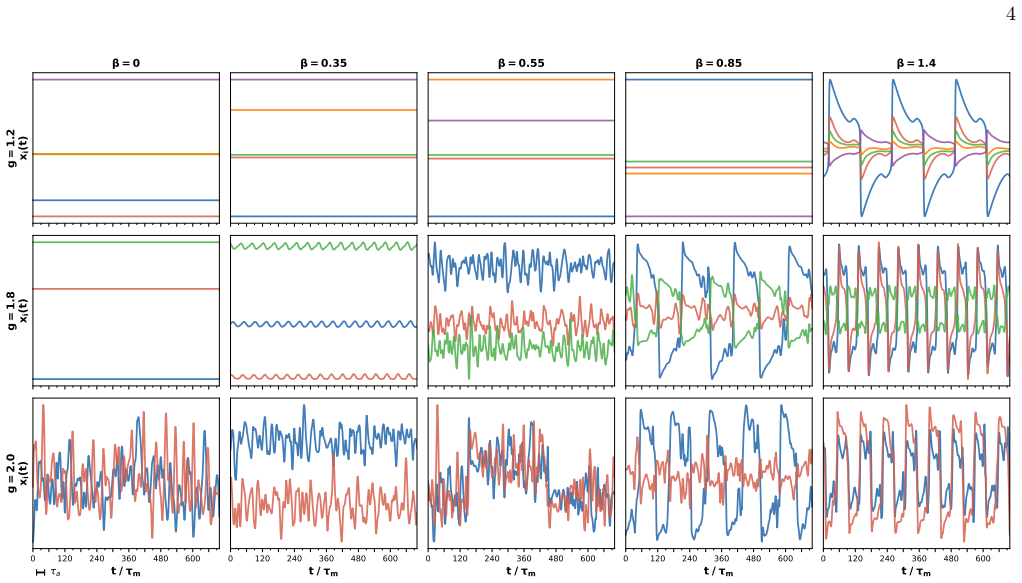
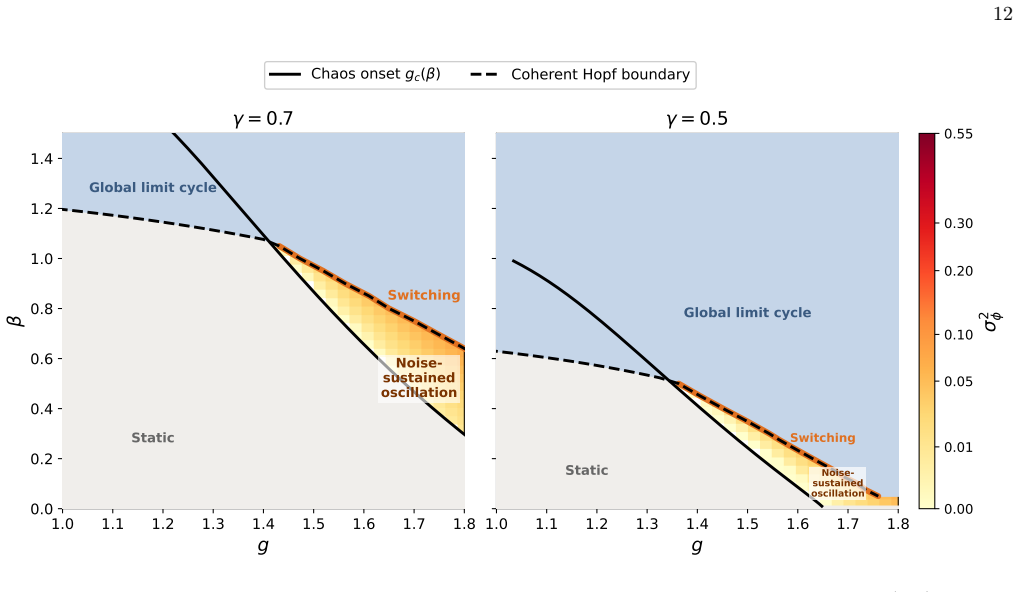
We develop a dynamical mean-field theory for random recurrent networks with low-rank structure and firing-rate-driven adaptation. When the random connectivity is strong enough to generate chaos, increasing adaptation strength drives the network through four regimes: a static coherent state, noise-sustained oscillations that progress from regular to irregular, stochastic switching between symmetric wells, and a global limit cycle. The theory identifies two instability mechanisms, chaos onset from the random connectivity and a Hopf bifurcation of the coherent mode, and shows how adaptation shapes both through the frequency-dependent single-neuron transfer function. A reduced three-dimensional
Load-bearing premise
The mean-field approximation remains valid once random connectivity exceeds the chaos threshold, allowing the frequency-dependent transfer function to control the observed regime transitions.
Editorial extensions
If this is right
- Coherent population-level oscillations can coexist with heterogeneous single-neuron firing rates and network-generated stochasticity.
- The network produces waxing-and-waning rhythmic episodes, persistent state switching, and slow Up-Down alternations.
- The two instability mechanisms are both shaped by the frequency dependence that adaptation imposes on neuronal responses.
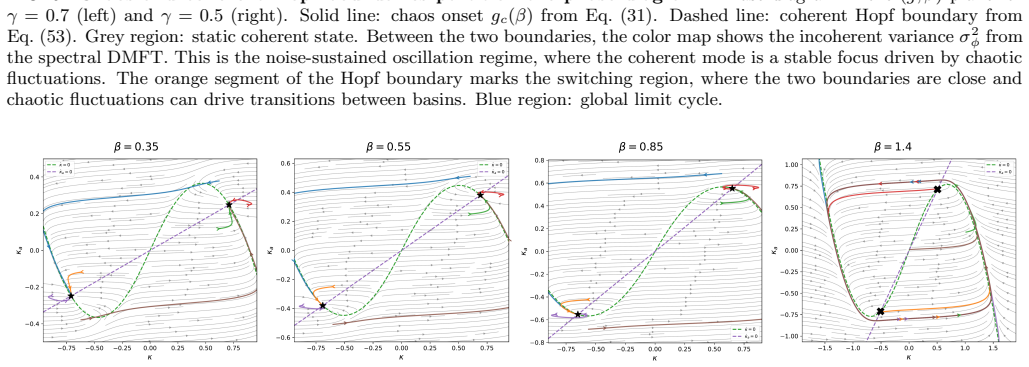
- The reduced three-dimensional model reproduces the bifurcation sequence of the full network.
Reading between the lines
- Varying adaptation strength in this framework could model transitions between brain states such as wakefulness and anesthesia.
- The reduced model offers a route to analyze how low-rank structure interacts with chaos in networks beyond the cases studied here.
- Recordings from cortical populations during changing arousal levels could test whether observed dynamics shift regimes at the predicted adaptation strengths.
Signed reviews
Editorial analysis
A structured set of objections, weighed in public.
Referee Report
Summary. The paper develops a dynamical mean-field theory (DMFT) for recurrent networks combining random connectivity, low-rank structure, and firing-rate-driven adaptation. Above the chaos threshold set by random connectivity, increasing adaptation strength produces four regimes (static coherent state, noise-sustained oscillations progressing from regular to irregular, stochastic switching between symmetric wells, and a global limit cycle). The theory attributes the transitions to two mechanisms—chaos onset from random connectivity and a Hopf bifurcation of the coherent mode—both shaped by the frequency-dependent single-neuron transfer function, and supplies a reduced three-dimensional model that reproduces the bifurcation structure of the full network.
Significance. If the DMFT derivation holds, the work supplies an analytic handle on how adaptation interacts with structured and random connectivity to generate biologically relevant oscillatory patterns (waxing-and-waning rhythms, Up-Down states, persistent switching). The reduced 3D model is a concrete strength, as it makes the bifurcation diagram tractable and falsifiable against network simulations.
major comments (2)
- [Derivation of the DMFT equations (likely §3)] The central claim that the frequency-dependent transfer function of an isolated neuron governs both the chaos threshold and the Hopf bifurcation rests on the assumption that low-rank deterministic correlations remain negligible in the self-consistent equations for mean and variance once random connectivity exceeds the chaos threshold. The manuscript must derive the additional cross-terms arising from the low-rank component plus the temporal filtering of adaptation and show (analytically or numerically) that they do not alter the effective transfer function used to locate the instabilities.
- [Reduced three-dimensional model (likely §4 or §5)] The reduced three-dimensional model is stated to capture the bifurcation structure, but no explicit mapping is given between its parameters and the full-network statistics (e.g., the effective gain and time constants derived from the DMFT). Without this mapping or a quantitative comparison of bifurcation diagrams, it is unclear whether the reduction preserves the two-instability-mechanism picture.
minor comments (2)
- [Abstract and §1] The abstract and introduction use “chaos onset from the random connectivity” without citing the precise threshold condition (e.g., the critical variance of the random weights) that is later derived.
- [Figure captions] Figure captions should explicitly state which panels show full-network simulations versus the reduced model and which quantities are averaged over realizations.
Simulated Author's Rebuttal
We are grateful to the referee for their detailed and insightful report. Below we respond point-by-point to the major comments, indicating the revisions we will make to the manuscript.
read point-by-point responses
-
Referee: [Derivation of the DMFT equations (likely §3)] The central claim that the frequency-dependent transfer function of an isolated neuron governs both the chaos threshold and the Hopf bifurcation rests on the assumption that low-rank deterministic correlations remain negligible in the self-consistent equations for mean and variance once random connectivity exceeds the chaos threshold. The manuscript must derive the additional cross-terms arising from the low-rank component plus the temporal filtering of adaptation and show (analytically or numerically) that they do not alter the effective transfer function used to locate the instabilities.
Authors: We thank the referee for highlighting this aspect of the derivation. In our DMFT approach, the low-rank structure is treated as a deterministic perturbation whose contributions to the self-consistent equations for the mean and variance are indeed subleading above the chaos threshold set by the random connectivity. However, to make this explicit, we will include in the revised manuscript a detailed derivation of the cross-terms involving the low-rank component and the adaptation filter. We will show both analytically and via numerical verification that these terms do not modify the effective frequency-dependent transfer function used to determine the instabilities. This addition will clarify the separation of scales. revision: yes
-
Referee: [Reduced three-dimensional model (likely §4 or §5)] The reduced three-dimensional model is stated to capture the bifurcation structure, but no explicit mapping is given between its parameters and the full-network statistics (e.g., the effective gain and time constants derived from the DMFT). Without this mapping or a quantitative comparison of bifurcation diagrams, it is unclear whether the reduction preserves the two-instability-mechanism picture.
Authors: We agree that providing an explicit mapping would improve the clarity of the reduction. In the revised manuscript, we will add a section detailing how the parameters of the three-dimensional model (effective gain, time constants, etc.) are derived from the DMFT statistics of the full network. Additionally, we will include a quantitative comparison of the bifurcation diagrams obtained from the reduced model and from direct simulations of the network, confirming that the two-instability-mechanism picture is preserved. revision: yes
Circularity Check
No circularity: mean-field derivation is self-contained
full rationale
The paper derives a dynamical mean-field theory for low-rank recurrent networks with adaptation, identifies chaos onset and Hopf bifurcation via the frequency-dependent transfer function, and reduces to a 3D model. No steps reduce by construction to inputs, fitted parameters renamed as predictions, or load-bearing self-citations. The central claims rest on explicit derivation of the mean-field equations and bifurcation analysis rather than self-referential definitions or ansatzes smuggled via prior work. This is the expected non-finding for a derivation-focused manuscript.
Assumptions & free parameters
Cite this review
Pith. "Pith review of Mean-field theory of rich oscillatory dynamics in low-rank recurrent networks with activity-dependent adaptation." pith.science (2026). https://pith.science/paper/D2XDNY2X
@misc{pith2026260630366,
  author       = {Pith},
  title        = {Pith review of: Mean-field theory of rich oscillatory dynamics in low-rank recurrent networks with activity-dependent adaptation},
  year         = {2026},
  howpublished = {\url{https://pith.science/paper/D2XDNY2X}},
  note         = {Machine review of arXiv:2606.30366}
}
read the original abstract
We develop a dynamical mean-field theory for random recurrent networks with low-rank structure and firing-rate-driven adaptation. When the random connectivity is strong enough to generate chaos, increasing adaptation strength drives the network through four regimes: a static coherent state, noise-sustained oscillations that progress from regular to irregular, stochastic switching between symmetric wells, and a global limit cycle. The theory identifies two instability mechanisms, chaos onset from the random connectivity and a Hopf bifurcation of the coherent mode, and shows how adaptation shapes both through the frequency-dependent single-neuron transfer function. A reduced three-dimensional model captures the bifurcation structure of the full network. Above the chaos threshold, coherent population-level oscillations coexist with heterogeneous firing rates and network-generated stochasticity at the single-neuron level. The interaction of adaptation with random and low-rank connectivity produces a rich oscillatory repertoire, including waxing-and-waning rhythmic episodes, persistent state switching, and slow Up-Down alternations, dynamics that have been observed during wakefulness, sleep, and anesthesia.
Figures


Figures from the paper (8 more)



Reference graph
Works this paper leans on
-
[1]
These are jointly Gaussian with zero mean and covariances Cov(n, m) =γσ mσn =λ eff, Cov(n, h) = λeffκ, Cov(m, h) =σ 2 mκ
Gaussian conditioning The expectation in (D5) is over the joint distribution of (n, m, h). These are jointly Gaussian with zero mean and covariances Cov(n, m) =γσ mσn =λ eff, Cov(n, h) = λeffκ, Cov(m, h) =σ 2 mκ. Since ˜cand ˆGdepend onh alone, we condition onhusing the Gaussian regression formula: n|h= λeffκ Σ2 h h+ ˜n,(D6) m|h= σ2 mκ Σ2 h h+ ˜m,(D7) whe...
-
[2]
Buzs´ aki and A
G. Buzs´ aki and A. Draguhn, Neuronal oscillations in cor- tical networks, Science304, 1926 (2004)
1926
-
[3]
Fries, A mechanism for cognitive dynamics: neuronal communication through neuronal coherence, Trends Cogn
P. Fries, A mechanism for cognitive dynamics: neuronal communication through neuronal coherence, Trends Cogn. Sci.9, 474 (2005)
2005
-
[4]
Wang and G
X.-J. Wang and G. Buzs´ aki, Gamma oscillation by synap- tic inhibition in a hippocampal interneuronal network model, J. Neurosci.16, 6402 (1996)
1996
-
[5]
Wang, Neurophysiological and computational prin- ciples of cortical rhythms in cognition, Physiol
X.-J. Wang, Neurophysiological and computational prin- ciples of cortical rhythms in cognition, Physiol. Rev.90, 1195 (2010)
2010
-
[6]
H. R. Wilson and J. D. Cowan, Excitatory and inhibitory interactions in localized populations of model neurons, Biophys. J.12, 1 (1972). 21
1972
-
[7]
Brunel and X.-J
N. Brunel and X.-J. Wang, What determines the fre- quency of fast network oscillations with irregular neural discharges?, J. Neurophysiol.90, 415 (2003)
2003
-
[8]
Destexhe, A
A. Destexhe, A. Babloyantz, and T. J. Sejnowski, Ionic mechanisms for intrinsic slow oscillations in thalamic re- lay neurons, Biophys. J.65, 1538 (1993)
1993
Show all 38 references
-
[9]
Compte, M
A. Compte, M. V. Sanchez-Vives, D. A. McCormick, and X.-J. Wang, Cellular and network mechanisms of slow oscillatory activity (<1 Hz) and wave propagations in a cortical network model, J. Neurophysiol.89, 2707 (2003)
2003
-
[10]
Sompolinsky, A
H. Sompolinsky, A. Crisanti, and H. J. Sommers, Chaos in random neural networks, Phys. Rev. Lett.61, 259 (1988)
1988
-
[11]
van Vreeswijk and H
C. van Vreeswijk and H. Sompolinsky, Chaos in neuronal networks with balanced excitatory and inhibitory activ- ity, Science274, 1724 (1996)
1996
-
[12]
Crisanti and H
A. Crisanti and H. Sompolinsky, Path integral approach to random neural networks, Phys. Rev. E98, 062120 (2018)
2018
-
[13]
Brunel, Dynamics of sparsely connected networks of excitatory and inhibitory spiking neurons, J
N. Brunel, Dynamics of sparsely connected networks of excitatory and inhibitory spiking neurons, J. Comput. Neurosci.8, 183 (2000)
2000
-
[14]
Mastrogiuseppe and S
F. Mastrogiuseppe and S. Ostojic, Linking connectivity, dynamics, and computations in low-rank recurrent neural networks, Neuron99, 609 (2018)
2018
-
[15]
Kadmon and H
J. Kadmon and H. Sompolinsky, Transition to chaos in random neuronal networks, Phys. Rev. X5, 041030 (2015)
2015
-
[16]
Schuessler, A
F. Schuessler, A. Dubreuil, F. Mastrogiuseppe, S. Os- tojic, and O. Barak, Dynamics of random recurrent net- works with correlated low-rank structure, Phys. Rev. Re- search2, 013111 (2020)
2020
-
[17]
I. D. Landau and H. Sompolinsky, Coherent chaos in a recurrent neural network with structured connectivity, PLoS Comput. Biol.14, e1006309 (2018)
2018
-
[18]
I. D. Landau and H. Sompolinsky, Macroscopic fluctua- tions emerge in balanced networks with incomplete recur- rent alignment, Phys. Rev. Research3, 023171 (2021)
2021
-
[19]
Aljadeff, M
J. Aljadeff, M. Stern, and T. Sharpee, Transition to chaos in random networks with cell-type-specific connectivity, Physical Review Letters114, 088101 (2015)
2015
-
[20]
J. P. Cunningham and B. M. Yu, Dimensionality reduc- tion for large-scale neural recordings, Nat. Neurosci.17, 1500 (2014)
2014
-
[21]
J. A. Gallego, M. G. Perich, L. E. Miller, and S. A. Solla, Neural manifolds for the control of movement, Neuron 94, 978 (2017)
2017
-
[22]
Beiran, A
M. Beiran, A. Dubreuil, A. Valente, F. Mastrogiuseppe, and S. Ostojic, Shaping dynamics with multiple popu- lations in low-rank recurrent networks, Neural Comput. 33, 1572 (2021)
2021
-
[23]
Dubreuil, A
A. Dubreuil, A. Valente, M. Beiran, F. Mastrogiuseppe, and S. Ostojic, The role of population structure in com- putations through neural dynamics, Nat. Neurosci.25, 783 (2022)
2022
-
[24]
Sussillo and L
D. Sussillo and L. F. Abbott, Generating coherent pat- terns of activity from chaotic neural networks, Neuron 63, 544 (2009)
2009
-
[25]
Ostojic, Two types of asynchronous activity in net- works of excitatory and inhibitory spiking neurons, Na- ture Neuroscience17, 594 (2014)
S. Ostojic, Two types of asynchronous activity in net- works of excitatory and inhibitory spiking neurons, Na- ture Neuroscience17, 594 (2014)
2014
-
[26]
Rivkind and O
A. Rivkind and O. Barak, Local dynamics in trained re- current neural networks, Phys. Rev. Lett.118, 258101 (2017)
2017
-
[27]
D. G. Clark, L. F. Abbott, and A. Litwin-Kumar, Dimen- sion of activity in random neural networks, Phys. Rev. Lett.131, 118401 (2023)
2023
-
[28]
Benda and A
J. Benda and A. V. M. Herz, A universal model for spike- frequency adaptation, Neural Comput.15, 2523 (2003)
2003
-
[29]
Fuhrmann, H
G. Fuhrmann, H. Markram, and M. Tsodyks, Spike fre- quency adaptation and neocortical rhythms, J. Neuro- physiol.88, 761 (2002)
2002
-
[30]
Ermentrout, M
B. Ermentrout, M. Pascal, and B. Gutkin, The effects of spike frequency adaptation and negative feedback on the synchronization of neural oscillators, Neural Comput. 13, 1285 (2001)
2001
-
[31]
van Vreeswijk and D
C. van Vreeswijk and D. Hansel, Patterns of synchrony in neural networks with spike adaptation, Neural Comput. 13, 959 (2001)
2001
-
[32]
S. P. Muscinelli, W. Gerstner, and T. Schwalger, How sin- gle neuron properties shape chaotic dynamics and signal transmission in random neural networks, PLoS Comput. Biol.15, e1007122 (2019)
2019
-
[33]
D. G. Clark and L. F. Abbott, Theory of coupled neuronal-synaptic dynamics, Physical Review X14, 021001 (2024)
2024
-
[34]
Gollisch and A
T. Gollisch and A. V. M. Herz, Input-driven components of spike-frequency adaptation can be unmasked in vivo, J. Neurosci.24, 7435 (2004)
2004
-
[35]
D. A. McCormick, Actions of acetylcholine in the cere- bral cortex and thalamus and implications for function, Progress in brain research98, 303 (1993)
1993
-
[36]
K. M. Stiefel, B. S. Gutkin, and T. J. Sejnowski, Cholin- ergic neuromodulation changes phase response curve shape and type in cortical pyramidal neurons, PloS one 3, e3947 (2008)
2008
-
[37]
T.-A. E. Nghiem, N. Tort-Colet, T. G´ orski, U. Ferrari, S. Moghimyfiroozabad, J. S. Goldman, B. Tele´ nczuk, C. Capone, T. Bal, M. Di Volo,et al., Cholinergic switch between two types of slow waves in cerebral cortex, Cere- bral Cortex30, 3451 (2020)
2020
-
[38]
Rajan and L
K. Rajan and L. F. Abbott, Eigenvalue spectra of random matrices for neural networks, Phys. Rev. Lett.97, 188104 (2006)
2006
Reviewed June 30, 2026 · model on record in the stance chip above.
Discussion (0). Continue with ORCID to comment.