REVIEW 2 major objections 4 minor 55 references
Recurrent State Encoders for Efficient Neural Combinatorial Optimization
T0 review · 2 major / 4 minor · reviewed 2026-08-05 · deepseek-v4-flash
Pith's one-line read The paper claims that a small recurrent encoder can update node embeddings step by step instead of recomputing them, matching or beating a 9-layer base encoder with 3x fewer layers and 1.8–4x lower latency on TSP, CVRP, and OP.
desk verdict Real new architecture with credible latency gains, but single-run curves cannot yet support the 'better' clause in the accuracy claim. read the letter →
The pith
A machine-rendered reading of the paper's core claim, the machinery that carries it, and where it could break.
The reading
What carries the argument
A lightweight recurrent encoder that maps (previous aligned embeddings, current state) to updated embeddings, learned to capture the difference between consecutive construction states. The update mechanism removes the embedding of the node that disappeared from the state, normalizes the old embeddings, concatenates them with fresh node-wise linear projections plus learned start/end tokens, applies a ReLU residual, then refines through L_U transformer blocks and projects back to the base embedding dimension. A hyperparameter k controls how often the full 9-layer base encoder recomputes embeddings, letting the model trade freshness against latency; this carries the efficiency claim because mos
What would settle it
Run the same recurrent encoder on a construction problem where each step removes many nodes or changes the state wholesale; if its solution gap exceeds the base encoder's at matched latency, the similarity premise fails. Alternatively, feed the recurrent update stale or random previous embeddings: if quality does not degrade, the recurrence is not doing the claimed work.
Extended reading notes
Core claim
On the paper's own terms: a recurrent state encoder UθU takes the previous aligned node embeddings and the current reduced state, and produces updated embeddings for the decoder; the full base encoder only runs every k steps. The update discards the embedding of the node that left the state, applies RMSNorm to the old embeddings, concatenates them with fresh linear projections of the current state plus learned start/end tokens, passes the result through a ReLU residual and L_U self-attention blocks, and projects back to embedding dimension. Trained by imitation learning in two stages—base model first, then the recurrent head while the base is frozen—this module reaches equivalent or better s
Load-bearing premise
The method assumes consecutive states in a construction differ by so little (usually one removed node) that a lightweight update of the previous embeddings can replace a full re-encoding; the paper notes problem types with larger state jumps would break the efficiency gain.
Editorial extensions
If this is right
- Neural construction policies can run 1.8–4x faster with no loss of solution quality on TSP, CVRP, and OP.
- A 3x-smaller encoder suffices when paired with the recurrent head; same-size non-recurrent encoders cannot match its accuracy.
- The recurrent head tolerates k=1000 even though trained with k=10, including on instances 10x larger, so the speedup can be pushed near the theoretical maximum.
- Plugged into large neighborhood search on 500–1000-node instances, the recurrent models improve the quality-versus-time frontier over the base encoder and published baselines.
- The frozen-base two-stage recipe makes the approach compatible with a large pretrained encoder that serves many small task-specific recurrent heads.
Reading between the lines
- If the learned-update idea generalizes, it applies not only to constructive MDPs but to any iterative optimization loop where consecutive candidate solutions differ locally, such as local search and insertion heuristics.
- The stability at k=1000 suggests the embeddings follow a smooth trajectory; measuring embedding drift across construction steps would give a direct diagnostic for whether a new problem class is suitable for this method.
- Because the recurrent head is trained on solver-generated labels, its ceiling is the expert solver; switching to RL or self-improvement training could let the recurrent model surpass the base encoder's quality, a testable variant the paper leaves open.
Editorial analysis
A structured set of objections, weighed in public.
Referee Report
Summary. The paper proposes a recurrent state encoder for constructive neural combinatorial optimization. A base encoder computes initial node embeddings, and a smaller recurrent module updates these embeddings at each construction step from the current state and the previous embeddings, with a hyperparameter k controlling how often the base encoder is re-run. The authors train by imitation learning on solver-generated trajectories for TSP, CVRP, and OP, evaluate on sizes 100–1000, and integrate the models into a large neighborhood search. The central claim is that the recurrent encoder with about 3× fewer layers than the base encoder achieves equivalent or better solution quality while reducing latency by 1.8–4×, and is robust to much larger k than used in training.
Significance. If the empirical claims hold, the paper makes a practically useful contribution: reusing computation across construction steps is a natural idea for NCO, and the reported latency gains in both direct construction and LNS are valuable. The paper is also commendable for providing code, checkpoints, and datasets, and for evaluating on three problems with out-of-distribution sizes. The main weakness is that the quality-equivalence claim is supported only by single-run evaluations without error bars, seed counts, or statistical tests; for differences of fractions of a percent this is insufficient to establish 'equivalent or better.' The latency improvement is large and consistent, so the core efficiency story is credible, but the accuracy claim needs stronger evidence.
major comments (2)
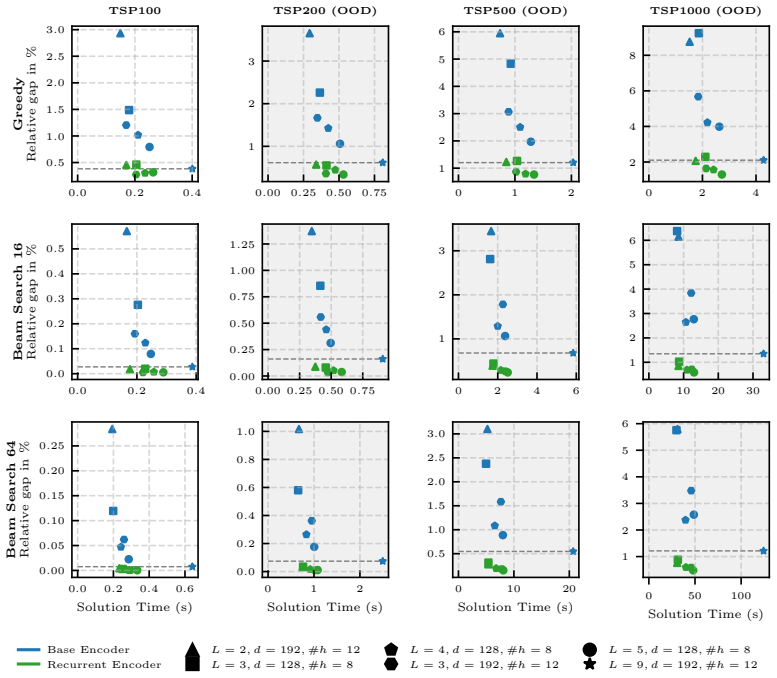
- [§4.2, Fig. 1 (and Figs. 4–7, Fig. 2)] The paper's central quality claim—'equivalent or better performance' and 'no significant accuracy drop'—is supported only by single-run curves/points. There are no error bars, no seed count, and no paired statistical test. For TSP100 and CVRP100, the differences between recurrent and base models are fractions of a percent, so a single run cannot distinguish a real effect from seed noise. This also affects the claimed robustness to k=200 (Fig. 1, right) and k=1000 (App. E), which extrapolate 20–100× beyond the training k=10. I request at least 3–5 independently trained seeds (or, minimally, paired bootstrap/permutation tests over the 1000 test instances) for the main comparisons and for the large-k and LNS experiments. For CVRP/OP, the heuristic reference solutions complicate interpretation because gaps can be negative; the relative claim to the base model is still meaningful, but the abs
- [Abstract and §3.2] The statement that the recurrent encoder 'consists of 3× fewer layers' is ambiguous and potentially misleading. The full recurrent model still includes the 9-layer base encoder E, which is run at t=1 and every k steps; only the update module U has L_U ∈ {2,3,4,5} layers. The measured latency gain comes from replacing E with U on the recurrent steps, not from a 3× smaller total model. Please restate the claim (e.g., 'update module with 3× fewer layers') and report total parameter counts and active per-step FLOPs for the full inference model.
minor comments (4)
- [§4.2, Fig. 1] The legend symbols are garbled (e.g., '2□2', '2□1'), making the figure hard to read. Please use clean labels or a table.
- [§4.2, Fig. 3] Methods that fall outside the axis range are simply not shown. The caption notes this, but a log-scale inset or a supplementary table with all values would make the comparison more complete.
- [§1] Typo: 'many problems inhibit the property' should be 'exhibit the property.'
- [§4.2, OP OOD] For OP200, the recurrent models do not match the base model. The text acknowledges this, but it would help to quantify the gap and discuss whether it is within the noise suggested by the single-run evaluation.
Circularity Check
No significant circularity: the performance claims are established by external benchmarks and independent evaluation, not by construction or self-citation.
full rationale
The paper's central claim — that a recurrent encoder with fewer layers matches or beats a non-recurrent base encoder — is empirical, not derived from its own definitions. The recurrent encoder update (Eq. 2) is a model architecture, not a result that presupposes the claimed equivalence. Both base and recurrent models are trained by imitation learning on trajectories from external solvers (Concorde, PyVRP, EA4OP), and evaluated on held-out instances against those same solvers as references; the gap metric is computed on test instances, not on training data, so no fitted parameter is being relabeled as a prediction. The recurrent model is trained to imitate expert actions, not to match the base model's embeddings or outputs, so its performance is not forced by construction to equal the base encoder. Self-citations appear only in related-work contexts (e.g., refs. [13,14,15] by group members) and are not load-bearing for the main results. The robustness claim for k=1000 is a genuine out-of-training-range extrapolation (trained with k=10), and the paper openly acknowledges the core similarity assumption may fail for other problem types (Section 5). The skeptical concern about missing error bars/seed counts is a statistical robustness issue, not circularity. Thus the derivation chain is self-contained against external evidence, warranting a low score.
Assumptions & free parameters
free parameters (3)
- training rollout length k =
10
- base encoder layers =
9
- embedding dimensions =
dE=192, dU=128-192
assumptions (3)
- domain assumption Recursive MDP formulation: after each construction step, the remaining unsolved nodes form a smaller instance of the same problem class (path-TSP, CVRP with depot, OP).
- domain assumption Expert trajectories generated by Concorde, PyVRP, and EA4OP are sufficiently close to optimal to serve as training labels for imitation learning.
- standard math Transformer layers with ReZero and RMSNorm are expressive enough to represent the needed embedding updates.
Cite this review
Pith. "Pith review of Recurrent State Encoders for Efficient Neural Combinatorial Optimization." pith.science (2026). https://pith.science/paper/D34HZ2XC
@misc{pith2026250905084,
  author       = {Pith},
  title        = {Pith review of: Recurrent State Encoders for Efficient Neural Combinatorial Optimization},
  year         = {2026},
  howpublished = {\url{https://pith.science/paper/D34HZ2XC}},
  note         = {Machine review of arXiv:2509.05084}
}
abstract
The primary paradigm in Neural Combinatorial Optimization (NCO) are construction methods, where a neural network is trained to sequentially add one solution component at a time until a complete solution is constructed. We observe that the typical changes to the state between two steps are small, since usually only the node that gets added to the solution is removed from the state. An efficient model should be able to reuse computation done in prior steps. To that end, we propose to train a recurrent encoder that computes the state embeddings not only based on the state but also the embeddings of the step before. We show that the recurrent encoder can achieve equivalent or better performance than a non-recurrent encoder even if it consists of $3\times$ fewer layers, thus significantly improving on latency. We demonstrate our findings on three different problems: the Traveling Salesman Problem (TSP), the Capacitated Vehicle Routing Problem (CVRP), and the Orienteering Problem (OP) and integrate the models into a large neighborhood search algorithm, to showcase the practical relevance of our findings.
Figures


Figures from the paper (4 more)


Reference graph
Works this paper leans on
-
[1]
Hydra: Sequentially-Dependent Draft Heads for Medusa Decoding
Zachary Ankner, Rishab Parthasarathy, Aniruddha Nrusimha, Christopher Rinard, Jonathan Ragan-Kelley, and William Brandon. Hydra: Sequentially-Dependent Draft Heads for Medusa Decoding. InFirst Conference on Language Modeling, August 2024
work page 2024
-
[2]
Thomas Bachlechner, Bodhisattwa Prasad Majumder, Huanru Henry Mao, Gary Cottrell, and Julian J. McAuley. ReZero is all you need: Fast convergence at large depth. In Cassio P. de Campos, Marloes H. Maathuis, and Erik Quaeghebeur, editors,Proceedings of the Thirty- Seventh Conference on Uncertainty in Artificial Intelligence, UAI 2021, Virtual Event, 27-30 ...
work page 2021
-
[3]
Jakob Bauer, Kate Baumli, Feryal Behbahani, Avishkar Bhoopchand, Nathalie Bradley-Schmieg, Michael Chang, Natalie Clay, Adrian Collister, Vibhavari Dasagi, Lucy Gonzalez, Karol Gregor, Edward Hughes, Sheleem Kashem, Maria Loks-Thompson, Hannah Openshaw, Jack Parker- Holder, Shreya Pathak, Nicolas Perez-Nieves, Nemanja Rakicevic, Tim Rocktäschel, Yannick S...
work page 1935
-
[4]
RL4CO: An Extensive Reinforcement Learning for Combinatorial Optimization Benchmark, June 2024
Federico Berto, Chuanbo Hua, Junyoung Park, Laurin Luttmann, Yining Ma, Fanchen Bu, Jiarui Wang, Haoran Ye, Minsu Kim, Sanghyeok Choi, Nayeli Gast Zepeda, André Hottung, Jianan Zhou, Jieyi Bi, Yu Hu, Fei Liu, Hyeonah Kim, Jiwoo Son, Haeyeon Kim, Davide Angioni, Wouter Kool, Zhiguang Cao, Qingfu Zhang, Joungho Kim, Jie Zhang, Kijung Shin, Cathy Wu, Sungsoo...
work page 2024
-
[5]
Wouda, Leon Lan, Kevin Tierney, and Jinkyoo Park
Federico Berto, Chuanbo Hua, Nayeli Gast Zepeda, André Hottung, Niels A. Wouda, Leon Lan, Kevin Tierney, and Jinkyoo Park. RouteFinder: Towards Foundation Models for Vehicle Routing Problems.CoRR, abs/2406.15007, 2024. doi: 10.48550/ARXIV .2406.15007
-
[6]
Accelerating Large Language Model Decoding with Speculative Sampling.CoRR, abs/2302.01318, 2023
Charlie Chen, Sebastian Borgeaud, Geoffrey Irving, Jean-Baptiste Lespiau, Laurent Sifre, and John Jumper. Accelerating Large Language Model Decoding with Speculative Sampling.CoRR, abs/2302.01318, 2023. doi: 10.48550/ARXIV .2302.01318
-
[7]
Decision Transformer: Reinforcement Learning via Sequence Modeling
Lili Chen, Kevin Lu, Aravind Rajeswaran, Kimin Lee, Aditya Grover, Michael Laskin, Pieter Abbeel, Aravind Srinivas, and Igor Mordatch. Decision Transformer: Reinforcement Learning via Sequence Modeling. In Marc’Aurelio Ranzato, Alina Beygelzimer, Yann N. Dauphin, Percy Liang, and Jennifer Wortman Vaughan, editors,Advances in Neural Information Processing ...
work page 2021
-
[8]
Simulation-guided Beam Search for Neural Combinatorial Optimization
Jinho Choo, Yeong-Dae Kwon, Jihoon Kim, Jeongwoo Jae, André Hottung, Kevin Tierney, and Youngjune Gwon. Simulation-guided Beam Search for Neural Combinatorial Optimization. In Sanmi Koyejo, S. Mohamed, A. Agarwal, Danielle Belgrave, K. Cho, and A. Oh, editors, Advances in Neural Information Processing Systems 35: Annual Conference on Neural Informa- tion ...
work page 2022
Show all 55 references
-
[9]
Applegate, Robert E
David L. Applegate, Robert E. Bixby, Vašek Chvatál, and William J. Cook. Concorde Home. https://www.math.uwaterloo.ca/tsp/concorde.html, 2003
2003
-
[10]
The Road Less Scheduled
Aaron Defazio, Xingyu Yang, Ahmed Khaled, Konstantin Mishchenko, Harsh Mehta, and Ashok Cutkosky. The Road Less Scheduled. In Amir Globersons, Lester Mackey, Danielle Belgrave, Angela Fan, Ulrich Paquet, Jakub M. Tomczak, and Cheng Zhang, editors,Advances in Neural Information...
2024
-
[11]
BQ-NCO: Bisimulation Quotienting for Efficient Neural Combinatorial Optimization
Darko Drakulic, Sofia Michel, Florian Mai, Arnaud Sors, and Jean-Marc Andreoli. BQ-NCO: Bisimulation Quotienting for Efficient Neural Combinatorial Optimization. InThirty-Seventh Conference on Neural Information Processing Systems, November 2023
2023
-
[12]
GOAL: A Generalist Combinato- rial Optimization Agent Learner
Darko Drakulic, Sofia Michel, and Jean-Marc Andreoli. GOAL: A Generalist Combinato- rial Optimization Agent Learner. InThe Thirteenth International Conference on Learning Representations, ICLR 2025, Singapore, April 24-28, 2025. OpenReview.net, 2025
2025
-
[13]
Falkner and Lars Schmidt-Thieme
Jonas K. Falkner and Lars Schmidt-Thieme. Learning to Solve Vehicle Routing Problems with Time Windows through Joint Attention.CoRR, abs/2006.09100, 2020
2006 arXiv
- [14]
-
[15]
Falkner, Daniela Thyssens, Ahmad Bdeir, and Lars Schmidt-Thieme
Jonas K. Falkner, Daniela Thyssens, Ahmad Bdeir, and Lars Schmidt-Thieme. Learning to Control Local Search for Combinatorial Optimization. volume 13717, pages 361–376. 2023. doi: 10.1007/978-3-031-26419-1_22
2023 doi
-
[16]
Generalize a Small Pre-trained Model to Arbitrarily Large TSP Instances
Zhang-Hua Fu, Kai-Bin Qiu, and Hongyuan Zha. Generalize a Small Pre-trained Model to Arbitrarily Large TSP Instances. InThirty-Fifth AAAI Conference on Artificial Intelligence, AAAI 2021, Thirty-Third Conference on Innovative Applications of Artificial Intelligence, IAAI 2021,...
2021 doi
-
[17]
Hausknecht and Peter Stone
Matthew J. Hausknecht and Peter Stone. Deep recurrent q-learning for partially observable mdps.CoRR, abs/1507.06527, 2015
2015 arXiv
-
[18]
Hunt, Timothy P
Nicolas Heess, Jonathan J. Hunt, Timothy P. Lillicrap, and David Silver. Memory-based control with recurrent neural networks.CoRR, abs/1512.04455, 2015
2015 arXiv
-
[19]
Neural large neighborhood search for routing problems
André Hottung and Kevin Tierney. Neural large neighborhood search for routing problems. Artif. Intell., 313:103786, 2022. doi: 10.1016/J.ARTINT.2022.103786
2022
-
[20]
Efficient Active Search for Combinatorial Optimization Problems
André Hottung, Yeong-Dae Kwon, and Kevin Tierney. Efficient Active Search for Combinatorial Optimization Problems. InThe Tenth International Conference on Learning Representations, ICLR 2022, Virtual Event, April 25-29, 2022. OpenReview.net, 2022
2022
-
[21]
PolyNet: Learning Diverse Solution Strategies for Neural Combinatorial Optimization
André Hottung, Mridul Mahajan, and Kevin Tierney. PolyNet: Learning Diverse Solution Strategies for Neural Combinatorial Optimization. InThe Thirteenth International Conference on Learning Representations, ICLR 2025, Singapore, April 24-28, 2025. OpenReview.net, 2025
2025
-
[22]
Neural Deconstruction Search for Vehicle Routing Problems, January 2025
André Hottung, Paula Wong-Chung, and Kevin Tierney. Neural Deconstruction Search for Vehicle Routing Problems, January 2025
2025
-
[23]
Pointerformer: Deep reinforced multi-pointer transformer for the traveling salesman problem
Yan Jin, Yuandong Ding, Xuanhao Pan, Kun He, Li Zhao, Tao Qin, Lei Song, and Jiang Bian. Pointerformer: Deep reinforced multi-pointer transformer for the traveling salesman problem. In Brian Williams, Yiling Chen, and Jennifer Neville, editors,Thirty-Seventh AAAI Conference on...
2023
-
[24]
Joshi, Thomas Laurent, and Xavier Bresson
Chaitanya K. Joshi, Thomas Laurent, and Xavier Bresson. An Efficient Graph Convolutional Network Technique for the Travelling Salesman Problem.CoRR, abs/1906.01227, 2019
1906 arXiv
-
[25]
Joshi, Quentin Cappart, Louis-Martin Rousseau, and Thomas Laurent
Chaitanya K. Joshi, Quentin Cappart, Louis-Martin Rousseau, and Thomas Laurent. Learning the travelling salesperson problem requires rethinking generalization.Constraints An Int. J., 27 (1-2):70–98, 2022. doi: 10.1007/S10601-022-09327-Y
2022 doi
-
[26]
Munos, and Will Dabney
Steven Kapturowski, Georg Ostrovski, John Quan, R. Munos, and Will Dabney. Recurrent Experience Replay in Distributed Reinforcement Learning. InInternational Conference on Learning Representations, September 2018. 12
2018
-
[27]
Learning Combinatorial Optimization Algorithms over Graphs
Elias Khalil, Hanjun Dai, Yuyu Zhang, Bistra Dilkina, and Le Song. Learning Combinatorial Optimization Algorithms over Graphs. InAdvances in Neural Information Processing Systems, volume 30. Curran Associates, Inc., 2017
2017
-
[28]
Sym-NCO: Leveraging Symmetricity for Neural Combinatorial Optimization
Minsu Kim, Junyoung Park, and Jinkyoo Park. Sym-NCO: Leveraging Symmetricity for Neural Combinatorial Optimization. InAdvances in Neural Information Processing Systems, October 2022
2022
-
[29]
Gorka Kobeaga, María Merino, and Jose A. Lozano. An efficient evolutionary algorithm for the orienteering problem.Computers & Operations Research, 90:42–59, February 2018. ISSN 0305-0548. doi: 10.1016/j.cor.2017.09.003
2018 doi
-
[30]
Attention, Learn to Solve Routing Problems! In7th International Conference on Learning Representations, ICLR 2019, New Orleans, LA, USA, May 6-9, 2019
Wouter Kool, Herke van Hoof, and Max Welling. Attention, Learn to Solve Routing Problems! In7th International Conference on Learning Representations, ICLR 2019, New Orleans, LA, USA, May 6-9, 2019. OpenReview.net, 2019
2019
-
[31]
Matrix Encoding Networks for Neural Combinatorial Optimization
Yeong-Dae Kwon, Jinho Choo, Iljoo Yoon, Minah Park, Duwon Park, and Youngjune Gwon. Matrix Encoding Networks for Neural Combinatorial Optimization
-
[32]
POMO: Policy optimization with multiple optima for reinforcement learning
Yeong-Dae Kwon, Jinho Choo, Byoungjip Kim, Iljoo Yoon, Youngjune Gwon, and Seungjai Min. POMO: Policy optimization with multiple optima for reinforcement learning. In Hugo Larochelle, Marc’Aurelio Ranzato, Raia Hadsell, Maria-Florina Balcan, and Hsuan-Tien Lin, editors,Advance...
2020
-
[33]
Fast Inference from Transformers via Spec- ulative Decoding
Yaniv Leviathan, Matan Kalman, and Yossi Matias. Fast Inference from Transformers via Spec- ulative Decoding. In Andreas Krause, Emma Brunskill, Kyunghyun Cho, Barbara Engelhardt, Sivan Sabato, and Jonathan Scarlett, editors,International Conference on Machine Learning, ICML 2...
2023
-
[34]
Learning to delegate for large-scale vehicle routing
Sirui Li, Zhongxia Yan, and Cathy Wu. Learning to delegate for large-scale vehicle routing. In Marc’Aurelio Ranzato, Alina Beygelzimer, Yann N. Dauphin, Percy Liang, and Jennifer Wort- man Vaughan, editors,Advances in Neural Information Processing Systems 34: Annual Confer- en...
2021
-
[35]
From Distribution Learning in Training to Gradient Search in Testing for Combinatorial Optimization
Yang Li, Jinpei Guo, Runzhong Wang, and Junchi Yan. From Distribution Learning in Training to Gradient Search in Testing for Combinatorial Optimization. InThirty-Seventh Conference on Neural Information Processing Systems, November 2023
2023
-
[36]
Neural Combinatorial Optimization with Heavy Decoder: Toward Large Scale Generalization
Fu Luo, Xi Lin, Fei Liu, Qingfu Zhang, and Zhenkun Wang. Neural Combinatorial Optimization with Heavy Decoder: Toward Large Scale Generalization. InThirty-Seventh Conference on Neural Information Processing Systems, November 2023
2023
-
[37]
Self- Improved Learning for Scalable Neural Combinatorial Optimization, May 2024
Fu Luo, Xi Lin, Zhenkun Wang, Xialiang Tong, Mingxuan Yuan, and Qingfu Zhang. Self- Improved Learning for Scalable Neural Combinatorial Optimization, May 2024
2024
-
[38]
Learning to Iteratively Solve Routing Problems with Dual-Aspect Collaborative Transformer
Yining Ma, Jingwen Li, Zhiguang Cao, Wen Song, Le Zhang, Zhenghua Chen, and Jing Tang. Learning to Iteratively Solve Routing Problems with Dual-Aspect Collaborative Transformer. InAdvances in Neural Information Processing Systems, November 2021
2021
-
[39]
Learning to Search Feasible and Infeasible Regions of Routing Problems with Flexible Neural k-Opt
Yining Ma, Zhiguang Cao, and Yeow Meng Chee. Learning to Search Feasible and Infeasible Regions of Routing Problems with Flexible Neural k-Opt. In Alice Oh, Tristan Naumann, Amir Globerson, Kate Saenko, Moritz Hardt, and Sergey Levine, editors,Advances in Neural Information Pr...
2023
-
[40]
Yimeng Min, Yiwei Bai, and Carla P. Gomes. Unsupervised Learning for Solving the Travelling Salesman Problem. InThirty-Seventh Conference on Neural Information Processing Systems, November 2023. 13
2023
-
[41]
Recurrent Reinforcement Learning with Memoroids
Steven Morad, Chris Lu, Ryan Kortvelesy, Stephan Liwicki, Jakob Nicolaus Foerster, and Amanda Prorok. Recurrent Reinforcement Learning with Memoroids. InThe Thirty-eighth Annual Conference on Neural Information Processing Systems, November 2024
2024
-
[42]
When Do Transformers Shine in RL? Decoupling Memory from Credit Assignment
Tianwei Ni, Michel Ma, Benjamin Eysenbach, and Pierre-Luc Bacon. When Do Transformers Shine in RL? Decoupling Memory from Credit Assignment. InThirty-Seventh Conference on Neural Information Processing Systems, November 2023
2023
-
[43]
A Deep Reinforcement Learning Algorithm Using Dynamic Attention Model for Vehicle Routing Problems
Bo Peng, Jiahai Wang, and Zizhen Zhang. A Deep Reinforcement Learning Algorithm Using Dynamic Attention Model for Vehicle Routing Problems. In Kangshun Li, Wei Li, Hui Wang, and Yong Liu, editors,Artificial Intelligence Algorithms and Applications, pages 636–650, Singapore, 20...
2020 doi
-
[44]
Jonathan Pirnay and Dominik G. Grimm. Self-Improvement for Neural Combinatorial Opti- mization: Sample Without Replacement, but Improvement.Transactions on Machine Learning Research, March 2024. ISSN 2835-8856
2024
-
[45]
Jonathan Pirnay and Dominik G. Grimm. Take a Step and Reconsider: Sequence Decoding for Self-Improved Neural Combinatorial Optimization, July 2024
2024
-
[46]
Blockwise Parallel Decoding for Deep Autoregressive Models
Mitchell Stern, Noam Shazeer, and Jakob Uszkoreit. Blockwise Parallel Decoding for Deep Autoregressive Models. InAdvances in Neural Information Processing Systems, volume 31. Curran Associates, Inc., 2018
2018
-
[47]
DIFUSCO: Graph-based Diffusion Solvers for Combinato- rial Optimization
Zhiqing Sun and Yiming Yang. DIFUSCO: Graph-based Diffusion Solvers for Combinato- rial Optimization. InThirty-Seventh Conference on Neural Information Processing Systems, November 2023
2023
-
[48]
Hybrid Genetic Search for the CVRP: Open-Source Implementation and SW AP* Neighborhood.arXiv:2012.10384 [cs], October 2021
Thibaut Vidal. Hybrid Genetic Search for the CVRP: Open-Source Implementation and SW AP* Neighborhood.arXiv:2012.10384 [cs], October 2021
2012 arXiv
-
[49]
A Hybrid Genetic Algorithm for Multidepot and Periodic Vehicle Routing Problems.Operations Research, 60(3):611–624, June 2012
Thibaut Vidal, Teodor Gabriel Crainic, Michel Gendreau, Nadia Lahrichi, and Walter Rei. A Hybrid Genetic Algorithm for Multidepot and Periodic Vehicle Routing Problems.Operations Research, 60(3):611–624, June 2012. ISSN 0030-364X. doi: 10.1287/opre.1120.1048
2012
-
[50]
Wouda, Leon Lan, and Wouter Kool
Niels A. Wouda, Leon Lan, and Wouter Kool. PyVRP: A high-performance VRP solver package. INFORMS Journal on Computing, 36(4):943–955, July 2024. ISSN 1091-9856, 1526-5528. doi: 10.1287/ijoc.2023.0055
2024
-
[51]
Liang Xin, Wen Song, Zhiguang Cao, and Jie Zhang. Multi-Decoder Attention Model with Em- bedding Glimpse for Solving Vehicle Routing Problems.Proceedings of the AAAI Conference on Artificial Intelligence, 35(13):12042–12049, May 2021. ISSN 2374-3468, 2159-5399. doi: 10.1609/aa...
2021 doi
-
[52]
NeuroLKH: Combining Deep Learning Model with Lin-Kernighan-Helsgaun Heuristic for Solving the Traveling Salesman Problem
Liang Xin, Wen Song, Zhiguang Cao, and Jie Zhang. NeuroLKH: Combining Deep Learning Model with Lin-Kernighan-Helsgaun Heuristic for Solving the Traveling Salesman Problem. In Marc’Aurelio Ranzato, Alina Beygelzimer, Yann N. Dauphin, Percy Liang, and Jennifer Wort- man Vaughan,...
2021
-
[53]
GLOP: Learning Global Partition and Local Construction for Solving Large-Scale Routing Problems in Real-Time
Haoran Ye, Jiarui Wang, Helan Liang, Zhiguang Cao, Yong Li, and Fanzhang Li. GLOP: Learning Global Partition and Local Construction for Solving Large-Scale Routing Problems in Real-Time. In Michael J. Wooldridge, Jennifer G. Dy, and Sriraam Natarajan, editors, Thirty-Eighth AA...
2024
-
[54]
Root mean square layer normalization
Biao Zhang and Rico Sennrich. Root mean square layer normalization. InProceedings of the 33rd International Conference on Neural Information Processing Systems, number 1110, pages 12381–12392. Curran Associates Inc., Red Hook, NY , USA, December 2019. 14 A Problems and Model D...
2019
-
[1000]
For results with varying k, see figure 5
All models use maximum k=1000 . For results with varying k, see figure 5. All models were trained on the same imitation learning dataset of 1 million trajectories with problems of size 100. The models in blue are differently sized configurations of non-recurrent models, while ...
Reviewed August 5, 2026 · model on record in the stance chip above.
Discussion (0). Continue with ORCID to comment.