REVIEW 4 major objections 6 minor 31 references
Lattice small polarons and magnetic interactions drive preferential nanocrystal growth in silicon doped hematite
T0 review · 4 major / 6 minor · reviewed 2026-08-14 · deepseek-v4-flash
Pith's one-line read Silicon doping turns hematite nanocrystals into nanowires by creating Fe2+ small polarons whose double exchange confines bond chaining to the [110] direction.
desk verdict The structural data are solid and worth citing; the magnetic double-exchange growth mechanism is an over-claim given the TMOS gel confound and indirect evidence. read the letter →
The pith
A machine-rendered reading of the paper's core claim, the machinery that carries it, and where it could break.
The reading
What carries the argument
The load-bearing object is the small lattice polaron: a localized Fe$^{2+}$ state that distorts its surrounding FeO$_6$ octahedron, quantified by the degree of distortion $D = (\mathrm{Fe{-}O})_E/(\mathrm{Fe{-}O})_F - 1$ and by the hexagonal strain $\eta = c/a$. The mechanism that carries the argument is ferromagnetic double exchange between Fe$^{2+}$ and Fe$^{3+}$ pairs: the extra $t_{2g}$ electron hops between mixed-valence Fe sites, and because Hund's rule keeps the hopping electron's spin parallel to the receiving site's spin, the interaction is ferromagnetic. Since the antiferromagnetic order of hematite along the c-axis would require a spin flip for hopping between layers, the double exchange is constrained to the basal plane and, within it, to the [110] direction. This directional constraint is what links the local polaron to crystal shape: it chains bonds along [110], raises the Fe reticular density in the ab plane only, and—through the Bravais-law relation between reticular density and face growth rate—elongates the crystal into nanowires with extended [110] facets. The paper also uses the crossover from small to large polarons, tracked by PDF at different r ranges, as the bridge connecting local Fe$^{2+}$ distortions to the average lattice strain.
What would settle it
Grow Si-doped hematite at fixed Si content by two routes, one using the gelling silicon alkoxide and one using a non-gelling silicate salt; if both produce the same [110] nanowire aspect ratio with the same FeO$_6$ distortion and ESR linewidth, the magnetic mechanism is supported, while if the elongation vanishes without the gel, the template effect is the cause.
Extended reading notes
Core claim
In Si-doped hematite, charge compensation for substitutional Si$^{4+}$ produces Fe$^{2+}$ species, and each Fe$^{2+}$ carries a small polaronic distortion of its FeO$_6$ octahedron, detected through the growth of hexagonal strain $\eta = c/a$ and the octahedral distortion parameter $D = (\mathrm{Fe{-}O})_E/(\mathrm{Fe{-}O})_F - 1$. The paper shows that this local distortion is present at the lowest doping levels and is composition-independent in magnitude, while the average structure continues to distort with increasing Si until a solubility limit near 4%, where silicon begins to segregate as an amorphous SiO$_2$-like phase. Comparing local and average structures, the authors identify an unreported crossover from small to large polarons: with more silicon, the correlation length of the polaronic distortion grows until local and average distortions coincide. Room-temperature ESR shows that the Fe$^{2+}$/Fe$^{3+}$ pairs engage in ferromagnetic double exchange, which—because the antiferromagnetic order along the c-axis forbids spin-flip hopping—constrains the interacting chains to the basal plane and specifically along [110]. The paper's central claim is that this [110]-confined double exchange increases the reticular density of Fe atoms in the basal plane, and by Bravais-law reasoning slows growth of basal faces, producing nanocrystals elongated along [110], i.e., the observed transition from pseudo-spherical nanoparticles to nanowires.
Load-bearing premise
The nanowire morphology is caused by internal magnetic interactions that change Fe reticular density, rather than by the silica gel network formed from the silicon precursor, by surface chemistry, or by growth kinetics during hydrothermal synthesis.
Editorial extensions
If this is right
- Doping hematite with aliovalent elements that create mixed-valence Fe$^{2+}$/Fe$^{3+}$ should generically favour [110] elongation, making the magnetic signature a predictor of nanowire morphology.
- Below the ~4% solubility limit the local polaron magnitude stays constant while the average distortion grows with Si content; above it silicon segregates as amorphous SiO$_2$ and all structural order parameters saturate.
- The double-exchange channels that drive growth are the same paths that carry charge, so nanowires elongated along [110] should also show enhanced conductivity and photoelectrochemical activity along that direction.
- A three-way fingerprint—local, medium, and average FeO$_6$ distortion together with ESR linewidth—can identify whether any dopant acts through polaronic magnetic interactions or merely through size and kinetic effects.
Reading between the lines
- The same logic would predict that other mixed-valence polaronic oxides, such as Ti- or Sn-doped hematite and doped manganites, should develop facet anisotropy along their ferromagnetic double-exchange directions, making ESR a fast morphology screen before growth experiments.
- If the magnetic mechanism is causal, applying a moderate external magnetic field during hydrothermal synthesis should bias the elongation direction or alter the aspect ratio at fixed Si content, a test the present data neither confirms nor rules out.
- Since all structural order parameters saturate above ~4% Si while silicon keeps segregating as amorphous SiO$_2$, any further aspect-ratio change at high doping is probably a template or composite effect, not the polaronic mechanism.
Signed reviews
Editorial analysis
A structured set of objections, weighed in public.
Referee Report
Summary. The manuscript reports a systematic study of Si-doped hematite (α-Fe2O3) nanoparticles and nanowires synthesized by a hydrothermal route with tetramethoxysilane (TMOS) as the Si source. Using high-resolution synchrotron X-ray powder diffraction, pair distribution function (PDF) analysis, transmission electron microscopy, and room-temperature electron spin resonance (ESR), the authors document a hyperbolic increase of hexagonal strain (η = c/a) and of the FeO6 octahedral distortion parameter D with Si content, saturating near 4% Si. PDF analysis is used to infer a crossover from small to large polarons: the local Fe-O distortion (DDA) is composition-independent, while the intermediate-range distortion (DPDF) grows with doping until it matches the average value. The authors attribute the observed nanoparticle-to-nanowire morphological transition along [110] to ferromagnetic double-exchange interactions between Fe2+ and Fe3+ species, which are argued to constrain polaron chains in the basal plane, increase the reticular density of Fe atoms along [110], and thereby drive anisotropic crystal growth.
Significance. If the central claim is correct, the paper would establish a new design principle in which magnetic and electronic interactions, rather than solely surface thermodynamics or template effects, control nanocrystal morphology in doped metal oxides. The experimental dataset is valuable: it spans a wide and finely spaced composition range, combines reciprocal-space and real-space structural probes with electron microscopy and ESR, and identifies a clear solubility limit near 4% Si with saturation of multiple order parameters. The local PDF direct analysis and the comparison of DDA, DPDF, and D provide a useful quantitative framework for discussing polaron-mediated distortion. However, the causal mechanism from Fe2+/Fe3+ double exchange to preferential [110] growth is not established by the data as presented; the synthesis protocol confounds Si doping with changes in the TMOS-derived gel, and the room-temperature, ex-situ nature of the ESR and structural measurements leaves a gap between the proposed growth-time mechanism and the observations. The manuscript is worth publishing after the causal claim is substantially strengthened or appropriately qualified.
major comments (4)
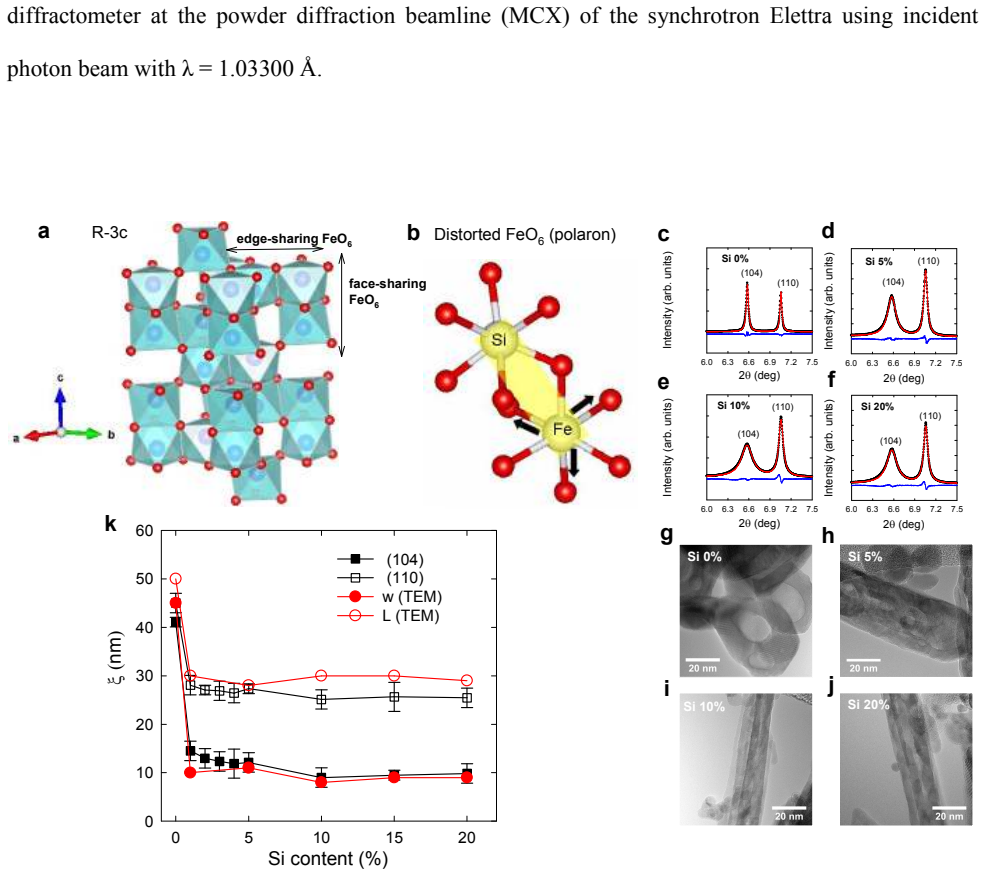
- [Section III, paragraphs beginning 'The structural findings reported here clarify...' and 'In terms of Bravais law...'] The central causal claim—that Fe2+ double-exchange interactions drive the [110] nanowire elongation—is confounded by the synthesis protocol. All doped samples are prepared by adding tetramethoxysilane (TMOS) to the hydrothermal mixture, and increasing the Si content is achieved by increasing the TMOS amount. The polymerizing gel network, its density, and the local surface chemistry in the autoclave therefore change in lockstep with the Si content. The manuscript invokes the gel only once ('The role of small polaron, during the formation of gel-like network mediated by TMOS, is hence reflected by the more extended length of nanowires along the [110]') and provides no control experiment that isolates the proposed magnetic/polaron mechanism from a gel-template, facet-adsorption, or diffusion-kinetics origin of the anisotropic growth. Without such a decoupling, the observed correlation between Fe2+ concentration and morphology does not establish causation.
- [Section III, paragraph beginning 'In terms of Bravais law...'] The Bravais-law argument is qualitative and does not establish the direction of causality. The authors state that the local contraction of edge-sharing (Fe-Fe)E distances (Fig. 2c) indicates an increase of the Fe reticular density along the ab plane, which 'causes the difference in the growth rate of prominent crystal faces.' However, the (Fe-Fe)E contraction could equally be a consequence of the nanowire morphology, for example through surface relaxation in high-aspect-ratio crystallites, or of Si segregation at surfaces or grain boundaries. No quantitative or atomistic relation between the Fe-Fe bond contraction and the face-specific growth rate is provided, so the inference from bond lengths to growth direction is not load-bearing as written.
- [Section III, subsection discussing PDF refinements and Fig. 2(d)] The claimed small-to-large polaron crossover rests on the comparison of DDA, DPDF, and D, but the intermediate-range values DPDF are obtained by fitting the average R-3c model in the range 2.7 ≤ r ≤ 12 Å with agreement factors Rw = 0.10–0.13 (Fig. 3e–h). The manuscript does not test alternative structural models that could produce the same apparent trend, such as a two-phase mixture of undoped and fully polaronic regions, a core-shell-like distribution of distortions, or a progressive increase of static disorder that the average model simply absorbs as larger apparent distortions. Without such model discrimination, the monotonic increase of DPDF with doping does not uniquely support a collective crossover from small to large polarons; it may be an artifact of the average-model fitting strategy.
- [Section III, ESR discussion and Fig. 3(i), Fig. 4(a)] The ESR and structural data are collected on the final washed and sintered powders at room temperature, whereas the morphological transition occurs during hydrothermal growth at 150 °C in the presence of the TMOS gel. The manuscript does not demonstrate that the ferromagnetic double-exchange interactions inferred at room temperature are operative or dominant at the growth temperature and in the gel environment; thus the ESR evidence supports the presence of Fe2+/Fe3+ exchange in the final material but not that this interaction controls the growth direction in the autoclave. In addition, the interpretation of the ESR linewidth drop at 0.22% Si is stated in a contradictory way: exchange narrowing by superexchange is said to be valid only for homo-spin dipolar interactions, yet the linewidth drop is first attributed to Fe2+ species and later to polaron motional narrowing. These explanations need to be reconciled or explicitly distinguished.
minor comments (6)
- [Abstract] The abstract contains several language errors that should be corrected, including 'In this regards' (should be 'In this regard'), 'degrees of freedoms' (should be 'degrees of freedom'), and the phrase 'constraining the chaining of chemical bonds along the [110] crystallographic direction' is awkwardly worded.
- [Section I, Introduction] The word 'inlaterated' appears to be a typo for 'unaltered'; 'riconducible' should be 'reducible'; 'accompaniend' should be 'accompanied'; 'razionalized' should be 'rationalized'; and 'fluctuactions' should be 'fluctuations'. A careful proofread is needed.
- [Section II, Fig. 1 caption] The main text refers to the evolution of the '(110) and (400)' reflections, but the Fig. 1 caption and the figure labels indicate (110) and (104). Please make the Miller indices consistent throughout.
- [Section II, Eq. (4)] Equation (4), the Kröger-Vink defect reaction, is typeset with subscripts and superscripts that are difficult to read, and the charge balance is not immediately transparent. A revised typeset version with explicit effective charges would improve accessibility.
- [Section III, PDF analysis] The distinction between 'direct analysis' (DA) and 'full structure profile PDF refinement' is introduced clearly, but the notation DDA versus DPDF could be confusing because both appear in Fig. 2(d). A brief sentence explicitly defining each symbol at first use in the figure caption would help.
- [Section III, ESR analysis] The sentence 'the observed L1 linewidth drop can be qualitatively explained with the motional narrowing as a result of polaron mobility' is not quantitatively supported, and the relationship between the ESR intensity normalization and the DPDF normalization in Fig. 4(d) should be stated explicitly (for example, whether both are normalized to unity at the same Si concentration).
Circularity Check
No significant circularity: the structural parameters are refined from data and the magnetic-growth mechanism is a post hoc interpretation, not a quantity derived from its own inputs.
full rationale
The paper's derivation chain is: (i) collect X-ray diffraction, PDF, TEM and ESR data as a function of Si content; (ii) refine structural parameters (η = c/a, Fe-O and Fe-Fe bond lengths, D from Eq. (3), DDA and DPDF) using standard Rietveld and PDFGUI fits; (iii) observe by TEM and by (110)/(104) peak-width anisotropy that Si doping changes particle shape to nanowires elongated along [110]; (iv) invoke Fe2+ small polarons and Fe2+/Fe3+ double exchange to rationalize the ESR linewidth/integrated-intensity evolution and the anisotropic Fe-Fe contraction in the basal plane; (v) use Bravais law to link increased Fe reticular density in the ab plane to the observed [110] elongation. No step defines a fitted parameter in terms of the conclusion: D, η and bond distances are refined from diffraction/PDF data, not constructed to match the morphology; the [110] elongation is measured independently by TEM and diffraction. The ESR interpretation is post hoc, and the synthesis does not isolate the polaron mechanism from the TMOS gel-template or kinetic effects, but that is a causal-identification/correctness limitation, not circularity. Self-citations ([10], [11], [24], [29], [30]) are prior experimental or methodological reports and are not used as a uniqueness theorem that forces the conclusion. Hence no circular step is exhibited.
Assumptions & free parameters
assumptions (5)
- domain assumption Si substitutes Fe substitutionally and charge compensation creates Fe2+ (Kröger-Vink equation 4).
- domain assumption The average R-3c hematite model remains valid for all doped samples and absorbs Si-induced changes in the refined parameters.
- domain assumption The observed Fe-O expansion and Fe-Fe contraction are caused by Fe2+ polaron formation, not by Si4+ ionic radius effects or strain from segregation alone.
- domain assumption ESR linewidth changes are dominated by exchange narrowing and double-exchange broadening from Fe2+/Fe3+ pairs, rather than by particle shape, aggregation, or superparamagnetic relaxation changes.
- domain assumption Crystal growth habit follows Bravais-law and reticular-density arguments (ref 16), so an increase in Fe density in the basal plane slows growth of basal faces and elongates the [110] direction.
invented entities (2)
-
Small-to-large polaron crossover / large structural polaron regime
-
Ferromagnetically coupled polaron chains constrained along [110]
Cite this review
Pith. "Pith review of Lattice small polarons and magnetic interactions drive preferential nanocrystal growth in silicon doped hematite." pith.science (2026). https://pith.science/paper/D35YBIVS
@misc{pith2026190803377,
  author       = {Pith},
  title        = {Pith review of: Lattice small polarons and magnetic interactions drive preferential nanocrystal growth in silicon doped hematite},
  year         = {2026},
  howpublished = {\url{https://pith.science/paper/D35YBIVS}},
  note         = {Machine review of arXiv:1908.03377}
}
abstract
Understanding the interplay between the structural, chemical and physical properties of nanomaterials is crucial for designing new devices with enhanced performance. In this regards, doping of metal oxides is a general strategy to tune size, morphology, charge, lattice, orbital and spin degrees of freedoms and has been shown to affect nanomaterials properties for photoelectrochemical water splitting, batteries, catalysis, magnetic applications and optics. Here we report the role of lattice small polaron in driving the morphological transition from nearly isotropic to nanowire crystals in Si doped hematite ($\alpha-Fe_2O_3$). Lattice small polaron formation is well evidenced by the increase of hexagonal strain and degree of distortion of $FeO_6$ showing a hyperbolic trend with increasing Si content. Local analysis via pair distribution function highlights an unreported crossover from small to large polarons, which affects the correlation length of the polaronic distortion from short to average scales. Ferromagnetic double exchange interactions between $Fe^{2+}/Fe^{3+}$ species is found to be the driving force of the crossover, constraining the chaining of chemical bonds along the [110] crystallographic direction. This promotes the increase in the reticular density of Fe atoms along the hematite basal plane only, which boosts the anisotropic growth of nanocrystals with more extended [110] facets. Our results show that magnetic and electronic interactions drive preferential crystallographic growth in doped metal oxides, thus providing a new route to design their functional properties.
Figures
Reference graph
Works this paper leans on
-
[110]
since this is the crystallographic direction along which polaron are constrained to interact according to the model proposed in Fig.4(f). In ter ms of Bravais law, during the nanocrystal growth, the formation of small polaron constrained along th e [110] direction affects the difference between reticular densities of atoms which in turns causes the differ...
work page 2019
- [1]
-
[2]
Wenhua Li Reza Zamani Maria Ibáñez Doris Cadavi d Alexey Shavel Joan Ramon Morante Jordi Arbiol Andreu Cabot, J. Am. Chem. Soc. 135, 4664 (2013)
work page 2013
-
[3]
Sebastian P. Schwaminger, Rifki Surya, Simon Fi lser, Andreas Wimmer, Florian Weigl, Paula Fraga-García, Sonja Berensmeier, Scientific Reports 7, 12609 (2017)
work page 2017
-
[4]
Jiabiao Lian Xiaochuan Duan Jianmin Ma Peng Pen g Tongil Kim Wenjun Zheng, ACS Nano 3, 3749 (2009)
work page 2009
-
[5]
Ilkay Cesar Kevin Sivula Andreas Kay Radek Zbor il Michael Grätzel J. Phys. Chem. C, 113, 772 (2009)
work page 2009
-
[6]
Jin Qu,Yu Yu,Chang-Yan Cao,and Wei-Guo Song Chem. Eur. J., 19, 11172 (2009)
work page 2009
-
[7]
Davide Cozzoli Raffaella Buonsanti Roberto Cingolani Yang Ren, J
Valeri Petkov P. Davide Cozzoli Raffaella Buonsanti Roberto Cingolani Yang Ren, J. Am. Chem. Soc. 131, 14264 (2009)
work page 2009
Show all 31 references
-
[8]
Andreas Kay Ilkay Cesar Michael Grätzel, J. Am. Chem. Soc. 128, 15714 (2006)
2006
-
[9]
Stepan Kment, Patrik Schmuki, Zdenek Hubicka, Libor Machala, Robin Kirchgeorg, Ning Liu, Lei Wang, Kiyoung Lee, Jiri Olejnice, Martin Cada, Ivan Gregora, Radek Zboril, ACS Nano 9, 7113 (2015). [10]Mattia Allieta, Marcello Marelli, Francesco Mal ara, Claudia L Bianchi, Saveria ...
2015
-
[12]
Liao P , Toroker MC , Carter EA, Nano Letters 11(4), 1775 (2011)
2011
-
[13]
Prezhdo, J
Zhaohui Zhou Pengju Huo Liejin Guo Oleg V. Prezhdo, J. Phys. Chem. C 119, 26303 (2015)
2015
-
[14]
E., Rettie William, D
Alexander J. E., Rettie William, D. Chemelewski, David Emin C., Buddie Mullins, J. Phys. Chem. Lett. 7, 471 (2016)
2016
-
[15]
M., Giovanoli, R., Polyhedron 7, 385 (1988)
Cornell R. M., Giovanoli, R., Polyhedron 7, 385 (1988). 25
1988
-
[16]
Wei Li, Xiaoliang Liang, Pengfei An, Xionghan Feng, Wenfeng Tan, Guohong Qiu, Hui Yin, Fan Liu Scientific Reports 6, 35960 (2016) and references therein
2016
-
[17]
T. Wang, S. Zhou, C. Zhang, J. Lian, Y. Liang, W. Yuan, New J. Chem. 38, 46 (2014)
2014
-
[18]
A. C. Larson and R. B. V. Dreele, Los Alamos National Laboratory Report LAUR (2004)
2004
-
[19]
X. Qiu, J. W. Thompson, and S. J. L. Billinge, J. Appl. Crystallogr. 37, 678 (2004)
2004
-
[20]
C. L. Farrow, P. Juhás, J.W. Liu, D. Bryndin, E. S. Bozin, J. Bloch, T. Proffen, and S. J. L. Billinge, J. Phys.: Condens. Matter 19, 335219 (2007)
2007
-
[21]
J Magn Reson
Stoll S, Schweiger A. J Magn Reson. 2006 Jan;1 78(1):42-55. Epub 2005 Sep 26, EasySpin, a comprehensive software package for spectral simulation and analysis in EPR
2006
-
[22]
Commun., 47, 8040 (2011)
Jun Liu, Changhao Liang, Hemin Zhang, Shuyu an Zhangb and Zhenfei Tiana Chem. Commun., 47, 8040 (2011)
2011
-
[23]
Gualtieri , G
A. Gualtieri , G. Artioli, Powder Diffraction 10, 269 (1995)
1995
-
[24]
Hill and Mattia Allieta Phys
Adrian H. Hill and Mattia Allieta Phys. Chem. Chem. Phys., 15, 8583 (2013)
2013
-
[25]
G. Kh. Rozenberg, L. S. Dubrovinsky, M. P. Pasternak, O. Naaman, T. Le Bihan, R. Ahuja, Phys. Rev. B. 65, 064112 (2002)
2002
-
[26]
F. A. Kröger and H. J. Vink, Solid State Phys. 3, 307 (1956)
1956
-
[27]
Sanson, A
A. Sanson, A. Zaltron, N. Argiolas, C. Sada, M. Bazzan, Phys. Rev. B 91, 094109 (2015)
2015
-
[28]
Louca, T
D. Louca, T. Egami, E. L. Brosha, H. Röder, A. R. Bishop, Phys. Rev. B 56 R8475 (1997)
1997
-
[29]
Mattia Allieta, Cesare Oliva, Marco Scavini, S erena Cappelli, Ekaterina Pomjakushina, Valerio Scagnoli, Phys. Rev. B 84, 235144 (2011)
2011
-
[30]
Allieta, M
M. Allieta, M. Scavini, A. Naldoni, M. Coduri, S. Cappelli, C. Oliva, S. Santangelo, C. Triolo, S. Patané, A. Lascialfari, V. Scagnoli, Phys. Rev. B 92, 054202 (2015)
2015
-
[31]
J. M. D. Coey, Magnetism and Magnetic Materials, Cambridge University Press (2010)
2010
-
[32]
Louca and T
D. Louca and T. Egami, J. Appl. Phys. 81, 5484 (1997). 26 V. SUPPORTING INFORMATION FIG.S1 (Color online) Low angle region of the X ray diffraction patterns related to Si 10% (a), Si 20 % (b) and Si 50% (c). In the insert short range PDF h ighlights the peak compatible to Si-O...
1997
Reviewed August 14, 2026 · model on record in the stance chip above.
Discussion (0). Continue with ORCID to comment.