REVIEW 3 major objections 6 minor 1 cited by
GasAgent: A Multi-Agent Framework for Automated Gas Optimization in Smart Contracts
T0 review · 3 major / 6 minor · reviewed 2026-08-06 · deepseek-v4-flash
Pith's one-line read GasAgent is the first multi-agent system to automatically discover, validate, and apply smart-contract gas optimizations in a closed loop.
desk verdict A real engineering contribution whose headline 9.97% is measured but only on deployment gas; the jump to user-facing message-call savings is asserted, not demonstrated. read the letter →
The pith
A machine-rendered reading of the paper's core claim, the machinery that carries it, and where it could break.
The reading
What carries the argument
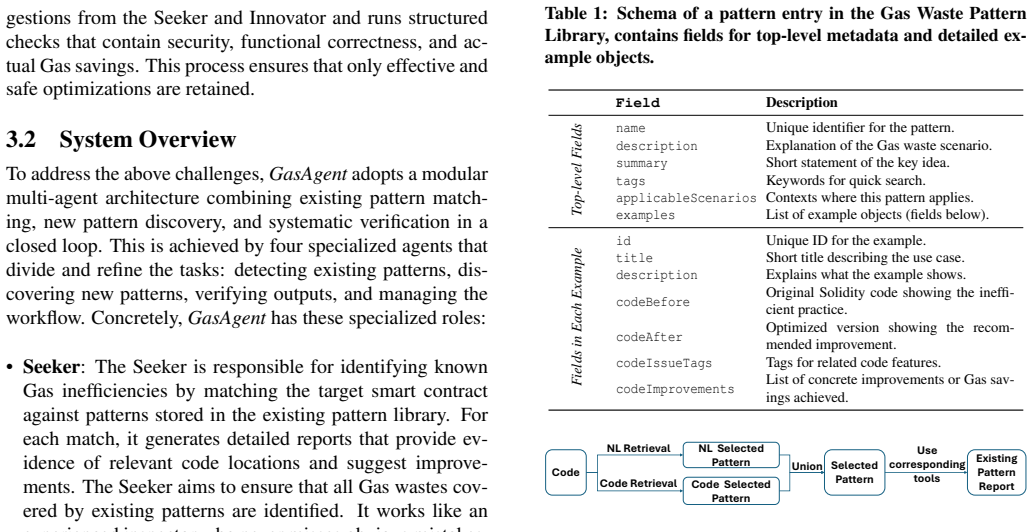
The load-bearing object is the closed-loop, four-agent workflow centered on an updatable Gas Waste Pattern Library. The Seeker performs dual retrieval over this library: it encodes contract code and example snippets into embeddings for cosine-similarity matching, and it also asks the LLM to select relevant pattern IDs from natural-language descriptions. The Innovator receives the Seeker's confirmed matches as context and proposes one new pattern per pass, checking a blacklist of previously invalidated ideas. The Executor runs a verification pipeline consisting of code refactoring, a security audit, automatically generated unit, boundary, and fuzz tests for behavioral consistency, and a gas-cost comparison, so that only changes passing all checks are kept. This machinery carries the argument because it couples comprehensive coverage of known patterns with bounded, verified exploration of new ones.
What would settle it
Measure the gas used by fixed sequences of common function calls on the original and optimized versions of the 82 successfully optimized contracts; if the optimized versions show message-call savings far below the 9.97% deployment figure, such as a median near zero or negative, the paper's practical cost-reduction claim collapses.
Extended reading notes
Core claim
The central claim is that a closed-loop multi-agent workflow can outperform both direct LLM rewriting and any single-agent variant at reducing smart-contract gas costs. The system's Seeker retrieves known gas waste patterns from an updatable pattern library using code-embedding similarity and natural-language matching; the Innovator proposes new patterns grounded in those confirmed matches and filters them against a blacklist; the Executor refactors the contract and validates each change through a security audit, differential and fuzz testing, and gas comparison; and the Manager decides when to stop iterating. The paper reports that this design optimizes 82 out of 100 real-world contracts with an average deployment gas saving of 9.97%, recalls 92.5% of 557 ground-truth pattern instances from 24 prior tools while cutting detection calls by 28.2%, and outperforms direct LLM rewriting (82 contracts versus 71, 9.97% versus 5.93% average saving).
Load-bearing premise
The headline savings are measured on the one-time cost of deploying a contract, and the paper assumes this cost moves together with the recurring cost users pay each time they call the contract, without supplying data to test that correlation.
Editorial extensions
If this is right
- If the 9.97% average deployment gas saving on 82 of 100 verified contracts holds, GasAgent can serve as an automated optimization pass over existing Solidity contracts without a human refactoring step.
- The 92.5% recall of 557 ground-truth pattern instances with 28.2% fewer detection calls implies that prior expert pattern tools can be consolidated into one retrieval-based system without losing most of their coverage.
- The ablation results imply that neither pattern retrieval alone nor LLM novelty discovery alone beats direct LLM rewriting, and that combining them in the multi-agent loop is the source of the gain.
- Because GasAgent optimizes 79.8% of LLM-generated contracts with model-dependent savings, it can act as a measurable optimization and diagnostic layer over LLM-assisted smart-contract development pipelines.
- Verified new patterns, such as Bitmap Role Management, can be added back to the pattern library, so repeated use should make the system cover more inefficiencies over time.
Reading between the lines
- The headline savings measure only one-time deployment gas, not the recurring message-call gas that users pay on every transaction, so the practical user-facing benefit could be smaller or larger than 9.97% until message-call measurements are reported.
- Because the Innovator's 68 new patterns include 30 sub-patterns that refine known ideas, the system's real novelty contribution may be in making existing patterns more actionable rather than in discovering wholly unknown classes of waste.
- The dependence on a single underlying LLM suggests the reported savings may shift with model choice; a natural extension is to test GasAgent with multiple backends to separate framework gains from model capability.
- The blacklist and verified-pattern pool create a self-improving loop: every rejected or accepted proposal changes future behavior, so running GasAgent repeatedly over a large corpus could converge to fewer redundant suggestions and higher recall.
Editorial analysis
A structured set of objections, weighed in public.
Referee Report
Summary. GasAgent is a four-agent LLM framework (Seeker, Innovator, Executor, Manager) that retrieves known gas-waste patterns from a pattern library, proposes new patterns, validates all changes through security audits, consistency checks, and gas measurements, and refactors smart contracts in a closed loop. The paper reports that on 100 verified real-world Etherscan contracts, GasAgent successfully optimizes 82 contracts with an average deployment-gas saving of 9.97%, and that on 500 LLM-generated contracts it optimizes 79.8% with model-wise average savings between 4.79% and 13.93%. It also claims 92.5% recall of 557 pattern instances drawn from six prior tools while reducing detection calls by 28.2%, and an ablation study showing the full system outperforms direct LLM rewriting and partial variants.
Significance. If the headline results hold, GasAgent is a meaningful step toward automated smart-contract gas optimization: it combines reuse of expert-curated patterns with automated discovery of new ones, applies security and consistency gates before accepting changes, cross-validates deployment-gas estimates on two EVM backends, and includes an ablation study supporting the multi-agent design. The reported repository and pattern catalog would also aid reproducibility. The main uncertainties are whether deployment-gas savings translate into the user-facing message-call gas savings implied by the abstract, and whether newly discovered patterns are reusable beyond the specific contracts on which they were proposed. These are empirically addressable but currently leave the central effectiveness claim only partially supported.
major comments (3)
- [§4.2, §4.4] The headline claim 'average deployment Gas savings of 9.97%' is measured only on deployment gas, while the abstract and introduction frame the contribution as gas savings for smart-contract users. Deployment gas is a one-time cost paid by the deployer; the recurring cost borne by users is message-call gas. Section 4.2 asserts that deployment gas 'often exhibits similar trends' to message-call gas, but no supporting data are provided, and the two metrics can diverge (e.g., removing a storage variable or a generated getter reduces deployment cost but may leave runtime cost unchanged). This proxy is load-bearing for the central effectiveness claim. I request a message-call gas measurement on the same 100 optimized contracts, or at minimum a reported correlation between deployment-gas and message-call-gas savings on the subset, with the headline claims adjusted accordingly.
- [§3.5, §4.4] The self-updating pattern library is qualified by the statement that after a new pattern is validated, 'its corresponding Python tool still needs to be manually implemented.' As a result, a newly discovered pattern cannot be applied automatically to a future contract until a human writes a detector; the 68 patterns are validated only on the specific contracts where they were proposed, and their transferability is not tested. The 'continuously evolving pattern library' and 'end-to-end automation' claims should be scoped to reflect this manual step, or the paper should provide evidence that new patterns are reused automatically in later optimization runs (e.g., by adding a newly validated pattern to the library and showing it is retrieved on a held-out contract).
- [§4.5] The pattern-incorporation ground truth is constructed by running the same 24 Python implementations that are integrated into GasAgent's library; recall therefore measures whether the Seeker retrieves instances detected by these implementations, not whether those instances are genuine gas waste with respect to an independent oracle. The claim 'compatibility with existing tools' is reasonable if framed as retrieval of tool-detected instances, but the paper should state this limitation explicitly and, if any human validation of the 557 instances was performed, report it. Without that, a reader cannot separate retrieval performance from the quality of the manually implemented detectors.
minor comments (6)
- [§4.4] The units for the reported savings (e.g., 96,516 and 36,084) are not specified; state whether these are gas units or wei and whether they refer to deployment or total cost.
- [§4.2] Define whether the reported 9.97% average is computed over all 100 contracts (including the 7% unchanged and the 11% that would increase) or only over the 82 optimized ones; the figure suggests the denominator matters.
- [Figure 6 caption] The caption and Section 4.5 use inconsistent tool names (GASaVER, Gasaver, Gassaver, GasMet); unify the spellings.
- [§4.4] The sentence 'Up to four valid new patterns were discovered in some cases' is not directly tied to a labeled panel; add a caption or table for the right-hand panel of Figure 4.
- [§6] The heading 'Conculsion' is a typo for 'Conclusion'.
- [Abstract, §1] The abstract and introduction use 'first' twice; consider softening to 'the first to our knowledge' unless a systematic comparison against existing multi-agent optimizers is provided.
Circularity Check
No significant circularity: headline results are empirical measurements against external benchmarks and prior-work ground truth, not derivations from their own definitions.
full rationale
GasAgent is an empirical systems paper; its central claims are measured outputs of a described pipeline rather than derived predictions. The 9.97% average deployment-gas saving and 82/100 success count are obtained by compiling contracts with solc 0.8.20 and measuring deployment gas on Ganache and Hardhat, with Slither security audits and Foundry differential/fuzz tests as correctness gates. The RQ2 recall (515/557, 92.5%) is benchmarked against a ground truth built by exhaustively running 24 independently implemented detection tools from six prior studies over the same 100 contracts; the Seeker must then retrieve/activate the relevant tools, and the reported recall at a fixed cosine-similarity threshold is an empirical result, not forced by construction (the authors even show the threshold can be lowered to 0 for 100% recall at higher cost). The 68 'new' patterns are proposed by the Innovator and then must survive the Executor's independent validation; the paper explicitly labels 30 of them as sub-patterns of known ones, so there is no renaming of prior results as novel. The only self-citation is [40] in a background sentence on sharding and is not load-bearing. The deployment-gas versus message-call-gas discussion in Section 4.2 is a stated external-validity assumption about whether deployment-gas savings proxy user-facing execution costs; it affects interpretation of the headline number but is not a circular derivation, since no parameter is fitted from the target quantity and then used to predict that same quantity. No uniqueness theorem, ansatz-by-citation, or fitted-input-called-prediction pattern is present. Accordingly, no circular step is identified.
Assumptions & free parameters
free parameters (2)
- cosine similarity retrieval threshold =
0.7
- differential test scale =
5 parameter combinations, 100 fuzz runs per function
assumptions (4)
- domain assumption Deployment gas trends with message-call gas consumption
- domain assumption Bounded differential testing and a Slither audit establish functional equivalence and safety
- domain assumption A sample of 100 contracts deployed after June 2025 represents real-world contracts
- domain assumption The authors' implementations of 24 patterns from six prior papers define ground truth
Cite this review
Pith. "Pith review of GasAgent: A Multi-Agent Framework for Automated Gas Optimization in Smart Contracts." pith.science (2026). https://pith.science/paper/D3N3DWHP
@misc{pith2026250715761,
  author       = {Pith},
  title        = {Pith review of: GasAgent: A Multi-Agent Framework for Automated Gas Optimization in Smart Contracts},
  year         = {2026},
  howpublished = {\url{https://pith.science/paper/D3N3DWHP}},
  note         = {Machine review of arXiv:2507.15761}
}
read the original abstract
Smart contracts are trustworthy, immutable, and automatically executed programs on the blockchain. Their execution requires the Gas mechanism to ensure efficiency and fairness. However, due to non-optimal coding practices, many contracts contain Gas waste patterns that need to be optimized. Existing solutions mostly rely on manual discovery, which is inefficient, costly to maintain, and difficult to scale. Recent research uses large language models (LLMs) to explore new Gas waste patterns. However, it struggles to remain compatible with existing patterns, often produces redundant patterns, and requires manual validation/rewriting. To address this gap, we present GasAgent, the first multi-agent system for smart contract Gas optimization that combines compatibility with existing patterns and automated discovery/validation of new patterns, enabling end-to-end optimization. GasAgent consists of four specialized agents, Seeker, Innovator, Executor, and Manager, that collaborate in a closed loop to identify, validate, and apply Gas-saving improvements. Experiments on 100 verified real-world contracts demonstrate that GasAgent successfully optimizes 82 contracts, achieving an average deployment Gas savings of 9.97%. In addition, our evaluation confirms its compatibility with existing tools and validates the effectiveness of each module through ablation studies. To assess broader usability, we further evaluate 500 contracts generated by five representative LLMs across 10 categories and find that GasAgent optimizes 79.8% of them, with deployment Gas savings ranging from 4.79% to 13.93%, showing its usability as the optimization layer for LLM-assisted smart contract development.
Figures


Figures from the paper (5 more)


Forward citations
Cited by 1 Pith paper
-
BetaWeb: Towards a Blockchain-enabled Trustworthy Agentic Web
BetaWeb promises a blockchain-enabled trustworthy agentic web, but the submitted manuscript body is a different mining-robot paper, leaving the proposal without supporting evidence.
Reference graph
Works this paper leans on
-
[1]
Smart contract development: Challenges and opportunities
Weiqin Zou, David Lo, Pavneet Singh Kochhar, Xuan- Bach Dinh Le, Xin Xia, Yang Feng, Zhenyu Chen, and Baowen Xu. Smart contract development: Challenges and opportunities. IEEE transactions on software engi- neering, 47(10):2084–2106, 2019. 1, 3
work page 2019
-
[2]
Blockchain 2.0, smart contracts and challenges
Martin V on Haller Gronbaek. Blockchain 2.0, smart contracts and challenges. Comput. Law, SCL Mag , 1: 1–5, 2016. 1, 3
work page 2016
-
[3]
Gaschecker: Scalable analysis for discovering gas-inefficient smart contracts
Ting Chen, Youzheng Feng, Zihao Li, Hao Zhou, Xi- aopu Luo, Xiaoqi Li, Xiuzhuo Xiao, Jiachi Chen, and Xiaosong Zhang. Gaschecker: Scalable analysis for discovering gas-inefficient smart contracts. IEEE Transactions on Emerging Topics in Computing , 9(3): 1433–1448, 2020. 1, 3, 10, 11
work page 2020
-
[4]
Un- derstanding out of gas exceptions on ethereum
Chao Liu, Jianbo Gao, Yue Li, and Zhong Chen. Un- derstanding out of gas exceptions on ethereum. In Blockchain and Trustworthy Systems: First Interna- tional Conference, BlockSys 2019, Guangzhou, China, December 7–8, 2019, Proceedings 1 , pages 505–519. Springer, 2020. 1, 3
work page 2019
-
[5]
Gas fee reduction by detecting loop fusible pat- terns in ethereum smart contract
Kawaldeep Kaur, Shubham Tomar, and Meenakshi Tri- pathi. Gas fee reduction by detecting loop fusible pat- terns in ethereum smart contract. In2022 IEEE Interna- tional Conference on Advanced Networks and Telecom- munications Systems (ANTS) , pages 458–463. IEEE,
-
[6]
Unearthing gas- wasting code smells in smart contracts with large lan- guage models
Jinan Jiang, Zihao Li, Haoran Qin, Muhui Jiang, Xi- apu Luo, Xiaoming Wu, Haoyu Wang, Yutian Tang, Chenxiong Qian, and Ting Chen. Unearthing gas- wasting code smells in smart contracts with large lan- guage models. IEEE Transactions on Software Engi- neering, 2024. 1, 3, 6, 8, 9, 11
work page 2024
-
[7]
Gasol: Gas analysis and optimization for ethereum smart contracts
Elvira Albert, Jesús Correas, Pablo Gordillo, Guillermo Román-Díez, and Albert Rubio. Gasol: Gas analysis and optimization for ethereum smart contracts. In In- ternational Conference on Tools and Algorithms for the Construction and Analysis of Systems, pages 118–125. Springer, 2020. 1, 3, 11
work page 2020
-
[8]
Gasaver: A static analysis tool for saving gas
Ziyi Zhao, Jiliang Li, Zhou Su, and Yuyi Wang. Gasaver: A static analysis tool for saving gas. IEEE Transactions on Sustainable Computing, 8(2):257–267,
Show all 64 references
-
[9]
The gotchas of ai coding and vibe coding
Stephane H Maes. The gotchas of ai coding and vibe coding. it’s all about support and maintenance, 2025. 1
2025
-
[10]
Metagpt: Meta programming for multi-agent collabo- rative framework
Sirui Hong, Xiawu Zheng, Jonathan Chen, Yuheng Cheng, Jinlin Wang, Ceyao Zhang, Zili Wang, Steven 11 Ka Shing Yau, Zijuan Lin, Liyang Zhou, et al. Metagpt: Meta programming for multi-agent collabo- rative framework. arXiv preprint arXiv:2308.00352, 3 (4):6, 2023. 1, 3
2023 arXiv
-
[11]
Evaluating large language models trained on code
Mark Chen, Jerry Tworek, Heewoo Jun, Qiming Yuan, Henrique Ponde De Oliveira Pinto, Jared Kaplan, Harri Edwards, Yuri Burda, Nicholas Joseph, Greg Brock- man, et al. Evaluating large language models trained on code. arXiv preprint arXiv:2107.03374, 2021. 1, 2
2021 arXiv
-
[12]
Large language model based multi- agents: A survey of progress and challenges
Taicheng Guo, Xiuying Chen, Yaqi Wang, Ruidi Chang, Shichao Pei, Nitesh V Chawla, Olaf Wiest, and Xiangliang Zhang. Large language model based multi- agents: A survey of progress and challenges. arXiv preprint arXiv:2402.01680, 2024. 1, 3
2024 arXiv
-
[13]
Improving factuality and reasoning in language models through multiagent debate
Yilun Du, Shuang Li, Antonio Torralba, Joshua B Tenenbaum, and Igor Mordatch. Improving factuality and reasoning in language models through multiagent debate. In Forty-first International Conference on Ma- chine Learning, 2023. 1, 3
2023
-
[14]
Attention is all you need
Ashish Vaswani, Noam Shazeer, Niki Parmar, Jakob Uszkoreit, Llion Jones, Aidan N Gomez, Łukasz Kaiser, and Illia Polosukhin. Attention is all you need. Advances in neural information processing systems, 30,
-
[15]
Large language models for software en- gineering: A systematic literature review
Xinyi Hou, Yanjie Zhao, Yue Liu, Zhou Yang, Kailong Wang, Li Li, Xiapu Luo, David Lo, John Grundy, and Haoyu Wang. Large language models for software en- gineering: A systematic literature review. ACM Trans- actions on Software Engineering and Methodology, 33 (8):1–79, 2024
2024
-
[16]
Harnessing the power of llms in practice: A survey on chatgpt and beyond
Jingfeng Yang, Hongye Jin, Ruixiang Tang, Xiaotian Han, Qizhang Feng, Haoming Jiang, Shaochen Zhong, Bing Yin, and Xia Hu. Harnessing the power of llms in practice: A survey on chatgpt and beyond. ACM Transactions on Knowledge Discovery from Data , 18 (6):1–32, 2024. 2
2024
-
[17]
Bert: Pre-training of deep bidi- rectional transformers for language understanding
Jacob Devlin, Ming-Wei Chang, Kenton Lee, and Kristina Toutanova. Bert: Pre-training of deep bidi- rectional transformers for language understanding. In Proceedings of the 2019 conference of the North Amer- ican chapter of the association for computational lin- guistics: human...
2019
-
[18]
Language models are unsupervised multitask learners
Alec Radford, Jeffrey Wu, Rewon Child, David Luan, Dario Amodei, Ilya Sutskever, et al. Language models are unsupervised multitask learners. OpenAI blog, 1(8): 9, 2019. 2
2019
-
[19]
Exploring the limits of transfer learning with a unified text-to-text transformer.Journal of machine learning research, 21(140):1–67, 2020
Colin Raffel, Noam Shazeer, Adam Roberts, Katherine Lee, Sharan Narang, Michael Matena, Yanqi Zhou, Wei Li, and Peter J Liu. Exploring the limits of transfer learning with a unified text-to-text transformer.Journal of machine learning research, 21(140):1–67, 2020. 2
2020
-
[20]
Codebert: A pre-trained model for programming and natural languages
Zhangyin Feng, Daya Guo, Duyu Tang, Nan Duan, Xi- aocheng Feng, Ming Gong, Linjun Shou, Bing Qin, Ting Liu, Daxin Jiang, et al. Codebert: A pre-trained model for programming and natural languages. arXiv preprint arXiv:2002.08155, 2020. 2
2002 arXiv
-
[21]
Codet5: Identifier-aware unified pre-trained encoder-decoder models for code understanding and generation
Yue Wang, Weishi Wang, Shafiq Joty, and Steven CH Hoi. Codet5: Identifier-aware unified pre-trained encoder-decoder models for code understanding and generation. arXiv preprint arXiv:2109.00859, 2021. 2
2021 arXiv
-
[22]
Gpt-4 technical report
Josh Achiam, Steven Adler, Sandhini Agarwal, Lama Ahmad, Ilge Akkaya, Florencia Leoni Aleman, Diogo Almeida, Janko Altenschmidt, Sam Altman, Shyamal Anadkat, et al. Gpt-4 technical report. arXiv preprint arXiv:2303.08774, 2023. 2
2023 arXiv
-
[23]
Gemini: a family of highly capable multi- modal models
Gemini Team, Rohan Anil, Sebastian Borgeaud, Jean- Baptiste Alayrac, Jiahui Yu, Radu Soricut, Johan Schalkwyk, Andrew M Dai, Anja Hauth, Katie Milli- can, et al. Gemini: a family of highly capable multi- modal models. arXiv preprint arXiv:2312.11805, 2023. 2
2023 arXiv
-
[24]
Artificial intelli- gence: a modern approach
Stuart J Russell and Peter Norvig. Artificial intelli- gence: a modern approach. pearson, 2016. 2
2016
-
[25]
Intelli- gent agents: Theory and practice
Michael Wooldridge and Nicholas R Jennings. Intelli- gent agents: Theory and practice. The knowledge engi- neering review, 10(2):115–152, 1995. 2
1995
-
[26]
Decomposed prompting: A modular ap- proach for solving complex tasks
Tushar Khot, Harsh Trivedi, Matthew Finlayson, Yao Fu, Kyle Richardson, Peter Clark, and Ashish Sab- harwal. Decomposed prompting: A modular ap- proach for solving complex tasks. arXiv preprint arXiv:2210.02406, 2022. 2
2022 arXiv
-
[27]
Api-bank: A comprehensive benchmark for tool-augmented llms
Minghao Li, Yingxiu Zhao, Bowen Yu, Feifan Song, Hangyu Li, Haiyang Yu, Zhoujun Li, Fei Huang, and Yongbin Li. Api-bank: A comprehensive benchmark for tool-augmented llms. arXiv preprint arXiv:2304.08244, 2023. 3
2023 arXiv
-
[28]
Tptu: large language model-based ai agents for task planning and tool usage
Jingqing Ruan, Yihong Chen, Bin Zhang, Zhiwei Xu, Tianpeng Bao, Guoqing Du, Shiwei Shi, Hangyu Mao, Ziyue Li, Xingyu Zeng, et al. Tptu: large language model-based ai agents for task planning and tool usage. arXiv preprint arXiv:2308.03427, 2023. 3
2023
-
[29]
A survey on in-context learning
Qingxiu Dong, Lei Li, Damai Dai, Ce Zheng, Jingyuan Ma, Rui Li, Heming Xia, Jingjing Xu, Zhiyong Wu, Tianyu Liu, et al. A survey on in-context learning. arXiv preprint arXiv:2301.00234, 2022. 3
2022 arXiv
-
[30]
Cognitive architectures for lan- guage agents
Theodore Sumers, Shunyu Yao, Karthik Narasimhan, and Thomas Griffiths. Cognitive architectures for lan- guage agents. Transactions on Machine Learning Re- search, 2023. 3
2023
-
[31]
Roco: Dialectic multi-robot collaboration with large language models
Zhao Mandi, Shreeya Jain, and Shuran Song. Roco: Dialectic multi-robot collaboration with large language models. In 2024 IEEE International Conference 12 on Robotics and Automation (ICRA) , pages 286–299. IEEE, 2024. 3
2024
-
[32]
Dynamic llm-agent network: An llm-agent col- laboration framework with agent team optimization
Zijun Liu, Yanzhe Zhang, Peng Li, Yang Liu, and Diyi Yang. Dynamic llm-agent network: An llm-agent col- laboration framework with agent team optimization. arXiv preprint arXiv:2310.02170, 2023. 3
2023 arXiv
-
[33]
Communicative agents for software development
Chen Qian, Xin Cong, Cheng Yang, Weize Chen, Yusheng Su, Juyuan Xu, Zhiyuan Liu, and Maosong Sun. Communicative agents for software development. arXiv preprint arXiv:2307.07924, 6(3), 2023. 3
2023 arXiv
-
[34]
Building cooperative embodied agents modularly with large language models
Hongxin Zhang, Weihua Du, Jiaming Shan, Qinhong Zhou, Yilun Du, Joshua B Tenenbaum, Tianmin Shu, and Chuang Gan. Building cooperative embodied agents modularly with large language models. arXiv preprint arXiv:2307.02485, 2023. 3
2023 arXiv
-
[35]
Simu- lating public administration crisis: A novel genera- tive agent-based simulation system to lower technol- ogy barriers in social science research
Bushi Xiao, Ziyuan Yin, and Zixuan Shan. Simu- lating public administration crisis: A novel genera- tive agent-based simulation system to lower technol- ogy barriers in social science research. arXiv preprint arXiv:2311.06957, 2023. 3
2023 arXiv
-
[36]
Generative agents: Interactive simulacra of human behavior
Joon Sung Park, Joseph O’Brien, Carrie Jun Cai, Meredith Ringel Morris, Percy Liang, and Michael S Bernstein. Generative agents: Interactive simulacra of human behavior. InProceedings of the 36th annual acm symposium on user interface software and technology , pages 1–22, 2023. 3
2023
-
[37]
Language agents with reinforcement learning for strate- gic play in the werewolf game
Zelai Xu, Chao Yu, Fei Fang, Yu Wang, and Yi Wu. Language agents with reinforcement learning for strate- gic play in the werewolf game. arXiv preprint arXiv:2310.18940, 2023. 3
2023 arXiv
-
[38]
An overview on smart contracts: Challenges, advances and platforms
Zibin Zheng, Shaoan Xie, Hong-Ning Dai, Weili Chen, Xiangping Chen, Jian Weng, and Muhammad Imran. An overview on smart contracts: Challenges, advances and platforms. Future Generation Computer Systems , 105:475–491, 2020. 3
2020
-
[39]
Ethereum: A secure decentralised generalised transaction ledger
Gavin Wood et al. Ethereum: A secure decentralised generalised transaction ledger. Ethereum project yellow paper, 151(2014):1–32, 2014. 3
2014
-
[40]
A two-layer blockchain sharding pro- tocol leveraging safety and liveness for enhanced per- formance
Yibin Xu, Jingyi Zheng, Boris Düdder, Tijs Slaats, and Yongluan Zhou. A two-layer blockchain sharding pro- tocol leveraging safety and liveness for enhanced per- formance. arXiv preprint arXiv:2310.11373, 2023. 3
2023 arXiv
-
[41]
An adaptive gas cost mechanism for ethereum to de- fend against under-priced dos attacks
Ting Chen, Xiaoqi Li, Ying Wang, Jiachi Chen, Zi- hao Li, Xiapu Luo, Man Ho Au, and Xiaosong Zhang. An adaptive gas cost mechanism for ethereum to de- fend against under-priced dos attacks. In Information Security Practice and Experience: 13th International Conference, ISPEC 2...
2017
-
[42]
Slither: a static analysis framework for smart con- tracts
Josselin Feist, Gustavo Grieco, and Alex Groce. Slither: a static analysis framework for smart con- tracts. In 2019 IEEE/ACM 2nd International Work- shop on Emerging Trends in Software Engineering for Blockchain (WETSEB), pages 8–15. IEEE, 2019. 5, 6
2019
-
[43]
Langgraph, 2025
LangChain. Langgraph, 2025. URL https://www. langchain.com/langgraph. 6
2025
-
[44]
Hello gpt-4o, 2024
OpenAI. Hello gpt-4o, 2024. URL https://openai. com/index/hello-gpt-4o/. 6, 7
2024
-
[45]
Jina embeddings 2: 8192-token general-purpose text embeddings for long documents
Michael Günther, Jackmin Ong, Isabelle Mohr, Alaed- dine Abdessalem, Tanguy Abel, Mohammad Kalim Akram, Susana Guzman, Georgios Mastrapas, Saba Sturua, Bo Wang, et al. Jina embeddings 2: 8192-token general-purpose text embeddings for long documents. arXiv preprint arXiv:2310.1...
-
[46]
Ganache, 2022
ConsenSys Software Inc. Ganache, 2022. URL https: //archive.trufflesuite.com/ganache/. 6
2022
-
[47]
Nomic foundation, 2025
HardHat. Nomic foundation, 2025. URL https:// hardhat.org/. 6
2025
-
[48]
Foundry, 2025
Foundry. Foundry, 2025. URL https://getfoundry. sh/. 6
2025
-
[49]
Profiling gas consumption in solidity smart contracts.Journal of Sys- tems and Software, 186:111193, 2022
Andrea Di Sorbo, Sonia Laudanna, Anna Vacca, Cor- rado A Visaggio, and Gerardo Canfora. Profiling gas consumption in solidity smart contracts.Journal of Sys- tems and Software, 186:111193, 2022. 6, 8, 9, 10
2022
-
[50]
Gassaver: A tool for solidity smart contract optimization
Quang-Thang Nguyen, Bao Son Do, Thi Tam Nguyen, and Ba-Lam Do. Gassaver: A tool for solidity smart contract optimization. In Proceedings of the fourth ACM international symposium on blockchain and se- cure critical infrastructure , pages 125–134, 2022. 8, 10
2022
-
[51]
De- sign patterns for gas optimization in ethereum
Lodovica Marchesi, Michele Marchesi, Giuseppe Destefanis, Giulio Barabino, and Danilo Tigano. De- sign patterns for gas optimization in ethereum. In 2020 IEEE International Workshop on Blockchain Oriented Software Engineering (IWBOSE) , pages 9–15. IEEE,
2020
-
[52]
Smart contracts in the real world: A statis- tical exploration of external data dependencies
Yishun Wang, Xiaoqi Li, Shipeng Ye, Lei Xie, and Ju Xing. Smart contracts in the real world: A statis- tical exploration of external data dependencies. arXiv preprint arXiv:2406.13253, 2025. 7
2025
-
[53]
Defi protocol dashboard, 2025
DefiLlama. Defi protocol dashboard, 2025. URL https://defillama.com/. 7
2025
-
[54]
The llama 4 herd: The beginning of a new era of natively multimodal ai innovation,
Meta. The llama 4 herd: The beginning of a new era of natively multimodal ai innovation,
-
[55]
Gemini 2.5 flash, 2025
Google. Gemini 2.5 flash, 2025. URL https:// deepmind.google/models/gemini/flash/. 7 13
2025
-
[56]
Deepseek, 2025
DeepSeek. Deepseek, 2025. URL https://www. deepseek.com/. 7
2025
-
[57]
Qwen3: Think deeper, act faster, 2025
Qwen Team. Qwen3: Think deeper, act faster, 2025. URL https://qwenlm.github.io/blog/qwen3/. 7
2025
-
[58]
Solidity-the optimizer, 2023
The Optimize. Solidity-the optimizer, 2023. URL https://docs.soliditylang.org/en/latest/ internals/optimizer.html. 10
2023
-
[59]
How solidity 0.8 protect against integer underflow/overflow and how they can still happen in solidity 0.8., 2023
Faizan Nehal. How solidity 0.8 protect against integer underflow/overflow and how they can still happen in solidity 0.8., 2023. URL https://faizannehal.medium.com/how- solidity-0-8-protect-against-integer- underflow-overflow-and-how-they-can-still- happen-7be22c4ab92f. 10
2023
-
[60]
How to save my gas fees: Understanding and detecting real- world gas issues in solidity programs
Mengting He, Shihao Xia, Boqin Qin, Nobuko Yoshida, Tingting Yu, Linhai Song, and Yiying Zhang. How to save my gas fees: Understanding and detecting real- world gas issues in solidity programs. arXiv preprint arXiv:2403.02661, 2024. 10
2024 arXiv
-
[61]
Under-optimized smart contracts devour your money
Ting Chen, Xiaoqi Li, Xiapu Luo, and Xiaosong Zhang. Under-optimized smart contracts devour your money. In 2017 IEEE 24th international confer- ence on software analysis, evolution and reengineering (SANER), pages 442–446. IEEE, 2017. 10
2017
-
[62]
Towards saving money in using smart contracts
Ting Chen, Zihao Li, Hao Zhou, Jiachi Chen, Xiapu Luo, Xiaoqi Li, and Xiaosong Zhang. Towards saving money in using smart contracts. In Proceedings of the 40th international conference on software engineering: new ideas and emerging results, pages 81–84, 2018. 10, 11
2018
-
[63]
Smart contracts refinement for gas optimization
Keerthi Nelaturu, Sidi Mohamed Beillahi, Fan Long, and Andreas Veneris. Smart contracts refinement for gas optimization. In 2021 3rd conference on blockchain research & applications for innovative networks and services (BRAINS), pages 229–236. IEEE, 2021. 11 14
2021
-
[2025]
URL https://ai.meta.com/blog/llama-4- multimodal-intelligence/. 7
Reviewed August 6, 2026 · model on record in the stance chip above.
Discussion (0). Sign in to comment.