Curriculum Learning of Physics-Informed Neural Networks based on Spatial Correlation
Pith reviewed 2026-05-19 16:54 UTC · model grok-4.3
The pith
Spatial curriculum learning guides PINN training from boundaries inward to reduce optimization failures on PDEs.
A machine-rendered reading of the paper's core claim, the machinery that carries it, and where it could break.
Core claim
The paper establishes that a spatially correlated curriculum learning framework, built around causal weights that move information from near-boundary regions inward, low-frequency consistency bridges between regions, and region-adaptive reweighting, reduces optimization failures and improves accuracy when training physics-informed neural networks on boundary value problems with strong spatial coupling.
What carries the argument
Spatial causal weights that guide information propagation from near-boundary subregions inward, together with low-frequency consistency bridges and region-adaptive loss reweighting.
If this is right
- Training becomes more stable for boundary value problems that have strong spatial dependencies.
- Solution accuracy rises on standard PDE test problems without raising computational cost.
- Spurious convergence is reduced by directing the optimization path through spatial ordering.
- Low-frequency drift across the domain is suppressed by enforcing consistency between regions.
- High-frequency solution details are recovered through adaptive adjustment of subregion losses.
Where Pith is reading between the lines
- The same spatial partitioning and consistency idea could be tested on other neural PDE solvers such as DeepONet or FNO.
- Domain decomposition strategies might be combined with this curriculum to handle very high-dimensional or complex-geometry problems.
- Extending the approach to time-dependent or parametric problems by layering spatial and temporal curricula is a natural next step.
- Real engineering boundary-value problems with noisy data or uncertain boundaries would be a direct test of practical value.
Load-bearing premise
Guiding information propagation from near-boundary regions inward via spatial causal weights, combined with low-frequency consistency bridges, will systematically reduce optimization failures in PINNs for BVPs with strong spatial coupling.
What would settle it
Direct experiments on the paper's PDE benchmarks that show no reduction in training failures or no gain in solution accuracy relative to baseline PINNs would disprove the central claim.
Figures





read the original abstract
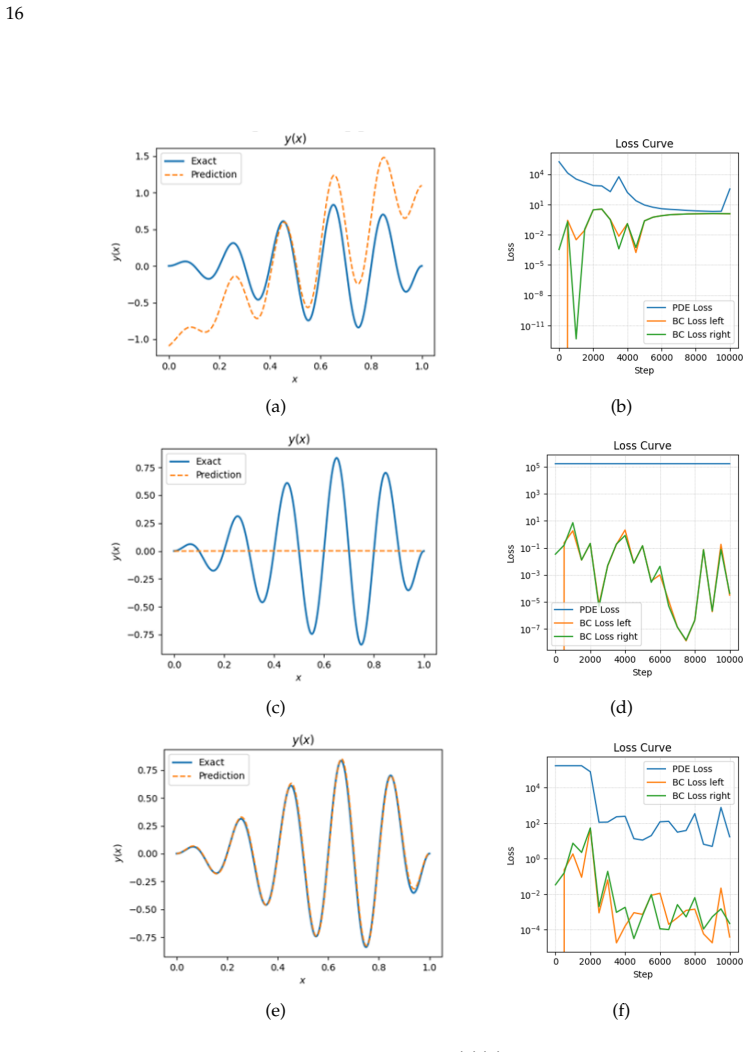
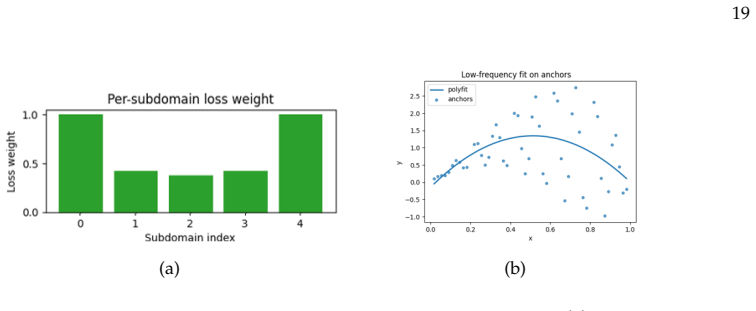
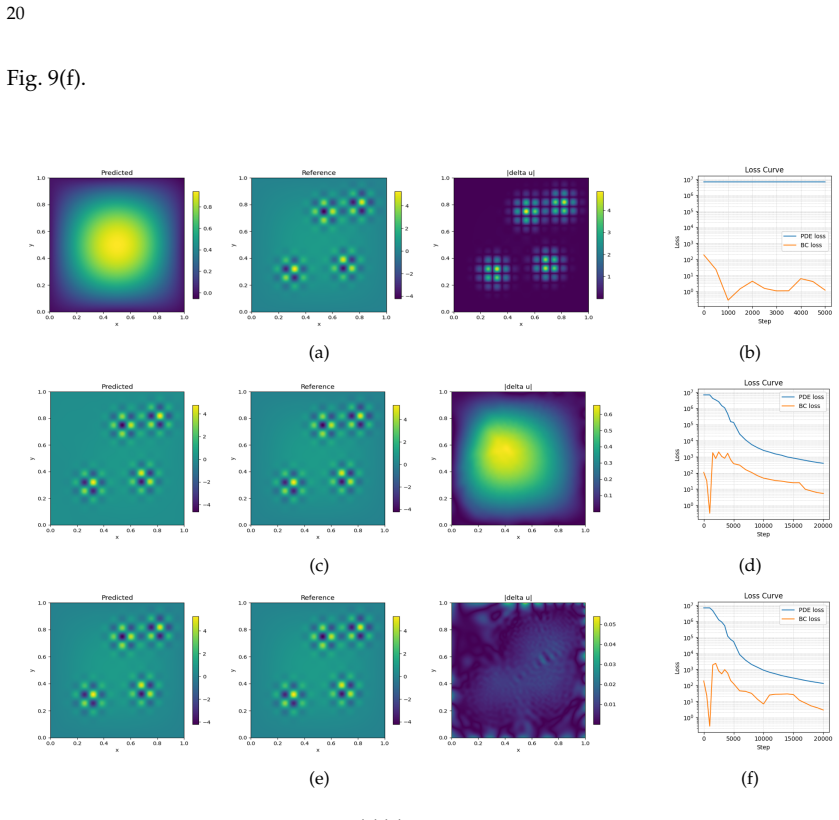
Physics-Informed Neural Networks (PINNs) combine deep learning with physical constraints for solving partial differential equations (PDEs), and are widely applied in fluid mechanics, heat transfer, and solid mechanics. However, PINN training still suffers from high-dimensional non-convex loss landscapes, imbalanced multiobjective constraints, and ineffective information propagation. Existing curriculum learning and causality-guided strategies improve training stability, but mainly focus on temporal or parametric progression, lacking explicit treatment of spatial information propagation and inter-region consistency. Moreover, they are not directly applicable to boundary value problems (BVPs) with strong spatial coupling. To address this issue, we propose a spatially correlated curriculum learning framework for PINNs. To the best of our knowledge, this is the first work to address PINN training difficulties from the perspective of spatial coupling among subregions. First, spatial causal weights guide information from near-boundary regions inward, reducing optimization failures and spurious convergence. Second, a low-frequency information bridge enforces pseudo-label-based consistency across spatially separated regions, suppressing global low-frequency drift. Third, a region-adaptive reweighting strategy adjusts subregion losses to reduce local residuals and recover high-frequency details. Experiments on PDE benchmarks show that, under comparable computational cost, the proposed method alleviates training failures and improves solution accuracy. The code is available at https://github.com/pigofmomo/CurriculumLearningPINN.
Editorial analysis
A structured set of objections, weighed in public.
Referee Report
Summary. The manuscript proposes a spatially correlated curriculum learning framework for Physics-Informed Neural Networks (PINNs) targeting boundary value problems (BVPs) with strong spatial coupling. It introduces three components: spatial causal weights to propagate information inward from near-boundary regions, a low-frequency information bridge enforcing pseudo-label consistency across separated regions, and region-adaptive reweighting to adjust subregion losses for better high-frequency recovery. The central claim is that these additions alleviate optimization failures and improve solution accuracy on PDE benchmarks at comparable computational cost, with code released for reproducibility.
Significance. If the empirical claims hold with quantitative support, the work would be moderately significant for scientific machine learning by shifting curriculum strategies from temporal/parametric to explicit spatial coupling, addressing a gap for BVPs in applications such as fluid mechanics and heat transfer. The code release aids reproducibility. However, the current presentation provides only qualitative benchmark statements, limiting the assessed impact until stronger evidence is supplied.
major comments (2)
- [Abstract and Experiments] Abstract and Experiments section: the central claim of alleviated training failures and improved accuracy under comparable cost is presented only qualitatively, with no reported quantitative metrics (e.g., L2 or relative errors), error bars, number of tested PDE cases, baseline comparisons, or ablation results on the three components; this directly undermines evaluation of whether the spatial causal weights, low-frequency bridges, and reweighting drive the gains.
- [§3.1] §3.1 (Spatial Causal Weights): the description of how causal weights are computed from boundary distances and propagated inward lacks an explicit equation or pseudocode showing the weighting function, making it difficult to verify independence from fitted parameters or to reproduce the information-propagation mechanism.
minor comments (2)
- [§3.3] Notation for region-adaptive reweighting factors could be clarified with a single summary equation rather than scattered definitions across subsections.
- [Introduction] The introduction would benefit from a brief table contrasting the proposed spatial curriculum with prior temporal and parametric curriculum methods for PINNs.
Simulated Author's Rebuttal
We thank the referee for the constructive and detailed comments. We address each major comment point by point below. Where the comments identify areas for improvement in quantitative support and methodological clarity, we agree and will revise the manuscript accordingly to strengthen the presentation.
read point-by-point responses
-
Referee: [Abstract and Experiments] Abstract and Experiments section: the central claim of alleviated training failures and improved accuracy under comparable cost is presented only qualitatively, with no reported quantitative metrics (e.g., L2 or relative errors), error bars, number of tested PDE cases, baseline comparisons, or ablation results on the three components; this directly undermines evaluation of whether the spatial causal weights, low-frequency bridges, and reweighting drive the gains.
Authors: We acknowledge that the experimental results in the current manuscript are presented primarily through qualitative visualizations and statements of improvement. To enable a more rigorous assessment of the contributions, we will revise the Experiments section to report quantitative metrics including L2 and relative errors, include error bars from multiple independent training runs, explicitly state the number of PDE benchmark cases evaluated, add direct comparisons to relevant baselines, and provide ablation studies that isolate the impact of each of the three components (spatial causal weights, low-frequency information bridge, and region-adaptive reweighting). Corresponding updates will be made to the Abstract to reflect these quantitative findings. revision: yes
-
Referee: [§3.1] §3.1 (Spatial Causal Weights): the description of how causal weights are computed from boundary distances and propagated inward lacks an explicit equation or pseudocode showing the weighting function, making it difficult to verify independence from fitted parameters or to reproduce the information-propagation mechanism.
Authors: We agree that an explicit formulation is required for full reproducibility and verification. In the revised §3.1, we will introduce a precise mathematical definition of the spatial causal weighting function based on boundary distances, together with pseudocode that details the inward propagation process. This formulation will be shown to depend only on the problem geometry and not on the trainable parameters of the neural network. revision: yes
Circularity Check
No significant circularity; derivation is self-contained
full rationale
The paper introduces a spatially correlated curriculum learning framework consisting of three explicit algorithmic components (spatial causal weights guiding inward propagation, low-frequency pseudo-label bridges for inter-region consistency, and region-adaptive reweighting) to mitigate PINN optimization issues in spatially coupled BVPs. These are presented as novel additions motivated by the limitations of prior temporal/parametric curriculum methods, with performance gains asserted via direct experimental comparison on PDE benchmarks under comparable cost. No equation or procedure reduces a claimed prediction or first-principles result to a fitted parameter or self-referential definition; the method does not invoke self-citations for uniqueness theorems, smuggle ansatzes, or rename known empirical patterns as new derivations. The central claim therefore rests on independent empirical validation rather than any closed loop.
Axiom & Free-Parameter Ledger
axioms (2)
- domain assumption Spatial causal weights can effectively guide information from near-boundary regions inward to reduce optimization failures.
- domain assumption Low-frequency information bridges can enforce consistency across spatially separated regions to suppress global drift.
Reference graph
Works this paper leans on
-
[1]
William F Ames.Numerical methods for partial differential equations. Academic press, 2014
work page 2014
-
[2]
Steven L Brunton and J Nathan Kutz. Promising directions of machine learning for partial differential equations.Nature Computational Science, 4(7):483–494, 2024
work page 2024
-
[3]
Maziar Raissi, Paris Perdikaris, and George E Karniadakis. Physics-informed neural net- works: A deep learning framework for solving forward and inverse problems involving nonlinear partial differential equations.Journal of Computational physics, 378:686–707, 2019
work page 2019
-
[4]
Weiwei Zhang, Wei Suo, Jiahao Song, and Wenbo Cao. Physics-informed neural networks (pinns) as intelligent computing technique for solving partial differential equations: Limita- tion and future prospects.SCIENCE CHINA Physics, Mechanics & Astronomy, 69(1):214602, 2026
work page 2026
-
[5]
Wenhui Fan and Xujia Chen. Embedding physics into machine learning: A review of physics informed neural networks as partial differential equation forward solvers.Tsinghua Science and Technology, 31(3):1326–1364, 2026
work page 2026
-
[6]
Aditi Krishnapriyan, Amir Gholami, Shandian Zhe, Robert Kirby, and Michael W Mahoney. Characterizing possible failure modes in physics-informed neural networks.Advances in neural information processing systems, 34:26548–26560, 2021
work page 2021
-
[7]
Challenges in training pinns: A loss landscape perspective.arXiv preprint arXiv:2402.01868, 2024
Pratik Rathore, Weimu Lei, Zachary Frangella, Lu Lu, and Madeleine Udell. Challenges in training pinns: A loss landscape perspective.arXiv preprint arXiv:2402.01868, 2024
-
[8]
Sifan Wang, Xinling Yu, and Paris Perdikaris. When and why pinns fail to train: A neural tangent kernel perspective.Journal of Computational Physics, 449:110768, 2022
work page 2022
-
[9]
Xin Wang, Yudong Chen, and Wenwu Zhu. A survey on curriculum learning.IEEE transac- tions on pattern analysis and machine intelligence, 44(9):4555–4576, 2021
work page 2021
-
[10]
Sifan Wang, Shyam Sankaran, and Paris Perdikaris. Respecting causality for training physics-informed neural networks.Computer Methods in Applied Mechanics and Engineering, 421:116813, 2024
work page 2024
-
[11]
Arka Daw, Jie Bu, Sifan Wang, Paris Perdikaris, and Anuj Karpatne. Mitigating propagation failures in physics-informed neural networks using retain-resample-release (r3) sampling. arXiv preprint arXiv:2207.02338, 2022
-
[12]
ConFIG: Towards conflict-free training of physics informed neural networks
Qiang Liu, Mengyu Chu, and Nils Thuerey. ConFIG: Towards conflict-free training of physics informed neural networks. InThe Thirteenth International Conference on Learning Rep- resentations, 2025
work page 2025
-
[13]
Jizu Huang, Rukang You, and Tao Zhou. Frequency-adaptive multi-scale deep neural net- works.Computer Methods in Applied Mechanics and Engineering, 437:117751, 2025
work page 2025
-
[14]
Victorita Dolean, Alexander Heinlein, Siddhartha Mishra, and Ben Moseley. Multilevel do- main decomposition-based architectures for physics-informed neural networks.Computer Methods in Applied Mechanics and Engineering, 429:117116, 2024
work page 2024
-
[15]
Xuhui Meng, Zhen Li, Dongkun Zhang, and George Em Karniadakis. Ppinn: Parareal physics-informed neural network for time-dependent pdes.Computer Methods in Applied Mechanics and Engineering, 370:113250, 2020
work page 2020
-
[16]
Tengmao Yang, Zhihao Qian, Nianzhi Hang, and Moubin Liu. S-pinn: Stabilized physics- informed neural networks for alleviating barriers between multi-level co-optimization.Com- puter Methods in Applied Mechanics and Engineering, 447:118348, 2025
work page 2025
-
[17]
Fujun Cao, Xiaobin Guo, Xinzheng Dong, and Dongfang Yuan. wbpinn: Weight balanced physics-informed neural networks for multi-objective learning.Applied Soft Computing, 170:112632, 2025. 36
work page 2025
-
[18]
Michael Penwarden, Ameya D Jagtap, Shandian Zhe, George Em Karniadakis, and Robert M Kirby. A unified scalable framework for causal sweeping strategies for physics-informed neural networks (pinns) and their temporal decompositions.Journal of Computational Physics, 493:112464, 2023
work page 2023
-
[19]
Yong Wang, Yanzhong Yao, and Zhiming Gao. An extrapolation-driven network architec- ture for physics-informed deep learning.Neural Networks, 183:106998, 2025
work page 2025
-
[20]
Fujun Cao, Kunkun Fan, Haoran Zhang, Dongfang Yuan, and Junmin Liu. Adaptive resid- ual splitting in pinns for solving complex pdes.Journal of Computational Physics, page 114297, 2025
work page 2025
-
[21]
Mahyar Jahani-Nasab and Mohamad Ali Bijarchi. Enhancing convergence speed with feature enforcing physics-informed neural networks using boundary conditions as prior knowledge.Scientific Reports, 14(1):23836, 2024
work page 2024
-
[22]
Yao-Hsuan Tsai, Hsiao-Tung Juan, Pao-Hsiung Chiu, and Chao-An Lin. Mld-pinn: A multi- level datasets training method in physics-informed neural networks.Computers & Fluids, page 106849, 2025
work page 2025
- [23]
-
[24]
Marcus M ¨unzer and Chris Bard. A curriculum-training-based strategy for distribut- ing collocation points during physics-informed neural network training.arXiv preprint arXiv:2211.11396, 2022
-
[25]
Simone Monaco and Daniele Apiletti. Training physics-informed neural networks: One learning to rule them all?Results in Engineering, 18:101023, 2023
work page 2023
-
[26]
Jiawei Guo, Yanzhong Yao, Han Wang, and Tongxiang Gu. Pre-training strategy for solving evolution equations based on physics-informed neural networks.Journal of Computational Physics, 489:112258, 2023
work page 2023
-
[27]
Wenbo Cao and Weiwei Zhang. Tsonn: Time-stepping-oriented neural network for solving partial differential equations.arXiv preprint arXiv:2310.16491, 2023
-
[28]
Revanth Mattey and Susanta Ghosh. A novel sequential method to train physics informed neural networks for allen cahn and cahn hilliard equations.Computer Methods in Applied Mechanics and Engineering, 390:114474, 2022
work page 2022
-
[29]
Shuning Lin and Yong Chen. Causality-guided adaptive sampling method for physics- informed neural networks solving forward problems of partial differential equations.Phys- ica D: Nonlinear Phenomena, page 134878, 2025
work page 2025
-
[30]
Dual-level time-marching neural network for solving time-dependent partial differential equations: J
Jia Guo, Ziyuan Liu, Haifeng Wang, and Chenping Hou. Dual-level time-marching neural network for solving time-dependent partial differential equations: J. guo et al.Nonlinear Dynamics, 113(20):27915–27939, 2025
work page 2025
-
[31]
Yuan Guo, Zhuojia Fu, Jian Min, Shiyu Lin, Xiaoting Liu, Youssef F Rashed, and Xiaoying Zhuang. Long-term simulation of physical and mechanical behaviors using curriculum- transfer-learning based physics-informed neural networks.arXiv preprint arXiv:2502.07325, 2025
-
[32]
Fujun Cao, Fei Gao, Dongfang Yuan, and Junmin Liu. Multistep asymptotic pre-training strategy based on pinns for solving steep boundary singular perturbation problems.Com- puter Methods in Applied Mechanics and Engineering, 431:117222, 2024
work page 2024
-
[33]
American mathematical society, 2022
Lawrence C Evans.Partial differential equations, volume 19. American mathematical society, 2022. [34]Classification of Partial Differential Equations, chapter Chapter 2, pages 27–47. 37
work page 2022
-
[34]
Muhammad Moneeb Tariq, Muhammad Bilal Riaz, Syeda Sarwat Kazmi, and Muhammad Aziz-ur Rehman. Unveiling chaos and stability in advection diffusion reaction systems via advanced dynamical and sensitivity analysis.Scientific Reports, 15(1):5513, 2025
work page 2025
-
[35]
Charles R. Doering and J. D. Gibbon.Applied Analysis of the Navier-Stokes Equations. Cam- bridge Texts in Applied Mathematics. Cambridge University Press, 1995
work page 1995
-
[36]
David Gilbarg, Neil S Trudinger, David Gilbarg, and NS Trudinger.Elliptic partial differential equations of second order, volume 2. Springer, 1998
work page 1998
discussion (0)
Sign in with ORCID, Apple, or X to comment. Anyone can read and Pith papers without signing in.