REVIEW 3 major objections 6 minor 91 references
Designing Fault-Tolerant Blind Quantum Computation
T0 review · 3 major / 6 minor · reviewed 2026-08-07 · deepseek-v4-flash
Pith's one-line read By moving syndrome extraction to the server and using loss-tolerant blind photon gates, this paper raises the communication-error threshold for fault-tolerant blind computation from 1% to 4%, and to 10% when only 5% of gates stay hidden.
desk verdict A serious architectural proposal for fault-tolerant blind quantum computing with believable threshold gains, conditional on a detector-certification assumption the authors already flag. read the letter →
The pith
A machine-rendered reading of the paper's core claim, the machinery that carries it, and where it could break.
The reading
What carries the argument
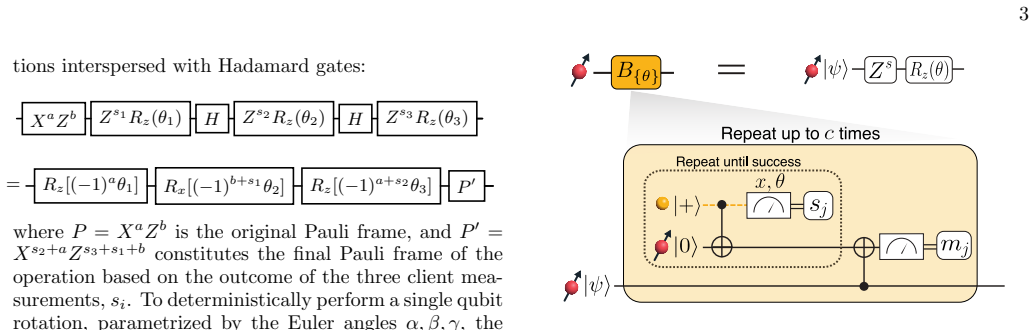
The load-bearing object is the loss-tolerant blind gate $B_{\{\theta\}}$, which implements $Z^s R_z(\theta)$ for a client-chosen angle $\theta$ from a discrete set $\{2\pi p/2^c\}$. The server entangles a photon with a communication qubit and sends the photon to the client, who measures it in basis $|\pm\rangle_{\phi}$ with $\phi = 2^j\theta$; a successful measurement teleports $Z^{s_j} R_z(\theta)$ onto the communication qubit. The server then entangles the communication qubit with a computational qubit and measures it; outcome $m_j = 0$ accepts the rotation, while $m_j = 1$ triggers a retry with angle $2\theta$. Because the angle set is discrete, the loop ends in at most $c$ rounds and on average $2-2^{1-c}$ successful photon measurements, and a lost photon only costs a communication qubit. The gate stays blind because the server's reduced state is a mixture over the client's outcomes, and the client tracks the Pauli frame classically while the server applies local Clifford gates and syndrome extraction.
What would settle it
Run a loss-tolerant blind gate with a detector whose efficiency measurably differs between the two measurement bases, and test whether the server's posterior distribution over the hidden angle shifts after seeing the retry pattern and classical messages; any detectable shift falsifies the blindness claim.
Extended reading notes
Core claim
The paper's central claim is that fault-tolerant blind computation can be split cleanly: the server owns all error correction, and the client owns only the secret rotation angles. The client measures photons entangled with auxiliary communication qubits; each successful measurement teleports a gate $Z^s R_z(\theta)$ onto a communication qubit, which is then entangled with and measured into a computational qubit. If the transfer measurement returns the wrong sign, the server retries with angle $2\theta$, and because angles are drawn from a discrete set $\{2\pi p/2^c\}$ the protocol terminates in at most $c$ rounds. This makes the gate loss-tolerant—a lost photon costs only a communication qubit—so the photonic overhead becomes linear rather than exponential. With syndrome extraction handled locally by the server, the simulated communication-error threshold rises from about 1% (blind syndrome extraction) to 4%, and the threshold reaches about 10% when the hiding fraction $R_h$ is reduced to 0.05; lower hiding fractions also support deeper logical circuits at fixed code distance. The same hybrid structure lets the client hide only the rotation angle of an $n$-qubit Pauli term, reaching the expressibility of a fully blind bricklayer circuit with polynomially fewer blind gates.
Load-bearing premise
The blindness guarantee rests entirely on the client's photon detector having basis-independent efficiency, or on a loophole-free Bell test certifying that no measurement information leaks to the server; neither certification is currently available on state-of-the-art hardware.
Editorial extensions
If this is right
- Blind delegated computation can be scaled to deep logical circuits without the client compiling syndrome extraction, removing the dominant photonic overhead of earlier fault-tolerant BQC proposals.
- The communication-error threshold rises from about 1% to 4% when syndrome extraction is moved to the server, and to roughly 10% when the hiding fraction is reduced to 0.05, relaxing the required link fidelity.
- The hiding fraction $R_h$ becomes a tunable security-efficiency knob: fewer blind gates mean fewer photons and better fidelity, but also a smaller set of unitaries the server must consider.
- For Hamiltonian simulation, hiding only the rotation angle of each Pauli term rather than the whole Pauli string yields a polynomial reduction in blind gates at equal expressibility.
- Resource estimates for both neutral-atom and silicon-vacancy platforms indicate that $10^{10}$ blind logical gates are within reach at surface-code distance 17, with runtime set by communication distance and number of parallel photonic links.
Reading between the lines
- The geometric sparsity argument that explains the outward-bowed threshold boundary suggests the same threshold gains should appear in other CSS codes with similar decoding graphs, not only the surface code.
- If the leakage loophole is closed through basis-independent detectors or loophole-free Bell certification, the architecture could be combined with trap-qubit checks to deliver both blindness and verifiability at scale; the paper notes compatibility with verification but does not develop it.
- The expressibility comparison points to a practical compilation heuristic: for a target Hamiltonian, hide only the minimal set of rotation angles that keeps the plausible-unitary set large, a design automation problem the paper leaves open.
- The same division of labor could be applied to all-photonic servers, where the server measures most of the resource state locally and sends only the photons that implement hidden gates, sharply reducing channel requirements; the paper mentions this extension in its outlook.
Editorial analysis
A structured set of objections, weighed in public.
Referee Report
Summary. This paper proposes an architecture for fault-tolerant blind quantum computation (FT-BQC) based on a hybrid light-matter platform. The server stores and processes qubits in matter, while the client performs measurements on photons to implement blind rotations. The central primitive is the loss-tolerant blind gate B{θ}, whose expected photon overhead is derived as (2-2^{1-c})/η. The authors combine this with transversal logical gates, server-side syndrome extraction, and blind magic-state teleportation. Circuit-level simulations of rotated surface codes at distances 3-9 with a correlated most-likely-error decoder give communication-error thresholds of ~1% when syndrome extraction is blind, ~4% when syndrome extraction is local, and ~10% when the hiding fraction Rh is reduced to 0.05. The paper also compares expressibility of bricklayer versus θ-blind Pauli-rotation circuits and gives resource estimates for SiV and neutral-atom implementations, including 10^10-gate computations at extrapolated code distance d=17.
Significance. If the blindness guarantee can be certified, the paper addresses a real bottleneck in BQC: currently the client must compile and execute error-correction primitives, and photon loss creates exponential overhead. The B{θ} overhead derivation is clean and the threshold simulations are concrete, with a clear noise model and use of Stim; the paper also explicitly discloses that d=17 and 10^10-gate estimates are obtained by fitting. The expressibility and platform analyses are useful for practitioners. However, because the blindness of B{θ} depends on a detector-efficiency certification that is not demonstrated or analyzed, the central 'blind fault-tolerant' claim is conditional. The paper is therefore interesting but needs revision to make the security assumptions and their costs explicit.
major comments (3)
- [Section 2, 'A few remarks are in order'; Supplementary S1, Eq. (S1)] The blindness guarantee for the central B{θ} primitive is not proven for the interactive classical messages. Eq. (S1) averages the server's quantum state only over the photon measurement outcomes s_j, whereas the server in the loss-tolerant protocol also observes the retry count and the communication-qubit outcomes m_j. The main text correctly acknowledges that information about measurement angles can leak through the classical protocol unless the client performs a loophole-free Bell test [27] or certifies basis-independent detection efficiency; however, this certification is not part of the protocol description and no overhead or leakage analysis is given. Because every downstream claim of 'blind' fault-tolerant computation in Sections 3-5 inherits this assumption, the manuscript must either provide a security proof under an explicit detector model or state the protocol's blindness as conditional with a quantitative feasibility analysis of the certification step.
- [Appendix B and Section 5, Fig. 7] The estimates of 10^10-gate circuits and required code distance d=17 are based on fitting logical error rates from simulations at d=3,5,7,9, as Appendix B states ('Logical error results with larger distances used in Section 5 are achieved by fitting'). The main text presents these as concrete feasibility results without reporting fit quality, error bars, or checks of the assumed exponential scaling below threshold. Since these numbers drive the platform-duration estimates in Fig. 7(b),(e), the authors should add validation of the extrapolation, such as comparing the fitting form against additional distances or providing confidence intervals.
- [Section 4, Fig. 5(e); Supplementary S7.4] The threshold improvement attributed to local syndrome extraction is obtained by comparing two different noise settings, but the main text does not specify how the blind-SE simulation distributes communication errors among the stabilizer-measurement operations, nor the exact number of error locations per SE round for the red curve. Without this detail, a reader cannot assess whether the 1% to 4% comparison controls for the number of error locations. Please provide the per-gate error model for the blind SE case in S7 or the main text, including the number and type of noisy operations per syndrome extraction round in each setting.
minor comments (6)
- [Fig. 3(b) caption] The expression for the maximally mixed-state fidelity contains a stray parenthesis: 'F(ρn,ρi)=2^{-n})'. Please fix.
- [References / Supplementary Materials] The main text abbreviates the supplementary information as Ref. [29] 'SI,' without a stable identifier; the supplement should be cited by section name (e.g., 'Supplementary S7') so that the noise-model details are traceable.
- [Section 5, Fig. 7 caption] The references to subpanels 'b(e)' and 'c(f)' are confusing because the two platforms are paired without a clear mapping; please list the platform-specific panels explicitly in the caption.
- [Appendix A, Eq. (A1)] The statement that A_Ei is not exponential and C_Ei is sublinear is asserted without derivation; since it underlies the linear scaling claimed in Fig. 4, add a reference or a one-line justification.
- [Fig. 4 and Appendix A] The word 'expressibility' is inconsistently spelled 'expressiblity' in Fig. 4 and its caption and in the Appendix A heading; please standardize the spelling.
- [Section 4, final paragraph] The claim that the observed threshold behavior is generic for CSS codes is a plausibility argument based on statistical-mechanics mappings, not a result of the presented simulations; I suggest phrasing it as a conjecture or expected property.
Circularity Check
No significant circularity: thresholds and overhead claims are computed from explicit simulations and stated noise models, with only minor disclosed fitting and tool reuse.
full rationale
Central claims are derived from explicit, stated models rather than from the quantities they purport to predict. The loss-tolerant B{θ} gate is a direct application of the externally published Morimae-Fujii blind-rotation primitive (ref [26]); the retry-count calculation (S2, Eq. S3) follows from elementary probability, and the photonic-overhead scaling Nγ = N(2−2^{1−c})/η is an explicit computation with a stated noise model. The headline threshold numbers (1%->4% for local SE, ->10% at Rh=0.05) come from circuit-level Stim simulations with a documented depolarizing-noise model (Appendix B) and are independently rationalized by counting error locations against known 2D/3D surface-code phenomenological thresholds (~10% and ~3%); no threshold is fit to the target value. The expressibility comparison is defined via frame potentials and computed numerically, not assumed. The only places where the paper's own outputs re-enter are (i) the d=17 resource estimates, which openly use fits from the d=3-9 simulation data (Appendix B), and (ii) reuse of the authors' MLE correlated decoder [44,49] and hybrid light-matter platform [22] as tools; neither reduces the central derivation to a self-citation, and the decoder is an independently published algorithm applied to standard Stim output. The acknowledged leakage caveat in Section 2 (basis-dependent detector efficiency / loophole-free Bell test) makes the blindness guarantee conditional, but conditionality is an explicitly stated assumption, not a circular definition. No equation is defined in terms of its own claimed consequence, and no fitted parameter is renamed as a prediction. Hence no significant circularity.
Assumptions & free parameters
assumptions (5)
- domain assumption The server is honest-but-curious: it follows the protocol but attempts to learn the client's computation.
- domain assumption The client's photon detector has basis-independent efficiency, or a loophole-free Bell test can certify the absence of leakage in the interactive loss-tolerant protocol.
- domain assumption The error model for blind gates is a single-qubit depolarizing channel with rate ϵcomm and for local CZ gates a two-qubit depolarizing channel with rate ϵlocal.
- domain assumption Logical error rates at large code distances follow the same scaling observed at d=3..9, allowing extrapolation by fitting.
- standard math Gottesman-Knill theorem and the MLE correlated decoder correctly predict logical error rates for Clifford circuits with Pauli noise.
Cite this review
Pith. "Pith review of Designing Fault-Tolerant Blind Quantum Computation." pith.science (2026). https://pith.science/paper/D3Z73LJD
@misc{pith2026250521621,
  author       = {Pith},
  title        = {Pith review of: Designing Fault-Tolerant Blind Quantum Computation},
  year         = {2026},
  howpublished = {\url{https://pith.science/paper/D3Z73LJD}},
  note         = {Machine review of arXiv:2505.21621}
}
read the original abstract
Blind quantum computing (BQC) is a computational paradigm that allows a client with limited quantum capabilities to delegate quantum computations to a more powerful server while keeping both the algorithm and data hidden. However, in practice, existing BQC protocols face significant challenges when scaling to large-scale computations due to photon losses, low efficiencies, and high overheads associated with fault-tolerant operations, requiring the client to compile both logical operations and error correction primitives. We use a recently demonstrated hybrid light-matter approach [PRL 132, 150604 (2024); Science 388, 509-513 (2025)] to develop an architecture for scalable fault-tolerant blind quantum computation. By combining high-fidelity local gates on the server's matter qubits with delegated blind rotations using photons, we construct loss-tolerant delegated gates that enable efficient algorithm compilation strategies and a scalable approach for fault-tolerant blind logical algorithms. Our approach improves the error-correction threshold and increases the speed and depth of blind logical circuits. Finally, we outline how this architecture can be implemented on state-of-the-art quantum hardware, including neutral atom arrays and solid-state spin defects. These new capabilities open up new opportunities for deep circuit blind quantum computing.
Figures


Figures from the paper (6 more)


Reference graph
Works this paper leans on
-
[27]
Q. Zhao, H. Mao, Y. Qiao, A. A. A. El-Latif, and Q. Li, Mathematics 11, 3035 (2023)
work page 2023
-
[1]
C. H. Bennett and G. Brassard, Theoretical Computer Science Theoretical Aspects of Quantum Cryptography – Celebrating 30 Years of BB84, 560, 7 (2014)
2014
-
[2]
A. K. Ekert, Physical Review Letters 67, 661 (1991)
1991
-
[3]
At the same time, this flexibility enables more concrete and efficient computations whereby the notion of security is better understood
It remains an open question how to quantify the information leaked when portions of the algorithm are revealed, and how these decisions inform the design of the blind computation. At the same time, this flexibility enables more concrete and efficient computations whereby the notion of security is better understood. While we analyzed the example of Hamiltonia...
-
[4]
Barnum, C
H. Barnum, C. Crepeau, D. Gottesman, A. Smith, and A. Tapp, in The 43rd Annual IEEE Symposium on Foun- dations of Computer Science, 2002. Proceedings. (2002) pp. 449–458
2002
-
[5]
communication zone
EXPERIMENT AL APPROACHES TO FT-BQC We now analyze the feasibility of our protocol on state- of-the-art quantum hardware. The envisioned server ar- chitecture consists of computational qubits holding and manipulating the quantum state, communication qubits interfacing with the client via photons, and a high-fidelity interface between these two elements [Fig...
-
[6]
DISCUSSION AND OUTLOOK In this work, we have introduced a novel approach for scalable fault-tolerant blind quantum computation using a hybrid light-matter architecture. By storing the quan- tum information in matter qubits and using photonic qubits for blind delegated operations, we demonstrate an improvement in the efficiency of delegated computation, whic...
-
[7]
Knaut, Moriz Mertz, Erik E
ACKNOWLEDGMENTS We acknowledge insightful discussions with Vladan Vuleti´ c, Aram Harrow, Katherine Van Kirk, Made- lyn Cain, Hengyun (Harry) Zhou, Josiah Sinclair, El- ham Kashefi, Nishad Maskara, Jake Bringewatt, Yan Qi Huan, Can M. Knaut, Moriz Mertz, Erik E. Knall, Umut Yazlar, Maxim Sirotin, Nazlı U˘ gur K¨ oyl¨ uo˘ glu, Andi Gu, and Nik O. Gjonbalaj....
Show all 91 references
-
[8]
Hillery, V
M. Hillery, V. Buˇ zek, and A. Berthiaume, Physical Re- view A 59, 1829 (1999)
1999
-
[9]
Renner, International Journal of Quantum Informa- tion 06, 1 (2008)
R. Renner, International Journal of Quantum Informa- tion 06, 1 (2008)
2008
-
[10]
Scarani, H
V. Scarani, H. Bechmann-Pasquinucci, N. J. Cerf, M. Duˇ sek, N. L¨ utkenhaus, and M. Peev,Reviews of Mod- ern Physics 81, 1301 (2009)
2009
-
[11]
Steane, Reports on Progress in Physics 61, 117 (1998)
A. Steane, Reports on Progress in Physics 61, 117 (1998)
1998
-
[12]
M. A. Nielsen and I. L. Chuang, Quantum Computa- tion and Quantum Information: 10th Anniversary Edi- tion (2010)
2010
-
[14]
A. M. Childs, Quantum Info. Comput. 5, 456 (2005)
2005
-
[15]
Broadbent, J
A. Broadbent, J. Fitzsimons, and E. Kashefi, in 2009 50th Annual IEEE Symposium on Foundations of Computer Science (2009) pp. 517–526. 17
2009
-
[16]
Morimae and K
T. Morimae and K. Fujii, Nature Communications 3, 1036 (2012)
2012
-
[17]
Cojocaru, L
A. Cojocaru, L. Colisson, E. Kashefi, and P. Wallden (2019) pp. 615–645, arXiv:1904.06303 [quant-ph]
2019 arXiv
-
[18]
Mahadev, in 2018 IEEE 59th Annual Symposium on Foundations of Computer Science (FOCS) (2018) pp
U. Mahadev, in 2018 IEEE 59th Annual Symposium on Foundations of Computer Science (FOCS) (2018) pp. 259–267
2018
-
[19]
Lee and D
Y. Lee and D. Chung, Partial Blind Quantum Computa- tion (2025), arXiv:2503.10007 [quant-ph]
2025 arXiv
-
[21]
S. Barz, E. Kashefi, A. Broadbent, J. F. Fitzsimons, A. Zeilinger, and P. Walther, Science 335, 303 (2012)
2012
-
[22]
Greganti, M.-C
C. Greganti, M.-C. Roehsner, S. Barz, T. Morimae, and P. Walther, New Journal of Physics 18, 013020 (2016)
2016
-
[23]
Polacchi, D
B. Polacchi, D. Leichtle, L. Limongi, G. Carvacho, G. Milani, N. Spagnolo, M. Kaplan, F. Sciarrino, and E. Kashefi, Nature Communications 14, 7743 (2023)
2023
-
[24]
Polacchi, D
B. Polacchi, D. Leichtle, G. Carvacho, G. Milani, N. Spagnolo, M. Kaplan, E. Kashefi, and F. Sciarrino, Experimental verifiable multi-client blind quantum com- puting on a Qline architecture (2024), arXiv:2407.09310 [quant-ph]
2024 arXiv
-
[25]
Drmota, D
P. Drmota, D. P. Nadlinger, D. Main, B. C. Nichol, E. M. Ainley, D. Leichtle, A. Mantri, E. Kashefi, R. Srinivas, G. Araneda, and others, Physical Review Letters 132, 150604 (2024)
2024
-
[28]
Zhao and J
Q. Zhao and J. C. S. Lui, Applying Quantum Error- correcting Codes for Fault-tolerant Blind Quantum Cloud Computation (2023), arXiv:2301.01960 [quant- ph]
2023 arXiv
-
[29]
Takeuchi, K
Y. Takeuchi, K. Fujii, T. Morimae, and N. Imoto, Fault- tolerant verifiable blind quantum computing with log- ical state remote preparation (2017), arXiv:1607.01568 [quant-ph]
2017 arXiv
-
[30]
Morimae and K
T. Morimae and K. Fujii, Physical Review A 87, 050301 (2013)
2013
-
[31]
B. W. Reichardt, F. Unger, and U. Vazirani, Nature 496, 456 (2013)
2013
-
[32]
Hayashi and T
M. Hayashi and T. Morimae, Physical Review Letters 115, 220502 (2015)
2015
-
[33]
A. J. Daley, I. Bloch, C. Kokail, S. Flannigan, N. Pearson, M. Troyer, and P. Zoller, Nature 607, 667 (2022)
2022
-
[34]
Maskara, S
N. Maskara, S. Ostermann, J. Shee, M. Kalinowski, A. McClain Gomez, R. Araiza Bravo, D. S. Wang, A. I. Krylov, N. Y. Yao, M. Head-Gordon, and others, Nature Physics 21, 289 (2025)
2025
-
[35]
H. F. Trotter, Proceedings of the American Mathematical Society 10, 545 (1959)
1959
-
[36]
McArdle, S
S. McArdle, S. Endo, A. Aspuru-Guzik, S. C. Benjamin, and X. Yuan, Reviews of Modern Physics 92, 015003 (2020)
2020
-
[37]
J. Haah, Y. Liu, and X. Tan, in 2024 IEEE 65th An- nual Symposium on Foundations of Computer Science (FOCS) (2024) pp. 463–475, arXiv:2402.05239 [quant- ph]
2024
-
[38]
S. Sim, P. D. Johnson, and A. Aspuru-Guzik, Advanced Quantum Technologies 2, 1900070 (2019)
2019
-
[40]
Tangpanitanon, S
J. Tangpanitanon, S. Thanasilp, N. Dangniam, M.-A. Lemonde, and D. G. Angelakis, Physical Review Re- search 2, 043364 (2020)
2020
-
[42]
M. Liu, J. Liu, Y. Alexeev, and L. Jiang, npj Quantum Information 8, 1 (2022)
2022
-
[43]
Kubica, B
A. Kubica, B. Yoshida, and F. Pastawski, New Journal of Physics 17, 083026 (2015)
2015
-
[44]
Ryan-Anderson, N
C. Ryan-Anderson, N. C. Brown, C. H. Baldwin, J. M. Dreiling, C. Foltz, J. P. Gaebler, T. M. Gat- terman, N. Hewitt, C. Holliman, C. V. Horst, and others, High-fidelity and Fault-tolerant Teleportation of a Logical Qubit using Transversal Gates and Lattice Surgery on a Trapped-...
2024 arXiv
-
[45]
Bluvstein, S
D. Bluvstein, S. J. Evered, A. A. Geim, S. H. Li, H. Zhou, T. Manovitz, S. Ebadi, M. Cain, M. Kalinowski, D. Hangleiter, and others, Nature 626, 58 (2024)
2024
-
[46]
H. Zhou, C. Zhao, M. Cain, D. Bluvstein, C. Duckering, H.-Y. Hu, S.-T. Wang, A. Kubica, and M. D. Lukin, Al- gorithmic Fault Tolerance for Fast Quantum Computing (2024), arXiv:2406.17653 [quant-ph]
2024
-
[47]
M. Cain, C. Zhao, H. Zhou, N. Meister, J. P. B. Ataides, A. Jaffe, D. Bluvstein, and M. D. Lukin, Physical Review Letters 133, 240602 (2024)
2024
-
[48]
Eastin and E
B. Eastin and E. Knill, Physical Review Letters 102, 110502 (2009)
2009
-
[49]
Horsman, A
D. Horsman, A. G. Fowler, S. Devitt, and R. V. Meter, New Journal of Physics 14, 123011 (2012)
2012
-
[50]
A. G. Fowler, M. Mariantoni, J. M. Martinis, and A. N. Cleland, Physical Review A 86, 032324 (2012)
2012
-
[51]
Litinski, Quantum 3, 205 (2019)
D. Litinski, Quantum 3, 205 (2019)
2019
-
[52]
Baranes, M
G. Baranes, M. Cain, J. P. B. Ataides, D. Bluvstein, J. Sinclair, V. Vuletic, H. Zhou, and M. D. Lukin, Lever- aging Atom Loss Errors in Fault Tolerant Quantum Al- gorithms (2025), arXiv:2502.20558 [quant-ph]
2025
-
[53]
Honecker, M
A. Honecker, M. Picco, and P. Pujol, Physical Review Letters 87, 047201 (2001)
2001
-
[54]
Ramette, J
J. Ramette, J. Sinclair, N. P. Breuckmann, and V. Vuleti´ c,npj Quantum Information 10, 1 (2024)
2024
-
[55]
Sinclair, J
J. Sinclair, J. Ramette, B. Grinkemeyer, D. Bluvstein, M. Lukin, and V. Vuleti´ c,Fault-tolerant optical intercon- nects for neutral-atom arrays (2024), arXiv:2408.08955 [quant-ph]
2024 arXiv
-
[56]
Dennis, A
E. Dennis, A. Kitaev, A. Landahl, and J. Preskill, Jour- nal of Mathematical Physics 43, 4452 (2002)
2002
-
[57]
Schupp, V
J. Schupp, V. Krcmarsky, V. Krutyanskiy, M. Meraner, T. Northup, and B. Lanyon, PRX Quantum 2, 020331 (2021)
2021
-
[58]
O’Sullivan, K
J. O’Sullivan, K. Reuer, A. Grigorev, X. Dai, A. Hern´ andez-Ant´ on, M. H. Mu˜ noz-Arias, C. Hellings, A. Flasby, D. C. Zanuz, J.-C. Besse, and others, Deter- ministic generation of a 20-qubit two-dimensional pho- tonic cluster state (2024), arXiv:2409.06623 [quant-ph]
2024 arXiv
-
[59]
Acharya, L
R. Acharya, L. Aghababaie-Beni, I. Aleiner, T. I. An- dersen, M. Ansmann, F. Arute, K. Arya, A. Asfaw, N. Astrakhantsev, J. Atalaya, and others, Quantum er- ror correction below the surface code threshold (2024), 18 arXiv:2408.13687 [quant-ph]
2024 arXiv
-
[60]
C. M. Knaut, A. Suleymanzade, Y.-C. Wei, D. R. As- sumpcao, P.-J. Stas, Y. Q. Huan, B. Machielse, E. N. Knall, M. Sutula, G. Baranes, and others, Nature 629, 573 (2024)
2024
-
[61]
Komza, X
L. Komza, X. Zhang, H. Song, Y.-L. Tang, X. Wei, and A. Sipahigil, Multiplexed color centers in a silicon pho- tonic cavity array (2025), arXiv:2501.17339 [quant-ph]
2025 arXiv
-
[62]
D. B. Higginbottom, A. T. K. Kurkjian, C. Chartrand, M. Kazemi, N. A. Brunelle, E. R. MacQuarrie, J. R. Klein, N. R. Lee-Hone, J. Stacho, M. Ruether, and oth- ers, Nature 607, 266 (2022)
2022
-
[63]
Ruskuc, C.-J
A. Ruskuc, C.-J. Wu, E. Green, S. L. N. Hermans, W. Pa- jak, J. Choi, and A. Faraon, Nature 639, 54 (2025)
2025
-
[64]
Pasini, N
M. Pasini, N. Codreanu, T. Turan, A. Riera Moral, C. F. Primavera, L. De Santis, H. K. C. Beukers, J. M. Brevo- ord, C. Waas, J. Borregaard, and others, Physical Review Letters 133, 023603 (2024)
2024
-
[65]
P.-J. Stas, Y. Q. Huan, B. Machielse, E. N. Knall, A. Su- leymanzade, B. Pingault, M. Sutula, S. W. Ding, C. M. Knaut, D. R. Assumpcao, and others, Science 378, 557 (2022)
2022
-
[66]
Bradac, W
C. Bradac, W. Gao, J. Forneris, M. E. Trusheim, and I. Aharonovich, Nature Communications 10, 5625 (2019)
2019
-
[67]
M. Ruf, N. H. Wan, H. Choi, D. Englund, and R. Hanson, Journal of Applied Physics 130, 070901 (2021)
2021
-
[68]
Simmons, PRX Quantum 5, 010102 (2024)
S. Simmons, PRX Quantum 5, 010102 (2024)
2024
-
[69]
Enthoven, M
L. Enthoven, M. Babaie, and F. Sebastiano, IEEE Trans- actions on Quantum Engineering 5, 1 (2024)
2024
-
[70]
De Bone, P
S. De Bone, P. M¨ oller, C. E. Bradley, T. H. Taminiau, and D. Elkouss, A VS Quantum Science 6, 033801 (2024)
2024
-
[71]
Alexander, A
K. Alexander, A. Benyamini, D. Black, D. Bonneau, S. Burgos, B. Burridge, H. Cable, G. Campbell, G. Cata- lano, A. Ceballos, and others, Nature , 1 (2025)
2025
-
[72]
Pederson, N
C. Pederson, N. S. Yama, L. Beale, M. Markham, M. E. Turiansky, and K.-M. C. Fu, Nano Letters 25, 673 (2025)
2025
-
[73]
S. J. Evered, D. Bluvstein, M. Kalinowski, S. Ebadi, T. Manovitz, H. Zhou, S. H. Li, A. A. Geim, T. T. Wang, N. Maskara, and others, Nature 622, 268 (2023)
2023
-
[74]
Henriet, L
L. Henriet, L. Beguin, A. Signoles, T. Lahaye, A. Browaeys, G.-O. Reymond, and C. Jurczak, Quantum 4, 327 (2020)
2020
-
[75]
T. M. Graham, Y. Song, J. Scott, C. Poole, L. Phutti- tarn, K. Jooya, P. Eichler, X. Jiang, A. Marra, B. Grinke- meyer, and others, Nature 604, 457 (2022)
2022
-
[76]
C. A. Pattison, G. Baranes, J. P. B. Ataides, M. D. Lukin, and H. Zhou, Fast quantum interconnects via constant- rate entanglement distillation (2024), arXiv:2408.15936 [quant-ph]
2024 arXiv
-
[77]
Welte, B
S. Welte, B. Hacker, S. Daiss, S. Ritter, and G. Rempe, Physical Review X 8, 011018 (2018)
2018
-
[78]
van Leent, M
T. van Leent, M. Bock, F. Fertig, R. Garthoff, S. Eppelt, Y. Zhou, P. Malik, M. Seubert, T. Bauer, W. Rosenfeld, and others, Nature 607, 69 (2022)
2022
-
[79]
C. B. Young, A. Safari, P. Huft, J. Zhang, E. Oh, R. Chinnarasu, and M. Saffman, Applied Physics B 128, 151 (2022)
2022
-
[80]
Grinkemeyer, E
B. Grinkemeyer, E. Guardado-Sanchez, I. Dimitrova, D. Shchepanovich, G. E. Mandopoulou, J. Borregaard, V. Vuleti´ c, and M. D. Lukin, Science 387, 1301 (2025)
2025
-
[81]
Tillich and G
J.-P. Tillich and G. Z´ emor, IEEE Transactions on Infor- mation Theory 60, 1193 (2014)
2014
-
[82]
N. P. Breuckmann and J. N. Eberhardt, PRX Quantum 2, 040101 (2021)
2021
-
[83]
Gidney, Quantum 5, 497 (2021)
C. Gidney, Quantum 5, 497 (2021)
2021
-
[84]
Designing Fault-Tolerant Blind Quantum Computation
D. Gottesman, Stabilizer Codes and Quantum Error Cor- rection (1997), arXiv:quant-ph/9705052. Supplementary Materials of “Designing Fault-Tolerant Blind Quantum Computation” (Dated: September 23, 2025) CONTENTS S1. Blindness Definition S2 S2. Implementing Bθ Gates S2 S3. Brickw...
1997 arXiv
-
[85]
The server generates a bell pair between a photon ( γ) and a communication qubit, yielding the state (|0⟩γ ⊗|0⟩comm +|1⟩γ ⊗|1⟩comm)/ √
-
[86]
The specific process used to create this bell pair depends on the server’s quantum computing platform
-
[87]
Steps 1 and 2 are repeated with new photons are comm unication qubits until a photon detection by the client heralds a successful measurement
The resulting entangled photon is sent to the client, who attempt s to measure the photon in the basis |+⟩θ = ( |0⟩ + eiθ |1⟩)γ/ √ 2 and |−⟩θ = ( |0⟩ − eiθ |1⟩)γ/ √ 2 with measurement outcome s = 0 and 1 respectively. Steps 1 and 2 are repeated with new photons are comm unicat...
-
[88]
click” from the client indicating a successful measurement. Upon this “click
A local CNOT on the communication qubit and conditioned on a computation q ubit in the state (a |0⟩ + b |1⟩)mq is performed, yielding [ |0⟩comm (a |0⟩ + b(−1)seiθ |1⟩)comp + |1⟩comm (a(−1)seiθ + b |1⟩)comp ] / √ 2. The communication qubit is measured in the z basis with measur...
-
[89]
J. F. Fitzsimons, npj Quantum Information 3, 1 (2017)
2017
-
[90]
Broadbent, J
A. Broadbent, J. Fitzsimons, and E. Kashefi, in 2009 50th Annual IEEE Symposium on Foundations of Computer Science (2009) pp. 517–526
2009
-
[91]
Poshtvan, O
A. Poshtvan, O. Lapiha, M. Doosti, D. Leichtle, L. Music, an d E. Kashefi, Selectively Blind Quantum Com- putation (2025), arXiv:2504.17612 [quant-ph]
2025 arXiv
-
[92]
S. Sim, P. D. Johnson, and A. Aspuru-Guzik, Advanced Quantu m Technologies 2, 1900070 (2019)
2019
-
[93]
Nakaji and N
K. Nakaji and N. Yamamoto, Quantum 5, 434 (2021)
2021
-
[94]
Hunter-Jones, Unitary designs from statistical mechanic s in random quantum circuits (2019), arXiv:1905.12053 [quant-ph]
N. Hunter-Jones, Unitary designs from statistical mechanic s in random quantum circuits (2019), arXiv:1905.12053 [quant-ph]
2019 arXiv
-
[95]
M. Liu, J. Liu, Y. Alexeev, and L. Jiang, npj Quantum Informa tion 8, 1 (2022)
2022
-
[96]
Wei, P.-J
Y.-C. Wei, P.-J. Stas, A. Suleymanzade, G. Baranes, F. Mac hado, Y. Q. Huan, C. M. Knaut, W. S. Ding, M. Merz, E. N. Knall, and others, Universal distributed blind qua ntum computing with solid-state qubits (2024), arXiv:2412.03020 [quant-ph]
2024 arXiv
Reviewed August 7, 2026 · model on record in the stance chip above.
Discussion (0). Sign in to comment.