REVIEW 4 major objections 5 minor 72 references
Streamlining Prediction in Bayesian Deep Learning
T0 review · 4 major / 5 minor · reviewed 2026-08-12 · deepseek-v4-flash
Pith's one-line read The paper claims that the posterior predictive distribution of a Bayesian neural network can be computed analytically in one forward pass by locally linearising activations and Gaussian-approximating each layer, matching or beating Monte…
desk verdict A useful single-pass recipe for BDL predictions, but the headline uncertainty gains are inflated by a validation-tuned variance scalar applied only to the proposed method. read the letter →
The pith
A machine-rendered reading of the paper's core claim, the machinery that carries it, and where it could break.
The reading
What carries the argument
The central mechanism is the simultaneous use of local linearisation and local Gaussian approximation at every layer. For a pre-activation $h^{(m)} = W^{(m)} a^{(m-1)} + b^{(m)}$, the method assumes activations of the previous layer and parameters of the current layer are independent (Assumption 3.1) and that each product $a_i^{(m-1)} W_{ki}^{(m)}$ is Gaussian; this yields closed-form mean and covariance for $h^{(m)}$ (Eqs. 2-4). For a nonlinear activation $g$, a first-order Taylor expansion $g(h) \approx g(\mathbb{E}[h]) + J_g|_{h=\mathbb{E}[h]}(h - \mathbb{E}[h])$ propagates the Gaussian through the activation, giving $a \sim \mathcal{N}(g(\mathbb{E}[h]), J^\top \Sigma_h J)$. In attention layers, the query and key are treated deterministically at their means, while only the value projection carries the propagated uncertainty, keeping the path tractable.
What would settle it
Train an MLP whose weight posterior is made heavy-tailed (for instance, by increasing the posterior temperature), then compare the analytic predictive entropy from a single forward pass against a very large Monte Carlo estimate (e.g., 100,000 samples) on an out-of-distribution test set; if the analytic entropy is much lower or higher while sampling is stable, the Gaussian-independence approximation is the cause and the claim of calibration parity fails.
Extended reading notes
Core claim
The central claim is that the posterior predictive distribution of a Bayesian neural network admits an accurate and tractable approximation through a single deterministic forward pass. The method recursively computes the mean and covariance of activations at every layer: for a linear layer, the pre-activation distribution is obtained from the weight posterior and the previous activation distribution under a local Gaussian assumption; for a nonlinear activation, a first-order Taylor expansion at the pre-activation mean maps the Gaussian distribution to a Gaussian. For classification, a probit approximation yields the predictive class probabilities. Empirical results show that this analytic predictive achieves lower or equal negative log predictive density and expected calibration error compared to Monte Carlo sampling and to the global linearised Laplace approximation, across regression and classification tasks, with near-zero runtime overhead relative to a standard forward pass.
Load-bearing premise
The load-bearing premise is that the propagated uncertainty remains accurate under the twin assumptions that each weight-activation product is Gaussian and that activations and weights are independent, which can fail when activation variances are large or the posterior is heavy-tailed.
Editorial extensions
If this is right
- Predictions from a Bayesian neural network no longer require sampling: a single forward pass produces both the predictive mean and uncertainty, which is a direct consequence of the closed-form propagation.
- The method applies to modern architectures including Vision Transformers and GPT-2, and to both Laplace and mean-field variational posteriors, making it compatible with large pre-trained models.
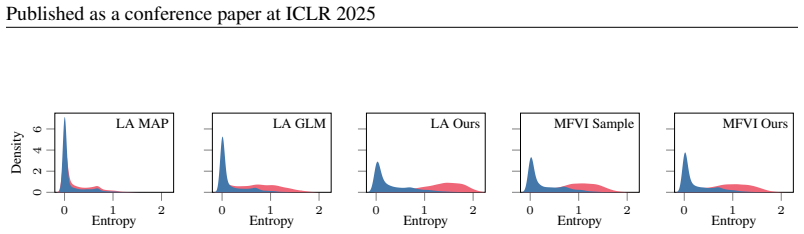
- The analytic predictive distribution is better calibrated than Monte Carlo sampling in most experiments, with lower NLPD and ECE while maintaining equal accuracy.
- Because the input distribution can be propagated analytically, sensitivity analysis with respect to inputs becomes tractable in a single pass, as demonstrated by the pixel-sensitivity maps in Sec. 4.3.
- The method's cost scales with the number of parameters and the posterior covariance structure, allowing further speedups through diagonal or Kronecker-factored approximations.
Reading between the lines
- This propagation scheme implies that the predictive uncertainty can be decomposed into contributions from weight uncertainty, bias uncertainty, and input (aleatoric) uncertainty at each layer, which the paper does not explicitly use but would be a natural extension for interpretable uncertainty attribution.
- If the independence assumption between activations and weights degrades in deeper networks with correlated activations, the analytic covariance will underestimate the true uncertainty; a testable extension would be to compare against sampling on networks trained with increasing depth and width.
- The method opens the possibility of real-time Bayesian prediction in latency-sensitive applications such as autonomous driving or medical diagnostics, where the cost of many forward passes is currently prohibitive.
- A similar layer-wise moment propagation could be applied to other posterior families beyond Gaussians (e.g., Student-t or alpha-stable), provided the local linearisation is adjusted accordingly, since the paper already exploits stability under linear maps.
Editorial analysis
A structured set of objections, weighed in public.
Referee Report
Summary. The paper proposes a single-forward-pass method for approximate posterior predictive inference in Bayesian deep learning. The method propagates mean and covariance through locally linearised activation functions and local Gaussian approximations at linear layers, supporting full, diagonal, and KFAC posterior covariance structures. It is applied to MLPs, Vision Transformers, and GPT-2, and evaluated on UCI regression, MNIST-like classification, and several large-scale classification and language-understanding tasks. The central claim is that this analytic propagation achieves better or on-par NLPD and ECE compared to Monte Carlo sampling and the global linearised Laplace approximation, with little or no runtime overhead.
Significance. If the empirical comparisons are valid, the contribution is practically useful: it removes the need for MC sampling at prediction time, provides a closed-form route to OOD detection and input-sensitivity analysis, and is supported by an open-source library and detailed derivations. The derivation of moment propagation, including the KFAC covariance block retrieval, is technically sound under the stated assumptions. However, the paper's headline uncertainty comparisons are confounded by a validation-set-fitted variance scaling factor applied only to the proposed method, so the significance of the empirical claims is currently not established.
major comments (4)
- [Sec. 4, Posterior approximations paragraph; Sec. 5 Limitations] The predictive variance for 'Ours' is rescaled by a scalar fitted by minimising NLPD on a validation set, while the MC sampling and GLM baselines receive no analogous calibration. Since NLPD and ECE both depend directly on predictive variance, the comparisons in Tables 1, 2, and 4 are not controlled for this free parameter; the Limitations section acknowledges the fitting but does not quantify its effect. Please provide an ablation without the scaling factor, report the fitted scaling values, or apply an equivalent validation-based calibration to the baselines, so that the reported gains can be attributed to the propagation method itself.
- [Table 5] On BoolQ, LA Ours has NLPD 0.665 vs 0.656 for LA Sampling and 0.633 for LA GLM; on MRPC, LA Ours has NLPD 0.706 vs 0.658 and 0.609, and ACC drops to 0.416 vs 0.665 and 0.720 for the baselines. The text states that 'our method systematically outperforms sampling,' which is contradicted by these rows. Please revise this claim and discuss the failure modes on these language-understanding tasks.
- [Table 1, CAC row] On the CAC regression data set, LA Ours has NLPD 2.662±1.096, which is substantially worse than LA Sampling (1.848±0.055) and GLM (1.281±0.069), with a large standard error. The general claim in Sec. 4.1 that 'our method achieves better NLPD in general' and the Table 1 caption 'better or matching performance' are not supported by this row. Please address this failure case or qualify the claim accordingly.
- [Assumption 3.1 and Assumption A1; Sec. A.2] The propagation relies on Assumption 3.1 (independence between activations and parameters) and Assumption A1 (local Gaussianity of each product a_i W_ki). The appendix itself shows the approximation fails to capture skewness for large-magnitude weights, and the manuscript provides no formal error bound or practical diagnostic for when activation variances are large or the posterior is heavy-tailed. Please add quantitative diagnostics, such as comparing propagated moments against MC samples on the actual posteriors used for the ViT/GPT-2 experiments, or a bounded-error statement.
minor comments (5)
- [Sec. 3.1, first paragraph] The sentence 'the covariance between the kth and the jth hidden unit' uses 'jth' but Eq. (3) defines the covariance between the kth and lth hidden unit; please correct the index notation.
- [Sec. 3.2, Eq. (7)] Treating the query and key as deterministic is a strong approximation that ignores their posterior covariance; the text gives only a brief 'computational reasons' justification. Please state clearly that this can underestimate the attention output variance and discuss the potential impact on uncertainty calibration.
- [Sec. 3.3, Eq. (10)] The approximation (B⊗A+λ²I)^{-1} ≈ (B+λI)^{-1}⊗(A+λI)^{-1} is stated without a source or empirical check; please add a reference or a small numerical verification of its accuracy for the models used.
- [Tables 2 and 4] ECE values are reported without standard errors or confidence intervals; please state whether these are averages over folds/seeds and how they were aggregated.
- [Acknowledgments] The acknowledgment mentions 'Jonas Vestergaard for finding a bug in our code' without indicating whether the bug affected any reported results; please clarify in the manuscript whether the experiments were rerun after the fix.
Circularity Check
Derivation is self-contained; empirical uncertainty comparisons are partially driven by a validation-tuned variance scaling applied only to Ours.
-
fitted input called prediction
[Section 4, 'Posterior approximations' paragraph (p. 6-7); see also Limitations (Sec. 5)]
"For our method, we fit an additional scaling factor on the predictive variance by minimising the NLPD on a validation set, similar to the pseudo-count used in Ritter et al. (2018)."
NLPD and ECE are the headline comparison metrics (Tables 1, 2, 4, 5), and ECE is a direct function of the predictive-variance scale. The scaling factor is selected by minimizing NLPD on a validation set, then the same NLPD/ECE values are reported on test as evidence that the method 'achieves better or on-par NLPD and ECE.' MC-sampling and GLM baselines are not given this validation-tuned variance calibration, so the comparison is not controlled: the variance entering the reported predictive distribution is not a pure analytic output of the Sec. 3 derivation but partly a fitted input, tuned to the exact metric being compared. The Limitations confirm the grid-search fitting of this scalar.
full rationale
The core propagation formulas (Eqs. 2-6) are derived from the stated Assumption 3.1 and from local linearisation, with an explicit error analysis in Sec. A.2; no equation reduces to its own input. The KFAC, attention, and residual-connection treatments are stated approximations, not circular steps. Self-citations (Baumann et al., Meronen et al., Scannell et al.) appear only as related work and are not load-bearing. The one substantive circularity-adjacent issue is the validation-set-fitted variance scaling in the experimental protocol: it makes the reported NLPD/ECE gains partially a fitted input rather than a pure prediction of the propagation method, and it is applied asymmetrically relative to the baselines. This compromises the headline empirical comparison but does not invalidate the derivation itself, so the overall circularity is moderate rather than complete.
Assumptions & free parameters
free parameters (1)
- predictive variance scaling factor (pseudo-count) =
not reported (grid search on validation set)
assumptions (5)
- domain assumption Activations of previous layer and parameters of the m-th layer are independent (Assumption 3.1).
- ad hoc to paper Each product a_i W_ki is Gaussian (Assumption A1).
- ad hoc to paper For attention, query and key are treated as deterministic (Eq. 7).
- ad hoc to paper Residual connections assume independence.
- ad hoc to paper KFAC covariance approximation (B⊗A+λ²I)^{-1} ≈ (B+λI)^{-1}⊗(A+λI)^{-1} (Eq. 10).
Cite this review
Pith. "Pith review of Streamlining Prediction in Bayesian Deep Learning." pith.science (2026). https://pith.science/paper/D4X5GUXD
@misc{pith2026241118425,
  author       = {Pith},
  title        = {Pith review of: Streamlining Prediction in Bayesian Deep Learning},
  year         = {2026},
  howpublished = {\url{https://pith.science/paper/D4X5GUXD}},
  note         = {Machine review of arXiv:2411.18425}
}
read the original abstract
The rising interest in Bayesian deep learning (BDL) has led to a plethora of methods for estimating the posterior distribution. However, efficient computation of inferences, such as predictions, has been largely overlooked with Monte Carlo integration remaining the standard. In this work we examine streamlining prediction in BDL through a single forward pass without sampling. For this we use local linearisation on activation functions and local Gaussian approximations at linear layers. Thus allowing us to analytically compute an approximation to the posterior predictive distribution. We showcase our approach for both MLP and transformers, such as ViT and GPT-2, and assess its performance on regression and classification tasks. Open-source library: https://github.com/AaltoML/SUQ
Figures


Figures from the paper (10 more)




Reference graph
Works this paper leans on
-
[1]
Post-hoc probabilistic vision-language models
Anton Baumann, Rui Li, Marcus Klasson, Santeri Mentu, Shyamgopal Karthik, Zeynep Akata, Arno Solin, and Martin Trapp. Post-hoc probabilistic vision-language models. arXiv preprint arXiv:2412.06014, 2024
arXiv 2024
-
[2]
The need for uncertainty quantification in machine-assisted medical decision making
Edmon Begoli, Tanmoy Bhattacharya, and Dimitri Kusnezov. The need for uncertainty quantification in machine-assisted medical decision making. Nature Machine Intelligence, 1 0 (1): 0 20--23, 2019
2019
-
[3]
Variational inference: A review for statisticians
David M Blei, Alp Kucukelbir, and Jon D McAuliffe. Variational inference: A review for statisticians. Journal of the American Statistical Association, 112 0 (518): 0 859--877, 2017
2017
-
[4]
Weight uncertainty in neural network
Charles Blundell, Julien Cornebise, Koray Kavukcuoglu, and Daan Wierstra. Weight uncertainty in neural network. In Proceedings of the 32th International Conference on Machine Learning (ICML), volume 37 of Proceedings of Machine Learning Research, pp.\ 1613--1622. PMLR, 2015
work page 2015
-
[5]
Sample average approximation for black-box variational inference
Javier Burroni, Justin Domke, and Daniel Sheldon. Sample average approximation for black-box variational inference. In Proceedings of the 40th Conference on Uncertainty in Artificial Intelligence (UAI). AUAI Press, 2024
work page 2024
-
[6]
Remote sensing image scene classification: Benchmark and state of the art
Gong Cheng, Junwei Han, and Xiaoqiang Lu. Remote sensing image scene classification: Benchmark and state of the art. Proceedings of the IEEE, 105 0 (10): 0 1865--1883, 2017
2017
-
[7]
Describing textures in the wild
Mircea Cimpoi, Subhransu Maji, Iasonas Kokkinos, Sammy Mohamed, and Andrea Vedaldi. Describing textures in the wild. In Proceedings of the IEEE Conference on Computer Vision and Pattern Recognition (CVPR), pp.\ 3606--3613. IEEE Computer Society, 2014
work page 2014
-
[8]
Wide mean-field bayesian neural networks ignore the data
Beau Coker, Wessel P Bruinsma, David R Burt, Weiwei Pan, and Finale Doshi-Velez. Wide mean-field bayesian neural networks ignore the data. In Proceedings of the twenty fifth International Conference on Artificial Intelligence and Statistics (AISTATS), volume 131 of Proceedings of Machine Learning Research, pp.\ 5276--5333. PMLR, 2022
work page 2022
Show all 72 references
-
[9]
Kronecker-factored approximate curvature (kfac) from scratch
Felix Dangel, Bálint Mucsányi, Tobias Weber, and Runa Eschenhagen. Kronecker-factored approximate curvature (kfac) from scratch. arXiv, 2025. URL https://github.com/f-dangel/kfac-tutorial
2025
-
[10]
Laplace redux -- effortless B ayesian deep learning
Erik Daxberger, Agustinus Kristiadi, Alexander Immer, Runa Eschenhagen, Matthias Bauer, and Philipp Hennig. Laplace redux -- effortless B ayesian deep learning. In Advances in Neural Information Processing Systems 34 (NeurIPS), volume 34, pp.\ 20089--20103. Curran Associates, ...
2021
-
[11]
B ayesian deep learning via subnetwork inference
Erik Daxberger, Eric Nalisnick, James U Allingham, Javier Antor \'a n, and Jos \'e Miguel Hern \'a ndez-Lobato. B ayesian deep learning via subnetwork inference. In Proceedings of the 38th International Conference on Machine Learning (ICML), volume 119 of Proceedings of Machin...
2021
-
[12]
Imagenet: A large-scale hierarchical image database
Jia Deng, Wei Dong, Richard Socher, Li-Jia Li, Kai Li, and Li Fei-Fei. Imagenet: A large-scale hierarchical image database. In Proceedings of the IEEE Conference on Computer Vision and Pattern Recognition (CVPR), pp.\ 248--255. IEEE Computer Society, 2009
2009
-
[13]
Efficient parametric approximations of neural network function space distance
Nikita Dhawan, Sicong Huang, Juhan Bae, and Roger Baker Grosse. Efficient parametric approximations of neural network function space distance. In Proceedings of the 40th International Conference on Machine Learning (ICML) , Proceedings of Machine Learning Research, pp.\ 7795--...
2023
-
[14]
An image is worth 16x16 words: Transformers for image recognition at scale
Alexey Dosovitskiy, Lucas Beyer, Alexander Kolesnikov, Dirk Weissenborn, Xiaohua Zhai, Thomas Unterthiner, Mostafa Dehghani, Matthias Minderer, Georg Heigold, Sylvain Gelly, Jakob Uszkoreit, and Neil Houlsby. An image is worth 16x16 words: Transformers for image recognition at...
2021
-
[15]
Mixtures of L apkace approximations for improved post-hoc uncertainty in deep learning
Runa Eschenhagen, Erik Daxberger, Philipp Hennig, and Agustinus Kristiadi. Mixtures of L apkace approximations for improved post-hoc uncertainty in deep learning. In NeurIPS workshop on B ayesian deep learning , 2021
2021
-
[16]
On the expressiveness of approximate inference in B ayesian neural networks
Andrew Foong, David Burt, Yingzhen Li, and Richard Turner. On the expressiveness of approximate inference in B ayesian neural networks. In Advances in Neural Information Processing Systems 33 (NeurIPS), pp.\ 15897--15908. Curran Associates, Inc., 2020
2020
-
[17]
B ayesian neural network priors revisited
Vincent Fortuin, Adri \`a Garriga-Alonso, Sebastian W Ober, Florian Wenzel, Gunnar R \"a tsch, Richard E Turner, Mark van der Wilk, and Laurence Aitchison. B ayesian neural network priors revisited. In International Conference on Learning Representations (ICLR), 2021
2021
-
[18]
Dropout as a bayesian approximation: Representing model uncertainty in deep learning
Yarin Gal and Zoubin Ghahramani. Dropout as a bayesian approximation: Representing model uncertainty in deep learning. In Proceedings of the 33th International Conference on Machine Learning (ICML), volume 48 of Proceedings of Machine Learning Research, pp.\ 1050--1059. PMLR, 2016
2016
-
[19]
Deep bayesian active learning with image data
Yarin Gal, Riashat Islam, and Zoubin Ghahramani. Deep bayesian active learning with image data. In Proceedings of the 34th International Conference on Machine Learning (ICML), Proceedings of Machine Learning Research, pp.\ 1183--1192. PMLR, 2017
2017
-
[20]
Yoav Gelberg, Tycho F. A. van der Ouderaa, Mark van der Wilk, and Yarin Gal. Variational inference failures under model symmetries: Permutation invariant posteriors for B ayesian neural networks. In ICML 2024 Workshop on Geometry-grounded Representation Learning and Generative...
2024
-
[21]
Black box variational inference with a deterministic objective: Faster, more accurate, and even more black box
Ryan Giordano, Martin Ingram, and Tamara Broderick. Black box variational inference with a deterministic objective: Faster, more accurate, and even more black box. Journal of Machine Learning Research, 25 0 (18): 0 1--39, 2024
2024
-
[22]
Tractable approximate G aussian inference for B ayesian neural networks
James-A Goulet, Luong Ha Nguyen, and Saeid Amiri. Tractable approximate G aussian inference for B ayesian neural networks. Journal of Machine Learning Research, 22 0 (251): 0 1--23, 2021
2021
-
[23]
Training independent subnetworks for robust prediction
Marton Havasi, Rodolphe Jenatton, Stanislav Fort, Jeremiah Zhe Liu, Jasper Snoek, Balaji Lakshminarayanan, Andrew Mingbo Dai, and Dustin Tran. Training independent subnetworks for robust prediction. In International Conference on Learning Representations (ICLR), 2021
2021
-
[24]
Deep residual learning for image recognition
Kaiming He, Xiangyu Zhang, Shaoqing Ren, and Jian Sun. Deep residual learning for image recognition. In IEEE Conference on Computer Vision and Pattern Recognition (CVPR), pp.\ 770--778. IEEE Computer Society, 2016
2016
-
[25]
The many faces of robustness: A critical analysis of out-of-distribution generalization
Dan Hendrycks, Kevin Zhao, Sebastian Basart, Jacob Steinhardt, and Dawn Song. The many faces of robustness: A critical analysis of out-of-distribution generalization. In Proceedings of the IEEE/CVF International Conference on Computer Vision (ICCV), pp.\ 8340--8349. IEEE , 2021
2021
-
[26]
Scalable marginal likelihood estimation for model selection in deep learning
Alexander Immer, Matthias Bauer, Vincent Fortuin, Gunnar R \"a tsch, and Khan Mohammad Emtiyaz. Scalable marginal likelihood estimation for model selection in deep learning. In Proceedings of the 38th International Conference on Machine Learning (ICML), Proceedings of Machine ...
2021
-
[27]
Improving predictions of B ayesian neural nets via local linearization
Alexander Immer, Maciej Korzepa, and Matthias Bauer. Improving predictions of B ayesian neural nets via local linearization. In Proceedings of the twenty forth International Conference on Artificial Intelligence and Statistics (AISTATS), volume 130 of Proceedings of Machine Le...
2021
-
[28]
Towards scalable B ayesian transformers: Investigating stochastic subset selection for nlp
Peter JT Kampen, Gustav RS Als, and Michael Riis Andersen. Towards scalable B ayesian transformers: Investigating stochastic subset selection for nlp. In Proceedings of the 40th Conference on Uncertainty in Artificial Intelligence (UAI). AUAI Press, 2024
2024
-
[29]
From moments of sum to moments of product
Raymond Kan. From moments of sum to moments of product. Journal of Multivariate Analysis, 99 0 (3): 0 542--554, 2008
2008
-
[30]
The UCI machine learning repository, 2023
Markelle Kelly, Rachel Longjohn, and Kolby Nottingham. The UCI machine learning repository, 2023. URL : https://archive.ics.uci.edu
2023
-
[31]
Being bayesian, even just a bit, fixes overconfidence in relu networks
Agustinus Kristiadi, Matthias Hein, and Philipp Hennig. Being bayesian, even just a bit, fixes overconfidence in relu networks. In Proceedings of the 37th International Conference on Machine Learning (ICML), volume 119 of Proceedings of Machine Learning Research, pp.\ 5436--54...
2020
-
[32]
Promises and pitfalls of the linearized L apkace in B ayesian optimization
Agustinus Kristiadi, Alexander Immer, Runa Eschenhagen, and Vincent Fortuin. Promises and pitfalls of the linearized L apkace in B ayesian optimization. In Fifth Symposium on Advances in Approximate B ayesian Inference , 2023
2023
-
[33]
Learning multiple layers of features from tiny images
Alex Krizhevsky and Geoffrey Hinton. Learning multiple layers of features from tiny images. Technical report, Toronto, ON, Canada, 2009
2009
-
[34]
Simple and scalable predictive uncertainty estimation using deep ensembles
Balaji Lakshminarayanan, Alexander Pritzel, and Charles Blundell. Simple and scalable predictive uncertainty estimation using deep ensembles. In Advances in Neural Information Processing Systems 30 (NeurIPS), volume 30, pp.\ 6402--6413. Curran Associates, Inc., 2017
2017
-
[35]
Gradient-based learning applied to document recognition
Yann LeCun, L \'e on Bottou, Yoshua Bengio, and Patrick Haffner. Gradient-based learning applied to document recognition. Proceedings of the IEEE, 86 0 (11): 0 2278--2324, 1998
1998
-
[36]
Soft: Softmax-free transformer with linear complexity
Jiachen Lu, Jinghan Yao, Junge Zhang, Xiatian Zhu, Hang Xu, Weiguo Gao, Chunjing Xu, Tao Xiang, and Li Zhang. Soft: Softmax-free transformer with linear complexity. In Advances in Neural Information Processing Systems 34 (NeurIPS), pp.\ 21297--21309. Curran Associates, Inc., 2021
2021
-
[37]
Information-based objective functions for active data selection
David JC MacKay. Information-based objective functions for active data selection. Neural Computation, 4 0 (4): 0 590--604, 1992 a
1992
-
[38]
B ayesian interpolation
David JC MacKay. B ayesian interpolation. Neural computation, 4 0 (3): 0 415--447, 1992 b
1992
-
[39]
B ayesian methods for backpropagation networks
David JC MacKay. B ayesian methods for backpropagation networks. In Models of Neural Networks III : A ssociation, Generalization, and Representation , pp.\ 211--254. Springer, 1996
1996
-
[40]
Maddox, Pavel Izmailov, Timur Garipov, Dmitry P
Wesley J. Maddox, Pavel Izmailov, Timur Garipov, Dmitry P. Vetrov, and Andrew Gordon Wilson. A simple baseline for B ayesian uncertainty in deep learning. In Advances in Neural Information Processing Systems 32 (NeurIPS), pp.\ 13132--13143. Curran Associates, Inc., 2019
2019
-
[41]
Optimizing neural networks with K ronecker-factored approximate curvature
James Martens and Roger Grosse. Optimizing neural networks with K ronecker-factored approximate curvature. In Proceedings of the 32nd International Conference on Machine Learning (ICML), Proceedings of Machine Learning Research, pp.\ 2408--2417. PMLR, 2015
2015
-
[42]
Periodic activation functions induce stationarity
Lassi Meronen, Martin Trapp, and Arno Solin. Periodic activation functions induce stationarity. In Advances in Neural Information Processing Systems 34 (NeurIPS), pp.\ 1673--1685. Curran Associates, Inc., 2021
2021
-
[43]
Fixing overconfidence in dynamic neural networks
Lassi Meronen, Martin Trapp, Andrea Pilzer, Le Yang, and Arno Solin. Fixing overconfidence in dynamic neural networks. In Proceedings of the IEEE/CVF Winter Conference on Applications of Computer Vision (WACV), pp.\ 2680--2690, 2024
2024
-
[44]
Uncertainty quantification with statistical guarantees in end-to-end autonomous driving control
Rhiannon Michelmore, Matthew Wicker, Luca Laurenti, Luca Cardelli, Yarin Gal, and Marta Kwiatkowska. Uncertainty quantification with statistical guarantees in end-to-end autonomous driving control. In IEEE International Conference on Robotics and Automation (ICRA), pp.\ 7344--...
2020
-
[45]
On the distribution of the product of correlated normal random variables
Saralees Nadarajah and Tibor K Pog \'a ny. On the distribution of the product of correlated normal random variables. Comptes Rendus. Math \'e matique , 354 0 (2): 0 201--204, 2016
2016
-
[46]
On priors for B ayesian neural networks
Eric Thomas Nalisnick. On priors for B ayesian neural networks . University of California, Irvine, 2018
2018
-
[47]
Reading digits in natural images with unsupervised feature learning
Yuval Netzer, Tao Wang, Adam Coates, Alessandro Bissacco, Baolin Wu, Andrew Y Ng, et al. Reading digits in natural images with unsupervised feature learning. In NIPS workshop on deep learning and unsupervised feature learning, 2011
2011
-
[48]
Theodore Papamarkou, Maria Skoularidou, Konstantina Palla, Laurence Aitchison, Julyan Arbel, David B. Dunson, Maurizio Filippone, Vincent Fortuin, Philipp Hennig, Jos \' e Miguel Hern \' a ndez - Lobato, Aliaksandr Hubin, Alexander Immer, Theofanis Karaletsos, Mohammad Emtiyaz...
2024
-
[49]
Uncertainty quantification via stable distribution propagation
Felix Petersen, Aashwin Ananda Mishra, Hilde Kuehne, Christian Borgelt, Oliver Deussen, and Mikhail Yurochkin. Uncertainty quantification via stable distribution propagation. In International Conference on Learning Representations (ICLR), 2024
2024
-
[50]
Uncertainty quantification in scientific machine learning: Methods, metrics, and comparisons
Apostolos F Psaros, Xuhui Meng, Zongren Zou, Ling Guo, and George Em Karniadakis. Uncertainty quantification in scientific machine learning: Methods, metrics, and comparisons. Journal of Computational Physics, 477: 0 111902, 2023
2023
-
[51]
Language models are unsupervised multitask learners
Alec Radford, Jeff Wu, Rewon Child, David Luan, Dario Amodei, and Ilya Sutskever. Language models are unsupervised multitask learners. OpenAI blog, 2019
2019
-
[52]
A scalable L aplace approximation for neural networks
Hippolyt Ritter, Aleksandar Botev, and David Barber. A scalable L aplace approximation for neural networks. In International Conference on Learning Representations (ICLR), 2018
2018
-
[53]
B ayesian Filtering and Smoothing
Simo S \"a rkk \"a and Lennart Svensson. B ayesian Filtering and Smoothing . Cambridge University Press, 2023
2023
-
[54]
Function-space parameterization of neural networks for sequential learning
Aidan Scannell, Riccardo Mereu, Paul Edmund Chang, Ella Tamir, Joni Pajarinen, and Arno Solin. Function-space parameterization of neural networks for sequential learning. In International Conference on Learning Representations (ICLR), 2024
2024
-
[55]
Variational learning is effective for large deep networks
Yuesong Shen, Nico Daheim, Bai Cong, Peter Nickl, Gian Maria Marconi, Bazan Clement Emile Marcel Raoul, Rio Yokota, Iryna Gurevych, Daniel Cremers, Mohammad Emtiyaz Khan, and Thomas Möllenhoff. Variational learning is effective for large deep networks. In Proceedings of the 41...
2024
-
[56]
Prediction-oriented bayesian active learning
Freddie Bickford Smith, Andreas Kirsch, Sebastian Farquhar, Yarin Gal, Adam Foster, and Tom Rainforth. Prediction-oriented bayesian active learning. In Proceedings of the twenty sixth International Conference on Artificial Intelligence and Statistics (AISTATS), Proceedings of ...
2023
-
[57]
All you need is a good functional prior for B ayesian deep learning
Ba-Hien Tran, Simone Rossi, Dimitrios Milios, and Maurizio Filippone. All you need is a good functional prior for B ayesian deep learning. Journal of Machine Learning Research, 23 0 (74): 0 1--56, 2022
2022
-
[58]
Attention is all you need
Ashish Vaswani, Noam Shazeer, Niki Parmar, Jakob Uszkoreit, Llion Jones, Aidan N Gomez, ukasz Kaiser, and Illia Polosukhin. Attention is all you need. In Advances in Neural Information Processing Systems 30 (NeurIPS). Curran Associates, Inc., 2017
2017
-
[59]
High-dimensional G aussian sampling: a review and a unifying approach based on a stochastic proximal point algorithm
Maxime Vono, Nicolas Dobigeon, and Pierre Chainais. High-dimensional G aussian sampling: a review and a unifying approach based on a stochastic proximal point algorithm. SIAM Review, 64 0 (1): 0 3--56, 2022
2022
-
[60]
Superglue: A stickier benchmark for general-purpose language understanding systems
Alex Wang, Yada Pruksachatkun, Nikita Nangia, Amanpreet Singh, Julian Michael, Felix Hill, Omer Levy, and Samuel Bowman. Superglue: A stickier benchmark for general-purpose language understanding systems. In Advances in Neural Information Processing Systems 32 (NeurIPS), pp.\ ...
2019
-
[61]
Glue: A multi-task benchmark and analysis platform for natural language understanding
Alex Wang, Amanpreet Singh, Julian Michael, Felix Hill, Omer Levy, and Samuel R Bowman. Glue: A multi-task benchmark and analysis platform for natural language understanding. In International Conference on Learning Representations (ICLR), 2019 b
2019
-
[62]
Florian Wenzel, Kevin Roth, Bastiaan Veeling, Jakub Swiatkowski, Linh Tran, Stephan Mandt, Jasper Snoek, Tim Salimans, Rodolphe Jenatton, and Sebastian Nowozin. How good is the B ayes posterior in deep neural networks really? In Proceedings of the 37th International Conference...
2020
-
[63]
The case for B ayesian deep learning
Andrew Gordon Wilson. The case for B ayesian deep learning. arXiv preprint arXiv:2001.10995, 2020
2001 arXiv
-
[64]
B ayesian deep learning and a probabilistic perspective of generalization
Andrew Gordon Wilson and Pavel Izmailov. B ayesian deep learning and a probabilistic perspective of generalization. In Advances in Neural Information Processing Systems 33 (NeurIPS), pp.\ 4697--4708. Curran Associates, Inc., 2020
2020
-
[65]
Huggingface's transformers: State-of-the-art natural language processing
Thomas Wolf, Lysandre Debut, Victor Sanh, Julien Chaumond, Clement Delangue, Anthony Moi, Pierric Cistac, Tim Rault, R \' e mi Louf, Morgan Funtowicz, and Jamie Brew. Huggingface's transformers: State-of-the-art natural language processing. arXiv preprint arXiv:1910.03771, 2019
1910 arXiv
-
[66]
Gaussian pre-activations in neural networks: Myth or reality? arXiv preprint arXiv:2205.12379, 2022
Pierre Wolinski and Julyan Arbel. Gaussian pre-activations in neural networks: Myth or reality? arXiv preprint arXiv:2205.12379, 2022
2022 arXiv
-
[67]
Turner, Jos \' e Miguel Hern \' a ndez - Lobato, and Alexander L
Anqi Wu, Sebastian Nowozin, Edward Meeds, Richard E. Turner, Jos \' e Miguel Hern \' a ndez - Lobato, and Alexander L. Gaunt. Deterministic variational inference for robust B ayesian neural networks. In International Conference on Learning Representations (ICLR), 2019
2019
-
[68]
Fashion-mnist: a novel image dataset for benchmarking machine learning algorithms
Han Xiao, Kashif Rasul, and Roland Vollgraf. Fashion-mnist: a novel image dataset for benchmarking machine learning algorithms. arXiv preprint arXiv:1708.07747, 2017
2017 arXiv
-
[69]
B ayesian low-rank adaptation for large language models
Adam X Yang, Maxime Robeyns, Xi Wang, and Laurence Aitchison. B ayesian low-rank adaptation for large language models. In International Conference on Learning Representations (ICLR), 2024
2024
-
[70]
Rubin, and Holger R
Jiancheng Yang, Rui Shi, Donglai Wei, Zeju Liu, Lin Zhao, Bilian Ke, Ziyang Shi, Yunzhu Li, Xiaoyang Hu, Yang Gao, Ye Xu, Daniel L. Rubin, and Holger R. Roth. Medmnist v2: A large-scale lightweight benchmark for 2d and 3d biomedical image classification. Scientific Data, 10 0 ...
2023 doi
-
[71]
u tepage, Hedvig Kjellstr \
Cheng Zhang, Judith B \"u tepage, Hedvig Kjellstr \"o m, and Stephan Mandt. Advances in variational inference. IEEE Transactions on Pattern Analysis and Machine Intelligence, 41 0 (8): 0 2008--2026, 2018
2008
-
[72]
write newline
" write newline "" before.all 'output.state := FUNCTION n.dashify 't := "" t empty not t #1 #1 substring "-" = t #1 #2 substring "--" = not "--" * t #2 global.max substring 't := t #1 #1 substring "-" = "-" * t #2 global.max substring 't := while if t #1 #1 substring * t #2 gl...
Reviewed August 12, 2026 · model on record in the stance chip above.
Discussion (0). Continue with ORCID to comment.