Prospective Coding and Path Integration Emerge as Equilibrium Solutions of Self-Organizing Neural Networks with Firing-Rate Adaptation
Pith reviewed 2026-06-27 04:32 UTC · model grok-4.3
The pith
Self-organizing neural networks with Hebbian plasticity and firing-rate adaptation spontaneously produce anticipatory dynamics and path integration.
A machine-rendered reading of the paper's core claim, the machinery that carries it, and where it could break.
Core claim
Translationally invariant inputs naturally drive the emergence of stable, Gaussian-profiled feedforward weights through Hebbian plasticity, firing-rate adaptation, and global inhibition. Anticipatory dynamics arise spontaneously within these feedforward architectures, shifting the activity bump forward without requiring recurrent excitatory collaterals. This predictive shift can be linearly amplified across multilayer networks, consistent with anticipatory activity observed in the superficial layers of the entorhinal cortex. Furthermore, introducing recurrent interactions allows the network to learn connections capable of self-sustaining a moving bump of activity. Finally, by modulating the
What carries the argument
The self-organization of Gaussian feedforward weights via Hebbian plasticity, firing-rate adaptation, and global inhibition, which produces forward-shifting activity bumps from translationally invariant inputs.
Load-bearing premise
Translationally invariant inputs naturally drive the emergence of stable, Gaussian-profiled feedforward weights through the combination of Hebbian plasticity, firing-rate adaptation, and global inhibition.
What would settle it
A simulation or experiment in which anticipatory forward shifts disappear when firing-rate adaptation is disabled while Hebbian plasticity and global inhibition remain intact would falsify the central claim.
Figures
read the original abstract
Continuous Attractor Neural Networks (CANNs) traditionally rely on pre-wired recurrent connectivity to model spatial representations, path integration, and anticipatory dynamics. However, the biological mechanisms through which this structured connectivity emerges via learning remain relatively unexplored. This work presents a theoretical framework revealing how continuous attractor connectivity and its computational properties self-organize through Hebbian plasticity, firing-rate adaptation, and global inhibition. We show that translationally invariant inputs naturally drive the emergence of stable, Gaussian-profiled feedforward weights. Crucially, anticipatory dynamics arise spontaneously within these feedforward architectures, shifting the activity bump forward without requiring recurrent excitatory collaterals. This predictive shift can be linearly amplified across multilayer networks, consistent with anticipatory activity observed in the superficial layers of the entorhinal cortex. Furthermore, introducing recurrent interactions allows the network to learn connections capable of self-sustaining a moving bump of activity. Finally, by modulating the network with an external, time-varying baseline current that encodes speed, the system adjusts its intrinsic velocity to function as a precise unidirectional path integrator. Ultimately, this study suggests that prospective coding and path integration are not manually engineered features, but rather naturally co-emergent properties of a single self-organizing competitive network.
Editorial analysis
A structured set of objections, weighed in public.
Referee Report
Summary. The manuscript develops a theoretical framework in which continuous attractor connectivity emerges in feedforward networks from translationally invariant inputs via the combination of Hebbian plasticity, firing-rate adaptation, and global inhibition. The resulting Gaussian feedforward weights spontaneously produce anticipatory shifts of the activity bump; these shifts amplify linearly across layers and, when recurrent connections and a speed-modulated baseline current are added, support self-sustained unidirectional path integration. The central claim is that prospective coding and path integration are equilibrium properties of this single self-organizing competitive network rather than pre-engineered features.
Significance. If the equilibrium analysis and simulations are correct, the result is significant: it supplies a mechanistic account, grounded in local plasticity rules, for how structured spatial representations and predictive dynamics can arise without hand-designed recurrent excitatory collaterals, consistent with superficial-layer entorhinal observations. The work also demonstrates that anticipatory and integrative functions co-emerge from the same set of ingredients, which is a parsimonious and falsifiable theoretical contribution.
minor comments (3)
- [§2.2] §2.2, Eq. (7): the global inhibition term is written as a constant; clarify whether its strength is fixed or co-varies with the number of neurons, as this affects the scaling of the emergent Gaussian width.
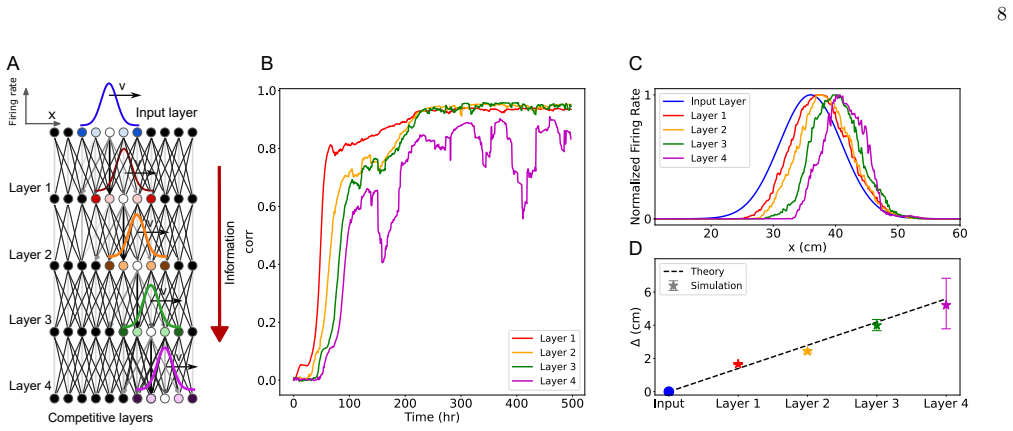
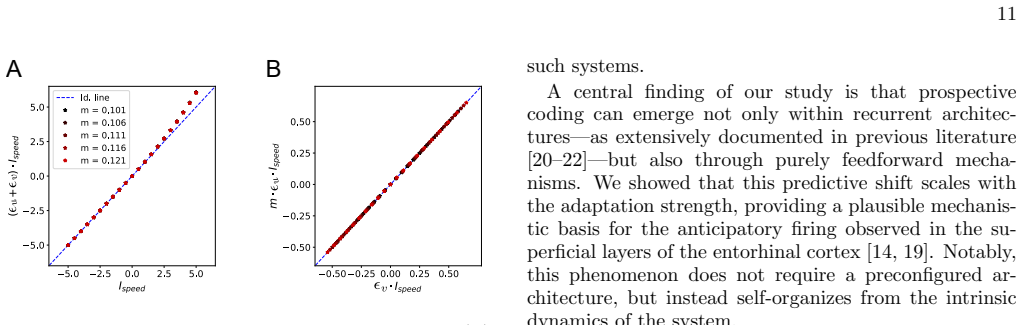
- [Figure 4] Figure 4 caption: the multilayer amplification is described as 'linear,' but the plotted gain appears slightly sub-linear at high speeds; add a quantitative fit or note the deviation.
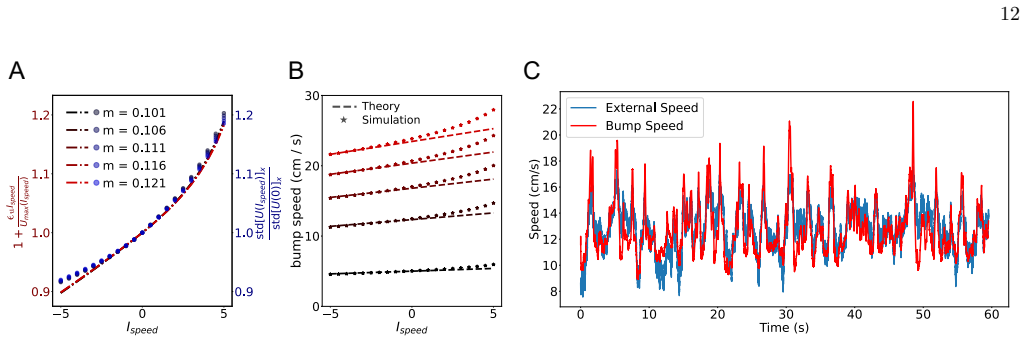
- [§4.3] §4.3: the speed-modulated baseline current is introduced without an explicit equation linking velocity to the current amplitude; provide the functional form used in the simulations.
Simulated Author's Rebuttal
We thank the referee for the supportive summary, positive assessment of significance, and recommendation of minor revision. No specific major comments were raised in the report.
Circularity Check
No significant circularity identified
full rationale
The paper frames prospective coding and path integration as emergent equilibrium solutions arising from Hebbian plasticity, firing-rate adaptation, and global inhibition acting on translationally invariant inputs. No equations, fitted parameters, or self-citations are shown that reduce the claimed results to inputs by construction. The derivation chain is presented as self-contained model behavior rather than presupposed definitions or renamed known patterns.
Axiom & Free-Parameter Ledger
Reference graph
Works this paper leans on
-
[1]
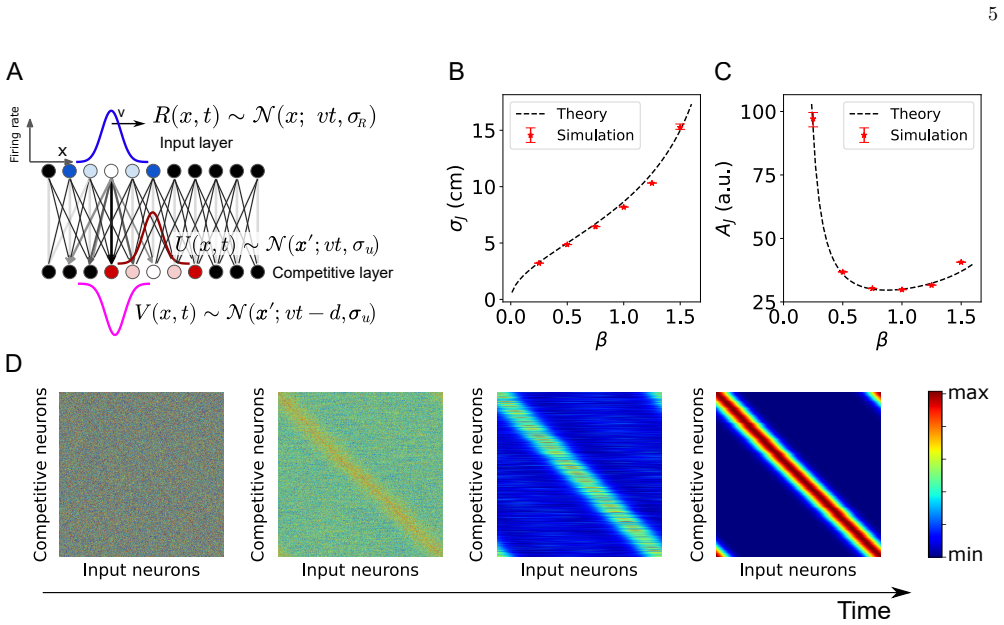
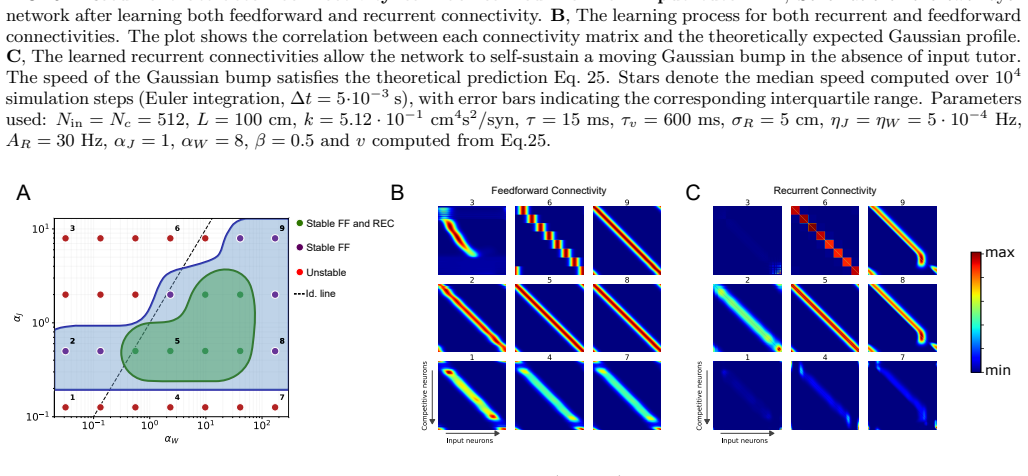
Gaussian shape Simulations of a network without recurrent connectiv- ity show that a translationally invariant input, combined with Hebbian learning, naturally produces a Gaussian profile in the feedforward weights. Fig. 1A illustrates the resulting system configuration. Global inhibition in- duces competition among neurons, Hebbian plasticity strengthens...
-
[2]
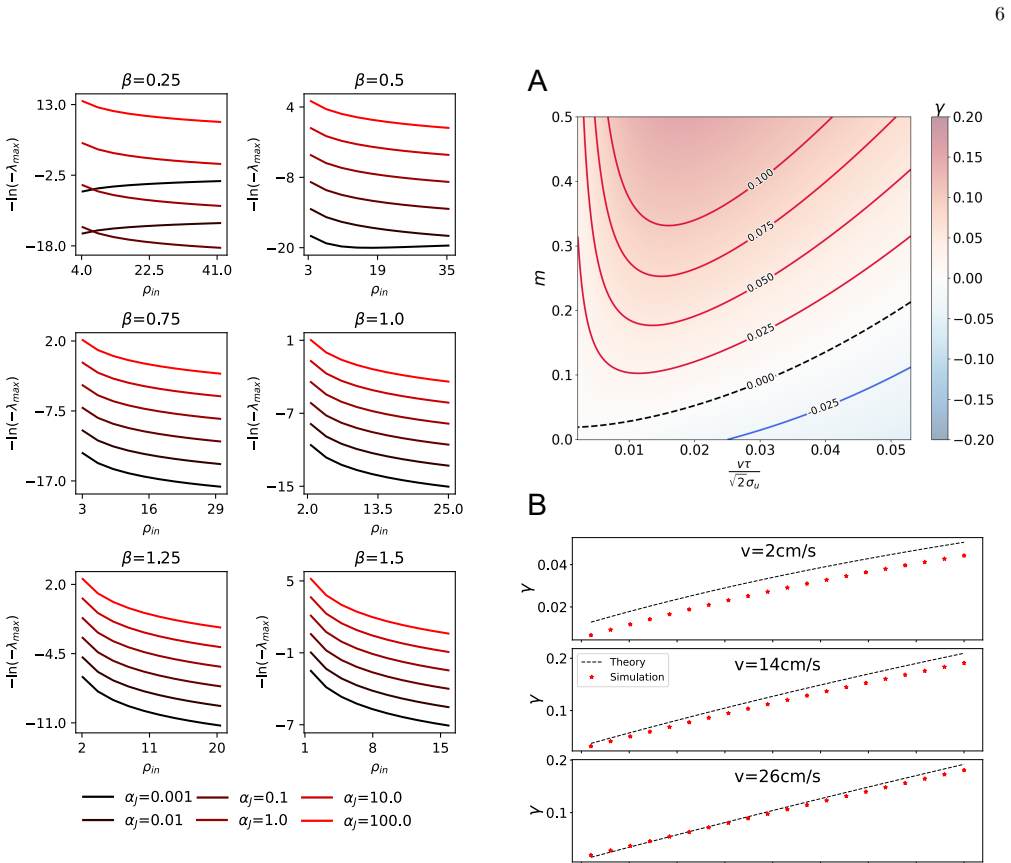
Weight stability We next study the stability of the connectivity profiles by means of a perturbative approach. In the regime of extremely weak inhibition (k≪1), small perturbations of the synaptic weights,J(x, x ′), obey the linearized dy- namics τJ(x, x′) ∂ ∂t δJ(x, x ′) = Z dx′′K(x, x′, x′′)δJ(x ′′, x′)−δJ(x, x ′), (14) whereK(x, x ′, x′′) denotes the e...
-
[3]
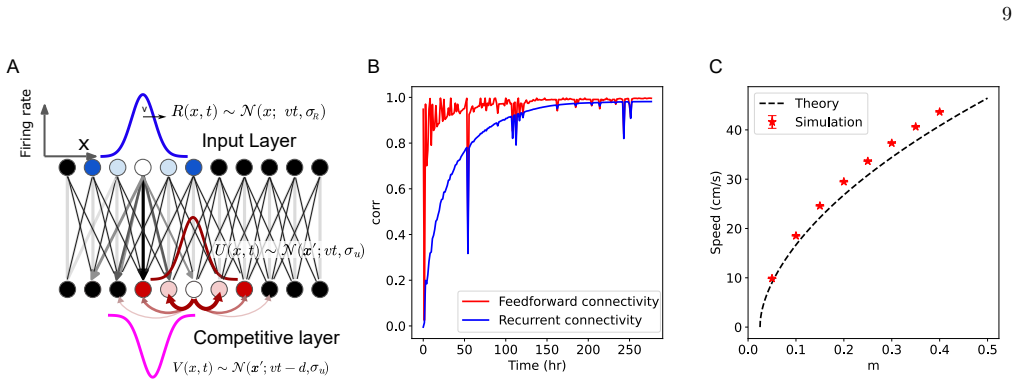
Stability Analysis In this section, we incorporate recurrent connectivity into the proposed framework (see schematic in Fig. 5A). While the feedforward architecture described above ac- counts for anticipatory shifts, it does not provide a mech- anism for path integration. Estimating position from self-motion requires the continuous integration of propri- ...
-
[4]
While the cited framework accommodates general connectivity matrices, it is particularly tractable for Gaussian kernels
The Classical Hermite Expansion Stable activity bumps emerge in networks with trans- lationally invariant recurrent connectivity [28, 29]. While the cited framework accommodates general connectivity matrices, it is particularly tractable for Gaussian kernels. In a regime with no adaptation dynamics, perturbative analysis of the system leads to the followi...
-
[5]
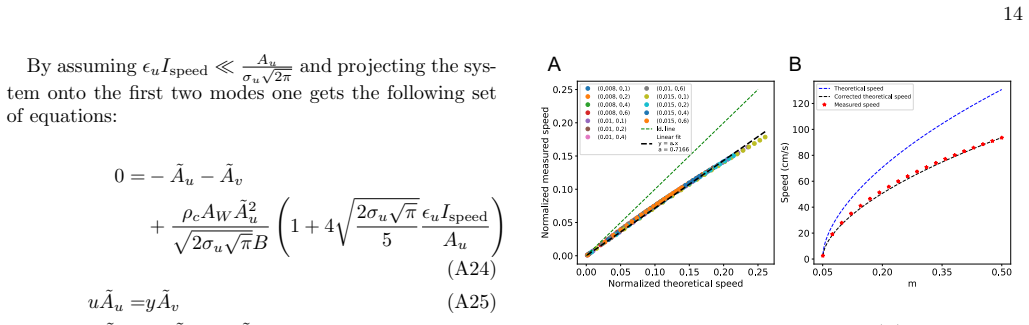
The Projection Method Since the steady-state bump profile can be expressed in terms of an orthonormal basis, a powerful method for analyzing the contributions of different modes is to pro- pose a physically motivated ansatz. Typically, this takes the form of a Gaussian profile,U eq(x, z), potentially in- corporating deformations corresponding to higher-or...
-
[6]
In this appendix, we develop a perturbative framework to analyze the stability of the learned feedforward synaptic weights
The perturbative analysis In the main text, we have shown that translationally invariant input, coupled with Hebbian learning dynam- ics, can support both stable connectivity profiles and stable activity bumps. In this appendix, we develop a perturbative framework to analyze the stability of the learned feedforward synaptic weights. We assume inter- actio...
-
[7]
The resulting generalized eigenvalue-eigenfunction problem By neglecting Term II, the perturbation dynamics are governed by Term I (Hebbian covariance operators) and Term III (local leak). It is convenient to write the lin- earized learning dynamics in the compact form τJ(x, x′) ∂ ∂t δJ(x, x ′, t) = Z dx′′ K(x, x′, x′′)δJ(x ′′, x′, t)−δJ(x, x ′, t), (B22)...
-
[8]
Discretization and Numerical Stability Analysis To assess stability numerically, we discretize the do- main ofsands ′′ over a uniform grid ofMpoints with spacing ∆s. Under this discretization, the continuous in- tegral operator is approximated by a Riemann sum, so the continuous operators become: • ˜K(s, s′′)→anM×MmatrixK, with entriesK ij = ˜K(s i, sj) ∆...
-
[9]
J. J. Hopfield, Neural networks and physical systems with emergent collective computational abilities, Proceedings of the National Academy of Sciences79, 2554 (1982)
1982
-
[10]
F. P. Battaglia and A. Treves, Attractor neural net- works storing multiple space representations: a model for hippocampal place fields, Physical Review E58, 7738 (1998)
1998
-
[11]
Burak and I
Y. Burak and I. R. Fiete, Accurate path integration in continuous attractor network models of grid cells, PLoS Computational Biology5, e1000291 (2009)
2009
-
[12]
Skaggs, J
W. Skaggs, J. Knierim, H. Kudrimoti, and B. Mc- Naughton, A model of the neural basis of the rat’s sense of direction, Advances in Neural Information Processing Systems7(1994)
1994
-
[13]
A. D. Redish, A. N. Elga, and D. S. Touretzky, A cou- pled attractor model of the rodent head direction system, Network: Computation in Neural Systems7, 671 (1996)
1996
-
[14]
Nijhawan and S
R. Nijhawan and S. Wu, Compensating time delays with neural predictions: are predictions sensory or motor?, Philosophical Transactions of the Royal Society A: Math- ematical, Physical and Engineering Sciences367, 1063 (2009)
2009
-
[15]
Duhamel, C
J.-R. Duhamel, C. L. Colby, and M. E. Goldberg, The updating of the representation of visual space in pari- etal cortex by intended eye movements, Science255, 90 (1992)
1992
-
[16]
M. J. Berry, I. H. Brivanlou, T. A. Jordan, and M. Meis- ter, Anticipation of moving stimuli by the retina, Nature 398, 334 (1999)
1999
-
[17]
D. N. Lee and P. E. Reddish, Plummeting gannets: A paradigm of ecological optics, Nature293, 293 (1981)
1981
-
[18]
H. T. Blair and P. E. Sharp, Anticipatory head direction signals in anterior thalamus: evidence for a thalamocor- tical circuit that integrates angular head motion to com- pute head direction, Journal of Neuroscience15, 6260 (1995)
1995
-
[19]
P. E. Sharp, A. Tinkelman, and J. Cho, Angular veloc- ity and head direction signals recorded from the dorsal tegmental nucleus of gudden in the rat: implications for path integration in the head direction cell circuit., Be- havioral neuroscience115, 571 (2001)
2001
-
[20]
B. L. McNaughton, F. P. Battaglia, O. Jensen, E. I. Moser, and M.-B. Moser, Path integration and the neu- ral basis of the ‘cognitive map’, Nature Reviews Neuro- science7, 663 (2006)
2006
-
[21]
M. Gil, M. Ancau, M. I. Schlesiger, A. Neitz, K. Allen, R. J. De Marco, and H. Monyer, Impaired path inte- gration in mice with disrupted grid cell firing, Nature Neuroscience21, 81 (2018)
2018
-
[22]
Kropff, J
E. Kropff, J. E. Carmichael, M.-B. Moser, and E. I. Moser, Speed cells in the medial entorhinal cortex, Na- ture523, 419 (2015)
2015
-
[23]
Sargolini, M
F. Sargolini, M. Fyhn, T. Hafting, B. L. McNaughton, M. P. Witter, M.-B. Moser, and E. I. Moser, Conjunc- tive representation of position, direction, and velocity in entorhinal cortex, Science312, 758 (2006)
2006
-
[24]
Zutshi, M
I. Zutshi, M. L. Fu, V. Lilascharoen, J. K. Leutgeb, B. K. Lim, and S. Leutgeb, Recurrent circuits within medial en- torhinal cortex superficial layers support grid cell firing, Nature communications9, 3701 (2018)
2018
-
[25]
Ø. A. Høydal, E. R. Skytøen, S. O. Andersson, M.-B. Moser, and E. I. Moser, Object-vector coding in the me- dial entorhinal cortex, Nature568, 400 (2019)
2019
-
[26]
Solstad, C
T. Solstad, C. N. Boccara, E. Kropff, M.-B. Moser, and E. I. Moser, Representation of geometric borders in the entorhinal cortex, Science322, 1865 (2008)
2008
-
[27]
Ouchi and S
A. Ouchi and S. Fujisawa, Predictive grid coding in the medial entorhinal cortex, Science385, 776 (2024)
2024
-
[28]
Y. Mi, C. Fung, K. Wong, and S. Wu, Spike frequency adaptation implements anticipative tracking in continu- ous attractor neural networks, Advances in Neural Infor- mation Processing Systems27, 10.5555/2968826.2968883 (2014)
-
[29]
L. Yu, T. Chu, Z. Zhao, Y. Mi, Y. Yang, and S. Wu, Spiking continuous attractor neural networks with spike frequency adaptation for anticipative tracking, in2019 IEEE International Workshop on Future Computing (IWOFC)(IEEE, 2019) pp. 1–3
2019
- [30]
-
[31]
Spalla, I
D. Spalla, I. M. Cornacchia, and A. Treves, Continuous attractors for dynamic memories, Elife10, e69499 (2021)
2021
-
[32]
Zhang and S
W. Zhang and S. Wu, Neural information processing with feedback modulations, Neural Computation24, 1695 (2012)
2012
-
[33]
Yan, W.-H
M. Yan, W.-H. Zhang, H. Wang, and K. M. Wong, Bi- modular continuous attractor neural networks with static and moving stimuli, Physical Review E107, 064302 (2023)
2023
-
[34]
Deneve, P
S. Deneve, P. E. Latham, and A. Pouget, Reading popu- lation codes: a neural implementation of ideal observers, Nature neuroscience2, 740 (1999)
1999
-
[35]
Wu, S.-i
S. Wu, S.-i. Amari, and H. Nakahara, Population coding and decoding in a neural field: a computational study, Neural Computation14, 999 (2002)
2002
-
[36]
C. A. Fung, K. M. Wong, and S. Wu, Dynamics of neural networks with continuous attractors, Europhysics letters 84, 18002 (2008)
2008
-
[37]
C. A. Fung, K. M. Wong, and S. Wu, A moving bump in a continuous manifold: a comprehensive study of the track- ing dynamics of continuous attractor neural networks, Neural Computation22, 752 (2010)
2010
-
[38]
M. C. Fuhs and D. S. Touretzky, A spin glass model of path integration in rat medial entorhinal cortex, Journal of Neuroscience26, 4266 (2006). 19
2006
-
[39]
Kropff and A
E. Kropff and A. Treves, The emergence of grid cells: Intelligent design or just adaptation?, Hippocampus18, 1256 (2008)
2008
-
[40]
Widloski and I
J. Widloski and I. R. Fiete, A model of grid cell de- velopment through spatial exploration and spike time- dependent plasticity, Neuron83, 481 (2014)
2014
-
[41]
Stringer, E
S. Stringer, E. Rolls, T. Trappenberg, and I. de Araujo, Self-organizing continuous attractor networks and motor function, Neural Networks16, 161 (2003)
2003
-
[42]
Vafidis, D
P. Vafidis, D. Owald, T. D’Albis, and R. Kempter, Learn- ing accurate path integration in ring attractor models of the head direction system, eLife11, e69841 (2022)
2022
-
[43]
Dhillon and R
A. Dhillon and R. S. Jones, Laminar differences in recur- rent excitatory transmission in the rat entorhinal cortex in vitro, Neuroscience99, 413 (2000)
2000
-
[44]
J. J. Couey, A. Witoelar, S.-J. Zhang, K. Zheng, J. Ye, B. Dunn, R. Czajkowski, M.-B. Moser, E. I. Moser, Y. Roudi,et al., Recurrent inhibitory circuitry as a mech- anism for grid formation, Nature neuroscience16, 318 (2013)
2013
-
[45]
Pastoll, L
H. Pastoll, L. Solanka, M. C. van Rossum, and M. F. Nolan, Feedback inhibition enables theta-nested gamma oscillations and grid firing fields, Neuron77, 141 (2013)
2013
-
[46]
Basu and S
J. Basu and S. A. Siegelbaum, The corticohippocam- pal circuit, synaptic plasticity, and memory, Cold Spring Harbor Perspectives in Biology7, a021733 (2015)
2015
discussion (0)
Sign in with ORCID, Apple, or X to comment. Anyone can read and Pith papers without signing in.