REVIEW 2 major objections 4 minor 299 references
Surviving cold clouds stay atomic without in situ dust growth; only dense enough clouds regrow dust and become molecular winds.
Reviewed by Pith at T0; open to challenge. T0 means a machine referee read the full paper against a public rubric. the ladder, T0–T4 →
T0 review · grok-4.5
2026-07-11 06:20 UTC pith:D54VIXVT
load-bearing objection First self-consistent cloud-crushing suite with dust growth/sputtering + H2 chemistry; growth is required for molecular winds above ~10–30 n_crit, and the qualitative result holds despite resolution limits. the 2 major comments →
Survival is not Enough: Dust Sputtering, Growth, and H₂ Formation in Galactic Winds
The pith
A machine-rendered reading of the paper's core claim, the machinery that carries it, and where it could break.
Core claim
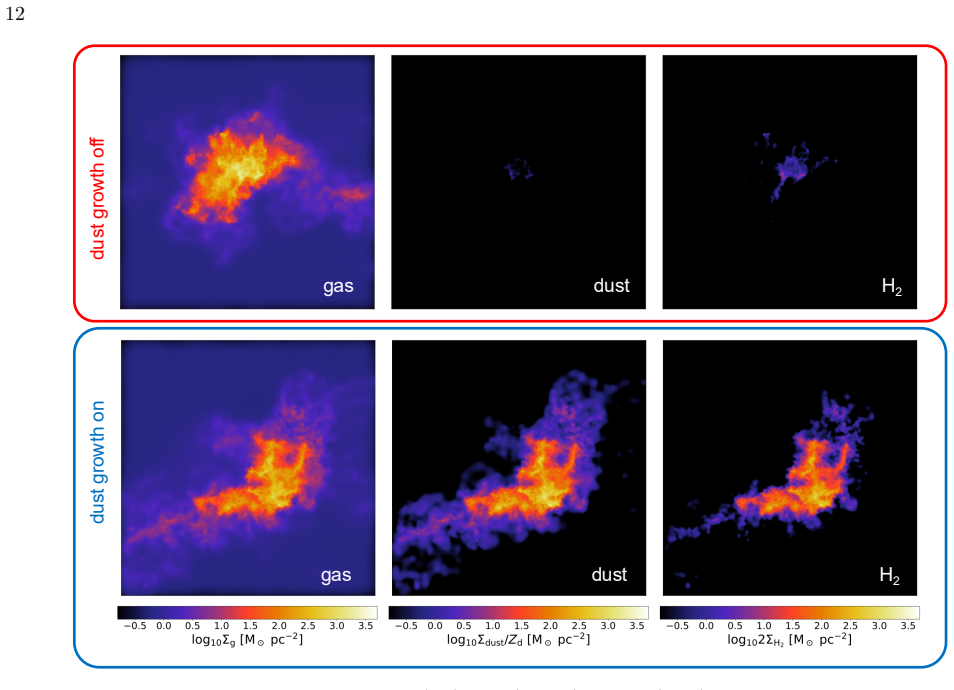
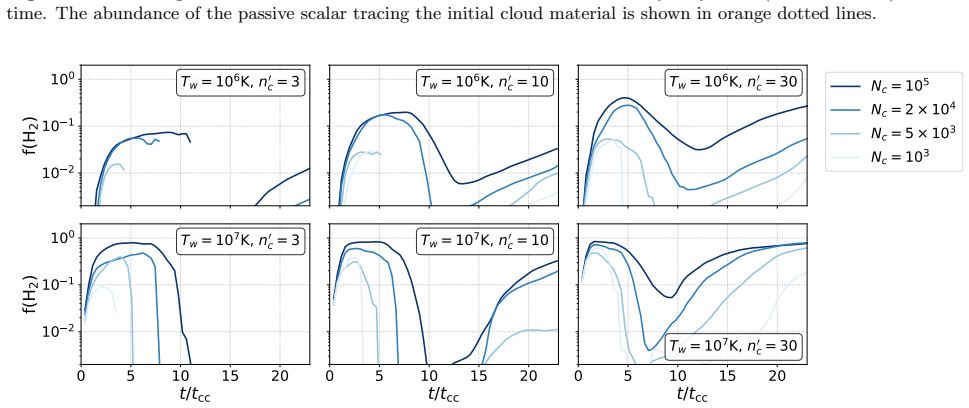
Entrained clouds develop high molecular fractions only when dust growth is enabled and cloud densities are high enough (greater than or equal to 10–30 times the critical density for cloud survival). Without growth the dust-to-gas ratio declines rapidly, suppressing H2 formation and leaving the cloud atomic even when most of the original dust survives.
What carries the argument
Coupled cloud-crushing runs with non-equilibrium chemistry plus dust mass evolution (thermal and nonthermal sputtering plus growth on an MRN grain distribution) that let the local dust-to-gas ratio control both H2 formation rates and shielding.
Load-bearing premise
The fixed grain-size distribution and the simple temperature switch for sticking (growth only below 300 K) fully set the race between growth and sputtering; a different size evolution or sticking law would move the density threshold for molecular winds.
What would settle it
Map dust-to-gas ratio and H2 fraction along multiphase galactic winds as a function of cloud density (or column) and wind temperature; molecular high-velocity gas should appear only where densities exceed roughly ten to thirty times the survival threshold and only if dust has re-grown.
Editorial analysis
A structured set of objections, weighed in public.
Referee Report
Summary. The paper presents the first cloud-crushing simulations that couple non-equilibrium cooling and chemistry with dust growth and sputtering. Surviving clouds (n'_c > 1) develop a two-phase structure (cold ~30 K core + warm ~10^4 K envelope). Dust initially in the cloud largely survives thermal sputtering in 10^6 K winds but is depleted in the mixing layer for 10^7 K winds; nonthermal sputtering is subdominant. Without dust growth the cloud DGR is rapidly diluted (or further sputtered), suppressing H2 formation so that entrained clouds remain atomic. High molecular fractions appear only when growth is enabled and n'_c ≳ 10–30. The authors conclude that in-situ dust growth is required to explain both CGM dust abundances and molecular gas in galactic winds.
Significance. If the central claim holds, the work supplies a concrete, observationally testable requirement (sufficiently dense clouds plus dust growth) that links multiphase wind survival to the presence of high-velocity H2 and halo dust. The systematic model suite (fiducial vs growth-off vs constant-DGR; two wind temperatures; density sequence) and the analytic growth-time estimates in §3.3.2 make the necessity of growth falsifiable rather than merely qualitative. The result also sharpens the distinction between “born-comoving” and “efficiently entrained” scenarios for molecular outflows. The paper already flags its main numerical limitation (Appendix B) and shows that higher resolution would strengthen rather than reverse the growth requirement, which is a methodological strength.
major comments (2)
- Appendix B and Figs. 15–16: DGR and f(H2) remain unconverged at Nc = 10^5 because the cold core is under-resolved. While the authors correctly note that the reported values are lower limits (so the necessity of growth is robust), the quantitative density threshold n'_c ≳ 10–30 that appears in the abstract and §5 is resolution-dependent. A short additional paragraph quantifying how the threshold is expected to shift (or an explicit statement that only the qualitative necessity of growth is claimed) is needed before the numerical values can be used as observational diagnostics.
- §2.1, Eqs. (2)–(4): The competition between growth and sputtering is controlled by a fixed MRN a_eff = 0.035 µm and a step-function sticking coefficient α_s = 1 only for T < 300 K. No sensitivity suite is presented. Because the analytic t_grow/t_cc estimates in §3.3.2 scale linearly with a_eff and inversely with α_s, a factor-of-three change in either parameter moves the molecular-wind threshold by the same factor. A brief exploration (or a clear statement that the quoted thresholds are specific to this microphysical choice) is required for the claim to be load-bearing.
minor comments (4)
- Fig. 2 caption and text: “bottomn panel” is a typo; also “T able 1” appears with a stray space.
- Eq. (A1) and Appendix A: The empirical NH–n relation is useful, but a one-sentence comparison of the resulting shielding factors against a TreeCol post-processing of a single snapshot would strengthen confidence that the approximation does not bias the late-time H2 fractions.
- §4.2: The claim of a “step-like” molecular velocity profile is interesting; a short note on how clump-size variations or continuous mass loading would smooth the feature would help observers.
- Table 1: The final column (“fate of cloud”) is useful; adding the final Mc/Mc,0 and f(H2) for the fiducial runs would make the table self-contained.
Circularity Check
No significant circularity: central claims emerge from controlled hydro+chemistry simulations comparing dust models, not from definitional tautologies or load-bearing self-fits.
full rationale
The paper's derivation chain is a suite of cloud-crushing runs (Gizmo MFM + Glover non-equilibrium network + Hu dust evolution) that systematically toggle thermal/nonthermal sputtering and growth (Table 2) while holding rates fixed to external literature (Nozawa sputtering, Zhukovska sticking, MRN a_eff). Survival criterion n_crit (Eq. 7) and t_cc (Eq. 6) are taken from prior independent work and merely confirmed; the key result—that high f(H2) appears only with growth at n'_c ≳ 10–30—follows from direct comparison of DGR and f(H2) time series (Figs. 6, 11) against passive-scalar dilution and constant-DGR controls. Analytic t_grow estimates (§3.3.2) are post-hoc interpretations of measured cold-gas densities, not inputs that force the outcome. The Appendix A NH–n fit is an empirical shielding approximation calibrated on the same runs but is not load-bearing for the dust-growth necessity claim; resolution tests (Appendix B) explicitly flag DGR/f(H2) as lower limits, reinforcing rather than circularly assuming the conclusion. No parameter is fitted to molecular-wind data and then re-predicted; no uniqueness theorem or ansatz is imported solely via overlapping-author citation to forbid alternatives. The work is therefore self-contained against its own simulation diagnostics.
Axiom & Free-Parameter Ledger
free parameters (4)
- a_eff (effective grain size) =
0.035 µm
- α_s (sticking coefficient) =
1 (T<300 K)
- G0 (FUV field) =
3.2e-3 (fiducial)
- sub-grid diffusion coefficient =
1
axioms (5)
- domain assumption Cloud survival when cooling time in mixing layer < t_cc (Gronke & Oh 2018 criterion, Eq. 7)
- domain assumption Thermal + nonthermal sputtering rates from Nozawa et al. (2006); growth timescale from physical collision rate
- ad hoc to paper Empirical NH–n shielding relation (Eq. A1) replaces TreeCol/Sobolev
- domain assumption No magnetic fields, self-gravity, thermal conduction or viscosity
- domain assumption Fixed non-evolving MRN grain-size distribution
read the original abstract
A substantial amount of dust is found in galactic halos extending far beyond the disks, the origin of which remains an open question. Closely linked and equally puzzling is the detection of molecular gas in high-velocity galactic winds. To address this, we present the first cloud-crushing simulations that self-consistently include non-equilibrium cooling and chemistry with dust growth and sputtering. We find that surviving clouds naturally develop a two-phase structure, with a cold ($\sim 30$ K), dense core embedded in a warm ($\sim 10^4$ K), diffuse envelope. However, the presence of a cold phase does not always lead to molecular winds. While dust initially in the cloud largely survives in $10^6$ K winds, it is severely depleted by sputtering in hotter winds ($\gtrsim 10^7$ K). Importantly, without dust growth, the dust-to-gas ratio (DGR) of the cloud declines rapidly, suppressing the formation of molecular hydrogen (H$_2$) and keeping the entrained cloud atomic, even in cases where the majority of the initial dust survives. Nonthermal sputtering plays a subdominant role in all cases. The entrained clouds develop high molecular fractions only when dust growth is enabled, provided the cloud densities are sufficiently high ($\gtrsim$ 10 - 30 times the critical density for cloud survival). Our results suggest that "in situ" dust growth is essential to explain both the observed abundance of halo dust and the molecular gas in galactic winds.
Figures




Reference graph
Works this paper leans on
-
[1]
Woven by the Whirls: The growth and entrainment of cold clouds in turbulent hot winds. , keywords =. doi:10.1093/mnras/stag1018 , archivePrefix =. 2510.03552 , primaryClass =
-
[2]
Massive molecular outflows and evidence for AGN feedback from CO observations. , keywords =. doi:10.1051/0004-6361/201322464 , archivePrefix =. 1311.2595 , primaryClass =
-
[3]
Wind from a starburst galaxy nucleus. , keywords =. doi:10.1038/317044a0 , adsurl =
-
[4]
Radiative Mixing Layers: Insights from Turbulent Combustion
Radiative mixing layers: insights from turbulent combustion. , keywords =. doi:10.1093/mnras/stab053 , archivePrefix =. 2008.12302 , primaryClass =
work page internal anchor Pith review Pith/arXiv arXiv doi:10.1093/mnras/stab053 2008
-
[5]
Living Reviews in Computational Astrophysics , keywords =
Simulations of multi-phase gas in and around galaxies. Living Reviews in Computational Astrophysics , keywords =. doi:10.1007/s41115-026-00025-7 , archivePrefix =. 2601.16566 , primaryClass =
-
[6]
Fading in the flow: suppression of cold gas growth in expanding galactic outflows. , keywords =. doi:10.1093/mnras/staf1845 , archivePrefix =. 2506.08545 , primaryClass =
-
[7]
, keywords =
Turbulent mixing layers in the interstellar and intracluster medium. , keywords =
-
[8]
It's Cloud's Illusions I Recall: Mixing Drives the Acceleration of Clouds from Ram Pressure Stripped Galaxies. , keywords =. doi:10.3847/1538-4357/abe7e2 , archivePrefix =. 2102.05061 , primaryClass =
work page internal anchor Pith review Pith/arXiv arXiv doi:10.3847/1538-4357/abe7e2
-
[9]
A Model for Line Absorption and Emission from Turbulent Mixing Layers
A model for line absorption and emission from turbulent mixing layers. , keywords =. doi:10.1093/mnrasl/slab100 , archivePrefix =. 2105.11496 , primaryClass =
work page internal anchor Pith review Pith/arXiv arXiv doi:10.1093/mnrasl/slab100
-
[10]
Universal Structure of Turbulent Radiative Mixing Layers. arXiv e-prints , keywords =. doi:10.48550/arXiv.2509.03802 , archivePrefix =. 2509.03802 , primaryClass =
-
[11]
The Launching of Cold Clouds by Galaxy Outflows I: Hydrodynamic Interactions with Radiative Cooling
Scannapieco, Evan and Br. The Astrophysical Journal , volume =. doi:10.1088/0004-637X/805/2/158 , archiveprefix =. 1503.06800 , pages =
work page internal anchor Pith review Pith/arXiv arXiv doi:10.1088/0004-637x/805/2/158
-
[12]
Hydrodynamical Coupling of Mass and Momentum in Multiphase Galactic Winds
Schneider, Evan E and Robertson, Brant E , year = 2017, month = jan, journal =. doi:10.3847/1538-4357/834/2/144 , archiveprefix =. 1607.01788 , pages =
work page internal anchor Pith review Pith/arXiv arXiv doi:10.3847/1538-4357/834/2/144 2017
-
[13]
Rupke, David , year = 2018, month = dec, journal =. A. doi:10.3390/galaxies6040138 , urldate =. arXiv , keywords =:1812.05184v1 , pages =
work page internal anchor Pith review Pith/arXiv arXiv doi:10.3390/galaxies6040138 2018
-
[14]
Monthly Notices of the Royal Astronomical Society , volume =
Entrainment in Trouble: Cool Cloud Acceleration and Destruction in Hot Supernova-Driven Galactic Winds , author =. Monthly Notices of the Royal Astronomical Society , volume =. doi:10.1093/mnras/stx822 , archiveprefix =. 1507.01951 , pages =
-
[15]
The Astrophysical Journal , volume =
Cooling Gas Outflows from Galaxies , author =. The Astrophysical Journal , volume =. doi:10.1086/175633 , keywords =
-
[16]
An Origin for Multi-Phase Gas in Galactic Winds and Halos
An Origin for Multiphase Gas in Galactic Winds and Haloes , author =. Monthly Notices of the Royal Astronomical Society , volume =. doi:10.1093/mnras/stv2428 , archiveprefix =. 1507.04362 , pages =
work page internal anchor Pith review Pith/arXiv arXiv doi:10.1093/mnras/stv2428
-
[17]
Monthly Notices of the Royal Astronomical Society , volume =
On the Survival of Cool Clouds in the Circumgalactic Medium , author =. Monthly Notices of the Royal Astronomical Society , volume =. doi:10.1093/mnras/stz3567 , urldate =
-
[18]
Leaman, Ryan and Fragkoudi, Francesca and Querejeta, Miguel and Leung, Gigi Y. C. and Gadotti, Dimitri A. and Husemann, Bernd and. Survival of Molecular Gas in a Stellar Feedback-Driven Outflow Witnessed with the. arXiv , keywords =:1907.13142 , pages =
Pith/arXiv arXiv 1907
-
[19]
Dense Molecular Gas Tracers in the Outflow of the Starburst Galaxy NGC 253
Walter, Fabian and Bolatto, Alberto D. and Leroy, Adam K. and Veilleux, Sylvain and Warren, Steven R. and Hodge, Jacqueline and Levy, Rebecca C. and Meier, David S. and Ostriker, Eve C. and Ott, Juergen and Rosolowsky, Erik and Scoville, Nick and Weiss, Axel and Zschaechner, Laura and Zwaan, Martin , year = 2017, month = feb, journal =. Dense. doi:10.3847...
work page internal anchor Pith review Pith/arXiv arXiv doi:10.3847/1538-4357/835/2/265 2017
-
[20]
Monthly Notices of the Royal Astronomical Society , volume =
Survival and Mass Growth of Cold Gas in a Turbulent, Multiphase Medium , author =. Monthly Notices of the Royal Astronomical Society , volume =. doi:10.1093/mnras/stab3351 , urldate =
-
[21]
Monthly Notices of the Royal Astronomical Society , volume =
Thermal Instability and the Feedback Regulation of Hot Haloes in Clusters, Groups and Galaxies , author =. Monthly Notices of the Royal Astronomical Society , volume =. doi:10.1111/j.1365-2966.2011.20246.x , keywords =
-
[22]
Baryon Cycles in the Biggest Galaxies , author =. Physics Reports , volume =. doi:10.1016/j.physrep.2022.04.005 , urldate =
-
[23]
Monthly Notices of the Royal Astronomical Society , volume =
The Launching of Galactic Winds from a Multiphase. Monthly Notices of the Royal Astronomical Society , volume =. doi:10.1093/mnras/stag539 , urldate =
-
[24]
Shock-Multicloud Interactions in Galactic Outflows --. 2011.05240 , archiveprefix =
Pith/arXiv arXiv 2011
-
[25]
Schneider, Evan E. and Ostriker, Eve C. and Robertson, Brant E. and Thompson, Todd A. , year = 2020, month = may, journal =. The. doi:10.3847/1538-4357/ab8ae8 , urldate =
-
[26]
and Kim, Chang-Goo and Bryan, Greg L
Steinwandel, Ulrich P. and Kim, Chang-Goo and Bryan, Greg L. and Ostriker, Eve C. and Somerville, Rachel S. and Fielding, Drummond B. , year = 2024, month = jan, journal =. The. doi:10.3847/1538-4357/ad09e1 , urldate =
-
[27]
Astronomy & Astrophysics , volume =
The (Limited) Effect of Viscosity in Multiphase Turbulent Mixing , author =. Astronomy & Astrophysics , volume =. doi:10.1051/0004-6361/202555233 , urldate =
-
[28]
The Astrophysical Journal , volume =
Br. The Astrophysical Journal , volume =. doi:10.3847/0004-637X/822/1/31 , keywords =
-
[29]
Br. The. arXiv , langid =:2304.09881 , primaryclass =
-
[30]
JWST Observations of Starbursts: Cold Clouds and Plumes Launching in the M82 Outflow
JWST observations of starbursts: cold clouds and plumes launching in the M 82 outflow. , keywords =. doi:10.1093/mnras/staf363 , archivePrefix =. 2405.03686 , primaryClass =
work page internal anchor Pith review Pith/arXiv arXiv doi:10.1093/mnras/staf363
-
[31]
Thermal instability in gravitationally stratified plasmas: implications for multiphase structure in clusters and galaxy haloes. , keywords =. doi:10.1111/j.1365-2966.2011.19972.x , archivePrefix =. 1105.2563 , primaryClass =
-
[32]
JWST Discovery of Warm Dust in the Circumgalactic Medium of the Makani Galaxy
JWST Discovery of Warm Dust in the Circumgalactic Medium of the Makani Galaxy. , keywords =. doi:10.3847/1538-4357/adee91 , archivePrefix =. 2507.08098 , primaryClass =
work page internal anchor Pith review Pith/arXiv arXiv doi:10.3847/1538-4357/adee91
-
[33]
JWST Observations of Starbursts: PAHs Closely Trace the Cool Phase of M82's Galactic Wind. arXiv e-prints , keywords =. doi:10.48550/arXiv.2510.01314 , archivePrefix =. 2510.01314 , primaryClass =
-
[34]
JWST Observations of Starbursts: Polycyclic Aromatic Hydrocarbon Emission at the Base of the M82 Galactic Wind. , keywords =. doi:10.3847/1538-4357/ad33c8 , archivePrefix =. 2401.16648 , primaryClass =
work page internal anchor Pith review Pith/arXiv arXiv doi:10.3847/1538-4357/ad33c8
-
[35]
Cosmic Dust in Mg II Absorbers. , keywords =. doi:10.1088/0004-637X/754/2/116 , archivePrefix =. 1204.1978 , primaryClass =
-
[36]
Key Physical Processes in the Circumgalactic Medium. , keywords =. doi:10.1146/annurev-astro-052920-125203 , archivePrefix =. 2301.10253 , primaryClass =
-
[37]
AGN feedback in a galaxy merger: multi-phase, galaxy-scale outflows with a fast molecular gas blob 6 kpc away from IRAS F08572+3915. , keywords =. doi:10.1051/0004-6361/201936434 , archivePrefix =. 1911.06326 , primaryClass =
work page internal anchor Pith review Pith/arXiv arXiv doi:10.1051/0004-6361/201936434 1911
-
[38]
Direct Evidence for AGN Feedback from Fast Molecular Outflows in Reionization-Era Quasars
Direct Evidence for Active Galactic Nuclei Feedback from Fast Molecular Outflows in Reionization-era Quasars. , keywords =. doi:10.3847/1538-4357/adb750 , archivePrefix =. 2502.05283 , primaryClass =
work page internal anchor Pith review Pith/arXiv arXiv doi:10.3847/1538-4357/adb750
-
[39]
Spatially Resolved ^ 12 CO(2-1)/ ^ 12 CO(1-0) in the Starburst Galaxy NGC 253: Assessing Optical Depth to Constrain the Molecular Mass Outflow Rate. , keywords =. doi:10.3847/1538-4357/aadf32 , archivePrefix =. 1809.01160 , primaryClass =
work page internal anchor Pith review Pith/arXiv arXiv doi:10.3847/1538-4357/aadf32
-
[40]
Dense Gas Properties and Star Formation in M82. , keywords =. doi:10.3847/1538-4357/ae0038 , archivePrefix =. 2509.11770 , primaryClass =
-
[41]
NOEMA High Fidelity Imaging of the Molecular Gas in and around M82
NOEMA High-fidelity Imaging of the Molecular Gas in and around M82. , keywords =. doi:10.3847/2041-8213/ac01e9 , archivePrefix =. 2105.07440 , primaryClass =
work page internal anchor Pith review Pith/arXiv arXiv doi:10.3847/2041-8213/ac01e9 2041
-
[42]
The Multi-phase Cold Fountain in M82 Revealed by a Wide, Sensitive Map of the Molecular Interstellar Medium. , keywords =. doi:10.1088/0004-637X/814/2/83 , archivePrefix =. 1509.02932 , primaryClass =
-
[43]
The Nature of Starburst Activity in M82
The Nature of Starburst Activity in M82. , keywords =. doi:10.1086/379097 , archivePrefix =. astro-ph/0309357 , primaryClass =
work page internal anchor Pith review Pith/arXiv arXiv doi:10.1086/379097
-
[44]
ALMA observations of feeding and feedback in nearby Seyfert galaxies: an AGN-driven outflow in NGC 1433. , keywords =. doi:10.1051/0004-6361/201322288 , archivePrefix =. 1309.7486 , primaryClass =
-
[45]
Massive Molecular Outflows and Negative Feedback in ULIRGs Observed by Herschel-PACS. , keywords =. doi:10.1088/2041-8205/733/1/L16 , archivePrefix =. 1105.1731 , primaryClass =
-
[46]
Molecular outflows in local galaxies: Method comparison and a role of intermittent AGN driving. , keywords =. doi:10.1051/0004-6361/201936803 , archivePrefix =. 1911.05608 , primaryClass =
-
[47]
Cool outflows in galaxies and their implications. , keywords =. doi:10.1007/s00159-019-0121-9 , archivePrefix =. 2002.07765 , primaryClass =
-
[48]
Star Formation in the Milky Way and Nearby Galaxies. , keywords =. doi:10.1146/annurev-astro-081811-125610 , archivePrefix =. 1204.3552 , primaryClass =
-
[49]
On the Formation of Molecular Clumps in QSO Outflows. , keywords =. doi:10.3847/1538-4357/833/1/46 , archivePrefix =. 1609.02561 , primaryClass =
-
[50]
Ubiquitous cold and massive filaments in cool core clusters
Ubiquitous cold and massive filaments in cool core clusters. , keywords =. doi:10.1051/0004-6361/201935350 , archivePrefix =. 1902.09164 , primaryClass =
work page internal anchor Pith review Pith/arXiv arXiv doi:10.1051/0004-6361/201935350 1902
-
[51]
Cold molecular gas in the Perseus cluster core. Association with X-ray cavity, H filaments and cooling flow. , keywords =. doi:10.1051/0004-6361:20054745 , archivePrefix =. astro-ph/0603350 , primaryClass =
work page internal anchor Pith review Pith/arXiv arXiv doi:10.1051/0004-6361:20054745
-
[52]
Polycyclic Aromatic Hydrocarbons, Ionized Gas, and Molecular Hydrogen in Brightest Cluster Galaxies of Cool-core Clusters of Galaxies. , keywords =. doi:10.1088/0004-637X/732/1/40 , archivePrefix =. 1103.1410 , primaryClass =
work page internal anchor Pith review Pith/arXiv arXiv doi:10.1088/0004-637x/732/1/40
-
[53]
ALMA observations of massive molecular gas filaments encasing radio bubbles in the Phoenix cluster
Alma Observations of Massive Molecular Gas Filaments Encasing Radio Bubbles in the Phoenix Cluster. , keywords =. doi:10.3847/1538-4357/836/1/130 , archivePrefix =. 1611.00017 , primaryClass =
work page internal anchor Pith review Pith/arXiv arXiv doi:10.3847/1538-4357/836/1/130
-
[54]
Close entrainment of massive molecular gas flows by radio bubbles in the central galaxy of Abell 1795. , keywords =. doi:10.1093/mnras/stx2255 , archivePrefix =. 1708.08935 , primaryClass =
-
[55]
Driving massive molecular gas flows in central cluster galaxies with AGN feedback
Driving massive molecular gas flows in central cluster galaxies with AGN feedback. , keywords =. doi:10.1093/mnras/stz2719 , archivePrefix =. 1902.09227 , primaryClass =
work page internal anchor Pith review Pith/arXiv arXiv doi:10.1093/mnras/stz2719 1902
-
[56]
Dusty Winds: Extraplanar Polycyclic Aromatic Hydrocarbon Features of Nearby Galaxies. , keywords =. doi:10.1088/0004-637X/774/2/126 , adsurl =
-
[57]
Exploring the Dust Content of Galactic Winds With Herschel. II. Nearby Dwarf Galaxies
Exploring the dust content of galactic winds with Herschel - II. Nearby dwarf galaxies. , keywords =. doi:10.1093/mnras/sty634 , archivePrefix =. 1803.03269 , primaryClass =
work page internal anchor Pith review Pith/arXiv arXiv doi:10.1093/mnras/sty634
-
[58]
Molecular Outflows in Local ULIRGs: Energetics from Multitransition OH Analysis. , keywords =. doi:10.3847/1538-4357/836/1/11 , archivePrefix =. 1612.08181 , primaryClass =
-
[59]
Quasar feedback revealed by giant molecular outflows. , keywords =. doi:10.1051/0004-6361/201015164 , archivePrefix =. 1006.1655 , primaryClass =
-
[60]
A-priori Validation of Subgrid-scale Models for Astrophysical Turbulence
A Priori Validation of Subgrid-scale Models for Astrophysical Turbulence. , keywords =. doi:10.3847/1538-4357/aba2d5 , archivePrefix =. 2003.13780 , primaryClass =
work page internal anchor Pith review Pith/arXiv arXiv doi:10.3847/1538-4357/aba2d5 2003
-
[61]
Scaling Laws of Passive-Scalar Diffusion in the Interstellar Medium
Scaling laws of passive-scalar diffusion in the interstellar medium. , keywords =. doi:10.1093/mnras/stx261 , archivePrefix =. 1610.06590 , primaryClass =
work page internal anchor Pith review Pith/arXiv arXiv doi:10.1093/mnras/stx261
-
[62]
2011 , month = jun, pages =
Jones, A P and Nuth, J A , journal =. 2011 , month = jun, pages =
2011
-
[63]
Astronomy and Astrophysics , title =
Serra D. Astronomy and Astrophysics , title =. 2008 , month = dec, pages =
2008
-
[64]
2016 , month = nov, number =
Zhukovska, Svitlana and Dobbs, Clare and Jenkins, Edward B and Klessen, Ralf S , journal =. 2016 , month = nov, number =
2016
-
[65]
2018 , month = mar, number =
Micelotta, E R and Matsuura, M and Sarangi, A , journal =. 2018 , month = mar, number =
2018
-
[66]
1972 , pages =
, title =. 1972 , pages =
1972
-
[67]
, title =
Rev.\ Mex.\ Astron.\ Astrofis. , title =. 2013 , month = apr, pages =
2013
-
[68]
, title =. 2008 , month = apr, pages =. arXiv , doi =:0706.0754 , keywords =
Pith/arXiv arXiv 2008
-
[69]
, title =. 2000 , month = jan, pages =. doi:10.1051/aas:2000312 , keywords =
-
[70]
, title =. 2005 , month = nov, pages =. doi:10.1051/0004-6361:20052862 , eprint =
-
[71]
, title =. 2013 , month = dec, pages =. arXiv , doi =:1309.7355 , keywords =
Pith/arXiv arXiv 2013
-
[72]
, title =. 2017 , month = apr, pages =. arXiv , doi =:1610.06569 , keywords =
Pith/arXiv arXiv 2017
-
[73]
, title =. 2017 , month = apr, pages =. arXiv , doi =:1610.02538 , keywords =
Pith/arXiv arXiv 2017
-
[74]
, title =. 2007 , month = sep, pages =. doi:10.1111/j.1365-2966.2007.12183.x , eprint =
-
[75]
, title =. 2013 , month = oct, pages =. arXiv , doi =:1304.1559 , keywords =
Pith/arXiv arXiv 2013
-
[76]
, title =. 1994 , month = jun, pages =. doi:10.1086/174188 , keywords =
doi:10.1086/174188 1994
-
[77]
Journal of Computational Physics , title =. 1995 , pages =. doi:10.1016/S0021-9991(95)90221-X , owner =
-
[78]
, title =. 1986 , month = dec, pages =. doi:10.1038/324446a0 , keywords =
doi:10.1038/324446a0 1986
-
[79]
, title =. 2012 , month = feb, pages =. arXiv , doi =:1110.1092 , keywords =
Pith/arXiv arXiv 2012
-
[80]
, title =. 1995 , month = nov, pages =. doi:10.1093/mnras/277.2.362 , eprint =
discussion (0)
Sign in with ORCID, Apple, or X to comment. Anyone can read and Pith papers without signing in.