REVIEW 4 major objections 4 minor 70 references
Relativistic quantum heat engine from uncertainty relation standpoint
T0 review · 4 major / 4 minor · reviewed 2026-08-14 · deepseek-v4-flash
Pith's one-line read Work and efficiency of a relativistic Stirling engine are bounded by the thermal position–momentum uncertainty relation.
desk verdict The claimed uncertainty-based efficiency bounds for a relativistic quantum heat engine collapse under the paper's own approximations. read the letter →
The pith
A machine-rendered reading of the paper's core claim, the machinery that carries it, and where it could break.
The reading
What carries the argument
The load-bearing object is the thermal sum uncertainty relation for a Klein–Gordon particle in a one-dimensional well of length $2L$: $\Delta X_T+\Delta P_T$, assembled from the thermal variances in Eqs. (11) and (12). The partition function $Z\approx \frac{1}{2}\sqrt{\pi/(\beta\alpha)}e^{-\beta mc^2}$ with $\alpha=\pi^2\hbar^2/[2m(2L)^2]$ converts the level-dependent position and momentum spreads into temperature-dependent ones, and Eq. (14) gives the lower bound $\Delta X_T+\Delta P_T\ge \hbar/2$. The reverse uncertainty inequality (20), obtained by squaring the Dunkl–Williams inequality, supplies the upper bound (22). The Stirling cycle then enters through two isothermal barrier manipulations at temperatures $T_1$ and $T_2$; the efficiency formula (30) combines the two uncertainty sums $f(\Delta X_{T_1}+\Delta P_{T_1})$ and $g(\Delta X_{T_2}+\Delta P_{T_2})$ with the partition-function logarithms $\ln(Z_B/Z_A)$ and $\ln(Z_D/Z_C)$, which is how uncertainty bounds are converted into efficiency bounds.
What would settle it
Compute the exact partition-function ratios $Z_B/Z_A$ and $Z_D/Z_C$ for the single-particle box, or keep the next order in $\alpha\beta$; if the ratios approach 1 in the regime where $U_A=U_B$ and $U_C=U_D$, then Eqs. (29) and (30) give $W=0$ and an indeterminate $\eta$, and the claimed efficiency bounds disappear. A numerical check of whether Fig. 5 can be reproduced from Eq. (30) with the stated $\beta$ values and masses would settle the same question.
Extended reading notes
Core claim
The central claim is that for a relativistic particle in a box of width $2L$, the Stirling engine's work and efficiency are determined by the thermal sum uncertainty $\Delta X_T+\Delta P_T$. Starting from the Klein–Gordon solution in the Feshbach–Villars form and the partition function $Z\approx \frac{1}{2}\sqrt{\pi/(\beta\alpha)}e^{-\beta mc^2}$, the paper defines thermal variances from Eqs. (11) and (12) and the sum relation (14). It then inverts this relation to express $Z$, the Helmholtz free energy, the entropy, the total work $W$ of Eq. (29), and the efficiency $\eta$ of Eq. (30) as functions of the uncertainty sums $f$ and $g$ at the two bath temperatures. Because $f$ and $g$ are bounded below by the sum-uncertainty inequality (17) and above by the reverse inequality (20) derived from the Dunkl–Williams inequality, the paper obtains upper and lower bounds on the efficiency. In the authors' words, they are 'able to determine the bounds (the upper and the lower bounds) of the efficiency of the heat engine through the thermal uncertainty relation.'
Load-bearing premise
The load-bearing assumption is that the high-temperature continuous approximation for the partition function can be used to set the internal energies equal on the two isothermal branches while the logarithmic terms $\ln(Z_B/Z_A)$ and $\ln(Z_D/Z_C)$ in Eqs. (25) and (27) remain different from zero; under the same approximation those ratios are one, so the stated work and efficiency would vanish.
Editorial extensions
If this is right
- One can state the efficiency range of this relativistic engine using only $\Delta X_T+\Delta P_T$ at the two bath temperatures; no energy-level measurements or population readouts are needed.
- The upper efficiency bound decreases monotonically as temperature grows, and the lower and upper bounds converge at large uncertainty, so the model predicts that larger quantum spread degrades the conversion of heat into work.
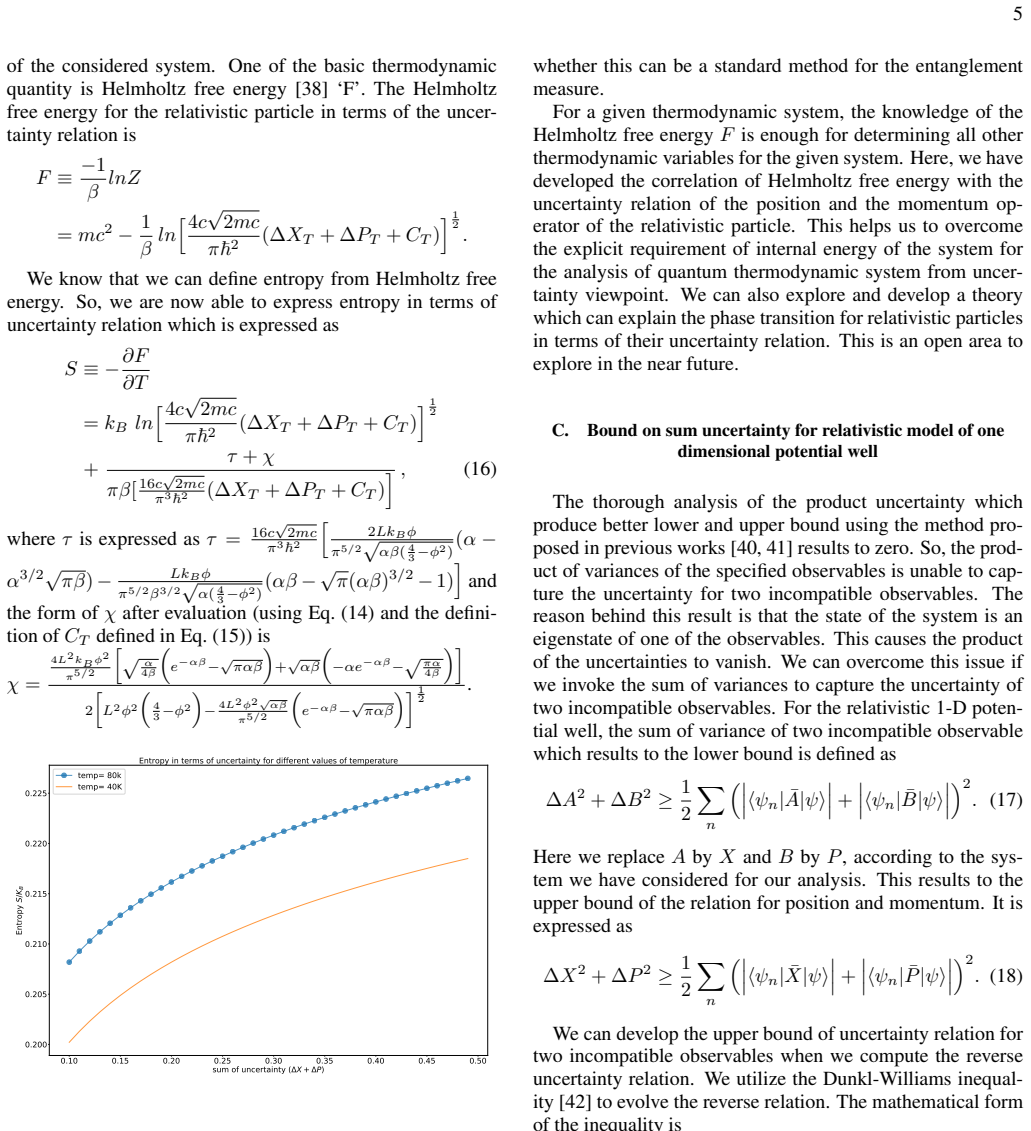
- Helmholtz free energy and entropy become functions of the same uncertainty sum; entropy increases with uncertainty, giving a direct thermodynamic signature of quantum spread.
- The dictionary developed for the box is meant to transfer to other cycles and working substances, including quantum phase transitions and relativistic condensed-matter-inspired engines.
Reading between the lines
- A general recipe is latent in the paper: any working substance whose partition function can be re-expressed through variances of two noncommuting observables will produce efficiency bounds without energy measurements. Testing the recipe on a harmonic oscillator or a two-level system, where partition functions are known exactly, would show whether the box example is special.
- The entropy–uncertainty link suggests a possible route toward an entanglement measure for mixed relativistic states, an open problem the paper points to; verifying it would require a separate bipartite calculation.
- An experiment with a single trapped ion or ultracold atom in a tunable box potential could measure the two variances and compare the measured efficiency band with Eq. (30), giving a direct test of the uncertainty bound.
Signed reviews
Editorial analysis
A structured set of objections, weighed in public.
Referee Report
Summary. The paper proposes a relativistic quantum Stirling engine whose working substance is a particle in a one-dimensional infinite potential well of length 2L, described by the Klein-Gordon equation. The cycle has four stages: isothermal insertion of a central barrier at temperature T1, cooling at fixed width to T2, isothermal removal of the barrier at T2, and heating back to T1. The authors compute thermal variances of position and momentum, ΔX_T and ΔP_T, from the partition function of the relativistic particle, invert the relation to express the partition function in terms of ΔX_T + ΔP_T (Eq. (15)), and thereby rewrite the internal energy, free energy, and entropy in terms of the uncertainty sum. They then derive lower and upper bounds on the sum uncertainty (Eqs. (17)-(22)) and claim corresponding bounds on the work and efficiency of the engine (Eqs. (29)-(30)), concluding that the efficiency bounds of the relativistic heat engine follow through the thermal uncertainty relation.
Significance. If the derivation were correct, connecting the work and efficiency of a relativistic quantum Stirling engine to position-momentum uncertainty would be a useful contribution to quantum thermodynamics, and the topic is timely. The physical setup and the use of the Feshbach-Villars formalism for the relativistic box are reasonable, and the reference list covers the relevant engine literature. These strengths do not outweigh the technical problems. The cycle calculation is internally inconsistent (Sec. III D), the thermal variance formulas are incorrect as written (Eqs. (11)-(12)), the central equations add quantities of different physical dimension (Eqs. (14)-(16), (21)-(22)), and the claimed upper bound in Eq. (21) reduces to the trivial variance-versus-second-moment inequality. The analytic results are not supported by an independent numerical check, and the figures do not give sufficient parameters for reproduction. The central claim is therefore not supported.
major comments (4)
- [Sec. III D (Eqs. (24)-(30))] The central result is invalidated by an internal consistency error in the treatment of the high-temperature approximation. Equation (24) sets U_A = U_B = 1/(2β1) + mc^2 using the continuum approximation Z ≈ (1/2)√(π/(βα)) e^{−βmc^2} of Eq. (9). The same approximation applied to the partitioned well gives Z_B = 2·(1/2)√(π/(β·4α)) e^{−βmc^2} = Z_A, and identically Z_D = Z_C, because inserting the barrier replaces α by 4α and adds the factor 2 for the two chambers. Hence ln(Z_B/Z_A) = ln(Z_D/Z_C) = 0, so Q_AB and Q_CD vanish in Eqs. (25) and (27), and the remaining exchanges Q_BC = U_C − U_B and Q_DA = U_A − U_D sum to zero; the total work in Eq. (29) is W = 0 and the efficiency in Eq. (30) is η = 0. If instead the exact discrete sums are retained, then U_A ≠ U_B and Eq. (24) is invalid, so Eq. (29) does not follow from the preceding derivation. Either way, the claimed bounds on efficiency from the thermal uncertainty relation are not supported by the calculation as written.
- [Eqs. (13)-(14) and (17)-(22)] The central quantities are dimensionally inconsistent. Since ℏ and c are kept explicit throughout, ΔX_T has the dimension of length while ΔP_T has the dimension of momentum, yet they are added directly in Eq. (14) and their squares are added in Eqs. (18) and (22); the same problem affects ΔX + ΔP in Eqs. (17)-(21) and the combination ΔX_T + ΔP_T + C_T in Eqs. (15)-(16), where C_T itself mixes a length with √(2mc). No natural-unit convention is stated that would make these sums meaningful. In addition, the right-hand side of the claimed upper bound in Eq. (21) is exactly ⟨X^2⟩ + ⟨P^2⟩ for the n-th eigenstate as listed in Eq. (8), so the bound is the trivial inequality ΔX^2 + ΔP^2 ≤ ⟨X^2⟩ + ⟨P^2⟩; the Dunkl-Williams chain in Eqs. (19)-(20) cannot produce this bound because Δ(X − P) is not dimensionally defined for position and momentum operators.
- [Eqs. (11)-(12)] The thermal variance in Eq. (11) is incorrect by definition. In a canonical ensemble, (ΔX)^2_T = ⟨X^2⟩_T − (⟨X⟩_T)^2 with ⟨X⟩_T = Z^{−1}Σ_n ⟨ψ_n|X|ψ_n⟩e^{−βE_n}; the second line of Eq. (11) instead subtracts the unsquared thermal average Z^{−1}Σ_n ⟨ψ_n|X|ψ_n⟩e^{−βE_n} from ⟨X^2⟩_T, which is neither the variance nor dimensionally consistent. Equation (12) has a related problem: it replaces ⟨n^2⟩_T by n̄^2 and writes +2mc^2 where the per-level momentum expectation in Eq. (8) has +2m^2c^2, so (ΔP)^2_T is dimensionally wrong as well. Since Eqs. (13)-(15), (22), and (29)-(30) are all constructed from these variances, the error propagates into the central results.
- [Secs. III B and III D (Eqs. (15), (29)-(30))] The claim that the efficiency bounds follow from the uncertainty principle is largely an algebraic rearrangement. The variances ΔX_T and ΔP_T are computed from the same eigenstates and partition function Z that define the heat exchanges; Eq. (15) then inverts this dependence to express Z in terms of ΔX_T + ΔP_T + C_T, and the functions f and g in Eqs. (29)-(30) are the same combination evaluated at T1 and T2. Both sides are functions of the same parameters (β, L, m), so the resulting bounds on W and η restate the temperature dependence of the partition-function ratios rather than constituting an independent restriction from position-momentum uncertainty. Correspondingly, the abstract's assertion that the efficiency is bounded through the thermal uncertainty relation without performing measurements overstates what is shown, since computing ΔX_T and ΔP_T requires the same spectral and thermal information as computing Z.
minor comments (4)
- [Figs. 1-2] The vertical axis of Figs. 1 and 2 is labeled 'Sum uncertainty (X^2+P^2)', but Eq. (14) defines ΔX_T + ΔP_T and the text refers to the sum of uncertainties; the label, the plotted quantity, and Eq. (22) should be reconciled, and the values of m and φ+(p) used in the plots should be stated.
- [Fig. 5] The efficiency plot in Fig. 5 carries an unexplained vertical offset '+1.637e3', and the particle mass and the bath temperatures T1 and T2 used for the plot are not given, so the displayed bounds cannot be reproduced from the manuscript.
- [Sec. III C] The statement that the product uncertainty for the system 'results to zero' is unexplained and appears incorrect: for every eigenstate of a particle in a box, ΔxΔp is nonzero and satisfies the Heisenberg bound, so the motivation for switching from the product to the sum uncertainty should be clarified.
- [Secs. II A and III D (Eqs. (6), (23)-(30))] The 'relativistic' engine is built on the spectrum E_n ≈ mc^2 + n^2π^2ℏ^2/(2m(2L)^2), which is the non-relativistic spectrum plus a constant rest-energy shift; the constant cancels in the partition-function ratios and internal-energy differences, so the work and efficiency derived in Sec. III D are identical to those of the non-relativistic engine under the same approximation, and the specifically relativistic content of the engine results should be stated explicitly.
Circularity Check
The central work/efficiency formulas are a repackaging of the partition function: Eq. (15) defines Z from the same thermal variances used to define those variances, so Eqs. (29)-(30) reduce to the original Stirling expression by construction.
-
self definitional
[Sec. III A, Eqs. (11)-(12); Sec. III B, Eq. (15); Sec. III D, Eqs. (29)-(30)]
"The partition function [38] of the system, Z, in terms of the variance by using Eq. (14) for replacing n in Eq. (9) is expressed as Z = π/2 e^{−βmc²}[16c√(2mc)/(π³ℏ²)(ΔX_T + ΔP_T + C_T)]^{1/2} ... W ≡ Q_AB + Q_BC + Q_CD + Q_DA = 8L²α/(ℏ²π²)[ f ln(Z_B/Z_A) + g ln(Z_D/Z_C)] , where f = [16c√(2mc)/(π³ℏ²)(ΔX_T1 + ΔP_T1 + C_T1)]"
The thermal uncertainties ΔX_T and ΔP_T are not independent inputs: they are computed in Eqs. (11)-(12) from the same Boltzmann-weighted eigenstates and partition function Z used for the thermodynamics. Eq. (15) is the algebraic inverse of that construction, making Z a one-to-one function of ΔX_T+ΔP_T+C_T. Substituting this identity into the standard Stirling heat formula Q_AB = k_B T1 ln(Z_B/Z_A), Q_CD = k_B T2 ln(Z_D/Z_C) gives Eq. (29), with f and g equal to the same bracket; the log ratios are untouched. The bounds on f and g from Eqs. (17) and (22) are therefore bounds on a repackaged form of Z, so the claimed determination of W and η through the thermal uncertainty relation is equivalent by construction to the original partition-function calculation, not an independent derivation.
full rationale
The paper's headline claim is that efficiency bounds follow from the thermal uncertainty relation, but the thermal uncertainty relation itself is derived from the equilibrium partition function of the same potential-well model. Eq. (15) then solves Z in terms of ΔX_T+ΔP_T, and Eqs. (29)-(30) insert that expression (through f and g) into the standard Stirling work formula. This is an exact change of variables, not a derivation from an independent principle: every 'uncertainty' quantity is a thermal expectation value over the same E_n and Z that define the heat engine. The external inequalities used for bounds (Eqs. (17), (20), (22)) do constrain the repackaged variable, but the underlying freedom/choice of the engine is still entirely parametrized by Z. Separately, the derivation has a serious internal inconsistency that is not itself circularity: Eq. (24) sets U_A=U_B and U_C=U_D using the same continuum approximation that also gives Z_B=Z_A and Z_D=Z_C, which would make the logarithm terms in Eqs. (25) and (27) vanish and W=0. That flaw makes the central result numerically unsupported, but the circularity score above is based on the definitional relabeling in Eqs. (15) and (29).
Assumptions & free parameters
assumptions (5)
- domain assumption The Klein-Gordon equation with Feshbach-Villars formalism and a position-dependent mass m(x) correctly describes a relativistic particle in a 1D infinite well without Klein paradox.
- domain assumption The partition function can be replaced by the continuous integral Z ≈ (1/2)√(π/(βα)) e^{-βmc²}.
- ad hoc to paper The sum uncertainty lower bound of Eq. (17) is a valid theorem applicable to X and P.
- ad hoc to paper The Dunkl-Williams inequality can be applied in the form of Eq. (19) to derive the reverse uncertainty bound Eq. (20).
- domain assumption Quasi-static insertion and removal of an infinite barrier gives a double-well spectrum of doubly degenerate E_{2n} levels and a reversible Stirling cycle.
Cite this review
Pith. "Pith review of Relativistic quantum heat engine from uncertainty relation standpoint." pith.science (2026). https://pith.science/paper/D572HAD4
@misc{pith2026190806819,
  author       = {Pith},
  title        = {Pith review of: Relativistic quantum heat engine from uncertainty relation standpoint},
  year         = {2026},
  howpublished = {\url{https://pith.science/paper/D572HAD4}},
  note         = {Machine review of arXiv:1908.06819}
}
read the original abstract
Established heat engines in quantum regime can be modeled with various quantum systems as working substances. For example, in the non-relativistic case, we can model the heat engine using infinite potential well as a working substance to evaluate the efficiency and work done of the engine. Here, we propose quantum heat engine with a relativistic particle confined in the one-dimensional potential well as working substance. The cycle comprises of two isothermal processes and two potential well processes of equal width, which forms the quantum counterpart of the known isochoric process in classical nature. For a concrete interpretation about the relation between the quantum observables with the physically measurable parameters (like the efficiency and work done), we develop a link between the thermodynamic variables and the uncertainty relation. We have used this model to explore the work extraction and the efficiency of the heat engine for a relativistic case from the standpoint of uncertainty relation, where the incompatible observables are the position and the momentum operators. We are able to determine the bounds (the upper and the lower bounds) of the efficiency of the heat engine through the thermal uncertainty relation.
Figures


Figures from the paper (2 more)


Reference graph
Works this paper leans on
-
[7]
Energy-transfer pumping of semicon- ductor nanocrystals using an epitaxial quantum well
Achermann, Marc, et al. “Energy-transfer pumping of semicon- ductor nanocrystals using an epitaxial quantum well.” Nature 429.6992 (2004): 642
work page 2004
-
[24]
F. Wu, L.G. Chen, F.R. Sun, C. Wu, Q. Li, “Generalized model and optimum performance of an irreversible quantum Brayton engine with spin systems”, Phys. Rev. E 73 (1) (2006) 016103
work page 2006
-
[1]
The reason behind this is the dominance of the first term of the expression of ∆X over the second term in Eq. 11 due to its exponential nature, which causes an overall decrease in the “total uncertainty”. We encounter the same nature in Fig. 2. The reason for this nature is obviously similar to the analysis made for Fig. 1. B. Correlation of thermodynamic ...
-
[2]
(13) Along with the product uncertainty relation, we also evaluate the thermal sum uncertainty relation of the position and the momentum operator for the potential well problem. Here, we have calculated the sum uncertainty as we are concerned about the fact that the product uncertainty relation is unable to cap- ture the uncertainty of the incompatible ob...
-
[3]
(14) 4 Fig.1 describes the variation of uncertainty with respect to 0.10 0.15 0.20 0.25 0.30 0.35 0.40 0.45 0.50 Length L in A 1.67090 1.67092 1.67094 1.67096 1.67098 1.67100 1.67102 1.67104Sum uncertainty ( X2 + P2) Sum uncertainty relation for different temperature temp = 80K temp = 320K FIG. 1. The variation of sum uncertainty relation for different te...
-
[4]
Quantum thermodynamics: A dynamical view- point
R. Kosloff, “Quantum thermodynamics: A dynamical view- point”, Entropy 15 (6) (2013) 21002128
work page 2013
-
[5]
Ultimate on-chip quantum amplifier
Astafiev, O. V ., et al. “Ultimate on-chip quantum amplifier.” Physical review letters 104.18 (2010): 183603
work page 2010
-
[6]
Magnetically driven quantum heat engine
Munoz, Enrique, and Francisco J. Pena. “Magnetically driven quantum heat engine.” Physical Review E 89.5 (2014): 052107
work page 2014
Show all 70 references
-
[8]
Pure spin thermoelectric generator based on a rashba quantum dot molecule
Liu, Yu-Shen, et al. “Pure spin thermoelectric generator based on a rashba quantum dot molecule.” Journal of Applied Physics 109.5 (2011): 053712
2011
-
[9]
Optimal power and efficiency of quantum Stirling heat engines
Y . Yin, L.G. Chen, F. Wu, “Optimal power and efficiency of quantum Stirling heat engines”, Eur. Phys. J. Plus 132 (1) (2017) 45
2017
-
[10]
Performance of quan- tum Stirling heat engine with numerous copies of extreme rela- tivistic particles confined in 1D potential well
Yin, Yong, Lingen Chen, and Feng Wu. “Performance of quan- tum Stirling heat engine with numerous copies of extreme rela- tivistic particles confined in 1D potential well.” Physica A: Sta- tistical Mechanics and its Applications 503 (2018): 58-70
2018
-
[11]
A single-atom heat engine
J. Ronagel, S.T. Dawkins, K.N. Tolazzi, O. Abah, E. Lutz, F. Schmidt-Kaler, K. Singer, “A single-atom heat engine”, Science 352 (6283) (2016) 325329
2016
-
[12]
Quantum thermal machines driven by vacuum forces
H. Terc ¸as, S. Ribeiro, M. Pezzutto, Y . Omar, “Quantum thermal machines driven by vacuum forces”, Phys. Rev. E 95 (2) (2017) 022135
2017
-
[13]
Efficiency at maximum power of a discrete feedback ratchet
J. Jarillo, T. Tangarife, F.J. Cao, “Efficiency at maximum power of a discrete feedback ratchet”, Phys. Rev. E 93 (1) (2016) 012142
2016
-
[14]
Performance analysis for Feynmans ratchet as a refrigerator with heat leak under different figure of merits
R. Long, B.D. Li, W. Liu, “Performance analysis for Feynmans ratchet as a refrigerator with heat leak under different figure of merits”, Appl. Math. Model. 40 (2324) (2016) 1043710446
2016
-
[15]
Engineering molecular machines
B. Erman, “Engineering molecular machines”, New J. Phys. 18 (4) (2016) 041002
2016
-
[16]
Brownian Carnot engine
I.A. Mart ´ınez, E. Roldan, L. Dinis, D. Petrov, J.M.R. Parrondo, 9 R.A. Rica, “Brownian Carnot engine”, Nat. Phys. 12 (1) (2016) 6770
2016
-
[17]
Thermodynamics at the microscale: from effective heating to the Brownian Carnot engine
L. Dinis, I.A. Mart´ınez, ´E. Rold´an, J.M.R. Parrondo, R.A. Rica, “Thermodynamics at the microscale: from effective heating to the Brownian Carnot engine”, J. Stat. Mech. Theory Exp. 19 (5) (2016) 054003
2016
-
[18]
J. C. Maxwell, Life and Scientific Work of Peter Guthrie Tait, edited by C. G. Knott (Cambridge University Press, London, 1911)
1911
-
[19]
Szilard, Zeitschrift f ¨ur Physik 53, 840 (1929)
L. Szilard, Zeitschrift f ¨ur Physik 53, 840 (1929)
1929
-
[20]
S. W. Kim, T. Sagawa, S. De Liberato, and M. Ueda, “Quantum Szilard engine. Phys. Rev. Lett 106, 070401 (2011)
2011
-
[21]
Work output and efficiency of a reversible quantum Otto cycle
F. Wu, Z.C. Yang, L.G. Chen, X.W. Liu, S. Wu,“ Work output and efficiency of a reversible quantum Otto cycle”, Thermal Sci. 14 (4) (2010) 879886
2010
-
[22]
Exotic properties and optimal control of quan- tum heat engine
C. Ou, S. Abe, “Exotic properties and optimal control of quan- tum heat engine”, Europhys. Lett. 113 (40) (2016) 40009
2016
-
[23]
Ecological optimization of an irreversible harmonic oscillators Carnot re- frigerator
L.G. Chen, X.W. Liu, Y .L. Ge, F. Wu, F.R. Sun,“ Ecological optimization of an irreversible harmonic oscillators Carnot re- frigerator”, J. Energy Inst. 86 (2) (2013) 8596
2013
-
[25]
Schiff, Quantum Mechanics, International series in pure and applied physics (McGraw-Hill, 1955)
L. Schiff, Quantum Mechanics, International series in pure and applied physics (McGraw-Hill, 1955)
1955
-
[26]
D. J. Griffiths, Introduction to Quantum Mechanics (Pearson Prentice Hall, 2005)
2005
-
[27]
Quan- tum heat engine based on level degeneracy
Thomas, George, Debmalya Das, and Sibasish Ghosh. “Quan- tum heat engine based on level degeneracy.” Phys. Rev. E 100, 012123
-
[28]
Relativistic particle in a box
P. Alberto, C. Fiolhais, and V . M. S. Gil, “Relativistic particle in a box.” European Journal of Physics 17, 19 (1996)
1996
-
[29]
On the boundary conditions for the Dirac equation
Alonso, Vidal, Salvatore De Vincenzo, and Luigi Mondino. “On the boundary conditions for the Dirac equation.” European Journal of Physics 18.5 (1997): 315
1997
-
[30]
Dirac particle in a box, and relativistic quantum Zeno dynamics
Menon, Govind, and Sergey Belyi. “Dirac particle in a box, and relativistic quantum Zeno dynamics.” Physics Letters A 330.1-2 (2004): 33-40
2004
-
[31]
Quantum-state disturbance versus infor- mation gain: Uncertainty relations for quantum information
C. A. Fuchs, A. Peres, “Quantum-state disturbance versus infor- mation gain: Uncertainty relations for quantum information.” Phys. Rev. A 53, 2038 (1996)
1996
-
[32]
Unconditional security of quantum key distri- bution and the uncertainty principle
Koashi, Masato. Unconditional security of quantum key distri- bution and the uncertainty principle. Journal of Physics: Con- ference Series. V ol. 36. No. 1. IOP Publishing, 2006
2006
-
[33]
Simple security proof of quantum key distribu- tion via uncertainty principle
Koashi, Masato. Simple security proof of quantum key distribu- tion via uncertainty principle. arXiv preprint quant-ph/0505108 (2005)
2005 arXiv
-
[34]
“Violation of local uncertainty relations as a signature of entanglement
Hofmann, Holger F., and Shigeki Takeuchi. “Violation of local uncertainty relations as a signature of entanglement. Physical Review A 68.3 (2003): 032103
2003
-
[35]
“Quantifying entanglement with scattering ex- periments
Marty, O., et al. “Quantifying entanglement with scattering ex- periments. Physical Review B 89.12 (2014): 125117
2014
-
[36]
Ad- vances in quantum metrology
Giovannetti, Vittorio, Seth Lloyd, and Lorenzo Maccone. “Ad- vances in quantum metrology.” Nature photonics 5.4 (2011): 222
2011
-
[37]
Spekkens, and Paolo Zanardi
Marvian, Iman, Robert W. Spekkens, and Paolo Zanardi. “Quantum speed limits, coherence, and asymmetry. Physical Review A 93.5 (2016): 052331
2016
-
[38]
Generalized geometric quantum speed limits
D. P. Pires, M. Cianciaruso, L. C. Cleri, G. Adesso, and D. O. Soares-Pinto, “Generalized geometric quantum speed limits.” Phys. Rev. X 6, 021031 (2016)
2016
-
[39]
An introduction to quantum field theory
Peskin, Michael E. An introduction to quantum field theory. CRC Press, 2018
2018
-
[40]
Rela- tivistic particle in a box: Klein-Gordon vs Dirac Equations
Alberto, Pedro, Saurya Das, and Elias C. Vagenas. “Rela- tivistic particle in a box: Klein-Gordon vs Dirac Equations.” Eur.J.Phys. 39 (2018) no.2, 025401
2018
-
[41]
Fundamentals of statistical and thermal physics
Reif, Frederick. Fundamentals of statistical and thermal physics. Waveland Press, 2009
2009
-
[42]
Andrews, Larry C. (1998). Special functions of mathematics for engineers. SPIE Press
1998
-
[43]
Prob- ing Uncertainty Relations in Non-Commutative Space
Chattopadhyay, Pritam, Ayan Mitra, and Goutam Paul. “Prob- ing Uncertainty Relations in Non-Commutative Space.” Int J Theor Phys (2019) 58: 2619
2019
-
[44]
“Tighter uncertainty and reverse uncertainty relations
Mondal, Debasis, Shrobona Bagchi, and Arun Kumar Pati. “Tighter uncertainty and reverse uncertainty relations. Physical Review A 95.5 (2017): 052117
2017
-
[45]
Cerone and S.S
P. Cerone and S.S. Dragomir, Mathematical Inequalities, Chap- man and Hall/CRC, p. 241-313 (2011)
2011
-
[46]
Quantum degeneracy effect on the work output from a Stirling cycle
Saygin, H., & S ¸is ¸man, A. (2001). “Quantum degeneracy effect on the work output from a Stirling cycle.” Journal of Applied Physics, 90(6), 3086-3089
2001
-
[47]
Quantum dynamical frame- work for Brownian heat engines
G. S. Agarwal and S. Chaturvedi, “Quantum dynamical frame- work for Brownian heat engines.” Phys. Rev. E 88, 012130 (2013)
2013
-
[48]
Quantum Stirling heat engine and refrigerator with single and coupled spin systems
X.-L. Huang, X.-Y . Niu, X.-M. Xiu, and X.-X. Yi, “Quantum Stirling heat engine and refrigerator with single and coupled spin systems.” The European Physical Journal D 68, 32 (2014)
2014
-
[49]
Realization of a micrometre-sized stochastic heat engine
V . Blickle and C. Bechinger, “Realization of a micrometre-sized stochastic heat engine.” Nat. Phys. 8, 143 (2011)
2011
-
[50]
An introduction to entanglement measures
Plenio, Martin B., and Shashank Virmani. “An introduction to entanglement measures.” arXiv preprint quant-ph/0504163 (2005)
2005 arXiv
-
[51]
Bound on efficiency of heat engine from uncertainty relation view- point
Chattopadhyay, Pritam, Ayan Mitra, and Goutam Paul. “Bound on efficiency of heat engine from uncertainty relation view- point.” arXiv preprint arXiv:1908.06804 (2019)
2019 arXiv
-
[52]
Hilbert space representation of the minimal length uncertainty relation
Kempf, Achim, Gianpiero Mangano, and Robert B. Mann. “Hilbert space representation of the minimal length uncertainty relation.” Physical Review D 52.2 (1995): 1108
1995
-
[53]
Composite system in deformed space with minimal length
Quesne, Christiane, and V . M. Tkachuk. “Composite system in deformed space with minimal length.” Physical Review A 81.1 (2010): 012106
2010
-
[54]
Noncommutative differ- ential forms on the kappa-deformed space
Meljanac, Stjepan, and Saa Krei-Juri. “Noncommutative differ- ential forms on the kappa-deformed space.” Journal of Physics A: Mathematical and Theoretical 42.36 (2009): 365204
2009
-
[55]
Irreversible performance of a quantum harmonic heat engine
Rezek, Yair, and Ronnie Kosloff. “Irreversible performance of a quantum harmonic heat engine.” New Journal of Physics 8.5 (2006): 83
2006
-
[56]
Entangled squeezed states in noncommutative spaces with minimal length uncertainty re- lations
Dey, Sanjib, and Vronique Hussin. “Entangled squeezed states in noncommutative spaces with minimal length uncertainty re- lations.” Physical Review D 91.12 (2015): 124017
2015
-
[57]
“Stringy
Ghosh, Subir, and Pinaki Roy. ““Stringy” coherent states in- spired by generalized uncertainty principle.” Physics Letters B 711.5 (2012): 423-427
2012
-
[58]
Holographic derivation of entanglement entropy from the antide sitter space/conformal field theory correspondence
Ryu, Shinsei, and Tadashi Takayanagi. “Holographic derivation of entanglement entropy from the antide sitter space/conformal field theory correspondence.” Physical review letters 96.18 (2006): 181602
2006
-
[59]
K., Giazotto, F., & Jordan, A
Manikandan, S. K., Giazotto, F., & Jordan, A. N. Supercon- ducting quantum refrigerator: Breaking and rejoining Cooper pairs with magnetic field cycles. Physical Review Applied, 11.5 (2019): 054034
2019
-
[60]
Superadiabatic quantum heat en- gine with a multiferroic working medium
Chotorlishvili, L., Azimi, M., Stagraczyski, S., Toklikishvili, Z., Schler, M., & Berakdar, J. Superadiabatic quantum heat en- gine with a multiferroic working medium. Physical Review E, 94.3 (2016): 032116
2016
-
[61]
K., Vekua, T., H¨ubner, W., & Berakdar, J
Azimi, M., Chotorlishvili, L., Mishra, S. K., Vekua, T., H¨ubner, W., & Berakdar, J. Quantum Otto heat engine based on a multi- ferroic chain working substance. New Journal of Physics, 16.6 10 2014: 063018
2014
-
[62]
Quantum heat engines with multiferroic working substance
Chotorlishvili, L., Azimi, M., Stagraczynski, S., & Berakdar, J. Quantum heat engines with multiferroic working substance. arXiv preprint arXiv:1703.00855 (2017)
2017 arXiv
-
[63]
E., Be- rakdar, J., & Ernst, A
Tulzer, G., Chotorlishvili, L., Hoffmann, M., Zillich, R. E., Be- rakdar, J., & Ernst, A. A quantum heat engine based on dynam- ical material design. arXiv preprint arXiv:1909.06102 (2019)
2019 arXiv
-
[64]
H., & V osko, S
MacDonald, A. H., & V osko, S. H. A relativistic density func- tional formalism. Journal of Physics C: Solid State Physics, 12.15 1979: 2977
1979
-
[65]
Relativistic Density Functional Calculations for P t 2
Anton, J., Jacob, T., Fricke, B., & Engel, E. Relativistic Density Functional Calculations for P t 2. Physical review letters, 89(21) (2002), 213001
2002
-
[66]
Relativistic Quantum Mechanics: with applications in condensed matter and atomic physics
Strange, P. Relativistic Quantum Mechanics: with applications in condensed matter and atomic physics. Cambridge University Press, 1998
1998
-
[67]
A., Schreckenbach, G., Martin, R
Shamov, G. A., Schreckenbach, G., Martin, R. L., & Hay, P. J. Crown ether inclusion complexes of the early actinide ele- ments,[AnO2 (18-crown-6)] n+, An= U, Np, Pu and n= 1, 2: A relativistic density functional study. Inorganic chemistry, 47.5 (2008): 1465-1475
2008
-
[68]
Y ., Wang, F., Bian, J., Han, J
Guo, P., Ren, Z. Y ., Wang, F., Bian, J., Han, J. G., & Wang, G. H. Structural and electronic properties of TaSi n (n= 113) clus- ters: a relativistic density functional investigation. The Journal of chemical physics, 121.24 (2004): 12265-12275
2004
-
[69]
J., & Martin, R
Schreckenbach, G., Hay, P. J., & Martin, R. L. Theoretical study of stable trans and cis isomers in [UO2 (OH) 4] 2-using rel- ativistic density functional theory. Inorganic chemistry, 37.17 (1998): 4442-4451
1998
-
[70]
H., Su, S
Ma, Y . H., Su, S. H., & Sun, C. P. Quantum thermodynamic cycle with quantum phase transition. Physical Review E, 96.2 (2017): 022143
2017
Reviewed August 14, 2026 · model on record in the stance chip above.
Discussion (0). Continue with ORCID to comment.