REVIEW 4 major objections 4 minor 40 references
GIFARC: Synthetic Dataset for Leveraging Human-Intuitive Analogies to Elevate AI Reasoning
T0 review · 4 major / 4 minor · reviewed 2026-08-07 · deepseek-v4-flash
Pith's one-line read GIFARC turns GIFs into 10,000 ARC-style puzzles with explicit analogies, and the paper reports that supplying such analogy labels in context shifts LLM reasoning on unseen ARC-AGI-2 tasks toward human-style everyday descriptions.
desk verdict A genuinely useful synthetic ARC dataset with a careful pipeline, but the human-intuitive analogy claim rests on an untested premise and an overclaim in the conclusion. read the letter →
The pith
A machine-rendered reading of the paper's core claim, the machinery that carries it, and where it could break.
The reading
What carries the argument
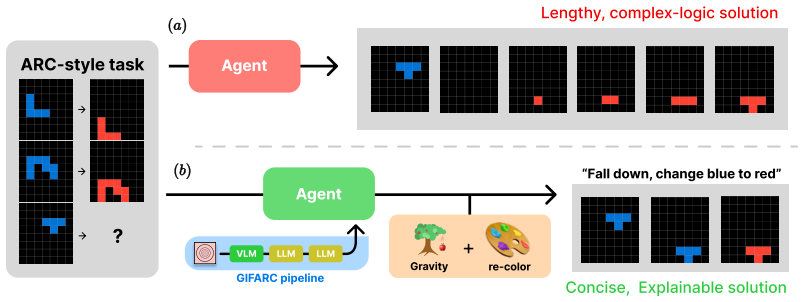
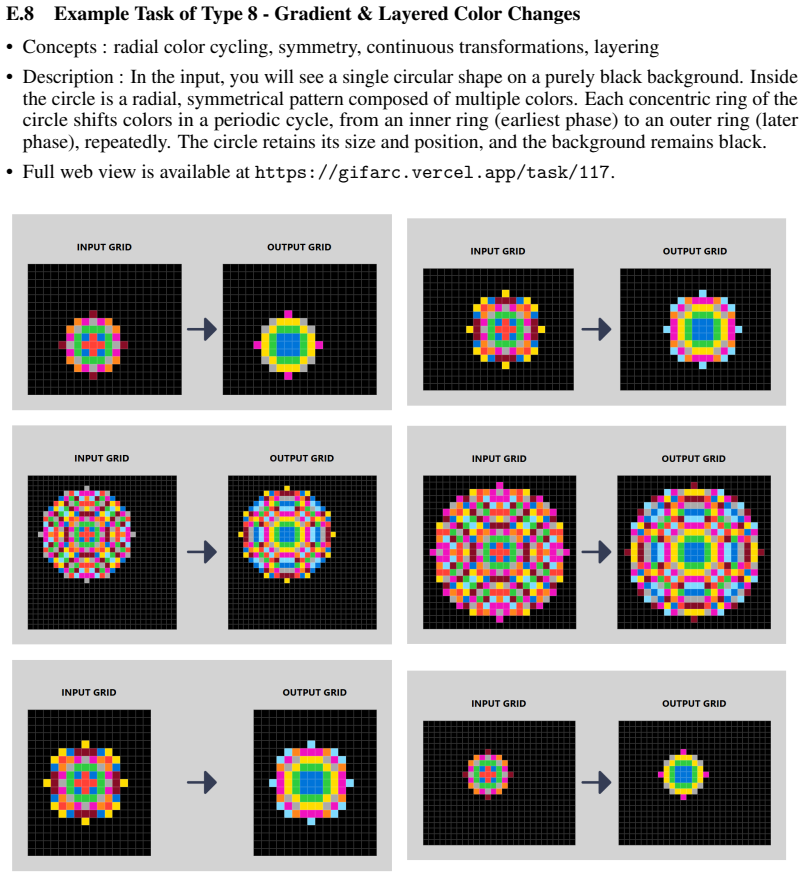
The load-bearing machinery is the GIFARC task triple T = (E, α, ϕ): a set E of input-output grid pairs, a short natural-language analogy α (for example “blocked water flow”), and a Python program ϕ that implements the deterministic transformation F such that y = F(x). This triple is produced in three stages: a VLM (GPT o1) reads a GIF and returns a structured JSON record of scenario, objects, static and dynamic patterns, core principles, and interactions; a text LLM (GPT o3-mini) compresses that record into a task sketch of concepts and description; and a final LLM compiles the sketch into executable code using retrieval-augmented in-context learning from human-written ARC example tasks (the BARC seed set). The analogy label is copied from the sketch into the final task, so the everyday concept is wired directly to the code that makes the grids. In the application experiments, 15 such full triples are used as in-context examples to guide GPT 4.1-mini on unseen ARC-AGI-2 tasks.
What would settle it
Score the human analogy descriptions collected in Appendix D against GIFARC's ground-truth analogy labels using the same LLM evaluator and embedding cosine the paper applies to the models; if human scores do not meet or exceed the full-description model's scores, the dataset's claim to contain human-intuitive analogies is not supported. A separate fine-tuning run on the original ARC benchmark would settle the paper's closing claim that GIFARC training boosts solver accuracy rather than only changing in-context phrasing.
Extended reading notes
Core claim
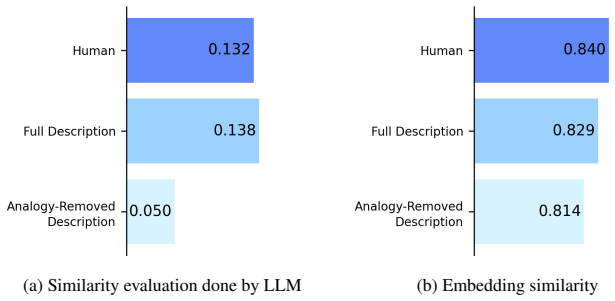
On the paper's own terms, the discovery is that analogies embedded in GIFs can be mined, compiled into executable ARC-style tasks, and then transferred to an LLM's problem-solving approach. The authors report that GPT 4.1-mini, given fifteen full GIFARC examples in context, described the underlying analogy of an ARC-AGI-2 task with phrases like “tidying up” and “organizing”, whereas a version given analogy-flattened examples stuck to grid-level terms such as “symmetrical horizontally” and “left cluster moving right”. Quantitatively, the full-description model's generated analogy scored 0.137 by an LLM evaluator and 0.829 by embedding cosine against the task's ground-truth analogy, versus 0.050 and 0.814 for the analogy-removed model. The authors interpret this as showing that GIFARC's analogy labels, not the grid examples alone, are what shift the model toward the human analogic approach.
Load-bearing premise
Everything depends on the unmeasured premise that the analogies a vision-language model extracts from GIFs are the same analogies a human would naturally see, and that such an analogy can be faithfully turned into a deterministic grid transformation; the paper collects human analogy descriptions for 12 tasks but never scores them against its own labels.
Editorial extensions
If this is right
- If GIFARC works as claimed, analogy labels become a transferable prior: showing an LLM a handful of analogy-labeled grid tasks before an unseen ARC puzzle pushes it to describe the puzzle in everyday conceptual terms rather than grid-level mechanics.
- The dataset itself is reusable: 10,000 tasks with ground-truth analogy α and executable solution ϕ can serve as training or prompting data for any ARC-style solver, not just the specific LLM tested.
- Because each analogy is compiled into deterministic code, GIFARC could support checks of whether a model's stated analogy actually matches the transformation it computes, making reasoning steps more auditable.
- The graded ablation (full description > without analogy > without analogy and without solution) implies that the analogy phrase is not decoration: removing it measurably reduces how well a model names the analogy of an unseen task.
Reading between the lines
- Editorial inference: the current experiments measure analogy-naming in context, not benchmark solve rates; the paper's conclusion credits fine-tuning and accuracy gains on the original ARC benchmark, but those runs are not reported, so a fair reader should treat them as open hypotheses.
- Editorial inference: since the pipeline compiles analogies into Python, one testable extension is to use GIFARC to explicitly train a verifier that checks whether a candidate solution's stated analogy is consistent with the executed transformation, which would make analogical reasoning auditable beyond phrasing.
- Editorial inference: the GIF-based analogy inventory is limited by what a single short loop can show; adapting the pipeline to longer video clips would likely require disentangling multiple entangled analogies, which the paper itself flags in Section 6.
Editorial analysis
A structured set of objections, weighed in public.
Referee Report
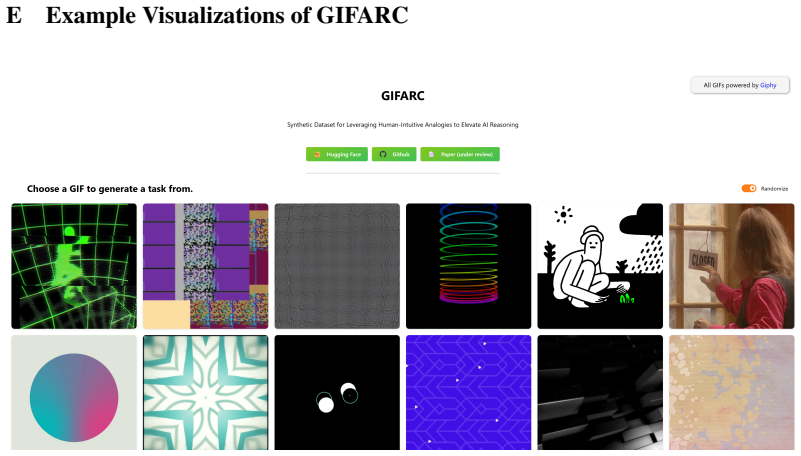
Summary. The paper introduces GIFARC, a synthetic dataset of 10,000 ARC-style tasks generated from GIF images via a three-stage VLM/LLM pipeline: visual abstraction extraction (GPT o1), task sketching (GPT o3-mini), and executable ARC task generation (GPT o3-mini / GPT 4.1), with each task paired with a natural-language analogy label and Python solution code. The authors claim that embedding human-intuitive analogies into ARC-style tasks guides LLMs to evaluate tasks analogically before brute-force search, and they report two application experiments (Sections 5.1 and 5.2) comparing GPT-4.1-mini with full-description, analogy-removed, and solution-removed in-context contexts on ARC-AGI-2 tasks, as well as similarity scores between generated analogies and ground truth. The manuscript also includes dataset statistics, generation fidelity pass rates, code complexity metrics, and examples.
Significance. If the central claim were established, GIFARC would be a useful resource: it is released on Hugging Face, includes executable code and filtering checks, and attempts to scale synthetic ARC-style task generation with analogy labels in a reproducible pipeline. The pipeline's stage-wise pass-rate checks and the public visualization site are concrete strengths. However, the paper's headline claim about human-intuitive analogies currently rests on LLM-generated ground truth and a hand-curated in-context subset; the collected human evaluations are not scored. The resource itself may still be valuable for training and prompting, but the alignment-with-human-analogies claim needs direct evidence.
major comments (4)
- [Section 5.2 and Appendix D] The human evaluator analogies collected for 12 tasks (Appendix D) are never scored against the GIFARC ground-truth analogies; Figures 5a and 5b report only the two model conditions against the same LLM-generated ground truth. Because the ground-truth analogies were produced by GPT o1/o3-mini in the same pipeline, the reported alignment scores cannot distinguish 'GIFARC guides models toward human intuition' from 'GIFARC models agree with the LLM distribution that generated the labels.' This is the load-bearing gap for the paper's central claim.
- [Section 6] The conclusion states that 'Empirical results on the original ARC benchmark confirm that both fine-tuning on GIFARC and leveraging analogy cues in the reasoning step boost solver accuracy,' but no accuracy experiment on ARC (original, AGI-1, or AGI-2) is reported anywhere in Section 5 or the appendices. This claim is unsupported by the manuscript's evidence and should be removed or substantiated.
- [Section 5.1 and Appendix C.3] The full-description condition was produced by an LLM and then manually refined by the researchers (Appendix C.3), so the experiment does not evaluate the released GIFARC dataset as-is; it evaluates a hand-curated subset. In addition, the evaluation uses 15 in-context examples and 12 tasks with no error bars, confidence intervals, or significance tests, so the reported differences (0.137 vs. 0.050 LLM similarity; 0.829 vs. 0.814 embedding cosine) are not established as reliable.
- [Section 3.2 and Section 5.2] The premise that the analogies extracted by GPT o1 from GIFs are 'human-intuitive' is not validated independently: Step 1 (Section 3.2) instructs the VLM to extract 'core reasoning principles,' and the same LLM family later judges similarity to those labels. A concrete test would be to score the collected human analogies from Appendix D against the ground-truth labels and to report agreement statistics; without this, the dataset's main conceptual contribution remains a claim about LLM self-consistency rather than human-aligned reasoning.
minor comments (4)
- [Appendix D] The human-evaluator guideline instructs participants to describe analogies for '13 tasks,' while Section 5.2 and the surrounding text state that 12 tasks were used; the discrepancy should be corrected.
- [Appendix B.2] The user prompt contains the typo 'Insturction' instead of 'Instruction'; the sentence 'input_bitmap_generation_code must be executable Python code, when it generate a bitmap...' is also ungrammatical and should be rewritten.
- [Section 4, Table 3] The success rates are reported as percentages but the pass criteria are described only in prose; the table would benefit from a definition column clarifying what each stage's pass/fail judgment is based on.
- [Abstract and Section 1] The phrase 'build a more concise and human-understandable solution' should be 'builds a more concise and human-understandable solution' for grammatical consistency.
Circularity Check
The reported 'human-level analogic approach' evidence is an LLM-to-LLM comparison: Section 5.2 scores model outputs against GIFARC's own LLM-generated ground-truth analogies, while the collected human analogies (Appendix D) are never scored.
-
other
[Section 5.2, Figure 5 (with Section 3.2-3.4 for the provenance of the ground-truth analogy labels)]
"The analogy α is copied from the task sketch created in Step 2, forming a ARC-style task T = (E, α, ϕ). ... The outputs of two models and three humans were then compared with the ground-truth analogies of the task generated with GIFARC pipeline. ... It resulted that the output of GPT 4.1-mini with full description showed 0.137 similarity, while the output of GPT 4.1 mini with analogy-removed description only measured 0.050."
The reference 'ground truth' in the alignment experiment is not human judgment but an artifact of the GIFARC pipeline: α originates from GPT o1's visual abstraction (Step 1), is condensed by GPT o3-mini into a task sketch (Step 2), and is then copied into the task triple. The similarity judge is also GPT o3-mini. The full-description condition is built from exactly these (E, α, ϕ) triples, so the measured 0.137 vs 0.050 difference reflects agreement with the pipeline's own label distribution, not with human intuition. The three human analogies collected for the same 12 tasks (Appendix D) are never scored in the reported figures.
full rationale
GIFARC's data-generation pipeline is not itself circular: the GIF sources are external, the generated tasks are filtered by compilation and well-formedness checks, and the dataset is publicly released with executable solutions. The circularity is concentrated in the empirical support for the paper's headline claim that GIFARC aligns LLMs with human analogic reasoning. In Section 5.2, the 'ground-truth analogies' used as the evaluation reference are produced by the same GPT o1 / GPT o3-mini pipeline that created the GIFARC tasks, and the similarity judge is another GPT o3-mini. The three human analogies collected for the same 12 tasks (Appendix D) are not scored in the reported figures, so the reported differences (0.137 vs 0.050 for LLM similarity; 0.829 vs 0.814 for cosine similarity) measure agreement with the pipeline's own labels, not human similarity. This makes the human-alignment conclusion reduce by construction to an LLM-to-LLM consistency result. Separately, Section 6 asserts that 'Empirical results on the original ARC benchmark confirm that both fine-tuning on GIFARC and leveraging analogy cues in the reasoning step boost solver accuracy,' but no accuracy experiment is reported in the paper; Appendix C.3 also discloses manual refinement of the full-description context, further weakening the controlled comparison. These are omitted-support and validity concerns rather than additional circularity. No load-bearing self-citation chain or imported uniqueness theorem is present, so the score is 6 rather than higher.
Assumptions & free parameters
free parameters (3)
- full_description sample count =
15
- evaluation task count =
12
- human evaluator count =
3
assumptions (3)
- domain assumption Analogies extracted by GPT o1 from GIFs are human-intuitive and semantically aligned with the GIF.
- domain assumption ARC-style grids can faithfully encode the visual transformations from GIFs.
- domain assumption In-context learning with 15 curated GIFARC samples is representative of training on the full GIFARC dataset.
Cite this review
Pith. "Pith review of GIFARC: Synthetic Dataset for Leveraging Human-Intuitive Analogies to Elevate AI Reasoning." pith.science (2026). https://pith.science/paper/D5LNWWH2
@misc{pith2026250520672,
  author       = {Pith},
  title        = {Pith review of: GIFARC: Synthetic Dataset for Leveraging Human-Intuitive Analogies to Elevate AI Reasoning},
  year         = {2026},
  howpublished = {\url{https://pith.science/paper/D5LNWWH2}},
  note         = {Machine review of arXiv:2505.20672}
}
read the original abstract
The Abstraction and Reasoning Corpus (ARC) poses a stringent test of general AI capabilities, requiring solvers to infer abstract patterns from only a handful of examples. Despite substantial progress in deep learning, state-of-the-art models still achieve accuracy rates of merely 40-55% on 2024 ARC Competition, indicative of a significant gap between their performance and human-level reasoning. In this work, we seek to bridge that gap by introducing an analogy-inspired ARC dataset, GIFARC. Leveraging large language models (LLMs) and vision-language models (VLMs), we synthesize new ARC-style tasks from a variety of GIF images that include analogies. Each new task is paired with ground-truth analogy, providing an explicit mapping between visual transformations and everyday concepts. By embedding robust human-intuitive analogies into ARC-style tasks, GIFARC guides AI agents to evaluate the task analogically before engaging in brute-force pattern search, thus efficiently reducing problem complexity and build a more concise and human-understandable solution. We empirically validate that guiding LLM with analogic approach with GIFARC affects task-solving approaches of LLMs to align with analogic approach of human.
Figures


Figures from the paper (24 more)





Reference graph
Works this paper leans on
-
[1]
On the Measure of Intelligence
François Chollet. On the Measure of Intelligence. arXiv:1911.01547, 2019
arXiv 1911
- [2]
-
[3]
Faith and fate: Limits of transformers on compositionality
Nouha Dziri, Ximing Lu, Melanie Sclar, Xiang Lorraine Li, Liwei Jiang, Bill Yuchen Lin, Sean Welleck, Peter West, Chandra Bhagavatula, Ronan Le Bras, et al. Faith and fate: Limits of transformers on compositionality. In NeurIPS, 2023
work page 2023
-
[4]
Seungpil Lee, Woochang Sim, Donghyeon Shin, Sanha Hwang, Wongyu Seo, Jiwon Park, Seokki Lee, Sejin Kim, and Sundong Kim. Reasoning Abilities of Large Language Models: In-Depth Analysis on the Abstraction and Reasoning Corpus. arXiv:2403.11793, 2024
arXiv 2024
-
[5]
Abstraction and analogy-making in artificial intelligence
Melanie Mitchell. Abstraction and analogy-making in artificial intelligence. Annals of the New York Academy of Sciences, 1505(1):79–101, 2021
work page 2021
-
[6]
Neural networks for abstraction and reasoning
Mikel Bober-Irizar and Soumya Banerjee. Neural networks for abstraction and reasoning. Scientific Reports, 14(1):27823, 2024
work page 2024
-
[7]
Understanding and Benchmarking Artificial Intelligence: Ope- nAI’s o3 Is Not AGI
Rolf Pfister and Hansueli Jud. Understanding and Benchmarking Artificial Intelligence: Ope- nAI’s o3 Is Not AGI. arXiv preprint arXiv:2501.07458, 2025
arXiv 2025
-
[8]
Abstraction and Reasoning Corpus for Artificial General Intelligence v2
Francois Chollet, Mike Knoop, and Greg Kamradt. Abstraction and Reasoning Corpus for Artificial General Intelligence v2. https://github.com/arcprize/ARC-AGI-2 , 2025
work page 2025
Show all 40 references
-
[9]
Object- Centric Compositional Imagination for Visual Abstract Reasoning
Rim Assouel, Pau Rodriguez, Perouz Taslakian, David Vazquez, and Yoshua Bengio. Object- Centric Compositional Imagination for Visual Abstract Reasoning. In ICLR Workshop on the Elements of Reasoning: Objects, Structure, and Causality, 2022
2022
-
[10]
H-ARC: A Robust Estimate of Human Performance on the Abstraction and Reasoning Corpus Benchmark
Solim LeGris, Wai Keen V ong, Brenden M Lake, and Todd M Gureckis. H-ARC: A Robust Estimate of Human Performance on the Abstraction and Reasoning Corpus Benchmark. arXiv preprint arXiv:2409.01374, 2024
2024 arXiv
-
[11]
Do Large Language Models Solve ARC Visual Analogies Like People Do? In CogSci, 2024
Gustaw Opiełka, Hannes Rosenbusch, Veerle Vijverberg, and Claire E Stevenson. Do Large Language Models Solve ARC Visual Analogies Like People Do? In CogSci, 2024
2024
-
[12]
PQA: Perceptual Question Answering
Yonggang Qi, Kai Zhang, Aneeshan Sain, and Yi-Zhe Song. PQA: Perceptual Question Answering. In CVPR, 2021
2021
-
[13]
Addressing the Abstraction and Reasoning Corpus via Procedural Example Generation
Michael Hodel. Addressing the Abstraction and Reasoning Corpus via Procedural Example Generation. arXiv:2404.07353, 2024
2024 arXiv
-
[14]
Tenenbaum
Samuel Acquaviva, Yewen Pu, Marta Kryven, Theodoros Sechopoulos, Catherine Wong, Gabrielle Ecanow, Maxwell Nye, Michael Tessler, and Joshua B. Tenenbaum. Communicating Natural Programs to Humans and Machines. In NeurIPS, 2022
2022
-
[15]
Playgrounds for Abstrac- tion and Reasoning
Subin Kim, Prin Phunyaphibarn, Donghyun Ahn, and Sundong Kim. Playgrounds for Abstrac- tion and Reasoning. In NeurIPS Workshop on Neuro Causal and Symbolic AI, 2022
2022
-
[16]
The ConceptARC Bench- mark: Evaluating Understanding and Generalization in the ARC Domain
Arseny Moskvichev, Victor Vikram Odouard, and Melanie Mitchell. The ConceptARC Bench- mark: Evaluating Understanding and Generalization in the ARC Domain. Transactions on Machine Learning Research, 2023
2023
-
[17]
LLMs and the Abstraction and Reasoning Corpus: Successes, Failures, and the Importance of Object-Based Representations
Yudong Xu, Wenhao Li, Pashootan Vaezipoor, Scott Sanner, and Elias B Khalil. LLMs and the Abstraction and Reasoning Corpus: Successes, Failures, and the Importance of Object-Based Representations. Transactions on Machine Learning Research, 2024
2024
-
[18]
Combining induction and transduction for abstract reasoning
Wen-Ding Li, Keya Hu, Carter Larsen, Yuqing Wu, Simon Alford, Caleb Woo, Spencer M Dunn, Hao Tang, Michelangelo Naim, Dat Nguyen, et al. Combining induction and transduction for abstract reasoning. arXiv preprint arXiv:2411.02272, 2024
2024 arXiv
-
[19]
From Generation to Selection Findings of Converting Analogical Problem-Solving into Multiple-Choice Questions
Donghyeon Shin, Seungpil Lee, Klea Lena Kovacec, and Sundong Kim. From Generation to Selection Findings of Converting Analogical Problem-Solving into Multiple-Choice Questions. In EMNLP, 2024
2024
-
[20]
name": "object name
Max Peeperkorn, Tom Kouwenhoven, Dan Brown, and Anna Jordanous. Is Temperature the Creativity Parameter of Large Language Models?, 2024. 10 Appendix A Examples of Prompts A.1 Full Prompt Example for Extracting Visual Abstractions The extraction of visual abstractions constitut...
2024
-
[21]
Inspect the example puzzle implementations, making note of the functions used and the physical/geometric/topological/logical details
-
[22]
Inspect the new puzzle’s description
-
[23]
Brainstorm a possible implementation for the new puzzle
-
[24]
library”: “<Write only the libraries used in the code. Ex. from common import* \n import numpy as np \n ....>
Generate a code block formatted like the earlier examples with a comment starting # concepts: listing the concepts and# description: describing the inputs and transforma- tion from the given description. When implementing code, please avoid using float type variables, numbers ...
-
[25]
At least 2 pairs of example problems (input/output)
-
[26]
Use of predictable transformation laws or analogies
-
[27]
Clear definition of each object’s role, interaction, and rule
-
[28]
Emphasis on fun/creativity and adjustable difficulty
-
[29]
Complex and creative Puzzle
-
[30]
input_bitmap_generation_code must be executable Python code, when it generate a bitmap, bitmap should be contained in the parameter which has formatted name, (short descrition, in 10 char)_input_bitmap_(idx) is the format you should keep, However the name of bitmap should star...
-
[31]
input_bitmap_generation_code
solution_code must be executable Python # Creating an ARC-Style Puzzle Problem → At least 2 pairs of example input–output → There is a pattern/rule → The human/AI infers the rule and solves the problem # Detailed Objectives You must use the provided functions to create objects...
-
[32]
Either the permuted grid or the input grid is not well-formed
-
[33]
Verification Changes in Reasoning Steps
The results differ even when only the colors are changed. Identity The input and output are completely identical. Non-Well Formed Output The transformation result is not well-formed (i.e., not a 2D list with equal row lengths and integer values between 0-9). Black Output The o...
-
[34]
What the provided input-output pairs are visualizing
-
[35]
What kind of analogy the pattern changing from input to output can be related to or expressed as
-
[36]
What the colors or object shapes shown in the input/output symbolize or represent
-
[37]
Ex-1) - It appears to be spreading from the center
Please write the expected rules if you don’t know the task’s analogy. Ex-1) - It appears to be spreading from the center. Ex-2) - The movement seems to change randomly and the colors are changing. [Working Example] {Example task} Analogy: In this task the grid represents a sce...
-
[38]
empty screen
Ensure the anchoring of the fractals at the bottom edge remains the same. 2) Preserve the radial symmetry of the central circular region and its common center point. 3) For each pulsation step in the input, magnify or contract the rings, lines, and fractals accordingly. 4) Con...
-
[39]
2) Preserve the radial symmetry of the central circular region and its common center point
Ensure the anchoring of the fractals at the bottom edge remains the same. 2) Preserve the radial symmetry of the central circular region and its common center point. 3) For each pulsation step in the input, magnify or contract the rings, lines, and fractals accordingly. 4) Con...
-
[40]
2) Preserve the radial symmetry of the central circular region and its common center point
Ensure the anchoring of the fractals at the bottom edge remains the same. 2) Preserve the radial symmetry of the central circular region and its common center point. 3) For each pulsation step in the input, magnify or contract the rings, lines, and fractals accordingly. 4) Con...
Reviewed August 7, 2026 · model on record in the stance chip above.
Discussion (0). Sign in to comment.