REVIEW 4 major objections 6 minor 57 references
Pattern-Based Phase-Separation of Tracer and Dispersed Phase Particles in Two-Phase Defocusing Particle Tracking Velocimetry
T0 review · 4 major / 6 minor · reviewed 2026-08-06 · deepseek-v4-flash
Pith's one-line read A convolutional neural network can separate tracer particles from bubbles or droplets in defocusing particle tracking velocimetry by reading defocused-image patterns, reaching 95-100% classification accuracy with a GAN-based auto-labeling…
desk verdict Useful integration of CNN detection and GAN auto-labeling for phase separation in two-phase DPTV, but the headline accuracy claim outruns the evidence because real two-phase classification is never measured. read the letter →
The pith
A machine-rendered reading of the paper's core claim, the machinery that carries it, and where it could break.
The reading
What carries the argument
The load-bearing object is the defocused particle image pattern: a regular, unidirectional interference fringe pattern produced by two or more glare points on a smooth transparent bubble or droplet, versus empty or irregular speckle patterns from opaque or rough tracers. Two machinery pieces carry the argument: (1) CNN object detectors, specifically Faster R-CNN and YOLOv4 (full and tiny), trained to output a bounding box and a phase class for each particle image; (2) a two-GAN auto-labeling pipeline in which one GAN generates tracer images and a second generates dispersed-phase images, each snippet gets a bounding box from the Hough transform, and the snippets are pasted into synthetic frames with known class labels. The networks are trained on roughly half a million generated particle images and evaluated with class-agnostic average precision, truncated average precision, classification accuracy, and false-positive class bias. The physical scattering model, expressed through glare-point counting, is what makes the pattern a reliable label rather than an arbitrary visual artifact.
What would settle it
Generate a synthetic two-phase test set with the paper's forward model in which tracers are modeled as smooth transparent particles with two ordered glare points, so their defocused images contain the same unidirectional fringes as droplets; if the CNN still classifies the two classes with near-95-100% accuracy, the separation is not actually driven by the fringe pattern, whereas chance-level accuracy would confirm that the pattern is the mechanism.
Extended reading notes
Core claim
The central claim is that phase identity in DPTV is encoded in the defocused particle image itself: transparent smooth particles such as bubbles and droplets scatter light from multiple glare points lying in one scattering plane, producing unidirectional interference fringes, whereas opaque or rough tracers yield either empty or speckled images. The paper shows that object-detection CNNs (Faster R-CNN and two YOLOv4 variants) trained on auto-labeled GAN-generated images can exploit this pattern difference to detect and classify particle images, with classification accuracy of 95-100% on most datasets. The strongest evidence is the synthetic two-phase set, where idealized, noise-free images force the networks to generalize; high accuracy there indicates the networks learned the fringe-versus-no-fringe physical feature rather than incidental image cues. The paper also demonstrates that the GAN auto-labeling framework removes the manual-annotation bottleneck, with the caveat that smooth transparent tracers such as DEHS can themselves produce fringes, so tracer material must be chosen to keep the pattern distinction valid.
Load-bearing premise
The load-bearing premise is that bubbles and droplets reliably show regular, unidirectional interference fringes in defocused images while the chosen tracers show empty or speckled patterns; if the tracer material also produces clean fringes, the visual cue the classifier relies on disappears.
Editorial extensions
If this is right
- A single camera with one optical access can produce simultaneous 3D-3C Lagrangian tracks for both the continuous and dispersed phases, since phase separation happens entirely in post-processing.
- The method stays effective when tracer and dispersed particles have overlapping size distributions, and it does not require high seeding densities or large velocity differences between phases.
- Because the networks learn a fringe-based physical feature, the approach can be combined with interferometric particle imaging to add size measurement of bubbles or droplets in the same data.
- The GAN auto-labeling framework can generate experiment-specific training data from roughly 100-1000 single-phase images per class, removing the manual labeling bottleneck for CNN-based DPTV.
- In domain-shifted test sets, precision remains high even where recall is limited, which suppresses ghost particles in tracking; improving recall is the stated next step for complete void-fraction estimation.
Reading between the lines
- As an editorial extension, the identical two-GAN auto-labeling pipeline could be transferred to astigmatism PTV, where defocused particle images also encode phase-specific appearance and single-camera volumetric tracking is equally valuable.
- Inferred from the reported false-positive class bias: in applications that count particles rather than track them, such as void-fraction estimation, the dispersed phase would be over-represented unless confidence thresholds are tuned or the training set is rebalanced toward tracers.
- Inferred from the scattering argument: the same pattern-based separation should work for solid dispersed particles whose surface roughness produces a speckle pattern distinct from tracer fringes, extending the method beyond gas-liquid flows even though the paper does not test this.
- A practical consequence of the paper's own caveat is that tracer material choice becomes part of experimental design: any new tracer should be screened in single-phase recordings for the presence of regular unidirectional fringes before the two-phase runs.
Editorial analysis
A structured set of objections, weighed in public.
Referee Report
Summary. The manuscript proposes a post-processing method for phase separation in defocusing particle tracking velocimetry (DPTV). The authors train convolutional object detectors (Faster R-CNN, YOLOv4, and tiny YOLOv4) to distinguish tracer particle images from bubble/droplet particle images on the basis of visual pattern: tracers are assumed to produce empty or speckled defocused particle images, whereas the dispersed phase produces regular, unidirectional interference fringes. To avoid manual labeling, the authors introduce a GAN-based auto-labeling framework in which two class-specific GANs generate synthetic particle images from single-phase calibration recordings, and the generated images are composited with known bounding-box and class labels into training images. The trained detectors are evaluated on six test sets: four real single-phase sets (T1–T4), one synthetic mixed-phase set (T5), and one real mixed-phase set (T6). High detection precision and near-perfect classification accuracy are reported on most familiar and some domain-shifted sets, with notable exceptions on T4 and T5. For the real two-phase set T6, only detection performance is reported because manual class labeling was deemed unreliable.
Significance. If the central claim were fully supported, the work would be a useful practical contribution: it offers a single-camera, post-processing route to phase-specific 3D particle tracking in dispersed two-phase flows without wavelength filtering, and it explicitly addresses the training-data bottleneck via GAN-generated auto-labeled data. The synthetic T5 test is a good positive control: because the synthetic images are nearly noise-free and differ only in the presence of fringes, high classification accuracy for two of the three networks provides credible evidence that at least those networks rely on the intended fringe feature. The GAN auto-labeling workflow is a clear practical step forward for CNN-based DPTV. However, the significance is reduced by the absence of a real mixed-phase classification measurement: the only real two-phase dataset (T6) contributes detection results only, so the paper's headline claim of robust phase separation in real two-phase DPTV is not directly demonstrated. The abstract's '95-100%' accuracy claim is also contradicted by the tables for the domain-shifted sets.
major comments (4)
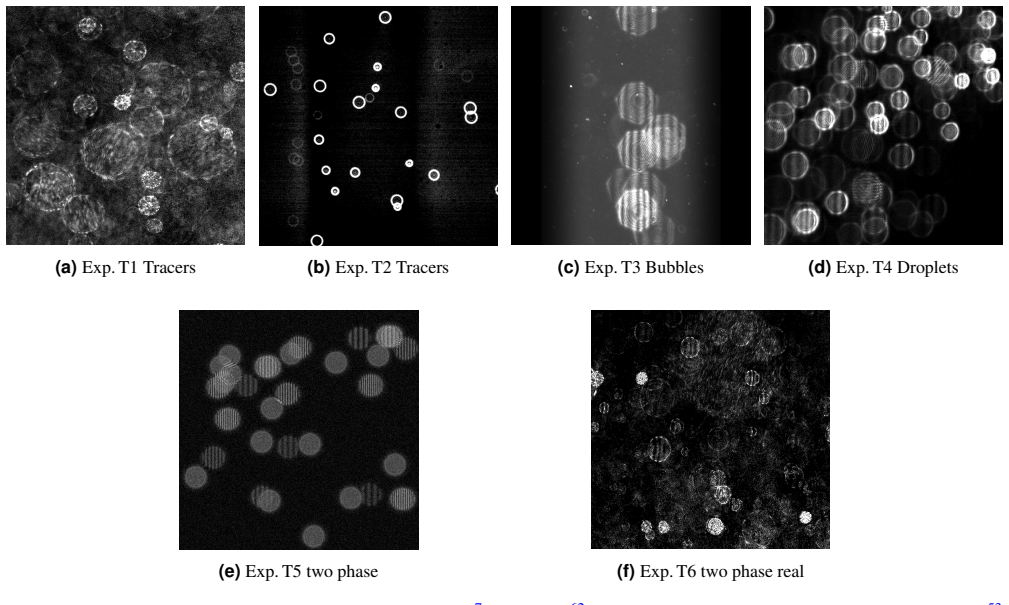
- [§4.1 and Table 2] The central claim that CNN-based phase separation works in real two-phase DPTV is not directly tested. Section 4.1 states that for Exp. T6, the only real two-phase flow dataset, manual class labeling proved unreliable, and Table 2 consequently reports no classification accuracy for T6. The classification accuracies that are reported come from real single-phase sets (T1–T4) and a synthetic mixed-phase set (T5). Single-phase sets cannot exercise genuine class confusion in a mixed-population image, and T5 is an idealized, noise-free case. The abstract's wording that the evaluation 'comprising synthetic two-phase and real single- and two-phase flows, demonstrates high detection precision and classification accuracy' is therefore overstated. To support the central claim, the authors should either provide a real mixed-phase classification result (for example, from carefully reviewed labels, multiple annotators, or a composited image set built from real single-phase images) or explicitly restrict the stated scope of the claim to the data actually tested.
- [Abstract, §4.3, Tables 1 and 2] The abstract's '95-100%' classification accuracy and 'even under domain shifts' claim is not supported by the reported numbers. In Table 2, Faster R-CNN achieves 0.754 classification accuracy on T4, YOLOv4 achieves 0.814 on T4 and 0.824 on T5, and only tiny YOLOv4 remains above 0.95 on all real sets. Detection performance also degrades under domain shift: Table 1 shows average precisions of 0.667–0.729 on T2 and 0.765–0.850 on T4. The authors should revise the summary claims to report these exceptions and discuss why the two-stage detector and the full YOLOv4 behave differently, especially the YOLOv4 drop on the synthetic T5 set relative to its strong real-domain performance.
- [§4.1 and §4.2] The assertion that the detector 'processes each instance independently, without relying on the overall image composition' is not established by the evaluation. Faster R-CNN and YOLOv4 operate on full images with global receptive fields, and the single-phase test sets T1–T4 provide no mixed-class context that could reveal context-dependent behavior. The paper's argument would be strengthened by a control experiment in which real single-phase particle images are composited into balanced mixed-phase images (with ground-truth classes known from the source sets), or by per-image class-conditional analysis and/or saliency maps showing that classification decisions are driven by the local particle-image pattern rather than background intensity, particle density, or other global cues.
- [Table 2 and §4.1] Classification accuracy is computed only over true-positive detections and is reported at a single operating point (the maximum F1-score) without confidence intervals or the per-cell number of true-positive detections. Given that some test sets are small (e.g., T3 contains 202 labeled particle images), the reported accuracies may have wide uncertainty, particularly for the T3 and T6 rows. Reporting the underlying confusion matrices and detection counts would make the differences between networks (e.g., Faster R-CNN's 0.754 vs tiny YOLOv4's 0.966 on T4) more interpretable.
minor comments (6)
- [§1 and §2] The verb 'utilities' appears twice ('This work utilities object detection networks' in §1 and 'utilities the pattern' in §2); it should be 'utilizes'.
- [Figure 6 caption] The caption reads 'T67' in '(f)'; this should be 'Exp. T6'.
- [Figure 7 caption] Both subfigure captions read 'GAN Tracers'; the second subfigure should be labeled 'GAN Dispersed Phase' to match the text describing the two GANs.
- [Table 5 header] The table header 'IoU≥0.5Faster R-CNN YOLOv4 YOLOv4' is difficult to parse; the columns for 'Tiny YOLOv4' and 'YOLOv4' should be clearly separated and labeled.
- [§5] The sentence 'while the CNNs demonstrated very high TAP with, this performance was achieved only within limited maximum recall ranges' appears to contain a missing word after 'with'; the sentence should be completed.
- [Eq. (4)] The normalized truncated average precision divides by max(R) but the text does not specify how max(R) is obtained or how the case max(R)=0 should be handled; this is a minor formal point, but a sentence of clarification would help.
Circularity Check
No significant circularity: the evaluation uses held-out real and synthetic test sets, and no predicted quantity reduces to a fitted input or to a self-citation chain.
full rationale
The paper's derivation chain is not circular. The phase-distinction target is an externally stated physical hypothesis, and the detector is trained on GAN-generated images with labels assigned by source GAN, not by the detector itself. All classification evaluations use held-out test sets (T1–T4) that were never used for GAN or detector training; T2 and T4 come from independent experimental groups (wet clutch and spray), providing external benchmark support. T5 is a synthetic forward-model test and is explicitly framed as a controlled probe of the learned fringe feature, not as real-flow validation. The paper itself flags the key evidence gap: in Section 4.1 it states that for the only real two-phase set T6, "manual class labeling of PIs proved unreliable" and therefore "only the detection but not the classification performance was assessed for this dataset." This weakens the abstract's wording but is a missing measurement, not a circular reduction. Similarly, Section 2 acknowledges that smooth transparent tracers such as DEHS can also produce fringes, limiting the pattern assumption; again a scope limitation rather than a self-referential step. The assertion that the detector "processes each instance independently, without relying on the overall image composition" is an untested methodological assumption, but it is not an input-output equivalence. No equation in the paper defines a predicted quantity in terms of the fitted inputs, and no load-bearing argument reduces to a self-citation; the self-citations are to data sources, a forward-model tool, and prior detector settings, none of which force the reported accuracy. The paper is therefore self-contained in its evaluation, and the reported results stand as empirical measurements rather than consequences of an ansatz or a fit. The lack of a classification accuracy for the real two-phase dataset is a genuine limitation for the strongest real-flow claim, but it is a completeness issue, not circularity.
Assumptions & free parameters
assumptions (3)
- domain assumption Bubbles and droplets consistently produce regular, unidirectional interference fringes in defocused images, while tracer particles (with appropriate material choice) do not.
- domain assumption GAN-generated particle images are sufficiently realistic that a detector trained on them transfers to real experimental images.
- domain assumption Manual labeling of single-phase test images yields reliable ground truth for classification evaluation.
Cite this review
Pith. "Pith review of Pattern-Based Phase-Separation of Tracer and Dispersed Phase Particles in Two-Phase Defocusing Particle Tracking Velocimetry." pith.science (2026). https://pith.science/paper/D5LWMULS
@misc{pith2026250618157,
  author       = {Pith},
  title        = {Pith review of: Pattern-Based Phase-Separation of Tracer and Dispersed Phase Particles in Two-Phase Defocusing Particle Tracking Velocimetry},
  year         = {2026},
  howpublished = {\url{https://pith.science/paper/D5LWMULS}},
  note         = {Machine review of arXiv:2506.18157}
}
read the original abstract
This work investigates the feasibility of a post-processing-based approach for phase separation in defocusing particle tracking velocimetry for dispersed two-phase flows. The method enables the simultaneous 3D localization determination of both tracer particles and particles of the dispersed phase, using a single-camera setup. The distinction between phases is based on pattern differences in defocused particle images, which arise from distinct light scattering behaviors of tracer particles and bubbles or droplets. Convolutional neural networks, including Faster R-CNN and YOLOv4 variants, are trained to detect and classify particle images based on these pattern features. To generate large, labeled training datasets, a generative adversarial network based framework is introduced, allowing the generation of auto-labeled data that more closely reflects experiment-specific visual appearance. Evaluation across six datasets, comprising synthetic two-phase and real single- and two-phase flows, demonstrates high detection precision and classification accuracy (95-100%), even under domain shifts. The results confirm the viability of using CNNs for robust phase separation in disperse two-phase DPTV, particularly in scenarios where traditional wavelength-, size-, or ensemble correlation-based methods are impractical.
Figures


Figures from the paper (6 more)




Reference graph
Works this paper leans on
-
[3]
Minier, J.-P., Ferrand, M. & Henry, C.Understanding Turbulent Systems - Progress in Particle Dynamics Modeling (Springer Nature Switzerland AG, 2025)
work page 2025
-
[4]
Computational flow modelling and design of bubble column reactors.Chem
Joshi, J. Computational flow modelling and design of bubble column reactors.Chem. Eng. Sci.56, 5893–5933, DOI: https://doi.org/10.1016/S0009-2509(01)00273-1 (2001). Proceedings of the 5th International Conference on Gas-Liquid and Gas-Liquid-Solid Reactor Engineering. 13/19
-
[5]
Grienberger, J. & Hofmann, H. Investigations and modelling of bubble columns.Chem. Eng. Sci.47, 2215–2220, DOI: https://doi.org/10.1016/0009-2509(92)87037-Q (1992). Twelfth International Symposium on Chemical Reaction Engineering Today
-
[6]
Leister, R., Brümmer, A. & Kriegseis, J. Laser-optical shear-flow analysis across the annular gap of a simplified displacement compressor model.IOP Conf. Series: Mater. Sci. Eng.1267, 012003, DOI: 10.1088/1757-899X/1267/1/ 012003 (2022)
-
[7]
Lange, H., Sax, C., Brümmer, A. & Kriegseis, J. Astigmatism quantification for depth localization of bubbles and tracers across curved surfaces.IOP Conf. Series: Mater. Sci. Eng.1322, DOI: 10.1088/1757-899X/1322/1/012005 (2024)
-
[8]
Gounder, J. D., Kourmatzis, A. & Rachid Masri, A. Turbulent piloted dilute spray flames: Flow fields and droplet dynamics. Combust. Flame159, 3372–3397, DOI: https://doi.org/10.1016/j.combustflame.2012.07.014 (2012)
-
[9]
Sahu, S., Hardalupas, Y . & Taylor, A. M. K. P. Interaction of droplet dispersion and evaporation in a polydispersed spray.J. Fluid Mech.846, 37–81, DOI: 10.1017/jfm.2018.247 (2018)
-
[10]
Cerqueira, R., Paladino, E., Ynumaru, B. & Maliska, C. Image processing techniques for the measurement of two- phase bubbly pipe flows using particle image and tracking velocimetry (piv/ptv).Chem. Eng. Sci.189, 1–23, DOI: https://doi.org/10.1016/j.ces.2018.05.029 (2018)
Show all 57 references
-
[11]
& Kouda, T
Kitagawa, A., Hagiwara, Y . & Kouda, T. Ptv investigation of phase interaction in dispersed liquid-liquid two-phase turbulent swirling flow.Exp. Fluids42, 871–880, DOI: 10.1007/s00348-007-0291-5 (2007)
2007 doi
-
[12]
Kiger, K. T. & Pan, C. Piv technique for the simultaneous measurement of dilute two-phase flows.J. Fluids Eng.122, 811–818, DOI: 10.1115/1.1314864 (2000). https://doi.org/10.1115/1.1314864
2000 doi
-
[13]
& Fan, L.-S
Chen, R. & Fan, L.-S. Particle image velocimetry for characterizing the flow structure in three-dimensional gas-liquid-solid fluidized beds.Chem. Eng. Sci.47, 3615–3622, DOI: 10.1016/0009-2509(92)85077-O (1992)
1992 doi
-
[14]
L., Easson, W
Jakobsen, M. L., Easson, W. J., Greated, C. A. & Glass, D. H. Particle image velocimetry: simultaneous two-phase flow measurements.Meas. Sci. Technol.7, 1270, DOI: 10.1088/0957-0233/7/9/012 (1996)
1996 doi
-
[15]
& Lecordier, B
Kosiwczuk, W., Cessou, A., Trinité, M. & Lecordier, B. Simultaneous velocity field measurements in two-phase flows for turbulent mixing of sprays by means of two-phase piv.Exp. Fluids39, 895–908, DOI: 10.1007/s00348-005-0027-3 (2005)
2005 doi
-
[16]
& Longmire, E
Khalitov, D. & Longmire, E. Simultaneous two-phase piv by two-parameter phase discrimination.Exp. Fluids32, 252–268, DOI: 10.1007/s003480100356 (2002)
2002 doi
-
[17]
& Westerweel, J
Delnoij, E., Kuipers, J., van Swaaij, W. & Westerweel, J. Measurement of gas–liquid two-phase flow in bubble columns using ensemble correlation piv.Chem. Eng. Sci.55, 3385–3395, DOI: 10.1016/S0009-2509(99)00595-3 (2000)
2000 doi
-
[18]
& Socolofsky, S
Seol, D. & Socolofsky, S. Vector post-processing algorithm for phase discrimination of two-phase piv.Exp. Fluids45, 223–239, DOI: 10.1007/s00348-008-0473-9 (2008)
2008 doi
-
[19]
& Hirata, M
Nishino, K., Kasagi, N. & Hirata, M. Three-dimensional particle tracking velocimetry based on automated digital image processing.J. Fluids Eng.111, 384–391, DOI: 10.1115/1.3243657 (1989). https://asmedigitalcollection.asme.org/ fluidsengineering/article-pdf/111/4/384/5900156/384_1.pdf
1989 doi
-
[20]
& Papantoniou, D
Maas, H., Gruen, A. & Papantoniou, D. Particle tracking velocimetry in three-dimensional flows.Exp. Fluids15, 133–146, DOI: https://doi.org/10.1007/BF00190953 (1993)
1993 doi
-
[21]
& Wieneke, B
Schanz, D., Schröder, A., Gesemann, S., Michaelis, D. & Wieneke, B. ‘shake the box’: A highly efficient and accurate tomographic particle tracking velocimetry (tomo-ptv) method using prediction of particle positions. InPIV13; 10th International Symposium on Particle Image V el...
2013
-
[22]
& Gesemann, S
Schanz, D. & Gesemann, S. . S. Shake-the-box: Lagrangian particle tracking at high particle image densities.Exp Fluids 57, 70DOI: 10.1007/s00348-016-2157-1 (2016). 23.Willert, C. E. & Gharib, M. Three-dimensional particle imaging with a single camera.Exp. Fluids12, 353–358 (1992)
2016 doi
-
[24]
& Adrian, R
Olsen, M. & Adrian, R. Out-of-focus effects on particle image visibility and correlation in microscopic particle image velocimetry.Exp. Fluids 29DOI: 10.1007/s003480070018 (2000)
2000 doi
-
[25]
& Kähler, C
Cierpka, C., Segura, R., Hain, R. & Kähler, C. J. A simple single camera 3c3d velocity measurement technique without errors due to depth of correlation and spatial averaging for microfluidics.Meas. Sci. Technol.21, 045401, DOI: 10.1088/0957-0233/21/4/045401 (2010)
2010 doi
-
[26]
& Verkman, A
Kao, H. & Verkman, A. Tracking of single fluorescent particles in three dimensions: use of cylindrical optics to encode particle position.Biophys. J.67, 1291–1300, DOI: https://doi.org/10.1016/S0006-3495(94)80601-0 (1994). 14/19
1994 doi
-
[27]
Neural Inf
Lecun, Y .et al.Handwritten digit recognition with a backpropagation network.Adv. Neural Inf. Process. Syst. volume 2 1990(1990)
1990
-
[28]
& Haffner, P
Lecun, Y ., Bottou, L., Bengio, Y . & Haffner, P. Gradient-based learning applied to document recognition.Proc. IEEE86, 2278–2324 (1998)
1998
-
[29]
& Mäder, P
Cierpka, C., König, J., Chen, M., Boho, D. & Mäder, P. On the use of machine learning algorithms for the calibration of astigmatism ptv.Proc. 13th Int. Symp. on Part. Image V elocim.(2019)
2019
-
[30]
& Krevor, S
Franchini, S. & Krevor, S. Cut, overlap and locate: a deep learning approach for the 3d localization of particles in astigmatic optical setups.Exp. Fluids61(2020)
2020
-
[31]
König, J.et al.On the use of a cascaded convolutional neural network for three-dimensional flow measurements using astigmatic ptv.Meas. Sci. Technol.31, 074015 (2020)
2020
-
[32]
Barnkob, R.et al.Defocus particle tracking: a comparison of methods based on model functions, cross-correlation, and neural networks.Meas. Sci. Technol.32, 094011 (2021)
2021
-
[33]
Dreisbach, M.et al.Particle detection by means of neural networks and synthetic training data refinement in defocusing particle tracking velocimetry.Meas. Sci. Technol.33, 124001 (2022)
2022
-
[34]
& Kriegseis, J
Sax, C., Dreisbach, M., Leister, R. & Kriegseis, J. Deep learning and hybrid approach for particle detection in defocusing particle tracking velocimetry.Meas. Sci. Technol.34, 095909, DOI: 10.1088/1361-6501/acd4b4 (2023)
2023 doi
-
[35]
Zhang, X.et al.3d positioning and autofocus of the particle field based on the depth-from-defocus method and the deep networks.Mach. Learn. Sci. Technol.4, 025030, DOI: 10.1088/2632-2153/acdb2e (2023)
2023 doi
-
[36]
& Cierpka, C
Ratz, M., Sachs, S., König, J. & Cierpka, C. A deep neural network architecture for reliable 3d position and size determination for lagrangian particle tracking using a single camera.Meas. Sci. Technol.34, 105203, DOI: 10.1088/ 1361-6501/ace070 (2023)
2023
-
[37]
& Sun, J
Ren, S., He, K., Girshick, R. & Sun, J. Faster r-cnn: Towards real-time object detection with region proposal networks. IEEE transactions on pattern analysis machine intelligence39, 1137–1149 (2017)
2017
-
[38]
& Farhadi, A
Redmon, J., Divvala, S., Girshick, R. & Farhadi, A. You only look once: Unified, real-time object detection. In2016 IEEE Conference on Computer Vision and Pattern Recognition (CVPR), 779–788, DOI: 10.1109/CVPR.2016.91 (2016)
2016 doi
-
[39]
& Farhadi, A
Redmon, J. & Farhadi, A. Yolo9000: Better, faster, stronger. In2017 IEEE Conference on Computer Vision and Pattern Recognition (CVPR), 6517–6525, DOI: 10.1109/CVPR.2017.690 (2017). 40.Redmon, J. & Farhadi, A. Yolov3: An incremental improvement (2018). 1804.02767. 41.Goodfellow...
2017 arXiv
- [42]
-
[43]
& Frohn, A
König, G., Anders, K. & Frohn, A. A new light-scattering technique to measure the diameter of periodically generated moving droplets.J. Aerosol Sci.17, 157–167, DOI: https://doi.org/10.1016/0021-8502(86)90063-7 (1986)
1986 doi
-
[44]
R., Skippon, S
Glover, A. R., Skippon, S. M. & Boyle, R. D. Interferometric laser imaging for droplet sizing: a method for droplet-size measurement in sparse spray systems.Appl. Opt.34, 8409–8421 (1995). https://doi.org/10.1364/AO.34.008409
1995 doi
-
[45]
& Maeda, M
Niwa, Y ., Kamiya, Y ., Kawaguchi, T. & Maeda, M. Bubble sizing by interferometric laser imaging.10th Int. Symp. on Appl. Laser Tech. to Fluid Mech.(2000)
2000
-
[46]
& Kriegseis, J
Sax, C., Griesmaier, R. & Kriegseis, J. Particle localization with dptv and sizing with ipi using a forward model and optimization.Meas. Sci. Technol.Manuscript under Review(2025)
2025
-
[47]
Laser Speckle and Related Phenomena(Springer Nature, Topics in Applied Physics, 1975)
Dainty, J.et al. Laser Speckle and Related Phenomena(Springer Nature, Topics in Applied Physics, 1975). https: //doi.org/10.1007/978-3-662-43205-1
1975 doi
-
[48]
van de Hulst, H. C. & Wang, R. T. Glare points.Appl. optics30, 4755–4763, DOI: https://doi.org/10.1364/AO.30.004755 (1991). 49.Atherton, T. J. & Kerbyson, D. J. The coherent circle hough transform.Br. Mach. Vis. Conf.27.1–27.10 (1993)
1991 doi
-
[50]
& Kerbyson, D
Atherton, T. & Kerbyson, D. Using phase to represent radius in the coherent circle hough transform. InIEE Colloquium on Hough Transforms, 5/1–5/4 (1993). 51.Atherton, T. & Kerbyson, D. Size invariant circle detection.Image Vis. Comput.17, 795–803 (1999). 15/19
1993
-
[52]
& Kriegseis, J
Pasch, S., Lange, H., Leister, R. & Kriegseis, J. Flow measurements above a dbd plasma actuator array by means of defocusing ptv. InProceedings of the International Symposium on the Application of Laser and Imaging Techniques to Fluid Mechanics, vol. 21, 1–19, DOI: 10.55037/lx...
2024 doi
-
[53]
& Kriegseis, J
Sax, C., Dreisbach, M. & Kriegseis, J. Interferometric particle imaging for particle sizing in the front-, side-, and back-scatter region (2023). https://arxiv.org/abs/2303.16013, 2303.16013
2023 arXiv
-
[54]
Matlab - gan
MathWorks, I. Matlab - gan. https://www.mathworks.com/help/deeplearning/ug/train-generative-adversarial-network.html (2020). [Online; last accessed 25-May-2025]
2020
-
[55]
& Sun, J
He, K., Zhang, X., Ren, S. & Sun, J. Deep residual learning for image recognition. In2016 IEEE Conference on Computer Vision and Pattern Recognition (CVPR), 770–778, DOI: 10.1109/CVPR.2016.90 (2016)
2016 doi
-
[56]
Software available from https://www.tensorflow.org/
Abadi, M.et al.TensorFlow: Large-scale machine learning on heterogeneous systems (2015). Software available from https://www.tensorflow.org/
2015
-
[57]
& Sun, J
He, K., Zhang, X., Ren, S. & Sun, J. Spatial pyramid pooling in deep convolutional networks for visual recognition.IEEE Transactions on Pattern Analysis Mach. Intell.37, 1904–1916, DOI: 10.1109/TPAMI.2015.2389824 (2015)
2015
-
[58]
& Jia, J
Liu, S., Qi, L., Qin, H., Shi, J. & Jia, J. Path aggregation network for instance segmentation. In2018 IEEE/CVF Conference on Computer Vision and Pattern Recognition, 8759–8768, DOI: 10.1109/CVPR.2018.00913 (2018)
2018
- [59]
- [60]
-
[61]
& Belongie, S
Cui, Y ., Song, Y ., Sun, C., Howard, A. & Belongie, S. Large scale fine-grained categorization and domain-specific transfer learning.IEEE/CVF Conf. on Comput. Vis. Pattern Recognit.4109–4118 (2018). http://dx.doi.org/10.1109/CVPR.2018. 00432
2018 doi
-
[62]
& Kriegseis, J
Leister, R., Fuchs, T., Mattern, P. & Kriegseis, J. Flow-structure identification in a radially grooved open wet clutch by means of defocusing particle tracking velocimetry.Exp. Fluids62(2021)
2021
-
[63]
Master’s thesis, Karlsruhe Institute of Technology (2023)
Pöppe, D.Evaluating the Applicability of Flow Measurement Techniques for Characterizing the Microdroplet Flow of the Aerosol-on-Demand Printer. Master’s thesis, Karlsruhe Institute of Technology (2023)
2023
- [64]
Reviewed August 6, 2026 · model on record in the stance chip above.
Discussion (0). Sign in to comment.