REVIEW 3 major objections 5 minor 22 references
Safe Primal-Dual Optimization with a Single Smooth Constraint
T0 review · 3 major / 5 minor · reviewed 2026-08-15 · deepseek-v4-flash
Pith's one-line read This paper establishes a primal-dual method for black-box minimization under a single unknown smooth safety constraint that keeps every iterate and oracle query feasible with high probability and reaches sample complexity $\tilde…
desk verdict A genuinely new safe primal-dual idea whose headline rates currently rest on an unstated diameter bound and a shaky initialization lemma; worth a serious referee, not worth citing as-is. read the letter →
The pith
A machine-rendered reading of the paper's core claim, the machinery that carries it, and where it could break.
The reading
What carries the argument
The argument is carried by a chain of nested safety balls $S(x_t)=B_d(x_t,-\hat g(x_t)/L_g)$: any point in such a ball is strictly feasible by the $L_g$-Lipschitz continuity of $g$. At each step the algorithm estimates $\hat g(x_t)$ from a minibatch, updates the dual variable with step size $\gamma=\mu_f/(8L_g^2)$, and solves the primal subproblem constrained to the safety ball, so every inner iterate remains safe. The matching smoothness and local strong concavity of the dual function, with $\mu_d\ge \beta^2/(4R^2(M_f+\lambda M_g))$, convert these safe steps into linear convergence of the dual iterates, giving the outer-iteration count $O(\log 1/\varepsilon_c)$. For non-convex problems, quadratic regularizers around the previous iterate make each subproblem strongly convex, and the same ball-chain machinery is reused in the outer loop.
What would settle it
Run the algorithm on a one-dimensional strongly convex instance such as $f(x)=x^2$, $g(x)=(x-1)^2-1$, and measure the number of dual iterations needed to reach complementary slackness $\varepsilon_c$; then repeat on a version with a long flat corridor in the constraint sublevel set while keeping $\|x_0-x^*\|\le R$. If the iteration count grows polynomially in the corridor length instead of staying $O(\log 1/\varepsilon_c)$, the uniform-diameter premise behind Lemma 6 fails and the stated rates do not follow.
Extended reading notes
Core claim
The paper's central claim is that for a single smooth constraint, the dual view exposes the safe region directly: the primal feasibility set in dual space is the halfline $\{\lambda\ge \lambda^*\}$, where $\lambda^*$ maximizes the dual function $d(\lambda)=\min_x [f(x)+\lambda g(x)]$. Starting from a deliberately large dual variable $\check\lambda$ and taking small dual-gradient steps toward $\lambda^*$, the corresponding primal minimizers $x_\lambda$ stay feasible. Moreover, by bounding each step so that $x_{\lambda_{t+1}}$ lies inside the safety ball $S(x_t)=B_d(x_t,-\hat g(x_t)/L_g)$, the algorithm can move safely from one primal iterate to the next using any feasible inner solver. The dual function is smooth and locally strongly concave, so the dual iterates converge linearly, and from this the paper derives the rates described above. The same construction is extended to non-convex problems by solving a sequence of strongly convex regularized subproblems, and to multiple constraints by smoothing the maximum of the constraints.
Load-bearing premise
The claimed rates rely on a uniform bound on how far the Slater point is from every point with constraint slack at least $-\beta/2$; the listed assumptions only bound the initial distance to the optimum, and if the feasible region contains a long near-flat corridor the local strong concavity constant $\mu_d$ can collapse, breaking the linear dual convergence and the $O(1/\varepsilon^2)$ rate.
Editorial extensions
If this is right
- In the strongly convex regime, the sample complexity $\tilde O(1/\varepsilon^2)$ matches the standard unconstrained stochastic-gradient rate up to logarithms, so the single constraint becomes essentially cost-free in sample count.
- The convex rate $\tilde O(1/\varepsilon^4)$ and non-convex KKT rate $\tilde O(1/\varepsilon^6)$ improve on the log-barrier baseline's $\tilde O(1/\varepsilon^6)$ and $\tilde O(1/\varepsilon^7)$; extending to multiple constraints via smoothed max costs one factor $1/\varepsilon$ but still beats the baseline in the convex and strongly convex cases.
- Every outer step is an ordinary dual-gradient update plus one minibatch constraint estimate, and any feasible constrained solver can play the inner role, so improvements in strongly convex optimization transfer directly to safe learning.
- The output is a certified $(\varepsilon_p,\varepsilon_c)$-approximate KKT point; under the stated accuracy conditions this also yields an $\varepsilon$-optimal feasible value, not merely a feasible point.
Reading between the lines
- The safety geometry only uses the constraint's Lipschitz constant, not its smoothness, so a version of the same ball-chain argument should extend to nonsmooth constraints with a Hölder or Lipschitz modulus; the paper does not develop this.
- The rates hide the local-strong-concavity constant, which depends on the diameter of the near-boundary sublevel set; for large feasible sets the practical iteration count will scale with that diameter even though the stated assumptions do not bound it.
- Since all guarantees hold with probability $1-\delta$, translating this method to a physical system requires setting $\delta$ from a risk budget; the minibatch sizes grow like $\log(T/\delta)/\varepsilon^2$, so confidence amplification is cheap in $\varepsilon$ but not free.
Signed reviews
Editorial analysis
A structured set of objections, weighed in public.
Referee Report
Summary. The paper proposes a primal-dual method (SCSA, extended to SafePD) for stochastic optimization with a single smooth inequality constraint, with the requirement that every oracle query be feasible. The algorithm first chooses a sufficiently large dual variable, then alternates between dual gradient-ascent steps and primal minimization over a safety ball, and finally uses a regularization scheme for nonconvex problems. The main theoretical claims are high-probability safety of all primal and dual iterates and sample complexities of O~(1/eps^2), O~(1/eps^4), and O~(1/eps^6) for strongly convex, convex, and nonconvex problems, respectively. An extension to multiple constraints via smoothing is also sketched.
Significance. If the claims hold, this would be a substantial improvement over the log-barrier baseline LB-SGD and would be the first primal-dual safe optimization method with zero constraint violation under a stochastic first-order oracle. The algorithmic idea is attractive: restricting dual steps to the primal feasibility set and chaining safety balls is a natural and potentially useful construction. The paper provides explicit algorithms, proof sketches, and supporting experiments. However, the two lemmas that carry the convergence rates rely on an unstated uniform radius R; until that assumption is added or derived, the central safety and sample-complexity claims are not established.
major comments (3)
- [Section 3, Lemma 4] The bound Delta_f <= ||grad f(hat x)|| R + (M_f/2) R^2 is asserted with R defined only by ||x0 - x*|| <= R, but the argument requires a bound on the diameter of the feasible set X. The stated bound is false even when X is bounded: take f(x)=x^2, g(x)=(x-1)(x-2), x0=3/2, and R=1/2; then Delta_f = f(2)-f(1) = 3, while the claimed bound is 4*(1/2) + (1/2)*(1/4) = 2.25. Since Algorithm 1 sets lambda_0 = Delta_f/alpha and Lemma 9 relies on lambda_0 >= (f(x0)-min_x f(x))/(-g(x0)), the safe-initialization step is not justified by the stated assumptions. The authors should either add an explicit diameter bound on X or prove an alternative bound on Delta_f from the existing assumptions.
- [Section 3, Lemma 6] Lemma 6's lower bound mu_d >= beta^2/(4R^2(M_f + lambda M_g)) is obtained by bounding ||x_lambda - x_tilde|| <= R for every lambda with g(x_lambda) >= -beta/2. No such uniform bound follows from Assumptions 1, 2, 3, and 8, which only give ||x0 - x*|| <= R; the proof explicitly uses 'the bounded diameter of the set ||x_tilde - x|| <= R' without adding this as an assumption. If this sublevel set has large diameter, mu_d can be arbitrarily small, and the linear contraction of the dual iterates in Theorem 13 - and hence the O~(1/eps^2), O~(1/eps^4), and O~(1/eps^6) sample complexities claimed for strongly convex, convex, and nonconvex problems - does not follow. This is a load-bearing missing assumption and should be stated explicitly or derived from additional regularity conditions.
- [Section 6] The extension to multiple constraints by replacing max_i g_i(x) with a smoothed surrogate does not, as written, preserve safety with respect to the original constraint. The safety chain and Lemma 7 are proved for the smoothed constraint h_nu, and h_nu(x) <= 0 does not imply max_i g_i(x) <= 0 when h_nu is only an approximation of the maximum. The paper needs a margin condition - for example h_nu(x) <= -nu - and should account for this margin in the stated sample complexity of the multi-constraint extension.
minor comments (5)
- [Abstract / Keywords] The keyword 'safe leaning' appears to be a typo and should read 'safe learning'.
- [Section 1 and Table 1] The LB-SGD sample-complexity rates are quoted inconsistently: the text says O~(1/eps^4), O~(1/eps^6), O~(1/eps^7) for strongly convex, convex, and nonconvex problems, while Table 1 lists O~(1/eps^5), O~(1/eps^6), O~(1/eps^7). Please reconcile the two statements.
- [Appendix C.1, proof of Lemma 23] The proof defines lambda_hat* as 'arg min_{lambda in R} d(lambda)', but d is a concave dual function and the intended object is the maximizer. This typo makes the proof of the inequality -g(x_lambda) >= (mu_d/2)(lambda - lambda*) harder to follow.
- [Section 4.1, Lemma 11] The accuracy condition on eta_t is stated in Lemma 11 as eta_t <= mu_f(-g_hat(x_{t-1}))^2/(32 L_g^2), while the proof uses eta_t <= mu_f(-g_hat(x_t))^2/(8 L_g^2). The discrepancy should be fixed and the exact value used in Algorithm 1 should be referenced.
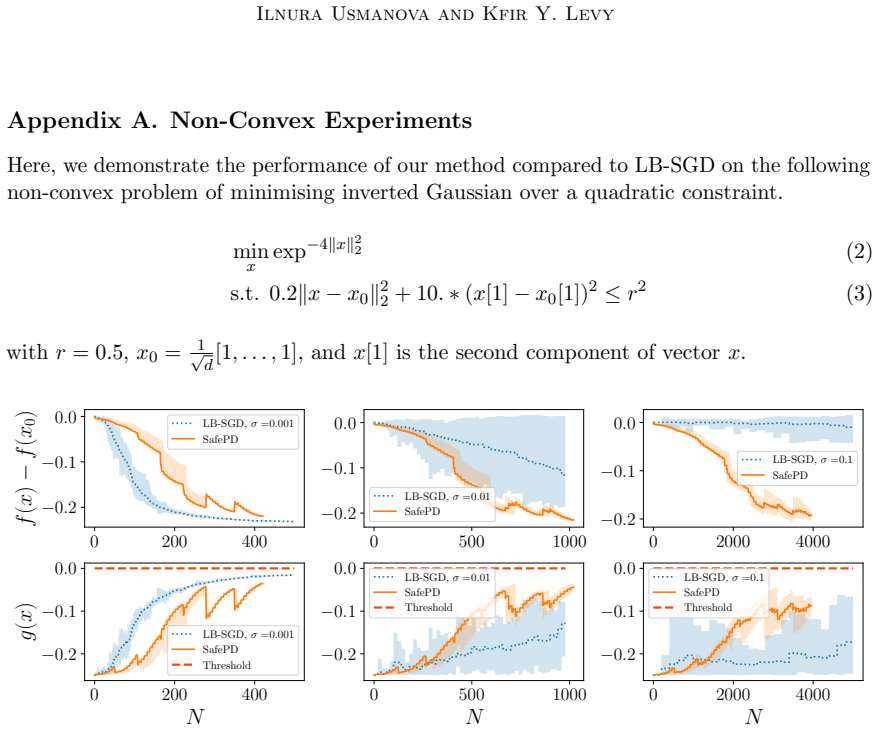
- [Section 7, Figures 3 and 4] The captions refer to a 'shady area' without defining it; please state whether it is the min-max range or the standard deviation over the 10 runs.
Circularity Check
No significant circularity; the claimed rates and safety guarantees are derived from stated assumptions, while the main flagged issue is an unstated diameter bound that is a correctness gap rather than a circular reduction.
full rationale
The paper's derivation chain is internally constructive rather than circular. The sample-complexity bounds in Theorems 13, 15, and 17 are obtained by composing outer dual-ascent iteration bounds with inner strongly-convex solver complexities and with minibatch sizes determined by the noise variances and target accuracies; no free parameter is fitted to data and later reported as a prediction, and the convergence rates are not used to set the algorithm's constants. The safety guarantees likewise follow from the Lipschitz safety set S(x_t), the chosen dual step-size, and the projection of primal updates onto S(x_t); they do not presuppose the convergence results. The citations to Usmanova et al. are used for baseline comparison, for the log-barrier sample-complexity rates, and for the form of a non-convex regularity condition, but no load-bearing theorem is imported from those papers: Assumption 16 is stated directly as an assumption, and the comparisons to LB-SGD do not enter the derivations of the safety or convergence claims. The main defect identified by a close reading is a missing correctness condition, not a circularity: Lemma 6 lower-bounds the dual local strong-concavity parameter as mu_d >= beta^2 / (4 R^2 (M_f + lambda M_g)) after asserting 'Given the bounded diameter of the set ||~x - x|| <= R', whereas R had earlier been defined as an upper bound on the initial distance ||x0 - x*||. Reusing the same symbol for a global or sublevel-set diameter is an unjustified step in the proof, and it weakens the stated guarantees, but it does not make the claimed result equal to its input by construction. There is therefore no circular step to report under the requested categories.
Assumptions & free parameters
free parameters (1)
- Regularization strengths rho_f, rho_g (Algorithm 3) =
unspecified; constrained by rho_f > M_f, rho_g > M_g, and Lemma 31 additionally needs mu_f >= rho_f/2, mu_g >= rho_g/2
assumptions (6)
- domain assumption f and g are smooth, g is Lipschitz continuous on X (Assumption 1)
- domain assumption There is a known strictly feasible starting point x0 with -g(x0) >= alpha > 0 (Assumption 2)
- domain assumption There is a known feasible x-tilde with -g(x-tilde) >= beta > 0 (Assumption 3)
- domain assumption f is mu_f-strongly convex and M_f-smooth; g is convex and M_g-smooth (Assumption 8)
- ad hoc to paper Uniform bound R on the distance between x-tilde and all x_lambda with g(x_lambda) >= -beta/2 (unstated, used in Lemma 6)
- domain assumption Extended MFCQ: for points with g(x) >= -theta, ||grad g(x)|| >= l (Assumption 16)
Cite this review
Pith. "Pith review of Safe Primal-Dual Optimization with a Single Smooth Constraint." pith.science (2026). https://pith.science/paper/D6PRI2OX
@misc{pith2026250509349,
  author       = {Pith},
  title        = {Pith review of: Safe Primal-Dual Optimization with a Single Smooth Constraint},
  year         = {2026},
  howpublished = {\url{https://pith.science/paper/D6PRI2OX}},
  note         = {Machine review of arXiv:2505.09349}
}
read the original abstract
This paper addresses the problem of safe optimization under a single smooth constraint, a scenario that arises in diverse real-world applications such as robotics and autonomous navigation. The objective of safe optimization is to solve a black-box minimization problem while strictly adhering to a safety constraint throughout the learning process. Existing methods often suffer from high sample complexity due to their noise sensitivity or poor scalability with number of dimensions, limiting their applicability. We propose a novel primal-dual optimization method that, by carefully adjusting dual step-sizes and constraining primal updates, ensures the safety of both primal and dual sequences throughout the optimization. Our algorithm achieves a convergence rate that significantly surpasses current state-of-the-art techniques. Furthermore, to the best of our knowledge, it is the first primal-dual approach to guarantee safe updates. Simulations corroborate our theoretical findings, demonstrating the practical benefits of our method. We also show how the method can be extended to multiple constraints.
Figures


Figures from the paper (1 more)
Reference graph
Works this paper leans on
-
[1]
Bayesian optimization with safety constraints: safe and automatic parameter tuning in robotics
Felix Berkenkamp, Andreas Krause, and Angela P Schoellig. Bayesian optimization with safety constraints: safe and automatic parameter tuning in robotics. arXiv preprint arXiv:1602.04450, 2016
arXiv 2016
-
[2]
D. P. Bertsekas. Nonlinear programming. Journal of the Operational Research Society, 48 0 (3): 0 334--334, 1997. doi:10.1057/palgrave.jors.2600425. URL https://doi.org/10.1057/palgrave.jors.2600425
-
[3]
Sasbo: Self-adapting safe bayesian optimization
Stefano De Blasi and Alexander Rainer Tassilo Gepperth. Sasbo: Self-adapting safe bayesian optimization. 2020 19th IEEE International Conference on Machine Learning and Applications (ICMLA), pages 220--225, 2020. URL https://api.semanticscholar.org/CorpusID:232061923
work page 2020
-
[4]
Reinforcement learning approach to autonomous pid tuning
Oguzhan Dogru, Kirubakaran Velswamy, Fadi Ibrahim, Yuqi Wu, Arun Senthil Sundaramoorthy, Biao Huang, Shu Xu, Mark Nixon, and Noel Bell. Reinforcement learning approach to autonomous pid tuning. Computers & Chemical Engineering, 161: 0 107760, 2022. ISSN 0098-1354. doi:https://doi.org/10.1016/j.compchemeng.2022.107760. URL https://www.sciencedirect.com/sci...
-
[5]
Randomized Smoothing for Stochastic Optimization
John C. Duchi, Peter L. Bartlett, and Martin J. Wainwright. Randomized smoothing for stochastic optimization, 2012. URL https://arxiv.org/abs/1103.4296
work page Pith review arXiv 2012
-
[6]
Safe Learning under Uncertain Objectives and Constraints
Mohammad Fereydounian, Zebang Shen, Aryan Mokhtari, Amin Karbasi, and Hamed Hassani. Safe learning under uncertain objectives and constraints. arXiv preprint arXiv:2006.13326, 2020
work page Pith review arXiv 2006
-
[7]
Safe zeroth-order optimization using quadratic local approximations, 2023
Baiwei Guo, Yuning Jiang, Giancarlo Ferrari-Trecate, and Maryam Kamgarpour. Safe zeroth-order optimization using quadratic local approximations, 2023
work page 2023
-
[8]
Online convex optimization with hard constraints: Towards the best of two worlds and beyond
Hengquan Guo, Xin Liu, Honghao Wei, and Lei Ying. Online convex optimization with hard constraints: Towards the best of two worlds and beyond. In S. Koyejo, S. Mohamed, A. Agarwal, D. Belgrave, K. Cho, and A. Oh, editors, Advances in Neural Information Processing Systems, volume 35, pages 36426--36439. Curran Associates, Inc., 2022. URL https://proceeding...
work page 2022
Show all 22 references
-
[9]
Han, Ishank Arora, and Jonathan Scarlett
E. Han, Ishank Arora, and Jonathan Scarlett. High-dimensional bayesian optimization via tree-structured additive models. ArXiv, abs/2012.13088, 2020. URL https://api.semanticscholar.org/CorpusID:229371449
2012 arXiv
-
[10]
Adaptive and safe bayesian optimization in high dimensions via one-dimensional subspaces
Johannes Kirschner, Mojmir Mutn \`y , Nicole Hiller, Rasmus Ischebeck, and Andreas Krause. Adaptive and safe bayesian optimization in high dimensions via one-dimensional subspaces. arXiv preprint arXiv:1902.03229, 2019 a
1902 arXiv
-
[11]
Bayesian optimisation for fast and safe parameter tuning of swissfel
Johannes Kirschner, Manuel Nonnenmacher, Mojm \' r Mutn \`y , Andreas Krause, Nicole Hiller, Rasmus Ischebeck, and Andreas Adelmann. Bayesian optimisation for fast and safe parameter tuning of swissfel. In FEL2019, Proceedings of the 39th International Free-Electron Laser Conf...
-
[12]
Balta, Andreas Krause, and Alisa Rupenyan
Christopher Koenig, Miks Ozols, Anastasia Makarova, Efe C. Balta, Andreas Krause, and Alisa Rupenyan. Safe risk-averse bayesian optimization for controller tuning, 2023
2023
-
[13]
Safe risk-averse bayesian optimization for controller tuning
Christopher K \"o nig, Miks Ozols, Anastasia Makarova, Efe C Balta, Andreas Krause, and Alisa Rupenyan. Safe risk-averse bayesian optimization for controller tuning. IEEE Robotics and Automation Letters, 2023
2023
-
[14]
The fritz john necessary optimality conditions in the presence of equality and inequality constraints
O.L Mangasarian and S Fromovitz. The fritz john necessary optimality conditions in the presence of equality and inequality constraints. Journal of Mathematical Analysis and Applications, 17 0 (1): 0 37--47, 1967. ISSN 0022-247X. doi:https://doi.org/10.1016/0022-247X(67)90163-1...
1967
-
[15]
Benchmarking safe exploration in deep reinforcement learning
Alex Ray, Joshua Achiam, and Dario Amodei. Benchmarking safe exploration in deep reinforcement learning. arXiv preprint arXiv:1910.01708, 2019
1910 arXiv
-
[16]
Safe exploration for optimization with gaussian processes
Yanan Sui, Alkis Gotovos, Joel Burdick, and Andreas Krause. Safe exploration for optimization with gaussian processes. In International Conference on Machine Learning, pages 997--1005, 2015
2015
-
[17]
Safe convex learning under uncertain constraints
Ilnura Usmanova, Andreas Krause, and Maryam Kamgarpour. Safe convex learning under uncertain constraints. In The 22nd International Conference on Artificial Intelligence and Statistics, pages 2106--2114, 2019
2019
-
[18]
Safe non-smooth black-box optimization with application to policy search
Ilnura Usmanova, Andreas Krause, and Maryam Kamgarpour. Safe non-smooth black-box optimization with application to policy search. In Learning for Dynamics and Control, pages 980--989, 2020
2020
-
[19]
Log barriers for safe black-box optimization with application to safe reinforcement learning, 2023
Ilnura Usmanova, Yarden As, Maryam Kamgarpour, and Andreas Krause. Log barriers for safe black-box optimization with application to safe reinforcement learning, 2023
2023
-
[20]
Hao Yu and Michael J. Neely. On the convergence time of dual subgradient methods for strongly convex programs. IEEE Transactions on Automatic Control, 63: 0 1105--1112, 2015
2015
-
[21]
Hao Yu and Michael J. Neely. A low complexity algorithm with o(√t) regret and o(1) constraint violations for online convex optimization with long term constraints. Journal of Machine Learning Research, 21 0 (1): 0 1--24, 2020. URL http://jmlr.org/papers/v21/16-494.html
2020
-
[22]
A single-loop smoothed gradient descent-ascent algorithm for nonconvex-concave min-max problems
Jiawei Zhang, Peijun Xiao, Ruoyu Sun, and Zhi-Quan Luo. A single-loop smoothed gradient descent-ascent algorithm for nonconvex-concave min-max problems. 10 2020
2020
Reviewed August 15, 2026 · model on record in the stance chip above.
Discussion (0). Continue with ORCID to comment.