Photon correlation microscopy of quantum matter
Pith reviewed 2026-06-29 10:42 UTC · model grok-4.3
The pith
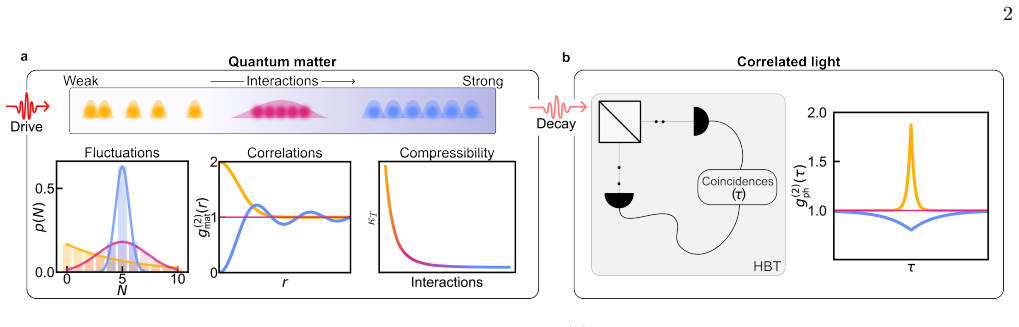
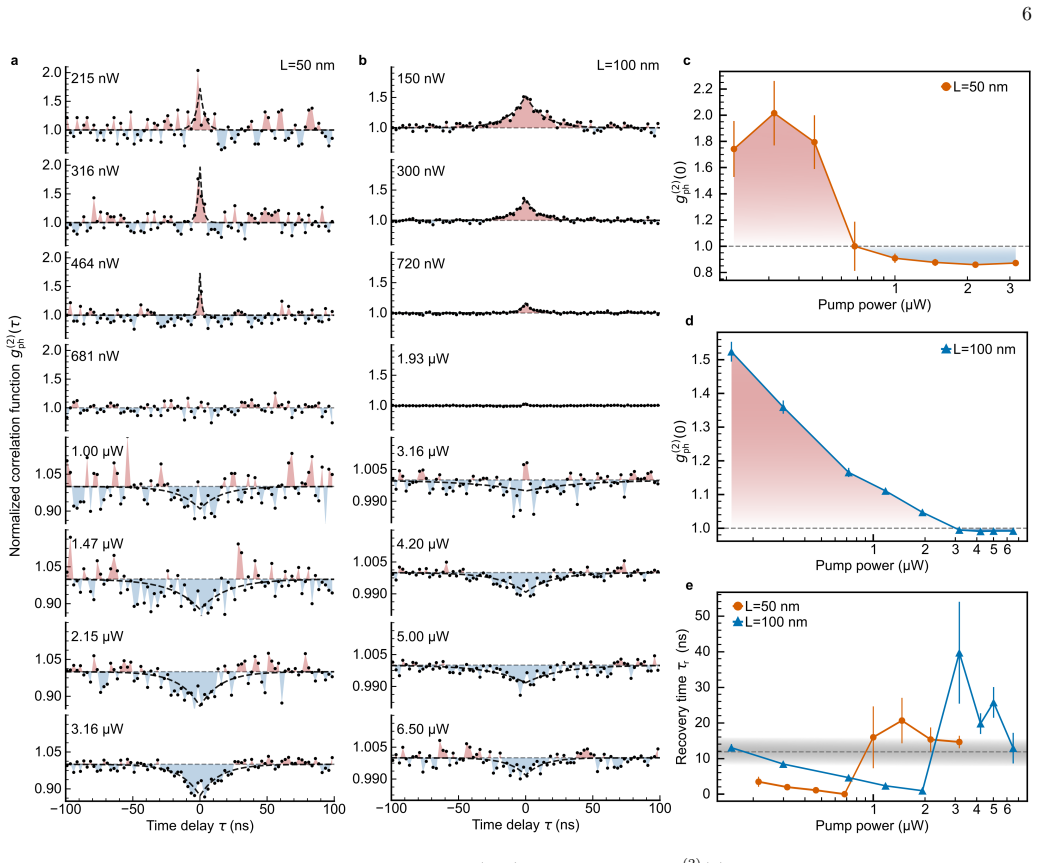
Photon correlations in emitted light evolve from bunching to antibunching with rising exciton density, revealing many-body blockade.
A machine-rendered reading of the paper's core claim, the machinery that carries it, and where it could break.
Core claim
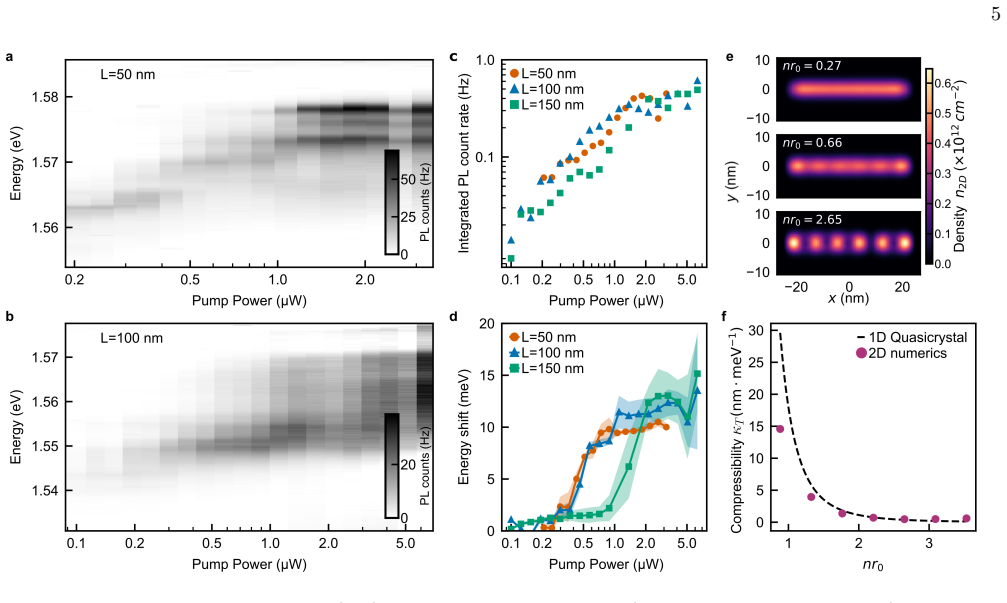
By confining a one-dimensional ensemble of dipolar excitons to mesoscopic length scales with gate-defined potentials, the authors measure a transition from a compressible to an incompressible phase signaled by simultaneous saturation of emission intensity and energy blueshift. Photon correlation measurements through this crossover show an evolution from bunching at low densities to antibunching at high densities. This constitutes a many-body blockade of photon emission emerging directly from a number-stabilized state driven by collective dipolar repulsion.
What carries the argument
Photon correlation microscopy (PCM) that extracts many-body exciton correlations from the second-order correlation function of the emitted photon field.
If this is right
- PCM extends to probe a broad class of correlated electronic phases through their emitted light.
- Many-body correlations in matter can be harnessed to produce non-classical light states.
- Gate-defined mesoscopic confinement makes matter correlations visible in the photon field.
- The incompressible phase corresponds to a number-stabilized exciton state that blocks simultaneous photon emission.
Where Pith is reading between the lines
- The technique could provide an optical, non-contact readout of number stabilization in other confined quantum systems such as quantum dots or cold-atom arrays.
- Varying the gate-defined confinement length offers a controllable parameter to tune the visibility and strength of the blockade effect.
- Collective repulsion might be engineered to control photon statistics in integrated photonic devices without external cavities or single-emitter isolation.
Load-bearing premise
The measured second-order photon correlation function directly and quantitatively reflects the underlying many-body correlations of the excitons without dominant contributions from other optical, disorder, or detection effects.
What would settle it
If the photon correlation function remains bunched or shows no clear transition to antibunching precisely at the densities where emission intensity saturates and the blueshift appears.
Figures
read the original abstract
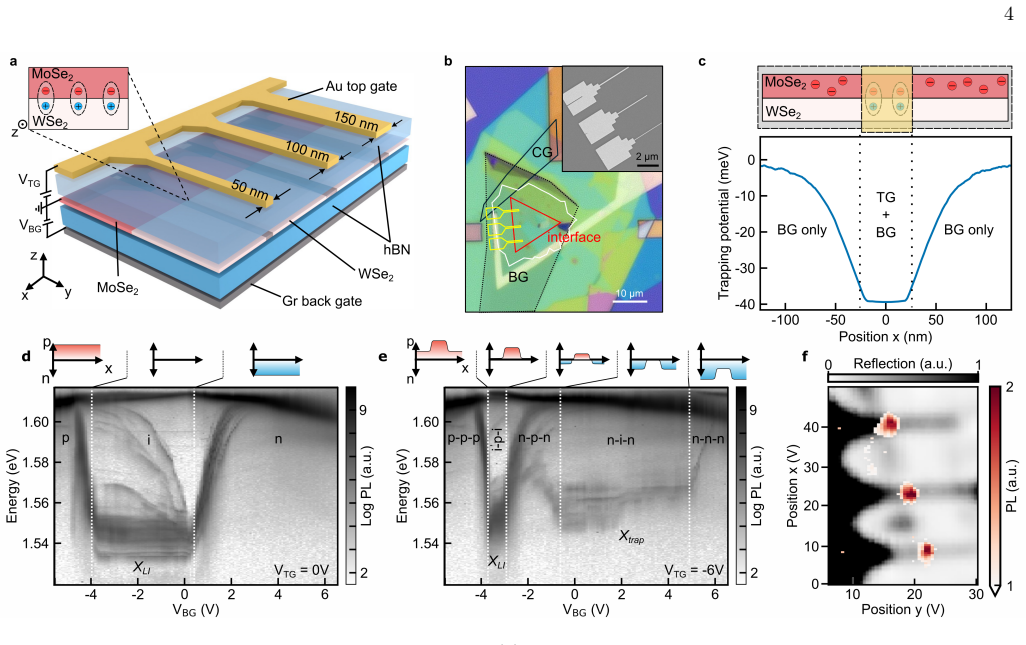
Light and matter share fundamental statistical properties, yet the experimental probes of quantum optics and many-body physics have largely evolved along separate trajectories. While many-body physics explores emergent collective phenomena, quantum optics has refined the measurement of correlations between individual photons. Here, we introduce photon correlation microscopy (PCM) - which bridges the two domains by leveraging correlations of emitted light to probe the correlations in quantum matter at mesoscopic scales. We demonstrate this approach using a one-dimensional (1D) ensemble of dipolar excitons confined at a lateral monolayer MoSe$_2$-WSe$_2$ heterojunction. We use gate-defined potentials to confine the 1D excitons to a mesoscopic lengthscale to enhance the visibility of matter correlations in the emitted photon field. Power-dependent spectroscopy reveals a transition from a compressible to an incompressible phase, signaled by the simultaneous saturation of the emission intensity and energy blueshift, which is supported by numerical simulations. Through this crossover, photon correlation measurements show a striking evolution from bunching at low densities to antibunching at high densities. This constitutes a many-body blockade of photon emission emerging directly from a number-stabilized state, driven by collective dipolar repulsion. Our results establish PCM as a powerful probe of many-body physics through the lens of quantum optics, extensible to a broad class of correlated electronic phases, while pointing toward a route to generating non-classical light through many-body correlations.
Editorial analysis
A structured set of objections, weighed in public.
Referee Report
Summary. The manuscript introduces photon correlation microscopy (PCM) as a technique to probe many-body correlations in quantum matter by measuring correlations among emitted photons. It demonstrates the method on a one-dimensional ensemble of dipolar excitons confined to mesoscopic length scales in a gate-defined MoSe₂-WSe₂ lateral heterojunction. Power-dependent spectroscopy reveals a crossover from compressible to incompressible phase, marked by simultaneous saturation of emission intensity and blueshift, supported by numerical simulations. Photon correlation measurements show an evolution from bunching (g^{(2)}>1) at low density to antibunching (g^{(2)}<1) at high density, interpreted as a many-body blockade of photon emission arising from a number-stabilized state driven by collective dipolar repulsion.
Significance. If the central mapping from measured photon statistics to many-body exciton correlations holds, the work provides a new experimental bridge between quantum optics and many-body physics at mesoscopic scales, with extensibility to other correlated phases and a potential route to non-classical light sources. The inclusion of numerical simulations to corroborate the compressible-incompressible transition is a methodological strength that grounds the spectroscopic signatures.
major comments (2)
- [§4] §4 (photon correlation results): The central claim that the measured evolution of g^{(2)}(0) from bunching to antibunching directly encodes the many-body blockade requires that extrinsic contributions (inhomogeneous broadening, finite temporal resolution, collection efficiency, or disorder) do not dominate the photon statistics. The manuscript provides no quantitative bounds, error propagation, or alternative single-particle models to establish this; this assumption is load-bearing for interpreting PCM as a probe of matter correlations.
- [§3.2] §3.2 (numerical simulations): While simulations are invoked to support the density-driven transition, the text does not report how simulation parameters (interaction strength, confinement potential) are constrained by the experimental intensity and blueshift data, nor whether the same parameters quantitatively reproduce the observed g^{(2)} values across the crossover.
minor comments (2)
- [Figure 4] Figure 4 and associated text: Axis labels and legends for g^{(2)}(τ) traces should explicitly state the integration time window and any background subtraction procedure to allow direct assessment of the antibunching depth.
- [Notation] Notation: Ensure uniform use of g^{(2)}(0) versus g(2) throughout the main text, supplementary material, and figure captions.
Simulated Author's Rebuttal
We thank the referee for their careful reading and constructive comments, which have helped us identify areas where the manuscript can be strengthened. We address each major comment below and outline the revisions we will make.
read point-by-point responses
-
Referee: [§4] §4 (photon correlation results): The central claim that the measured evolution of g^{(2)}(0) from bunching to antibunching directly encodes the many-body blockade requires that extrinsic contributions (inhomogeneous broadening, finite temporal resolution, collection efficiency, or disorder) do not dominate the photon statistics. The manuscript provides no quantitative bounds, error propagation, or alternative single-particle models to establish this; this assumption is load-bearing for interpreting PCM as a probe of matter correlations.
Authors: We agree that explicit quantification of extrinsic effects is necessary to support the interpretation. In the revised manuscript we will add a dedicated subsection in §4 that (i) estimates the contribution of inhomogeneous broadening and finite detector resolution to the measured g^{(2)}(0) using the independently measured linewidth and instrument response function, (ii) provides error propagation for the reported g^{(2)} values, and (iii) shows that a single-particle model with the same parameters cannot reproduce the observed density-dependent crossover from bunching to antibunching. These additions will supply the quantitative bounds requested while preserving the central claim. revision: yes
-
Referee: [§3.2] §3.2 (numerical simulations): While simulations are invoked to support the density-driven transition, the text does not report how simulation parameters (interaction strength, confinement potential) are constrained by the experimental intensity and blueshift data, nor whether the same parameters quantitatively reproduce the observed g^{(2)} values across the crossover.
Authors: The referee correctly notes that the fitting procedure and predictive power for g^{(2)} were not fully documented. In the revision we will expand §3.2 to (i) describe the least-squares procedure used to constrain the dipolar interaction strength and gate-defined confinement potential from the measured intensity saturation and blueshift, and (ii) present a direct comparison in which the same parameters are used to compute the expected g^{(2)}(0) across the compressible-incompressible crossover, showing quantitative consistency with the experimental photon-correlation data. This will explicitly link the spectroscopic observables to the correlation measurements. revision: yes
Circularity Check
No circularity: experimental observations with independent support
full rationale
The manuscript reports experimental measurements of photon correlations in a gate-confined 1D exciton system. Power-dependent spectroscopy and g(2) data are presented as direct observations of a compressible-to-incompressible crossover, with numerical simulations cited only as supporting evidence rather than as the source of the central claim. No equations, fitted parameters, or self-citations are shown to reduce the reported evolution from bunching to antibunching back to the input data by construction. The mapping of measured g(2) to many-body blockade rests on experimental assumptions about extrinsic contributions, but those assumptions are not enforced by any definitional loop or self-referential derivation within the paper's own chain.
Axiom & Free-Parameter Ledger
axioms (1)
- domain assumption Photon second-order correlation functions measured in the far field directly encode the spatial and number correlations of the underlying exciton many-body state.
Reference graph
Works this paper leans on
-
[1]
Bruus and K
H. Bruus and K. Flensberg,Many-body quantum theory in condensed matter physics — an introduction(Oxford University Press, 2004)
2004
-
[2]
Mandel and E
L. Mandel and E. Wolf,Optical Coherence and Quantum Optics(Cambridge University Press, 1995)
1995
-
[3]
Blanter and M
Y. Blanter and M. B¨ uttiker, Shot noise in mesoscopic conductors, Physics Reports336, 1 (2000)
2000
-
[4]
Bloch, J
I. Bloch, J. Dalibard, and W. Zwerger, Many-body physics with ultracold gases, Rev. Mod. Phys.80, 885 (2008)
2008
-
[5]
F¨ olling, F
S. F¨ olling, F. Gerbier, A. Widera, O. Mandel, T. Gericke, and I. Bloch, Spatial quantum noise interferometry in ex- panding ultracold atom clouds, Nature434, 481 (2005)
2005
-
[6]
W. S. Bakr, J. I. Gillen, A. Peng, S. F¨ olling, and M. Greiner, A quantum gas microscope for detecting sin- gle atoms in a hubbard-regime optical lattice, Nature 462, 74 (2009)
2009
-
[7]
T. A. Hilker, G. Salomon, F. Grusdt, A. Omran, M. Boll, E. Demler, I. Bloch, and C. Gross, Revealing hidden an- tiferromagnetic correlations in doped hubbard chains via string correlators, Science357, 484 (2017)
2017
-
[8]
Bergschneider, V
A. Bergschneider, V. M. Klinkhamer, J. H. Becher, R. Klemt, L. Palm, G. Z¨ urn, S. Jochim, and P. M. Preiss, Experimental characterization of two-particle entangle- ment through position and momentum correlations, Na- ture Physics15, 640 (2019)
2019
-
[9]
Holten, L
M. Holten, L. Bayha, K. Subramanian, S. Brandstetter, C. Heintze, P. Lunt, P. M. Preiss, and S. Jochim, Obser- vation of cooper pairs in a mesoscopic two-dimensional fermi gas, Nature606, 287 (2022)
2022
-
[10]
R. Yao, S. Chi, M. Wang, R. J. Fletcher, and M. Zwier- lein, Measuring pair correlations in bose and fermi gases via atom-resolved microscopy, Phys. Rev. Lett.134, 183402 (2025)
2025
-
[11]
D. E. Chang, V. Vuleti´ c, and M. D. Lukin, Quantum nonlinear optics — photon by photon, Nature Photonics 8, 685 (2014)
2014
-
[12]
H. J. Kimble, M. Dagenais, and L. Mandel, Photon anti- bunching in resonance fluorescence, Phys. Rev. Lett.39, 691 (1977)
1977
-
[13]
Hennessy, A
K. Hennessy, A. Badolato, M. Winger, D. Gerace, M. Atat¨ ure, S. Gulde, S. F¨ alt, E. L. Hu, and A. Imamo˘ glu, Quantum nature of a strongly coupled sin- gle quantum dot–cavity system, Nature445, 896 (2007)
2007
-
[14]
Aharonovich, D
I. Aharonovich, D. Englund, and M. Toth, Solid-state single-photon emitters, Nature Photonics10, 631 (2016)
2016
-
[15]
Toninelli, I
C. Toninelli, I. Gerhardt, A. S. Clark, A. Reserbat- Plantey, S. G¨ otzinger, Z. Ristanovi´ c, M. Colautti, P. Lombardi, K. D. Major, I. Deperasi´ nska, W. H. Per- nice, F. H. L. Koppens, B. Kozankiewicz, A. Gourdon, V. Sandoghdar, and M. Orrit, Single organic molecules for photonic quantum technologies, Nature Materials20, 1615 (2021)
2021
-
[16]
Peyronel, O
T. Peyronel, O. Firstenberg, Q.-Y. Liang, S. Hofferberth, A. V. Gorshkov, T. Pohl, M. D. Lukin, and V. Vuleti´ c, Quantum nonlinear optics with single photons enabled by strongly interacting atoms, Nature488, 57 (2012)
2012
-
[17]
Weber, M
T. Weber, M. H¨ oning, T. Niederpr¨ um, T. Manthey, O. Thomas, V. Guarrera, M. Fleischhauer, G. Barontini, and H. Ott, Mesoscopic rydberg-blockaded ensembles in the superatom regime and beyond, Nature Physics11, 9 157 (2015)
2015
-
[18]
Delteil, T
A. Delteil, T. Fink, A. Schade, S. H¨ ofling, C. Schnei- der, and A. ˙Imamo˘ glu, Towards polariton blockade of confined exciton–polaritons, Nature materials18, 219 (2019)
2019
-
[19]
Mu˜ noz-Matutano, A
G. Mu˜ noz-Matutano, A. Wood, M. Johnsson, X. Vidal, B. Q. Baragiola, A. Reinhard, A. Lemaˆ ıtre, J. Bloch, A. Amo, G. Nogues,et al., Emergence of quantum cor- relations from interacting fibre-cavity polaritons, Nature materials18, 213 (2019)
2019
-
[20]
R. K. Pathria and P. D. Beale,Statistical Mechanics, 4th ed. (Academic Press, 2021)
2021
-
[21]
M. C. Teich and B. E. A. Saleh, I photon bunching and antibunching, Progress in Optics26, 1 (1988)
1988
-
[22]
X. Duan, C. Wang, J. Shaw, R. Cheng, Y. Chen, H. Li, X. Wu, Y. Tang, Q. Zhang, A. Pan, J. Jiang, R. Yu, Y. Huang, and X. Duan, Lateral epitaxial growth of two- dimensional layered semiconductor heterojunctions, Na- ture nanotechnology9(2014)
2014
-
[23]
P. K. Sahoo, S. Memaran, Y. Xin, L. Balicas, and H. R. Guti´ errez, One-pot growth of two-dimensional lateral heterostructures via sequential edge-epitaxy, Nature553, 63 (2018)
2018
-
[24]
K. W. Lau, Calvin, Z. Gong, H. Yu, and W. Yao, In- terface excitons at lateral heterojunctions in monolayer semiconductors, Phys. Rev. B98, 115427 (2018)
2018
-
[25]
Rosati, I
R. Rosati, I. Paradisanos, L. Huang, Z. Gan, A. George, K. Watanabe, T. Taniguchi, L. Lombez, P. Renucci, A. Turchanin,et al., Interface engineering of charge- transfer excitons in 2d lateral heterostructures, Nature communications14, 2438 (2023)
2023
-
[26]
E. Vandoolaeghe, F. Fortuna, S. K. Chakraborty, B. Nayak, T. Taniguchi, K. Watanabe, P. K. Sahoo, T. Chervy, and P. A. Murthy, Dipolar excitonic quan- tum wires at atomically sharp lateral interfaces (2026), arXiv:2509.24465
-
[27]
Citro, S
R. Citro, S. De Palo, E. Orignac, P. Pedri, and M.- L. Chiofalo, Luttinger hydrodynamics of confined one- dimensional Bose gases with dipolar interactions, New Journal of Physics10, 045011 (2008)
2008
-
[28]
M. A. Cazalilla, R. Citro, T. Giamarchi, E. Orignac, and M. Rigol, One dimensional bosons: From condensed mat- ter systems to ultracold gases, Rev. Mod. Phys.83, 1405 (2011)
2011
-
[29]
Deuretzbacher, J
F. Deuretzbacher, J. C. Cremon, and S. M. Reimann, Ground-state properties of few dipolar bosons in a quasi- one-dimensional harmonic trap, Phys. Rev. A81, 063616 (2010)
2010
-
[30]
Roscilde and M
T. Roscilde and M. Boninsegni, Off-diagonal correlations in a one-dimensional gas of dipolar bosons, New Journal of Physics12, 033032 (2010)
2010
-
[31]
L. Peng, J. Pan, S. Yi, and T. Shi, Unveiling quantum phases in quasi-one-dimensional dipolar gases using con- tinuous matrix product states, Phys. Rev. A110, 023330 (2024)
2024
-
[32]
Citro, E
R. Citro, E. Orignac, S. De Palo, and M. L. Chiofalo, Evidence of luttinger-liquid behavior in one-dimensional dipolar quantum gases, Phys. Rev. A75, 051602(R) (2007)
2007
-
[33]
Sinha and L
S. Sinha and L. Santos, Cold dipolar gases in quasi- one-dimensional geometries, Phys. Rev. Lett.99, 140406 (2007)
2007
-
[34]
Lagoin, K
C. Lagoin, K. Baldwin, L. Pfeiffer, and F. m. c. Du- bin, Superlattice quantum solid of dipolar excitons, Phys. Rev. Lett.132, 176001 (2024)
2024
-
[35]
Lagoin, S
C. Lagoin, S. Suffit, K. Baldwin, L. Pfeiffer, and F. Dubin, Mott insulator of strongly interacting two- dimensional semiconductor excitons, Nature Physics18, 149 (2022)
2022
-
[36]
G. J. Schinner, J. Repp, E. Schubert, A. K. Rai, D. Reuter, A. D. Wieck, A. O. Govorov, A. W. Holleit- ner, and J. P. Kotthaus, Many-body correlations of elec- trostatically trapped dipolar excitons, Phys. Rev. B87, 205302 (2013)
2013
-
[37]
Thureja, A
D. Thureja, A. Imamoglu, T. Smole´ nski, I. Amelio, A. Popert, T. Chervy, X. Lu, S. Liu, K. Barmak, K. Watanabe,et al., Electrically tunable quantum con- finement of neutral excitons, Nature606, 298 (2022)
2022
-
[38]
J. Hu, E. Lorchat, X. Chen, K. Watanabe, T. Taniguchi, T. F. Heinz, P. A. Murthy, and T. Chervy, Quantum control of exciton wave functions in 2d semiconductors, Science Advances10, eadk6369 (2024)
2024
-
[39]
Heithoff, ´A
M. Heithoff, ´A. Moreno, I. Torre, M. S. G. Feuer, C. M. Purser, G. M. Andolina, G. Calaj` o, K. Watanabe, T. Taniguchi, D. M. Kara, P. Hays, S. A. Tongay, V. I. Fal’ko, D. Chang, M. Atat¨ ure, A. Reserbat-Plantey, and F. H. Koppens, Valley-hybridized gate-tunable 1d exci- ton confinement in MoSe 2, ACS Nano18, 30283 (2024)
2024
-
[40]
Thureja, F
D. Thureja, F. E. Yazıc ı, T. Smole´ nski, M. Kroner, D. J. Norris, and A. ˙Imamoˇ glu, Electrically defined quan- tum dots for bosonic excitons, Phys. Rev. B110, 245425 (2024)
2024
-
[41]
Y. Tang, L. Li, T. Li, Y. Xu, S. Liu, K. Barmak, K. Watanabe, T. Taniguchi, A. H. MacDonald, J. Shan, and K. F. Mak, Simulation of Hubbard-model physics in WSe2/WS2 moir´ e superlattices, Nature579, 353 (2020)
2020
-
[42]
Smole´ nski, P
T. Smole´ nski, P. E. Dolgirev, C. Kuhlenkamp, A. Popert, Y. Shimazaki, P. Back, X. Lu, M. Kroner, K. Watanabe, T. Taniguchi, I. Esterlis, E. Demler, and A. Imamo˘ glu, Signatures of Wigner crystal of electrons in a monolayer semiconductor, Nature595, 53 (2021)
2021
-
[43]
E. C. Regan, D. Wang, C. Jin, M. I. Bakti Utama, B. Gao, X. Wei, S. Zhao, W. Zhao, Z. Zhang, K. Yu- migeta, M. Blei, K. Watanabe, T. Taniguchi, S. Tongay, A. Zettl, M. Crommie, Y. R. Shen, and F. Wang, Mott and generalized Wigner crystal states in WSe 2/WS2 moir´ e superlattices, Nature579, 359 (2020)
2020
-
[44]
W. Li, C. Wang Beach, C. Hu, T. Taniguchi, K. Watan- abe, J.-H. Chu, A. Imamo˘ glu, T. Cao, D. Xiao, and X. Xu, Signatures of fractional charges via anyon–trions in twisted MoTe2, Nature651, 48 (2026)
2026
-
[45]
Beams, L
R. Beams, L. G. Can¸ cado, S.-H. Oh, A. Jorio, and L. Novotny, Spatial coherence in near-field raman scat- tering, Phys. Rev. Lett.113, 186101 (2014)
2014
- [46]
-
[47]
Nambiar, A
G. Nambiar, A. Grankin, and M. Hafezi, Diagnosing elec- tronic phases of matter using photonic correlation func- tions, Phys. Rev. X15, 041020 (2025)
2025
-
[48]
Cadiz, E
F. Cadiz, E. Courtade, C. Robert, G. Wang, Y. Shen, H. Cai, T. Taniguchi, K. Watanabe, H. Carrere, D. La- garde, M. Manca, T. Amand, P. Renucci, S. Tongay, X. Marie, and B. Urbaszek, Excitonic linewidth ap- proaching the homogeneous limit in mos 2-based van der 10 waals heterostructures, Phys. Rev. X7, 021026 (2017)
2017
-
[49]
A. Raja, L. Waldecker, J. Zipfel, Y. Cho, S. Brem, J. D. Ziegler, M. Kulig, T. Taniguchi, K. Watanabe, E. Malic, T. F. Heinz, T. C. Berkelbach, and A. Chernikov, Dielec- tric disorder in two-dimensional materials, Nature Nan- otechnology14, 832 (2019)
2019
-
[50]
Moody, J
G. Moody, J. Schaibley, and X. Xu, Exciton dynamics in monolayer transition metal dichalcogenides, J. Opt. Soc. Am. B33, C39 (2016)
2016
-
[51]
Cai, W.-Y
C.-S. Cai, W.-Y. Lai, P.-H. Liu, T.-C. Chou, R.-Y. Liu, C.-M. Lin, S. Gwo, and W.-T. Hsu, Ultralow auger- assisted interlayer exciton annihilation in ws2/wse2 moir´ e heterobilayers, Nano Letters24, 2773 (2024)
2024
-
[52]
G. E. Astrakharchik and Y. E. Lozovik, Super-tonks- girardeau regime in trapped one-dimensional dipolar gases, Phys. Rev. A77, 013404 (2008)
2008
-
[53]
A. S. Arkhipov, G. E. Astrakharchik, A. V. Belikov, and Y. E. Lozovik, Ground-state properties of a one- dimensional system of dipoles, Journal of Experimental and Theoretical Physics Letters82, 39 (2005)
2005
-
[54]
V. R. Policht, H. Mittenzwey, O. Dogadov, M. Katzer, A. Villa, Q. Li, B. Kaiser, A. M. Ross, F. Scotognella, X. Zhu, A. Knorr, M. Selig, G. Cerullo, and S. Dal Conte, Time-domain observation of interlayer exciton formation and thermalization in a mose2/wse2 heterostructure, Na- ture Communications14, 7273 (2023)
2023
-
[55]
A. J. Leggett, Bose-einstein condensation in the alkali gases: Some fundamental concepts, Rev. Mod. Phys.73, 307 (2001)
2001
-
[56]
Haegeman, D
J. Haegeman, D. Draxler, V. Stojevic, J. I. Cirac, T. J. Osborne, and F. Verstraete, Quantum Gross-Pitaevskii Equation, SciPost Phys.3, 006 (2017)
2017
-
[57]
Kinoshita, T
T. Kinoshita, T. Wenger, and D. S. Weiss, Observation of a one-dimensional tonks-girardeau gas, Science305, 1125 (2004)
2004
-
[58]
O. E. Alon, A. I. Streltsov, and L. S. Cederbaum, Multiconfigurational time-dependent hartree method for bosons: Many-body dynamics of bosonic systems, Phys. Rev. A77, 033613 (2008)
2008
-
[59]
Cudazzo, I
P. Cudazzo, I. V. Tokatly, and A. Rubio, Dielectric screening in two-dimensional insulators: Implications for excitonic and impurity states in graphane, Phys. Rev. B 84, 085406 (2011)
2011
-
[60]
T. C. Berkelbach, M. S. Hybertsen, and D. R. Reich- man, Theory of neutral and charged excitons in mono- layer transition metal dichalcogenides, Phys. Rev. B88, 045318 (2013)
2013
-
[61]
Molignini, S
P. Molignini, S. Dutta, and E. Fasshauer, Many-body quantum dynamics with MCTDH-X, SciPost Physics Lecture Notes94(2025)
2025
-
[62]
R. Lin, P. Molignini, L. Papariello, M. C. Tsatsos, C. L´ evˆ eque, S. E. Weiner, E. Fasshauer, R. Chitra, and A. U. J. Lode, MCTDH-X: The multiconfigura- tional time-dependent hartree method for indistinguish- able particles software, Quantum Science and Technology 5, 024004 (2020)
2020
-
[63]
Photon correlation microscopy of quantum matter
A. U. J. Lode, M. Tsatsos, E. Fasshauer, R. Lin, L. Papariello, P. Molignini, C. L´ evˆ eque, S. Weiner, M. B¨ uttner, J. Xiang, S. Dutta, D. Ortu˜ no- Gonzalez, Y. Bilinskaya, M. Eder, and L. Fichte, MCTDH-X: The time-dependent multiconfigurational hartree method for indistinguishable particles (soft- ware),https://gitlab.com/the-mctdh-x-repository/ mctd...
2025
-
[64]
Thermal Bose gas.For a non-degenerate 1D Bose gas (nλ T ≲1), the pair correlator factorizes as g(2) mat(r) = 1 +|g (1)(r)|2 with a Gaussian first-order co- herence|g (1)(r)|2 =e −r2/λ2 T on the scale of the thermal de Broglie wavelengthλ T =ℏ p 2π/(mkBT). Integrating over a trap of lengthL: g(2) ph (0) = 1 + 1 L Z −L L e−r2/λT 2 (1− |r|/L)dr(S15) which in...
-
[65]
Quantum-degenerate regime.Asnλ T ≳1, number fluctuations approach the Poissonian value Var(N)→ ⟨N⟩, the spatial pair correlator approaches unity across the trap, andg (2) ph (0)→1
-
[66]
As repulsive interactions stiffen the chemical potential, κT →0 and the system develops a correlation hole at short range,g (2) mat(0)→0
Strongly correlated incompressible regime. As repulsive interactions stiffen the chemical potential, κT →0 and the system develops a correlation hole at short range,g (2) mat(0)→0. The master identity then yields the Poisson floor. g(2) ph (0)→1− 1 ⟨N⟩ ,(S16) attained only in the perfectly number-stabilized limit. For the specific case of contact-interact...
-
[67]
Classical chaotic emission.A complemen- tary single-mode result arises classically:Nindepen- dent emitters with random phases produce a fieldE=P j ajeiϕj that follows a complex Gaussian distribution by the central limit theorem, yielding exponentially dis- tributed intensity andg (2) ph (0) = 2. This is the classical chaotic limit, identical in value to t...
discussion (0)
Sign in with ORCID, Apple, or X to comment. Anyone can read and Pith papers without signing in.